
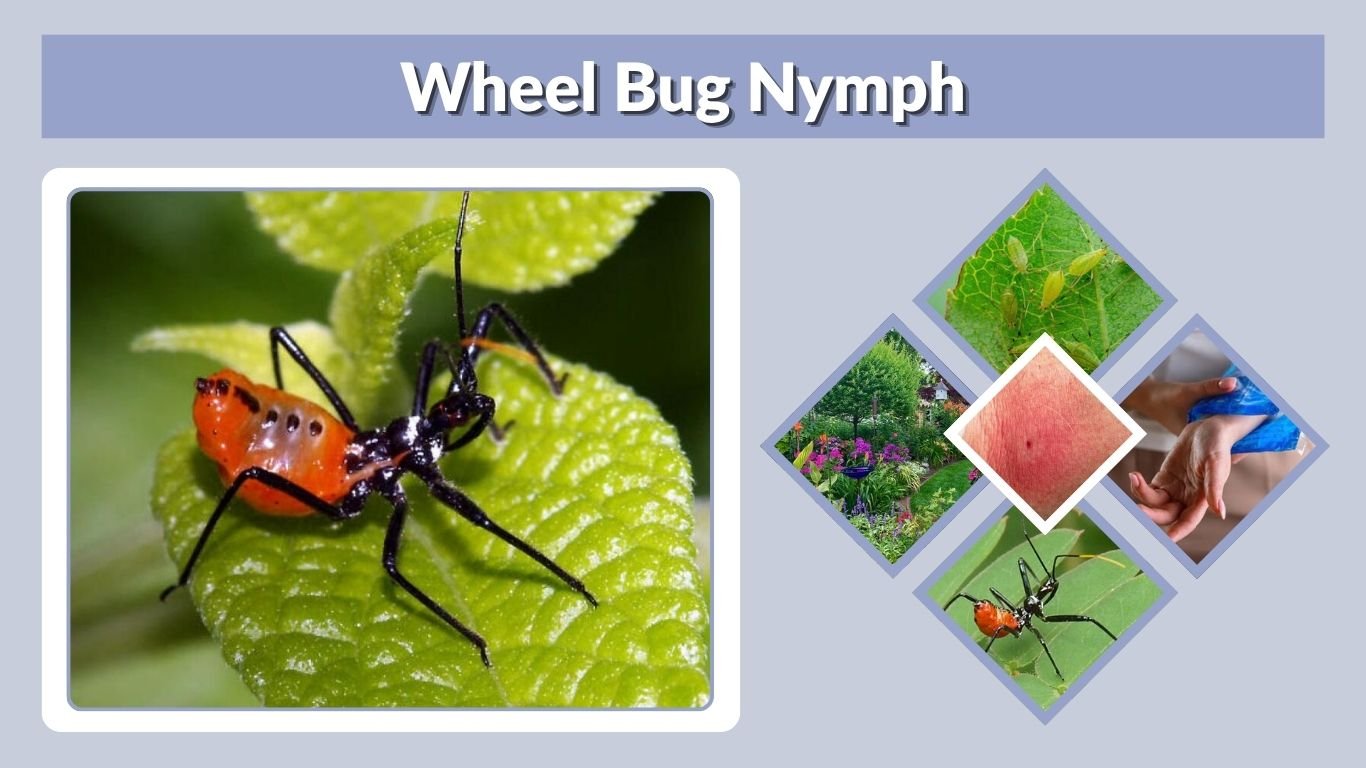
A wheel bug nymph is the immature stage of the North American wheel bug, Arilus cristatus. Unlike the gray-brown adult, a young nymph usually has a bright red or orange abdomen, long black legs, and no wheel-shaped crest. It is an active predator that helps control caterpillars, aphids, beetles, and other insects. Although beneficial, wheel bug nymphs should never be handled because their piercing mouthparts can deliver a painful defensive bite.
Wheel Bug Nymph Overview
Wheel bugs undergo incomplete metamorphosis. This means they develop from eggs into nymphs and then adults without passing through a caterpillar-like larval or pupal stage. A nymph resembles a smaller, wingless version of a true bug, although its coloration differs considerably from that of an adult wheel bug.
| Feature | Wheel bug nymph |
| Scientific name | Arilus cristatus |
| Family | Reduviidae |
| Common color | Red or orange with black markings |
| Number of nymph stages | Five instars |
| Wings | Absent; older nymphs develop wing pads |
| Wheel-shaped crest | Absent |
| Diet | Insects and other small arthropods |
| Bite risk | Painful when handled or trapped |
| Development period | Approximately three months |
| Adult form | Gray-brown insect with a cog-shaped crest |
What Does a Wheel Bug Nymph Look Like?
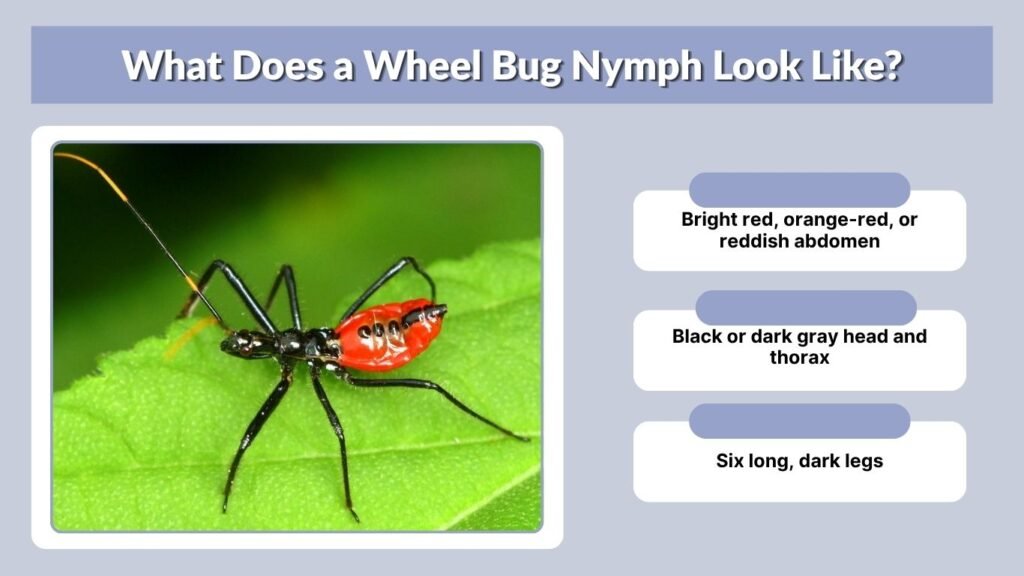
Young wheel bug nymphs look dramatically different from adults. Newly hatched individuals usually have bright red or orange abdomens combined with dark heads, legs, and thoraxes. Their long legs and upward-curving abdomens may give them a spider-like appearance.
Wheel Bug Nymph Identification
Look for the following characteristics:
- Bright red, orange-red, or reddish abdomen
- Black or dark gray head and thorax
- Six long, dark legs
- Long antennae, often with orange tips
- Narrow head with a neck-like area behind it
- Curved, three-segmented beak beneath the head
- Small dark markings across the abdomen
- No complete wings
- No wheel-shaped crest
Small nymphs are generally brighter red, while later-stage nymphs become darker and more heavily patterned. The final nymphal stage may look gray-black with reddish areas and visible wing pads.
Why Doesn’t a Wheel Bug Nymph Have a Wheel?
The famous cogwheel-shaped structure develops only after the final molt into adulthood. It is part of the adult thorax, not a structure that slowly rises throughout the young nymphal stages.
Consequently, the absence of a wheel does not rule out a wheel bug when examining an immature insect. Color, body shape, long legs, antennae, and the predatory beak are more useful when identifying a nymph.
Wheel Bug Nymph Stages
A wheel bug passes through five nymphal stages called instars. Each instar begins after the insect sheds its old exoskeleton. The new body is initially soft but gradually hardens and darkens.
Published observations recorded an average total nymphal development period of approximately 99 days. Actual development can vary according to temperature, weather, food availability, location, and the individual insect.
| Nymphal stage | Approximate duration |
| First instar | 21 days |
| Second instar | 14 days |
| Third instar | 15 days |
| Fourth instar | 17 days |
| Fifth instar | 32 days |
| Total | About 99 days |
First and Second Instars
Newly hatched wheel bugs are small, bright red, and relatively delicate. They may remain clustered near the egg mass briefly before dispersing to find food.
Early nymphs commonly hunt small, soft-bodied insects such as aphids. Their wings and wheel-shaped crests are entirely absent at this stage.
Third and Fourth Instars
Middle-stage nymphs become larger, stronger, and darker. Black markings become more noticeable across the abdomen, although red or orange coloration usually remains visible.
They can overpower larger prey than newly hatched nymphs. Wing pads may begin to appear, but these structures are not yet functional wings.
Fifth Instar
The fifth instar is the last nymphal stage and generally lasts longer than the earlier stages. A fifth-instar nymph may look gray, black, or dark brown with red markings. Its wing pads are clearly visible, but it still lacks the adult’s complete wings and cog-shaped crest.
After the final molt, it becomes a winged adult with the characteristic wheel on its back.
What Do Wheel Bug Nymphs Eat?
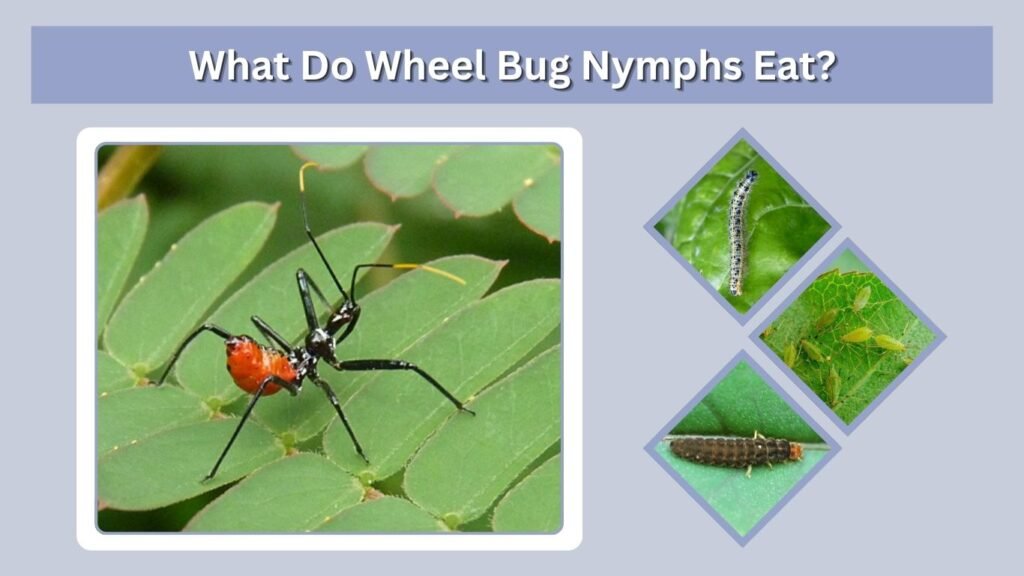
Wheel bug nymphs are predators from an early age. They hunt insects rather than feeding on plants, roots, stored food, fabric, or human blood.
Common prey includes:
- Aphids
- Small caterpillars
- Beetle larvae
- Sawfly larvae
- Stink bug nymphs
- Leafhoppers
- Moths
- Flies
- Other true bugs
- Occasionally other wheel bug nymphs
The nymph approaches its prey, holds it with its front legs, and inserts its sharp beak. Saliva injected through the beak immobilizes the prey and begins breaking down its internal tissues. The nymph then draws out the liquefied contents. Wheel bug saliva can immobilize insect prey very quickly.
Wheel bugs are considered beneficial because they consume numerous plant-damaging insects. However, they are generalist hunters and may occasionally eat lady beetles, bees, or other helpful insects. Cannibalism has also been observed, particularly when individuals are crowded or food is limited.
Do Wheel Bug Nymphs Bite?
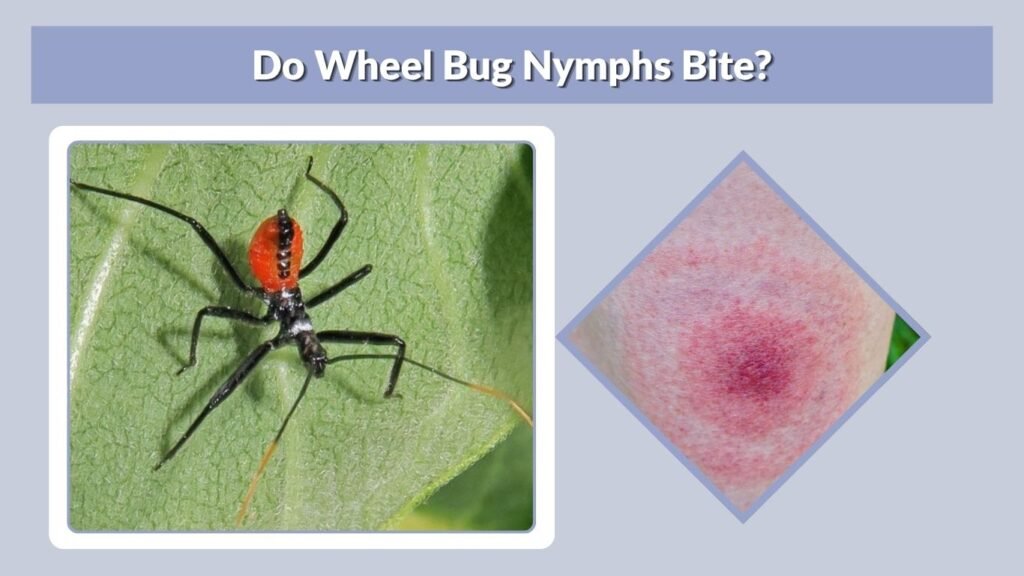
Yes. A wheel bug nymph can bite a person with the same general type of piercing mouthpart used by an adult. Its smaller size does not make it safe to pick up.
Nymphs do not chase people, seek human blood, or bite as a normal feeding behavior. Most bites occur when a nymph is:
- Picked up with bare fingers
- Squeezed or restrained
- Trapped against clothing or skin
- Disturbed while hiding on vegetation
- Handled by a curious child
- Investigated by a dog or cat
The injury is technically a bite rather than a sting because wheel bugs do not have stingers.
What Does the Bite Feel Like?
A defensive bite may produce immediate sharp or burning pain. Redness, swelling, warmth, tingling, tenderness, or temporary numbness may develop around the puncture.
Descriptions of wheel bug bites commonly involve adults, but extension guidance warns that both nymphs and adults should be avoided because both can inflict painful bites.
Are Wheel Bug Nymphs Poisonous?
Wheel bug nymphs are not poisonous to touch. The danger comes from their ability to puncture skin and introduce saliva through their beaks.
This saliva is adapted to immobilize insect prey. In people, it may cause pain and localized inflammation, but wheel bugs are not blood-feeding kissing bugs and are not regarded as Chagas disease vectors.
Treating a Wheel Bug Nymph Bite
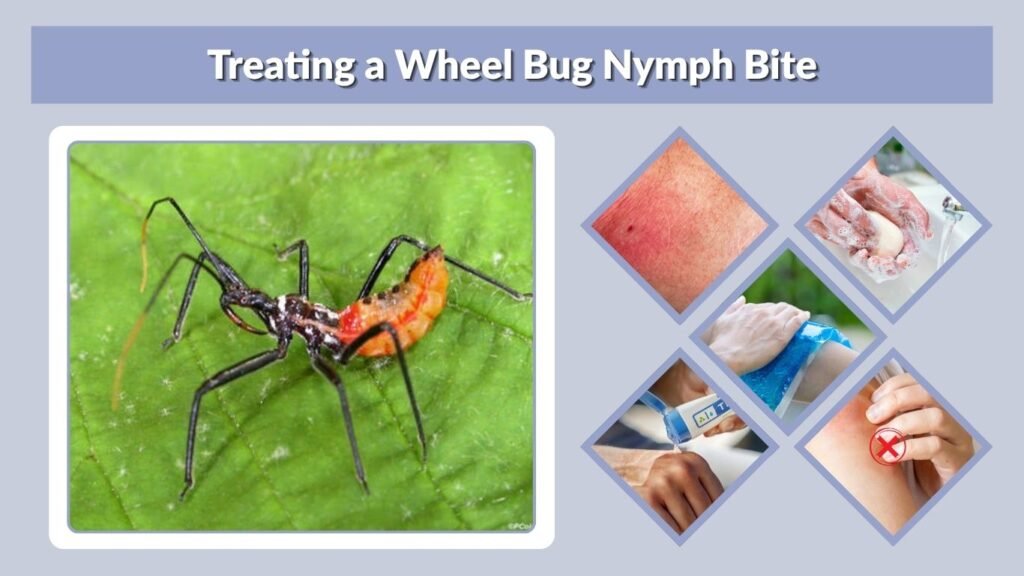
Wash the wound gently with soap and clean water. Apply a cold pack wrapped in cloth for 10–20 minutes to reduce pain and swelling. Do not cut, squeeze, scratch, or attempt to suck material from the puncture.
Medical assessment is appropriate when:
- Pain or swelling continues to increase
- Redness spreads beyond the bite area
- Numbness persists
- The wound develops pus or drainage
- Red streaks or fever appear
- The bite occurred near an eye or inside the mouth
- The affected person has a history of serious allergic reactions
Difficulty breathing, facial or throat swelling, fainting, or widespread hives requires emergency assistance. Wheel bug bite effects may occasionally persist when secondary infection or individual hypersensitivity occurs.
Wheel Bug Nymphs Hatching
Adult females lay compact clusters of brown, bottle-shaped eggs during fall. The eggs are positioned upright, cemented together, and coated with a protective gummy material. A cluster may contain approximately 42–182 eggs.
Egg masses are commonly attached to:
- Tree trunks
- Branches and twigs
- Shrubs
- Fence posts
- Outdoor furniture
- Sheds and other structures
The species usually spends winter in the egg stage. Hatching occurs during spring, although exact timing differs by region. Virginia Cooperative Extension reports that eggs commonly hatch during May and June in its region, while records from warmer areas indicate that nymphs may appear earlier.
Wheel Bug Nymph vs. Spotted Lanternfly Nymph
Wheel bug nymphs are frequently mistaken for spotted lanternfly nymphs because both can display red and black coloration.
| Feature | Wheel bug nymph | Spotted lanternfly nymph |
| Body form | Long-legged and predatory | Compact and planthopper-like |
| Early color | Red or orange abdomen | Black with white spots |
| Later color | Red and black | Red, black, and white |
| Legs | Long and mostly dark | Shorter and spotted |
| Feeding | Hunts insects | Sucks plant sap |
| Movement | Walks and stalks prey | Frequently jumps |
| Beak | Strong predatory beak | Plant-feeding mouthparts |
Penn State describes wheel bug nymphs as having orange-red bodies with black legs, while early spotted lanternfly nymphs are black with clearly visible white dots.
Are Wheel Bug Nymphs Found in Australia?
Arilus cristatus is a North and Central American species, with records extending through much of the United States and south into Mexico and Guatemala. It is not considered a native Australian insect.
Australia has its own assassin bugs, and some of their nymphs may resemble wheel bug nymphs. An orange or red Australian insect should therefore not be identified as Arilus cristatus based on appearance alone.
FAQs
Are wheel bug nymphs dangerous?
They are not aggressive, but they can inflict a painful defensive bite when handled, squeezed, or trapped against the skin. Observe them without touching them.
Can a baby wheel bug bite?
Yes. Even young wheel bug nymphs possess piercing mouthparts. A smaller nymph may produce a less substantial puncture than a large individual, but it should still never be handled.
Why is a wheel bug nymph red?
Bright red or orange coloration is normal in younger nymphs. Their appearance becomes darker and more adult-like as they pass through successive molts.
How long does a wheel bug remain a nymph?
Development through the five nymphal stages takes roughly three months under favorable conditions. Temperature, food, weather, and geographic location can affect the exact duration.
Is a wheel bug nymph good for the garden?
Yes. It consumes aphids, caterpillars, beetle larvae, stink bugs, and other potential pests. However, it is a generalist predator and may occasionally capture beneficial insects as well.
