
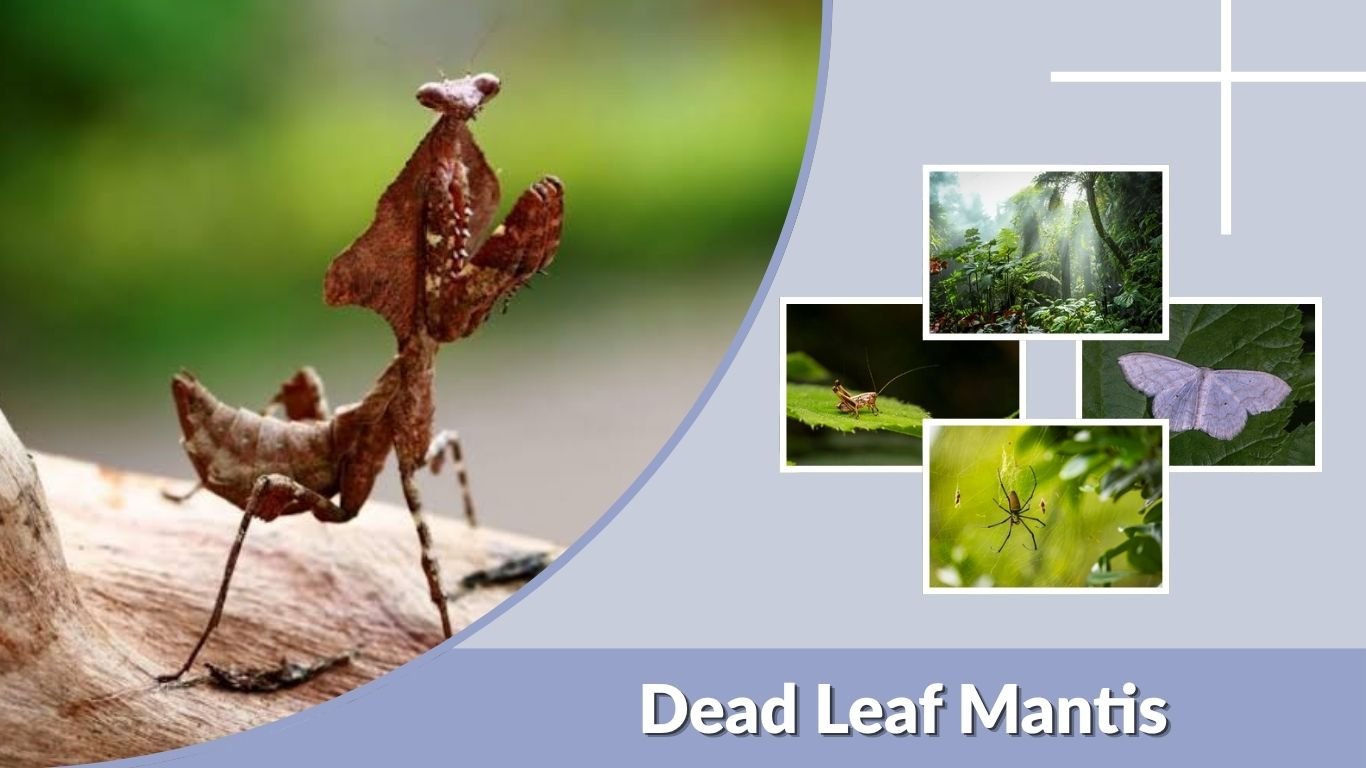
The dead leaf mantis is one of the most convincing masters of camouflage in the insect world. With a flattened brown body, irregular edges, and markings that resemble the veins and blemishes of a dried leaf, it can virtually disappear among forest vegetation.
Several mantises in the genus Deroplatys are called dead leaf mantises. One of the best known is the Malaysian giant dead leaf mantis (Deroplatys desiccata), a large Southeast Asian species popular among mantis enthusiasts because of its unusual appearance and behavior.
What Is a Dead Leaf Mantis?
A dead leaf mantis is a praying mantis adapted to resemble dried foliage. The name is especially associated with species of the genus Deroplatys, including Deroplatys desiccata, D. lobata, D. truncata, and several related species.
The giant dead leaf mantis, Deroplatys desiccata, is one of the most recognizable members of this group.
Dead Leaf Mantis Identification
Important features include:
- Scientific name commonly associated with the giant species: Deroplatys desiccata
- Genus: Deroplatys
- Order: Mantodea
- Brown or mottled coloration
- Large, flattened shield-like pronotum
- Leaf-shaped abdomen and wings
- Irregular edges resembling damaged foliage
- Dark and light patches similar to marks on old leaves
- Powerful grasping front legs
- Triangular mantis head
The broad shield behind the head is particularly important because it breaks up the mantis’s body outline and helps create its leaf-like appearance.
Dead Leaf Mantis Camouflage
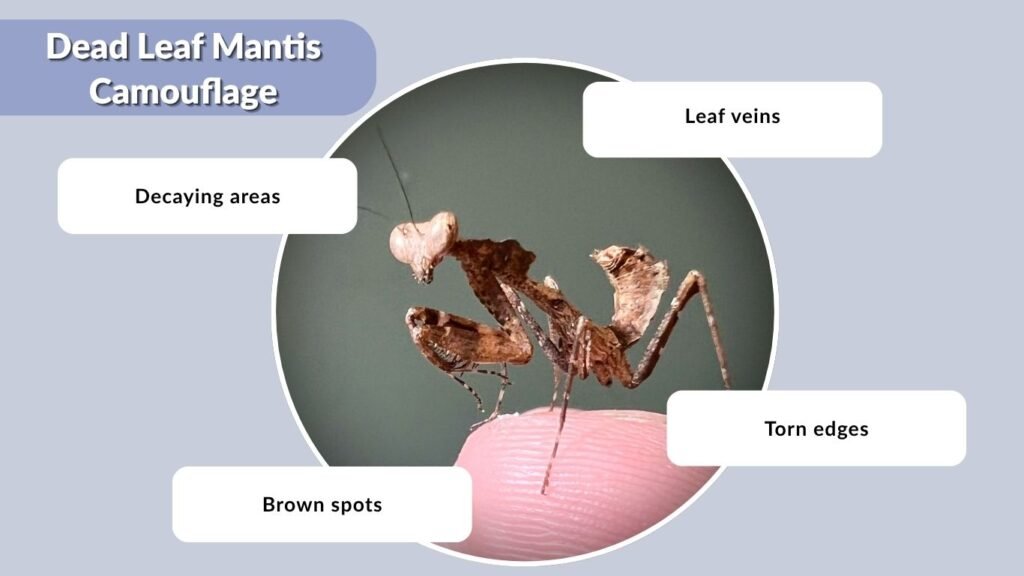
Camouflage is the feature that makes these insects famous.
Rather than chasing prey over long distances, the mantis can remain almost motionless among dried leaves and branches. Its brown coloration, flattened shape, and uneven body margins help it blend into the background.
How Does a Dead Leaf Mantis Camouflage?
The insect resembles more than the color of a leaf. Its body can imitate:
- Leaf veins
- Torn edges
- Brown spots
- Decaying areas
- Folded foliage
- Dry leaf shapes
Some nymphs also remain still or drop toward the ground when frightened, further strengthening their resemblance to dead vegetation. Adults can use additional defensive displays when threatened.
Mimicry and Defensive Behavior
When camouflage fails, Deroplatys desiccata may suddenly expose contrasting colors on its wings and forelegs in a threat display. The quick change from a motionless brown “leaf” to a larger, brightly patterned insect may surprise a potential predator.
Some individuals may also remain motionless in a behavior resembling death-feigning.
Where Do Dead Leaf Mantises Live?
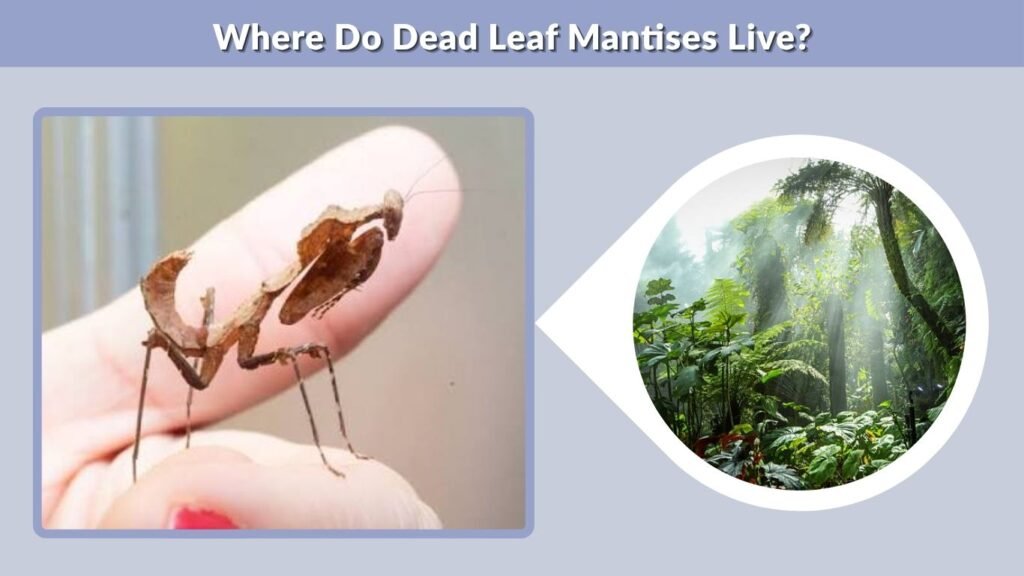
Dead leaf mantises are primarily associated with tropical regions of Asia, although other leaf-mimicking mantises occur elsewhere in the world.
The giant Malaysian dead leaf mantis, Deroplatys desiccata, originates in Southeast Asia and is particularly associated with Malaysia.
Dead Leaf Mantis Habitat
Their natural surroundings generally include warm, humid, heavily vegetated environments where leaf litter provides excellent camouflage.
Typical habitat features include:
- Tropical forests
- Dense vegetation
- Forest understory
- Shrubs
- Leaf litter
- Branches covered with dead foliage
- Warm and humid conditions
Their camouflage is most effective in environments containing mixtures of brown leaves, bark, twigs, and shadows.
Dead Leaf Mantis Size
Size depends on the species and sex.
In Deroplatys desiccata, adult females can reach roughly 9 cm (3.5 inches) in body length, while males are usually smaller at approximately 7–8 cm (2.8–3.1 inches). Females are also noticeably broader and heavier.
Female vs. Male Dead Leaf Mantis
Females usually have a larger, wider body and a more prominent leaf-like shield. Their wings generally end near the tip of the abdomen.
Males are slimmer and have relatively longer wings that can extend beyond the abdomen. Their lighter construction also makes adult males better suited for flight.
The strong difference between the sexes becomes easier to recognize as the insects mature.
What Do Dead Leaf Mantises Eat?
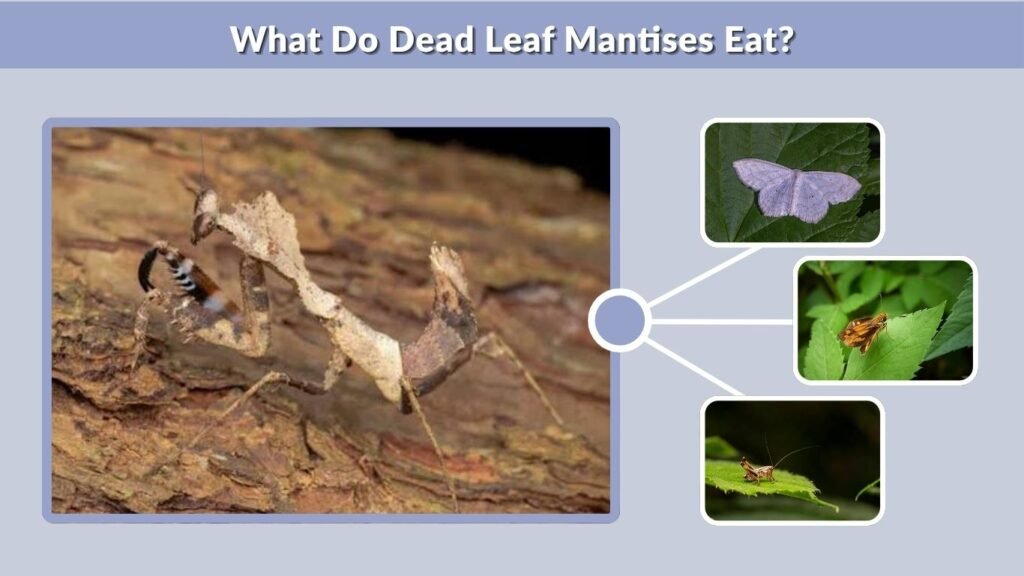
Dead leaf mantises are carnivorous ambush predators.
They wait for suitable prey to approach and then seize it rapidly with their specialized raptorial front legs.
Dead Leaf Mantis Diet
Their prey can include appropriately sized insects such as:
- Flies
- Moths
- Crickets
- Roaches
- Small grasshoppers
- Other soft-bodied insects
Young nymphs require much smaller prey, with fruit flies commonly used when these mantises are maintained in captivity. Larger individuals can handle progressively larger feeder insects.
Like other praying mantises, they rely heavily on movement to detect potential prey.
Dead Leaf Mantis Life Cycle
Dead leaf mantises undergo incomplete metamorphosis, so they do not have a caterpillar or chrysalis stage.
Their development includes three major stages.
Egg
A mature female produces an egg case known as an ootheca. The protective structure contains multiple eggs.
Nymph
Young mantises emerge resembling miniature wingless adults. As they grow, they periodically shed their outer skeleton in a process known as molting.
The leaf-like shape becomes increasingly developed as the nymph matures.
Adult
After the final molt, the mantis develops functional adult wings and becomes sexually mature.
Males generally mature faster than females in some commonly kept Deroplatys species.
How Long Do Dead Leaf Mantises Live?
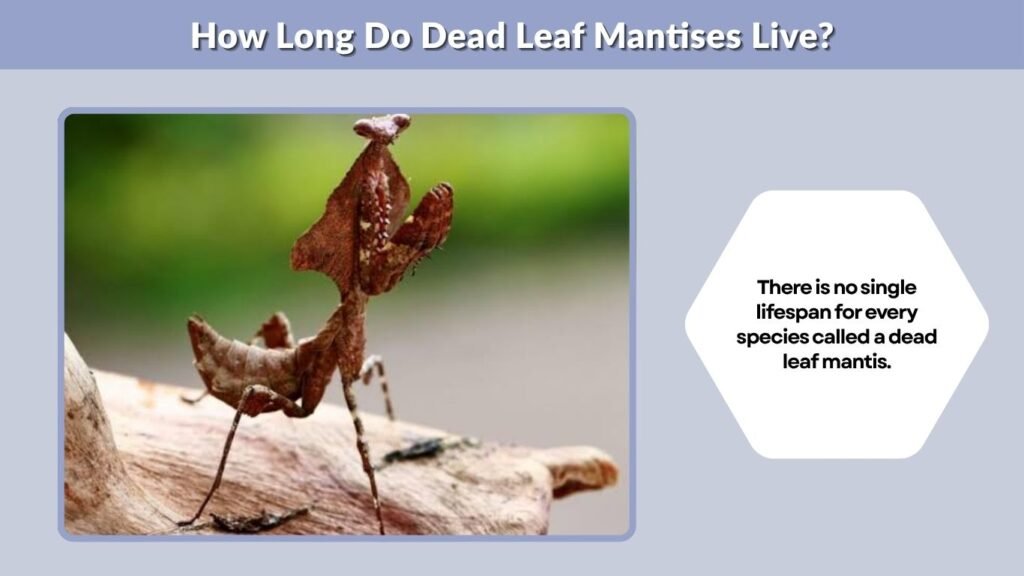
There is no single lifespan for every species called a dead leaf mantis.
Their longevity depends on species, sex, temperature, diet, environmental conditions, and captive husbandry. Females generally survive longer than males because males mature more rapidly in many mantis species.
Higher temperatures can accelerate metabolism and development, while unsuitable temperatures, poor hydration, unsuccessful molts, or nutritional problems can shorten survival.
Dead Leaf Mantis Molting
Molting is one of the most important parts of a young mantis’s development.
Before a molt, a mantis may:
- Stop eating
- Become less active
- Hang upside down
- Ignore nearby prey
During the molt, the insect hangs from a secure surface and slowly pulls itself from its old exoskeleton. It then remains relatively soft while the new outer skeleton hardens. Adequate vertical space is therefore critical for captive mantises.
A mantis that cannot hang freely may suffer serious deformities during a molt.
Dead Leaf Mantis Care
Dead leaf mantises are sometimes kept as exotic pets, but they require more specialized care than many common household pets.
For Deroplatys desiccata, keepers generally provide a warm, moderately humid, well-ventilated enclosure with plenty of vertical space and secure surfaces for molting. One commonly cited captive-care range is around 50–80% relative humidity, with temperatures kept warm rather than cold.
Enclosure
The enclosure should be considerably taller than the mantis’s body length so it can hang safely during molting.
Branches, artificial foliage, mesh, and other climbing surfaces provide useful attachment points.
Good airflow is also important because constantly stagnant, overly wet conditions can create husbandry problems.
Feeding
Offer appropriately sized live insects rather than prey that is excessively large.
Nymphs can begin with small flies, while older mantises can take larger flying or crawling insects. Uneaten prey should not be left to disturb a mantis preparing to molt.
Housing
Keeping adult mantises separately is generally safest. Although some dead leaf mantises may appear relatively tolerant, cannibalism remains possible. D. desiccata is commonly recommended for individual housing.
Malaysian Dead Leaf Mantis
The Malaysian dead leaf mantis usually refers to Deroplatys desiccata, also called the giant dead leaf mantis.
Its combination of large size, broad thoracic shield, mottled brown coloration, and irregular wing shape creates an exceptionally convincing imitation of a dried leaf.
It should not be confused with every insect sold or described simply as a “dead leaf mantis,” since several Deroplatys species share similar common names.
Other Types of Dead Leaf Mantis
The name applies to multiple species rather than one single mantis.
Examples include:
- Deroplatys desiccata – giant or Malaysian dead leaf mantis
- Deroplatys lobata – Southeast Asian dead leaf mantis
- Deroplatys truncata – another leaf-mimicking Deroplatys
- Deroplatys trigonodera – another member of the genus
The genus contains additional species, all demonstrating variations on the flattened, cryptic body form for which the group is famous.
Dead Leaf Mantis Predators and Defense
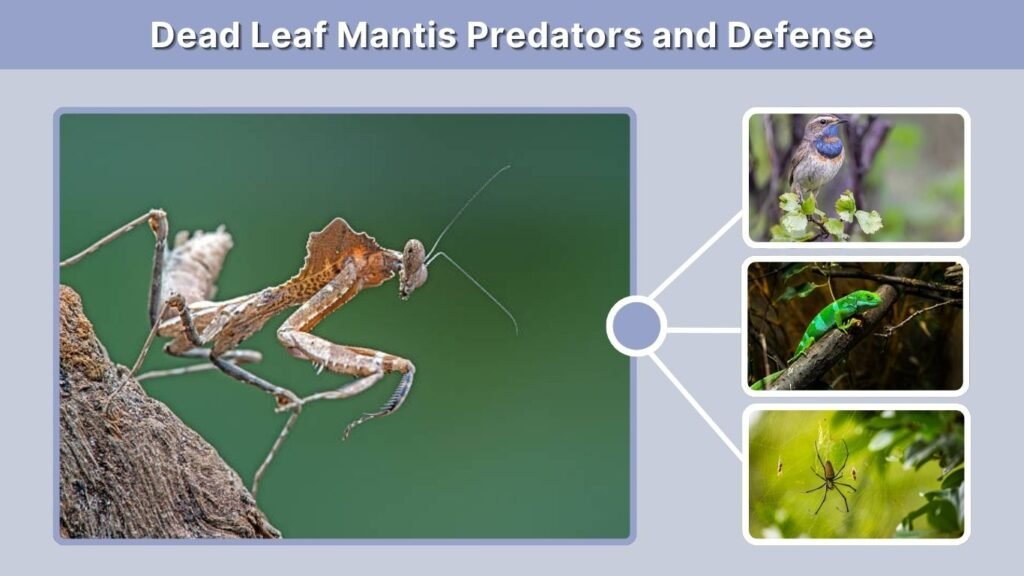
Potential predators include insect-eating birds, reptiles, amphibians, spiders, and other animals capable of capturing large insects.
The mantis’s first defense is usually avoiding detection.
Its remarkable disguise lets it remain hidden without needing to flee. If discovered, sudden movement, defensive postures, wing displays, or death-feigning behavior may provide another chance to escape.
Interesting Dead Leaf Mantis Facts
- Several species are called dead leaf mantises.
- Deroplatys desiccata is one of the best-known species.
- Females are generally larger and broader than males.
- Their bodies imitate torn and decaying leaves.
- They are predators, not plant-eating insects.
- Young mantises develop through repeated molts.
- Females lay their eggs inside protective oothecae.
- Their camouflage assists both predator avoidance and ambush hunting.
- Threatened adults can expose striking wing patterns.
- They are sometimes maintained as exotic pets.
FAQs
What is the scientific name of the dead leaf mantis?
There is no single scientific name for every dead leaf mantis because several Deroplatys species use the common name. The giant Malaysian dead leaf mantis is Deroplatys desiccata, one of the best-known members of the group.
Where do dead leaf mantises live?
Dead leaf mantises in the genus Deroplatys occur primarily in tropical Asia. They inhabit warm, humid areas with dense vegetation, branches, shrubs, and abundant dead foliage that allow their brown coloration and leaf-shaped bodies to provide effective camouflage.
What do dead leaf mantises eat?
They are carnivorous predators that capture live insects with their powerful front legs. Depending on their size, prey can include flies, moths, crickets, roaches, and other insects. Very young mantises require much smaller prey than adults.
How big does a giant dead leaf mantis get?
Female Deroplatys desiccata can reach about 9 cm, while males are commonly around 7–8 cm long. Females also appear considerably larger because their bodies and leaf-like thoracic shields are broader.
Can you keep a dead leaf mantis as a pet?
Yes, some Deroplatys species are kept in captivity. They need live prey, warmth, controlled humidity, good ventilation, and enough vertical space for safe molting. Individual housing is usually the safest approach because mantises can cannibalize one another.
