
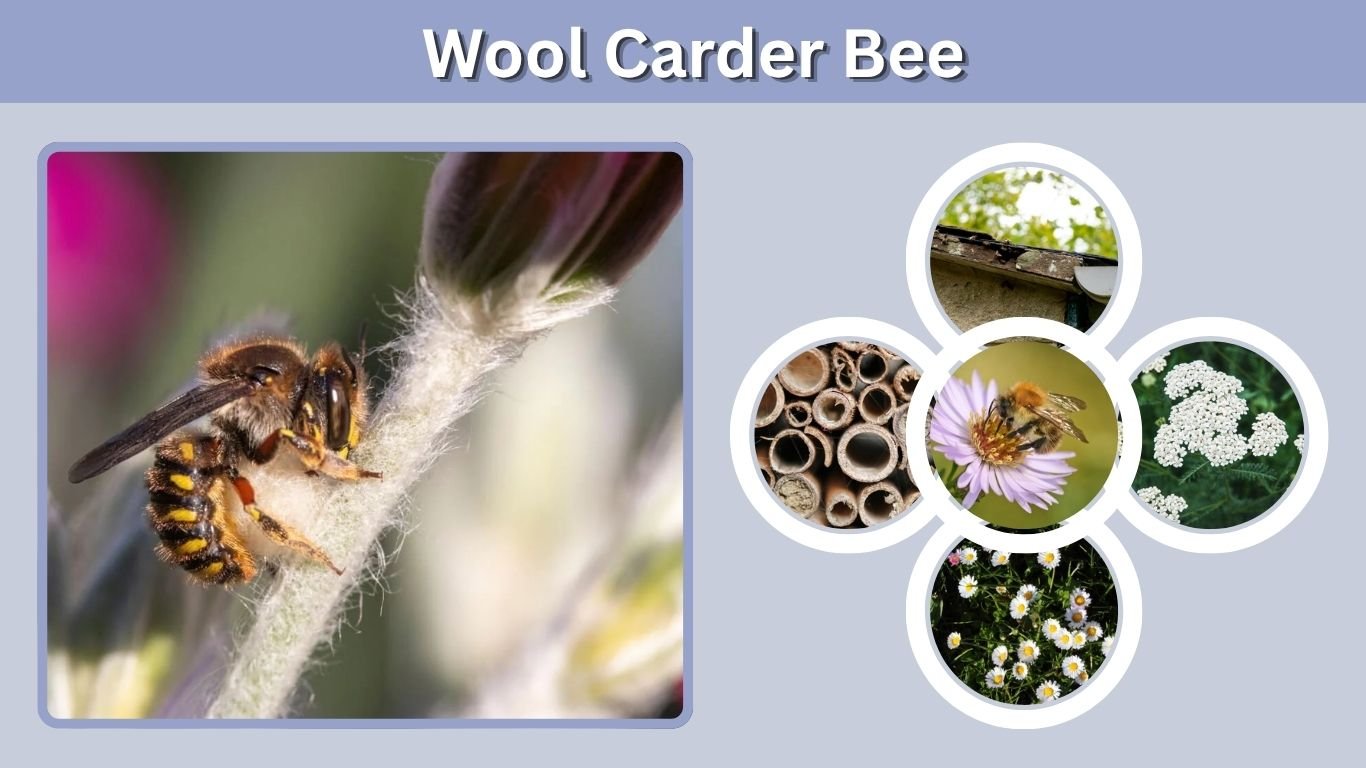
The wool carder bee is a distinctive solitary bee known for collecting soft plant hairs to build its nest. The European wool carder bee, Anthidium manicatum, has a stocky black body, bright yellow markings, and unusually territorial males. It is native to Europe and nearby regions but has become established in North America and other parts of the world. Despite its wasp-like appearance and aggressive flight around flowers, this bee is mainly a pollinator and usually poses little danger to people.
What Does a Wool Carder Bee Look Like?
Wool carder bees are robust members of the family Megachilidae, which also contains mason and leafcutter bees. Their contrasting yellow-and-black coloration causes them to be confused with wasps, but their hairy, stocky bodies reveal their bee identity. Adults commonly appear in gardens during summer, particularly wherever lamb’s ear and other favored flowers grow.
Wool Carder Bee Identification
Important identification features include:
- Stocky, robust bee-like body
- Black abdomen with yellow spots or bands
- Pale or golden hairs around the thorax
- Yellow facial markings
- Approximately 12–16 mm long
- Females carry pollen beneath the abdomen
- Males have several pointed abdominal spines
- Fast flight around patches of flowers
Their combination of yellow abdominal markings and dense body hair makes them quite distinctive when viewed closely.
Male Wool Carder Bee vs Female
Unusually for many bees, male wool carders are typically larger than females. Males patrol patches of flowering plants and aggressively chase away other insects. They have five noticeable projections at the end of the abdomen that can be used during confrontations.
Females are smaller and perform the characteristic “carding” behavior. They scrape soft fibers from hairy leaves, gather the material into a bundle, and carry it back to their nest.
Wool Carder Bee Nest and Carding Behavior
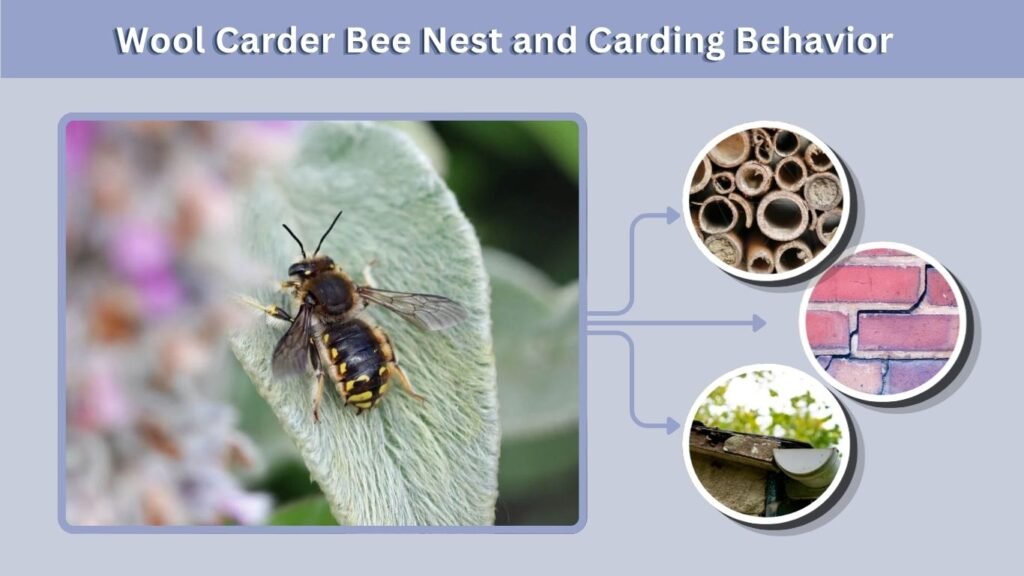
The wool carder bee is a solitary bee, meaning females do not form large worker colonies like honey bees or many bumblebees. Instead, an individual female prepares her own nest. She does not normally excavate a large nest from scratch; instead, she selects an existing cavity and lines it with soft plant fibers.
Where Do Wool Carder Bees Nest?
Possible wool carder bee nest sites include:
- Hollow plant stems
- Existing holes in dead wood
- Old insect exit holes
- Cracks in masonry
- Small cavities in walls
- Pre-existing holes in soil
- Bee hotels
- Suitable artificial objects
The female divides the cavity into brood cells where eggs and food provisions are placed. Buglife notes that wool carders are aerial cavity nesters that readily use existing openings above ground.
Why Are They Called Wool Carder Bees?
Their name comes directly from their unusual nest-building technique.
Females use their jaws to scrape or “card” fine hairs from woolly leaves. They gather these fibers into a ball, transport them to the nest, and spread the material along the inside of the cavity. The fibers form brood-cell walls and eventually help close the nest entrance.
Lamb’s ear is particularly famous for supplying this wool-like material.
Wool Carder Bee Plants and Diet
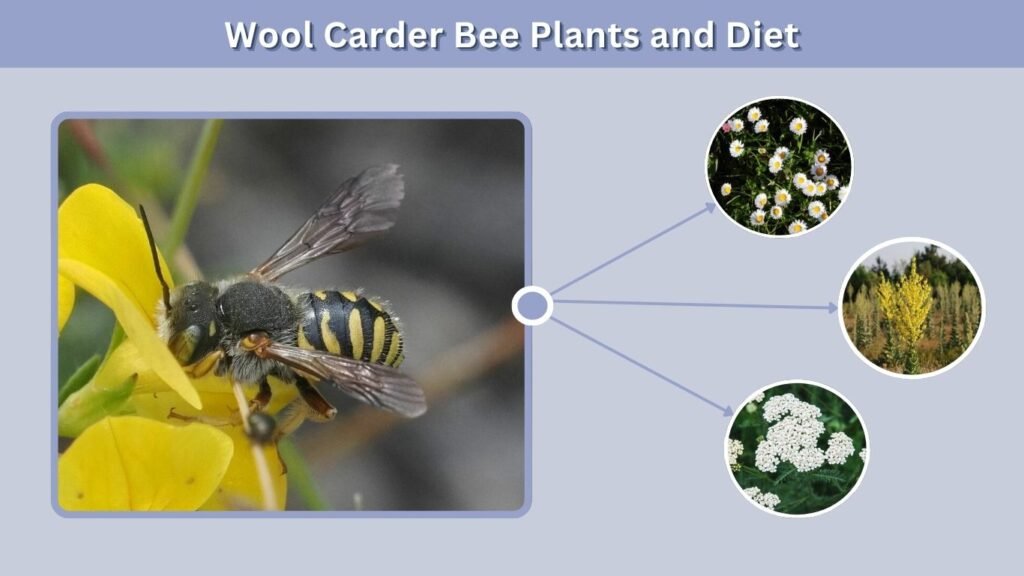
Wool carder bees need flowers for nectar and pollen, but females also need plants with soft, hairy leaves for nest construction. Because these two resources may occur together in gardens, wool carders are frequently noticed around ornamental flower beds. Males may even establish territories around productive flower patches and repeatedly patrol the same small area.
Plants Associated With Wool Carder Bees
Plants commonly associated with them include:
- Lamb’s ear (Stachys byzantina)
- Woundworts
- Great mullein
- Yarrow
- Pelargonium
- Cotton thistle
- House-leek
- Lavender
- Other nectar-rich garden flowers
Not all of these are “host plants” in the butterfly sense. Wool carder larvae develop inside nests and eat stored pollen and nectar rather than feeding directly on leaves. Some plants instead supply the fibers needed to construct their brood cells.
What Do Wool Carder Bees Eat?
Adults feed on nectar, while females collect pollen to provision their developing young.
They visit numerous flower species rather than depending completely on one food plant. Lamb’s ear is especially attractive because it can provide both flowers and the soft leaf hairs females need for nesting.
This association explains why gardeners sometimes notice several wool carder bees repeatedly returning to the same patch.
Does a Wool Carder Bee Sting?
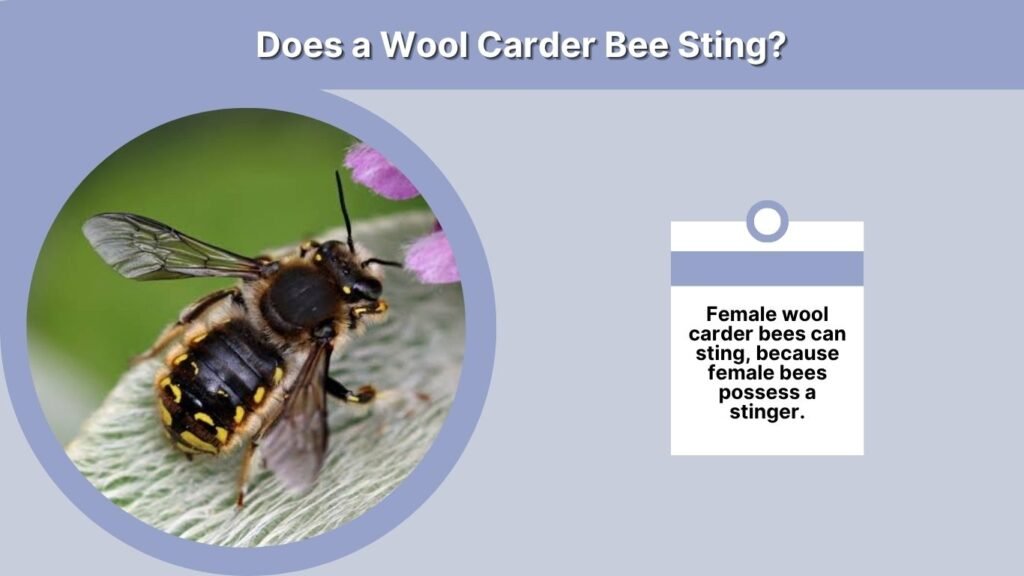
The keyword “wool carder bee sting” can sound alarming because males behave aggressively around flowers. However, their aggressive behavior is mostly directed toward competing insects rather than people. Wool carders are solitary bees and do not have a large colony, queen, honey stores, or worker population to defend in the way social bees and wasps do.
Can Wool Carder Bees Sting People?
Female wool carder bees can sting, because female bees possess a stinger. However, solitary bees generally sting only when physically threatened, trapped, or handled.
Male wool carder bees cannot sting. The stinger in bees is derived from the female reproductive structure, so males lack one entirely.
This distinction is important because males are the individuals most likely to fly aggressively around a person standing near their flower territory.
Why Are Male Wool Carder Bees Aggressive?
Male wool carder bees may:
- Patrol a favored flower patch
- Chase other male wool carders
- Drive away other bee species
- Confront larger insects
- Hover around animals or people entering the area
- Use abdominal spines during fights with insects
Their behavior protects access to flowers visited by females. Although the display looks intimidating, a male hovering near your face cannot sting you.
European Wool Carder Bee Range and Invasive Status
Anthidium manicatum is commonly called the European wool carder bee because its original distribution includes Europe and nearby regions. Human movement allowed it to establish populations far outside its native range. Today it can occur in urban and suburban gardens, where ornamental plants provide abundant nesting fibers, pollen, and nectar.
Wool Carder Bee in North America
The species was recorded as introduced into North America around 1960. The U.S. Geological Survey reports populations across the northeastern United States, upper Midwest, southern Canada, central Rockies, and West Coast, including established populations in California.
This explains searches for wool carder bee California and wool carder bee Oregon.
It is frequently associated with urban gardens containing Stachys, especially lamb’s ear.
Is the Wool Carder Bee Invasive?
It is clearly an introduced, non-native bee in North America. The word “invasive” is also frequently used, but introduced is the more precise general description unless a particular authority has formally designated it invasive in a specific region.
Researchers pay attention to introduced bees because they may compete with native species for flowers or nest cavities.
Wool Carder Bee vs Wasp and Other Carder Bees
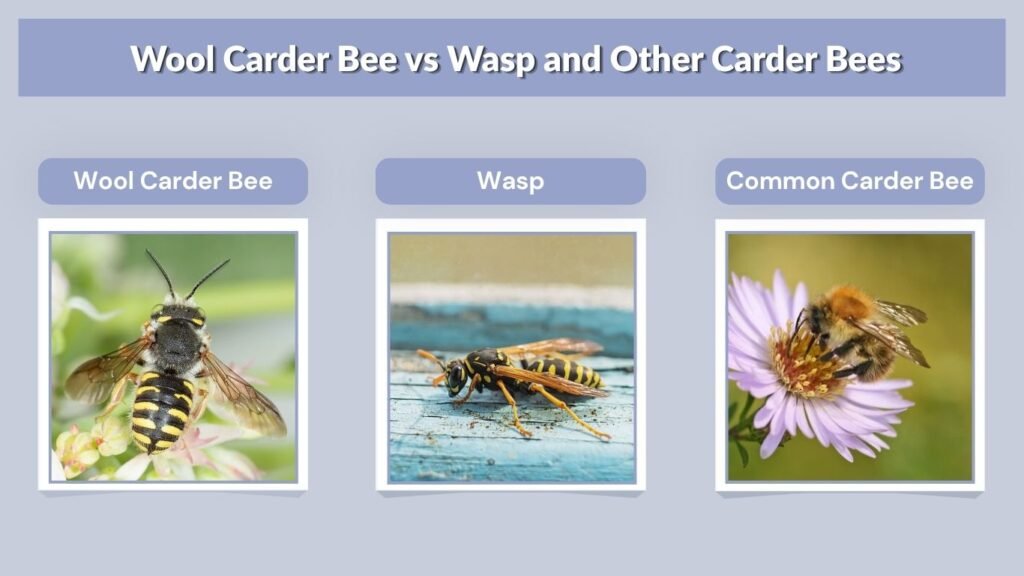
The term “carder bee” can cause considerable confusion. Not every bee with “carder” in its common name is closely related to the wool carder. Several familiar carder bees are actually bumblebees in the genus Bombus, whereas Anthidium manicatum belongs to the Megachilidae family. Appearance also causes wool carders to be mistaken for yellow-and-black wasps.
Wool Carder Bee vs Wasp
A wool carder resembles a wasp because of its yellow-and-black pattern, but its body is noticeably stockier and hairier. Female wool carders also have pollen-carrying hairs beneath the abdomen.
Wasps generally appear smoother and less densely hairy. Watching a female carrying pollen underneath her abdomen can therefore provide a strong clue that you are looking at a wool carder rather than a wasp.
Common Carder Bee vs Wool Carder Bee
The common carder bee (Bombus pascuorum) is a bumblebee, not an Anthidium wool carder.
Likewise, the moss carder bee, shrill carder bee, brown-banded carder bee, and red-shanked carder bee belong to Bombus. They received the “carder” name because of nesting-material behavior, but they are biologically distinct from the European wool carder.
FAQs
These small solitary bees attract attention because their unusual nesting behavior and territorial males differ considerably from familiar honey bees. Understanding the answers to a few common questions makes them much easier to recognize and appreciate around gardens.
1. Are wool carder bees dangerous?
Usually not. Females can sting if threatened or handled, but wool carder bees are solitary and normally have little reason to attack people. Territorial males may appear aggressive but cannot sting.
2. What is the scientific name of the wool carder bee?
The European wool carder bee’s scientific name is Anthidium manicatum. It belongs to the bee family Megachilidae.
3. Where do wool carder bees build nests?
Females use pre-existing cavities such as hollow stems, holes in wood, masonry gaps, soil cavities, and artificial structures. They line the cavities with plant fibers.
4. Why do wool carder bees like lamb’s ear?
Lamb’s ear has densely hairy leaves. Females scrape off these soft fibers and carry them to their nests to construct brood cells. Its flowers can also provide nectar.
5. Can male wool carder bees sting?
No. Male wool carder bees do not have stingers, even though they are highly territorial and may aggressively chase other insects around flowers.
