
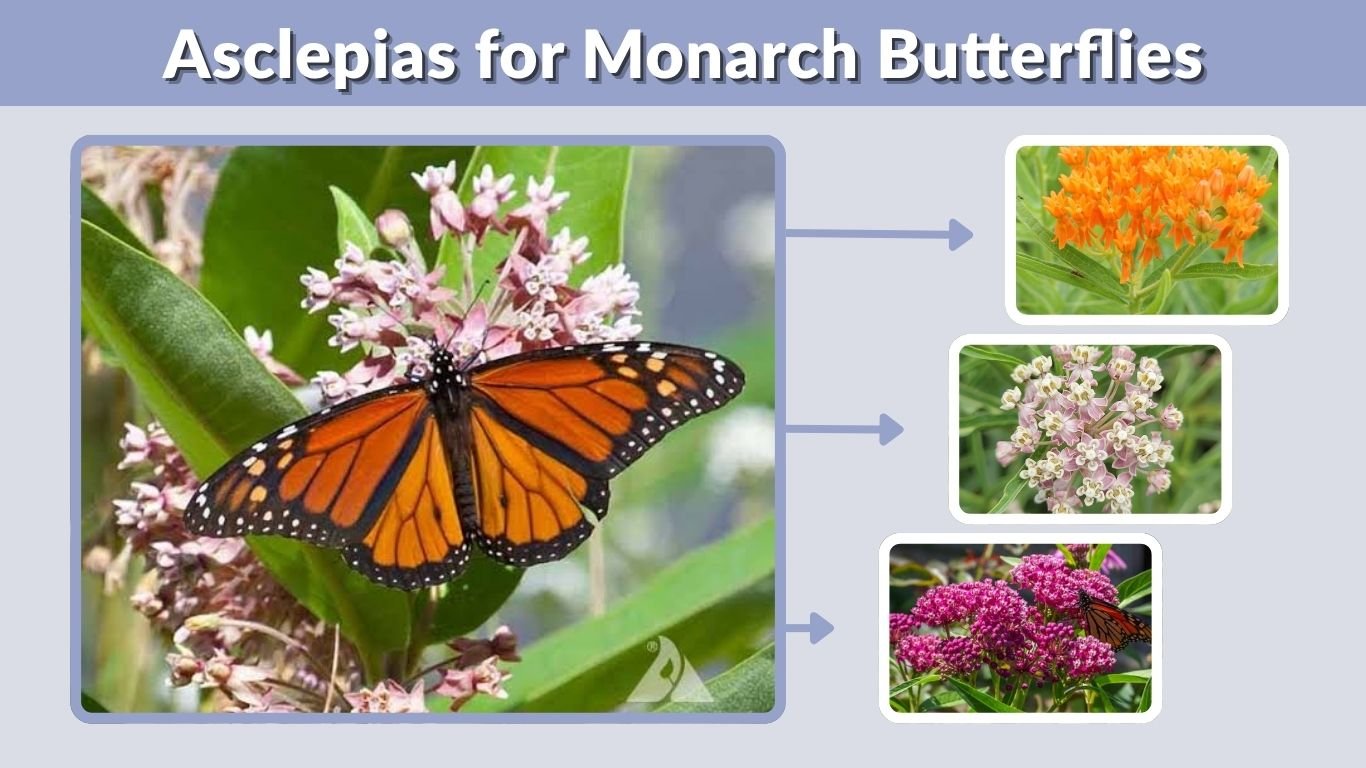
The Asclepias monarch butterfly relationship is one of the best-known examples of a butterfly depending on a particular group of plants. Asclepias, commonly called milkweed, provides the essential host plants monarch caterpillars need for growth and development. Adult monarchs also visit many milkweed flowers for nectar. Species such as butterfly weed, common milkweed, narrowleaf milkweed, and woollypod milkweed can support monarchs when planted within their native ranges. Choosing the right milkweed can provide food, breeding habitat, and valuable resources for other pollinators.
Why Is Asclepias Important to Monarch Butterflies?
Milkweed is essential to monarch reproduction. Female monarchs search for suitable milkweed plants and usually place individual eggs on their leaves. Once the eggs hatch, the caterpillars feed on milkweed as they develop through their larval stages. Adult butterflies are much less specialized and drink nectar from many kinds of flowers.
Milkweed Is the Monarch Host Plant
Monarch caterpillars in North America rely on milkweed in the genus Asclepias and a few closely related plants.
The caterpillars eat leaves, flowers, and sometimes tender stems as they grow. Without suitable host plants, female monarchs have nowhere appropriate to lay their eggs and newly hatched caterpillars lack their primary food source.
North America has roughly 110 milkweed species, giving monarchs many regionally adapted host plants.
Adult Monarchs Use Flowers Differently
Adult monarchs do not depend only on milkweed.
They drink nectar from milkweed flowers as well as asters, goldenrods, blazing stars, sunflowers, and many other flowering plants. A good monarch garden therefore needs both milkweed for caterpillars and diverse nectar plants for adults.
This becomes particularly important during migration, when adults need abundant nectar for energy.
Best Asclepias Plants for Monarch Butterflies
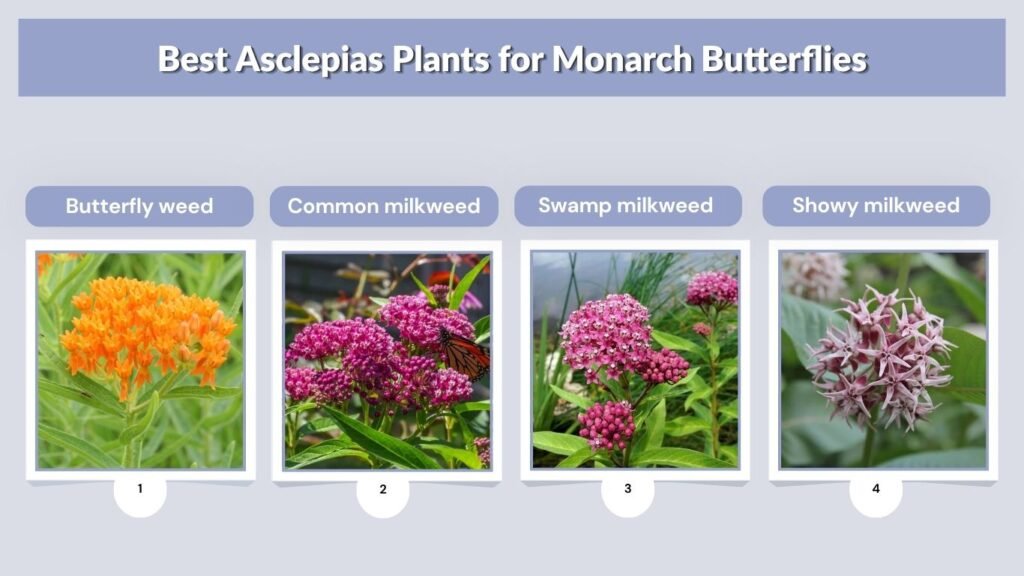
There is no single milkweed species that is best everywhere. The strongest conservation approach is to choose Asclepias species native to your region and appropriate for the site’s soil, moisture, and sunlight. Xerces recommends regionally appropriate native milkweeds because different parts of North America naturally support different species.
Good Milkweed Choices
Depending on your location, suitable species can include:
- Butterfly weed (Asclepias tuberosa) – Bright orange flowers and good tolerance of dry, sunny sites.
- Common milkweed (Asclepias syriaca) – A widespread host plant with large leaves and pinkish flower clusters.
- Swamp milkweed (Asclepias incarnata) – Well suited to moist soils and rain gardens.
- Narrowleaf milkweed (Asclepias fascicularis) – An important western species, particularly in California.
- Showy milkweed (Asclepias speciosa) – A valuable western host plant with large pink flowers.
- Woollypod milkweed (Asclepias eriocarpa) – A native California species that can provide early-season foliage.
- Prairie milkweed (Asclepias sullivantii) – Useful in parts of the central United States.
Native Species Are Usually the Better Choice
Native milkweeds are adapted to regional climate and growing conditions.
They also naturally die back or enter dormancy according to local seasonal cycles. This helps maintain the normal rhythm between monarch breeding, migration, and plant availability.
Xerces specifically recommends planting native milkweeds rather than relying on nonnative evergreen species.
Asclepias Tuberosa and Monarch Butterflies
Asclepias tuberosa, commonly called butterfly weed, is one of the most popular ornamental milkweeds. Its clusters of orange flowers make it attractive in pollinator gardens, while its leaves can support developing monarch caterpillars. It is native across a large portion of North America and works particularly well in sunny, relatively dry locations.
Is Asclepias Tuberosa Good for Monarchs?
Yes. Asclepias tuberosa is a true milkweed and an accepted monarch host plant.
Female monarchs can lay eggs on it, and caterpillars can feed on its foliage.
Its flowers also provide nectar for adult monarchs, bees, and other pollinating insects, making it useful at more than one trophic level.
Is Asclepias Tuberosa Bad for Monarch Butterflies?
No. Native A. tuberosa is not considered harmful to monarchs when grown appropriately.
One source of confusion is that butterfly weed contains less obvious milky latex than many other milkweeds. However, not every Asclepias species produces conspicuous milky sap, and visible latex is not required for a plant to function as monarch host habitat.
Why Do Monarch Caterpillars Eat Asclepias?
Milkweed provides nutrition, but it also contains unusual chemicals called cardenolides or cardiac glycosides. Monarch caterpillars have evolved adaptations that allow them to eat these chemically defended plants. Some of the compounds become incorporated into the caterpillar and adult butterfly, contributing to the monarch’s chemical defense against many predators.
Milkweed’s Chemical Defense
Most animals find milkweed difficult or unpleasant to eat because of its chemical compounds.
Monarch caterpillars are specialists and can tolerate these defenses much better than most herbivores.
The exact cardenolide concentration varies among milkweed species, meaning different Asclepias plants can expose caterpillars to different chemical levels.
Why Monarchs Still Need Other Plants
Milkweed supports the caterpillar stage, but adult monarchs require a wider landscape.
After emerging from the chrysalis, butterflies need nectar-rich flowers for carbohydrates and energy.
A garden containing only milkweed may therefore provide excellent breeding habitat but inadequate nectar through the entire season.
Asclepias Fascicularis and Monarch Butterflies
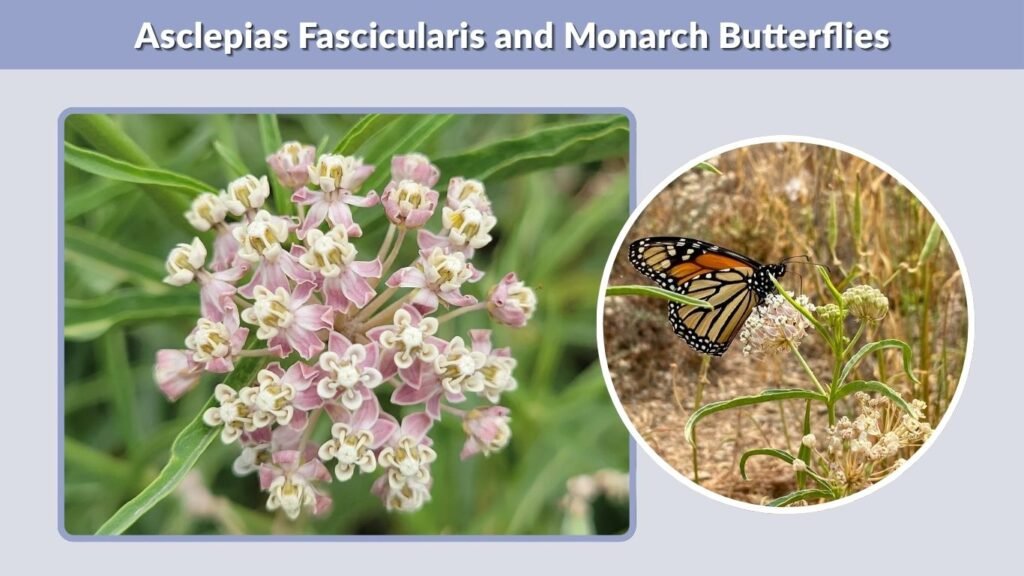
Narrowleaf milkweed, Asclepias fascicularis, is particularly important in western North America. It has narrow leaves arranged along upright stems and clusters of pale pink or whitish flowers. In California and nearby areas, it is frequently recommended as a native host plant for monarchs and other milkweed-associated insects.
The Monarch–Milkweed Relationship
Female monarchs use narrowleaf milkweed as an egg-laying plant, and their caterpillars consume its foliage.
The relationship benefits the butterfly by providing essential larval food. Adult monarchs can also pollinate flowers while feeding on nectar, although milkweed is pollinated by many other insects as well.
This relationship is better described as ecological dependence by the monarch than as a strict one-to-one mutualism.
Asclepias Eriocarpa for Monarch Butterflies
Asclepias eriocarpa, commonly called woollypod milkweed, is another western North American species used by monarchs. It has broad leaves and hairy seed pods and occurs naturally in parts of California. Because it can emerge relatively early in the season, it may provide useful host foliage when monarchs are returning to breeding areas.
Is Woollypod Milkweed Suitable?
Yes, where it occurs naturally.
Woollypod milkweed can function as both larval habitat and an adult nectar source.
As with any native milkweed, gardeners should consider whether its natural range, soil requirements, and climate match the planting location instead of selecting plants solely because they are labeled “monarch friendly.”
Tropical Asclepias and Monarch Butterflies
Tropical milkweed, Asclepias curassavica, attracts monarchs and can support their caterpillars. However, conservation organizations discourage its use in many parts of the United States, particularly where mild winters allow the plant to remain green throughout the year. Persistent foliage can alter seasonal monarch behavior and increase opportunities for disease transmission.
Concerns With Tropical Milkweed
Potential problems include:
- Remaining green throughout winter in warm climates
- Encouraging monarchs to breed outside normal seasonal periods
- Increasing exposure to the parasite Ophryocystis elektroscirrha (OE)
- Supporting parasite buildup on leaves over time
- Potentially interfering with normal migratory behavior
- Replacing regionally appropriate native milkweeds in gardens
What About Silky Gold Asclepias?
Plants sold as Silky Gold milkweed are forms of tropical milkweed rather than native North American milkweeds.
Monarchs may readily lay eggs on them, but attractiveness does not necessarily make them the best conservation choice.
In regions where tropical milkweed remains evergreen, replacing it with locally native Asclepias species is generally the safer approach for supporting monarch populations.
How to Plant Asclepias for Monarch Butterflies
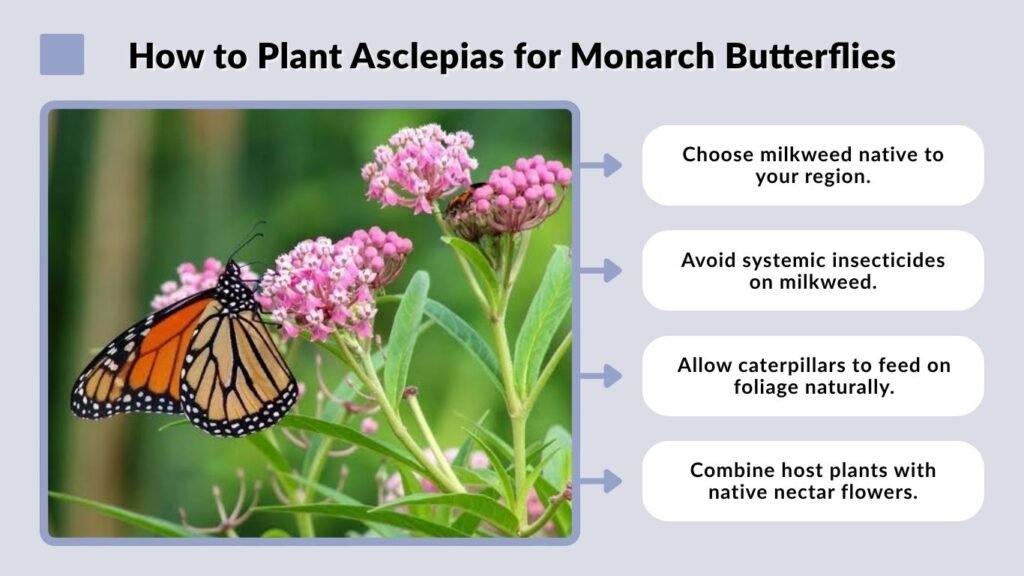
Successful monarch habitat combines appropriate milkweed with nectar plants and pesticide-conscious gardening. Different Asclepias species prefer different soil moisture levels, so matching the plant to your site improves survival and produces healthier foliage for caterpillars.
Monarch Garden Tips
For a stronger habitat:
- Choose milkweed native to your region.
- Plant several milkweed plants rather than a single specimen.
- Provide sunny growing conditions when required by the species.
- Include flowers that bloom from spring through fall.
- Avoid systemic insecticides on milkweed.
- Allow caterpillars to feed on foliage naturally.
- Expect some leaf damage during monarch breeding.
- Combine host plants with native nectar flowers.
- Leave seasonal stems when they provide habitat, unless disease management requires removal.
- Avoid replacing native milkweed with tropical milkweed in mild climates.
Xerces emphasizes that monarchs benefit most from habitat containing appropriate native host and nectar plants rather than milkweed alone.
Asclepias and the Monarch Life Cycle
Milkweed is involved only during specific parts of the monarch’s life cycle, but those stages are essential. A female begins the process by locating a suitable plant and laying an egg. The caterpillar develops while consuming the leaves before leaving the plant or nearby vegetation to form a chrysalis.
From Egg to Butterfly
The egg hatches into a tiny caterpillar that begins eating milkweed.
As it grows, the larva molts repeatedly before eventually becoming a mature fifth-instar caterpillar. It then forms a chrysalis and undergoes metamorphosis.
The emerging adult no longer eats milkweed leaves. Instead, it drinks flower nectar and eventually searches for milkweed again when the next generation is ready to reproduce.
FAQs
1. Is Asclepias good for monarch butterflies?
Yes. Asclepias, or milkweed, provides the essential host plants that monarch caterpillars need to grow and develop.
2. Is Asclepias tuberosa good for monarchs?
Yes. Butterfly weed (Asclepias tuberosa) is a native milkweed used by monarch caterpillars and also provides nectar for adult butterflies.
3. Which Asclepias should I plant for monarch butterflies?
Choose milkweed species native to your region and suitable for your soil and climate. Native choices can include butterfly weed, common milkweed, swamp milkweed, narrowleaf milkweed, and others.
4. Is tropical Asclepias bad for monarchs?
Tropical milkweed (Asclepias curassavica) can increase concerns about OE disease and altered breeding behavior where it remains green through winter, so native alternatives are generally recommended.
5. Do adult monarch butterflies eat Asclepias?
Adults drink nectar from milkweed flowers but also use many other flowering plants. Monarch caterpillars are the life stage that depends specifically on milkweed foliage for food.
