
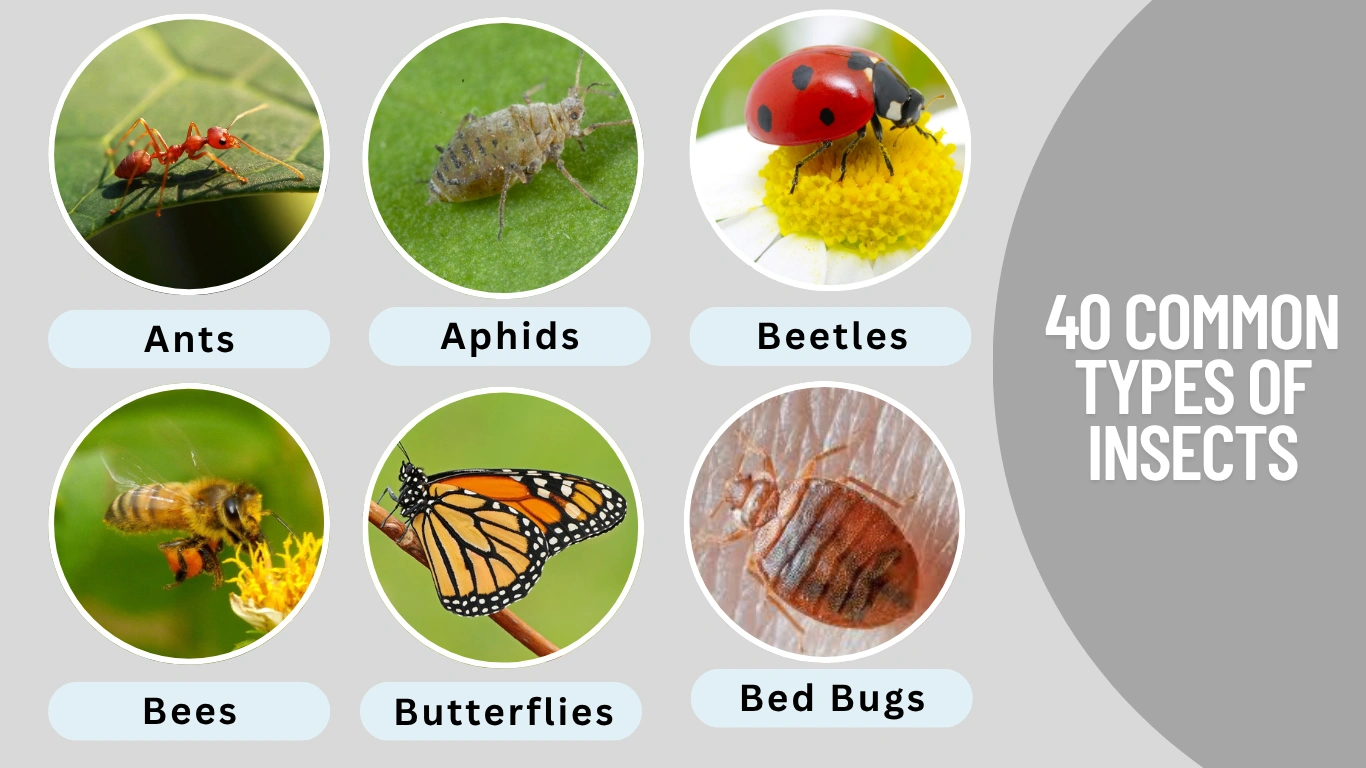
Insects are the most diverse group of animals on Earth, with millions of species adapted to nearly every environment. From the helpful ladybug to the destructive termite, insects play vital roles in nature, agriculture, and even our homes. This list introduces 40 of the most commonly found insect types—including pollinators, predators, pests, and decomposers. Each entry highlights the insect’s appearance, behavior, habitat, and ecological impact, helping you better identify and understand the tiny creatures all around us.
1. Ants
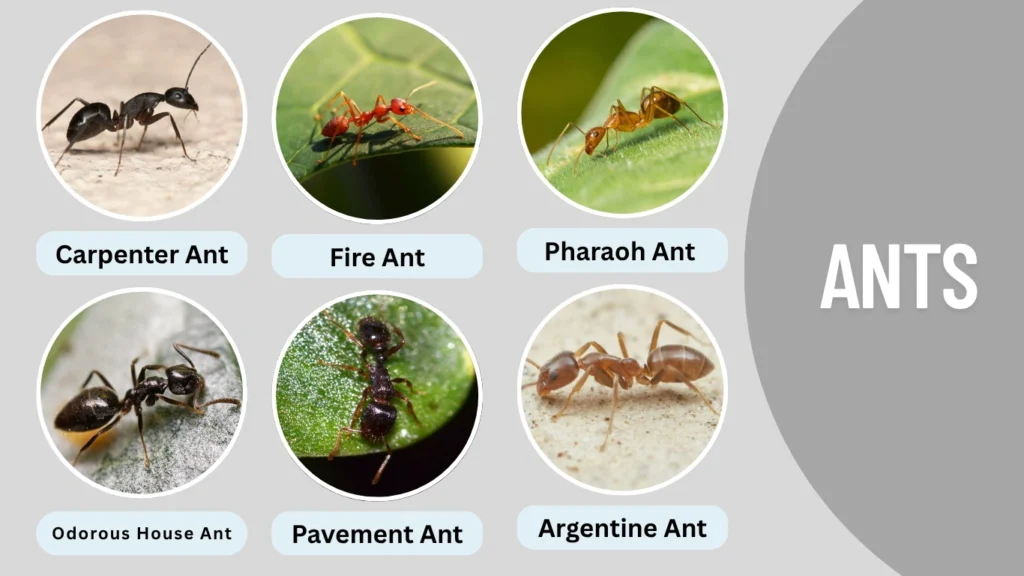
Ants are among the most widespread and organized insects on Earth. Belonging to the family Formicidae, they are known for their social behavior, colony structure, and ability to thrive in nearly every habitat except the polar regions. Ants live in complex societies and perform a wide variety of tasks like foraging, defending, and caring for the young.
Common Types of Ants
- Carpenter Ant (Camponotus spp.)
- Fire Ant (Solenopsis spp.)
- Pharaoh Ant (Monomorium pharaonis)
- Odorous House Ant (Tapinoma sessile)
- Pavement Ant (Tetramorium caespitum)
- Argentine Ant (Linepithema humile)
Habitat
Ants are highly adaptable and can live in soil, wood, leaf litter, inside walls, under rocks, or in trees. Some species, like carpenter ants, prefer moist, decaying wood, while others nest under pavement or in kitchen pantries.
Behavior
Ants live in colonies with a strict social hierarchy consisting of queens, workers, and males. Worker ants gather food, protect the nest, and care for eggs and larvae. Some ants are aggressive and bite or sting, while others rely on chemical trails to communicate and find food. Their teamwork and ability to form long-lasting nests make them difficult to eliminate once they infest an area.
Diet
Most ants are omnivorous. They eat a wide range of foods including sweets, proteins, fruits, grease, and even other insects. Some species, like leafcutter ants, feed on fungus they cultivate using chewed plant material.
Interaction with Humans
While ants play important ecological roles such as aerating soil and recycling nutrients, they can become household pests. Certain species damage structures, contaminate food, or deliver painful stings. Others, like fire ants, pose serious health risks due to their aggressive nature and venomous sting.
2. Aphids

Aphids are tiny, soft-bodied insects that feed on the sap of plants. They belong to the superfamily Aphidoidea and are considered serious pests in gardens, greenhouses, and farms due to their rapid reproduction and plant-damaging feeding habits. Aphids are known for secreting a sticky substance called honeydew, which attracts ants and promotes sooty mold growth.
Common Types of Aphids
- Green Peach Aphid (Myzus persicae)
- Cabbage Aphid (Brevicoryne brassicae)
- Black Bean Aphid (Aphis fabae)
- Cotton Aphid (Aphis gossypii)
- Rose Aphid (Macrosiphum rosae)
- Woolly Apple Aphid (Eriosoma lanigerum)
Habitat
Aphids are found on a wide range of plants, including vegetables, fruit trees, ornamentals, and weeds. They live on the undersides of leaves, stems, flower buds, or roots. They thrive in temperate climates and are most active in spring and early summer.
Behavior
Aphids reproduce rapidly, often giving birth to live young without mating (a process called parthenogenesis). They cluster in groups and feed by piercing plant tissue and sucking sap. Some species are winged and spread to new plants when populations become overcrowded.
Diet
Aphids feed exclusively on plant sap. This weakens the plant, causes yellowing or curling of leaves, stunts growth, and can transmit plant viruses.
Interaction with Humans
Aphids are a major agricultural concern. Besides direct plant damage, their honeydew attracts ants and causes fungal issues. Gardeners and farmers often use ladybugs, neem oil, or insecticidal soaps to control infestations.
3. Beetles
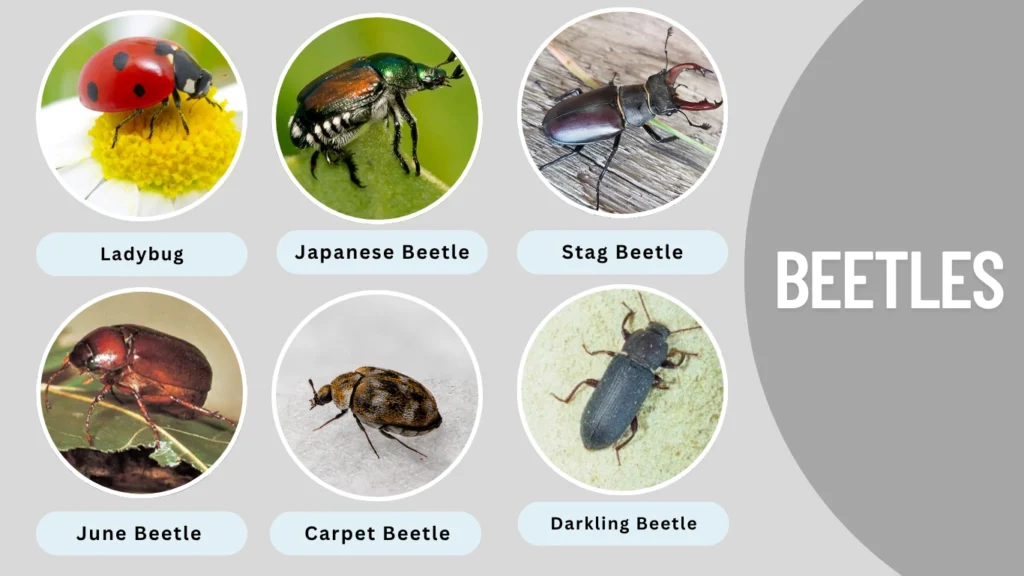
Beetles are the largest group of insects, with over 400,000 known species worldwide. Belonging to the order Coleoptera, they are recognized by their hard, shell-like wing covers (elytra) that protect the delicate flight wings beneath. Beetles are found in nearly every habitat and perform various ecological roles, from pollinators to decomposers.
Common Types of Beetles
- Ladybug (Coccinellidae)
- Japanese Beetle (Popillia japonica)
- Stag Beetle (Lucanidae)
- June Beetle (Phyllophaga spp.)
- Carpet Beetle (Anthrenus spp.)
- Darkling Beetle (Tenebrionidae)
Habitat
Beetles inhabit forests, gardens, fields, deserts, water bodies, and even homes. Some live under bark, in soil, or among stored food and fabrics. Aquatic beetles thrive in ponds and streams, while others dwell on flowers or foliage.
Behavior
Beetles display a wide range of behaviors. Some are strong fliers and active pollinators, while others hide during the day and feed at night. Many beetles go through complete metamorphosis: egg, larva (grub), pupa, and adult.
Diet
Their diet varies greatly:
- Herbivores: Feed on leaves, stems, or roots (e.g., Japanese beetles)
- Carnivores: Prey on smaller insects (e.g., ladybugs eat aphids)
- Detritivores: Consume decaying matter (e.g., darkling beetles)
- Scavengers: Found in compost and forest litter
Interaction with Humans
Some beetles, like ladybugs, are beneficial and control pests. Others, such as carpet beetles or grain beetles, are indoor pests. Agricultural beetles can cause severe crop damage, making them targets for pest control efforts.
4. Bees

Bees are flying insects belonging to the superfamily Apoidea. Known for their role in pollination, bees are essential to ecosystems and agriculture. While many people think of honeybees, there are thousands of wild bee species that also contribute to pollination. Bees are social or solitary, depending on the species, and many live in colonies with highly structured roles.
Common Types of Bees
- Honeybee (Apis mellifera)
- Bumblebee (Bombus spp.)
- Carpenter Bee (Xylocopa spp.)
- Leafcutter Bee (Megachile spp.)
- Mason Bee (Osmia spp.)
- Sweat Bee (Halictidae)
Habitat
Bees live in a variety of habitats including gardens, meadows, forests, orchards, and even urban environments. Honeybees build wax hives, often in human-made boxes or hollow trees. Solitary bees may nest in soil, wood, or plant stems.
Behavior
Honeybees and bumblebees are social, living in large colonies with queens, drones, and workers. Solitary bees build individual nests. Bees communicate using pheromones, movement (like the waggle dance), and scent trails. Most are active during daylight and return to their nest at night.
Diet
Bees feed primarily on nectar (as a source of energy) and pollen (as a protein source). Some species, like the honeybee, produce and store honey. Larvae are fed a mixture of nectar and pollen.
Interaction with Humans
Bees are crucial pollinators for fruits, vegetables, and flowers. Without them, many crops would fail. However, some bees—particularly carpenter bees—can damage wood structures. Bee stings can be painful and dangerous for allergic individuals, though most bees sting only when provoked.
5. Butterflies
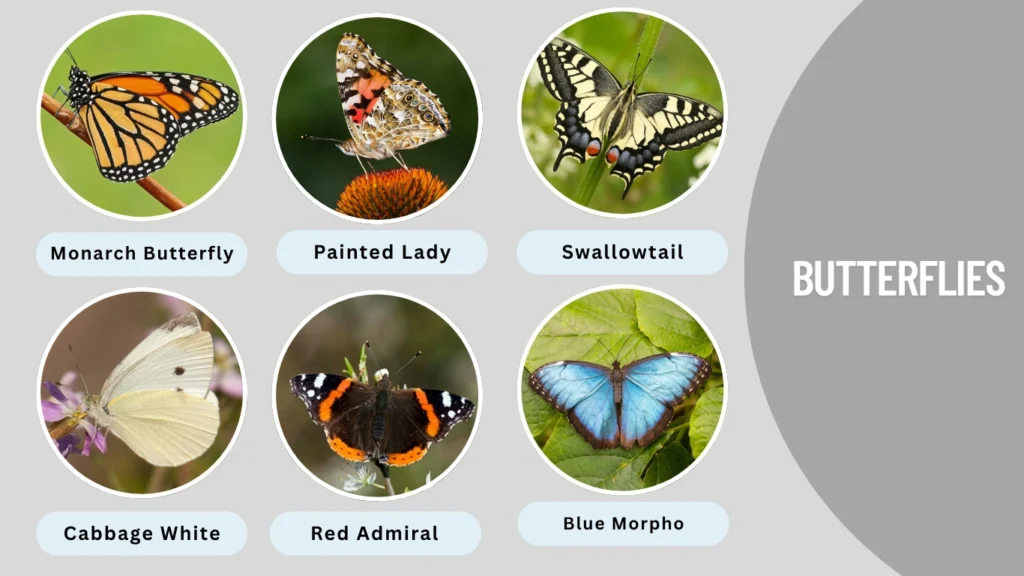
Butterflies are colorful, flying insects in the order Lepidoptera, which they share with moths. Known for their striking wing patterns and graceful flight, butterflies are often used as symbols of transformation due to their complete metamorphosis lifecycle. They are vital pollinators and indicators of healthy ecosystems.
Common Types of Butterflies
- Monarch Butterfly (Danaus plexippus)
- Painted Lady (Vanessa cardui)
- Swallowtail (Papilio spp.)
- Cabbage White (Pieris rapae)
- Red Admiral (Vanessa atalanta)
- Blue Morpho (Morpho spp.)
Habitat
Butterflies are found in gardens, meadows, forests, wetlands, and tropical rainforests. They prefer sunny, open areas with flowering plants and host plants for laying eggs. Many migrate long distances, such as the monarch.
Behavior
Butterflies are diurnal and feed on flower nectar. They use visual cues and chemical signals to locate food and mates. Males may patrol or perch while seeking females. Many species exhibit sunbathing behavior, using their wings to absorb warmth.
Diet
Adult butterflies primarily drink nectar, but some also consume tree sap, overripe fruit, and even mineral-rich mud. Caterpillars (larvae) feed on host plant leaves, specific to their species.
Interaction with Humans
Butterflies are important pollinators and enhance biodiversity. Their beauty also makes them popular in butterfly gardens and educational exhibits. However, habitat loss and pesticide use have led to declines in many species, prompting conservation efforts worldwide.
6. Bed Bugs
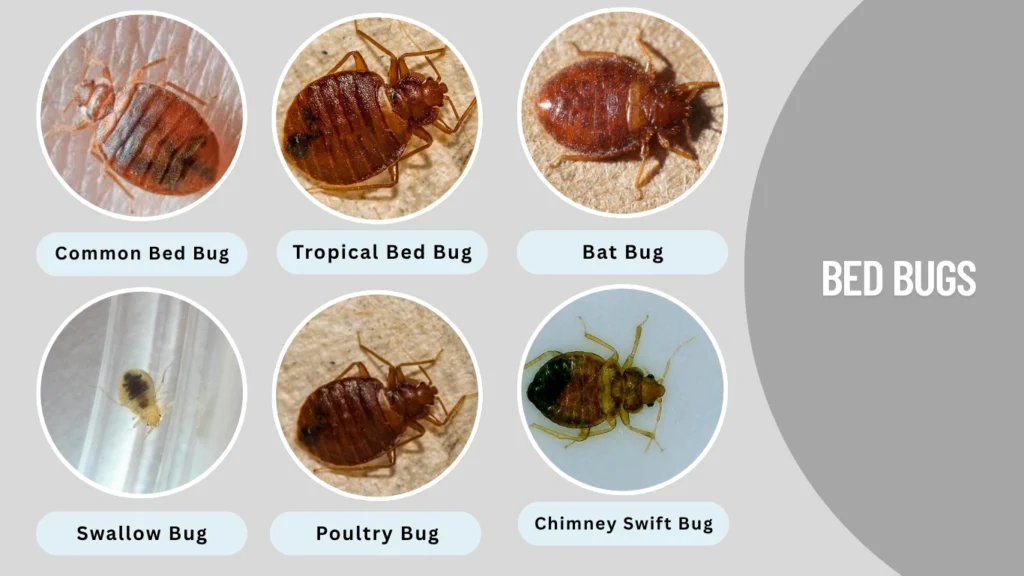
Bed bugs (Cimex lectularius) are small, flat, wingless insects that feed exclusively on the blood of humans and animals. Known for hiding in mattresses, furniture, and cracks, they are active at night and difficult to detect until infestations grow.
Common Types of Bed Bugs
- Common Bed Bug (Cimex lectularius)
- Tropical Bed Bug (Cimex hemipterus)
- Bat Bug (Cimex pilosellus)
- Swallow Bug (Oeciacus vicarius)
- Poultry Bug (Haematosiphon inodorus)
- Chimney Swift Bug (Cimexopsis nyctalis)
Habitat
Bed bugs are typically found in bedrooms, especially in mattresses, box springs, bed frames, and headboards. They also hide in cracks, behind wallpapers, and in furniture seams. Infestations can also occur in hotels, dormitories, buses, and theaters.
Behavior
Bed bugs are nocturnal and feed on blood while hosts sleep. They detect body heat and CO₂ to locate their host. After feeding, they hide and may go weeks without feeding again. They reproduce rapidly, with females laying hundreds of eggs in their lifetime.
Diet
Their only source of food is blood. They feed on humans but will also bite pets or other animals when necessary. Nymphs and adults both require blood to grow and molt.
7. Booklice
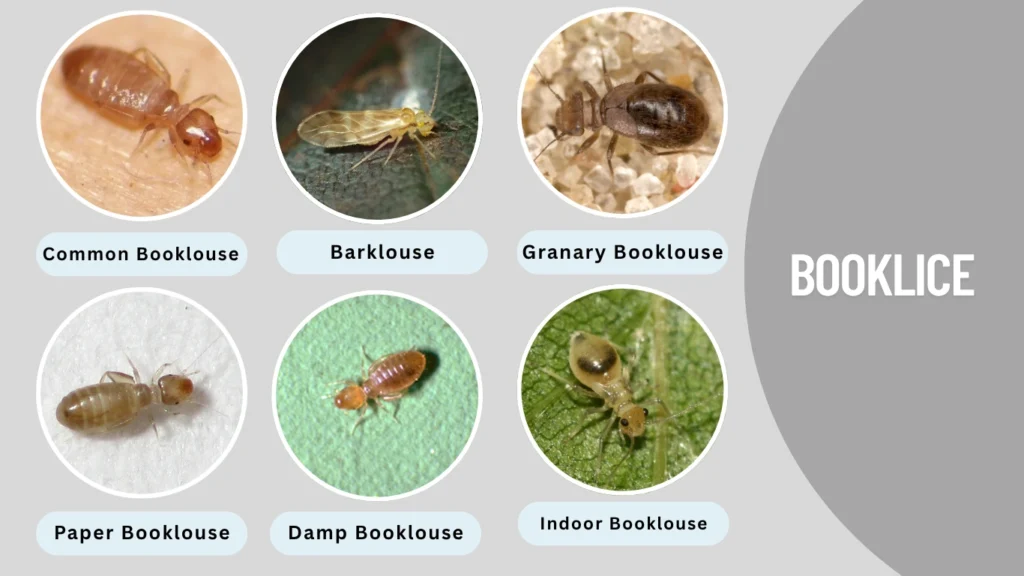
Booklice (Psocoptera) are tiny, soft-bodied insects often found in damp, humid areas of homes. Despite the name, they are not true lice and do not bite or feed on blood. They are attracted to mold, paper, and stored products.
Common Types of Booklice
- Common Booklouse (Liposcelis bostrychophila)
- Barklouse (Psocus spp.)
- Granary Booklouse (Liposcelis entomophila)
- Paper Booklouse (Lachesilla spp.)
- Damp Booklouse (Trogium pulsatorium)
- Indoor Booklouse (Liposcelis decolor)
Habitat
Booklice thrive in warm, humid environments like basements, bathrooms, and kitchens. They hide in books, wallpaper, cardboard boxes, and food storage areas where mold is present. They are also found under peeling paint and around leaky pipes.
Behavior
They do not cause structural damage or transmit disease but may become a nuisance when numerous. Booklice avoid light and quickly scatter when disturbed. Their numbers rise rapidly in moisture-rich environments.
Diet
They feed on mold, fungi, starch, dead insect parts, and even the glue in book bindings or wallpaper paste. In pantries, they may infest flour, grains, and cereals that have absorbed moisture.
8. Cicadas

Cicadas are large, winged insects known for their loud, buzzing calls produced by males during mating season. They belong to the order Hemiptera and are famous for their unique life cycles, with some species emerging every 13 or 17 years in massive broods.
Common Types of Cicadas
- Periodical Cicada (Magicicada spp.)
- Dog-Day Cicada (Neotibicen canicularis)
- Linne’s Cicada (Neotibicen linnei)
- Northern Dusk-Singing Cicada (Neotibicen auriferus)
- Greengrocer Cicada (Cyclochila australasiae)
- Green Cicada (Diceroprocta viridifascia)
Habitat
Cicadas live in wooded areas, parks, gardens, and forest edges. Nymphs spend most of their lives underground feeding on tree roots, while adults emerge and are often found in trees and shrubs.
Behavior
Males produce loud, distinctive calls to attract females, with each species having a unique song. After mating, females lay eggs in tree twigs. Nymphs hatch and burrow underground, where they remain for years before resurfacing.
Diet
Nymphs feed on sap from plant roots, while adults feed on xylem fluids from trees and shrubs. They don’t bite or sting and cause minimal direct damage to trees.
9. Cockroaches

Cockroaches are resilient, nocturnal insects that can survive in a variety of environments. Belonging to the order Blattodea, they are often associated with filth and decay, although many species live harmlessly in nature.
Common Types of Cockroaches
- American Cockroach (Periplaneta americana)
- German Cockroach (Blattella germanica)
- Oriental Cockroach (Blatta orientalis)
- Brown-Banded Cockroach (Supella longipalpa)
- Smokybrown Cockroach (Periplaneta fuliginosa)
- Australian Cockroach (Periplaneta australasiae)
Habitat
Cockroaches live in dark, moist environments such as kitchens, bathrooms, basements, and sewers. Outdoors, they hide under logs, mulch, and leaf litter. They can enter buildings through cracks, vents, and drains.
Behavior
They are primarily nocturnal and scurry when exposed to light. Cockroaches reproduce quickly and are highly adaptable. They can live for weeks without food and even survive decapitation for a short time.
Diet
Omnivorous scavengers, cockroaches eat almost anything: food scraps, grease, paper, glue, soap, and decaying organic matter. Their ability to consume a wide range of materials helps them thrive in human environments.
10. Crickets
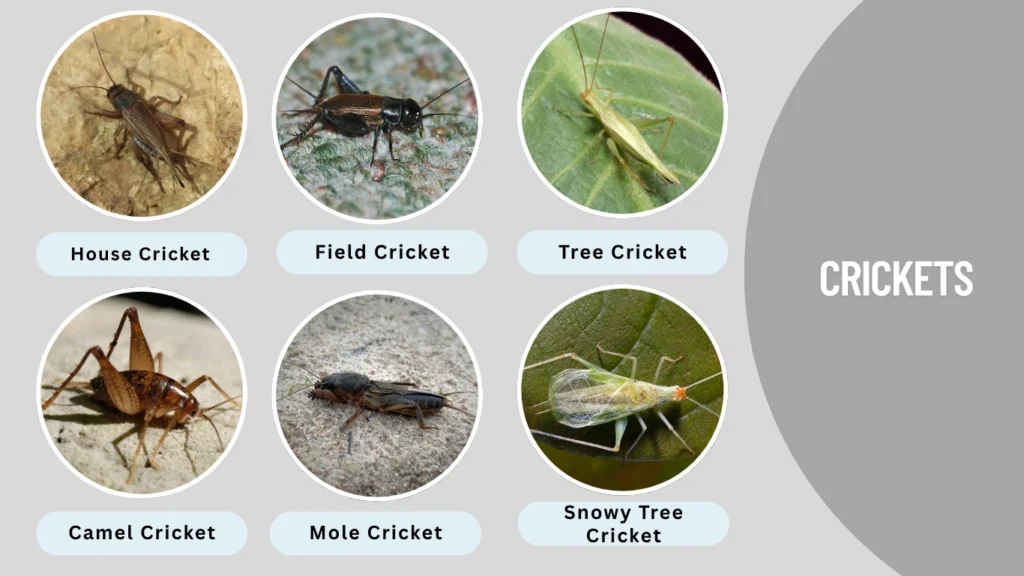
Crickets are chirping insects from the family Gryllidae, known for their long antennae and ability to produce sound by rubbing their wings together (a process called stridulation). They are common in fields, homes, and gardens and are often heard more than seen.
Common Types of Crickets
- House Cricket (Acheta domesticus)
- Field Cricket (Gryllus spp.)
- Tree Cricket (Oecanthus spp.)
- Camel Cricket (Ceuthophilus spp.)
- Mole Cricket (Gryllotalpidae)
- Snowy Tree Cricket (Oecanthus fultoni)
Habitat
Crickets inhabit grassy fields, forests, basements, under logs, inside wall voids, and even urban areas. Some prefer warm, dry places, while others like moist, dark environments.
Behavior
Most crickets are nocturnal and are drawn to warmth and light. Males chirp to attract females, and the sound varies by species and temperature. Some crickets, like mole and camel crickets, don’t chirp and are silent jumpers.
Diet
Crickets are omnivores. They feed on plant material, fungi, insects, food crumbs, and decaying organic matter. Indoors, they may nibble on fabric or paper products.
11. Damselflies

Damselflies are slender, delicate flying insects closely related to dragonflies. They belong to the order Odonata and are typically seen near freshwater sources. Unlike dragonflies, they rest with their wings closed over their backs and have thinner bodies.
Common Types of Damselflies
- Eastern Forktail (Ischnura verticalis)
- Blue-Tailed Damselfly (Ischnura elegans)
- Azure Damselfly (Coenagrion puella)
- Ebony Jewelwing (Calopteryx maculata)
- Fragile Forktail (Ischnura posita)
- American Rubyspot (Hetaerina americana)
Habitat
Damselflies are found near ponds, lakes, slow-moving streams, and wetlands. They prefer clean water for breeding and are often seen perching on plants close to water.
Behavior
They are strong fliers but move more delicately than dragonflies. Damselflies hunt by sight and capture prey mid-air. Mating involves a unique wheel-shaped coupling between males and females.
Diet
Adults feed on small flying insects like gnats, mosquitoes, and flies. Larvae (naiads) are aquatic predators that feed on tiny aquatic invertebrates and are important for keeping freshwater ecosystems balanced.
12. Dragonflies

Dragonflies are powerful, fast-flying insects in the order Odonata, suborder Anisoptera. Known for their broad wings and agile flight, dragonflies are expert hunters that help control mosquito and gnat populations. They are commonly seen around lakes, ponds, and wetlands.
Common Types of Dragonflies
- Common Green Darner (Anax junius)
- Blue Dasher (Pachydiplax longipennis)
- Twelve-Spotted Skimmer (Libellula pulchella)
- Widow Skimmer (Libellula luctuosa)
- Black Saddlebags (Tramea lacerata)
- Eastern Pondhawk (Erythemis simplicicollis)
Habitat
Dragonflies live near freshwater sources like ponds, lakes, rivers, and marshes. Their larvae (nymphs) are aquatic, requiring water to grow and develop. Adults are often seen flying over water or perched on reeds and plants.
Behavior
Dragonflies are territorial and excellent aerial predators. They can hover, fly backward, and change direction quickly. Males often defend territories along the water’s edge, while females lay eggs on or near water surfaces.
Diet
Adult dragonflies eat mosquitoes, flies, moths, and other small flying insects. Nymphs (larvae) feed on aquatic invertebrates, tadpoles, and even small fish. Both life stages are highly predatory and beneficial for pest control.
13. Earwigs

Earwigs are small, elongated insects with a pair of noticeable pincers (cerci) on their abdomen. They belong to the order Dermaptera and are mostly harmless, despite myths about crawling into ears. Earwigs are nocturnal and often hide in dark, moist places during the day.
Common Types of Earwigs
- Common Earwig (Forficula auricularia)
- Striped Earwig (Labidura riparia)
- Ring-Legged Earwig (Euborellia annulipes)
- Maritime Earwig (Anisolabis maritima)
- Seaside Earwig (Anisolabis littorea)
- Shore Earwig (Labidura truncata)
Habitat
Earwigs are found under rocks, mulch, leaves, flowerpots, and bark. Indoors, they may hide in bathrooms, basements, or laundry rooms. They prefer moist environments and come out at night to feed.
Behavior
They are mostly solitary and use their pincers for defense and during mating. Some species are maternal, guarding their eggs and young. Earwigs are active at night and are attracted to lights.
Diet
Omnivorous feeders—earwigs eat plant matter, decaying organic materials, fungi, and small insects. While they occasionally damage plants and flowers, they also help clean up decomposing material.
14. Fireflies (Lightning Bugs)
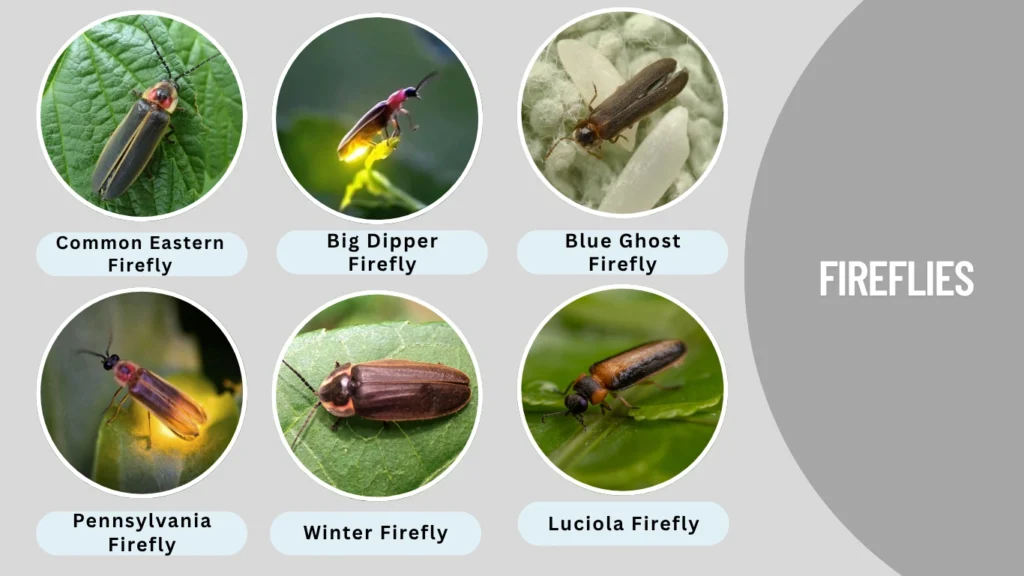
Fireflies, also known as lightning bugs, are soft-bodied beetles in the family Lampyridae. They are best known for their ability to produce light through bioluminescence, which they use for communication and mating. Fireflies are a summer evening favorite in many parts of the world.
Common Types of Fireflies
- Common Eastern Firefly (Photinus pyralis)
- Big Dipper Firefly (Photinus scintillans)
- Blue Ghost Firefly (Phausis reticulata)
- Pennsylvania Firefly (Photuris pennsylvanica)
- Winter Firefly (Ellychnia corrusca)
- Luciola Firefly (Luciola cruciata)
Habitat
Fireflies prefer moist habitats such as fields, gardens, forest edges, meadows, and wetlands. Larvae live in soil or leaf litter, while adults are often seen flying low over grass or near wooded areas.
Behavior
Most fireflies are active at dusk or night. Males fly while flashing specific light patterns to attract females, who respond with timed signals. Some species, like Photuris, mimic other fireflies to lure prey. Not all species glow—some are day-active and use pheromones instead.
Diet
Larvae are carnivorous and feed on snails, slugs, and other soft invertebrates. Adult fireflies may feed on nectar, pollen, or not eat at all. Some adult species are also predatory and feed on other fireflies.
15. Fleas
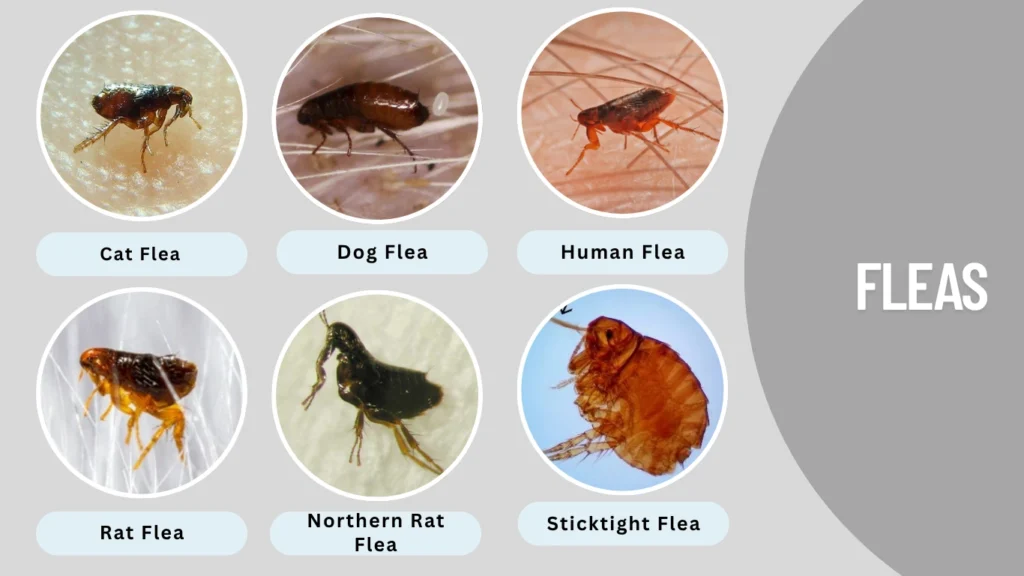
Fleas are tiny, wingless, blood-sucking insects that infest mammals and birds. Belonging to the order Siphonaptera, they are known for their jumping ability and are common pests on pets like dogs and cats. Fleas can spread rapidly and are hard to eliminate once established.
Common Types of Fleas
- Cat Flea (Ctenocephalides felis)
- Dog Flea (Ctenocephalides canis)
- Human Flea (Pulex irritans)
- Rat Flea (Xenopsylla cheopis)
- Northern Rat Flea (Nosopsyllus fasciatus)
- Sticktight Flea (Echidnophaga gallinacea)
Habitat
Fleas thrive in warm, humid environments—indoors in carpets, pet bedding, and cracks in floors, or outdoors in shaded soil and grass. Larvae live in dust and debris, while adults reside on hosts.
Behavior
Fleas are parasitic and feed on the blood of their hosts. They are excellent jumpers and move quickly through fur or hair. Females lay hundreds of eggs, which fall into the environment and hatch into larvae.
Diet
Fleas feed exclusively on blood. Larvae consume organic debris, including dried blood (flea dirt) left behind by adults. Their feeding behavior can cause itching, allergic reactions, and transmit diseases.
16. Flies

Flies are fast-moving, two-winged insects from the order Diptera. Known for their quick flight and large compound eyes, flies are some of the most widespread insects globally. While some species are harmless or even beneficial, others are notorious for spreading diseases and infesting food.
Common Types of Flies
- Housefly (Musca domestica)
- Fruit Fly (Drosophila melanogaster)
- Horsefly (Tabanus spp.)
- Blow Fly (Calliphoridae)
- Cluster Fly (Pollenia spp.)
- Stable Fly (Stomoxys calcitrans)
Habitat
Flies are extremely adaptable and found in homes, garbage sites, fields, farms, forests, wetlands, and around bodies of water. They breed in decaying organic matter, manure, garbage, and moist areas.
Behavior
Most flies are active during the day. Houseflies are known for constantly moving, landing on food, people, and surfaces. They lay eggs on decaying organic material, which hatch into maggots. Some species, like horseflies, are aggressive biters.
Diet
Flies feed on liquids or moist substances. Their diet includes garbage, rotting food, feces, nectar, blood (in biting species), and even animal wounds. They can’t chew solid food and instead vomit enzymes to dissolve it before ingestion.
17. Fruit Flies

Fruit Flies (Drosophilidae) are tiny, tan or yellowish flies commonly found near rotting fruit and vegetables. They are famous in scientific research due to their simple genetics and rapid reproduction. Indoors, they’re a common nuisance in kitchens and pantries.
Common Types of Fruit Flies
- Common Fruit Fly (Drosophila melanogaster)
- Dark-Eyed Fruit Fly (Drosophila repleta)
- Mediterranean Fruit Fly (Ceratitis capitata)
- Olive Fruit Fly (Bactrocera oleae)
- Mexican Fruit Fly (Anastrepha ludens)
- Caribbean Fruit Fly (Anastrepha suspensa)
Habitat
Fruit flies are most often found in homes, markets, grocery stores, and restaurants—especially near overripe fruits, fermenting liquids, garbage disposals, and drains. Outdoors, they inhabit orchards and compost piles.
Behavior
Fruit flies are attracted to sugary, fermenting materials. Females lay eggs near the surface of moist organic matter. Larvae feed where they hatch and mature quickly, sometimes in as little as a week.
Diet
Adults feed on fermenting fruits, vegetables, alcohol, vinegar, and sugary residues. Larvae consume yeast and decaying plant material. Their presence signals food spoilage or hygiene issues.
18. Grasshoppers

Grasshoppers are jumping insects from the order Orthoptera, known for their powerful hind legs and ability to produce sound by rubbing their legs or wings together. They are primarily plant-eaters and are common in fields, grasslands, and agricultural areas.
Common Types of Grasshoppers
- Differential Grasshopper (Melanoplus differentialis)
- Red-Legged Grasshopper (Melanoplus femurrubrum)
- American Grasshopper (Schistocerca americana)
- Two-Striped Grasshopper (Melanoplus bivittatus)
- Spur-Throated Grasshopper (Melanoplus ponderosus)
- Desert Locust (Schistocerca gregaria)
Habitat
Grasshoppers are typically found in open, grassy environments like meadows, pastures, prairies, farms, and forest clearings. Some species also inhabit deserts and wetlands.
Behavior
Most grasshoppers are diurnal (active during the day). They are solitary but can become highly gregarious under the right conditions, forming large swarms known as locusts. They communicate through sound and visual displays.
Diet
Grasshoppers are herbivores, feeding on grasses, crops, and leaves. In high numbers, they can cause severe agricultural damage, especially during dry seasons when plant competition is high.
19. Green Lacewings

Green Lacewings are delicate-looking insects in the family Chrysopidae, valued for their pest control abilities. Despite their fragile appearance, their larvae—known as “aphid lions”—are fierce predators of many garden pests.
Common Types of Green Lacewings
- Common Green Lacewing (Chrysoperla carnea)
- Golden-Eyed Lacewing (Chrysopa oculata)
- Brown Lacewing (Hemerobiidae, often mistaken for green lacewings)
- Eastern Green Lacewing (Chrysoperla rufilabris)
- Western Green Lacewing (Chrysoperla plorabunda)
- Big-Eyed Lacewing (Pseudomallada spp.)
Habitat
Found in gardens, farms, forests, greenhouses, and meadows. Adults are attracted to flowering plants and light at night. They are especially common in areas with heavy aphid populations.
Behavior
Adults are usually nocturnal and feed on nectar, pollen, and honeydew. Larvae, however, are aggressive predators that roam plant surfaces, hunting soft-bodied pests.
Diet
Larvae feed on aphids, whiteflies, spider mites, thrips, and small insect eggs. Adults typically consume pollen and honeydew, though some species may also prey on small insects. They’re often released as biological control agents in farming and gardening.
20. Hornets

Hornets are large, social wasps belonging to the genus Vespa. Known for their painful stings and aggressive defense of their nests, hornets are among the most feared stinging insects. Despite their reputation, they play an important role in controlling other insect populations.
Common Types of Hornets
- European Hornet (Vespa crabro)
- Asian Giant Hornet (Vespa mandarinia)
- Bald-Faced Hornet (Dolichovespula maculata)
- Yellow-Legged Hornet (Vespa velutina)
- Japanese Hornet (Vespa simillima)
- Oriental Hornet (Vespa orientalis)
Habitat
Hornets build large paper nests in trees, shrubs, under eaves, attics, and sometimes underground. They prefer forest edges, wooded areas, and suburban environments where food sources are abundant.
Behavior
Hornets are social insects that live in colonies led by a queen. They are territorial and will defend their nest aggressively if disturbed. Most are active during the day and return to the nest at night.
Diet
Hornets are omnivorous. They feed on nectar, tree sap, and fruit juices, but are also skilled predators that hunt other insects, including flies, caterpillars, and even bees. They chew up prey to feed their larvae.
21. Houseflies

Houseflies (Musca domestica) are one of the most common insects in the world. Known for their constant buzzing and quick movement, they are a major nuisance in homes and food establishments. While small, they can carry and spread various bacteria and diseases.
Common Types of Houseflies
- Common Housefly (Musca domestica)
- Lesser Housefly (Fannia canicularis)
- Little Housefly (Fannia scalaris)
- Garbage Fly (Ophyra spp.)
- Stable Fly (Stomoxys calcitrans)
- Bush Fly (Musca vetustissima)
Habitat
Houseflies thrive in human environments—especially near garbage, animal waste, and decaying organic matter. Indoors, they rest on walls, ceilings, and food surfaces. Outdoors, they are common around farms, trash bins, and compost piles.
Behavior
They are active during daylight and rest at night. Flies reproduce quickly, with females laying hundreds of eggs in decaying organic material. Larvae (maggots) hatch within a day and grow rapidly.
Diet
Houseflies feed on liquids or moist substances, including rotting food, feces, sugary spills, and food waste. They can’t chew solid food, so they regurgitate digestive enzymes onto their food to liquefy it for ingestion.
22. Katydids
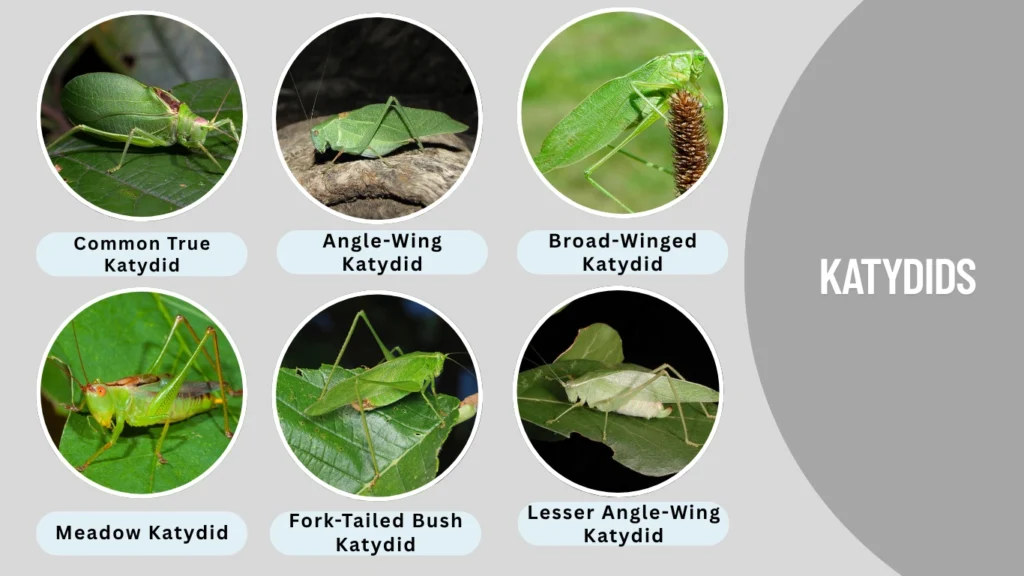
Katydids are large, leaf-like insects in the family Tettigoniidae, closely related to crickets and grasshoppers. Known for their excellent camouflage and nighttime songs, katydids are often heard more than seen, especially in wooded or garden areas.
Common Types of Katydids
- Common True Katydid (Pterophylla camellifolia)
- Angle-Wing Katydid (Microcentrum rhombifolium)
- Broad-Winged Katydid (Microcentrum retinerve)
- Meadow Katydid (Orchelimum spp.)
- Fork-Tailed Bush Katydid (Scudderia furcata)
- Lesser Angle-Wing Katydid (Microcentrum minus)
Habitat
Katydids inhabit forests, shrubs, gardens, and grasslands. They are usually found on leaves, branches, or tall plants where they blend in with foliage. Most are active at night.
Behavior
Katydids produce sound by rubbing their wings together (stridulation), usually at night to attract mates. Their calls vary by species and can sound like “katy-did, katy-didn’t.” They are solitary and avoid predators using camouflage.
Diet
Primarily herbivores, katydids feed on leaves, flowers, fruits, and stems. Some species are omnivorous and consume small insects, including aphids and caterpillars.
23. Ladybugs (Ladybird Beetles)

Ladybugs, or ladybird beetles, are small, dome-shaped beetles in the family Coccinellidae. They are considered beneficial insects due to their appetite for plant pests, especially aphids.
Common Types of Ladybugs
- Seven-Spotted Ladybug (Coccinella septempunctata)
- Asian Lady Beetle (Harmonia axyridis)
- Convergent Ladybug (Hippodamia convergens)
- Two-Spotted Ladybug (Adalia bipunctata)
- Fifteen-Spotted Ladybug (Anatis labiculata)
- Pink-Spotted Ladybug (Coleomegilla maculata)
Habitat
Ladybugs live in gardens, forests, meadows, crop fields, and even indoors during cold seasons. They are often found on plants infested with aphids or scale insects.
Behavior
Ladybugs are active during the day and often seen crawling on plant leaves in search of prey. Some species gather in large numbers to overwinter in protected areas, including buildings.
Diet
Most species are predators that feed on aphids, mealybugs, mites, and soft-bodied insects. Some feed on pollen and nectar. Their larvae are also voracious pest eaters and help in natural pest control.
24. Lice

Lice are tiny, wingless, parasitic insects that live on the skin or in the hair of mammals and birds. They belong to the order Phthiraptera and are known for feeding on blood, skin debris, or feathers. Lice are host-specific and spread primarily through direct contact.
Common Types of Lice
- Head Louse (Pediculus humanus capitis)
- Body Louse (Pediculus humanus corporis)
- Pubic Louse (Pthirus pubis)
- Dog Louse (Trichodectes canis)
- Chicken Body Louse (Menacanthus stramineus)
- Cattle Biting Louse (Bovicola bovis)
Habitat
Lice live directly on the body of their host—on the scalp, body, or genital area, depending on the species. They lay their eggs (nits) on hair shafts, feathers, or clothing fibers.
Behavior
They cannot jump or fly and spread through close personal contact, shared clothing, bedding, or grooming tools. Lice are highly adapted to cling to hair or feathers and survive by feeding multiple times a day.
Diet
- Sucking lice: Feed on blood (e.g., head, body, and pubic lice)
- Chewing lice: Feed on skin flakes, hair, or feathers (e.g., bird and pet lice)
25. Mantises (Praying Mantises)

Mantises, often called praying mantises, are predatory insects in the order Mantodea. Named for their folded “praying” front legs, these insects are skilled ambush hunters that feed on live prey. They are often praised in gardens for controlling pest populations.
Common Types of Mantises
- Chinese Mantis (Tenodera sinensis)
- Carolina Mantis (Stagmomantis carolina)
- European Mantis (Mantis religiosa)
- Giant Asian Mantis (Hierodula membranacea)
- African Mantis (Sphodromantis spp.)
- Orchid Mantis (Hymenopus coronatus)
Habitat
Mantises are found in gardens, forests, grasslands, and farmland. They prefer warm climates with abundant vegetation for camouflage and hunting. Some species thrive in tropical forests, while others adapt to temperate zones.
Behavior
Mantises are solitary and sit motionless, blending with their surroundings until prey comes close. They strike quickly with their spiny front legs. Some species can fly, especially males, and may display threat postures when disturbed.
Diet
Mantises are carnivorous and feed on flies, crickets, moths, grasshoppers, and even other mantises. Larger species may capture small reptiles or amphibians. They are important natural pest controllers in gardens and farms.
26. Mayflies

Mayflies are delicate, short-lived insects in the order Ephemeroptera, known for their brief adult lifespan and unique upright wing position. They are often seen near freshwater sources and are important indicators of water quality.
Common Types of Mayflies
- Common Burrower Mayfly (Hexagenia limbata)
- Small Minnow Mayfly (Baetis spp.)
- Flatheaded Mayfly (Heptagenia spp.)
- Pale Evening Dun (Ephemerella invaria)
- Blue-Winged Olive (Baetis tricaudatus)
- Green Drake Mayfly (Ephemera danica)
Habitat
Mayflies are found near clean, slow- to fast-flowing freshwater bodies like rivers, streams, and lakes. Nymphs live underwater, often hiding among stones, vegetation, or sediment.
Behavior
Adult mayflies do not feed and live only a few hours to a couple of days—just long enough to reproduce. Swarms may form near water, especially during spring and summer evenings. Nymphs molt several times underwater before emerging as adults.
Diet
- Nymphs: Feed on algae, plant debris, and organic particles in water
- Adults: Do not feed; their only function is reproduction
27. Mealybugs

Mealybugs are small, soft-bodied insects in the family Pseudococcidae that feed on plant sap and are covered in a white, waxy coating. They are common pests in greenhouses, gardens, and indoor plants, where they cause stunted growth and leaf drop.
Common Types of Mealybugs
- Citrus Mealybug (Planococcus citri)
- Longtailed Mealybug (Pseudococcus longispinus)
- Grape Mealybug (Pseudococcus maritimus)
- Pink Hibiscus Mealybug (Maconellicoccus hirsutus)
- Root Mealybug (Rhizoecus spp.)
- Comstock Mealybug (Pseudococcus comstocki)
Habitat
Mealybugs are found on stems, leaf joints, roots, and undersides of leaves—especially in warm, humid environments. They prefer houseplants, ornamental shrubs, fruit trees, and greenhouse crops.
Behavior
They move slowly and cluster in groups. Females lay eggs in cottony sacs, and some species give birth to live young. Mealybugs secrete honeydew, leading to sooty mold and attracting ants.
Diet
They feed on the sap of plants by inserting needle-like mouthparts into tissue. This weakens the plant, causes yellowing, and may transmit plant diseases. They are notorious pests in horticulture and agriculture.
28. Midges
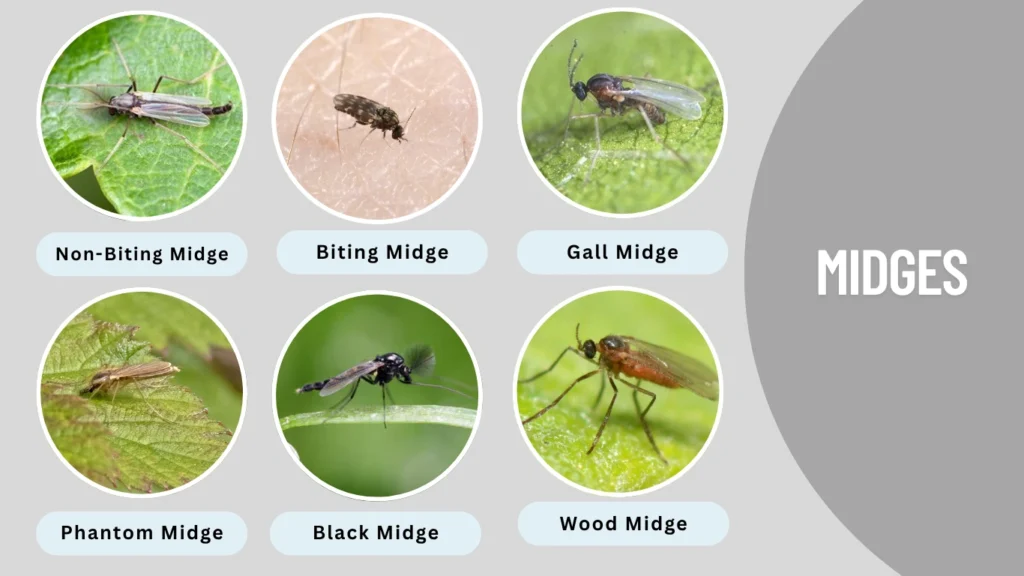
Midges are small, delicate, fly-like insects that belong to several families within the order Diptera. While many midges are harmless, some—like biting midges—are notorious for painful bites and blood-feeding. Others, like non-biting midges, are important to ecosystems and resemble mosquitoes but do not bite.
Common Types of Midges
- Non-Biting Midge (Chironomidae)
- Biting Midge (Ceratopogonidae)
- Gall Midge (Cecidomyiidae)
- Phantom Midge (Chaoboridae)
- Black Midge (Austrosimulium spp.)
- Wood Midge (Mycetophilidae)
Habitat
Midges are found near water sources such as lakes, ponds, swamps, and marshes. They also breed in moist soil, compost piles, and decaying vegetation. Many are abundant near lights at night.
Behavior
Non-biting midges often swarm in large numbers at dusk. Biting midges, sometimes called “no-see-ums,” can penetrate clothing and are active during twilight hours. Gall midges affect plants by inducing abnormal growths (galls).
Diet
- Non-biting midges: Adults may feed on nectar; larvae eat algae, organic matter, or detritus
- Biting midges: Females feed on blood; males feed on nectar
- Gall midges: Feed on plant tissues
29. Mosquitoes

Mosquitoes are slender, long-legged insects from the family Culicidae, best known for their biting behavior and role in spreading serious diseases. Only females bite, as they require blood to develop eggs.
Common Types of Mosquitoes
- Aedes Mosquito (Aedes aegypti)
- Culex Mosquito (Culex pipiens)
- Anopheles Mosquito (Anopheles gambiae)
- Asian Tiger Mosquito (Aedes albopictus)
- Yellow Fever Mosquito (Aedes aegypti)
- Southern House Mosquito (Culex quinquefasciatus)
Habitat
Mosquitoes lay their eggs in standing water: ponds, puddles, birdbaths, old tires, gutters, and containers. Larvae develop in water, and adults rest in tall grass, shrubs, or shaded areas near homes.
Behavior
Most mosquitoes are crepuscular (active at dawn and dusk). Females use carbon dioxide, body heat, and scent to locate hosts. They can be highly persistent and are capable of flying for miles in search of a blood meal.
Diet
- Females: Feed on blood from humans, mammals, birds, or reptiles to nourish their eggs
- Males: Feed only on plant nectar and do not bite humans
Larvae feed on microorganisms and organic material in water.
30. Moths

Moths are winged insects in the order Lepidoptera, closely related to butterflies. They are typically nocturnal and are drawn to light. With tens of thousands of species worldwide, moths vary greatly in size, color, and behavior—ranging from tiny pantry pests to large, beautiful pollinators.
Common Types of Moths
- Luna Moth (Actias luna)
- Gypsy Moth (Lymantria dispar)
- Hawk Moth (Sphingidae family)
- Clothes Moth (Tineola bisselliella)
- Indian Meal Moth (Plodia interpunctella)
- Atlas Moth (Attacus atlas)
Habitat
Moths can be found in forests, grasslands, gardens, homes, and near lights at night. Their larvae (caterpillars) inhabit vegetation, stored food, or fabrics, depending on the species.
Behavior
Most moths are nocturnal and are strongly attracted to artificial lights. Some species are excellent pollinators, while others—like pantry or clothes moths—are pests. Moths use pheromones to locate mates and lay eggs on host plants or materials suitable for their larvae.
Diet
- Adults: Feed on nectar, fruit, tree sap, or not at all (some don’t have functioning mouths)
- Larvae (caterpillars): Feed on leaves, grains, wool, flour, or dried food depending on the species
31. Silverfish
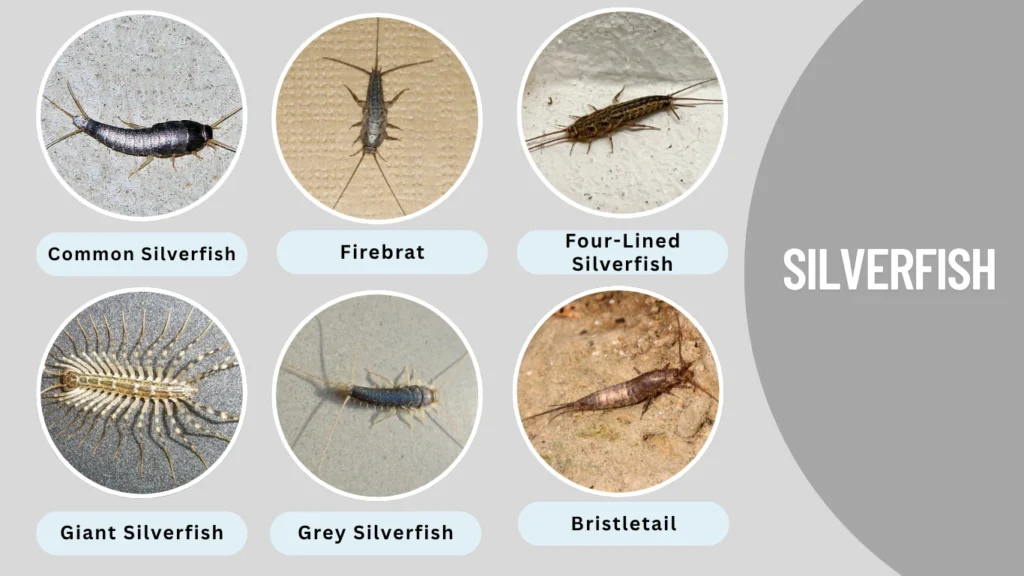
Silverfish are primitive, wingless insects in the order Zygentoma, known for their silvery-gray color and quick, fish-like movements. They are often found indoors, particularly in humid areas like bathrooms, basements, and kitchens.
Common Types of Silverfish
- Common Silverfish (Lepisma saccharinum)
- Firebrat (Thermobia domestica)
- Four-Lined Silverfish (Ctenolepisma lineatum)
- Giant Silverfish (Ctenolepisma longicaudatum)
- Grey Silverfish (Ctenolepisma spp.)
- Bristletail (closely related to silverfish, Archaeognatha)
Habitat
Silverfish prefer dark, moist, and humid environments. They are often found in cupboards, under sinks, behind appliances, or inside old books and cardboard boxes.
Behavior
They are nocturnal and avoid light. Silverfish move quickly and can live up to several years. They reproduce slowly compared to other household pests but can persist unnoticed for long periods.
Diet
Silverfish feed on starches, glue, paper, flour, dead insects, and fabrics containing cellulose. They can damage wallpaper, books, and clothing, especially if left undisturbed in storage.
32. Springtails
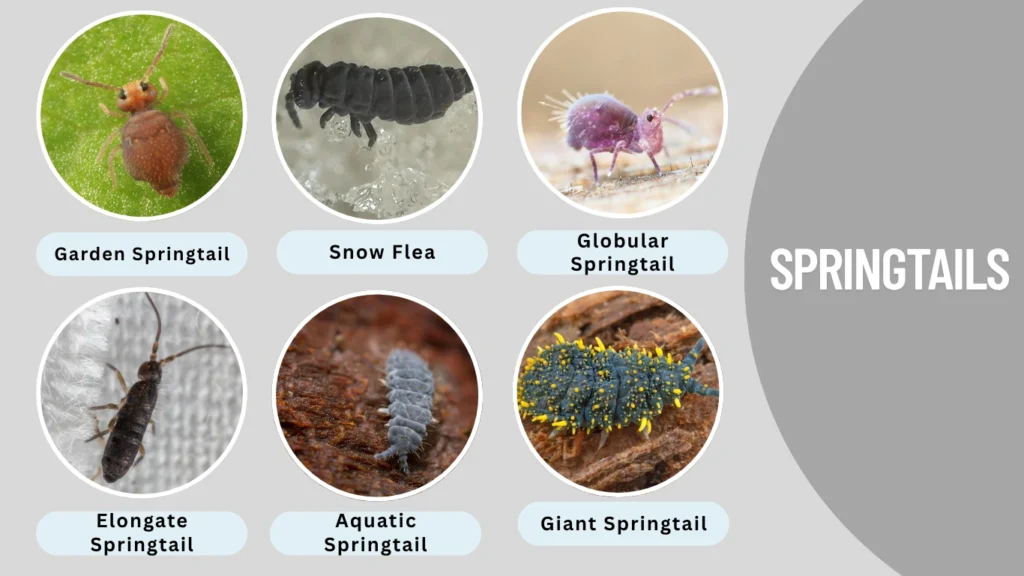
Springtails are tiny, wingless insects in the class Collembola. Known for their ability to jump using a tail-like structure called a furcula, they are harmless to humans but are commonly found in damp soil, leaf litter, and even indoor plant pots.
Common Types of Springtails
- Garden Springtail (Orchesella cincta)
- Snow Flea (Hypogastrura nivicola)
- Globular Springtail (Sminthuridae family)
- Elongate Springtail (Entomobryidae family)
- Aquatic Springtail (Podura aquatica)
- Giant Springtail (Tomocerus spp.)
Habitat
Springtails prefer moist environments: soil, compost, decaying logs, leaf litter, mulch, and around sinks or bathrooms indoors. They’re commonly seen jumping around on the soil surface or near potted plants.
Behavior
They are extremely small (usually 1–2 mm) and use their furcula to spring into the air when disturbed. Springtails are most active in humid conditions and often appear in large numbers after rainfall or in overwatered indoor plants.
Diet
Springtails feed on decaying organic matter, fungi, algae, bacteria, and mold. They play an important role in soil health by aiding decomposition and nutrient recycling.
33. Stick Insects

Stick Insects, also known as walking sticks, belong to the order Phasmatodea. These masters of camouflage mimic twigs and branches to evade predators. Most are herbivorous and are commonly found in forests and shrubs.
Common Types of Stick Insects
- Indian Stick Insect (Carausius morosus)
- Giant Spiny Stick Insect (Extatosoma tiaratum)
- Jungle Nymph (Heteropteryx dilatata)
- Northern Walking Stick (Diapheromera femorata)
- Pink Winged Stick Insect (Sipyloidea sipylus)
- Vietnamese Stick Insect (Baculum extradentatum)
Habitat
Stick insects live in forests, jungles, gardens, and shrublands. They prefer areas with abundant vegetation for feeding and hiding. In captivity, they are kept in enclosed terrariums with foliage.
Behavior
They are slow-moving and rely on camouflage rather than speed. Some sway to mimic twigs moving in the wind. When threatened, some species drop limbs, flash bright colors, or emit a defensive odor.
Diet
Stick insects are herbivores that feed primarily on leaves from plants such as bramble, ivy, oak, eucalyptus, and rose. They typically eat at night and rest motionless during the day.
34. Stink Bugs

Stink Bugs are shield-shaped insects in the family Pentatomidae, named for the foul-smelling odor they release when threatened or crushed. While some are beneficial predators, many are serious plant pests in gardens and agriculture.
Common Types of Stink Bugs
- Brown Marmorated Stink Bug (Halyomorpha halys)
- Green Stink Bug (Chinavia hilaris)
- Southern Green Stink Bug (Nezara viridula)
- Harlequin Bug (Murgantia histrionica)
- Rough Stink Bug (Brochymena quadripustulata)
- Spined Soldier Bug (Podisus maculiventris) — beneficial predator
Habitat
Stink bugs are found in gardens, orchards, crop fields, woodlands, and sometimes inside homes, especially in the fall when they seek warmth for overwintering. They hide in cracks, behind siding, or inside attics and walls.
Behavior
They are most active during the growing season and feed on plant juices using piercing-sucking mouthparts. Some species overwinter in homes and become a nuisance when they emerge in spring. Their distinctive odor acts as a defense against predators.
Diet
Most stink bugs feed on fruits, vegetables, and ornamental plants by sucking out sap, which can cause deformities and reduce yield. Some predatory species feed on caterpillars, beetle larvae, and other pests, making them beneficial in gardens.
35. Termites

Termites are eusocial insects in the order Blattodea, closely related to cockroaches. They are known for their ability to digest cellulose, making them a major threat to wooden structures, paper, and furniture. Termites live in highly organized colonies with a caste system.
Common Types of Termites
- Subterranean Termite (Reticulitermes spp.)
- Drywood Termite (Cryptotermes spp.)
- Dampwood Termite (Zootermopsis spp.)
- Formosan Termite (Coptotermes formosanus)
- Conehead Termite (Nasutitermes corniger)
- Desert Termite (Gnathamitermes spp.)
Habitat
Termites are found in wood, soil, dead trees, walls, and building foundations. Subterranean species build tunnels in moist soil, while drywood termites live entirely inside wooden structures or furniture.
Behavior
They live in large colonies with queens, workers, soldiers, and reproductive alates (winged termites). Workers build tunnels, care for the young, and gather food. Alates swarm to start new colonies, usually after rain.
Diet
Termites feed on cellulose-rich materials like wood, paper, cardboard, plant fibers, and even drywall. They can silently cause extensive structural damage over time, often without immediate visible signs.
36. Thrips
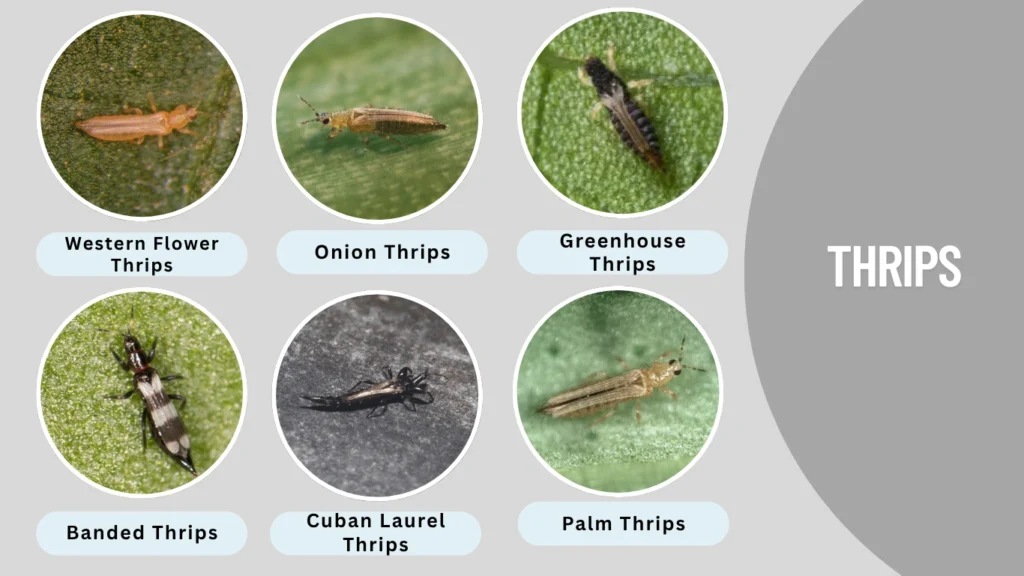
Thrips are tiny, slender insects in the order Thysanoptera, often found on flowers, fruits, and leaves. Despite their small size, they can cause significant damage to plants by puncturing and sucking out cell contents, leaving behind silvered or stippled marks.
Common Types of Thrips
- Western Flower Thrips (Frankliniella occidentalis)
- Onion Thrips (Thrips tabaci)
- Greenhouse Thrips (Heliothrips haemorrhoidalis)
- Banded Thrips (Aeolothrips fasciatus)
- Cuban Laurel Thrips (Gynaikothrips ficorum)
- Palm Thrips (Parthenothrips dracaenae)
Habitat
Thrips are found on flowers, buds, leaves, fruits, and vegetables—particularly in greenhouses, gardens, and agricultural fields. They prefer warm, dry environments and are often found in large numbers on host plants.
Behavior
Thrips are fast-moving and difficult to see without magnification. They feed in groups and can fly or be spread by wind. Many species are vectors for plant viruses, making them a serious pest in agriculture.
Diet
They feed on plant sap, pollen, and flower parts by scraping the surface and sucking out fluids. Some predatory thrips species feed on mites, insect eggs, and smaller thrips.
37. Ticks (Note: Not true insects — they are arachnids)

Ticks are small, blood-feeding arachnids in the order Ixodida. They are external parasites of mammals, birds, and reptiles, and are notorious for transmitting serious diseases such as Lyme disease and Rocky Mountain spotted fever.
Common Types of Ticks
- Deer Tick (Blacklegged Tick) (Ixodes scapularis)
- American Dog Tick (Dermacentor variabilis)
- Lone Star Tick (Amblyomma americanum)
- Brown Dog Tick (Rhipicephalus sanguineus)
- Western Blacklegged Tick (Ixodes pacificus)
- Gulf Coast Tick (Amblyomma maculatum)
Habitat
Ticks thrive in wooded areas, tall grass, brush, leaf litter, and areas near animal habitats. They are commonly found on pets, wildlife, and livestock and may also enter homes attached to animals or clothing.
Behavior
Ticks do not jump or fly but wait on vegetation with their front legs extended in a posture called “questing,” ready to latch onto a passing host. Once attached, they feed slowly over several days before dropping off.
Diet
Ticks are obligate blood feeders. They feed on the blood of mammals, birds, reptiles, and amphibians during each life stage (larva, nymph, adult). Their saliva contains anticoagulants and anesthetics to aid feeding without being detected.
38. Wasps

Wasps are flying insects in the order Hymenoptera, closely related to bees and ants. They are known for their narrow waists, stingers, and diverse behaviors—ranging from aggressive predators to solitary pollinators. Some wasps are beneficial for pest control, while others are feared for their painful stings.
Common Types of Wasps
- Yellowjacket (Vespula spp.)
- Paper Wasp (Polistes spp.)
- Hornet (Vespa spp.)
- Mud Dauber (Sceliphron spp.)
- Cicada Killer Wasp (Sphecius speciosus)
- Potter Wasp (Eumeninae)
Habitat
Wasps live in various environments including gardens, forests, meadows, and urban areas. Social species build paper nests in trees, eaves, attics, or underground. Solitary species build mud nests or burrow into soil.
Behavior
Social wasps live in colonies with a queen, workers, and drones. They defend their nests aggressively and can sting repeatedly. Solitary wasps hunt alone, paralyze prey, and often place them in nests for their larvae. Some species are excellent pollinators or biological pest controllers.
Diet
Adult wasps feed on nectar, fruit, and sugary substances. Larvae are typically fed chewed-up insects, spiders, or caterpillars by adult wasps. Some species, like yellowjackets, scavenge human food and waste.
39. Weevils

Weevils are small beetles in the superfamily Curculionoidea, easily identified by their elongated snouts. Most are plant feeders and can become serious pests in agriculture and stored grains. Their larvae often develop inside seeds, nuts, or roots.
Common Types of Weevils
- Rice Weevil (Sitophilus oryzae)
- Granary Weevil (Sitophilus granarius)
- Boll Weevil (Anthonomus grandis)
- Vine Weevil (Otiorhynchus sulcatus)
- Maize Weevil (Sitophilus zeamais)
- Clover Weevil (Sitona lepidus)
Habitat
Weevils are commonly found in stored food products, pantries, fields, gardens, and agricultural settings. They prefer grains, legumes, nuts, and root vegetables.
Behavior
Females often bore into seeds or grains to lay eggs. The larvae hatch inside and feed unnoticed. Weevils generally infest stored food from the inside out, making detection difficult until visible damage occurs.
Diet
Weevils feed on plant-based materials. Some species prefer grains and cereals (like rice and wheat), while others target fruits, vegetables, or ornamental plants. Root weevils attack underground parts of plants, causing wilting or plant death.
40. Whiteflies

Whiteflies are tiny, soft-bodied insects in the family Aleyrodidae, named for their white, powdery wings. Though they resemble small moths, they are more closely related to aphids and scale insects. Whiteflies are major agricultural pests, especially in greenhouses and warm climates.
Common Types of Whiteflies
- Greenhouse Whitefly (Trialeurodes vaporariorum)
- Silverleaf Whitefly (Bemisia tabaci)
- Bandedwing Whitefly (Trialeurodes abutiloneus)
- Giant Whitefly (Aleurodicus dugesii)
- Citrus Whitefly (Dialeurodes citri)
- Spiraling Whitefly (Aleurodicus dispersus)
Habitat
Whiteflies are commonly found on the undersides of leaves in greenhouses, gardens, and tropical environments. They thrive on a wide range of host plants including vegetables, ornamentals, and fruits.
Behavior
Whiteflies feed in large colonies, quickly weakening plants by sucking out sap. They excrete honeydew, which promotes sooty mold growth and attracts ants. Infestations often lead to yellowing leaves, stunted growth, and reduced crop yields.
Diet
Whiteflies feed exclusively on plant sap. Both nymphs and adults use piercing-sucking mouthparts to draw nutrients from leaves, disrupting photosynthesis and plant vigor. They can also transmit several plant viruses, further damaging crops.
