

Katydids are remarkable insects known for their leaf-like camouflage, long antennae, and unique songs. With over 6,000 species globally, they range from slender tree dwellers to bulky, ground-hugging predators. In this guide, you’ll explore 45 fascinating types of katydids—including bush-crickets, coneheads, and rare tropical varieties—each with distinct traits, habitats, and behaviors that showcase the incredible diversity of these singing insects.
1. Great Green Bush-Cricket

The Great Green Bush-Cricket (Tettigonia viridissima) is one of the largest and most recognizable katydids in Europe. Known for its vibrant green body, long antennae, and powerful hind legs, this species thrives in meadows, hedgerows, and forest edges during the warm months.
Identification
- Bright green body with long, narrow wings
- Long, thread-like antennae (often longer than the body)
- Yellowish stripe along the back
- Females have a noticeable sword-like ovipositor
- Size ranges from 28 to 42 mm in body length
Where Are They Found?
This species is common throughout Europe and parts of western Asia. It favors sunny, grassy environments and can often be spotted resting on tall plants or shrubs.
Do They Make Sounds?
Yes, males are known for their loud, continuous “churr” sound made by rubbing their wings together (stridulation), especially during late summer evenings.
Are They Dangerous?
Not at all. While large in size and equipped with strong mandibles, the Great Green Bush-Cricket is harmless to humans. It may bite if handled roughly, but it’s not venomous or aggressive.
What Do They Eat?
They are omnivorous. While they mostly feed on leaves, flowers, and fruits, they are also known to eat smaller insects and caterpillars when available.
2. Saga pedo

Saga pedo is one of the largest katydid species in the world and is unique for being a predatory and parthenogenetic (reproducing without males) insect. Native to southeastern Europe and parts of Asia, it stands out for its size, aggressive hunting behavior, and rarity.
Identification
- Olive-green to brownish coloration
- Very long, spiny legs adapted for catching prey
- Robust body, can reach up to 12 cm
- Long sword-like ovipositor in females
- No wings; it is a flightless species
What Makes It Unique?
Unlike most katydids, Saga pedo is carnivorous and hunts other insects, including grasshoppers and other katydids. It’s also unusual because the population consists entirely of females.
Where Does It Live?
It prefers dry grasslands, steppe regions, and Mediterranean-type habitats in countries like Hungary, Romania, and parts of Turkey.
How Does It Reproduce?
Through parthenogenesis—females lay unfertilized eggs that hatch into genetically identical offspring. This adaptation allows populations to survive even in low densities.
3. Phaneropterinae

Phaneropterinae is a subfamily of katydids commonly referred to as leaf katydids or sickle-bearing bush-crickets. These katydids are known for their leaf-like wings, delicate structure, and agile movement through vegetation.
Identification
- Green, flat, leaf-mimicking wings
- Slender, lightweight body
- Long antennae often exceeding body length
- Typically smaller than other bush-crickets
- Slightly curved ovipositor in females
What Are Common Genera?
This subfamily includes well-known genera such as Phaneroptera, Tylopsis, and Ectomoptera. These are commonly found across Europe, Asia, and tropical regions.
How Do They Communicate?
Males produce soft, rhythmic sounds by rubbing their forewings together. These calls attract females for mating and may also serve as territorial signals.
Are They Active During the Day?
Phaneropterinae are mostly nocturnal but can sometimes be spotted basking during the day. Their camouflage helps them remain undetected in dense foliage.
4. Wart-biter

The Wart-biter (Decticus verrucivorus) is a rare and historically significant bush-cricket named after an old Swedish folk remedy where it was used to bite off warts. It’s a large, ground-dwelling species known for its strong legs and distinctive song.
Identification
- Dark green to brown body with mottled patterns
- Strong hind legs with spines
- Broad, rounded wings
- Female has a curved, dagger-like ovipositor
- Grows up to 35 mm in body length
Why Is It Called Wart-biter?
Its name originates from a medieval belief that it could bite off skin warts. While this practice is obsolete, the name remains a curious historical footnote.
Where Can It Be Found?
This species lives in dry grasslands and heathlands across parts of Europe, especially in the UK, Sweden, and Germany. It prefers undisturbed habitats with mixed vegetation.
Is It Endangered?
Yes, in some regions it is considered endangered due to habitat loss. Conservation programs in the UK and other countries are working to protect and reintroduce populations.
5. Meconema thalassinum

Meconema thalassinum, also known as the oak bush-cricket, is a small, agile katydid that spends most of its time in trees. Unlike many katydids, it’s almost silent and more active in the treetops than in grasses.
Identification
- Slender, light green body
- Very long, thin antennae
- Small wings, rarely used for flight
- Yellowish stripe down the back
- Typically around 12–15 mm long
Does It Make Sounds?
Unlike most bush-crickets, this species produces very soft or no audible sound. It communicates with gentle vibrations or tapping, making it harder to detect.
Where Does It Live?
Primarily found in oak and deciduous trees across Europe, especially in the UK, France, and Germany. It prefers the canopy and rarely comes to the ground.
What Does It Eat?
It feeds on aphids, caterpillars, and other small insects, making it a beneficial predator for natural pest control in forest ecosystems.
6. Tettigonia

Tettigonia is a genus of large green bush-crickets, best known for its loud song and active behavior in grassy habitats. Species in this genus are often mistaken for grasshoppers but are distinguished by their long antennae and powerful jumping legs.
Identification
- Bright green color with brown-tipped wings
- Extremely long antennae
- Strong hind legs for jumping
- Females have a prominent, curved ovipositor
- Species size ranges between 30–42 mm
Common Species in the Genus
The most well-known is Tettigonia viridissima (Great Green Bush-Cricket), but other species include Tettigonia cantans and Tettigonia caudata, found across Europe and parts of Asia.
How Do They Communicate?
Males produce a continuous, loud chirping sound by rubbing their forewings together—most noticeable in late summer evenings. This song helps locate mates.
Are They Easy to Spot?
Yes, due to their size and sound, but they are well-camouflaged in tall grasses and shrubs, often spotted by sound before sight.
7. Hexacentrus japonicus

Hexacentrus japonicus is a tropical katydid species native to East Asia. Known for its robust body and nocturnal habits, it plays a role in local ecosystems as both predator and prey.
Identification
- Sturdy body with green or brown coloration
- Broad, shield-like pronotum
- Antennae longer than body
- Distinct dark markings on wings
- Size usually around 25–35 mm
Habitat and Distribution
This species is mainly found in Japan, Korea, and parts of China. It prefers moist forests, dense shrubbery, and bamboo groves where it hides during the day.
Behavior and Activity
It’s primarily nocturnal and active during warm, humid nights. Males produce short, clicking sounds to attract females, and they often remain hidden in leaf litter.
What Does It Eat?
Omnivorous by nature, it consumes small insects, leaves, and plant stems, contributing to both pest control and the plant-herbivore balance.
8. Roesel’s Bush-Cricket

Roesel’s Bush-Cricket (Roeseliana roeselii) is a compact, short-winged katydid found commonly in meadows and grassy fields across Europe. It is known for its metallic-sounding song and adaptability to semi-urban environments.
Identification
- Green or brown body with yellow-brown edge along the thorax
- Typically short wings, though long-winged forms exist
- Very long antennae
- Compact body around 13–26 mm long
- Female has a slightly curved ovipositor
What Sound Does It Make?
Its song is a long, continuous buzzing that resembles an electric hum, often heard during warm afternoons from tall grasses or wildflower patches.
Can It Fly?
Most individuals have short wings and cannot fly, but some long-winged morphs are capable of flight and help colonize new areas.
Is It Common?
Yes, especially in lowland meadows, roadsides, and urban green spaces. Its presence is often a sign of healthy grassland ecosystems.
9. Pholidoptera griseoaptera

Pholidoptera griseoaptera, commonly known as the dark bush-cricket, is a flightless and widespread species across Europe. It prefers shaded areas and dense vegetation, where its dark color provides excellent camouflage.
Identification
- Dark brown to blackish body
- Very short wings, barely covering the thorax
- Long legs and antennae
- Female has a stout, upturned ovipositor
- Body size ranges from 15–22 mm
Where Is It Found?
Commonly found in woodland edges, hedgerows, and shaded gardens throughout central and western Europe. It prefers cooler, moist habitats compared to sun-loving species.
Does It Make Noise?
Yes, males produce a short, dry “tik-tik-tik” sound, mostly in the evening. It’s quieter than many bush-crickets and harder to detect unless you’re close.
What Is Its Role in Nature?
As both herbivore and occasional predator, it feeds on leaves, decaying plant matter, and smaller insects. It also serves as food for birds and small mammals.
10. Gampsocleis buergeri

Gampsocleis buergeri is a medium to large-sized katydid found in parts of East Asia, especially Japan and Korea. This species is known for its striking coloration and loud, buzzing calls produced by males.
Identification
- Green or brownish body with distinctive banded wings
- Rounded, wide head with large mandibles
- Males have thickened forewings used for stridulation
- Female has a slightly curved ovipositor
- Body length ranges from 30–35 mm
What Type of Sound Does It Make?
Males produce a loud, rapid buzzing or rasping sound, mainly at dusk. The sound serves both to attract mates and to establish territory among rival males.
Where Is It Most Commonly Seen?
It thrives in grasslands, forest edges, and low-lying shrubs, particularly in hilly or rural regions of Japan and Korea. It avoids densely urbanized areas.
Does It Have Predators?
Yes, it’s preyed upon by birds, frogs, and predatory insects. Its green coloration helps it blend into vegetation and avoid detection during the day.
11. Mormon Cricket

Despite its name, the Mormon cricket (Anabrus simplex) is a flightless katydid species native to western North America. It’s famous for forming massive migratory swarms that can devastate vegetation.
Identification
- Large, robust body ranging from green to dark brown
- Short wings and no functional flight ability
- Thick hind legs adapted for jumping
- Female has a curved, sword-like ovipositor
- Adults can grow up to 8 cm long
Why Is It Called “Mormon” Cricket?
The name comes from a historical account in the 1800s where swarms of these insects threatened Mormon settlers’ crops in Utah. Seagulls reportedly ate the crickets, saving the harvest—a story known as the “Miracle of the Gulls.”
What Do They Eat?
They are omnivores and can consume crops, grass, other insects, and even dead members of their own species. In swarms, their consumption becomes highly destructive.
Are They Dangerous?
Not to humans, but they can cause serious agricultural damage. Their mass migrations lead to traffic hazards and ecological disruptions in affected areas.
12. Conocephalus melaenus

Conocephalus melaenus is a small, slender katydid found primarily in parts of Asia. Known for its pointed head and grass-like body, this species blends well into grassy environments and is often active during the night.
Identification
- Slender, green body with a sharply pointed head
- Transparent or light green wings held flat over the body
- Long antennae often exceeding body length
- Body size ranges from 15–25 mm
- Female has a thin, straight ovipositor
What Makes Its Head Unique?
The cone-shaped head is a hallmark of the Conocephalus genus. It helps distinguish these katydids from others and contributes to their nickname “coneheads.”
Where Is It Found?
This species prefers humid grassy areas, wetlands, and rice fields in Southeast Asia. It often hides in tall grass or reeds during the day and becomes active at night.
Does It Communicate?
Yes, males produce high-pitched, short trills or ticks that are hard for humans to hear without audio equipment. These songs help attract mates during nighttime hours.
13. Mecopoda nipponensis

Mecopoda nipponensis is a robust, dark-colored katydid native to East Asia, particularly Japan and parts of China. It is notable for its powerful hind legs and long-lasting, rhythmic songs.
Identification
- Dark brown or black body with irregular markings
- Long hind legs with strong femurs
- Very long antennae
- Body length ranges from 30–40 mm
- Females have a slightly curved ovipositor
How Does It Sound?
This katydid is known for its repetitive, rhythmic song that can last several minutes. The sound is loud and can be heard from a significant distance during the night.
What Is Its Habitat?
It lives in wooded areas, forest edges, and dense shrubs. It prefers warm, moist environments and is active mainly at night when it climbs vegetation to sing.
What Does It Feed On?
Omnivorous in nature, it feeds on both plant material and small insects, playing a dual role in the food web as both herbivore and predator.
14. Pseudophyllinae

Pseudophyllinae is a large and diverse subfamily of katydids, often referred to as “leaf-mimicking katydids” due to their incredible camouflage. These insects are primarily found in tropical rainforests and are known for their stillness and ability to mimic dried or green leaves.
Identification
- Wings shaped like leaves with visible vein-like patterns
- Color ranges from bright green to brown or mottled tan
- Flattened body with leaf-like extensions
- Long antennae and strong hind legs
- Size varies widely from 25 to 60+ mm
Where Do They Live?
Mostly found in tropical rainforests of South America, Central Africa, and Southeast Asia. They hide in the canopy or understory during the day and become active at night.
Why Are They Hard to Spot?
Their wing shape and coloration allow them to blend seamlessly into their leafy environment. Many species even mimic damaged or curled leaves, making them nearly invisible to predators.
What Do They Eat?
Most are herbivorous, feeding on leaves, flowers, and soft plant parts, though a few species have been observed eating small insects opportunistically.
15. Tettigoniinae
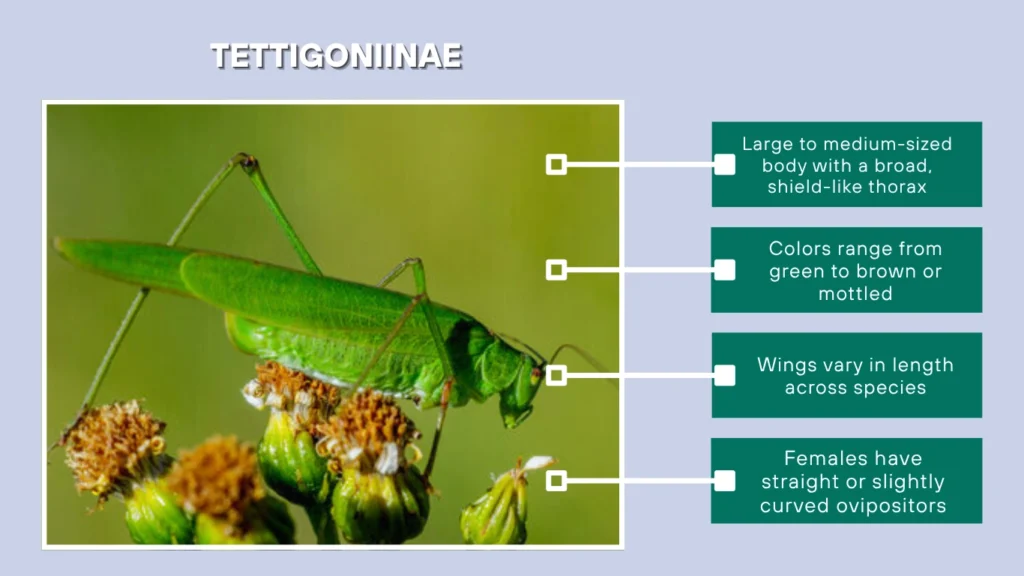
Tettigoniinae is a subfamily of katydids commonly known as shield-backed katydids or true bush-crickets. They are widely distributed across Europe, North America, and parts of Asia, and include both herbivorous and omnivorous species.
Identification
- Large to medium-sized body with a broad, shield-like thorax
- Colors range from green to brown or mottled
- Wings vary in length across species
- Females have straight or slightly curved ovipositors
- Antennae longer than body length
What Habitats Do They Prefer?
Tettigoniinae species thrive in grasslands, forest edges, rocky slopes, and even alpine meadows. Some prefer dry scrublands, while others inhabit wet grassy areas.
How Do They Communicate?
Males create a variety of calling songs—ranging from short clicks to long trills—by rubbing their wings together. These sounds help attract females and may also deter rivals.
Do They Have Any Predators?
Yes, birds, reptiles, spiders, and bats prey on them. Some species have evolved cryptic coloration or behaviors to reduce predation, such as freezing or mimicking dead leaves.
16. Decticus

Decticus is a genus of large bush-crickets found across Europe, Asia, and parts of North Africa. These insects are known for their powerful build, long legs, and loud, crackling songs. Some species, like Decticus verrucivorus (wart-biter), are particularly well-known for their historical and ecological importance.
Identification
- Robust, green or brown body with speckled patterns
- Thick hind legs built for jumping
- Long, sword-like ovipositor in females
- Wings often extend past the abdomen
- Size ranges from 30 to 40 mm
What Makes Them Unique?
Species in this genus are often predatory, feeding on smaller insects in addition to plant material. Their mixed diet makes them ecologically versatile.
Are They Active Flyers?
Yes, many Decticus species are capable of short flights. They use both flying and jumping to escape predators or move between patches of habitat.
Where Can They Be Found?
They prefer warm, open environments like meadows, grasslands, scrublands, and agricultural edges across southern and central Europe, parts of Asia, and North Africa.
17. Conocephalinae

Conocephalinae is a subfamily of katydids commonly referred to as conehead katydids, named for the distinctive pointed shape of their heads. These katydids are slender, fast-moving, and often found in grassy or wetland habitats.
Identification
- Elongated, green or straw-colored body
- Cone-shaped head
- Transparent wings held tight over the body
- Long antennae and slender legs
- Body size ranges from 15–30 mm depending on species
Where Are Coneheads Most Common?
They are found worldwide, especially in warm, grassy, or marshy environments. In North America, species like Neoconocephalus are common in wetlands and fields.
Do They Make High-Pitched Sounds?
Yes, males produce extremely high-pitched, continuous buzzes or trills that can be hard for some people to hear. These songs are used to attract mates at night.
Are They Harmful?
No, conehead katydids are harmless to humans. They may nibble on garden plants but are not considered pests. In fact, their presence is often a sign of a healthy ecosystem.
18. Short-winged Conehead

The Short-winged Conehead (Conocephalus dorsalis) is a small katydid species known for its reduced wings and sleek, green body. It thrives in damp grasslands and marshy habitats, where its slim form helps it move easily among reeds and tall grasses.
Identification
- Bright green body with brownish stripe along the back
- Very short wings, often not extending past the thorax
- Pointed cone-like head
- Long, slender antennae
- Body size typically 12–18 mm
Can It Fly?
No, due to its shortened wings, this species is flightless. It relies on jumping and crawling through vegetation to escape predators or seek mates.
Where Is It Found?
Commonly found in wet meadows, fens, and marshy grasslands throughout Europe. It favors humid environments with dense vegetation.
What Is Its Song Like?
Males produce a rapid, high-pitched “buzz” that is often difficult to hear without amplification. The sound is continuous and mostly heard during warm summer evenings.
19. Phaneroptera

Phaneroptera is a genus within the Phaneropterinae subfamily, consisting of slender, long-winged katydids known for their gentle calls and excellent camouflage. These katydids are often spotted in bushes, hedgerows, and woodlands.
Identification
- Green, lightweight body with large, leaf-like wings
- Long antennae and narrow legs
- Females have a sickle-shaped ovipositor
- Wing veins mimic leaf venation
- Body length usually ranges from 14–22 mm
What Are Common Species?
Two widely known species include Phaneroptera falcata and Phaneroptera nana, both found across Europe and parts of Asia. They differ slightly in size and song patterns.
How Do They Communicate?
Males create short, soft chirps in rhythmic patterns. These gentle songs are sometimes difficult to distinguish from background insect noise without close listening.
What Do They Eat?
Primarily herbivorous, they feed on a variety of plant leaves, flowers, and soft stems, though they occasionally nibble on small insects or aphids.
20. Microcentrum

Microcentrum is a genus of broad-winged katydids known for their striking resemblance to green leaves. Native to North and Central America, these katydids are especially common in woodlands and gardens, where their camouflage offers excellent protection.
Identification
- Bright green body with wings shaped and veined like a leaf
- Broad, flat wings that extend beyond the body
- Long, thin antennae
- Female has a thick, upward-curved ovipositor
- Body size ranges from 30–50 mm
Are They Easy to Spot?
No, their leaf-like appearance makes them difficult to detect during the day. They remain still on vegetation and only become active after dusk.
What Sounds Do They Make?
Males produce short, “ticking” or “clicking” calls at night. These calls are often repeated in bursts and vary slightly by species.
What Is Their Role in Gardens?
They feed on leaves but rarely cause serious plant damage. They are considered part of the natural balance and occasionally prey on soft-bodied insects.
21. Platycleis

Platycleis is a widespread genus of bush-crickets found across Europe and Asia. These katydids vary in size and color but are known for their adaptability to dry, open habitats like grasslands and stony hillsides.
Identification
- Brown, grey, or greenish body with dark markings
- Medium-length wings and robust legs
- Antennae as long as or longer than the body
- Females have a long, straight ovipositor
- Size typically between 18–28 mm
What Makes Them Adaptable?
Species of Platycleis are found in a wide range of environments—from dry scrub to alpine meadows. Their coloration often matches their surroundings, providing natural camouflage.
How Do They Communicate?
They emit short, high-pitched buzzing or ticking calls, usually during late afternoon or evening. Males often sing from elevated grass stems or rocks.
Are They Territorial?
Males may guard small territories and sing from preferred perches to attract females. Their songs can overlap with others, creating a chorus in dense populations.
22. Bradyporinae

Bradyporinae is a subfamily of large, ground-dwelling katydids known for their heavy bodies and reduced wings. These katydids are typically slow-moving and are found in drier habitats such as scrublands and rocky hillsides in parts of Europe and the Middle East.
Identification
- Thick, robust body with a dark or earthy coloration
- Very short or no wings (flightless)
- Powerful hind legs with noticeable spines
- Antennae are long and filamentous
- Body size can reach up to 50 mm or more
Where Are They Found?
Species in this subfamily are commonly seen in Mediterranean regions. They live among low vegetation, rocks, and leaf litter, where their dull colors provide camouflage.
Are They Active at Night?
Yes, Bradyporinae are mostly nocturnal and come out during the evening to feed or mate. They stay hidden during the daytime to avoid predators.
What Do They Eat?
They are omnivores—feeding on plant materials, decaying matter, and occasionally small invertebrates, which makes them ecologically flexible.
23. Hexacentrus

Hexacentrus is a genus of bush-crickets mainly distributed across tropical and subtropical Asia. These katydids are known for their tough appearance, spiny legs, and versatile diets. Several species in this group are also used in bioacoustic research due to their unique calls.
Identification
- Stout body with green or brown coloration
- Forelegs may have prominent spines for gripping prey
- Cone-shaped head in some species
- Antennae often longer than the body
- Size varies from 20 to 35 mm
Do They Have Loud Songs?
Yes, males produce continuous, mechanical-sounding trills, often heard during warm nights. Their calls vary by species and are used to attract mates.
What Is Their Behavior Like?
They are active and quick-moving, often hiding in thick foliage during the day. At night, they come out to hunt and call.
What Do They Feed On?
They are omnivorous, feeding on leaves, fruits, and occasionally insects. Some species may be predatory and use their spiny legs to capture prey.
24. Neobarrettia

Neobarrettia is a genus of large, aggressive katydids native to North and Central America. These katydids are known for their powerful mandibles and predatory habits, often feeding on other insects, including grasshoppers and caterpillars.
Identification
- Large, green or brown body with sharp spines on legs
- Short wings with bold venation
- Very strong mandibles for catching and chewing prey
- Females have a thick, curved ovipositor
- Body size can exceed 50 mm
Are They Dangerous?
While not dangerous to humans, they can deliver a strong bite if handled. Their predatory nature makes them valuable in natural pest control.
What Sounds Do They Produce?
Males emit harsh, clicking or buzzing calls at night to attract females. These sounds can be surprisingly loud for their size.
Where Are They Found?
They are typically found in dry forests, thorny scrublands, and sometimes gardens in Mexico, the southern U.S., and parts of Central America.
25. Stilpnochlora

Stilpnochlora is a genus of katydids often referred to as “leaf katydids” due to their stunning resemblance to fresh green leaves. Native to tropical and subtropical regions of the Americas, these katydids are excellent at camouflage and are rarely noticed in the wild.
Identification
- Bright green, flat body with perfect leaf-like wings
- Veins on wings mimic natural leaf venation
- Long legs and extremely long antennae
- Wings typically cover the entire body
- Size usually between 40–60 mm
Where Do They Live?
They inhabit rainforests, dense vegetation, and forest edges across Central and South America. They are arboreal and stay high in the canopy during the day.
Do They Sing?
Yes, males produce gentle ticking or whispering sounds, usually at night. These soft calls can be hard for humans to hear but are effective for attracting mates.
What Is Their Primary Defense?
Camouflage is their greatest asset. Many even exhibit small “leaf spots” or mimic blemishes and bite marks, making them nearly indistinguishable from actual leaves.
26. Orchelimum

Orchelimum is a genus of katydids commonly known as meadow katydids. These insects are smaller than many bush-crickets and are typically found in grassy meadows, wetlands, and along stream banks in North America. They are known for their bright green bodies and often colorful legs or faces.
Identification
- Small to medium-sized green body
- Often with bright orange or red coloration on the face or legs
- Transparent wings usually held flat against the back
- Long antennae and curved ovipositor in females
- Size ranges from 15–30 mm
What Sounds Do They Make?
Males produce a rapid series of ticks or buzzes, typically during the day or at dusk. Their calls are often heard in chorus within grassy fields.
Where Are They Found?
They are abundant in the eastern and central United States, particularly in moist grassy areas and low vegetation. Their bright colors can make them easier to spot than other katydids.
Are They Harmful?
Not at all. Orchelimum species are harmless and contribute to the ecosystem by feeding on plants and sometimes small insects like aphids.
27. Meconematinae
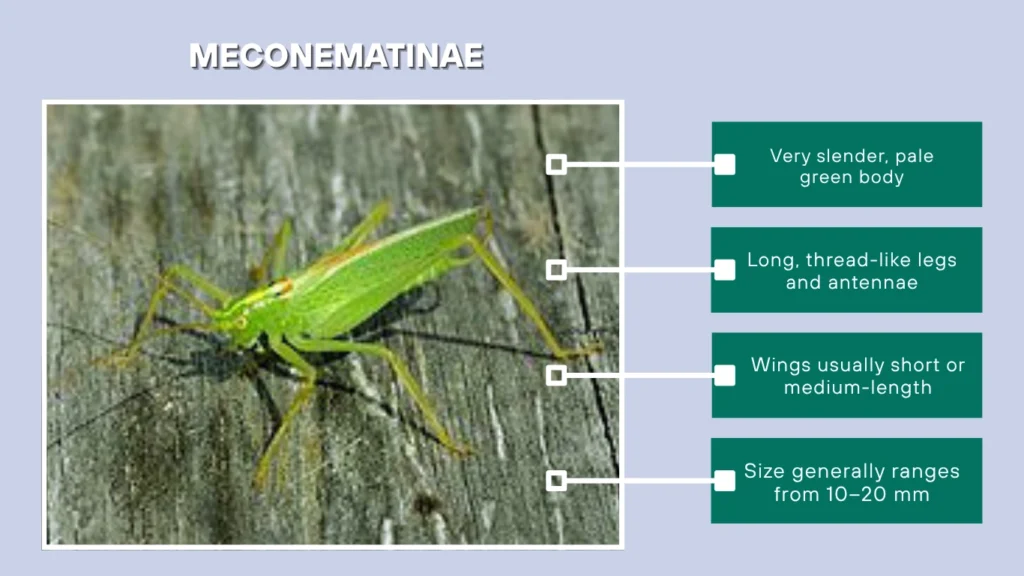
Meconematinae is a subfamily of small, delicate katydids known for their tree-dwelling habits and nearly silent behavior. Unlike many other katydids, most species in this group do not sing or chirp and instead communicate using substrate vibrations.
Identification
- Very slender, pale green body
- Long, thread-like legs and antennae
- Wings usually short or medium-length
- Size generally ranges from 10–20 mm
- Ovipositor thin and needle-like
Where Do They Live?
These katydids are found in Europe and Asia, living high in the canopies of deciduous forests, shrubs, and hedgerows. Some species have also adapted to urban parks and gardens.
How Do They Communicate?
Instead of making sounds, Meconematinae often use body movements or substrate-borne vibrations (like tapping on leaves) to communicate, especially during mating.
What Do They Feed On?
They are mostly carnivorous or scavengers, feeding on small arthropods such as aphids, mites, and soft-bodied insects, making them helpful for natural pest control.
28. Barbitistes serricauda

Barbitistes serricauda is a striking katydid species found across Europe, recognized by its bold color patterns and nocturnal habits. Unlike the typical green katydid, this species often displays a mix of green, brown, and black, offering excellent camouflage in shrubs and forests.
Identification
- Color varies: often green with black or brown patches
- Short to medium-length wings
- Female has a serrated, slightly upturned ovipositor
- Long antennae and strong jumping legs
- Body length ranges from 15–25 mm
When Are They Active?
They are mainly nocturnal, active during summer nights. During the day, they remain hidden in vegetation, relying on their disruptive coloration for concealment.
Where Are They Found?
Barbitistes serricauda thrives in forest edges, bushy clearings, and hedgerows, especially in central and southern Europe. They prefer warm, dry environments with dense shrubbery.
What Do They Feed On?
Primarily herbivorous, they feed on leaves and flowers of shrubs and low plants. They may also occasionally nibble on small insects or larvae.
29. Eupholidoptera

Eupholidoptera is a genus of vibrantly colored bush-crickets native to southeastern Europe and parts of the Middle East. These katydids are known for their robust build, short wings, and active behavior in warm, rocky habitats.
Identification
- Usually bright green or yellow-green with dark markings
- Short, non-functional wings (flightless)
- Thick hind legs with dark bands
- Females have a curved ovipositor
- Body size typically between 20–30 mm
Are They Easy to Spot?
Yes, in sunny, open habitats, they may be seen hopping through vegetation or basking on rocks. Their bold markings and movements make them more visible than many other katydids.
What Habitat Do They Prefer?
They are commonly found in Mediterranean scrublands, rocky hillsides, and areas with sparse trees and dense ground vegetation.
Do They Sing?
Yes, but their songs are quieter and often consist of short, repeated clicks or buzzing notes, usually heard in the early morning or evening hours.
30. Copiphora

Copiphora is a genus of tropical katydids found primarily in Central and South America. These katydids are notable for their horn-like projections on the head and their loud, frog-like calls at night, making them one of the most vocal katydids in the rainforest.
Identification
- Large, green body with a distinctive cone or horn on the head
- Strong mandibles and well-developed legs
- Transparent wings with prominent veins
- Females have a long, sword-like ovipositor
- Size ranges from 40–60 mm
What Is the Purpose of the Horn?
The horn-like structure is thought to aid in sound amplification or visual mimicry for camouflage, though its exact function is still being studied.
How Loud Are They?
Very loud—some Copiphora species can rival frogs in volume. Their calls are produced at night and are used to attract mates in the dense rainforest.
What Do They Eat?
They are omnivorous, feeding on soft plant material, flowers, and small insects. Their strong jaws allow them to tackle a variety of foods.
31. Hetrodinae
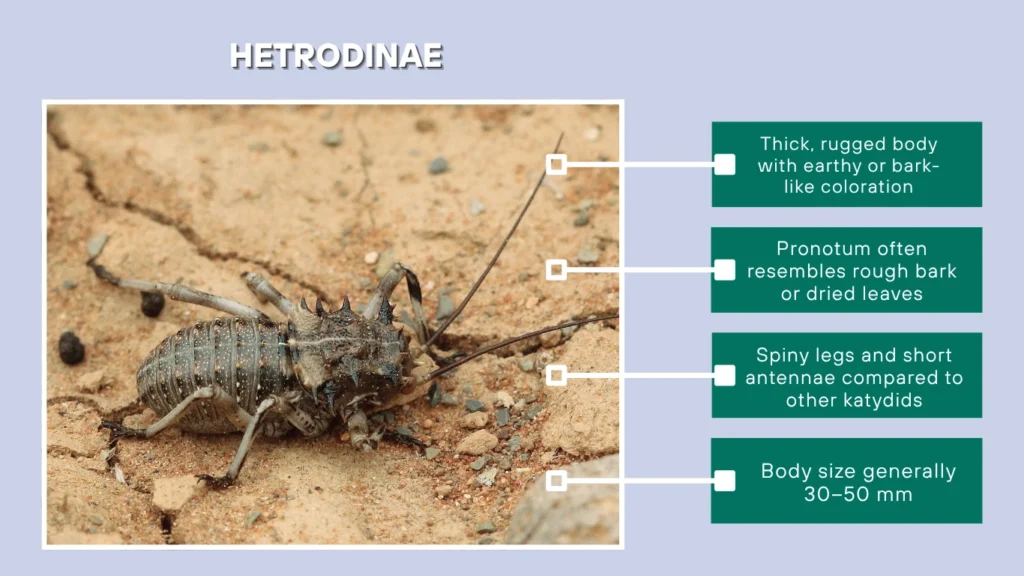
Hetrodinae is a subfamily of katydids primarily found in Africa and the Middle East. Members of this group are robust, spiny-legged, and often exhibit cryptic or bark-like coloration. Some are adapted to extremely dry environments.
Identification
- Thick, rugged body with earthy or bark-like coloration
- Pronotum often resembles rough bark or dried leaves
- Spiny legs and short antennae compared to other katydids
- Short or absent wings in many species
- Body size generally 30–50 mm
What Type of Habitat Do They Prefer?
They inhabit arid zones, savannas, and dry woodlands. Their camouflage allows them to blend with tree bark, rocks, and dry vegetation.
Are They Nocturnal?
Yes, most Hetrodinae species are active at night, when they forage or seek mates. During the day, they remain motionless and hidden from predators.
What Do They Eat?
They are typically omnivorous, feeding on dry plant matter, leaves, and sometimes small arthropods. Their feeding habits help recycle nutrients in dry ecosystems.
32. Polysarcus denticauda

Polysarcus denticauda is a rare and brightly colored bush-cricket species found in parts of central and southeastern Europe. It is notable for its wide distribution range, but declining numbers due to habitat loss make it a conservation concern in many regions.
Identification
- Bright green body with black spots and a reddish underside
- Long, wide wings that cover the body
- Long antennae and sturdy hind legs
- Females have a slender, slightly curved ovipositor
- Size ranges from 25–35 mm
Where Is It Found?
It inhabits flower-rich meadows, mountain pastures, and grassy slopes in countries like Austria, Romania, and Bulgaria. It prefers undisturbed habitats with high plant diversity.
Is It a Protected Species?
Yes, in several European countries, Polysarcus denticauda is legally protected due to its shrinking habitat and low population density.
What Do They Feed On?
They are primarily herbivorous, feeding on a mix of flowering plants and grasses, which also serve as shelter and calling sites for males.
33. Apote

Apote is a lesser-known genus of katydids from Central and South America, usually found in dense, humid tropical forests. These katydids are recognized by their camouflaged appearance and often remain understudied due to their elusive nature and canopy-dwelling behavior.
Identification
- Medium to large size with leaf-like wings
- Green to brown coloration with fine wing venation
- Head and body are well-blended for camouflage
- Antennae are long and thread-like
- Typically around 30–40 mm in length
What Is Known About Their Behavior?
They are nocturnal and arboreal, staying high in the forest canopy. They avoid light and are rarely seen by casual observers, making research on them limited.
Do They Communicate?
Like most katydids, males produce calling songs at night, though many species in this genus are so high-pitched or faint that they’re difficult for humans to detect without audio tools.
What Is Their Role in the Ecosystem?
They contribute to the balance of rainforest ecosystems by feeding on plant matter and serving as prey for birds, bats, and reptiles.
34. Acanthodis

Acanthodis is a genus of katydids typically found in Central and South America. These katydids are recognized by their spiny bodies and cryptic coloration, which help them blend into dry leaves and bark in tropical forests.
Identification
- Spiny body with leaf- or bark-like texture
- Color ranges from dull green to brown or grey
- Camouflaged wings with jagged edges
- Long antennae and strong legs
- Body size usually 30–45 mm
How Do They Use Camouflage?
Their wing texture and body coloration make them nearly indistinguishable from the forest floor or tree bark, helping them avoid detection by predators like birds and frogs.
Are They Active at Night?
Yes, they are nocturnal and become active after sunset. They remain motionless during the day, relying on camouflage for protection.
What Do They Eat?
Primarily herbivores, feeding on leaves and decaying plant material. Some may also scavenge soft-bodied insects if available.
35. Habra

Habra is a small genus of katydids native to tropical Asia, especially regions like Borneo and Malaysia. These katydids are known for their compact body, soft coloration, and tree-dwelling behavior.
Identification
- Small to medium-sized body
- Pale green or yellow-green wings
- Wings often rounded and leaf-like in shape
- Long, delicate antennae
- Size typically between 20–30 mm
Where Are They Found?
They are arboreal, often living in the mid- to upper canopy of tropical rainforests. They are most active during humid nights and are rarely seen during the day.
Do They Make Sounds?
Yes, males produce soft, irregular clicking or rustling sounds at night, used for mating communication. The sounds are usually too faint to be heard from a distance.
What Role Do They Play in Nature?
They help maintain plant health by grazing on soft foliage and also serve as food for nocturnal predators like bats, spiders, and tree frogs.
