
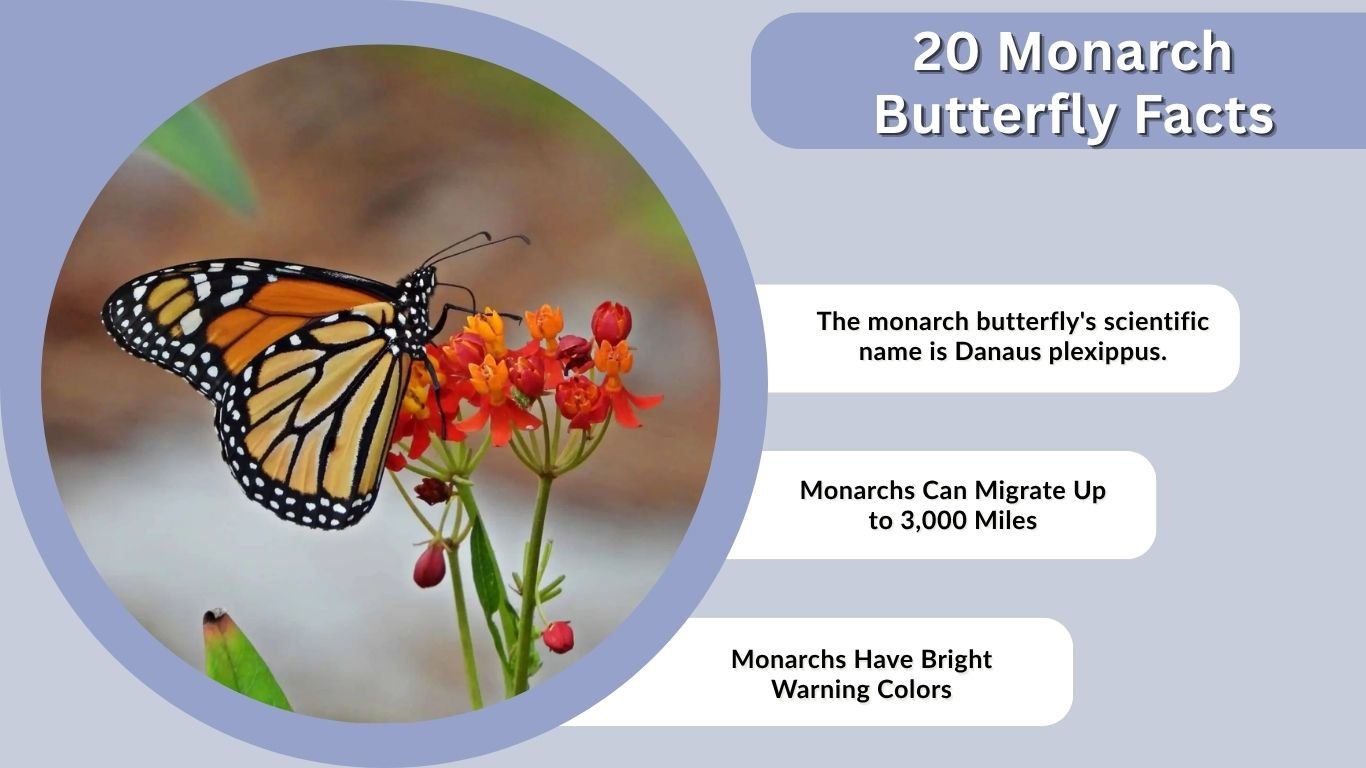
Monarch butterflies are famous for their brilliant orange wings, remarkable migration, and close relationship with milkweed. But there is much more to these insects than their appearance. From growing nearly 2,000 times larger as caterpillars to traveling thousands of miles without ever having visited their destination before, monarchs have an extraordinary biology. These 20 monarch butterfly facts cover their appearance, diet, caterpillars, chrysalis, life cycle, migration, habitat, and conservation while explaining some of the most fascinating features of Danaus plexippus.
Monarch Butterfly Appearance and Biology Facts
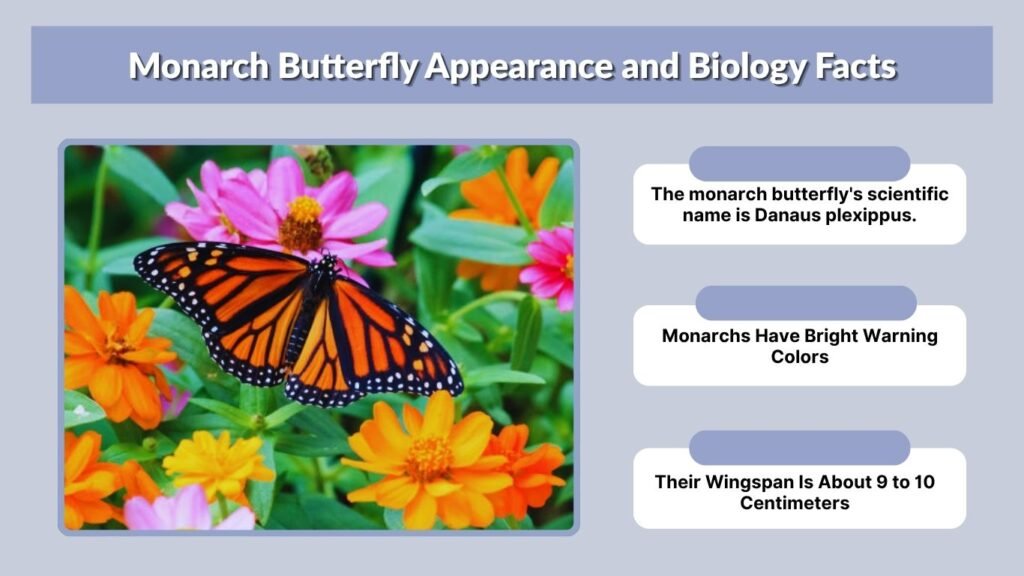
Monarch butterflies are among the easiest North American butterflies to recognize, but their wings contain more information than many people realize. Size, markings, sex differences, and chemical defenses all contribute to their distinctive appearance. These basic facts about monarch butterflies provide a useful introduction before exploring their remarkable transformation and migration.
1. Their Scientific Name Is Danaus plexippus
The monarch butterfly’s scientific name is Danaus plexippus. It belongs to the brush-footed butterfly family, Nymphalidae. Monarchs probably originated in the Americas, although populations now occur in several other parts of the world, including Australia, New Zealand, Hawaii, Caribbean islands, and occasionally western Europe.
2. Monarchs Have Bright Warning Colors
Adult monarch butterflies are famous for orange wings divided by strong black veins and bordered with black containing white spots.
Their bright coloration serves as a warning to many predators. Monarch caterpillars obtain defensive chemicals from milkweed, and those chemicals help make the resulting butterflies distasteful or toxic to susceptible predators.
3. Their Wingspan Is About 9 to 10 Centimeters
An adult monarch typically has a wingspan of roughly 9–10 cm, or around 3.5–4 inches. That makes it a relatively large and conspicuous butterfly.
Despite those broad wings, monarchs are exceptionally lightweight; educational monitoring resources note that an adult weighs less than a gram.
4. Male and Female Monarchs Look Different
Male monarchs have a small black spot on a vein of each hindwing. Females lack these spots and usually have broader, darker black veins.
These markings make adult males and females comparatively easy to distinguish once you know what to look for. Females can also appear somewhat darker overall.
5. Their Wings Do More Than Provide Flight
Monarch wings are covered in thousands of microscopic scales. These scales create the colors and patterns we see and contribute to the aerodynamic surface of the wing.
Adult wing size is established when the butterfly emerges from the chrysalis; unlike many body structures, the wings do not continue growing afterward.
Monarch Butterfly Life Cycle and Caterpillar Facts

Monarchs undergo complete metamorphosis, passing through four very different life stages: egg, larva, pupa, and adult. Their caterpillar stage is especially important because this is when monarchs consume milkweed and rapidly accumulate body mass. The entire transformation from a tiny egg to a flying butterfly is one of the most interesting monarch butterfly facts for kids and adults alike.
6. Female Monarchs Lay Their Eggs on Milkweed
Female monarch butterflies search specifically for milkweed when laying eggs because newly hatched caterpillars depend on it for food.
Females normally lay eggs individually rather than in clusters, often attaching them to the underside of a milkweed leaf near the plant’s upper growth.
7. A Female Can Lay Hundreds of Eggs
A female monarch commonly lays around 300–500 eggs during several weeks of egg laying.
Each egg is tiny—approximately the size of a pinhead—and usually hatches within three to five days depending on temperature. Monarch Joint Venture reports a captive record of more than 1,100 eggs from one female.
8. Monarch Caterpillars Have Five Growth Stages
Monarch caterpillars pass through five larval stages called instars. Between each instar, the caterpillar molts and sheds its old skin.
During this period it eats almost continuously and grows tremendously. Monarch caterpillars can increase to nearly 2,000 times their original mass before they are ready to pupate.
9. Caterpillars Depend on Milkweed
Monarch caterpillars cannot simply switch to ordinary garden leaves when milkweed disappears. Milkweeds in the genus Asclepias are their primary North American host plants.
Adults are very different: they drink nectar from numerous flower species, so a monarch habitat needs nectar-rich flowers as well as milkweed.
10. A Chrysalis Is Not a Cocoon
After reaching its final caterpillar stage, a monarch often leaves the milkweed, finds a protected surface, attaches itself with silk, and hangs in a J shape.
It then sheds its skin to reveal a green chrysalis, or pupa. Under typical summer conditions, the pupal stage lasts approximately 8–15 days.
Fun Facts About Monarch Butterfly Migration
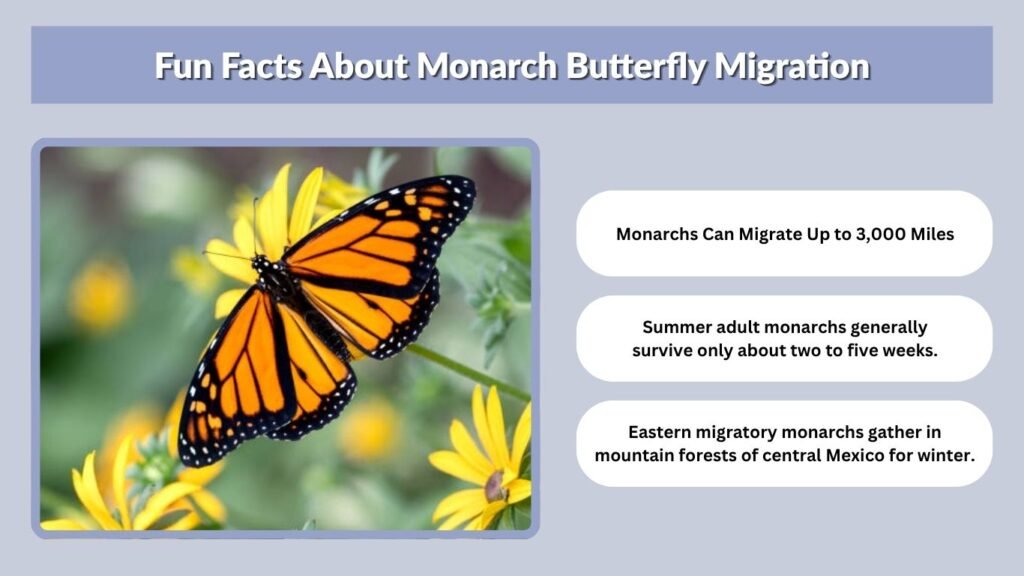
Migration is what makes monarchs extraordinary among butterflies. North America’s migratory populations travel enormous distances between breeding and overwintering areas. Even more remarkably, the monarch that begins the annual cycle is not necessarily the butterfly that completes every part of it. Migration, longevity, weather, and multiple generations all work together to create this spectacular natural event.
11. Monarchs Can Migrate Up to 3,000 Miles
Eastern North American monarchs originating near the northern end of their breeding range may travel up to approximately 3,000 miles during fall migration to central Mexico.
Western monarchs generally undertake shorter migrations toward California, although some western individuals have also been documented traveling to Mexico.
12. They Use Air Currents to Save Energy
Monarchs do not flap their wings continuously for their entire migration.
They use favorable air currents and soar much like birds, reducing the amount of energy required for long-distance travel. Under typical conditions they may cover around 25–30 miles in a day, although weather can greatly change daily distances.
13. Migrating Monarchs Live Much Longer
Summer adult monarchs generally survive only about two to five weeks.
The migratory generation is dramatically different. Butterflies emerging in late summer enter a delayed reproductive state and can survive for many months, with successful migratory adults sometimes living six to nine months.
14. One Butterfly Does Not Complete the Entire Annual Journey
The monarch’s northward recolonization of North America occurs across multiple generations.
Monarchs leaving Mexico in spring reproduce as they move north. Their descendants continue the journey, and several generations may occur before monarchs again occupy northern breeding areas. The long-lived fall generation later makes the remarkable return south.
15. Many Eastern Monarchs Overwinter in Mexico
Eastern migratory monarchs gather in mountain forests of central Mexico for winter.
Their principal overwintering areas occur in the states of México and Michoacán, where the cool, moist mountain environment helps them conserve energy. USDA information describes monarch use of a relatively small number of mountain areas during the overwintering season.
Interesting Monarch Butterfly Facts About Survival

Monarch survival depends on much more than flight. Their relationship with milkweed, ability to store defensive chemicals, global distribution, long-lived migratory generation, and dependence on specific habitats all contribute to their success. At the same time, these specialized behaviors make monarch populations vulnerable when important breeding, migration, and overwintering habitats disappear.
16. Milkweed Helps Make Monarchs Toxic
Milkweed contains defensive compounds called cardiac glycosides or cardenolides.
Monarch caterpillars have adaptations that let them consume these plants and retain some of their chemicals. This makes monarchs distasteful or harmful to many vertebrate predators and works together with their orange-and-black warning coloration.
17. Their Chemical Defense Does Not Stop Every Predator
Monarchs are protected, but they are far from invincible.
Some birds and other predators can tolerate monarch defenses, avoid the most toxin-rich body parts, or prey on monarchs during vulnerable stages. Eggs and young caterpillars are also eaten by spiders, insects, and other small predators.
18. Monarchs Live Beyond North America
Although monarchs are strongly associated with Canada, the United States, and Mexico, populations also occur elsewhere.
Monarch Joint Venture reports them from Australia, New Zealand, Hawaii, Caribbean islands, and many Pacific islands. Their spectacular North American migration, however, is what has made the species especially famous.
19. Scientists Track Monarchs With Tiny Tags
Researchers and community scientists have tagged monarch butterflies for decades to learn about migration routes and survival.
Traditional programs use lightweight numbered stickers. More recently, tiny solar-powered radio tags have been tested; some weigh only 0.06 grams and can transmit signals detectable by compatible devices.
20. Monarch Populations Face Serious Threats
Monarch populations have experienced major declines. Important threats include loss and degradation of breeding, migration, and overwintering habitat, insecticide exposure, and climate change.
As of October 2026, the monarch is not yet federally listed as threatened under the U.S. Endangered Species Act; the U.S. The Fish and Wildlife Service has proposed threatened status, but a final ruling has not yet occurred.
Planting regionally appropriate native milkweed and nectar flowers, reducing unnecessary pesticide use, and protecting overwintering habitat are among the conservation measures recommended for supporting monarch populations.
FAQs
What are the most interesting facts about monarch butterflies?
One of the most remarkable monarch butterfly facts is their migration. Eastern monarchs may travel up to 3,000 miles to overwinter in central Mexico. Their caterpillars also feed on milkweed, grow nearly 2,000 times their original mass, and pass through five instars before forming a chrysalis.
How long does a monarch butterfly live?
Most summer adult monarch butterflies live approximately two to five weeks. However, the migratory generation that emerges in late summer can survive for six to nine months. These long-lived monarchs postpone reproduction while migrating and overwintering, allowing them to survive until the following spring.
What do monarch butterflies eat?
Adult monarch butterflies drink nectar from many flowering plants using a tube-like proboscis. Monarch caterpillars have a much more specialized diet and depend on milkweed host plants. Milkweed supplies both nutrition and defensive compounds that help make monarch caterpillars and adults distasteful to many predators.
How can you tell a male monarch from a female?
Male monarch butterflies have a distinct black spot on a vein of each hindwing. Females do not have these spots and generally display thicker black wing veins. Females may also appear somewhat darker than males, making sex identification relatively easy when an adult’s wings are visible.
Are monarch butterflies endangered?
Their legal status depends on the country. In the United States, monarchs are not federally listed as endangered or threatened as of October 2026, although the U.S. Fish and Wildlife Service has proposed listing them as threatened. Their populations face significant conservation concerns due to habitat loss, pesticides, and climate-related pressures.
