

The monarch butterfly (Danaus plexippus) is one of the most recognizable and beloved butterflies in North America. Known for its striking orange and black wings, this species plays a crucial role in pollination and has an extraordinary migration journey.
However, due to its similarity to other butterflies, it’s essential to understand how to identify a monarch correctly. In this guide, we’ll explore key identification features, look-alike species, life stages, and how to attract monarchs to your garden.
1. Monarch Butterfly Appearance
Size & Shape
Monarch butterflies typically have a wingspan of 3.5 to 4 inches (9-10 cm). Their wings are broad and rounded, and they have a relatively slender body with long, black antennae.
Color & Patterns

- The upper side of the wings is bright orange with black veins and black edges adorned with small white spots.
- The underside of the wings is a duller orange-brown, helping them blend with their surroundings when at rest.
- Their body is black with tiny white dots.
Male vs. Female Monarchs
To distinguish between male and female monarchs:
- Males have two small black spots on the hind wings, which are scent glands.
- Females lack these spots and have thicker black veins on their wings.
2. Monarch Butterfly Life Cycle (With Images)

Monarch butterflies go through four life stages, each with distinct features:
- Egg Stage
- Tiny, oval, and cream-colored eggs are laid on milkweed leaves.
- They hatch within 3-5 days.
- Caterpillar (Larva) Stage
- Monarch caterpillars have black, white, and yellow stripes.
- They grow rapidly and molt several times over two weeks.
- Chrysalis (Pupa) Stage
- The caterpillar transforms into a bright green chrysalis with golden spots.
- Inside, the butterfly develops for 10-14 days before emerging.
- Adult Butterfly Stage
- The newly emerged monarch pumps fluid into its wings before flying.
3. Monarch Butterfly vs. Look-Alikes (With Comparison Images)

Some butterflies mimic monarchs to deter predators. Here’s how to tell them apart:
- Viceroy Butterfly (Limenitis archippus)
- Slightly smaller with an extra black horizontal line on the hind wings.
- Does not migrate like the monarch.
- Queen Butterfly (Danaus gilippus)
- Similar in color but lacks prominent black veins.
- More brownish-orange than bright orange.
- Painted Lady Butterfly (Vanessa cardui)
- Smaller and lacks the black wing borders with white spots.
- Wings have a more patchy, spotted appearance.
4. Monarch Butterfly Behavior & Habits
Migration Patterns
Monarch butterflies are famous for their long-distance migration to avoid cold temperatures.
- Eastern monarchs travel from Canada and the U.S. to Mexico for the winter.
- Western monarchs migrate to California for the winter.
Feeding Habits
- Monarchs feed on nectar from various flowers, including milkweed, coneflowers, and goldenrod.
- They rely on milkweed plants for reproduction, as caterpillars only eat milkweed leaves.
Resting & Roosting Behavior
- During migration, they cluster together in trees at night for warmth.
- On hot days, they rest in shady areas to conserve energy.
5. How to Attract Monarch Butterflies to Your Garden
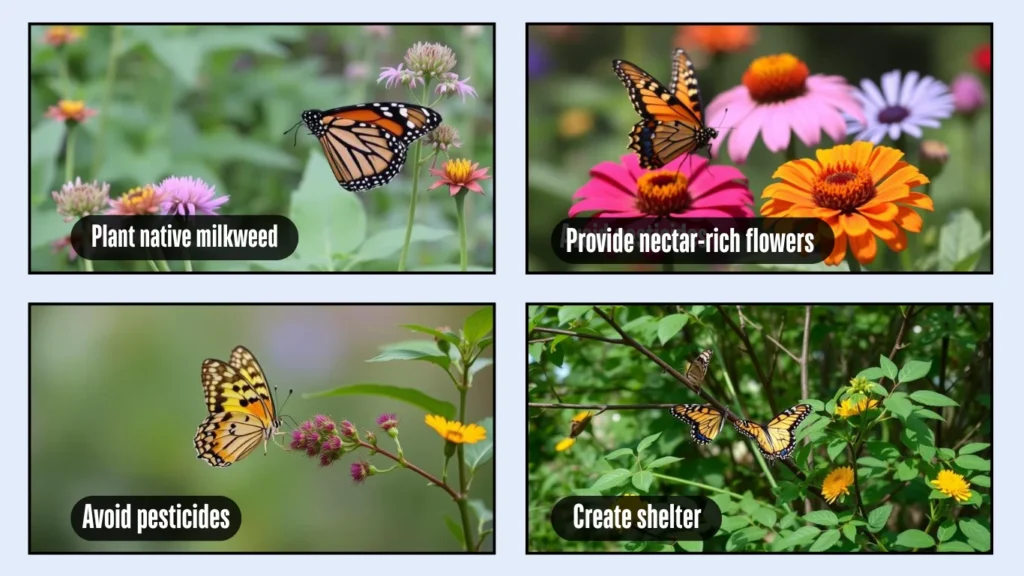
Want to invite monarchs to your garden? Here’s how:
- Plant native milkweed – Monarchs lay eggs only on milkweed.
- Provide nectar-rich flowers – Choose blooms like zinnias, butterfly bush, and asters.
- Avoid pesticides – Chemicals can harm butterflies and their caterpillars.
- Create shelter – Trees and shrubs give butterflies a place to rest.
6. Conservation & Threats to Monarchs
Monarch butterflies face significant threats, including:
- Habitat loss due to deforestation and agriculture.
- Declining milkweed availability because of herbicide use.
- Climate change disrupting migration patterns.
How You Can Help:
- Plant native milkweed and nectar flowers.
- Support butterfly conservation organizations.
- Avoid using harmful pesticides in your garden.
Conclusion
Monarch butterflies are not only beautiful but also vital to ecosystems. By understanding their identifying features, life cycle, and behaviors, you can appreciate these stunning insects even more. If you want to help monarch populations thrive, consider planting milkweed, providing nectar sources, and protecting their habitats.
Would you like to add more personal observations or include your own images in this article? Let me know if you need any edits!
