
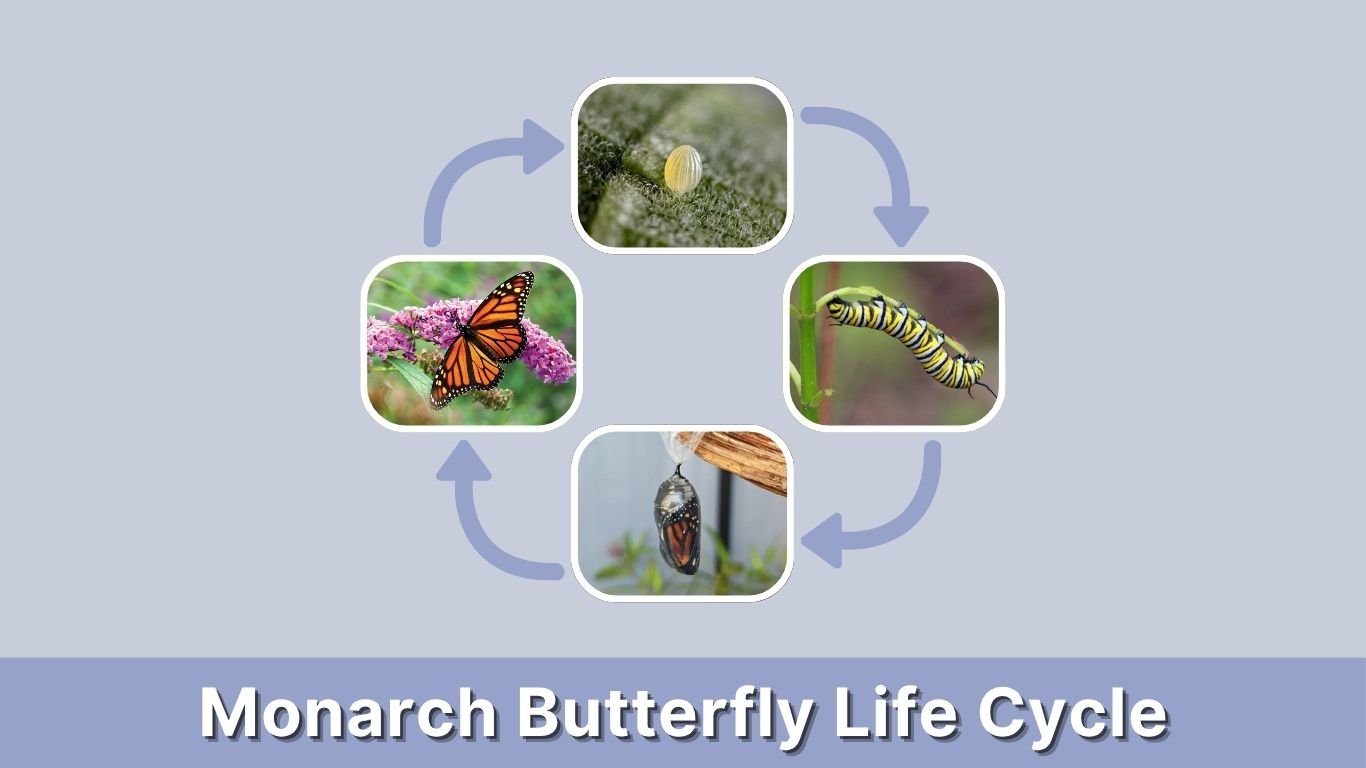
The monarch butterfly life cycle is a remarkable transformation that begins with a tiny egg and progresses through caterpillar, chrysalis, and adult stages. Monarchs undergo complete metamorphosis, and under favorable summer conditions, development from egg to adult may take roughly four weeks. Temperature and environmental conditions can make the process shorter or longer. Each stage has a different purpose, from rapid caterpillar growth on milkweed to dramatic transformation inside the chrysalis. This guide explains the complete timeline, stages, migration connection, and important life cycle facts.
What Is the Monarch Butterfly Life Cycle?
The life cycle of a monarch butterfly consists of four main stages: egg, larva or caterpillar, pupa or chrysalis, and adult butterfly. This process is called complete metamorphosis because the monarch changes dramatically between its immature and adult forms. Development speed varies with temperature, but warm summer conditions usually allow the immature stages to be completed within several weeks.
Four Stages of the Monarch Butterfly Life Cycle
The four basic stages are:
- Egg: A female lays a tiny egg on a milkweed plant.
- Larva: The caterpillar hatches and spends most of its time eating and growing.
- Pupa: The caterpillar forms a green chrysalis where metamorphosis is completed.
- Adult: A fully developed orange-and-black butterfly emerges, feeds on nectar, mates, and eventually continues the cycle.
Monarchs depend heavily on milkweed during their immature stages because females lay eggs on milkweed and caterpillars feed on its leaves.
Stage 1: Monarch Butterfly Egg
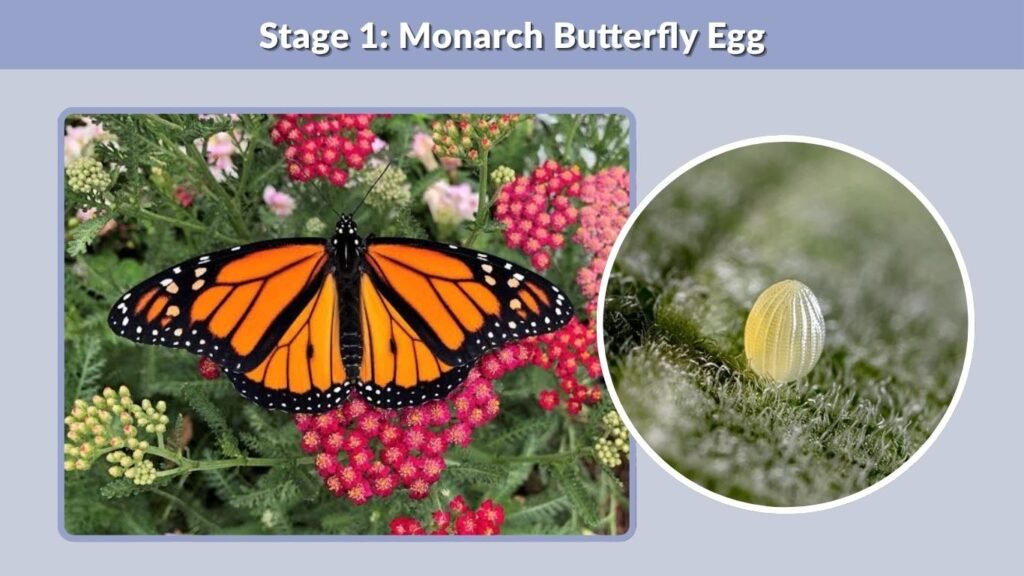
The first stage starts when a female monarch finds suitable milkweed and deposits an egg, usually individually rather than in large clusters. Monarch eggs are extremely small, pale cream or yellowish, and covered with tiny vertical ridges. Choosing milkweed is essential because the newly hatched caterpillar needs immediate access to the plant that provides its primary food.
Where Do Monarchs Lay Their Eggs?
Female monarchs usually place their eggs on milkweed, often on the underside of a leaf or near tender new growth.
A female may lay hundreds of eggs during her reproductive life, but she commonly distributes them among many plants. Monarch Joint Venture reports that females generally lay about 300–500 eggs during two to five weeks of egg laying.
How Long Does the Egg Stage Last?
The egg stage commonly lasts approximately 3–5 days, depending largely on temperature.
As development progresses, the caterpillar’s dark head may become visible through the egg shortly before hatching. The tiny larva eventually breaks through the eggshell and may consume part or all of the remaining shell before beginning to feed on milkweed.
Stage 2: Monarch Butterfly Caterpillar
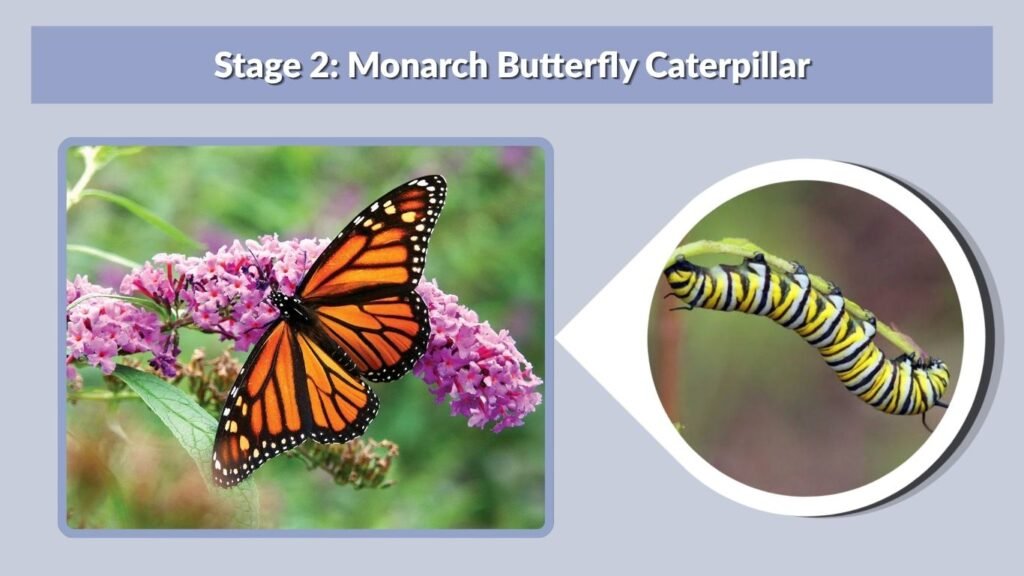
The caterpillar stage is when nearly all of the monarch’s visible growth occurs. A newly hatched caterpillar is extremely small, but continuous feeding allows it to increase enormously in size. Monarch caterpillars have distinctive black, white, and yellow bands as they mature and feed almost exclusively on milkweed during this part of their life cycle.
Five Monarch Caterpillar Instars
Monarch caterpillars pass through five instars, or growth periods separated by molts.
During these stages, the caterpillar:
- Begins as a tiny, pale larva.
- Eats milkweed and grows quickly.
- Sheds its restrictive outer skin.
- Develops increasingly obvious stripes and tentacles.
- Repeat the process through five instars.
- Reaches its largest caterpillar size before pupation.
The entire larval stage commonly lasts about 9–14 days under normal summer temperatures, although environmental conditions can alter the timing.
Why Do Monarch Caterpillars Eat Milkweed?
Milkweed provides both nutrition and chemical protection. Monarch caterpillars ingest defensive compounds called cardenolides from milkweed, which can make them distasteful or toxic to many predators.
The caterpillar spends much of this stage eating because it needs enough stored energy and nutrients to support the enormous transformation that occurs during pupation.
Stage 3: Monarch Butterfly Chrysalis
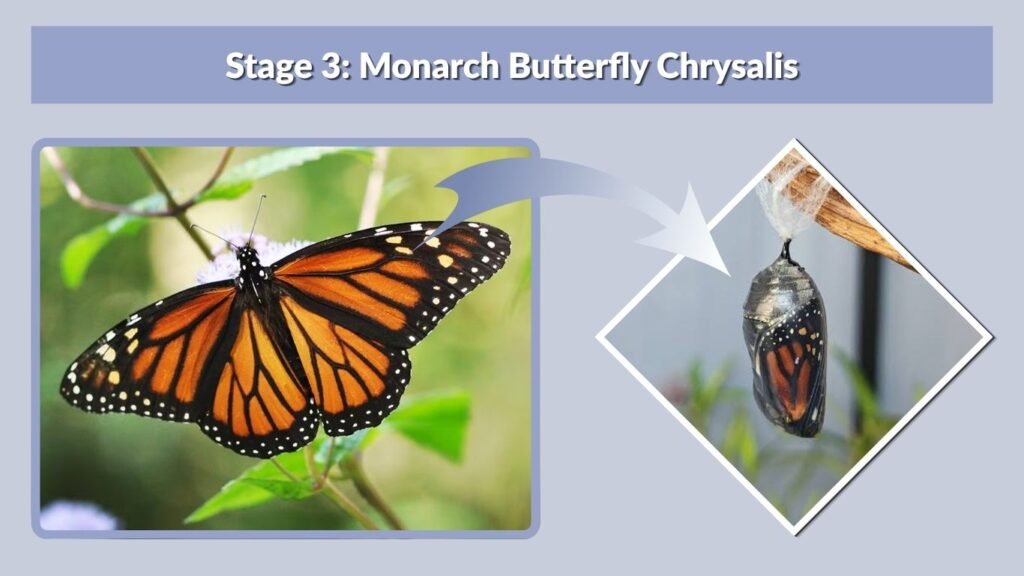
After completing its fifth instar, the caterpillar stops feeding and searches for a protected location. It attaches itself using a small silk pad and hangs upside down in a characteristic J shape. The caterpillar eventually sheds its outer skin for the final time, revealing the bright green chrysalis that contains the developing adult butterfly.
What Happens Inside the Chrysalis?
The chrysalis stage is much more than a period of rest. Major developmental changes reorganize the caterpillar into the adult form.
During this stage:
- Adult wings complete their development.
- The body changes into the butterfly’s adult shape.
- Adult legs and antennae develop fully.
- Mouthparts become adapted for drinking nectar.
- Reproductive structures continue developing.
- The familiar black, orange, and white wing pattern appears shortly before emergence.
Monarch Joint Venture notes that much of the groundwork for adult structures begins before pupation, while the transformation is completed during the chrysalis stage.
How Long Is a Monarch in a Chrysalis?
Under normal summer conditions, the chrysalis stage generally lasts about 8–15 days.
Near the end, the adult wing colors become visible through the pupal covering. The butterfly then breaks free in a process called eclosion. After emerging, it pumps fluid into its folded wings and waits several hours for them to expand, strengthen, and dry.
Stage 4: Adult Monarch Butterfly
The final stage produces the familiar adult monarch with bright orange wings crossed by black veins and bordered with black and white spots. Adults no longer eat milkweed leaves. Instead, they drink nectar from flowers, providing energy for flight, reproduction, and, in migratory generations, extraordinarily long journeys.
What Happens After a Monarch Emerges?
A newly emerged monarch cannot immediately fly. Its wings initially appear small, soft, and folded.
The butterfly pumps fluid through the wing veins until the wings expand. After they harden and dry, the monarch can begin flying, feeding, and searching for suitable habitat.
Most summer-generation monarchs become reproductively mature within several days. Their primary role as adults is to mate and produce the next generation.
How Long Do Adult Monarchs Live?
Summer generations generally live about two to five weeks. The migratory generation is dramatically different.
Monarchs emerging near the end of summer may delay reproduction and migrate to overwintering locations. These long-lived adults can survive for up to about nine months, enabling them to overwinter and begin the return journey the following spring.
Monarch Butterfly Life Cycle Timeline
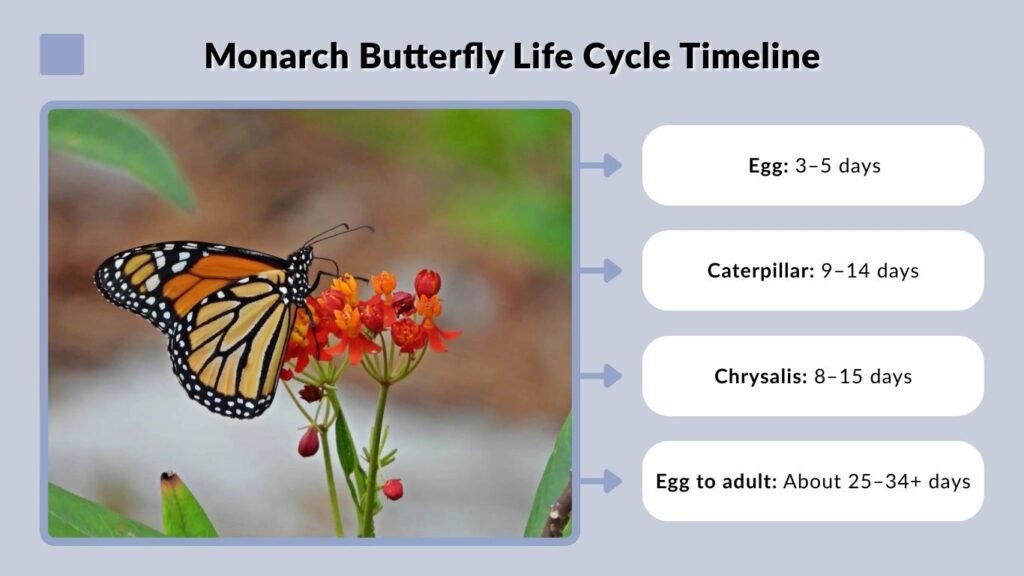
People searching for a monarch butterfly life cycle timeline often want to know exactly how many days transformation takes. There is no single fixed number because temperature strongly affects insect development. Monarchs grow faster under suitable warm conditions and more slowly during cooler periods, so any timeline should be treated as an approximate biological range rather than an exact schedule.
Monarch Butterfly Life Cycle in Days
A typical summer timeline looks approximately like this:
| Life Cycle Stage | Approximate Duration |
| Egg | 3–5 days |
| Caterpillar | 9–14 days |
| Chrysalis | 8–15 days |
| Egg to adult | About 25–34+ days |
| Summer adult | About 2–5 weeks |
| Migratory adult | Up to about 9 months |
The National Park Service notes that development from egg to adult can occur in as few as about 25 days in warm temperatures, while cooler conditions can significantly lengthen development.
Monarch Butterfly Life Cycle and Migration
The monarch’s annual story does not end when an adult emerges. In North America’s migratory populations, several generations participate in a remarkable seasonal cycle. Spring and summer monarchs reproduce relatively quickly, whereas the late-summer migratory generation delays reproduction and invests energy in surviving a long journey and winter.
How Migration Fits Into the Life Cycle
Eastern North American monarchs can migrate thousands of miles toward overwintering areas in central Mexico. The journey is multigenerational: no single summer monarch completes the entire annual north-and-south cycle.
The late-season generation enters reproductive diapause, allowing it to devote resources to migration and winter survival. After winter, those adults become reproductive and begin moving north while producing the next generation.
Why the Migratory Generation Lives Longer
Most summer monarchs focus quickly on mating and egg laying, giving them comparatively short adult lives.
Migratory monarchs delay reproduction in response to seasonal signals such as changing day length and temperature. Instead, they feed extensively on nectar, migrate, and spend winter clustered at overwintering sites. This different life-history strategy allows them to survive many months longer than typical summer adults.
Interesting Monarch Butterfly Life Cycle Facts
Every stage of the monarch butterfly life cycle is specialized for a different purpose. Eggs protect developing embryos, caterpillars specialize in growth, the chrysalis completes metamorphosis, and adults specialize in dispersal and reproduction. These dramatic differences make the monarch one of the best-known examples of complete metamorphosis.
Quick Life Cycle Facts
Monarch caterpillars grow through five larval instars and can increase to nearly 2,000 times their original mass. Females normally lay one egg at a time on milkweed, helping newly hatched larvae gain immediate access to food. Butterflies form a chrysalis rather than the silk-covered cocoon associated with many moths. Seasonal monarch generations can also differ dramatically in lifespan and reproductive behavior.
FAQs
1. What are the four stages of the monarch butterfly life cycle?
The four stages are egg, larva or caterpillar, pupa or chrysalis, and adult butterfly. Monarchs undergo complete metamorphosis, so each stage looks and functions differently. Eggs and caterpillars depend on milkweed, while adult monarchs mainly drink nectar from flowering plants and reproduce.
2. How long is the monarch butterfly life cycle?
From egg to adult, monarch development can take roughly 25 to 34 days or longer, depending primarily on temperature and environmental conditions. Eggs usually require several days, caterpillars about two weeks, and the chrysalis roughly another one to two weeks before an adult butterfly emerges.
3. How long does a monarch stay a caterpillar?
A monarch generally remains in the larval or caterpillar stage for approximately 9–14 days under normal summer conditions. During this period, it eats milkweed extensively and passes through five growth stages called instars, shedding its skin between each stage as its body becomes larger.
4. How long does a monarch stay in its chrysalis?
The monarch chrysalis stage generally lasts approximately 8–15 days under normal summer conditions. Temperature can change the timing. Shortly before the adult emerges, its orange, black, and white wing colors become visible through the pupal covering as final development is completed.
5. How does migration affect the monarch butterfly life cycle?
Most summer monarchs live only several weeks and reproduce quickly, but late-season migratory monarchs delay reproduction. They migrate to overwintering locations and may survive for many months. The following spring, these adults become reproductive and begin producing the next generation, continuing the annual multigenerational migration cycle.
