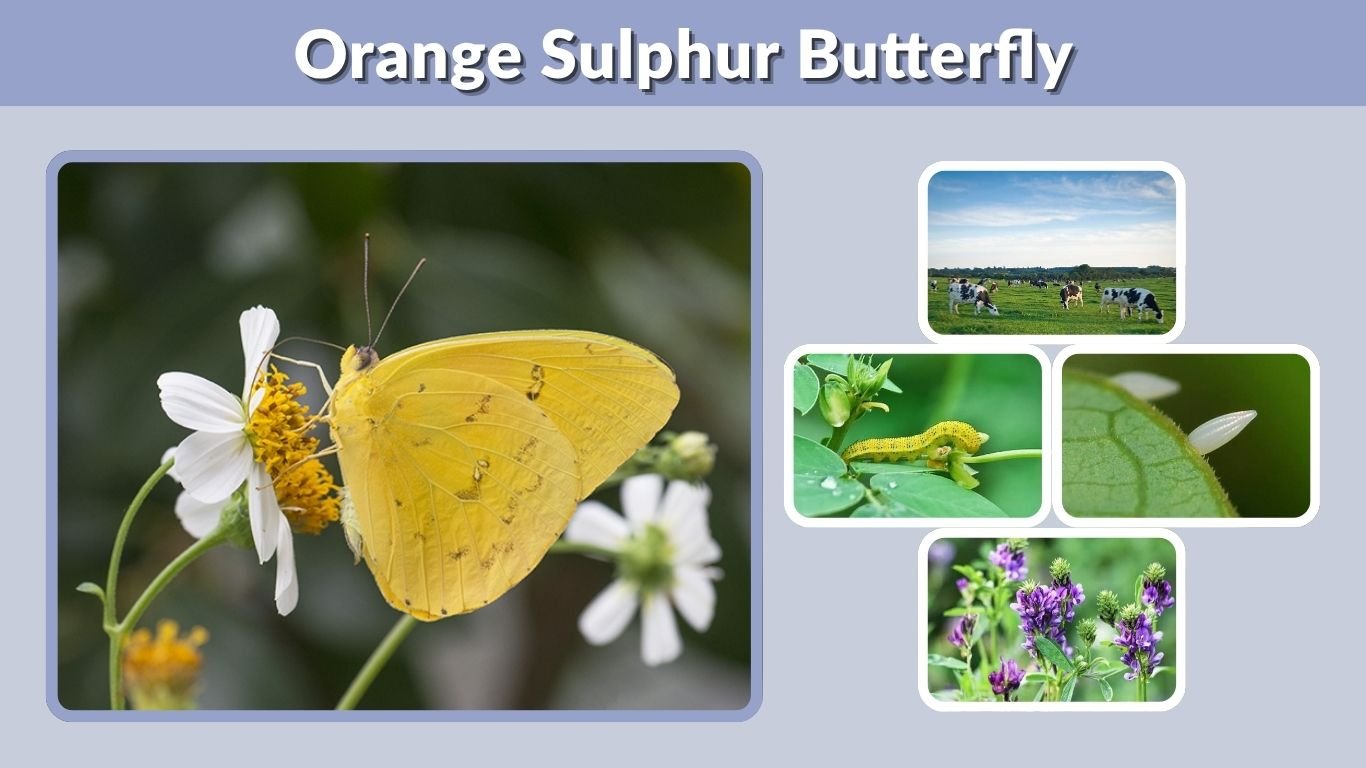
The orange sulphur butterfly (Colias eurytheme) is a colorful North American butterfly recognized by its bright yellow-orange wings and distinctive black borders. Also called the alfalfa butterfly, this species commonly inhabits meadows, grasslands, agricultural fields, and gardens. Its caterpillars feed on plants in the pea family, while adults visit flowers for nectar. Understanding the orange sulphur butterfly’s appearance, habitat, diet, life cycle, and differences from similar species can help nature enthusiasts identify this widespread butterfly.
What Is an Orange Sulphur Butterfly?
The orange sulphur butterfly belongs to the Pieridae family, a large group that includes white, yellow, and orange butterflies. It is one of North America’s most widespread sulphur species and frequently appears in open landscapes where flowering plants and suitable caterpillar host plants grow.
Scientific Classification
- Common name: Orange Sulphur Butterfly
- Scientific name: Colias eurytheme
- Family: Pieridae
- Subfamily: Coliadinae
- Genus: Colias
- Other name: Alfalfa Butterfly
- Wingspan: Approximately 1.4–2.75 inches (3.5–7 cm)
The name alfalfa butterfly comes from its close association with alfalfa fields, where its caterpillars sometimes become abundant enough to damage crops.
What Does an Orange Sulphur Butterfly Look Like?
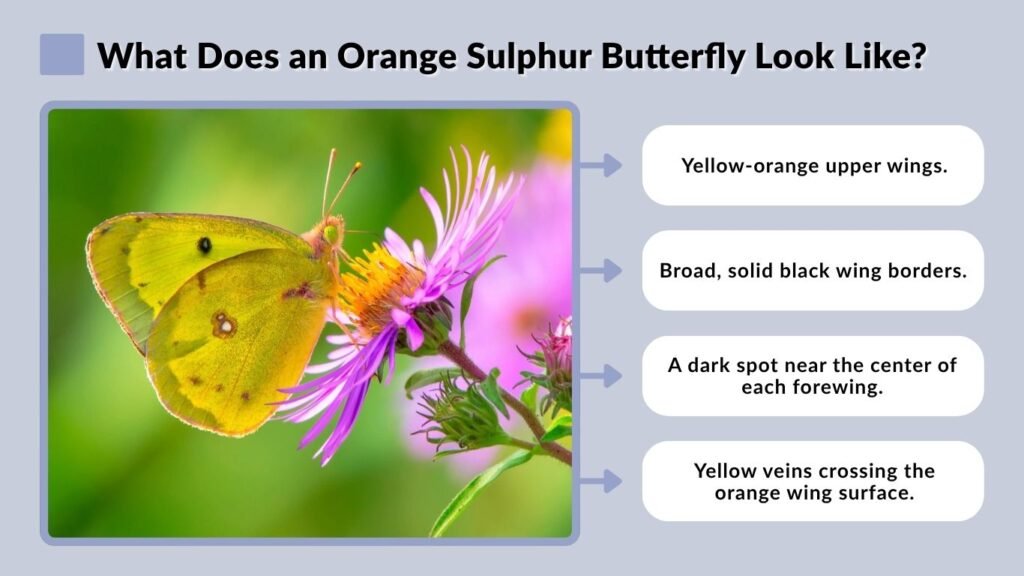
Orange sulphur butterflies display considerable variation in wing coloration. Some individuals appear bright orange, while others are mostly yellow with small orange patches. Seasonal conditions and sex influence their appearance, making careful observation important for accurate identification.
Male Orange Sulphur Butterfly
Male orange sulphurs generally have bright yellow wings with a noticeable orange wash across the upper surface.
Their main identification features include:
- Yellow-orange upper wings.
- Broad, solid black wing borders.
- A dark spot near the center of each forewing.
- Yellow veins crossing the orange wing surface.
- Pale yellow undersides with distinctive markings.
Males frequently fly low over open vegetation while searching for receptive females.
Female Orange Sulphur Butterfly
Female orange sulphur butterflies display greater color variation than males.
Some females have yellow-orange wings, while others appear almost completely white.
Their black wing borders usually contain pale spots, unlike the more continuous black borders found on males.
Female butterflies also tend to have broader wings and may appear slightly larger than males.
Orange Sulphur Butterfly Underwing Identification
When resting, orange sulphur butterflies usually hold their wings closed, exposing their yellow or greenish-yellow undersides.
A noticeable feature is the silvery spot on each hindwing, surrounded by reddish or brownish rings.
Additional small dark spots may appear along the wing margins.
However, these underside markings closely resemble those of the clouded sulphur, making some individuals difficult to identify without seeing the upper wings.
Orange Sulphur Butterfly Habitat and Range
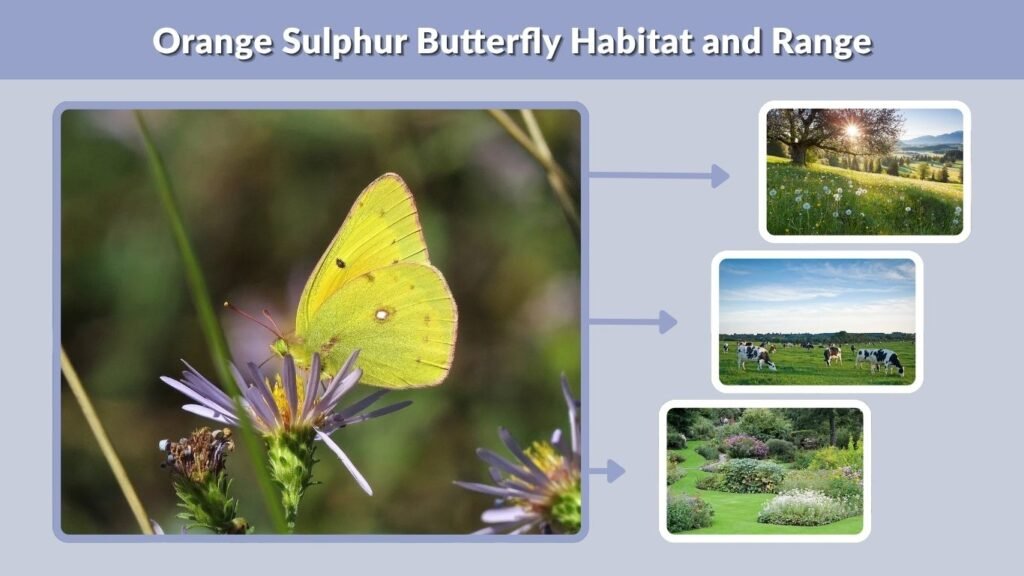
Orange sulphur butterflies thrive in open environments with abundant sunshine, flowering plants, and legumes. Their adaptability allows them to inhabit both natural grasslands and human-modified landscapes. These butterflies are especially common around agricultural areas, where alfalfa and clover provide food for developing caterpillars.
Where Do Orange Sulphur Butterflies Live?
The orange sulphur butterfly occurs across much of North America, from southern Canada through the United States into central Mexico.
Common habitats include:
- Grasslands and open meadows.
- Alfalfa and clover fields.
- Roadside vegetation.
- Agricultural pastures.
- Flower gardens and parks.
- Open woodland edges.
Orange sulphurs are especially noticeable during summer and early autumn when several generations may be active.
Their numbers vary with local weather, plant growth, and breeding conditions.
Orange Sulphur Butterfly Life Cycle
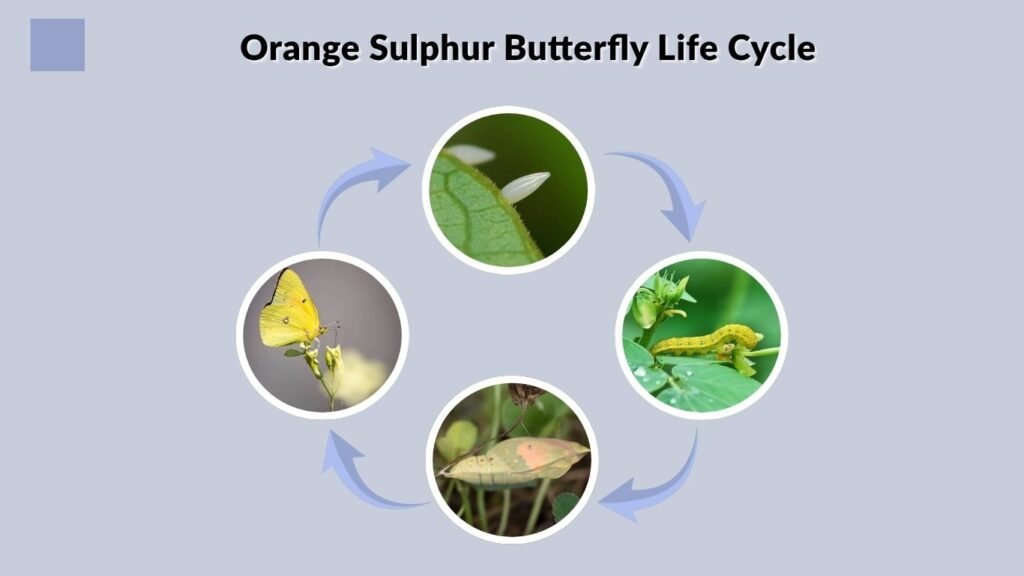
The orange sulphur butterfly undergoes complete metamorphosis through four stages: egg, caterpillar, chrysalis, and adult. Its development depends on temperature, host plant availability, and seasonal conditions. Multiple generations can develop during a single growing season, particularly in warmer regions.
1. Orange Sulphur Butterfly Eggs
Female orange sulphurs lay small, elongated eggs individually on suitable host plants.
Newly laid eggs are usually whitish or pale yellow. They gradually develop orange or reddish coloration as the embryos mature.
The eggs are generally deposited on the upper surfaces of leaves, particularly on clover, alfalfa, and related plants.
Under favorable warm conditions, caterpillars may hatch within approximately four to five days.
2. Orange Sulphur Caterpillar
The orange sulphur caterpillar has a smooth, green body that helps it blend into surrounding leaves.
Mature caterpillars often display a narrow white stripe along each side, sometimes accompanied by reddish or orange markings.
Young caterpillars initially create small holes in leaves, while larger larvae consume more extensive portions of the foliage.
They commonly feed during nighttime hours, reducing their exposure to some daytime predators.
3. Orange Sulphur Chrysalis
After completing its caterpillar development, the larva attaches itself to a suitable support and transforms into a chrysalis.
The chrysalis is generally green, sometimes displaying pale side stripes and darker markings.
Its appearance provides camouflage among vegetation.
Inside the chrysalis, the caterpillar transforms into an adult butterfly through extensive changes in its body structure.
The duration of this stage depends on temperature and seasonal conditions.
4. Adult Orange Sulphur Butterfly
Once the adult emerges, its wings expand and harden before it begins flying.
Adult butterflies immediately depend on flower nectar for energy.
Males patrol suitable habitats searching for females, while females seek appropriate host plants for egg laying.
In warm regions, several generations may develop each year.
What Do Orange Sulphur Butterflies Eat?
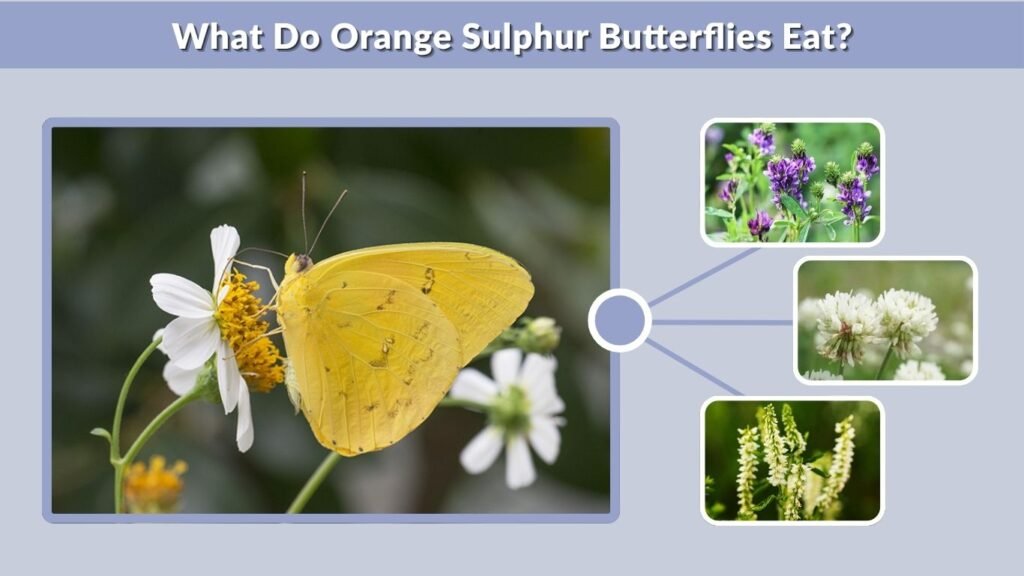
The orange sulphur butterfly changes its feeding habits as it develops. Caterpillars consume leaves from specific host plants, while adults obtain liquid nourishment from flowers. Suitable food sources are essential for successful reproduction and maintaining healthy butterfly populations.
Orange Sulphur Butterfly Host Plants
Orange sulphur caterpillars primarily feed on plants belonging to the pea family, Fabaceae.
Important host plants include:
- Alfalfa (Medicago sativa).
- White clover (Trifolium repens).
- White sweet clover (Melilotus albus).
- Various vetch species (Vicia spp.).
These plants provide the nutrients caterpillars need for growth.
Because alfalfa is an important agricultural crop, large orange sulphur caterpillar populations may occasionally cause noticeable feeding damage.
What Do Adult Orange Sulphur Butterflies Eat?
Adult orange sulphurs primarily consume nectar from flowering plants.
Common nectar sources include dandelions, goldenrods, asters, milkweeds, and clovers.
Adults also visit other flowering plants that provide accessible nectar.
Males sometimes gather around damp soil to absorb dissolved minerals through a behavior called mud-puddling.
This behavior helps them obtain nutrients not readily available from flower nectar alone.
Orange Sulphur vs. Clouded Sulphur Butterfly
The orange sulphur (Colias eurytheme) and clouded sulphur (Colias philodice) are closely related butterflies with similar appearances. Both commonly inhabit meadows, fields, and other open environments. However, their wing coloration provides important clues for identification.
Key Identification Differences
| Feature | Orange sulphur | Clouded sulphur |
| Scientific name | Colias eurytheme | Colias philodice |
| Upper wing color | Yellow with orange wash | Predominantly clear yellow |
| Black borders | Often broad and dark | Usually somewhat narrower |
| Underside | Yellowish or greenish | Yellowish or greenish |
| Host plants | Clover, alfalfa, legumes | Clover, alfalfa, legumes |
The most useful identification feature is the orange coloration on the upper wings.
Clouded sulphurs generally lack this orange wash, although both species display considerable variation.
White-form females and naturally occurring hybrids can be particularly difficult to distinguish.
Orange Sulphur vs. Orange-Barred Sulphur
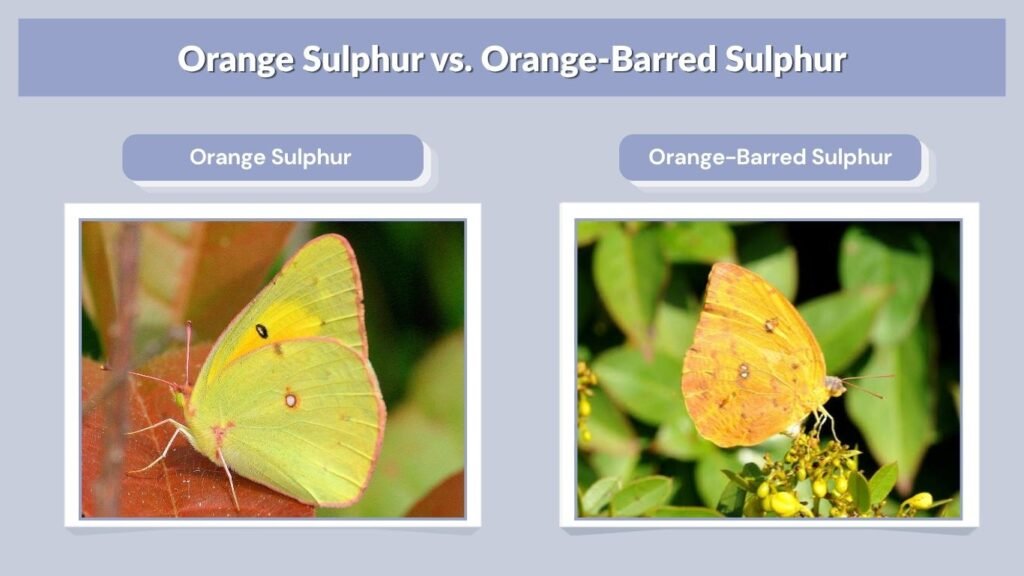
Although their names are similar, the orange sulphur and orange-barred sulphur are two different butterfly species.
The orange-barred sulphur (Phoebis philea) is larger, with a wingspan reaching approximately four inches.
Males have brilliant yellow-orange wings with a distinctive reddish-orange bar on the forewings.
This tropical species occurs primarily in Central America, South America, and southern Florida.
Its caterpillars feed on Cassia and related plants, while orange sulphur caterpillars commonly use clover and alfalfa.
The large orange sulphur (Phoebis agarithe) and sleepy orange (Abaeis nicippe) are also separate species, despite their similar coloration.
How Long Do Orange Sulphur Butterflies Live?
Adult orange sulphur butterflies generally survive for a few weeks when they are not overwintering.
Their lifespan depends on environmental conditions, food availability, predation, and seasonal temperatures.
The complete life cycle may take several weeks during favorable weather.
In colder regions, seasonal dormancy allows the species to survive unfavorable conditions, often in the chrysalis stage.
Orange sulphurs may produce two or three generations annually in northern regions and additional generations farther south.
FAQs
1. Are orange sulphur butterflies rare?
Orange sulphur butterflies are generally common throughout much of North America. They frequently inhabit agricultural fields, meadows, and roadside vegetation. Their abundance varies seasonally, with particularly large populations sometimes developing in areas containing extensive alfalfa fields.
2. Are orange sulphur butterflies poisonous?
Orange sulphur butterflies are not considered poisonous or dangerous to humans. They do not sting or bite people. Their green caterpillars are also generally harmless, although handling wild caterpillars unnecessarily can damage their delicate bodies.
3. Do orange sulphur butterflies migrate?
Orange sulphur butterflies can disperse over considerable distances and move between suitable habitats. They sometimes appear in large numbers following favorable breeding conditions. However, they do not undertake the same well-known multigenerational migration associated with monarch butterflies.
4. What is the difference between male and female orange sulphurs?
Male orange sulphurs generally have yellow-orange wings with broad, continuous black borders. Females often have black borders containing pale spots and may display yellow, orange, or white wing coloration. These differences help distinguish the sexes.
5. What flowers attract orange sulphur butterflies?
Orange sulphur butterflies visit dandelions, asters, goldenrods, milkweeds, clovers, and various other nectar-producing flowers. Growing suitable flowering plants alongside caterpillar host plants such as native clovers can help support butterflies throughout their life cycle.