
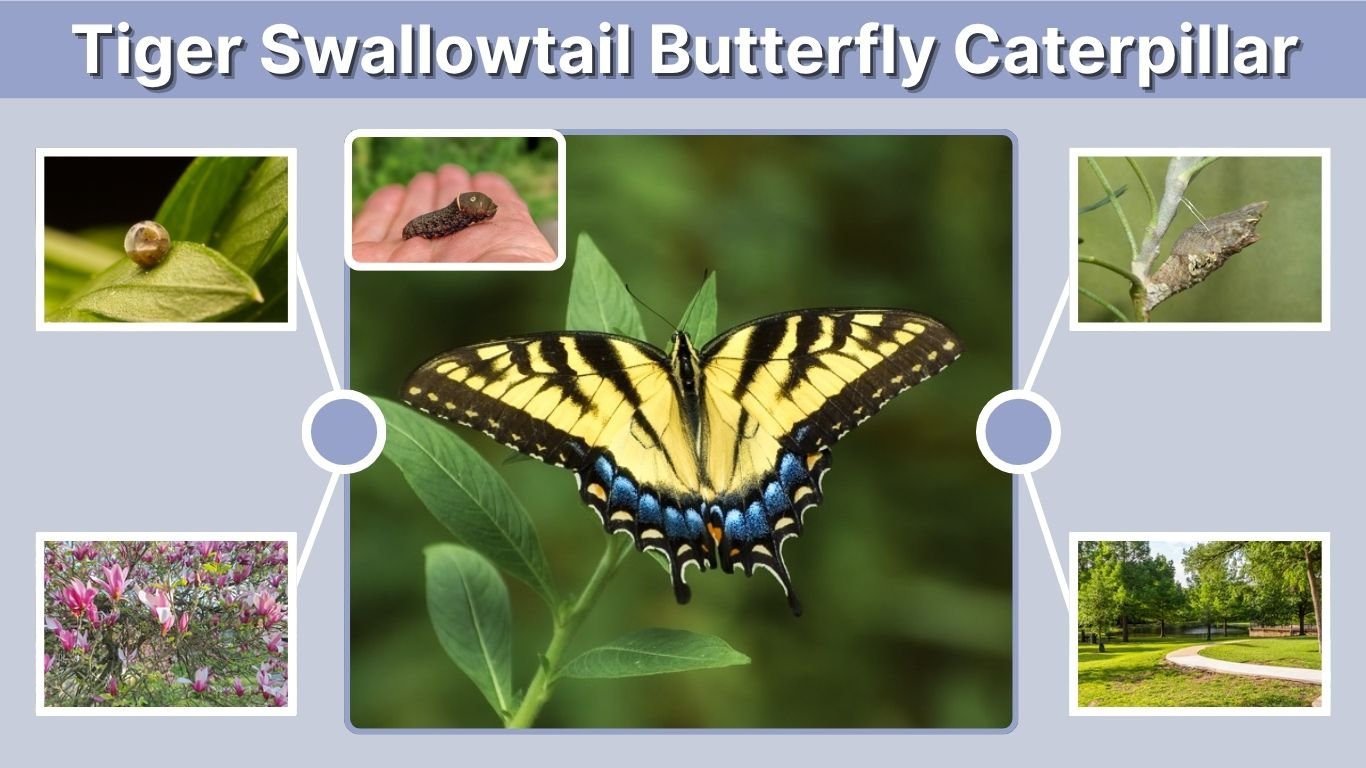
The tiger swallowtail butterfly caterpillar is a fascinating larval stage known for its green body, large false eyespots, and remarkable camouflage. Depending on the species, these caterpillars may develop into eastern, western, Canadian, Appalachian, or other tiger swallowtail butterflies. They feed on specific host plants and pass through several growth stages before forming a chrysalis. Understanding their appearance, diet, habitat, life cycle, and defensive behavior makes it much easier to identify these impressive caterpillars in gardens, forests, and natural areas.
What Does a Tiger Swallowtail Butterfly Caterpillar Look Like?
Tiger swallowtail caterpillars change dramatically as they grow. Young larvae often look quite different from mature ones, which can make identification confusing. Early stages may resemble bird droppings, while older caterpillars usually become smooth and green. Their most recognizable feature is a pair of large false eyespots near the front of the body.
Tiger Swallowtail Caterpillar Identification
Common identification features include:
- Smooth, plump body
- Green coloration in later stages
- Large false eyespots near the head
- Small actual head tucked below the eye markings
- Yellow or pale band behind the false eyes
- Short thoracic segments
- Brown coloration before pupation
- Forked defensive organ called an osmeterium
Why Does It Look Like a Snake?
The large eyespots of a mature tiger swallowtail caterpillar create the illusion of a much larger animal. When viewed from the front, the caterpillar may resemble a tiny snake.
This form of mimicry can make predators hesitate before attacking. The caterpillar may also pull its head inward and enlarge the front of its body, strengthening the snake-like appearance.
Types of Tiger Swallowtail Caterpillars
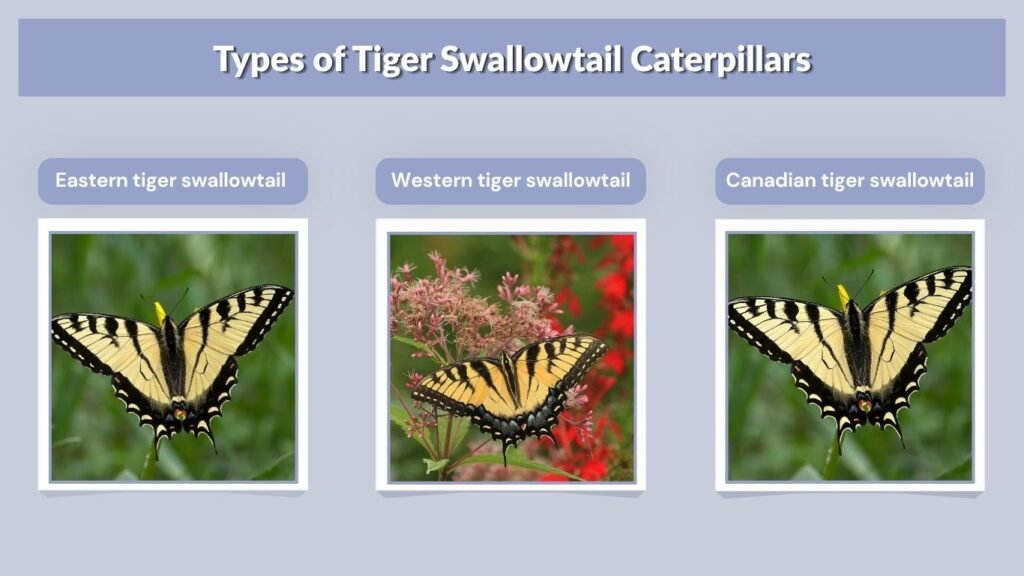
Several closely related tiger swallowtail species live across North America. Their caterpillars often look similar, so geographic location and host plants can be important clues. Eastern and western tiger swallowtails are among the best known, but Canadian and Appalachian tiger swallowtails also occur in suitable habitats.
Common Tiger Swallowtail Species
Important types include:
- Eastern tiger swallowtail – Common throughout much of eastern North America.
- Western tiger swallowtail – Found mainly across western regions.
- Canadian tiger swallowtail – Common in Canada and cooler northern areas.
- Appalachian tiger swallowtail – Associated mainly with the Appalachian region.
- Two-tailed swallowtail – A related tiger-patterned swallowtail of western North America.
Eastern Tiger Swallowtail Caterpillar
The eastern tiger swallowtail caterpillar becomes bright green as it matures. Its large yellow-and-black false eyespots are located near the front of the body.
It commonly feeds on trees such as tulip tree, wild cherry, ash, birch, and magnolia. Before pupation, the caterpillar usually changes from green to brown as it prepares to leave its feeding area.
Western Tiger Swallowtail Caterpillar
The western tiger swallowtail caterpillar is also green and possesses prominent false eyespots. It occurs primarily in western North America.
Its host plants commonly include willow, poplar, cottonwood, alder, and certain fruit trees. Mature caterpillars may be discovered on trees near streams, parks, roadsides, and wooded landscapes.
What Do Tiger Swallowtail Caterpillars Eat?
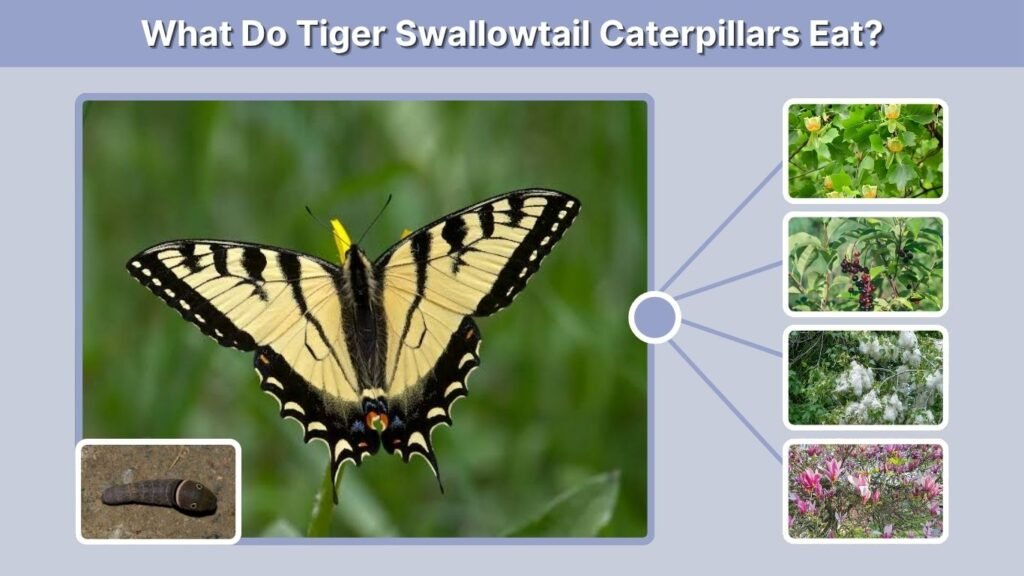
Tiger swallowtail caterpillars feed mainly on the leaves of trees and shrubs rather than small garden herbs. The exact host plant depends on the species and region. Adult females carefully select appropriate plants when laying eggs because newly hatched caterpillars need suitable foliage immediately after emerging.
Tiger Swallowtail Caterpillar Host Plants
Common host plants may include:
- Tulip tree
- Wild cherry
- Willow
- Birch
- Ash
- Cottonwood
- Poplar
- Magnolia
- Sweetbay
- Alder
- Sycamore
- Aspen
What Does an Eastern Tiger Swallowtail Caterpillar Eat?
Eastern tiger swallowtail caterpillars often feed on tulip tree, black cherry, sweetbay magnolia, birch, and ash.
They normally remain on their host plant while growing through several larval stages. Young caterpillars typically rest on leaves when they are not feeding, and older larvae may consume larger portions of foliage as they prepare for pupation.
What Does a Western Tiger Swallowtail Caterpillar Eat?
Western tiger swallowtail larvae commonly use willow, cottonwood, poplar, alder, and related trees.
The caterpillar’s preferred host plant can vary according to local plant availability. Because tiger swallowtails rely heavily on trees and shrubs, they may be found higher above the ground than caterpillars that feed primarily on herbs.
Tiger Swallowtail Butterfly Caterpillar Life Cycle
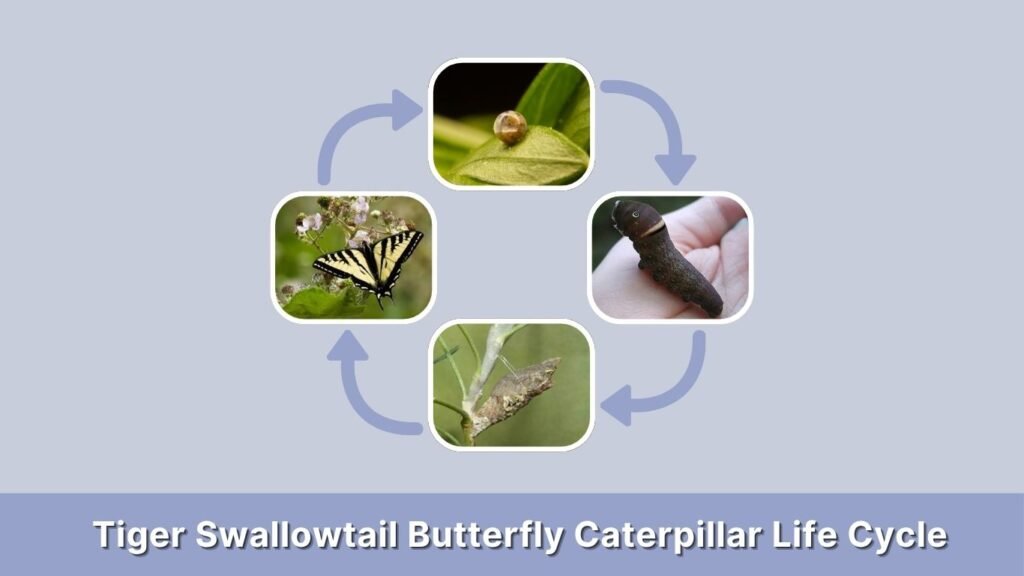
The tiger swallowtail undergoes complete metamorphosis, passing through egg, larva, pupa, and adult butterfly stages. Environmental temperature, location, season, and species influence how quickly development occurs. Caterpillars grow rapidly during warm weather but may spend considerably longer in the chrysalis stage when overwintering.
Egg Stage
Female tiger swallowtails usually place individual eggs on suitable host plant leaves.
The eggs are small and generally round or slightly dome-shaped. After several days, depending on temperature, a tiny caterpillar emerges and begins feeding on the surrounding leaf tissue.
Caterpillar Stages
The larval period contains several growth stages called instars. The caterpillar sheds its outer skin between each stage.
Young tiger swallowtail caterpillars are usually darker and may resemble bird droppings. As they mature, they become greener and develop their characteristic false eyespots.
Near the end of the caterpillar stage, the body often turns brownish.
Chrysalis Stage
When feeding is complete, the caterpillar leaves its host plant or moves to a protected location. It attaches itself with silk and forms a chrysalis.
The chrysalis is commonly brown or gray and blends into tree bark, stems, and dry vegetation. A silk girdle helps hold it securely in position.
Adult Butterfly
After metamorphosis is complete, an adult tiger swallowtail emerges from the chrysalis.
The butterfly expands and dries its wings before taking flight. Adult tiger swallowtails typically feed on flower nectar and can often be observed visiting gardens, fields, woodland edges, and wet soil.
How Tiger Swallowtail Caterpillars Defend Themselves
Tiger swallowtail caterpillars have several defense mechanisms that help compensate for their slow movement. Camouflage is their first line of protection, but false eyespots and chemical defenses provide additional protection. These adaptations can make the caterpillar appear larger and more threatening than it really is.
Main Defense Methods
Their defenses include:
- Green camouflage among leaves
- Bird-dropping mimicry in early stages
- Large false eyespots
- Snake-like appearance
- Head-retracting behavior
- Osmeterium deployment
- Strong defensive odor
- Brown camouflage before pupation
What Is the Osmeterium?
The osmeterium is a forked organ hidden behind the caterpillar’s head. When threatened, the caterpillar pushes it outward.
This structure may be orange, red, or yellowish and releases a strong-smelling chemical. The odor can discourage ants, spiders, and other predators from continuing an attack.
The osmeterium looks dramatic, but it is not a venomous stinger.
Are Tiger Swallowtail Caterpillars Poisonous?
Tiger swallowtail caterpillars may look intimidating because of their large eyespots and defensive organ, but they are not considered dangerous caterpillars for people. Their appearance is primarily designed to frighten or confuse predators rather than injure humans.
Can Tiger Swallowtail Caterpillars Sting?
Tiger swallowtail caterpillars do not possess the venomous hairs or stinging spines seen in some moth caterpillars.
Their smooth body makes them relatively easy to distinguish from many stinging species. The osmeterium may release an unpleasant odor when the caterpillar feels threatened, but it does not function as a stinger.
Is It Safe to Touch One?
Gentle contact is unlikely to cause problems for most people, but unnecessary handling should be avoided.
Caterpillars have delicate bodies and can be injured through squeezing, dropping, or repeated handling. If one must be moved, allowing it to crawl onto a leaf or twig is usually safer than picking it up directly.
Where Do Tiger Swallowtail Caterpillars Live?
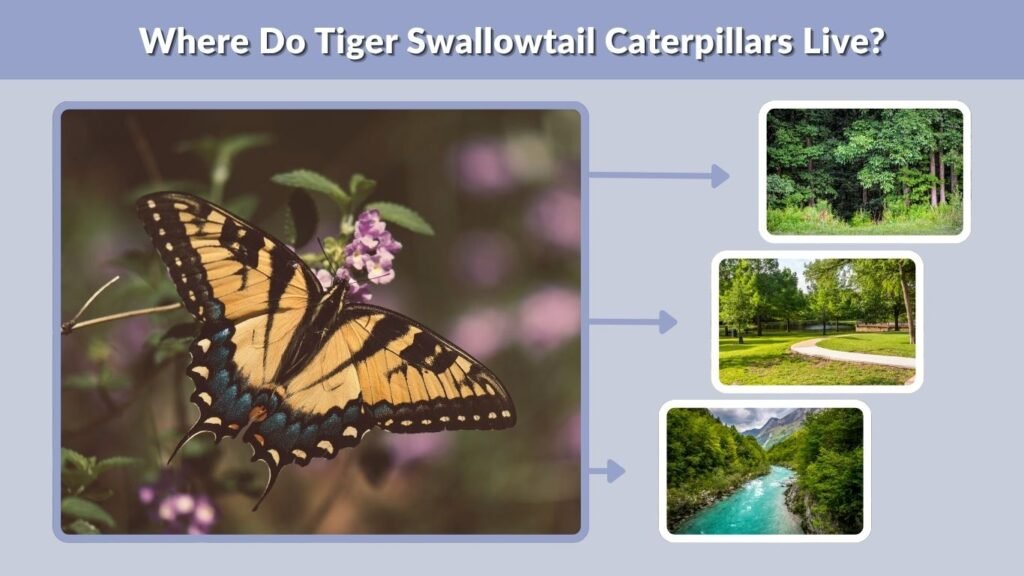
Tiger swallowtail caterpillars primarily occur wherever suitable host trees grow. Different species occupy different regions, but many favor deciduous forests, woodland edges, parks, gardens, river corridors, and suburban landscapes. Because their larvae feed on trees, people often overlook the caterpillars even when adult butterflies are commonly seen nearby.
Typical Habitat
They may be found in:
- Deciduous forests
- Woodland edges
- Gardens with mature trees
- Parks
- Stream banks
- River valleys
- Suburban landscapes
- Forest clearings
Where to Look for Caterpillars
Searching the leaves of known host trees is the most effective way to find tiger swallowtail caterpillars.
Look especially for partially eaten leaves, folded or silk-covered resting areas, and caterpillar droppings beneath foliage. Mature green caterpillars can blend exceptionally well with leaves, so careful observation is often necessary.
Tiger Swallowtail Caterpillar to Butterfly
The transformation from a tiger swallowtail caterpillar into a butterfly is one of the most remarkable parts of its life cycle. After reaching full size, the caterpillar stops feeding, changes color, and begins searching for a sheltered place to pupate.
Preparing for Pupation
A mature caterpillar often becomes restless before pupation. It may travel away from its host plant and appear darker or brownish.
Once a suitable site is found, the caterpillar produces silk, anchors its rear end, and creates a supportive silk band around its body.
Emerging as a Tiger Swallowtail Butterfly
Inside the chrysalis, larval tissues reorganize as adult butterfly structures develop.
Eventually, the chrysalis darkens shortly before emergence. The butterfly pushes its way out, hangs nearby, and pumps fluid into its folded wings. Once the wings harden and dry, the adult can begin flying and searching for nectar.
FAQs
Tiger swallowtail caterpillars are often confused with other large green caterpillars because of their color and eyespots. Their unusual appearance also leads to questions about their diet, safety, host plants, and transformation. These common questions can help with quick identification and understanding of their behavior.
What does a tiger swallowtail butterfly caterpillar look like?
A mature tiger swallowtail caterpillar is usually smooth and green with two prominent false eyespots near its head. Younger caterpillars are darker and may resemble bird droppings.
What does a tiger swallowtail butterfly caterpillar eat?
Tiger swallowtail caterpillars feed on tree leaves. Depending on the species, host plants may include tulip tree, wild cherry, willow, birch, ash, cottonwood, poplar, magnolia, and alder.
Is a tiger swallowtail caterpillar poisonous?
Tiger swallowtail caterpillars are not generally considered dangerous to humans. They do not have venomous stinging hairs. Their main defenses are camouflage, false eyespots, and an odor-producing osmeterium.
How long does a tiger swallowtail caterpillar take to become a butterfly?
Development time varies with temperature, season, and species. The larval stage often lasts several weeks, while the chrysalis stage may last days, weeks, or several months when the pupa overwinters.
Why does a tiger swallowtail caterpillar have big eyes?
The apparent eyes are actually false eyespots. They help make the caterpillar resemble a snake or larger animal, which can frighten or confuse potential predators.
