
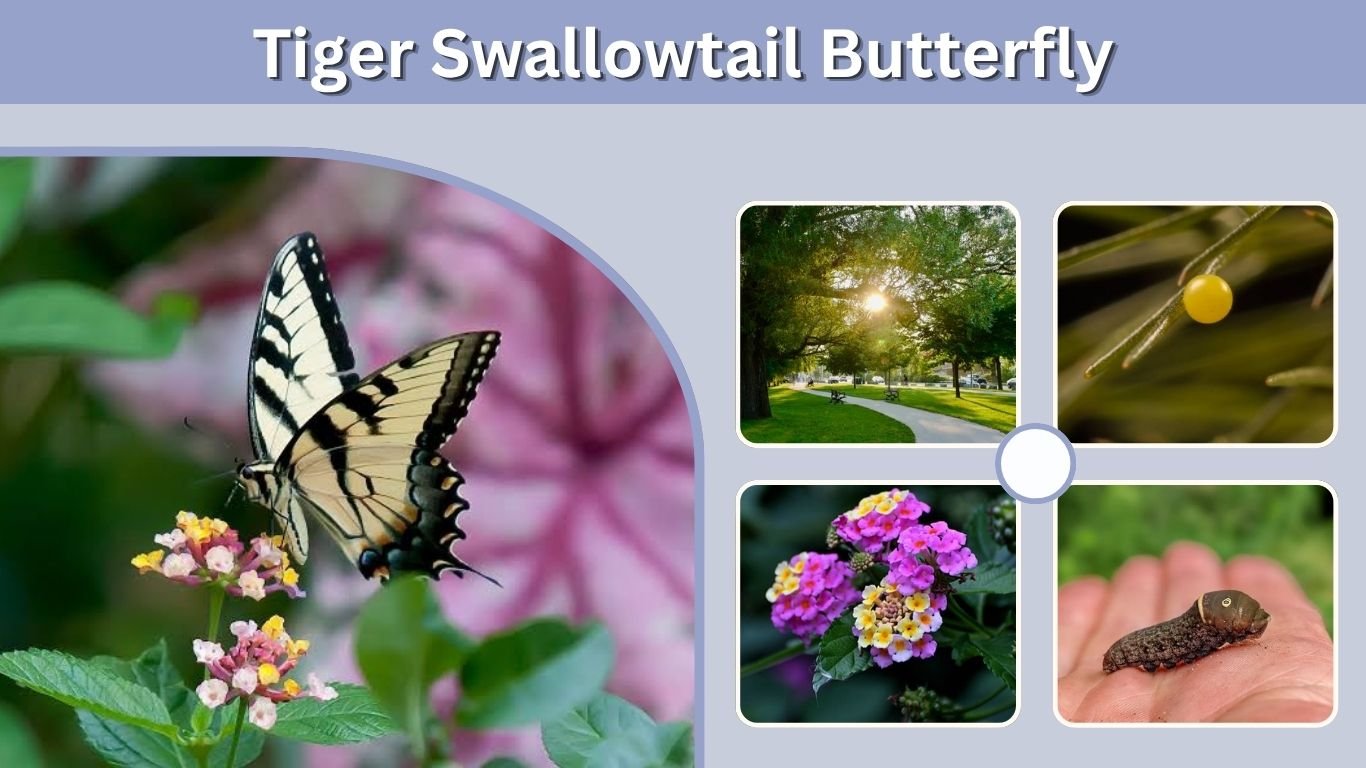
The Tiger Swallowtail butterfly is one of North America’s most recognizable butterflies, famous for its large yellow wings crossed by bold black tiger-like stripes. Several closely related species share this appearance, including the Eastern, Western, Canadian, Appalachian, and Two-Tailed Tiger Swallowtails. These butterflies commonly visit gardens, forests, parks, and woodland edges where nectar flowers and suitable caterpillar host plants grow. This guide covers Tiger Swallowtail identification, caterpillars, host plants, habitat, diet, male and female differences, life cycle, lifespan, and symbolic meaning.
What Is a Tiger Swallowtail Butterfly?
Tiger Swallowtails belong to the swallowtail family Papilionidae. The name refers to several closely related butterflies with yellow-and-black striped wings rather than a single worldwide species. In eastern North America, the Eastern Tiger Swallowtail is especially familiar, while related forms dominate western, northern, and Appalachian regions.
Common Tiger Swallowtail Species
- Eastern Tiger Swallowtail
- Western Tiger Swallowtail
- Canadian Tiger Swallowtail
- Appalachian Tiger Swallowtail
- Two-Tailed Swallowtail
- Pale Tiger Swallowtail
The Eastern Tiger Swallowtail is scientifically known as Papilio glaucus. Western Tiger Swallowtails are Papilio rutulus, while Canadian Tiger Swallowtails are Papilio canadensis.
Why Are They Called Tiger Swallowtails?
The word “tiger” refers to the dark vertical stripes crossing their yellow wings. “Swallowtail” describes the narrow tail-like extensions on the hindwings that resemble the forked tail of a swallow bird.
These tails may also help divert predator attacks away from the butterfly’s head. A bird may strike the rear of the wings instead, allowing the butterfly to escape even if part of a tail is damaged.
Tiger Swallowtail Butterfly Identification
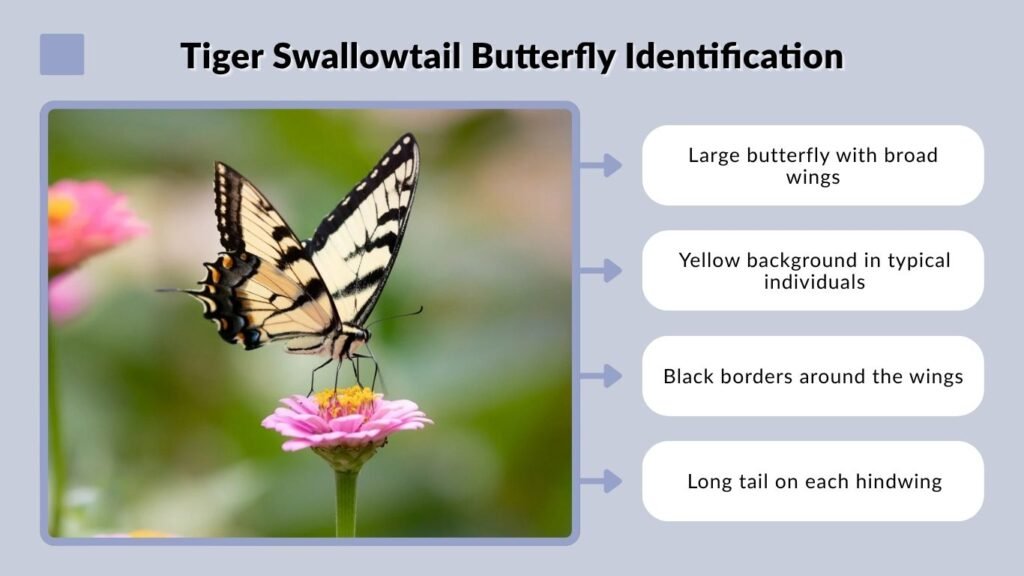
Tiger Swallowtails are large butterflies with strong flight and unmistakable wing patterns. Although yellow individuals are easiest to recognize, some females—especially Eastern Tiger Swallowtails—can occur in a dark form. Location, tail shape, wing markings, and color pattern therefore all help with identification.
Key Identification Features
- Large butterfly with broad wings
- Yellow background in typical individuals
- Four bold black tiger-like stripes on each forewing
- Black borders around the wings
- Long tail on each hindwing
- Blue markings near the lower hindwings
- Orange spots near the hindwing margins
- Wingspan commonly around 3 to 5.5 inches
- Strong, graceful flight
Eastern vs. Western Tiger Swallowtail
Eastern and Western Tiger Swallowtails appear very similar but occupy largely different geographic regions.
Eastern Tiger Swallowtails are widespread across eastern North America, while Western Tiger Swallowtails occur mainly in western regions. Western individuals generally have somewhat different stripe and hindwing patterns, but geographic location is often one of the easiest clues.
A person seeing a yellow-and-black Tiger Swallowtail in the eastern United States is therefore more likely to be looking at an Eastern Tiger Swallowtail.
Male vs. Female Tiger Swallowtail Butterfly
Male and female Tiger Swallowtails can sometimes be distinguished by their hindwing coloration. Eastern Tiger Swallowtails are especially interesting because females may be either yellow or almost entirely dark. This variation creates some of the most commonly searched identification questions surrounding the species.
Male Tiger Swallowtail
Male Eastern Tiger Swallowtails are almost always yellow.
Their wings display bold black tiger stripes, and the hindwings usually contain relatively little blue. Males frequently patrol woodland edges, hilltops, roadsides, and open spaces while searching for females.
They may also gather on damp soil to obtain minerals through a behavior known as puddling.
Female Tiger Swallowtail
Females may be yellow like males but generally display more extensive blue coloration on the hindwings.
In parts of the Eastern Tiger Swallowtail’s range, females can also occur in a dark form. These butterflies appear mostly black with blue markings and can resemble Pipevine Swallowtails.
This resemblance may provide protection because Pipevine Swallowtails contain defensive chemicals that make them unpleasant to predators.
Tiger Swallowtail Butterfly Caterpillar
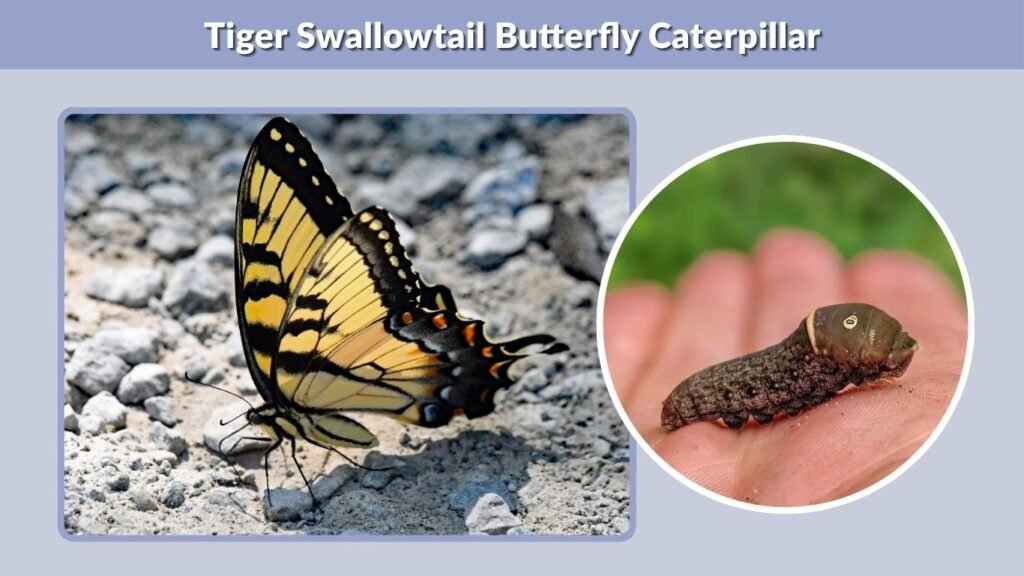
Tiger Swallowtail caterpillars look completely different from the adults. Young caterpillars are dark and often resemble bird droppings, while mature larvae become smooth and green. Their unusual markings and defensive adaptations make them particularly interesting to gardeners and butterfly enthusiasts.
Caterpillar Identification
- Young larvae are dark brown or blackish.
- Early stages may resemble bird droppings.
- Mature caterpillars become bright green.
- Two large false eyespots appear near the front.
- A pale yellow band may cross the body.
- The real head is much smaller than the false eyes suggest.
- The body becomes thick and smooth before pupation.
- An orange defensive osmeterium can appear when threatened.
Why Does the Caterpillar Have Fake Eyes?
The large markings near the front of a mature caterpillar are not real eyes. They create the appearance of a much larger animal, possibly resembling a snake.
This type of mimicry can discourage birds and other predators from attacking.
Like other swallowtail caterpillars, Tiger Swallowtail larvae also possess an osmeterium. When threatened, this orange, fork-shaped organ emerges from behind the head and releases a strong odor.
Tiger Swallowtail Butterfly Host Plants
Female Tiger Swallowtails lay eggs on plants their caterpillars can safely eat. Host plants vary somewhat between different Tiger Swallowtail species and geographic regions. Trees are especially important, making woodland edges, wooded neighborhoods, and gardens containing native trees excellent breeding habitat.
Common Host Plants
- Tulip tree
- Wild cherry
- Black cherry
- Sweetbay magnolia
- Ash
- Willow
- Birch
- Cottonwood
- Aspen
- Sycamore
Eastern Tiger Swallowtail caterpillars commonly use tulip trees, cherries, magnolias, and ash. Western and Canadian Tiger Swallowtails may rely more heavily on willow, cottonwood, aspen, birch, and related trees depending on location.
How Females Choose Host Plants
A female inspects suitable trees before laying her eggs, often placing eggs individually on leaves.
Once a caterpillar hatches, it begins feeding on the host plant. Because larvae depend on particular trees, the presence of nectar flowers alone is not enough to create complete Tiger Swallowtail habitat.
A garden with both adult nectar sources and appropriate host trees provides much better support for reproduction.
Tiger Swallowtail Butterfly Life Cycle
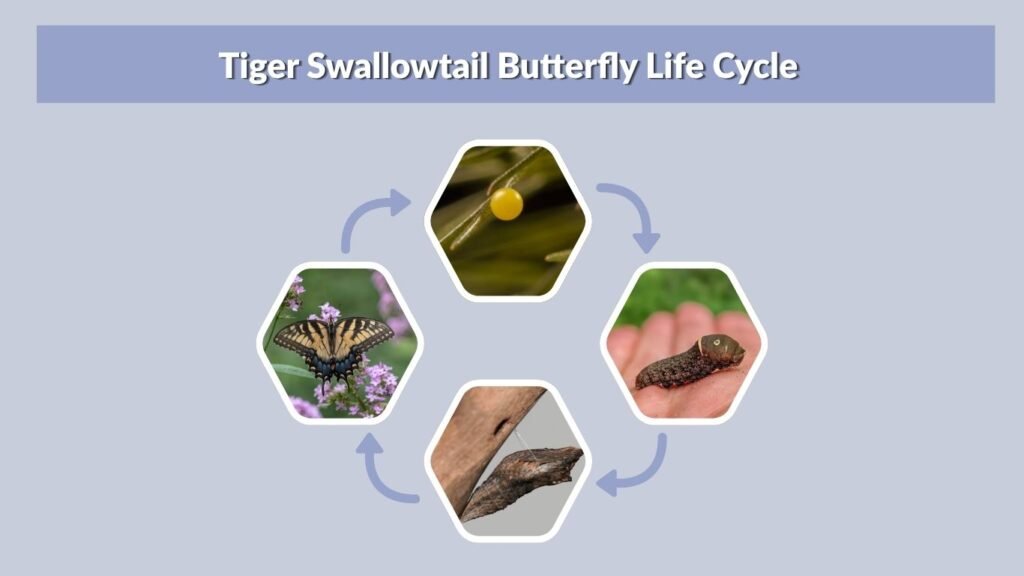
Tiger Swallowtails undergo complete metamorphosis through egg, caterpillar, chrysalis, and adult stages. Development speed changes with temperature and season. Warm-weather generations may complete the cycle relatively quickly, while late-season individuals can spend winter as chrysalises before emerging the following spring.
Egg and Larval Stage
Females usually lay single eggs on suitable host leaves. The newly hatched caterpillar begins feeding soon afterward.
As it grows, it passes through several instars and molts repeatedly. Its appearance changes dramatically during this period, eventually developing the characteristic green body and false eyespots.
After reaching full size, the caterpillar stops feeding and searches for a sheltered location where it can pupate.
Tiger Swallowtail Chrysalis
The mature caterpillar attaches itself to a branch, stem, tree trunk, or another firm surface.
Like other swallowtails, it secures itself with silk at the rear and uses a silk girdle around the middle of its body. The chrysalis may be brown or green, helping it blend into surrounding vegetation.
In summer, development may continue and produce an adult relatively quickly. Late-season pupae often enter diapause, remaining inactive through winter before emerging in spring.
Adult Stage
A newly emerged butterfly must expand and dry its wings before flying.
Once active, adults search for nectar, mates, and breeding habitat. Females eventually locate host plants and begin laying eggs, starting another generation.
Depending on climate, Eastern Tiger Swallowtails may produce more than one generation during the year.
What Do Tiger Swallowtail Butterflies Eat?
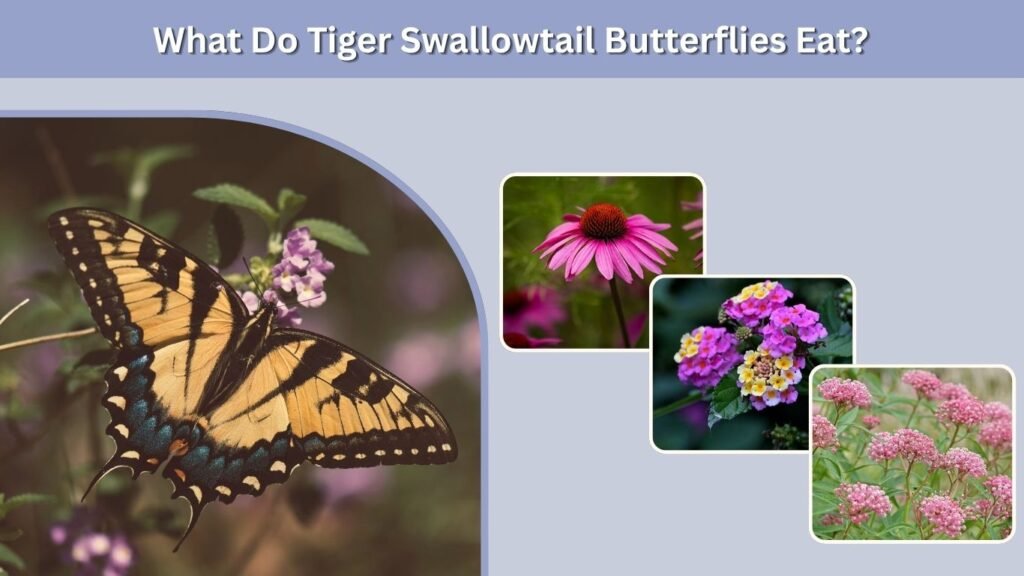
Adult Tiger Swallowtails need liquid carbohydrates for flight and reproduction, while caterpillars rely on host-plant foliage. Adults use a long proboscis to reach nectar inside flowers and can travel between many flowering plants during a single day.
Adult Food Sources
- Milkweed
- Butterfly bush
- Phlox
- Lantana
- Coneflower
- Joe-Pye weed
- Thistle
- Verbena
- Lilac
- Other nectar-rich flowers
Tiger Swallowtails may also visit damp ground, mud, animal droppings, or other mineral-rich areas. Males are particularly well known for puddling, where they absorb water and dissolved salts.
Tiger Swallowtail Butterflies Habitat and Distribution

Tiger Swallowtails occupy a broad range of habitats across North America. The exact distribution depends on species, but woodland edges are especially important because they provide caterpillar host trees along with sunny openings where adults can fly and feed.
Where Do Tiger Swallowtails Live?
Eastern Tiger Swallowtails occur widely across eastern North America. Western Tiger Swallowtails dominate many western areas, while Canadian Tiger Swallowtails occur farther north.
Suitable habitats include deciduous forests, woodland edges, parks, gardens, river corridors, roadsides, suburban neighborhoods, and open fields near trees.
Adults frequently travel into flower gardens even when their caterpillar host trees are located some distance away.
Tiger Swallowtail Lifespan and Meaning
The adult phase represents only one portion of a Tiger Swallowtail’s life. Its total development includes time spent as an egg, caterpillar, and chrysalis. Butterflies have also gained symbolic meanings in many cultures, although these interpretations come from human traditions rather than biological characteristics.
How Long Does a Tiger Swallowtail Live?
Adult Tiger Swallowtails generally live for several weeks, though lifespan varies with weather, predators, food availability, and reproductive activity.
Individuals that overwinter as chrysalises spend much longer completing their full life cycle. In these cases, the pupal stage can last for several months before the adult emerges.
Tiger Swallowtail Butterfly Meaning
Tiger Swallowtails are often associated symbolically with transformation, change, optimism, freedom, and personal growth.
Their transformation from caterpillar to butterfly naturally contributes to these interpretations. Yellow butterflies are also sometimes connected with happiness, hope, or positive change.
These meanings are cultural or personal rather than scientific. Seeing a Tiger Swallowtail does not have a scientifically established spiritual message.
FAQs
Is a Tiger Swallowtail butterfly yellow and black?
Most Tiger Swallowtails have yellow wings with bold black stripes. However, some female Eastern Tiger Swallowtails occur in a dark form that is primarily black with blue markings.
What do Tiger Swallowtail caterpillars eat?
They feed on leaves of specific host trees. Common hosts include tulip tree, wild cherry, magnolia, ash, willow, birch, cottonwood, and aspen, depending on the species and location.
What does a Tiger Swallowtail caterpillar look like?
Mature caterpillars are usually green with two large false eyespots near the front. Young caterpillars are darker and often resemble bird droppings.
How long does a Tiger Swallowtail butterfly live?
Adults generally survive for several weeks. The full life cycle lasts longer and can include several months spent as an overwintering chrysalis.
What is the difference between male and female Tiger Swallowtails?
Male Eastern Tiger Swallowtails are typically yellow with relatively little blue on the hindwings. Females generally have stronger blue markings and may occur in either yellow or dark forms.
