

Dragonflies are among the most fascinating insects in the natural world. Known for their vibrant colors, swift flight, and impressive hunting skills, they have captured human curiosity for centuries. With around 5,000 species found worldwide, dragonflies come in an incredible variety of shapes, sizes, and colors. Each species has its own unique features that make it stand out, whether it’s the bright blue body of the Blue Dasher or the striking yellow rings of the Golden-ringed Dragonfly.
In this guide, we’ll explore 25 different types of dragonflies, highlighting their key identification points, habitats, and behaviors. Whether you are a nature enthusiast, a photographer, or simply curious about these beautiful creatures, this list will help you recognize and appreciate the diversity of dragonflies you might encounter in the wild.
1.Common Green Darner

The Common Green Darner (Anax junius) is one of the largest and most easily recognized dragonflies in North America. With its bright green thorax and powerful flying ability, it is often seen near ponds, lakes, and wetlands throughout the warmer seasons.
Habitat
Common Green Darners are typically found around freshwater habitats such as ponds, marshes, lakes, and slow-moving rivers. They are also known for their seasonal migrations.
Behavior
These dragonflies are agile fliers and aggressive hunters. They patrol open areas, often capturing mosquitoes, flies, and other small insects mid-air.
Identification
- Bright green thorax
- Males have a blue abdomen; females have a greenish to brown abdomen
- Body length around 7 to 8 centimeters (approximately 3 inches)
- Clear wings with a slight amber tint at the bases
- Large, touching eyes at the top of the head
- Slender, elongated body
2. Blue Dasher

The Blue Dasher (Pachydiplax longipennis) is a small but striking dragonfly commonly found across North America. It is well known for its vivid blue coloration and energetic behavior around ponds and marshes.
Habitat
Blue Dashers prefer still or slow-moving freshwater bodies like ponds, lakes, and marshy areas with abundant vegetation.
Behavior
These dragonflies are active hunters, often perching on stems or twigs near water, ready to dart after prey.
Identification
- Bright blue abdomen in males; females are brown with yellow stripes
- White face with large compound eyes
- Wings often have a smoky patch near the tips
- Body length about 3 to 4 centimeters
- Slightly flattened, slender body
3. Twelve-spotted Skimmer

The Twelve-spotted Skimmer (Libellula pulchella) is an attractive dragonfly known for the bold black and white patches on its wings, making it easily identifiable.
Habitat
It is usually seen near ponds, lakes, marshes, and slow streams, especially where aquatic vegetation is plentiful.
Behavior
Twelve-spotted Skimmers often perch on tall reeds or branches, surveying their territory and flying in short bursts to catch insects.
Identification
- Twelve black spots (three on each wing)
- White patches between the black spots on mature males
- Dark brown body with lighter markings
- Body length about 5 to 5.5 centimeters
- Broad wings giving a “spotted” appearance
4. Eastern Pondhawk

The Eastern Pondhawk (Erythemis simplicicollis) is a robust dragonfly widely distributed across the eastern United States, easily recognized by its green and blue coloration.
Habitat
They favor ponds, lakes, marshes, and quiet backwaters with lots of aquatic plants.
Behavior
Eastern Pondhawks are fierce predators, catching insects both in the air and on vegetation. They often rest flat on the ground or low plants.
Identification
- Bright green body in females and young males
- Adult males turn powdery blue
- Clear wings without markings
- Stocky body shape
- Body length around 4 to 4.5 centimeters
5. Black Saddlebags

The Black Saddlebags (Tramea lacerata) is a unique dragonfly named for the large, dark patches on its hindwings that look like saddlebags.
Habitat
They inhabit ponds, lakes, and wetlands, and are also commonly seen gliding over open fields during migration.
Behavior
Black Saddlebags are strong fliers, often seen soaring effortlessly in groups, especially during late summer migrations.
Identification
- Black saddle-shaped patches on the hindwings
- Slender black body
- Long, clear forewings
- Large eyes widely spaced on the head
- Body length about 5 to 6 centimeters
6. Flame Skimmer

The Flame Skimmer (Libellula saturata) is a brilliantly colored dragonfly known for its fiery orange body and wings, mostly found in the western United States.
Habitat
They are typically found near warm, still water bodies such as ponds, hot springs, and slow streams.
Behavior
Flame Skimmers often perch on exposed branches or rocks, basking in the sun before swiftly catching prey.
Identification
- Bright orange-red body and wings
- Wings often tinted orange throughout
- Large, thick body
- Deep red eyes
- Body length around 5 to 6 centimeters
7. Widow Skimmer

The Widow Skimmer (Libellula luctuosa) is a striking dragonfly recognized by its broad black and white wing markings. It is commonly found across ponds, lakes, and marshes in North America.
Habitat
Widow Skimmers prefer calm, shallow waters with abundant aquatic plants and open sunlit areas.
Behavior
They are known for their relaxed, gliding flight and often perch prominently on stems or reeds.
Identification
- Broad black bands at the base of each wing
- Mature males have white patches next to the black ones
- Powdery blue abdomen in mature males; females are brown with yellow sides
- Body length about 4 to 5 centimeters
- Wings appear wide and dramatic in flight
8. Scarlet Darter

The Scarlet Darter (Crocothemis erythraea) is a vibrant dragonfly found across Europe, Africa, and parts of Asia, known for its intense red color.
Habitat
Scarlet Darters prefer warm, sunny locations near lakes, ponds, and slow rivers.
Behavior
They frequently perch on rocks, sticks, or bare ground, darting out quickly to catch flying insects.
Identification
- Bright scarlet-red body in males
- Females are yellow-brown
- Broad, flat abdomen
- Clear wings with a slight amber base
- Body length about 3.5 to 4.5 centimeters
9. Emperor Dragonfly
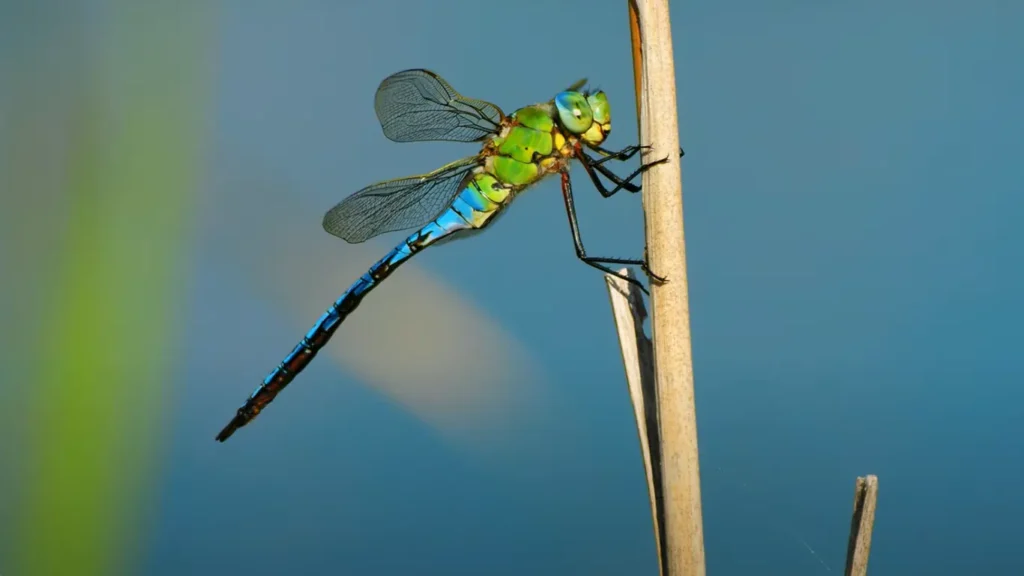
The Emperor Dragonfly (Anax imperator) is one of Europe’s largest and most powerful dragonflies, known for its brilliant colors and strong flight.
Habitat
Emperor Dragonflies are found around lakes, large ponds, and slow rivers, often hunting over open water.
Behavior
They are aggressive predators, spending much of their time on the wing patrolling large territories.
Identification
- Bright blue abdomen with a black dorsal stripe
- Green thorax
- Very large size, body length around 7 to 8 centimeters
- Clear wings with a strong, steady beat during flight
- Large greenish-blue eyes
10. Four-spotted Chaser

The Four-spotted Chaser (Libellula quadrimaculata) is a medium-sized dragonfly easily recognized by the dark spots on its wings.
Habitat
It thrives in marshes, ponds, lakes, and slow streams, particularly those with plenty of reeds and vegetation.
Behavior
Four-spotted Chasers are often territorial and will chase away intruding dragonflies from their perches.
Identification
- Four distinct dark spots — one on each wing
- Brownish body with a slight metallic sheen
- Clear wings with amber shading at the base
- Stout body about 4 to 5 centimeters long
- Fast, jerky flight patterns
11. Common Whitetail

The Common Whitetail (Plathemis lydia) is a robust and very common dragonfly across much of North America, known for its short, thick body and distinctive markings.
Habitat
Common Whitetails are found near ponds, lakes, and slow-moving rivers, often favoring areas with open water and scattered vegetation.
Behavior
They are active hunters, often flying low over the water surface to catch prey and resting frequently on open ground or rocks.
Identification
- Short, thick, chalky-white abdomen in adult males
- Brown body with three dark bands on each wing
- Females are brown with yellow side stripes
- Broad, heavy body shape
- Body length around 4 to 5 centimeters
12. Red-veined Darter
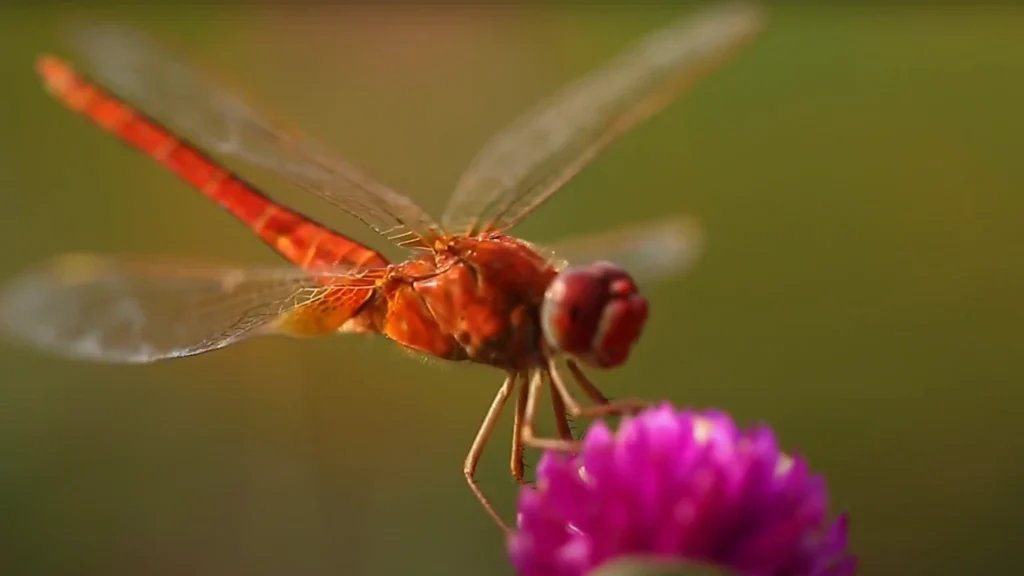
The Red-veined Darter (Sympetrum fonscolombii) is a medium-sized dragonfly known for its vivid red coloration and distinct red veins on the wings.
Habitat
It is commonly found near ponds, lakes, and shallow wetlands across Europe, Africa, and Asia.
Behavior
Red-veined Darters are highly active fliers, often seen basking on bare ground or stones in sunny areas.
Identification
- Bright red body in males; females are yellow-brown
- Prominent red veins in the wings
- Broad, flat abdomen
- Clear wings with a slight amber tint near the base
- Body length about 3.5 to 4.5 centimeters
13. Yellow-winged Darter

The Yellow-winged Darter (Sympetrum flaveolum) is a colorful dragonfly recognized for its distinctive yellow-tinged wings and bright body color.
Habitat
This species prefers marshes, ponds, and lakes with still or slow-flowing water, often in open sunny areas.
Behavior
Yellow-winged Darters often perch low on vegetation or the ground, launching quick flights to hunt.
Identification
- Golden-yellow wings with noticeable yellow bases
- Red body in males; yellowish-brown body in females
- Short, broad abdomen
- Small to medium size, about 3.5 to 4 centimeters
- Clear, shiny appearance when basking
14. Wandering Glider

The Wandering Glider (Pantala flavescens) is one of the most widespread dragonflies globally, known for its impressive migratory behavior.
Habitat
Wandering Gliders are found near temporary water bodies, rice fields, ponds, and puddles, especially after rains.
Behavior
They are strong flyers and rarely perch, often seen gliding effortlessly over open fields and roads.
Identification
- Yellowish body with a slightly flattened abdomen
- Clear wings with a broad base
- Large, broad hindwings for gliding
- Body length about 4 to 5 centimeters
- Large reddish-brown eyes
15. Halloween Pennant

The Halloween Pennant (Celithemis eponina) is a beautiful dragonfly that looks like a small, colorful flag fluttering in the wind.
Habitat
It prefers calm freshwater habitats like ponds, lakes, and marshes with lots of emergent vegetation.
Behavior
Halloween Pennants often perch at the tips of tall grass or reeds, swaying gently in the breeze.
Identification
- Orange wings with dark brown bands
- Pale orange to reddish body
- Wings often spread horizontally when perched
- Body length about 3.5 to 4 centimeters
- Large eyes that are reddish in adults
16. Banded Pennant
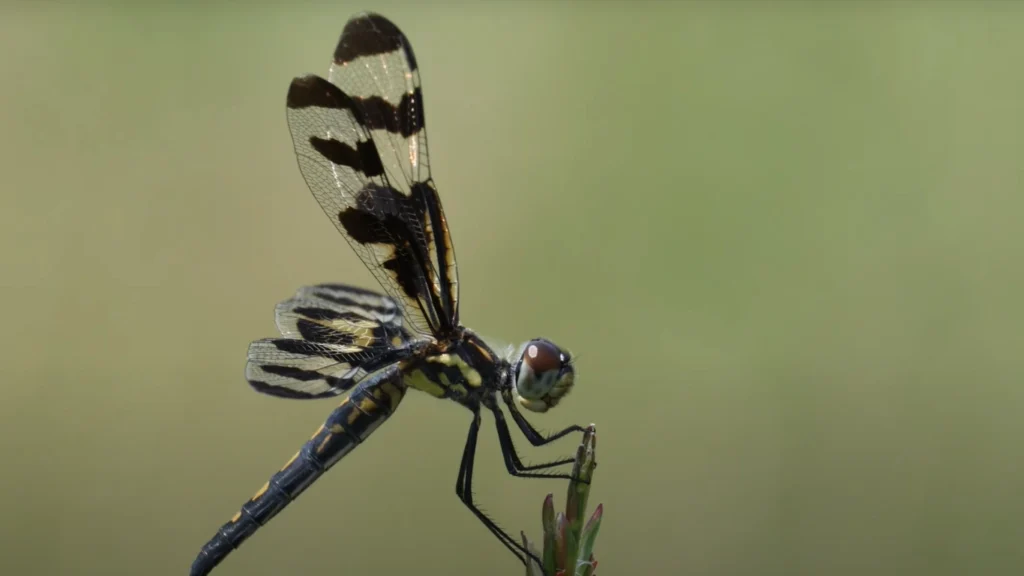
The Banded Pennant (Celithemis fasciata) is a striking dragonfly with distinctively banded wings, common in the eastern United States.
Habitat
They inhabit ponds, lakes, and marshes, especially where there is open space for hunting.
Behavior
Banded Pennants are calm flyers and often glide above open water or perch on exposed stems.
Identification
- Clear wings with dark brown bands
- Bluish body in males; females have a brownish body
- Broad, slightly curved abdomen
- Wings often spread widely at rest
- Body length around 3.5 to 4 centimeters
17. Roseate Skimmer

The Roseate Skimmer (Orthemis ferruginea) is one of the most beautiful dragonflies in the Americas, admired for its vibrant pink and purple hues. Males have an unmistakable rosy pink body with violet eyes, making them one of the most photogenic species found near water.
Habitat
This dragonfly prefers sunny, open freshwater areas like ponds, ditches, and marshy wetlands. It often appears in disturbed or man-made water bodies as well.
Behavior
Roseate Skimmers are territorial and often seen perched on sticks or tall grasses near the water. Males display their color and flight patterns to ward off rivals and attract females.
Identification
- Rosy-pink to magenta body in mature males
- Brownish or amber body in females and juveniles
- Violet or reddish eyes
- Clear wings with a small amber patch near the base
- Slender, medium-sized body
- Body length around 4.5 to 5.5 centimeters
18. Slaty Skimmer

The Slaty Skimmer (Libellula incesta) is a sleek, dark dragonfly commonly seen across the eastern United States. It’s often mistaken for other species due to its uniform bluish-black coloring, especially among males.
Habitat
Slaty Skimmers are usually found in still or slow-moving waters like lakes, ponds, and marshy areas with plenty of shoreline vegetation.
Behavior
They tend to perch on low branches or grass tips and defend their territory aggressively against intruders, often flying short distances to chase off others.
Identification
- Slate-blue body in adult males
- Dark brown body in females with yellow side stripes
- Clear wings without any distinctive markings
- Wide thorax and short, strong abdomen
- Large brownish to blue eyes
- Body length about 4.5 to 5.5 centimeters
19. Carolina Saddlebags

The Carolina Saddlebags (Tramea carolina) is a glider-style dragonfly, known for the dark patches on its hindwings that resemble saddlebags. It’s commonly found across the southeastern United States.
Habitat
They prefer open areas near freshwater — including lakes, ponds, and even large puddles. They can also be seen migrating in groups during late summer and fall.
Behavior
Carolina Saddlebags rarely perch. Instead, they glide gracefully over open spaces, especially in fields and clearings, often appearing to dance in the air.
Identification
- Deep red to burgundy body
- Large black patches on the hindwings
- Long, clear forewings
- Slender abdomen with slight curvature
- Wingspan broader than most skimmers
- Body length around 5 to 6 centimeters
20. Metallic Pennant

The Metallic Pennant (Idiataphe cubensis) is a rare but stunning dragonfly found in the southeastern U.S., Central America, and the Caribbean. Its name comes from the shiny, metallic sheen on its thorax.
Habitat
Found near warm, quiet waters such as small lakes and wetlands. It prefers places with low vegetation and open water surfaces.
Behavior
Metallic Pennants often perch upright on plant tips and occasionally hover briefly before darting off after prey.
Identification
- Metallic blue to bronze thorax
- Dark brown to black abdomen
- Clear wings with small, dark stigmas
- Compact, streamlined body
- Eyes appear glossy under sunlight
- Body length around 3.5 to 4.5 centimeters
21. Azure Hawker

The Azure Hawker (Aeshna caerulea) is a northern species with vivid blue markings, mostly found in subarctic and alpine habitats. It’s one of the few dragonflies adapted to colder climates.
Habitat
Unlike most dragonflies, the Azure Hawker inhabits cool, acidic bogs, peatlands, and moorlands. It’s typically found in northern Europe and parts of Canada.
Behavior
It flies low and slow, basking in sunny patches on warm days. Males often patrol small areas and rest with wings spread flat.
Identification
- Brilliant blue markings on a black body (males)
- Females are brown with pale yellow spots
- Broad, rounded wings
- Dark brown to black thorax with blue side spots
- Large, rounded eyes
- Body length about 4 to 5 centimeters
22. Southern Hawker

The Southern Hawker (Aeshna cyanea) is a colorful and curious dragonfly commonly found throughout Europe. It’s known for its striking blue and green patterns and its habit of approaching humans out of curiosity.
Habitat
Southern Hawkers prefer woodland ponds, shaded lakes, and garden ponds. They thrive in freshwater environments with rich vegetation.
Behavior
They are active flyers, often seen patrolling shaded paths and overhanging water edges. Males are territorial and will circle small areas to ward off rivals.
Identification
- Bright green thorax with black stripes
- Blue markings along the black abdomen (males)
- Females have greenish or brownish abdomens
- Large, clear wings with a slight amber tint
- Very large eyes, almost touching at the top
- Body length about 7 to 8 centimeters
23. Common Hawker

The Common Hawker (Aeshna juncea) is a strong-flying dragonfly that is widely distributed across northern Europe, Asia, and parts of North America. It is well adapted to cooler climates.
Habitat
It inhabits acidic wetlands, moorland pools, and peat bogs, favoring remote areas with limited human disturbance.
Behavior
Common Hawkers are swift and powerful in flight, often patrolling large areas of open water and occasionally venturing over land.
Identification
- Dark body with blue (males) or yellow (females) spots
- Greenish thorax with yellow side stripes
- Clear wings with a dark brown stigma
- Long, slender body
- Prominent brown to blue eyes
- Body length about 7 to 7.5 centimeters
24. Golden-ringed Dragonfly
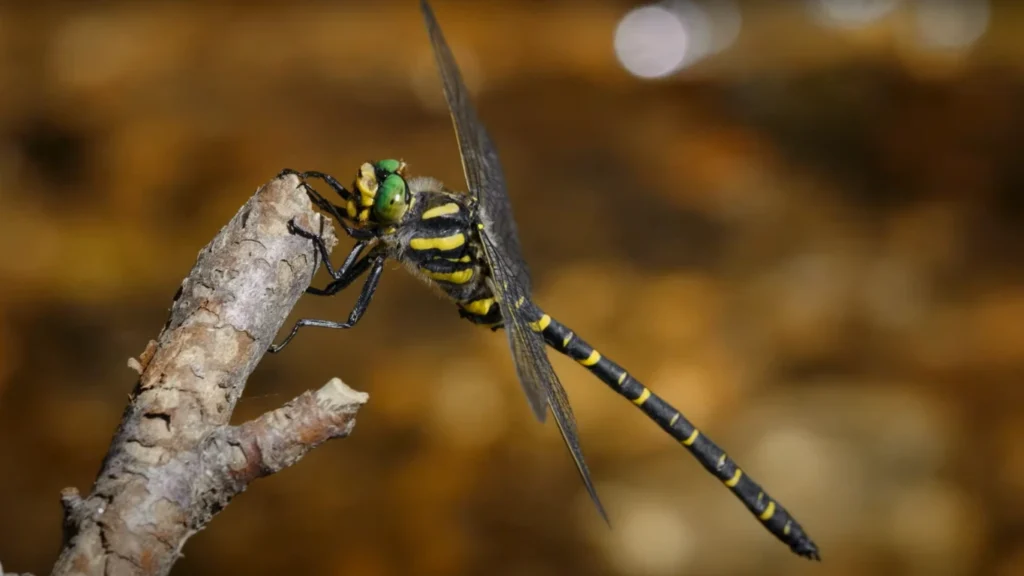
The Golden-ringed Dragonfly (Cordulegaster boltonii) is one of Britain’s largest dragonflies, easily identified by its striking black and yellow body.
Habitat
Golden-ringed Dragonflies favor clean, fast-flowing streams and rivers, especially in upland and moorland regions.
Behavior
They are strong fliers and highly territorial. They patrol long stretches of streams, often flying close to the water’s surface.
Identification
- Bold black body with vivid yellow rings
- Long, slender abdomen
- Clear wings with a smoky tint
- Green eyes widely spaced
- Very large body size, about 8 to 9 centimeters
25. Brown Hawker

The Brown Hawker (Aeshna grandis) is a large and powerful dragonfly recognized by its warm brown body and amber-tinted wings.
Habitat
They prefer still or slow-moving waters such as lakes, ponds, canals, and ditches, often with plenty of floating vegetation.
Behavior
Brown Hawkers are strong, fast fliers. They often patrol the edges of water bodies and occasionally rest in shaded areas like trees or shrubs.
Identification
- Chocolate brown body
- Amber-colored wings
- Blue spots along the sides of the abdomen in males
- Broad wingspan with robust build
- Brown to reddish eyes
- Body length around 7.5 to 8 centimeters
