

Joro spiders are large, colorful arachnids that have recently gained attention for rapidly spreading across the southeastern United States. But are they dangerous? Can they fly? Should you be worried? In this detailed guide, we answer 38 of the most common questions about Joro spiders—including their appearance, bite, behavior, venom, diet, and geographic range. Whether you’re curious or concerned, this breakdown offers everything you need to know about these striking invasive spiders.
Basic FAQs

What is a Joro spider?
The Joro spider (Trichonephila clavata) is a large, brightly colored orb-weaving spider originally from East Asia—specifically Japan, China, Korea, and Taiwan. It gets its name from “Jorōgumo,” a mythical Japanese creature described as a spider woman. Joro spiders were first spotted in the U.S. around 2013 and have since spread across several states.
They are easily identified by their:
- Bright yellow and blue patterned abdomen
- Long black legs with yellow bands
- Large, symmetrical golden orb webs
Females are much larger and more striking than males, often reaching up to 3 inches across (including leg span).
What are Joro spiders?
Joro spiders belong to the orb-weaver family (Araneidae) and are known for spinning strong, golden webs. Unlike many spider species, Joro spiders are diurnal (active during the day), which makes their webs more visible in sunlight. While they may appear alarming due to their size and color, they are not aggressive toward humans or pets.
Are Joro spiders real?
Yes, Joro spiders are very real. They are an introduced species in the southeastern United States, most notably in Georgia, and their population is growing. Despite online rumors and exaggerated fears, they are a documented, scientifically studied spider species with no proven danger to humans.
Is the Joro spider an orb weaver?
Yes, the Joro spider is a true orb weaver. It creates classic circular webs—often up to 3 feet wide—with a golden shimmer, especially visible in sunlight. These webs are not just decorative; they are functional, helping the spider catch a variety of flying insects like mosquitoes, stink bugs, and even small wasps.
FAQs About Venom, Bite & Safety

Are Joro spiders venomous?
Yes, Joro spiders are venomous, like most spiders. They use venom to immobilize and digest their insect prey. However, their venom is not harmful to humans or pets unless there’s an extremely rare allergic reaction.
Are Joro spiders poisonous?
No, Joro spiders are not poisonous. “Poisonous” refers to being harmful when touched or eaten, which does not apply to Joro spiders. They are safe to be around, even if their appearance seems intimidating.
Is Joro spider venomous?
Yes, as clarified above, Joro spiders are venomous to insects, not to humans.
Is Joro spider poisonous?
No, the Joro spider is not poisonous. Touching one does not pose a health risk, and they are not toxic by contact.
Are Joro spiders poisonous to humans?
No. While they have venom, it is not medically significant to humans. Their bite is often compared to a bee sting—mild, with little to no lasting effect unless allergic.
Are Joro spiders poisonous to dogs?
No. There are no verified cases of Joro spiders harming dogs. A bite might cause localized irritation, but it is not toxic or deadly to pets.
Do Joro spiders bite?
Yes, they can bite, but they are extremely unlikely to do so. Biting is a defensive reaction, not a common behavior. They prefer to flee when disturbed.
Do Joro spiders bite humans?
Only if provoked or handled roughly. Even then, their bite is mild, often causing little more than slight redness or a minor sting.
Can Joro spiders bite?
Yes, but their fangs are small and not adapted to pierce human skin deeply. They bite only in defense and not during normal human interaction.
Can Joro spiders bite humans?

Technically yes, but it’s very rare. They are not aggressive and will typically retreat rather than confront a person.
Are Joro spiders deadly?
No. There is no evidence that Joro spiders are deadly to humans, pets, or other large animals. Their bite is harmless in nearly all cases.
Why are Joro spiders dangerous?
Despite their appearance, they are not truly dangerous. Some people call them “dangerous” due to their invasive spread and intimidating look, but in reality:
- They are non-aggressive
- Their venom is not medically significant
- They may displace native spiders, which is more of an ecological issue than a human health risk
Are Joro spiders dangerous?
No, not in terms of health. They are more of a nuisance species than a harmful one.
Are Joro spiders bad?
They are not bad for people, but ecologists are still studying their impact on native ecosystems. While they help reduce pest insects, they may also compete with local spider species.
FAQs About Behavior & Traits

Can Joro spiders fly?
Not in the way birds or insects do—but yes, they can “fly” using ballooning.
Joro spiderlings (young spiders) release silk threads into the air, which catch wind currents and carry them over long distances. This behavior, called ballooning, is how they’ve rapidly spread across U.S. states. Adult Joro spiders, however, cannot balloon or fly.
Do Joro spiders fly?
Again, they don’t flap wings or actively fly, but they use wind-powered ballooning to move through the air as juveniles. This unique dispersal method has helped them spread fast, especially in open landscapes.
Do Joro spiders die in the winter?
Adult Joro spiders typically die in winter, especially in colder regions. However, their egg sacs survive the cold, and hatchlings emerge in spring. This life cycle makes it easy for them to come back year after year.
Can Joro spiders live in cold climates?
Yes, surprisingly, Joro spiders are cold-tolerant.
Studies show they survive temperatures as low as 32°F (0°C), making them adaptable to regions beyond the southeastern U.S. Their tolerance for cold allows them to expand into more temperate and northern areas.
FAQs About Diet
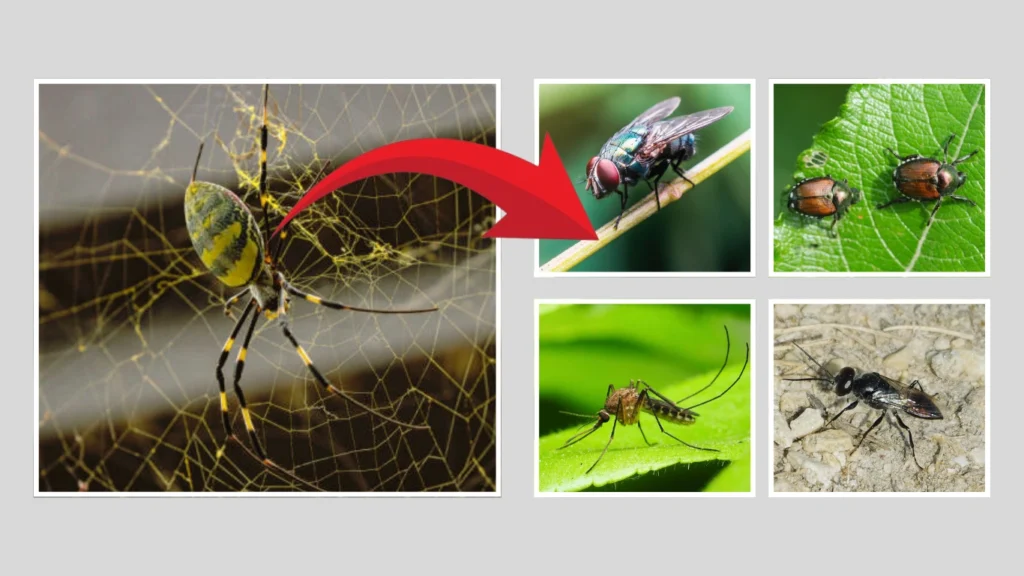
Joro spiders are highly effective predators that play a role in reducing insect populations. Their large webs and active hunting habits allow them to trap a wide range of prey.
What do Joro spiders eat?
Joro spiders primarily eat:
- Flying insects like mosquitoes, flies, and moths
- Beetles
- Wasps and stink bugs
They wait in the center of their golden web and respond quickly to vibrations caused by trapped insects. Their venom immobilizes the prey, which they then wrap in silk and consume later.
Do Joro spiders eat birds?
No, Joro spiders do not eat birds. While their webs are large enough to potentially snare very small creatures, there’s no evidence they are capable of capturing or feeding on birds.
Do Joro spiders eat hummingbirds?
This is a common myth, but again, no.
While some large orb-weavers in other parts of the world have caught hummingbirds, Joro spiders do not target birds. Their diet consists almost entirely of insects.
Do Joro spiders eat spotted lanternflies?
Yes, they have been observed eating spotted lanternflies, a major invasive pest. This behavior has led some researchers to suggest that Joro spiders could be beneficial in controlling lanternfly populations.
Do Joro spiders eat ticks?
Not directly. Ticks do not usually get caught in webs because of their crawling behavior. Joro spiders prefer aerial prey (flying or jumping insects), so ticks are not a regular part of their diet.
FAQs About Geographic Range

Joro spiders have rapidly expanded their range in the United States since they were first observed. Their ballooning behavior and adaptability to different climates make them well-suited for spreading across states.
Are Joro spiders in the US?
Yes. Joro spiders are established in the southeastern United States, particularly Georgia, where they were first reported around 2013. They have since expanded to multiple states and continue spreading north and west.
Are Joro spiders in Georgia?
Yes, Georgia is the epicenter of the Joro spider invasion in the U.S. They are extremely common in both urban and rural areas throughout the state, especially during late summer and early fall.
Are Joro spiders in Florida?
As of recent reports, Joro spiders have been sighted in northern Florida. Their range is expanding, and their tolerance to warmer climates makes Florida a suitable habitat.
Are Joro spiders in North Carolina (NC)?
Yes, Joro spiders have been confirmed in North Carolina, especially in areas bordering Georgia and South Carolina. Their spread into the state has been steady.
Are Joro spiders in Ohio?
There have been occasional sightings in Ohio, and experts believe it’s only a matter of time before they establish populations due to their cold tolerance.
Are Joro spiders in Pennsylvania?
Some reports suggest they are moving toward Pennsylvania, but as of now, there is no confirmed widespread population. However, they could appear soon through ballooning.
Are Joro spiders in Indiana?
Sightings have occurred, but no large population is confirmed yet. Indiana’s climate is within the range of the spider’s tolerance, making it a likely area for future spread.
Are Joro spiders in Michigan?
Not yet widespread, but their cold-hardiness means they could survive Michigan winters. Researchers are monitoring their potential to establish in the state.
Are Joro spiders in Texas?
They are not yet widespread in Texas, but their potential for long-distance travel through ballooning could eventually bring them there. Texas climates, especially in the east, are suitable for their survival.
FAQs About Invasiveness

Joro spiders are not just fascinating because of their bright color and size—they’re also a species of concern due to their rapid spread in the United States. This section covers their invasive status and potential problems they may cause.
Are Joro spiders invasive?
Yes, Joro spiders are considered invasive in the United States. Originally native to East Asia, they were accidentally introduced and have since established strong populations, especially in Georgia and surrounding states. Their ability to:
- Survive cold weather
- Reproduce quickly
- Travel long distances by ballooning
makes them highly successful invaders.
Unlike many invasive species, they don’t appear to be aggressive toward humans or pets, but their ecological impact is still being studied.
Why are Joro spiders a problem?
Joro spiders may become a problem for several reasons:
- Competition with native spiders for habitat and food
- Rapid population growth, overwhelming native species in some areas
- Public fear due to their large size and sudden presence in large numbers
However, they also help reduce populations of nuisance insects, including some invasive pests like lanternflies. Whether they are ultimately beneficial or harmful to local ecosystems is still under investigation by scientists.