

If you’ve spotted a large brown spider in your home, it’s easy to panic—especially with all the concern around the brown recluse. But not every brown spider indoors is dangerous. One commonly mistaken species is the southern house spider. Although it shares some traits with the recluse, such as color and size, these two spiders are quite different in behavior, appearance, and medical risk.
Let’s explore how to distinguish between the southern house spider and the brown recluse, and why knowing the difference can save you from unnecessary worry.
Comparison Table: Southern House Spider vs Brown Recluse
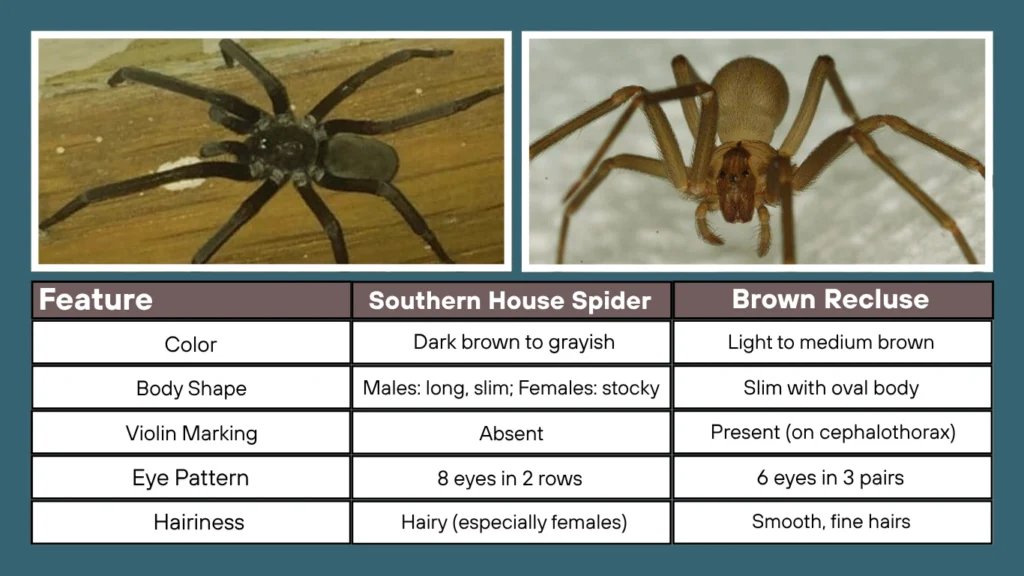
| Feature | Southern House Spider (Kukulcania hibernalis) | Brown Recluse (Loxosceles reclusa) |
| Color | Dark brown to grayish | Light to medium brown |
| Body Shape | Males: long, slim; Females: stocky | Slim with oval body |
| Violin Marking | Absent | Present (on cephalothorax) |
| Eye Pattern | 8 eyes in 2 rows | 6 eyes in 3 pairs |
| Hairiness | Hairy (especially females) | Smooth, fine hairs |
| Web Type | Messy, sheet-like near corners or crevices | Irregular retreat webs, not for catching prey |
| Bite Danger | Harmless, not medically significant | Potentially serious (necrotic bite) |
| Geographic Range | Southern U.S. | Central and Southern U.S. |
| Common Indoor Areas | Windows, wall gaps, ceilings | Closets, shoes, behind furniture |
Color and Body Structure
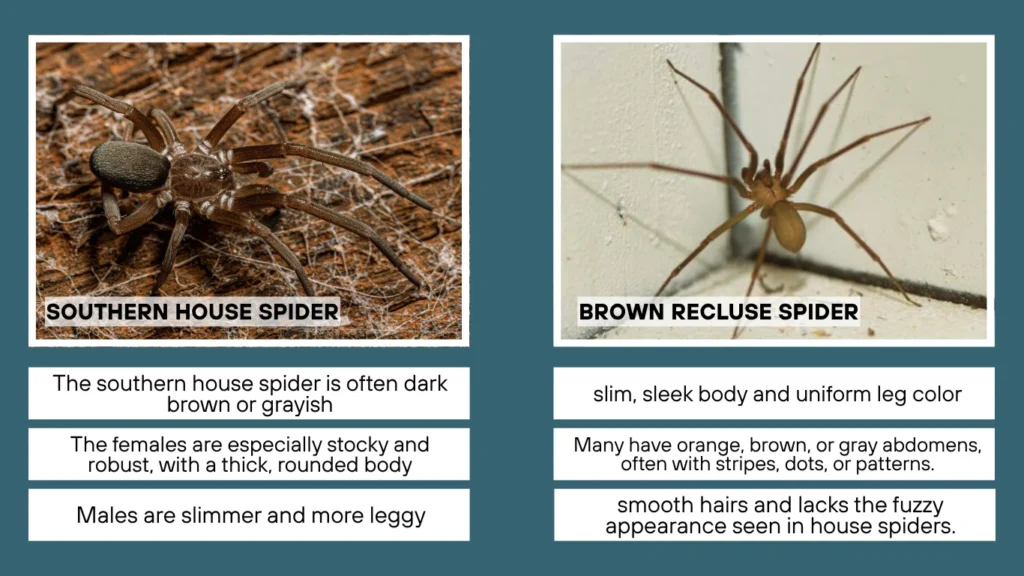
At a glance, both spiders appear brown—but the shade and body features differ.
The southern house spider is often dark brown or grayish, and the females are especially stocky and robust, with a thick, rounded body. Males are slimmer and more leggy, often mistaken for recluse spiders due to their size and speed. Their bodies are covered in fine hair, giving them a fuzzy look.
The brown recluse tends to be light to medium brown, with a slim, sleek body and uniform leg color. It has fine, smooth hairs and lacks the fuzzy appearance seen in house spiders.
Distinctive Markings
One of the most talked-about features of the brown recluse is its violin-shaped marking on its back (technically the cephalothorax). This marking can be faint or dark depending on the individual, but it’s an important identifier.
The southern house spider does not have this violin mark. Males may have slight markings or patterns on their head region, but nothing that resembles a violin.
Eye Arrangement
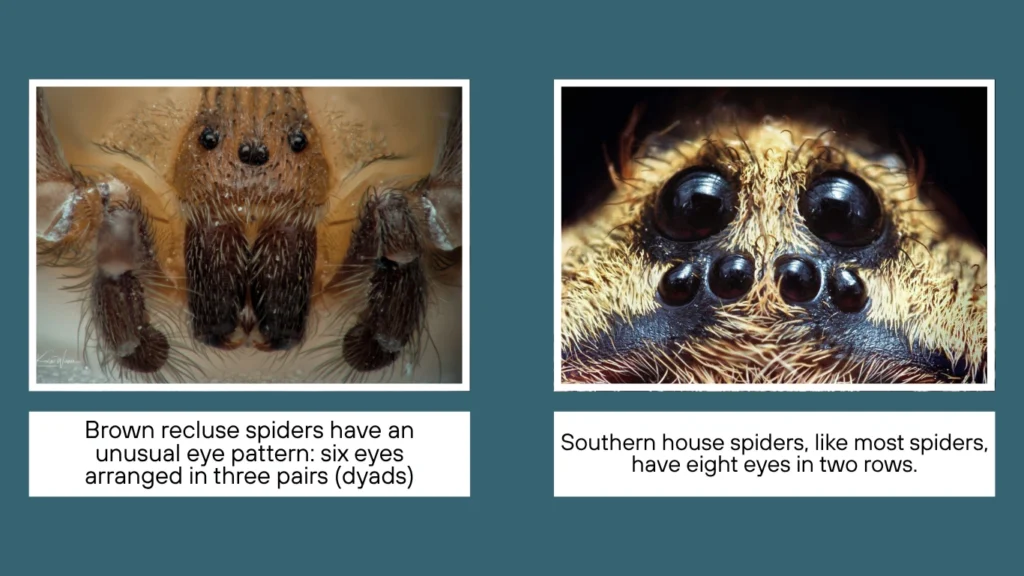
This is one of the most reliable ways to tell them apart, especially under close observation or using a magnifying tool.
- Brown recluse spiders have an unusual eye pattern: six eyes arranged in three pairs (dyads), which is rare in spiders.
- Southern house spiders, like most spiders, have eight eyes in two rows.
If you’re unsure, a close-up photo or examination under a light can often settle the question.
Web Building Behavior
Both species build non-orb webs, but for different reasons and in different ways.
- Southern house spiders spin messy, sheet-like webs, often in the corners of ceilings, under windowsills, or around cracks in walls. These webs may serve as both retreats and traps, especially for the sedentary females who rarely leave them.
- Brown recluse spiders build irregular, disorganized webs, often in dark, undisturbed areas like cardboard boxes, the inside of shoes, or behind wall hangings. Their webs are not used to catch prey but serve as safe shelters.
Behavior and Temperament
Despite its intimidating name, the southern house spider is harmless to humans. Males are active and fast-moving, often darting around looking for mates. This can cause alarm when one rushes across the floor or drops from a ceiling, but it’s all harmless.
Females stay hidden, often building permanent retreat webs and rarely moving unless disturbed. These spiders rarely bite, and when they do, the bite is no more painful than a mild insect sting.
The brown recluse is much more medically significant. Its bite can cause necrotic skin lesions, and though fatalities are extremely rare, some bites result in ulceration, scarring, or infection. That said, they are shy and non-aggressive, only biting when trapped or provoked—such as when someone puts on a shoe or shirt where the spider is hiding.
Where They’re Found Indoors
- Southern house spiders love to build near windows, doors, ceiling corners, vents, and anywhere they can find a narrow crevice. In older buildings with gaps or high humidity, they’re more likely to settle in.
- Brown recluses prefer quiet, undisturbed locations, like:
- Under furniture
- Inside closets
- Inside shoes
- Behind wall trim
- Under furniture
Because their favorite hiding spots overlap in southern regions of the U.S., it’s common for house spiders to be misidentified as brown recluses.
Venom and Risk to Humans
Here’s the key difference: only the brown recluse poses a serious medical risk.
- Southern house spiders have weak venom, and even if they bite (which is rare), symptoms are minimal—slight redness or itching at most. They do not have necrotic venom.
- Brown recluse bites, on the other hand, can lead to:
- Pain
- Redness and blistering
- Skin ulceration
- Secondary infection
- In rare cases, systemic symptoms like fever or nausea
- Pain
Prompt medical attention can prevent most complications, especially if the bite is caught early.
FAQs
1. Why do people confuse southern house spiders with brown recluses?
Because male southern house spiders are brown, fast-moving, and about the same size as a recluse. Without seeing the eyes or markings, it’s easy to mistake one for the other.
2. Do either of these spiders jump or chase humans?
No. Both species avoid human contact. Southern house spiders might appear bold because the males are active, but they do not chase or jump at people.
3. Should I kill a southern house spider if I find one?
No need. It’s harmless and actually beneficial, eating insects like flies, moths, and roaches. If you prefer, gently remove it and release it outdoors.
4. How do I safely check if a spider is a recluse?
Look for the violin marking, eye pattern (6 vs. 8 eyes), and body texture. If you’re still unsure, capture the spider in a jar and consult a local pest expert or entomologist.
5. Are brown recluses common in all U.S. states?
No. They are mostly found in the central and southern United States—especially Missouri, Kansas, Texas, and neighboring states. Sightings outside these areas are rare and often misidentifications.