

If you’re tired of battling spider mites, thrips, and fungus gnats, predatory mites might be your best natural solution. These tiny but mighty allies help keep pest populations under control without chemicals. In this guide, I’ll walk you through 15 effective predatory mite species, their appearance, habitats, and what pests they target—perfect for gardeners, farmers, and greenhouse growers alike.
1. Phytoseiulus persimilis

Phytoseiulus persimilis is a highly effective predatory mite commonly used in greenhouses and gardens to control spider mite infestations. It’s particularly known for targeting the two-spotted spider mite with precision and speed.
This mite is small, typically around 0.5 mm in length. It has a distinctive bright orange to reddish color, which makes it easier to identify compared to other predatory mites. Its body is pear-shaped and more elongated than the pests it preys on.
Phytoseiulus persimilis prefers warm, humid environments and is most often found in indoor plant settings, greenhouses, or heavily vegetated outdoor areas where spider mites are present.
2. Neoseiulus californicus

Neoseiulus californicus is a versatile predatory mite used for managing a variety of pests, especially spider mites and thrips. It adapts well to fluctuating humidity and temperature conditions, making it suitable for both greenhouse and outdoor use.
It measures around 0.4–0.5 mm in size and is translucent beige to light tan in color. Its body is slightly oval and less brightly colored than Phytoseiulus persimilis.
This mite thrives in warm environments and is often introduced to crops like strawberries, cucumbers, and ornamental plants. It performs well in both dry and moderately humid climates.
3. Amblyseius swirskii

Amblyseius swirskii is a popular generalist predator, known for feeding on thrips, whiteflies, and spider mites. It’s especially favored in integrated pest management (IPM) programs for crops like peppers and cucumbers.
It is about 0.5 mm long, with a pale tan or light yellow body. Under magnification, you might notice its slightly shiny, smooth appearance.
Native to the Mediterranean region, Amblyseius swirskii prefers warm, humid environments and is commonly used in greenhouse settings and indoor farming operations.
4. Amblyseius andersoni

Amblyseius andersoni is a highly adaptable predatory mite that preys on a wide range of small pests, including spider mites, russet mites, and pollen. It remains active in cooler temperatures compared to many other mite predators.
It measures around 0.4–0.5 mm and has a translucent or pale cream-colored body, sometimes with a slightly pinkish hue depending on diet.
Found in orchards, vineyards, and greenhouses, Amblyseius andersoni is valued for its ability to function in varying climates and its tolerance for low humidity.
5. Neoseiulus cucumeris

Neoseiulus cucumeris is widely used to control thrips larvae and spider mites in greenhouses and indoor gardens. It is especially effective when introduced early in the growing cycle as a preventive measure.
This mite is small, around 0.35–0.45 mm in size, with a light tan or pale brown color. It has a somewhat rounded body and moves more slowly than other predatory mites.
Its preferred habitats include greenhouse vegetables, ornamental plants, and strawberries. It thrives in moderate to high humidity and performs well in shaded or leaf-dense environments.
6. Galendromus occidentalis

Galendromus occidentalis is a fast-moving predatory mite used for controlling a wide variety of spider mites, particularly in orchards and vineyards. It is highly tolerant of hot, dry conditions, making it ideal for arid environments.
This species grows up to 0.5 mm long and is typically tan to reddish in color, depending on its diet. It has a narrow, elongated body and is very active.
Commonly found on apple, pear, and grape plants, Galendromus occidentalis is often used in outdoor crop systems and integrated pest management programs.
7. Stratiolaelaps scimitus (formerly Hypoaspis miles)

Stratiolaelaps scimitus is a soil-dwelling predatory mite primarily used to control fungus gnat larvae, thrips pupae, and springtails. It is commonly used in potting soil, compost, and greenhouse floors.
It measures about 0.5–0.7 mm and has a light brown to amber body with a robust, rounded shape. Unlike many predatory mites, it lives in the top layer of soil.
This species thrives in moist, organic-rich soils and is often introduced in nurseries, hydroponics, and mushroom cultivation setups.
8. Typhlodromus pyri

Typhlodromus pyri is a well-known predatory mite used mainly in orchards and vineyards for controlling spider mites and eriophyid mites. It is valued for its ability to overwinter and remain active at cooler temperatures.
It measures about 0.4–0.5 mm and is translucent to light brown in color. Its body is oval-shaped and slightly flattened, aiding its movement across leaves.
This mite is commonly found on apple, grape, and pear trees. It thrives in temperate climates and can survive in low prey conditions by feeding on pollen and plant exudates.
9. Macrocheles robustulus

Macrocheles robustulus is a soil-dwelling predatory mite primarily targeting larvae of fungus gnats, thrips, and other small insects. It’s commonly used in greenhouses and mushroom farms.
This mite is slightly larger than many others, around 0.7–1.0 mm in size, and dark reddish-brown in color with a strong, rounded body.
It lives in moist substrates like compost, potting soil, and under mulch. It’s often introduced into growing media before planting to provide early pest control.
10. Cheyletus eruditus

Cheyletus eruditus is a generalist predatory mite that feeds on various mites and small arthropods, including stored product pests. It’s used in grain storage, libraries, and old bookshelves to reduce infestations.
It grows to about 0.4–0.5 mm in length and has a pale yellowish to tan body with large, claw-like front legs adapted for grasping prey.
Its habitat includes stored grains, dried foods, and indoor environments with dust mite populations. It’s especially useful in dry, low-humidity areas like pantries and warehouses.
11. Blattisocius tarsalis

Blattisocius tarsalis is a lesser-known but effective predatory mite that targets fly eggs, moth eggs, and other soft-bodied insects, making it useful in stored product environments and poultry houses.
It measures about 0.4–0.5 mm and has a light creamy to pale yellow body. It has a sleek, oval shape with noticeable legs that help it navigate dry surfaces.
This species thrives in dry, dusty conditions such as grain storage areas, animal bedding, and feed warehouses, where insect eggs and larvae are present.
12. Neoseiulus barkeri

Neoseiulus barkeri is a generalist predatory mite used to control thrips, spider mites, and other small pests. It is commonly used in greenhouses and indoor plant systems.
It is approximately 0.4 mm in length, with a translucent, beige-to-pale-brown body. Its smooth, oval-shaped form allows it to move easily on plant surfaces.
This mite prefers humid conditions and is frequently found on crops like peppers, eggplants, and cucumbers. It performs best in moderate temperatures with consistent moisture.
13. Anystis baccarum
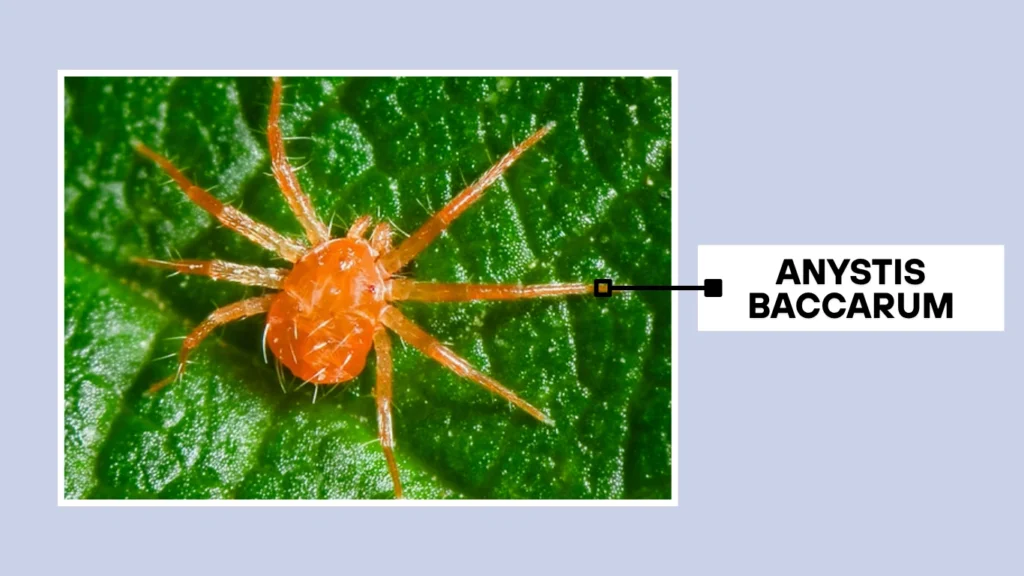
Anystis baccarum is a larger and highly active predatory mite known for feeding on aphids, thrips, and mites. It is used in orchards, greenhouses, and gardens for general pest control.
It is relatively large for a mite, reaching up to 1 mm, with a reddish-orange color and long legs that allow fast movement.
Anystis baccarum lives on foliage and soil surfaces in a range of habitats, including orchards, vegetable gardens, and nursery plants. It can function well across varying temperatures and prey levels.
14. Gaeolaelaps gillespiei
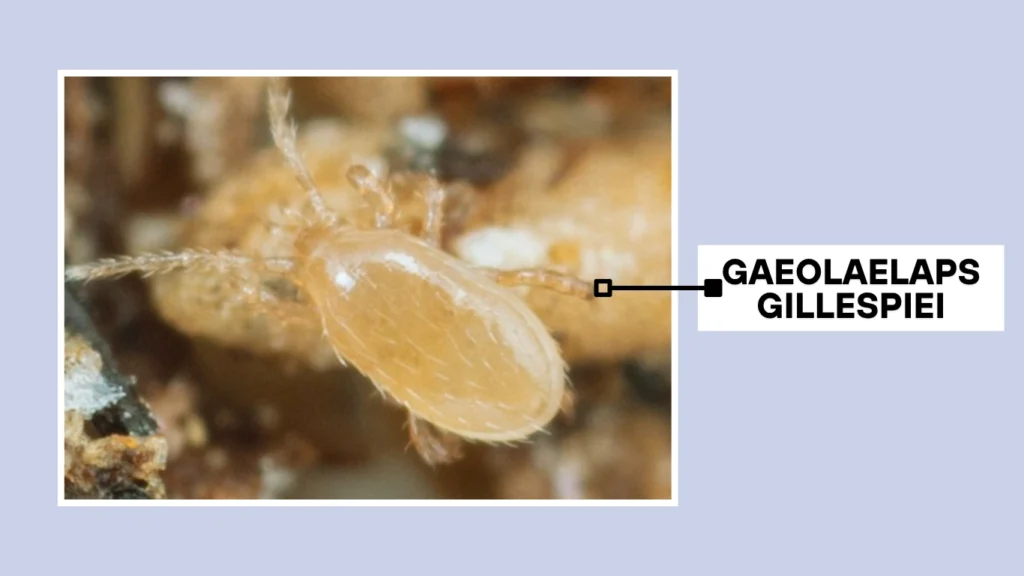
Gaeolaelaps gillespiei is a soil-dwelling predatory mite that preys on fungus gnat larvae, thrips pupae, and springtails. It is often used in horticulture and hydroponic systems for early-stage pest prevention.
This mite measures around 0.5–0.7 mm and has a shiny, light brown to amber body with a sturdy, oval shape.
It thrives in moist, organic soils and is most commonly introduced in greenhouse substrates, compost, and root zone areas of potted plants.
15. Proprioseiopsis mexicanus
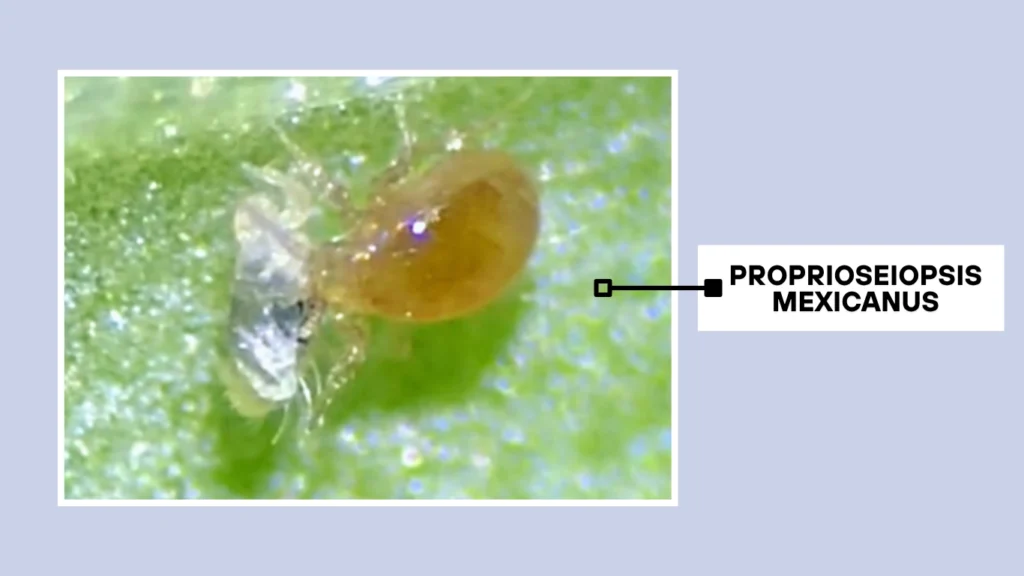
Proprioseiopsis mexicanus is a lesser-known predatory mite that feeds on various small arthropods, including thrips, whiteflies, and spider mites. It has shown potential in integrated pest management systems.
It is about 0.4–0.5 mm in size and has a translucent yellowish body with a streamlined, pear-shaped form.
This species prefers warm, humid environments and is usually found in greenhouse crops, particularly vegetables and ornamentals with dense foliage.
FAQs
1. What are predatory mites used for?
Predatory mites are primarily used in biological pest control. They feed on harmful pests like spider mites, thrips, fungus gnat larvae, and whiteflies, helping to naturally reduce pest populations in gardens, greenhouses, and farms.
2. Are predatory mites safe for humans and pets?
Yes, predatory mites are completely harmless to humans, pets, and plants. They do not bite or cause any health concerns and are used as a natural alternative to chemical pesticides.
3. How long do predatory mites live?
The lifespan of predatory mites varies by species but generally ranges from 2 to 4 weeks. During this time, they can consume dozens of pests, making them effective short-term solutions for infestations.
4. How do I introduce predatory mites to my garden or greenhouse?
Predatory mites are usually introduced by sprinkling them directly onto plants or soil. They are shipped in bottles or sachets containing the mites and a carrier material. It’s best to apply them early in the morning or late evening to avoid heat stress.
5. Can predatory mites survive without pests to eat?
Some species can survive by feeding on pollen or plant exudates, but most require prey to thrive and reproduce. Without pests, their population naturally declines, making them a self-regulating solution.