

Sac spiders are a diverse group known for their silk retreats rather than intricate webs. Belonging mainly to the families Clubionidae and Miturgidae, they are small to medium-sized hunters that dwell in hidden spaces—from forest floors to indoor corners. These spiders are often misunderstood due to their occasional bites and secretive nature. In this guide, we explore 11 types of sac spiders from North America, Europe, and Australia, highlighting how to identify them, where they live, their life cycles, and how they behave.
1. Yellow Sac Spider (Cheiracanthium inclusum)

The yellow sac spider is one of the most frequently encountered sac spiders in North America. Often mistaken for more dangerous species, it is small, fast-moving, and mostly active at night. Known for its pale yellow to light green body, this spider builds a silken sac-like retreat rather than a web. It prefers quiet corners in homes, especially during cooler months, and is sometimes associated with minor spider bites in humans.
Identification Features
- Pale yellow, greenish, or beige body
- Slightly darker stripe running down the center of the abdomen
- Long front legs
- Body size ranges from 5 to 10 mm
- Eyes arranged in two horizontal rows
Preferred Habitat
Yellow sac spiders are adaptable and often found in both outdoor and indoor environments. Outdoors, they reside under leaves, stones, and bark. Indoors, they take shelter in upper corners of walls, behind picture frames, or within folds of fabric and curtains. Their retreats are built in undisturbed, hidden places.
Lifecycle and Retreat Building
These spiders do not build a typical web to catch prey. Instead, they construct small silk sacs where they rest during the day. Females lay their eggs inside these sacs and guard them until they hatch. The lifecycle progresses from egg to spiderling and then through several molts to adulthood, often within a few months under favorable conditions.
Activity and Behaviors
Yellow sac spiders are nocturnal hunters. At night, they actively roam in search of small insects. They use speed and agility to ambush prey rather than relying on webs. When disturbed, they may drop and flee quickly. Although they can bite humans, their venom is generally not considered medically significant, causing only mild irritation in most cases.
2. Agrarian Sac Spider (Cheiracanthium mildei)
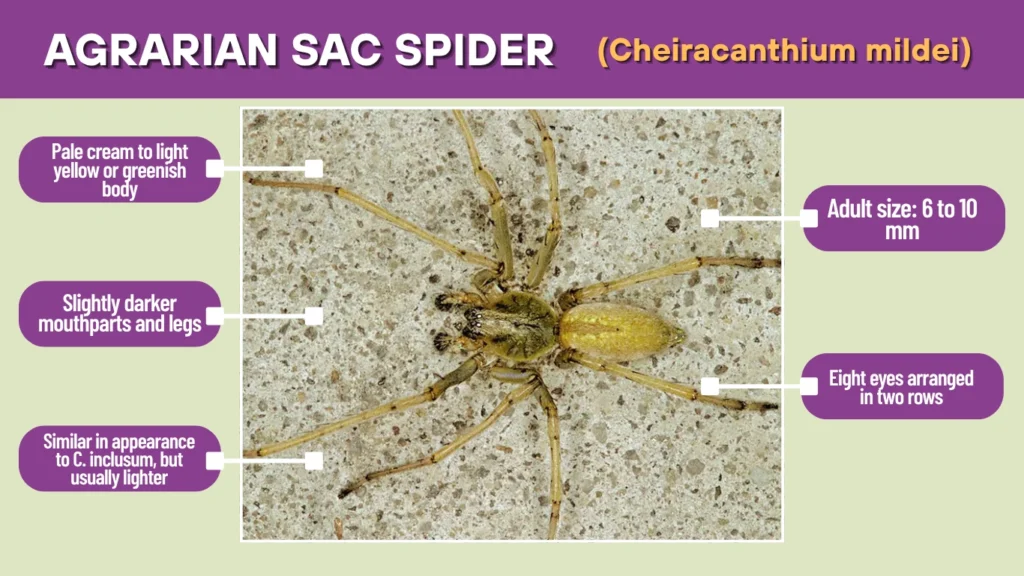
The agrarian sac spider, originally from Europe, has now established itself across North America. Like its close relative, the yellow sac spider, this species is known for creating sac-like silk shelters and being active at night. It’s commonly found in homes, especially in fall and winter when it seeks warmth.
Identification Features
- Pale cream to light yellow or greenish body
- Slightly darker mouthparts and legs
- Similar in appearance to C. inclusum, but usually lighter
- Adult size: 6 to 10 mm
- Eight eyes arranged in two rows
Urban and Indoor Habitat
Cheiracanthium mildei is frequently found inside human dwellings, especially in cool or temperate climates. They build their sacs in corners of ceilings, baseboards, and within storage areas. Outdoors, they reside under tree bark or stones but are more often seen indoors during colder seasons.
Egg Sacs and Lifecycle
Females create silk sacs to house eggs, often laying around 30 to 50 eggs per sac. These sacs are attached to flat surfaces, and the female typically stays nearby to guard them. Spiderlings hatch and disperse quickly, beginning their development through successive molts until they reach maturity.
Behavior and Human Interaction
This spider is a solitary nocturnal hunter. It uses its quick reflexes to catch prey, typically small insects and other arthropods. Though it may bite in self-defense, especially when trapped in clothing or bedding, the bite effects are usually mild and short-lived. It rarely causes serious medical reactions.
3. Black-Footed Yellow Sac Spider (Cheiracanthium punctorium)

Native to Europe and parts of Asia, the black-footed yellow sac spider is one of the largest members of the Cheiracanthium genus. It’s recognized for its distinctive dark leg tips and more aggressive behavior compared to its cousins. Though not typically found indoors, it prefers open grasslands and agricultural fields.
Identification Features
- Yellow to yellow-green body with dark-tipped legs
- Robust fangs and chelicerae
- Size: females can grow up to 15 mm
- Eight small eyes grouped closely together
- Dark stripes near the cephalothorax may be visible
Natural Environment and Range
This spider favors sunny meadows, wheat fields, and grasslands. It builds its sacs among tall grasses and low vegetation, especially where prey is abundant. It is found across Eastern and Central Europe, and its range is expanding westward due to climate change and agriculture.
Webbing and Development Stages
Instead of spinning a hunting web, it constructs a silk retreat where it hides during the day. Females lay eggs in protective sacs anchored to grass stems or leaves. The spiderlings hatch within a few weeks and disperse. Adults are seen more often in late summer.
Hunting and Defense Habits
The black-footed yellow sac spider is a fast and aggressive predator. It actively searches for prey rather than waiting in ambush. Though bites to humans are rare, they may occur when the spider is unintentionally disturbed. In such cases, the bite can cause localized pain and inflammation, but serious symptoms are uncommon.
4. Northern Yellow Sac Spider (Cheiracanthium sp.)

The term “Northern Yellow Sac Spider” is commonly used to refer to various Cheiracanthium species found in cooler climates, particularly in the northern regions of North America and Europe. These spiders are almost indistinguishable from other yellow sac spiders but are adapted to survive in temperate zones.
Identification Features
- Pale yellow or light beige body
- Long front legs, often held forward in a “crab-like” stance
- Small body: 5 to 9 mm in length
- Lacks bold markings; uniform coloration
- Eight eyes arranged in two horizontal rows
Typical Habitat and Range
This spider is commonly found in temperate and northern areas, especially in the United States, Canada, and parts of Europe. It builds its daytime sacs in secluded areas like wood piles, under stones, within sheds, and occasionally inside homes, particularly near windows and ceilings.
Sac Building and Growth Cycle
The spider creates silken retreats where it hides during daylight hours. Eggs are deposited inside these retreats, with females often staying close to protect them. The young emerge and go through several molts before reaching adulthood. Adults are often more visible in the late summer and fall.
Activity Patterns and Traits
These spiders are active hunters at night, moving quickly in search of small arthropods. They are solitary and do not build webs for capturing prey. Though capable of biting when provoked, their venom typically causes only mild skin irritation. They tend to avoid human interaction.
5. Clubiona trivialis
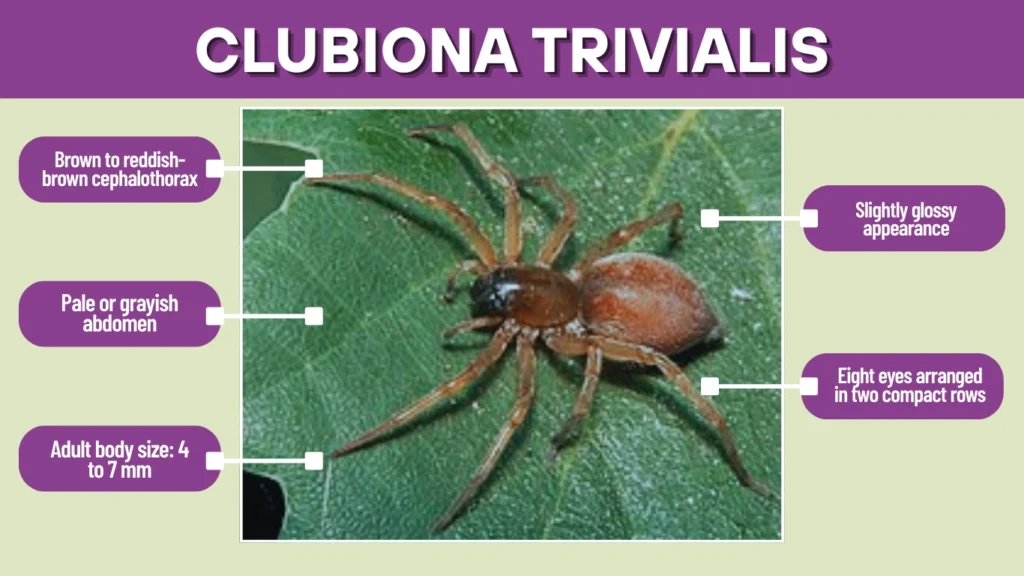
Clubiona trivialis is a member of the Clubionidae family and is found widely across Europe and parts of Asia. It is smaller and less aggressive than Cheiracanthium species and is known for its habit of building silk retreats under bark or among leaf litter.
Identification Features
- Brown to reddish-brown cephalothorax
- Pale or grayish abdomen
- Adult body size: 4 to 7 mm
- Slightly glossy appearance
- Eight eyes arranged in two compact rows
Natural Shelter and Distribution
This spider is typically found in forests, grasslands, and gardens. It hides beneath loose bark, in leaf litter, or under stones during the day. Occasionally, it may enter outbuildings or sheds but rarely ventures into houses. It’s well-distributed throughout Europe and parts of Central Asia.
Web Use and Life Process
Clubiona trivialis doesn’t spin webs to catch prey. Instead, it constructs small silk sacs for resting and laying eggs. These sacs are hidden in safe, shaded areas. Eggs are guarded until they hatch, and spiderlings go through several molts before becoming adults, usually within a few months.
Behavior and Movement
This spider is a calm, non-aggressive nocturnal hunter. It captures prey like small flies, ants, and beetles through stealth and speed. Unlike some of its relatives, it rarely bites and is considered harmless to humans. Its behavior is quiet and reclusive, making it easy to overlook in nature.
6. Clubiona corticalis
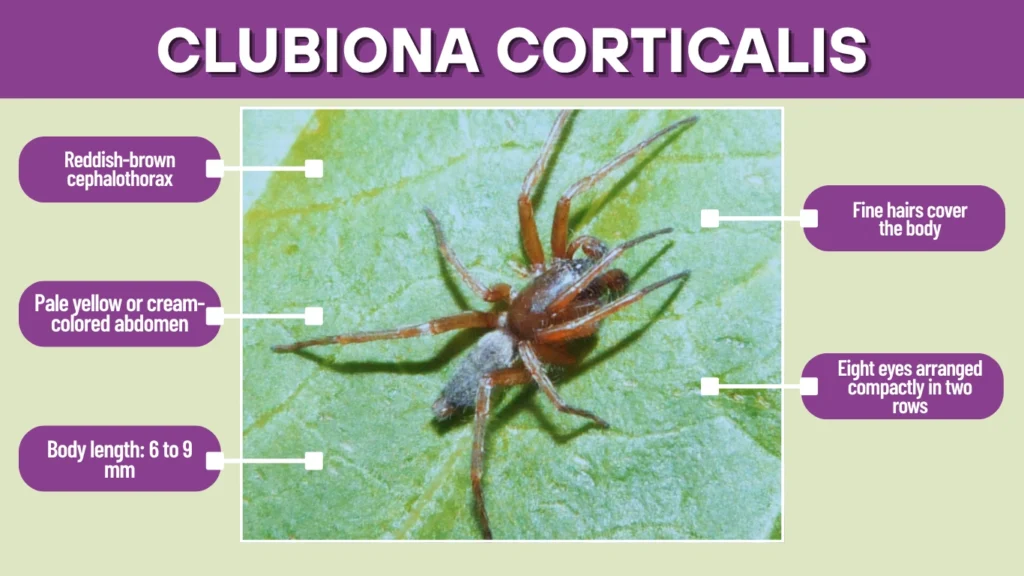
Clubiona corticalis, commonly known as the bark sac spider, is a tree-dwelling species that prefers living under the bark of old trees. It is widespread across Europe and is easily recognized by its reddish body and secretive behavior. Though it rarely comes indoors, it’s frequently encountered in natural wooded areas.
Identification Features
- Reddish-brown cephalothorax
- Pale yellow or cream-colored abdomen
- Body length: 6 to 9 mm
- Fine hairs cover the body
- Eight eyes arranged compactly in two rows
Woodland Habitat and Range
This spider is strongly associated with old trees, especially those with peeling bark or deep cracks. It lives primarily under the bark of oaks, pines, and other mature trees. Occasionally, it may be found in wooden fences or sheds. It’s common in forests throughout Europe and parts of Asia.
Sac Retreats and Development
Clubiona corticalis creates silk sacs beneath bark and within wood crevices. These sacs are used for resting and egg-laying. The lifecycle follows the usual pattern—egg, spiderling, and multiple molts to maturity. Mating typically occurs in spring, and spiderlings emerge by early summer.
Night Behavior and Adaptations
A stealthy, nocturnal hunter, this spider preys on insects and small arthropods using surprise and speed. It does not rely on a web for capture. Its coloring helps it blend into bark surfaces, and it shows minimal movement during the day, remaining safely tucked inside its silk sac.
7. Clubiona robusta
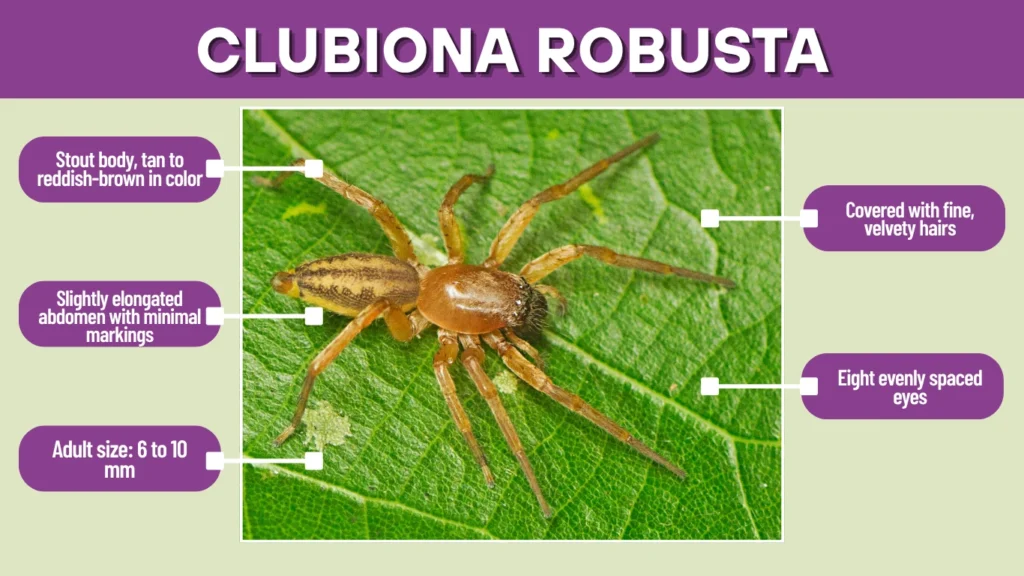
Clubiona robusta is a ground-dwelling sac spider found throughout the Northern Hemisphere. As its name suggests, it is more robust in build compared to many other Clubiona species. It’s often found in grassy fields, gardens, and forest floors, where it builds its silk retreats beneath debris or soil.
Identification Features
- Stout body, tan to reddish-brown in color
- Slightly elongated abdomen with minimal markings
- Adult size: 6 to 10 mm
- Covered with fine, velvety hairs
- Eight evenly spaced eyes
Ground-Level Habitat
Unlike tree bark dwellers, Clubiona robusta prefers life at ground level. It shelters under rocks, within grass clumps, or inside soil cracks. It’s often seen in meadows, agricultural fields, and garden beds. While not considered a household spider, it may enter homes occasionally during heavy rains.
Lifecycle and Nesting Habits
This spider forms silk sacs under natural debris for shelter and egg protection. The female lays eggs within the sac and stays close until the young hatch. Spiderlings disperse soon after and grow through several molts, often maturing in a single season, depending on the environment.
Behavior and Prey Capture
Clubiona robusta hunts actively at night, using its size and speed to overpower insects and other small prey. It tends to freeze when threatened rather than flee. Known for its resilience, it’s capable of surviving in disturbed or human-altered environments like farmlands and urban edges.
8. Clubiona abboti

Clubiona abboti is a sac spider native to North America, commonly found in wooded and grassy areas. It’s a lesser-known species in the Clubiona genus, but it’s notable for its reddish carapace and nocturnal behavior. Like others in its group, it builds sac-like silk shelters and does not use webs to capture prey.
Identification Features
- Reddish-brown cephalothorax
- Pale to grayish abdomen
- Adult size ranges from 5 to 8 mm
- Slender legs with fine hairs
- Eight eyes arranged in two tight rows
Habitat and Geographic Range
This species is commonly encountered across the eastern and central regions of the United States and southern Canada. It inhabits low vegetation, shrubs, and sometimes leaf litter. It prefers undisturbed areas like meadows, forest edges, and even home gardens with dense plant growth.
Lifecycle and Shelter Use
Clubiona abboti constructs small, silk sacs on leaves or hidden in vegetation, which it uses as a daytime retreat. The female lays her eggs in similar sacs and guards them until hatching. Spiderlings grow through multiple molts, reaching adulthood within one growing season.
Behavior and Hunting Strategy
A solitary night hunter, this spider actively stalks and ambushes small insects. It remains well-hidden during the day and shows minimal aggression. It plays a role in natural pest control by preying on aphids and other plant pests, making it beneficial in gardens.
9. Miturga lineata

Miturga lineata is a member of the Miturgidae family, often called the striped ground sac spider. Native to Australia, this species is fast-moving, ground-dwelling, and slightly more aggressive than its Clubiona counterparts. It’s commonly seen in gardens, under rocks, and among leaf litter.
Identification Features
- Brown to gray body with subtle stripe patterns
- Slightly flattened appearance
- Leg span noticeably longer than body length
- Adult size: 10 to 14 mm
- Eight small eyes arranged in a curved pattern
Environment and Distribution
Found widely across southeastern Australia, this spider prefers dry open habitats, including gardens, bushlands, and suburban lawns. It hides beneath rocks, logs, and leaf litter during the day. Occasionally, it may wander into homes, especially during heatwaves or dry spells.
Nesting and Development
Rather than building above-ground sacs, Miturga lineata shelters in burrows or hidden crevices lined with silk. It deposits eggs in these retreats and remains nearby for protection. Spiderlings hatch and disperse into the surrounding environment, where they continue the growth cycle.
Movement and Defensive Traits
Miturga lineata is a swift, active hunter and reacts quickly to threats. It does not use a web for trapping prey but instead roams at night in search of insects. While it may bite when provoked, its venom is not considered dangerous to humans, though it can cause mild swelling or discomfort.
10. Miturga sp. (General Group)

The Miturga genus includes several species of fast, ground-dwelling sac spiders native to Australia. These spiders are commonly found in dry, bushy, or open habitats. Though they may vary slightly in appearance, most Miturga spiders share similar hunting behaviors and build sac-like silk retreats for shelter rather than for prey capture.
Identification Features
- Brown, gray, or dark reddish bodies
- Distinctive longitudinal stripes on some species
- Size varies: typically 8 to 15 mm in body length
- Long legs suited for fast movement
- Eight small eyes arranged in two tight rows
Habitat and Native Range
Miturga species are distributed widely across Australia, from coastal areas to arid inland regions. They are usually ground-dwelling, hiding under logs, rocks, bark, or within leaf litter. Occasionally, they are spotted on walls or ceilings indoors when seeking shelter from dry heat or rain.
Retreats and Life History
These spiders do not build webs but create small silk sacs to rest in during the day. The sacs are usually hidden under stones, bark, or soil clumps. Females lay eggs in these retreats, and the young hatch after a few weeks. The spiderlings develop rapidly in warm climates and are often seen in summer.
Predatory Habits and Activity
Miturga spiders are active nocturnal hunters that chase and overpower prey such as beetles, flies, and ants. They use speed and stealth rather than webs. Some species may bite in defense if handled, and while the bite is generally mild, it may cause temporary pain or swelling.
11. Trachelas tranquillus

Though not a true sac spider, Trachelas tranquillus is often grouped with them due to its similar behavior of building sac-like retreats. Native to North America, this spider is sometimes found indoors, and it’s known for its striking coloration and occasional human encounters.
Identification Features
- Glossy red or reddish-orange cephalothorax
- Gray to dark abdomen, sometimes with faint markings
- Short, powerful legs
- Body length: 5 to 10 mm
- Eight eyes arranged in a compact pattern
Common Habitats and Distribution
This spider is widespread in the eastern and central United States. It lives under bark, in leaf piles, and sometimes indoors—especially in basements, attics, or wall voids. It’s more frequently observed in the late summer and fall when adults are actively hunting.
Egg Sacs and Lifecycle Behavior
Trachelas tranquillus builds a thick silk sac for resting and laying eggs. These sacs are placed in hidden areas like wall cracks or leaf litter. Females lay a small number of eggs and guard them. The development cycle includes multiple molts before maturity, typically within a year.
Temperament and Hunting Style
This species is an aggressive hunter, using its strength to subdue prey. It does not rely on silk traps but ambushes insects directly. Bites can occur when the spider is disturbed indoors, but symptoms are usually mild. Despite its vivid color, it’s not considered dangerous to humans.
Summary
Sac spiders, such as the yellow sac spider, Clubiona species, and Miturga types, are solitary, nocturnal hunters that prefer building sac-like retreats over spinning prey-catching webs. Found in forests, gardens, and homes across the world, these spiders play a crucial role in natural pest control. While some can bite when disturbed, their venom is usually mild. This guide covers 11 common sac spider types, offering detailed identification tips and insight into their habitats, lifecycles, and behavior patterns for easier understanding and safe recognition.
