





The bowhead whale is one of the most extraordinary marine mammals on Earth, known for its massive size, Arctic lifestyle, and remarkable longevity. Unlike most whales, it thrives in icy waters and can live for over 200 years, making it the longest-living mammal. With its enormous skull and thick blubber, the bowhead whale is perfectly adapted to extreme conditions. In this guide, we explore its size, diet, habitat, life cycle, and unique facts.
What Is a Bowhead Whale?
The bowhead whale (Balaena mysticetus) is a species of baleen whale found primarily in Arctic and sub-Arctic waters. It belongs to the right whale family and is easily recognized by its large, bow-shaped head, which makes up nearly one-third of its body length.
Unlike many other whales, the bowhead lacks a dorsal fin, an adaptation that helps it navigate under sea ice. Its thick skull allows it to break through ice up to 60 cm (2 feet) thick to breathe. These whales are slow swimmers but are highly specialized for survival in freezing environments.
How Big Is a Bowhead Whale?
Bowhead whales are among the largest whales in the world. Adult individuals typically measure between 14 to 18 meters (45 to 60 feet) in length. Females are usually slightly larger than males.
In terms of weight, a fully grown bowhead whale can weigh between 60 and 100 tons. One of its most impressive features is its skull, which is the largest of any animal and can account for up to 40% of its total body length.
Compared to the blue whale—the largest animal ever—bowhead whales are smaller but still enormous. Their thick layer of blubber, sometimes over 50 cm (20 inches), helps them retain heat in icy waters.
How Long Do Bowhead Whales Live?
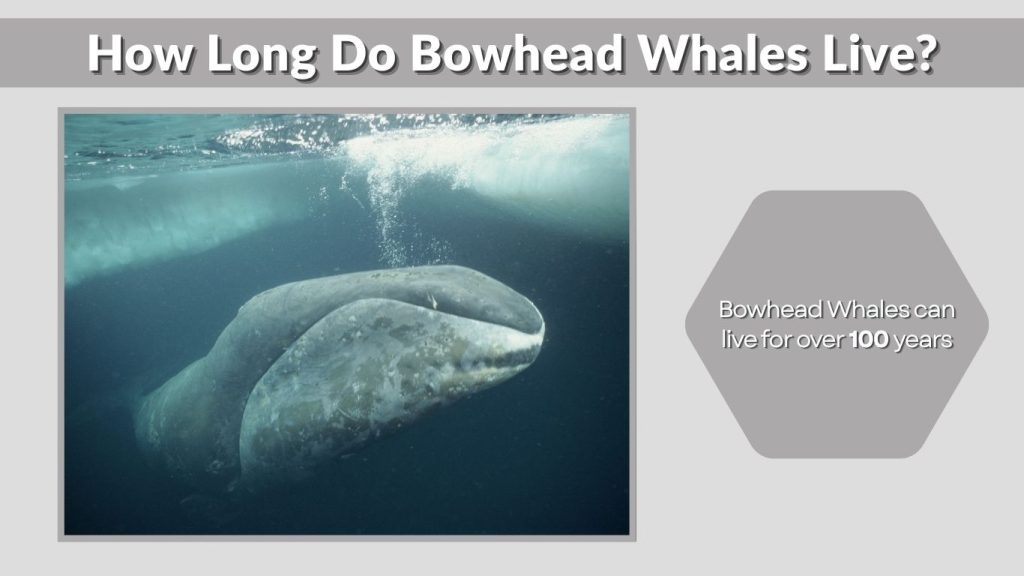
One of the most fascinating aspects of the bowhead whale is its incredible lifespan. These whales can live for over 100 years, and some individuals are believed to reach 200 years or more.
Scientists discovered this remarkable longevity when they found ancient harpoon tips embedded in whales that were still alive decades later. This evidence suggests that some bowhead whales were born before modern industrial times.
Their long lifespan is thought to be linked to slow metabolism, low predation risk, and unique genetic traits that help prevent diseases such as cancer. This makes them one of the longest-living mammals on the planet.
What Do Bowhead Whales Eat?

Bowhead whales are filter feeders, meaning they do not hunt large prey. Instead, they feed on tiny organisms found in the ocean.
Their primary diet consists of:
- Zooplankton
- Copepods
- Krill
- Small crustaceans
They use baleen plates—long, flexible structures in their mouths—to filter food from seawater. When feeding, a bowhead whale swims slowly with its mouth open, taking in large amounts of water. The baleen then traps the tiny prey while the water is expelled.
Despite eating small organisms, bowhead whales consume enormous quantities of food daily, sometimes several tons, to maintain their large body size.
Where Do Bowhead Whales Live?

Bowhead whales are uniquely adapted to life in cold environments and are found mainly in the Arctic Ocean and nearby seas. They prefer areas with sea ice, which helps protect them from predators and human activity.
Their range includes regions such as:
- The Bering Sea
- The Beaufort Sea
- The Chukchi Sea
- The Canadian Arctic
Unlike many whale species that migrate long distances to warm waters, bowhead whales tend to stay within Arctic regions year-round, moving only slightly based on seasonal ice conditions.
Bowhead Whale Hunting: Past and Present
Bowhead whales have a long history of being hunted by humans. During the 16th to early 20th centuries, commercial whaling drastically reduced their population. They were especially valued for their thick blubber, which was used to produce oil, and their baleen, which had many industrial uses.
However, today commercial hunting is banned, and bowhead whales are protected under international law. Indigenous Arctic communities, such as the Inuit, are still allowed limited subsistence hunting. This practice is carefully regulated and plays an important cultural and nutritional role for these communities.
Thanks to conservation efforts, bowhead whale populations have been gradually recovering, though they still face modern threats.
Bowhead Whale Life Cycle Explained
The life cycle of a bowhead whale is slow and steady, reflecting its long lifespan.
Mating and Reproduction
Bowhead whales typically mate in late winter or early spring. Males often compete for females through vocal displays and physical interactions.
Gestation Period
After mating, the female carries the calf for about 13 to 14 months.
Birth and Early Life
Calves are usually born in spring and measure around 4 to 4.5 meters (13–15 feet) at birth. They rely on their mother’s milk, which is rich in fat, to grow quickly in the cold environment.
Growth Stages
As they mature, bowhead whales go through several stages:
- Calf
- Juvenile
- Adult
They reach sexual maturity at around 15 to 20 years, which is relatively late compared to many animals.
15 Fascinating Bowhead Whale Facts
Bowhead whales are full of surprising features and abilities. Here are some fascinating facts:
- They have the thickest blubber of any animal.
- Their baleen plates can reach over 4 meters (13 feet) long.
- They can break through thick sea ice to breathe.
- Bowhead whales are among the longest-living mammals.
- They produce complex songs and vocalizations.
- Their skull is strong enough to act like an icebreaker.
- They lack a dorsal fin, helping them move under ice.
- They are slow swimmers but highly efficient feeders.
- Their mouths are enormous, allowing them to filter large amounts of water.
- They can weigh as much as 100 tons.
- Their tongues alone can weigh as much as an elephant.
- They have a large curved jaw, giving them a unique appearance.
- They prefer icy habitats where few predators can survive.
- They store energy in thick blubber for long winters.
- They play an important role in the Arctic ecosystem.
How Bowhead Whales Survive in Extreme Cold
Living in freezing Arctic waters requires special adaptations, and bowhead whales are perfectly equipped for the challenge.
Blubber Insulation
Their thick blubber layer acts like a natural thermal blanket, keeping their body warm even in near-freezing temperatures.
Ice Navigation
Bowhead whales can navigate through dense ice fields and even break through ice using their powerful heads.
Breathing Through Ice
They maintain breathing holes in ice-covered waters, allowing them to surface for air even in harsh conditions.
Social Behavior
Although often seen alone or in small groups, bowhead whales communicate using low-frequency sounds that travel long distances underwater.
Are Bowhead Whales Endangered?
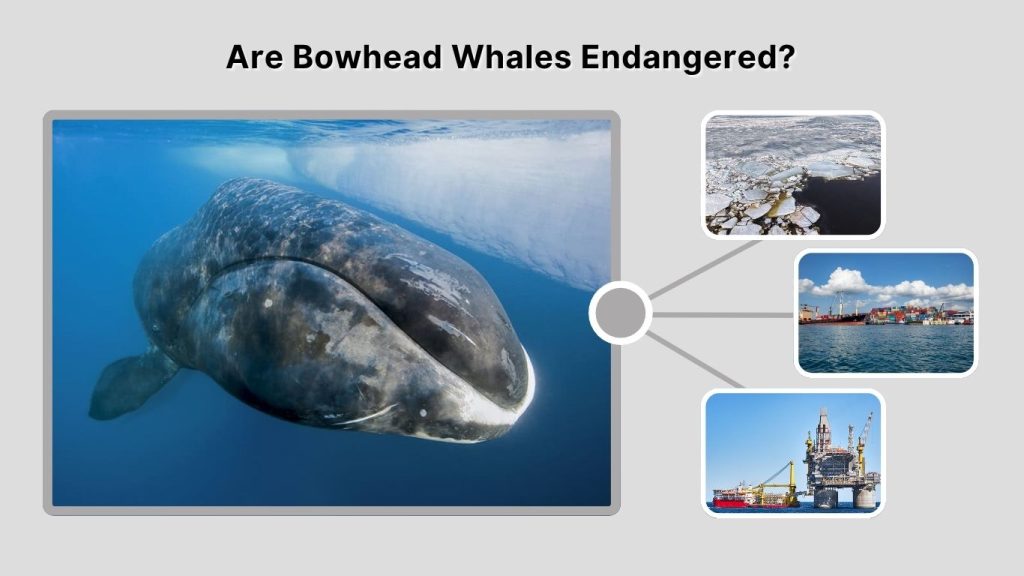
Bowhead whales are currently classified as Least Concern in some populations, though status can vary by region. After severe declines due to whaling, their numbers have improved significantly.
Current Population
Some populations, like the Western Arctic group, are now estimated to be in the tens of thousands.
Threats
Despite recovery, they still face several risks:
- Climate change affecting sea ice
- Increased shipping traffic
- Noise pollution
- Oil and gas exploration
Protection Efforts
International agreements and conservation programs help protect these whales and their habitats.
Future Outlook
If conservation measures continue, bowhead whales are expected to remain stable or even grow in number, though climate change remains a major concern.
FAQs
What do bowhead whales eat?
Bowhead whales eat small marine organisms such as zooplankton, krill, and copepods, which they filter from seawater using baleen plates.
How long do bowhead whales live?
They can live over 100 years, with some individuals reaching more than 200 years.
How big is a bowhead whale?
They typically grow between 45 and 60 feet long and can weigh up to 100 tons.
Where do bowhead whales live?
They live in Arctic and sub-Arctic waters, often in ice-covered regions.
Are bowhead whales dangerous?
No, bowhead whales are not dangerous to humans and are generally calm, slow-moving animals.