





The narwhal, often called the “unicorn of the sea,” is one of the most mysterious marine mammals inhabiting the icy waters of the Arctic. Famous for its long, spiral tusk, this unique whale has inspired myths and legends for centuries. However, beyond its magical appearance lies a fascinating creature with complex behaviors, specialized adaptations, and an important role in the marine ecosystem. In this article, we’ll explore what narwhals are, their physical characteristics, and the science behind their iconic tusk.
What is a Narwhal?
A narwhal is a medium-sized toothed whale scientifically known as Monodon monoceros. It belongs to the same family as the beluga whale, making it one of only two members of the Monodontidae family. Narwhals are uniquely adapted to life in the Arctic, where freezing temperatures and thick sea ice dominate the environment.
The name “narwhal” is believed to come from the Old Norse word nár, meaning “corpse,” referring to the whale’s pale, mottled skin. Often referred to as the “unicorn of the sea,” narwhals earned this nickname due to their long, spiraling tusk, which resembles a mythical horn.
Unlike many other whale species, narwhals spend most of their lives in cold Arctic waters, rarely venturing far south. Their close relative, the beluga whale, shares some similarities, but narwhals remain distinct due to their tusk and different behavioral traits.
Narwhal Size, Weight, and Appearance
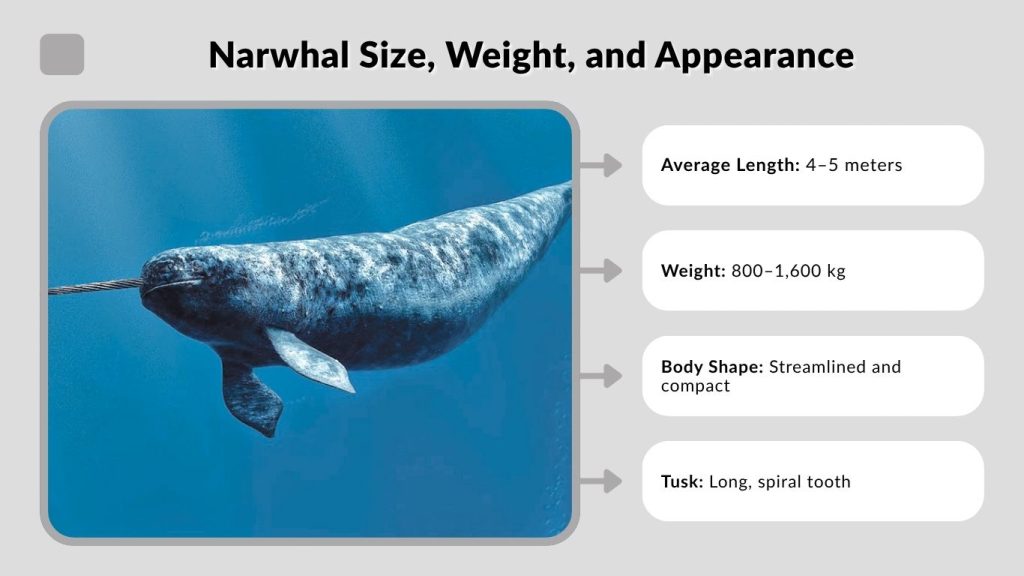
Narwhals are medium-sized whales uniquely adapted to life in the Arctic. Their bodies are built for efficiency in cold, icy waters, combining streamlined shapes with specialized features that help them survive under sea ice. While they may not be the largest whales, their distinct appearance—especially the long tusk—makes them one of the most recognizable marine mammals.
Quick Overview
- Average Length: 4–5 meters (13–16 feet)
- Weight: 800–1,600 kg (1,760–3,500 lbs)
- Gender Difference: Males are generally larger than females
- Body Shape: Streamlined and compact for deep diving
Key Physical Features
- Tusk: Long, spiral tooth (mainly in males), up to 3 meters (10 feet)
- Skin Color: Mottled gray, black, and white; becomes lighter with age
- Dorsal Fin: Absent; replaced by a low ridge for easier movement under ice
- Head Shape: Rounded, without a pronounced beak
- Blubber Layer: Thick insulation to survive freezing temperatures
Distinctive Traits
- No dorsal fin helps prevent injury under ice
- Highly flexible neck compared to most whales
- Aging changes skin tone from dark to nearly white
This combination of size, coloration, and unique features allows narwhals to thrive in one of the harshest environments on Earth.
The Narwhal Tusk Explained
The most iconic feature of the narwhal is its long, spiral tusk. This tusk is actually an elongated canine tooth that can grow up to 3 meters (10 feet) in length. It usually protrudes from the left side of the upper jaw and spirals in a counterclockwise direction.
Interestingly, not all narwhals have visible tusks. The tusk is most commonly found in males, while females rarely develop one. In rare cases, a narwhal may grow two tusks, though this is extremely uncommon.
For centuries, scientists debated the purpose of the narwhal’s tusk. Early theories suggested it was used for fighting or breaking ice. However, modern research has revealed that the tusk is a highly sensitive sensory organ. It contains millions of nerve endings that can detect changes in water temperature, pressure, and salinity.
This discovery has transformed our understanding of narwhals, showing that their tusk plays a crucial role in how they interact with their environment.
Why Do Narwhals Have Tusks?
The function of the narwhal’s tusk has been a subject of scientific curiosity for many years. While no single explanation fully accounts for its purpose, several well-supported theories provide insight.
One leading theory suggests that the tusk acts as a sensory tool. Because of its nerve-rich structure, the tusk can help narwhals detect subtle environmental changes in the Arctic waters. This ability may be especially important for locating prey or navigating through ice-covered regions.
Another possibility is that the tusk plays a role in mating displays. Male narwhals are often observed rubbing their tusks together in a behavior known as “tusking.” This interaction may help establish dominance or attract potential mates.
There is also some evidence that narwhals use their tusks during feeding. Recent observations have shown narwhals using their tusks to stun fish, making them easier to catch. Although this behavior is not fully understood, it suggests that the tusk may have multiple functions.
Where Do Narwhals Live?

Narwhals are found primarily in the Arctic waters around Greenland, Canada, and parts of Russia. They are highly specialized for life in this extreme environment, where sea ice plays a central role in their survival.
Unlike many marine mammals, narwhals depend heavily on sea ice. They use cracks and openings in the ice, known as leads, to breathe. These whales are also known for their seasonal migrations, moving closer to shore during the summer and returning to deeper offshore waters in the winter.
Their strong connection to sea ice makes them particularly vulnerable to environmental changes. As Arctic ice continues to melt due to climate change, narwhals face increasing challenges in maintaining their natural habitat.
What Do Narwhals Eat?

Narwhals are carnivorous marine mammals with a diet primarily consisting of fish, squid, and shrimp. Some of their most common prey include Greenland halibut, Arctic cod, and cuttlefish. Their feeding habits are closely tied to the Arctic environment, where food availability can change with the seasons.
These whales are deep divers, capable of reaching depths of up to 1,500 meters (nearly 5,000 feet) in search of food. Most of their feeding occurs during the winter months when they dive beneath thick sea ice to hunt in darker, deeper waters.
Hunting Techniques
Narwhals rely heavily on echolocation to find prey. By emitting sound waves and interpreting the returning echoes, they can detect objects and animals even in complete darkness. This ability is essential in the Arctic, where visibility is often limited.
Recent studies have also shown that narwhals may use their tusks while hunting. They have been observed tapping or striking fish, possibly to stun them before eating. This behavior suggests that the tusk may serve both sensory and functional roles.
Narwhal Behavior and Communication
Narwhals are social animals that typically travel in groups known as pods. These pods can range from a few individuals to several dozen, depending on the season and location. During migration, large groups may gather together, creating impressive gatherings in Arctic waters.
Their behavior is strongly influenced by seasonal changes. In summer, narwhals move closer to coastal areas, while in winter, they migrate to deeper offshore regions covered by sea ice.
Communication
Like other toothed whales, narwhals communicate using a variety of sounds, including clicks, whistles, and pulses. These sounds are used for navigation, hunting, and social interaction.
Echolocation is one of their most important communication tools. It allows them to “see” their environment using sound, helping them locate prey and avoid obstacles beneath the ice. This sophisticated system is vital for survival in the Arctic’s harsh conditions.
Narwhal Lifespan and Reproduction

Narwhals are relatively long-lived animals, with an average lifespan of around 40 to 50 years. Some individuals may live even longer, although exact lifespans are difficult to determine due to the challenges of studying them in the wild.
Reproduction Cycle
Female narwhals typically give birth once every three years. After a gestation period of about 14 months, a single calf is born. Newborn calves are usually about 1.5 meters (5 feet) long and rely heavily on their mothers for survival during their early months.
Calves stay close to their mothers, learning essential skills such as swimming, diving, and hunting. This strong maternal bond is crucial for their development in the demanding Arctic environment.
Narwhal vs Beluga Whale

Narwhals are often compared to beluga whales due to their close genetic relationship. However, there are several key differences between the two species.
Narwhals are best known for their long tusk, while beluga whales lack this feature entirely. Belugas also have a more rounded head, known as a melon, and are generally more vocal.
In terms of coloration, beluga whales are typically pure white as adults, whereas narwhals have a mottled gray and white pattern. While both species inhabit Arctic waters, their behaviors and migration patterns differ slightly.
Are Narwhals Endangered?

Narwhals are currently classified as “Near Threatened,” meaning they are not immediately at risk of extinction but face several ongoing challenges. Their specialized habitat and dependence on sea ice make them particularly vulnerable to environmental changes.
Major Threats
One of the biggest threats to narwhals is climate change. As Arctic sea ice continues to melt, their habitat is rapidly changing. This can affect their migration routes, feeding patterns, and access to breathing holes.
Human activities also pose risks. Increased shipping traffic, noise pollution, and industrial development in the Arctic can disrupt narwhal behavior. In some regions, narwhals are also hunted by indigenous communities, although this is usually regulated and part of traditional practices.
Interesting Narwhal Facts
Narwhals are full of fascinating and surprising traits that make them one of the most unique marine animals on Earth.
- Their tusk can detect subtle changes in water temperature and salinity
- The tusk inspired ancient myths about unicorns
- Some narwhals grow two tusks, though this is extremely rare
- They can hold their breath for up to 25 minutes
- Narwhals spend much of their lives in remote, ice-covered waters
FAQs
Why are narwhals called the unicorn of the sea?
Because of their long, spiral tusk that resembles a unicorn’s horn.
Can narwhals live in captivity?
No, narwhals do not survive well in captivity and are rarely kept in aquariums.
Do female narwhals have tusks?
Most females do not have tusks, but in rare cases, they may develop small ones.
How rare are narwhals?
Narwhals are not extremely rare but are difficult to study due to their remote Arctic habitat.
Conclusion
The narwhal is truly one of the ocean’s most extraordinary creatures. From its iconic tusk to its deep-diving abilities and Arctic adaptations, it continues to intrigue scientists and nature enthusiasts alike. However, as climate change and human activity reshape the Arctic, the future of narwhals remains uncertain. Understanding and protecting these unique animals is essential to preserving the delicate balance of the marine ecosystem they call home.