




The South China tiger (Panthera tigris amoyensis), also known as the Amoy tiger, is one of the most critically endangered tiger subspecies in the world. Native to southern China, it is considered one of the oldest and most genetically important tiger lineages. Historically, it roamed widely across China, but today it is believed to be functionally extinct in the wild, with only a small number surviving in captivity.
This tiger holds great significance in both science and culture. It is often regarded as the “ancestral tiger,” meaning many modern tiger subspecies may have evolved from it. Despite its importance, decades of habitat loss, hunting, and human expansion have pushed it to the brink of extinction.
South China Tiger Identification & Characteristics
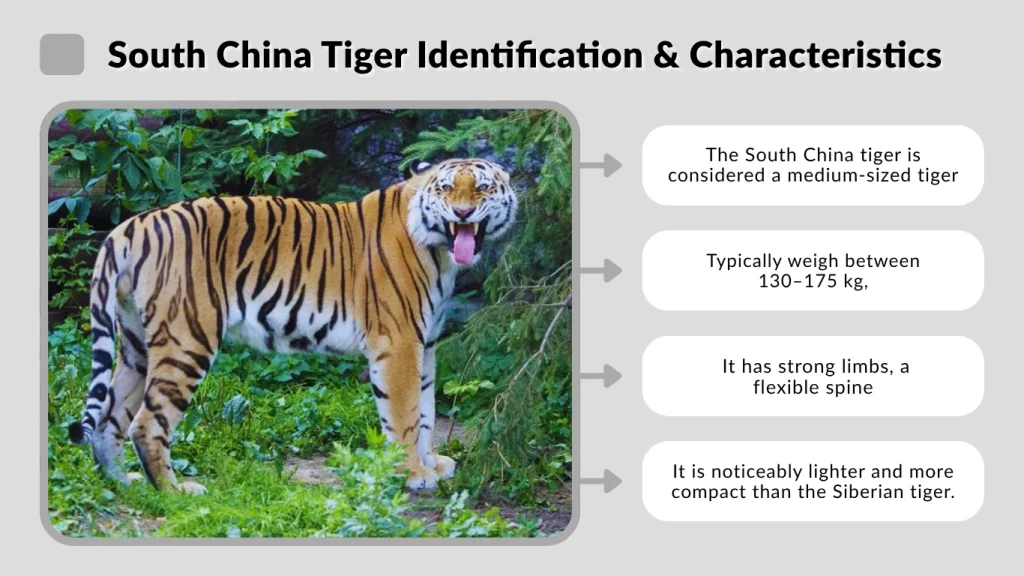
Physical Appearance
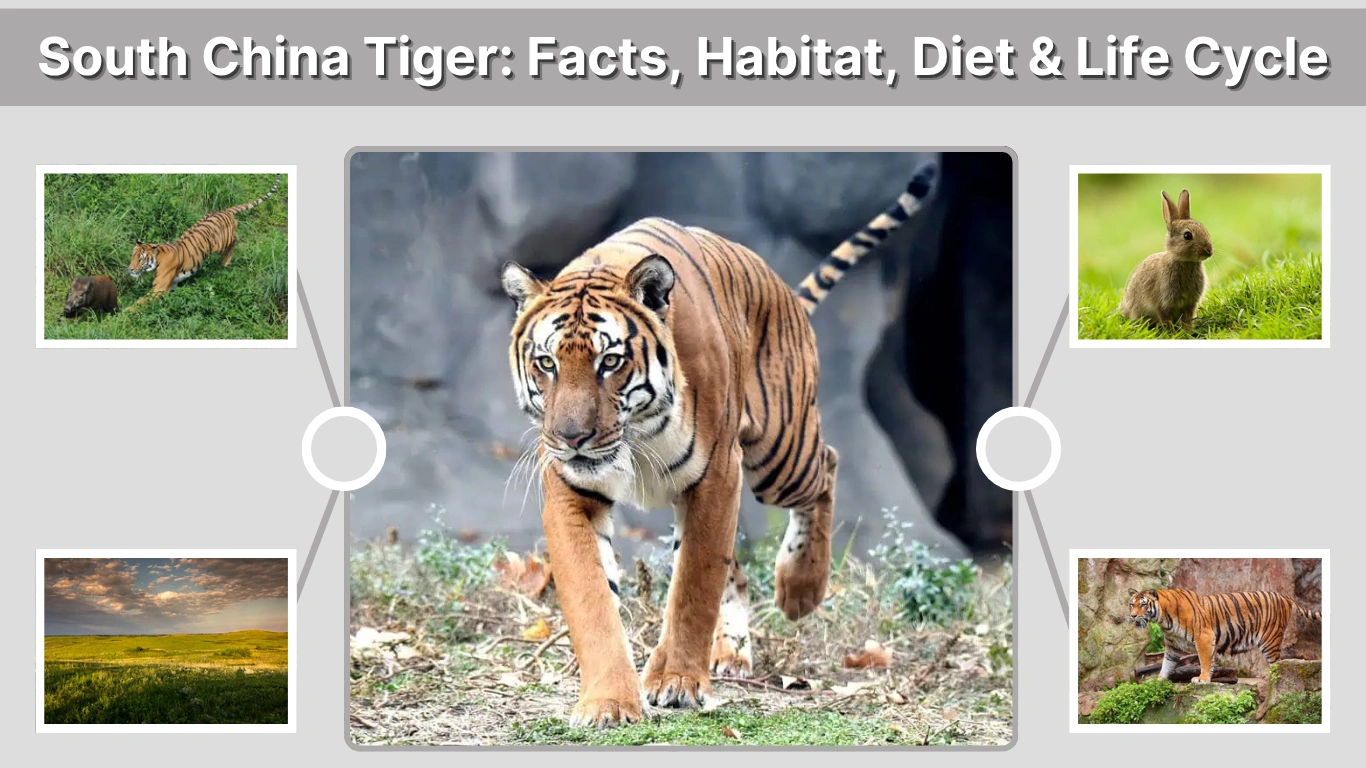
The South China tiger has a bright orange coat with black stripes, similar to other tiger subspecies. However, its stripes are fewer in number and more widely spaced, giving it a distinct appearance. The underside of its body, chest, and parts of the face are white, which creates a strong contrast with its darker stripes.
Its head is slightly longer and narrower compared to other tigers, and its facial structure appears more elongated. These features help distinguish it from larger subspecies like the Siberian or Bengal tiger.
Size and Weight
The South China tiger is considered a medium-sized tiger. Adult males typically weigh between 130–175 kg, while females weigh around 100–115 kg. In terms of length, they can reach about 2.3 to 2.6 meters, including the tail.
Although not the smallest tiger, it is noticeably lighter and more compact than the Siberian tiger. This size allows it to move more easily through mountainous and forested environments.
Unique Characteristics
One of the most notable characteristics of the South China tiger is its evolutionary importance. Scientists believe it represents one of the earliest tiger subspecies, making it crucial for understanding tiger evolution.
Its body is built for agility rather than bulk. It has strong limbs, a flexible spine, and sharp claws that help it navigate rugged terrain. These adaptations make it well-suited for life in mountainous forests.
South China Tiger Facts
The South China tiger is surrounded by many fascinating facts that highlight both its uniqueness and its endangered status.
- Scientific name: Panthera tigris amoyensis
- Status: Critically endangered
- Population: Fewer than 200 individuals, mostly in captivity
- Native region: Southern China
- Behavior: Solitary and territorial
- Activity: Mostly nocturnal
- Communication: Uses roars, scent marking, and visual signals
One of the most interesting facts is that the South China tiger has not been reliably seen in the wild for decades. Some experts believe it may already be extinct in its natural habitat. Despite this, conservationists continue efforts to preserve the subspecies through captive breeding and reintroduction programs.
South China Tiger Habitat
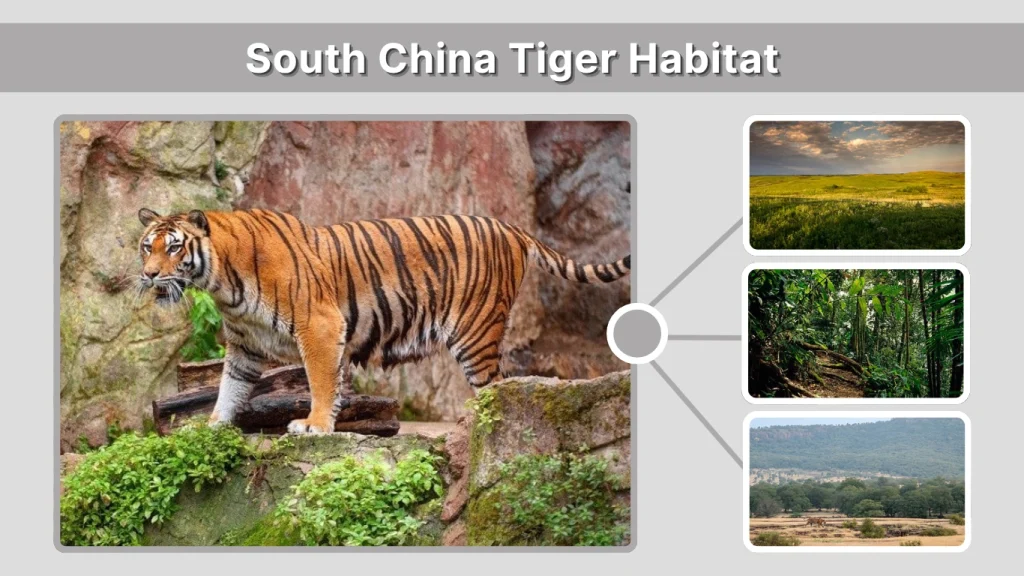
Natural Habitat
South China tigers historically lived in subtropical forests, mountainous regions, and areas with dense vegetation. These habitats provided enough cover for hunting and hiding, as well as a steady supply of prey.
They preferred regions with a mix of forests and grasslands, allowing them to move freely while stalking animals. Access to water sources such as rivers and streams was also essential for their survival.
Historical Distribution
In the past, South China tigers were widely distributed across several provinces, including Fujian, Guangdong, Hunan, and Jiangxi. They were once one of the most common tiger subspecies in China.
However, rapid industrialization and population growth led to a dramatic decline in their numbers. Large areas of forest were cleared for agriculture and development, leaving the tigers with limited space to survive.
Current Habitat Situation
Today, there are no confirmed populations of South China tigers living in the wild. Most individuals exist in captivity, where they are part of breeding programs aimed at saving the subspecies.
Efforts have been made to create suitable environments for potential reintroduction, but restoring wild populations remains a major challenge.
South China Tiger Diet
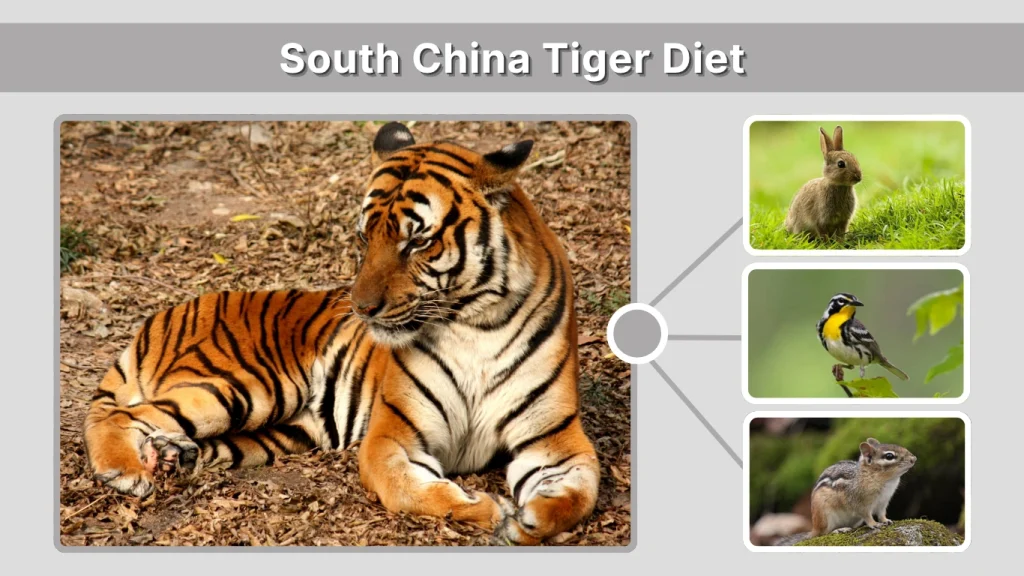
Main Prey
The South China tiger is a carnivorous predator that primarily feeds on medium to large-sized animals. Its main prey includes deer species and wild boar, which provide the energy needed to sustain its active lifestyle.
When larger prey is scarce, it may hunt smaller animals such as rabbits, birds, or other small mammals. Its diet largely depends on what is available in its environment.
Hunting Techniques
Like other tigers, the South China tiger is an ambush predator. It relies on stealth, patience, and camouflage to approach its prey without being detected. Once close enough, it launches a powerful attack, using its strength and sharp claws to capture the animal.
Most hunting takes place at night, when it is easier to remain hidden. Its striped coat helps it blend into the shadows of the forest, making it an effective hunter.
Feeding Behavior
After making a kill, the tiger usually drags its prey to a safe and secluded area before feeding. It may consume a large portion at once and return to the carcass later.
As an apex predator, the South China tiger plays an important role in controlling prey populations, which helps maintain the balance of its ecosystem.
South China Tiger Lifespan
The lifespan of the South China tiger varies depending on its environment and living conditions. In the wild, it is estimated that they could live between 10 to 15 years, although exact data is limited due to the lack of confirmed wild populations.
In captivity, where they are protected from threats such as poaching and food shortages, South China tigers can live up to 20 years. Factors like proper nutrition, medical care, and safe living conditions significantly increase their lifespan.
South China Tiger Life Cycle

Birth and Early Development
South China tiger cubs are born blind and completely dependent on their mother. At birth, they are small and vulnerable, relying on maternal care for warmth, protection, and nourishment. The mother keeps them hidden in a secure den during the early weeks.
Growth and Learning Stage
As the cubs grow, they begin to explore their surroundings and develop essential survival skills. During this stage, they learn how to stalk, hunt, and recognize danger by observing their mother. This learning period is crucial for their survival in the wild.
Adult Stage
By the age of 2–3 years, South China tigers reach maturity and become independent. Adult tigers are solitary and establish their own territories. They rely on their strength, speed, and hunting skills to survive.
Reproduction
Female South China tigers have a gestation period of about 3 to 3.5 months. A typical litter consists of 2–4 cubs. The mother raises the cubs alone, providing food and protection until they are ready to live independently.
South China Tiger Interesting Facts
The South China tiger is one of the most unique and historically important tiger subspecies.
- It is often called the “ancestral tiger” because of its genetic importance
- It has not been reliably seen in the wild since the 1990s
- Most remaining individuals live in captivity
- It once roamed widely across China
- It plays an important role in understanding tiger evolution
- It is a strong cultural symbol in Chinese history and folklore
South China Tiger vs Other Tigers
Size Comparison
The South China tiger is smaller than large subspecies like the Siberian and Bengal tigers but larger than some smaller tiger types. Its medium size makes it well-suited for mountainous environments.
Habitat Differences
Unlike tigers that live in cold climates or open grasslands, the South China tiger adapted to subtropical forests and rugged mountain terrain. These environments require agility and flexibility.
Physical Differences
South China tigers have fewer and more widely spaced stripes compared to other tigers. Their skull shape and body structure are also slightly different, reflecting their early evolutionary lineage.
Conservation Status and Efforts
Current Status
The South China tiger is classified as critically endangered and is considered functionally extinct in the wild. This means there are no confirmed breeding populations in natural habitats.
Major Threats
The primary threats to this tiger include habitat destruction, human expansion, and hunting. In the past, they were heavily hunted as pests, which drastically reduced their population.
Conservation Programs
Conservation efforts focus on captive breeding programs aimed at increasing population numbers. Some initiatives are also exploring rewilding, where tigers are gradually reintroduced into protected environments.
Challenges in Conservation
One of the biggest challenges is genetic diversity, as the remaining population is small. Additionally, restoring suitable habitats and ensuring prey availability make reintroduction efforts complex.
Importance of the South China Tiger
The South China tiger plays a vital role in both ecology and culture.
As an apex predator, it helps maintain the balance of ecosystems by controlling prey populations. Its presence indicates a healthy and functioning environment.
Culturally, the tiger is a powerful symbol in China, representing strength, courage, and protection. Scientifically, it is important for understanding the evolution and diversity of tiger species.
FAQs
What is the lifespan of a South China tiger?
South China tigers are estimated to live around 10–15 years in the wild, though exact data is limited due to their absence in natural habitats. In captivity, where they receive proper care and protection, they can live up to 20 years.
What do South China tigers eat?
They primarily feed on deer and wild boar, which provide the energy needed for survival. When necessary, they may also hunt smaller animals like rabbits or birds. Their diet depends on prey availability within their habitat.
Where do South China tigers live?
Historically, they lived in the subtropical forests and mountainous regions of southern China. Today, there are no confirmed wild populations, and most South China tigers exist in captivity under conservation programs.
Why are South China tigers endangered?
They became endangered due to excessive hunting, habitat destruction, and human expansion. Large-scale deforestation and agricultural development reduced their natural habitat, while hunting further decreased their population.
Are South China tigers extinct?
South China tigers are not officially declared extinct, but they are considered functionally extinct in the wild. This means there are no confirmed surviving populations in natural habitats, although some individuals still exist in captivity.
Conclusion
The South China tiger is one of the most endangered and historically significant tiger subspecies. From its unique characteristics and diet to its near disappearance from the wild, it represents both the beauty and fragility of wildlife.
Protecting this tiger is essential not only for biodiversity but also for preserving an important part of natural and cultural heritage. Continued conservation efforts offer hope, but immediate and sustained action is needed to secure its future.