


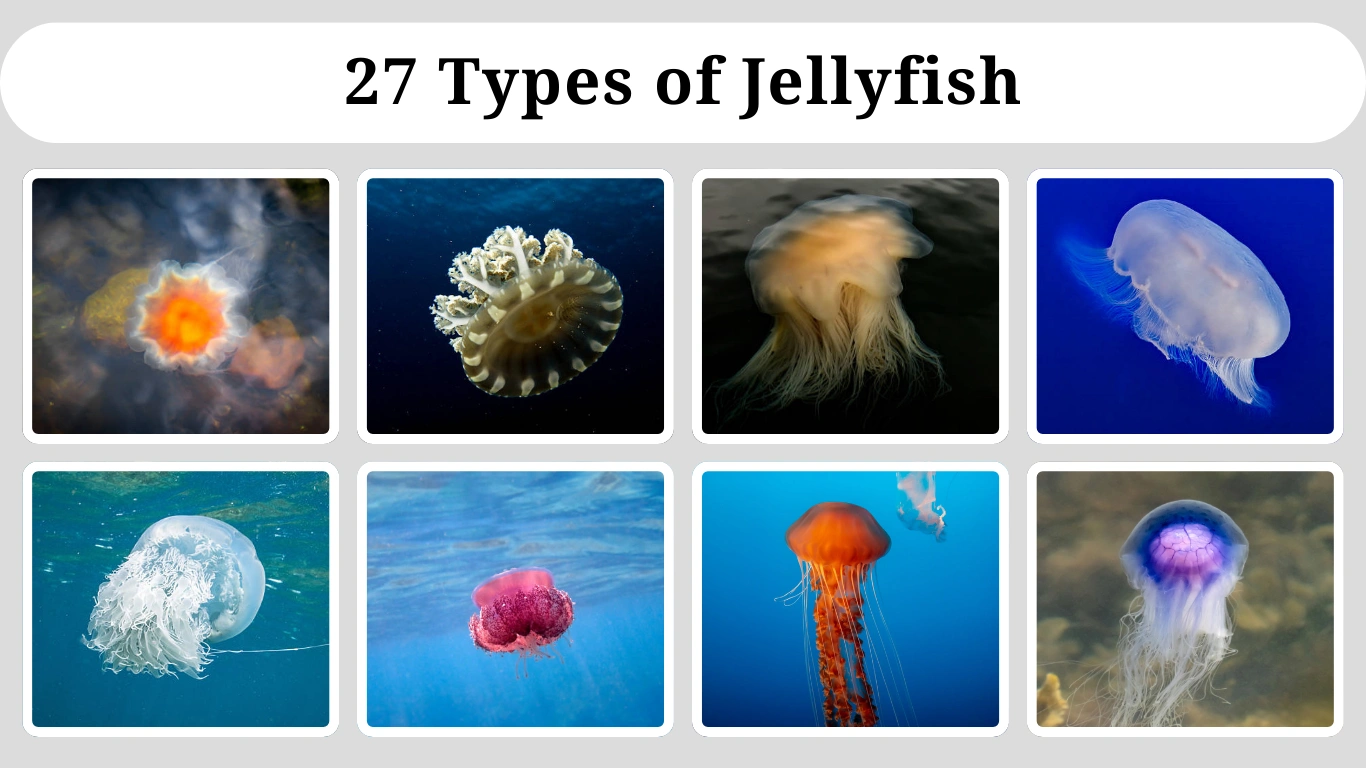
Jellyfish are among the oldest and most fascinating creatures in the ocean, known for their graceful movement, unique body structures, and wide range of habitats. From harmless, translucent species drifting near shorelines to highly venomous jellyfish living in tropical seas or deep oceans, each type has distinct features and behaviors. This guide introduces 27 different types of jellyfish, highlighting their diversity, identification traits, habitats, and ecological roles in marine ecosystems.
1. Moon Jellyfish (Aurelia aurita)

The moon jellyfish is one of the most recognizable and widely distributed jellyfish in the world. Known for its translucent, saucer-shaped body, it is commonly found in coastal waters and is generally harmless to humans, making it a favorite subject for marine studies and aquariums.
Identification
- Transparent, disc-shaped bell with four horseshoe-shaped gonads visible at the center
- Bell diameter usually ranges from 5 to 16 inches
- Short, fine tentacles lining the edge of the bell
- Soft, gelatinous body with a milky or glass-like appearance
Habitat and Distribution
Moon jellyfish are found in oceans worldwide, especially in temperate and tropical coastal waters. They prefer bays, estuaries, and harbors where currents are gentle. These jellyfish can tolerate varying salinity levels, allowing them to thrive in both open seas and brackish waters.
Behavior and Diet
They drift slowly using rhythmic bell contractions and rely heavily on ocean currents for movement. Moon jellyfish feed on plankton, small crustaceans, fish larvae, and microscopic organisms, capturing prey with their tentacles and oral arms.
Interaction With Humans
Moon jellyfish stings are mild and usually cause little to no discomfort. They are not considered dangerous and are often touched safely in aquariums. However, sensitive individuals may experience slight skin irritation after contact.
2. Box Jellyfish (Chironex fleckeri)
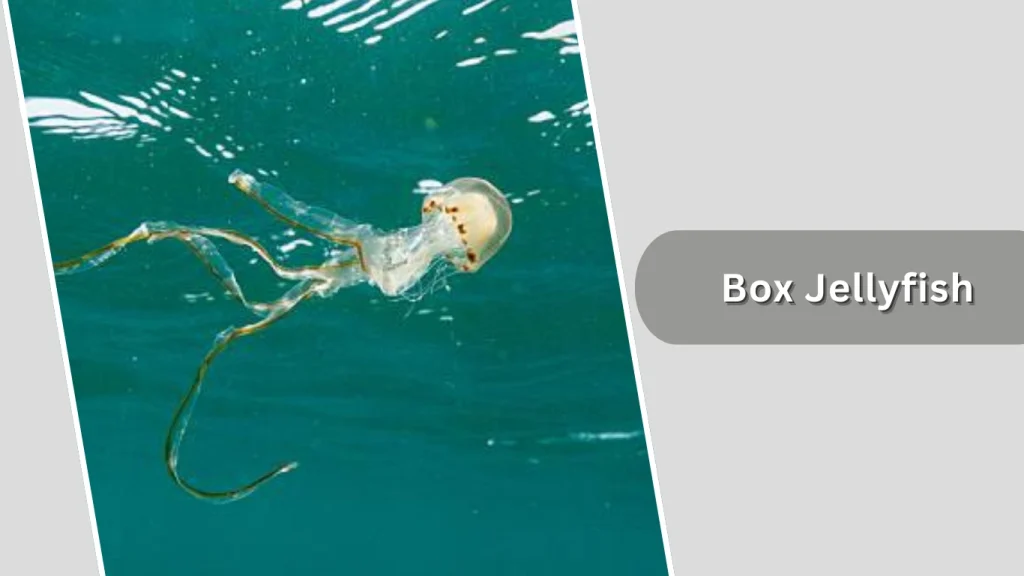
The box jellyfish is considered one of the most dangerous marine animals in the world. It is named for its cube-shaped bell and is known for its powerful venom, which can be fatal to humans in severe cases.
Identification
- Cube-shaped, transparent bell with four distinct sides
- Bell size usually up to 10 inches wide
- Long tentacles extending from each corner, reaching up to 10 feet
- Pale blue or nearly invisible body in water
Habitat and Distribution
Box jellyfish are primarily found in warm coastal waters of the Indo-Pacific region, especially around northern Australia and Southeast Asia. They favor shallow waters, river mouths, and sandy beaches.
Behavior and Diet
Unlike most jellyfish, box jellyfish are active swimmers and can move with purpose. They feed on small fish and crustaceans, using their tentacles to inject venom that quickly immobilizes prey.
Venom and Defense
Their venom is extremely potent and attacks the heart, nervous system, and skin cells. Tentacles are covered with millions of nematocysts that fire on contact, making the box jellyfish highly effective at both hunting and defense.
3. Lion’s Mane Jellyfish (Cyanea capillata)

The lion’s mane jellyfish is the largest known jellyfish species, famous for its massive size and flowing tentacles. Its name comes from the thick, hair-like tentacles that resemble a lion’s mane when spread through the water.
Identification
- Large, reddish-gold or brown bell with scalloped edges
- Bell diameter can exceed 7 feet in extreme cases
- Hundreds of long, thin tentacles arranged in clusters
- Color ranges from pale yellow to deep red depending on age
Habitat and Distribution
Lion’s mane jellyfish inhabit cold, northern waters of the Atlantic and Pacific Oceans. They are commonly found near the Arctic, drifting into coastal areas during seasonal blooms.
Behavior and Diet
They are slow-moving drifters that rely on currents for travel. Their diet includes small fish, zooplankton, crustaceans, and even smaller jellyfish, which are captured and paralyzed by their stinging tentacles.
Size and Growth
This species grows continuously throughout its life and thrives in colder temperatures. Cooler waters allow it to reach exceptional sizes, making it one of the most impressive invertebrates in the ocean.
4. Blue Jellyfish (Cyanea lamarckii)

The blue jellyfish is a smaller relative of the lion’s mane jellyfish and is known for its striking blue coloration. It is commonly seen in shallow coastal waters during warmer months.
Identification
- Blue or bluish-yellow bell with a smooth, rounded shape
- Bell diameter typically up to 12 inches
- Fine, pale tentacles extending from the bell margin
- Bright coloration that is more vivid in younger individuals
Habitat and Distribution
Blue jellyfish are found mainly in the North Atlantic Ocean, especially around European coastlines. They prefer shallow waters and are often spotted near the surface during summer blooms.
Behavior and Diet
They drift with ocean currents and feed on plankton, fish eggs, and small crustaceans. Their tentacles help guide prey toward the mouth using mild stinging cells.
Seasonal Appearance
This species is most commonly seen in late spring and summer. Population numbers can increase rapidly under favorable conditions, leading to noticeable jellyfish blooms along coastlines.
5. Immortal Jellyfish (Turritopsis dohrnii)

The immortal jellyfish is famous for its unique ability to revert its cells back to an earlier life stage, effectively restarting its life cycle. This rare biological trait has made it one of the most studied jellyfish species in the world.
Identification
- Very small, transparent bell usually less than 0.2 inches wide
- Dome-shaped body with a smooth surface
- Short tentacles arranged evenly around the bell margin
- Reddish stomach visible through the transparent body
Habitat and Distribution
Immortal jellyfish are found in warm and temperate oceans worldwide. Originally native to the Mediterranean Sea, they have spread globally through ship ballast water and now inhabit many coastal regions.
Behavior and Diet
They drift passively and feed on plankton, fish eggs, and microscopic marine organisms. Their small size allows them to survive in calm waters where food is abundant.
Life Cycle and Regeneration
When stressed, injured, or old, this jellyfish can transform its adult cells back into juvenile polyps. This process allows it to avoid death under ideal conditions, giving rise to its “immortal” reputation.
6. Cannonball Jellyfish (Stomolophus meleagris)

The cannonball jellyfish is named for its round, compact shape resembling a cannonball. It is one of the most commonly harvested jellyfish species for human consumption in parts of Asia.
Identification
- Firm, dome-shaped bell with a smooth surface
- Bell diameter usually between 5 and 10 inches
- Short, fused oral arms rather than long tentacles
- Milky white or light brown coloration
Habitat and Distribution
Cannonball jellyfish inhabit coastal waters of the western Atlantic Ocean and the Gulf of Mexico. They prefer warm, shallow waters and are often found near the ocean floor.
Behavior and Diet
They are slow-moving drifters that feed on plankton and tiny crustaceans. Unlike many jellyfish, they rely more on oral arms than tentacles to capture food.
Ecological Importance
This species plays a role in marine food webs as prey for sea turtles and fish. Large seasonal blooms can influence plankton populations and coastal ecosystems.
7. Crystal Jellyfish (Aequorea victoria)
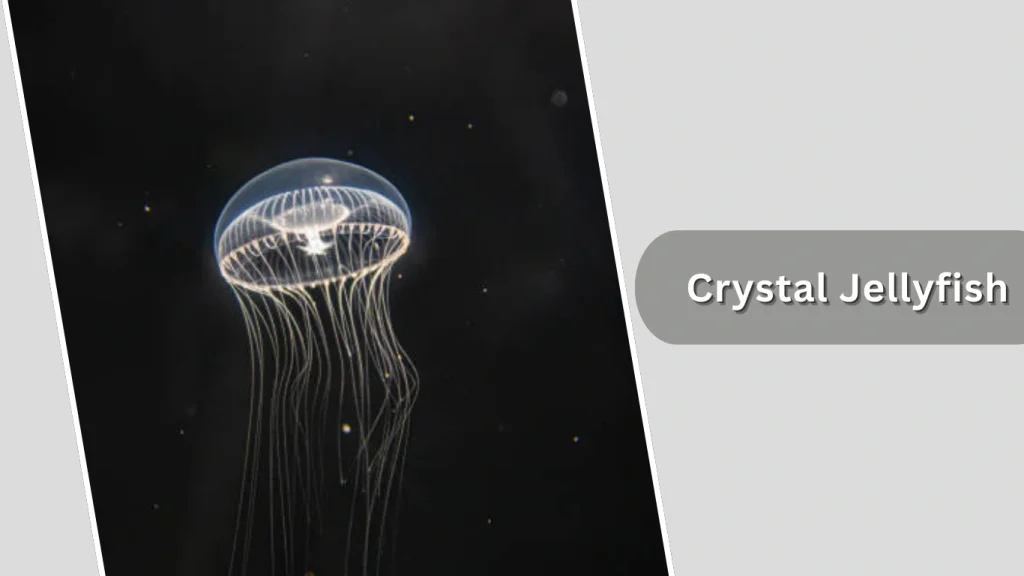
The crystal jellyfish is a transparent, bioluminescent species best known for its role in scientific research. It produces green fluorescent protein (GFP), which has become a vital tool in biological and medical studies.
Identification
- Completely transparent, glass-like bell
- Bell diameter usually 6–10 inches
- Dozens of fine tentacles around the bell margin
- Radial canals visible like spokes from the center
Habitat and Distribution
Crystal jellyfish are native to the west coast of North America, from Alaska to California. They are commonly found near the ocean surface in calm, coastal waters.
Behavior and Diet
They drift with currents and feed on plankton, fish eggs, and small marine organisms. Prey is captured using mild stinging cells along the tentacles.
Bioluminescence
When disturbed, crystal jellyfish emit flashes of blue light caused by a chemical reaction in their bodies. This glowing ability helps deter predators and has contributed greatly to scientific discoveries.
8. Comb Jellyfish (Ctenophora)

Comb jellyfish are not true jellyfish but are often mistaken for them due to their gelatinous bodies. They are known for their shimmering, rainbow-like light patterns created by rows of tiny comb-like structures.
Identification
- Transparent or milky oval-shaped body
- Eight rows of comb-like cilia running along the body
- No stinging tentacles in most species
- Soft, jelly-like texture
Habitat and Distribution
Comb jellies are found in oceans worldwide, from surface waters to the deep sea. They inhabit both coastal and open-ocean environments.
Behavior and Diet
They move by beating their cilia, making them graceful swimmers. Their diet consists of plankton, fish larvae, and small crustaceans, which are trapped using sticky cells rather than venom.
Movement and Light Display
The comb rows refract light, creating a colorful, shimmering effect as the animal moves. This visual display is not bioluminescence but light diffraction from the cilia.
9. Sea Nettle (Chrysaora species)

Sea nettles are well-known jellyfish recognized for their long, trailing tentacles and noticeable sting. They are commonly encountered in coastal waters and are one of the most familiar jellyfish to beachgoers.
Identification
- Bell is rounded and semi-transparent with radial markings
- Bell diameter typically 6–12 inches
- Long, thin tentacles that can extend several feet
- Color varies from pale white to reddish-brown
Habitat and Distribution
Sea nettles are found in temperate and tropical oceans worldwide. They are especially common in estuaries, bays, and nearshore waters where plankton is abundant.
Behavior and Diet
They drift with currents and feed on plankton, small fish, and crustaceans. Their tentacles contain stinging cells used to capture prey and deter predators.
Seasonal Blooms
Sea nettle populations often increase during warmer months. Large blooms can impact tourism and local marine ecosystems by reducing fish larvae numbers.
10. Portuguese Man o’ War (Physalia physalis)

The Portuguese man o’ war is not a true jellyfish but a floating colonial organism made up of specialized polyps. It is easily recognized by its inflated, sail-like float.
Identification
- Blue or purple gas-filled float above the water surface
- Long tentacles that may exceed 30 feet in length
- Float length usually 6–12 inches
- Bright coloration that warns predators
Habitat and Distribution
This species is found in warm and subtropical oceans worldwide. It is commonly carried by winds and currents, often washing up on beaches in large numbers.
Behavior and Diet
Portuguese man o’ wars drift on the ocean surface and feed on small fish and plankton. Their tentacles deliver venom that paralyzes prey instantly.
Colonial Structure
Each individual is a colony of interconnected organisms, each with a specific role such as feeding, reproduction, or defense. This unique structure sets it apart from true jellyfish.
11. White-Spotted Jellyfish (Phyllorhiza punctata)
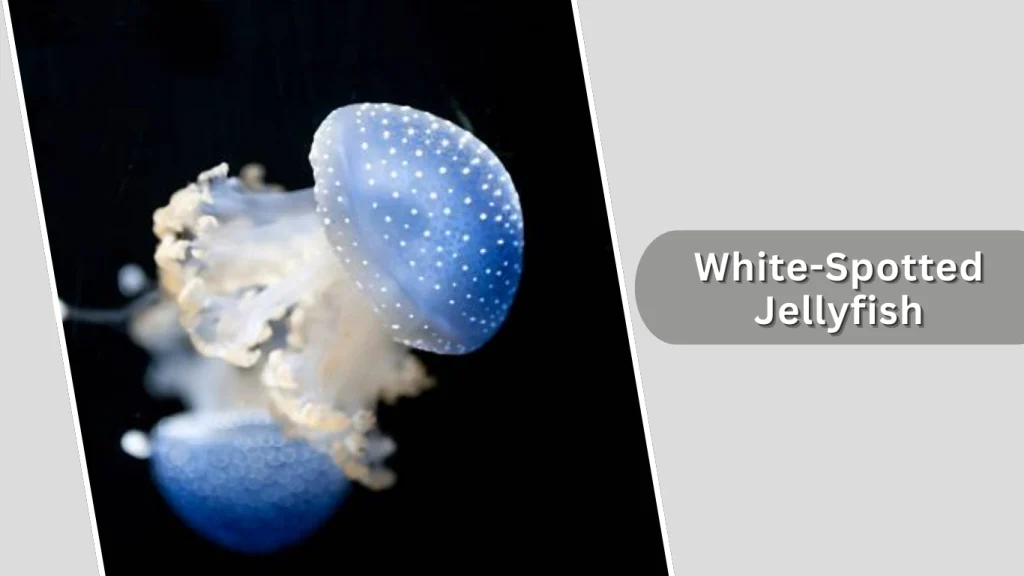
The white-spotted jellyfish is a large, visually striking species known for the bright white spots scattered across its bell. It is often seen in warm coastal waters and has become invasive in some regions.
Identification
- Large, dome-shaped bell covered with white spots
- Bell diameter commonly 12–24 inches
- Thick oral arms with frilly ends
- Bell color ranges from brown to golden-yellow
Habitat and Distribution
Native to the Indo-Pacific region, this jellyfish has spread to the Mediterranean Sea, Gulf of Mexico, and parts of the Atlantic Ocean. It prefers warm, shallow coastal waters.
Behavior and Diet
White-spotted jellyfish feed mainly on plankton and microscopic organisms. They use their oral arms rather than long tentacles to capture food.
Invasive Impact
In non-native areas, large blooms can disrupt local ecosystems by consuming vast amounts of plankton, which affects fish populations and water quality.
12. Fried Egg Jellyfish (Cotylorhiza tuberculata)

The fried egg jellyfish gets its name from its appearance, which resembles a sunny-side-up egg floating in the water. It is considered one of the most harmless jellyfish species.
Identification
- Flat, translucent bell with a raised yellow center
- Bell diameter usually 8–14 inches
- Short, club-shaped oral arms
- Smooth bell edges without long tentacles
Habitat and Distribution
This species is commonly found in the Mediterranean Sea and nearby Atlantic waters. It favors warm, calm coastal areas and lagoons.
Behavior and Diet
Fried egg jellyfish drift slowly and feed on plankton and microscopic algae. They also host symbiotic algae that contribute to their nutrition through photosynthesis.
Symbiotic Relationship
The algae living inside the jellyfish provide additional energy, allowing it to thrive in nutrient-poor waters. This relationship also enhances its distinctive yellow coloration.
13. Pacific Sea Nettle (Chrysaora fuscescens)

The Pacific sea nettle is a large, colorful jellyfish commonly seen along the western coast of North America. It is known for its long, flowing tentacles and graceful swimming movements.
Identification
- Golden-brown bell with darker radial markings
- Bell diameter typically 12–18 inches
- Numerous long, thin tentacles extending several feet
- Ruffled oral arms beneath the bell
Habitat and Distribution
This species inhabits the Pacific Ocean from Alaska to Mexico. It is most often found in coastal and offshore waters, sometimes forming large seasonal blooms.
Behavior and Diet
Pacific sea nettles feed on plankton, small fish, and other jellyfish. Their tentacles are equipped with stinging cells that efficiently capture and immobilize prey.
Swimming and Movement
Unlike many jellyfish, this species is an active swimmer. Strong bell contractions allow it to move against currents and maintain position in productive feeding areas.
14. Flower Hat Jellyfish (Olindias formosus)

The flower hat jellyfish is admired for its colorful, flower-like appearance created by bright tentacle tips. Despite its beauty, it possesses a painful sting.
Identification
- Transparent bell with dome-shaped form
- Colorful tentacle tips in purple, blue, yellow, or green
- Bell diameter usually 4–6 inches
- Tentacles arranged in neat rows around the bell
Habitat and Distribution
Flower hat jellyfish are native to the western Pacific Ocean, particularly around Japan and nearby coastal regions. They prefer shallow, sandy-bottom waters.
Behavior and Diet
They actively swim near the sea floor and feed on small fish and crustaceans. Their tentacles trail behind them, ready to sting passing prey.
Visual Appearance
The vivid colors of the tentacles make this species highly distinctive. These bright markings may serve as a warning to predators about its stinging capability.
15. Atolla Jellyfish (Atolla wyvillei)

The Atolla jellyfish is a deep-sea species best known for its dramatic bioluminescent displays. It lives far below the ocean surface and is rarely seen by humans.
Identification
- Deep red or maroon bell with a flattened shape
- Bell diameter usually 4–7 inches
- One tentacle noticeably longer than the others
- Distinct circular groove around the bell
Habitat and Distribution
Atolla jellyfish inhabit deep ocean waters worldwide, typically at depths of 1,000 to 13,000 feet. They are most commonly found in cold, dark environments of the open ocean.
Behavior and Diet
They drift slowly in deep water and feed on small crustaceans and plankton. Their movement is minimal, conserving energy in the low-food deep-sea environment.
Bioluminescent Defense
When threatened, the Atolla jellyfish emits bright blue light in a circular pattern. This “burglar alarm” display is believed to attract larger predators that may scare away or attack its attacker.
16. Black Sea Nettle (Chrysaora achlyos)

The black sea nettle is one of the largest and rarest jellyfish species found in the Pacific Ocean. Its dark coloration and long tentacles give it a striking, almost otherworldly appearance.
Identification
- Dark brown to black bell with a smooth surface
- Bell diameter can reach up to 3 feet
- Extremely long, ribbon-like tentacles
- Thick oral arms trailing beneath the bell
Habitat and Distribution
This species is found mainly in the eastern Pacific Ocean, especially off the coast of California. Sightings are rare and often associated with warmer ocean conditions.
Behavior and Diet
Black sea nettles feed on plankton, small fish, and other jellyfish. Their long tentacles allow them to capture prey over a wide area.
Rarity and Sightings
They are seldom observed and usually appear in small numbers. Large individuals are often recorded during unusual ocean warming events, making sightings noteworthy.
17. Mauve Stinger (Pelagia noctiluca)

The mauve stinger is a small but highly venomous jellyfish known for its painful sting and frequent blooms. It is also capable of bioluminescence, glowing in the dark when disturbed.
Identification
- Pink, mauve, or purple bell with wart-like bumps
- Bell diameter usually 3–5 inches
- Long, thin tentacles extending from the bell
- Small oral arms beneath the body
Habitat and Distribution
Mauve stingers are commonly found in the Mediterranean Sea and the eastern Atlantic Ocean. They prefer open waters but often drift close to shore during bloom events.
Behavior and Diet
They are active drifters that feed on plankton, fish eggs, and larvae. Their stinging cells are potent and effective for both hunting and defense.
Bioluminescent Ability
When touched or disturbed, the mauve stinger emits a faint glow. This light production may help confuse predators or serve as a warning signal.
18. Spotted Lagoon Jellyfish (Mastigias papua)

The spotted lagoon jellyfish is famous for its unique lifestyle and gentle nature. It is best known from marine lakes, where it has adapted to a closed, predator-free environment.
Identification
- Golden-brown bell with white spots
- Bell diameter usually 4–6 inches
- Short, thick oral arms without long tentacles
- Rounded, soft body shape
Habitat and Distribution
This species lives primarily in isolated marine lakes in the Indo-Pacific region, especially in Palau. These lakes are connected to the ocean but have limited water exchange.
Behavior and Diet
Spotted lagoon jellyfish migrate daily within the lake, following sunlight. They feed mainly on symbiotic algae living in their tissues.
Unique Adaptation
Over time, this jellyfish has lost much of its stinging ability due to the absence of predators. This makes it relatively safe for humans to observe up close.
19. Ghost Jellyfish (Cyanea capillata variant)

The ghost jellyfish is a pale, almost transparent form often associated with very light-colored lion’s mane jellyfish. Its faint appearance gives it an eerie, floating look in the water.
Identification
- Extremely pale or whitish translucent bell
- Large, softly scalloped bell edges
- Numerous fine, hair-like tentacles
- Ghostly, near-transparent body coloration
Habitat and Distribution
Ghost jellyfish are found in cold and temperate waters, especially in the North Atlantic and North Pacific Oceans. They are typically seen drifting near the surface.
Behavior and Diet
They drift slowly with ocean currents and feed on plankton, small fish, and crustaceans. Their tentacles capture prey using mild to moderate stinging cells.
Visual Characteristics
The lack of strong pigmentation makes this jellyfish difficult to spot in open water. Its pale appearance helps it blend into its surroundings, offering some protection from predators.
20. Crown Jellyfish (Cephea cephea)

The crown jellyfish is named for the raised, crown-like structure on top of its bell. It is a large and visually distinctive species found in warm ocean waters.
Identification
- Thick bell with a raised central dome
- Bell diameter typically 12–20 inches
- Short tentacles and large, frilly oral arms
- Brownish or bluish bell coloration
Habitat and Distribution
Crown jellyfish inhabit tropical and subtropical waters of the Indo-Pacific region. They are commonly found in coastal areas, lagoons, and coral reef environments.
Behavior and Diet
They move slowly through the water and feed on plankton and microscopic organisms. Their oral arms help guide food toward the mouth.
Structural Feature
The crown-like dome on the bell is its most defining feature. This structure distinguishes it from many other large jellyfish species in the same habitat.
21. Nomura’s Jellyfish (Nemopilema nomurai)

Nomura’s jellyfish is one of the largest jellyfish species in the world and is known for forming massive seasonal blooms. Its enormous size makes it a significant presence in the waters it inhabits.
Identification
- Thick, pale white to brownish bell
- Bell diameter can exceed 6 feet
- Short tentacles with long, heavy oral arms
- Robust, dense body structure
Habitat and Distribution
This species is found mainly in the western Pacific Ocean, particularly around China, Korea, and Japan. It prefers coastal and offshore waters with strong currents.
Behavior and Diet
Nomura’s jellyfish feed on plankton, fish larvae, and small crustaceans. Their large size allows them to consume significant amounts of food, impacting local marine ecosystems.
Bloom Formation
Under favorable conditions, populations can explode into massive blooms. These events can interfere with fishing operations and alter marine food chains.
22. Pink Meanie Jellyfish (Drymonema larsoni)

The pink meanie jellyfish is a rare and relatively newly identified species known for its massive size and pink coloration. It is a predator of other jellyfish.
Identification
- Pale pink to salmon-colored bell
- Bell diameter often over 3 feet
- Thick, long tentacles and oral arms
- Smooth bell surface with soft coloration
Habitat and Distribution
Pink meanie jellyfish are found in the Gulf of Mexico and parts of the western Atlantic Ocean. Sightings are uncommon but increasing in recent years.
Behavior and Diet
Unlike many jellyfish, this species actively hunts other jellyfish, especially moon jellyfish. Its tentacles are adapted to capture and consume gelatinous prey.
Ecological Role
As a jellyfish predator, the pink meanie helps regulate populations of other jellyfish species, playing a unique role in marine ecosystems.
23. Irukandji Jellyfish (Carukia barnesi)
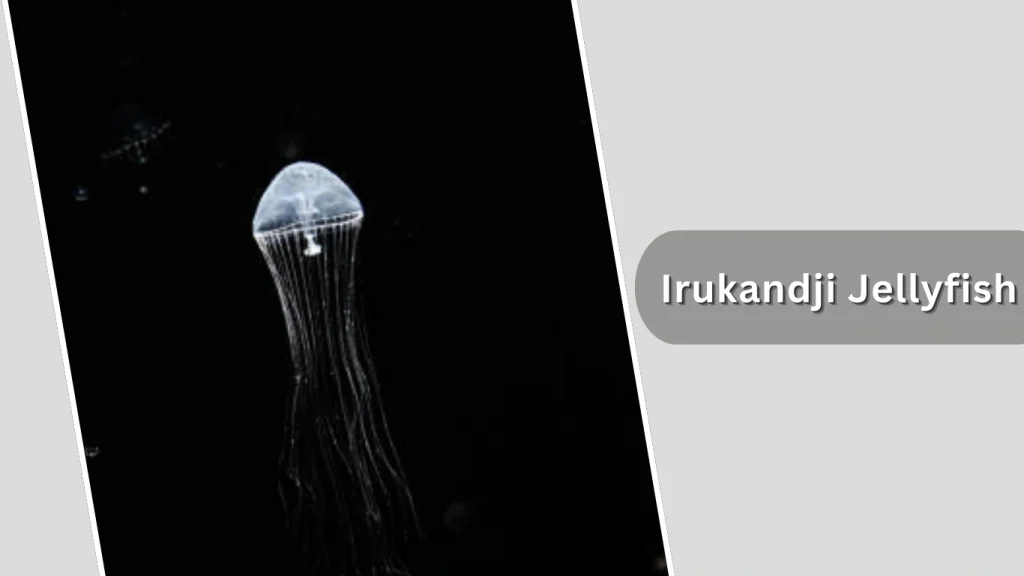
The Irukandji jellyfish is small in size but extremely dangerous due to its powerful venom. It is infamous for causing Irukandji syndrome, a serious and painful medical condition.
Identification
- Tiny, transparent bell usually less than 1 inch wide
- Four long, thin tentacles extending from the bell corners
- Nearly invisible body in water
- Small, box-shaped form
Habitat and Distribution
Irukandji jellyfish are found mainly in the warm waters of northern Australia. They inhabit coastal areas, reefs, and open ocean environments.
Behavior and Diet
They are active swimmers and feed on small fish and plankton. Their tentacles deliver venom that quickly incapacitates prey.
Venom Effects
The venom causes severe pain, muscle cramps, nausea, and heart complications in humans. Symptoms may appear minutes after a sting and require immediate medical attention.
24. Upside-Down Jellyfish (Cassiopea species)

The upside-down jellyfish is known for resting on the seafloor with its tentacles facing upward. This unusual posture supports its symbiotic relationship with photosynthetic algae.
Identification
- Flattened bell with frilly oral arms pointing upward
- Bell diameter usually 4–12 inches
- Brownish or greenish coloration
- Short, branched tentacles
Habitat and Distribution
This species is commonly found in shallow, tropical coastal waters, lagoons, and mangroves. It prefers calm, sunny environments.
Behavior and Diet
Upside-down jellyfish spend most of their time resting on the seabed. They gain nutrients from symbiotic algae and also feed on plankton.
Symbiotic Lifestyle
The algae living in their tissues perform photosynthesis, providing energy. This relationship explains their upside-down posture and preference for sunlit waters.
25. Helmet Jellyfish (Periphylla periphylla)
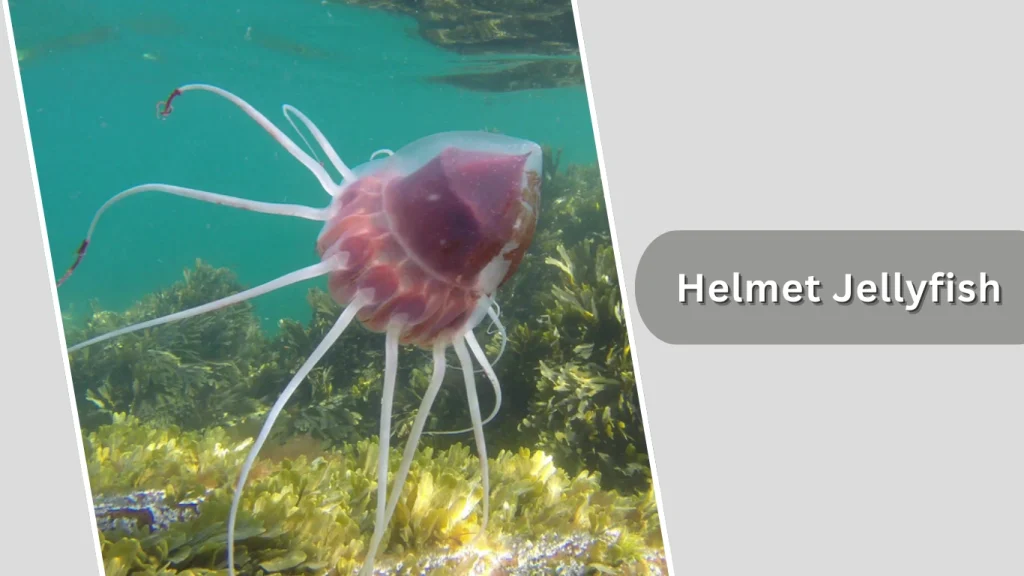
The helmet jellyfish is a deep-sea species named for its rounded, helmet-like bell. It is known for its dark coloration and ability to thrive in low-light environments.
Identification
- Deep red to dark purple bell with a smooth surface
- Bell diameter usually 2–4 inches
- Short tentacles arranged evenly around the bell
- Thick, sturdy body structure
Habitat and Distribution
This jellyfish inhabits deep ocean waters worldwide, often at depths of 1,000 to 10,000 feet. It prefers cold, dark environments and is rarely seen near the surface.
Behavior and Diet
Helmet jellyfish migrate vertically, moving closer to the surface at night to feed. Their diet consists of plankton and small marine organisms.
Light Sensitivity
This species is highly sensitive to light and avoids bright conditions. Sudden exposure to strong light can damage its tissues, influencing its deep-sea lifestyle.
26. Fire Jellyfish (Cyanea capillata)

The fire jellyfish is a common name used for highly stinging jellyfish, often referring to certain lion’s mane jellyfish varieties. It is known for its intense sting and fiery appearance.
Identification
- Large bell with reddish or orange tones
- Dense clusters of long, hair-like tentacles
- Bell diameter varies widely, often over 12 inches
- Flowing, flame-like tentacle appearance
Habitat and Distribution
Fire jellyfish are found in cold and temperate oceans, particularly in the North Atlantic and North Pacific. They are commonly encountered during seasonal blooms.
Behavior and Diet
They drift with currents and feed on plankton, small fish, and other jellyfish. Their tentacles deliver strong stings used to subdue prey.
Common Name Usage
The term “fire jellyfish” is not a formal species name. It is often used to describe jellyfish that cause burning sensations upon contact.
27. Deep-Sea Red Jellyfish

The deep-sea red jellyfish is a rarely seen species adapted to life in the dark depths of the ocean. Its red coloration makes it nearly invisible in deep water, where red light does not penetrate.
Identification
- Deep red or crimson bell coloration
- Rounded, smooth bell shape
- Short to moderately long tentacles
- Soft, gelatinous body adapted to high pressure
Habitat and Distribution
This jellyfish lives in deep ocean waters across multiple regions of the world. It is typically found at depths where sunlight cannot reach, far below the surface.
Behavior and Diet
Deep-sea red jellyfish drift slowly and conserve energy. They feed on plankton, small crustaceans, and organic particles drifting down from upper layers.
Deep-Sea Adaptation
The red coloration provides camouflage in deep water. Combined with slow movement and low metabolism, this adaptation helps the jellyfish survive in an extreme environment.