



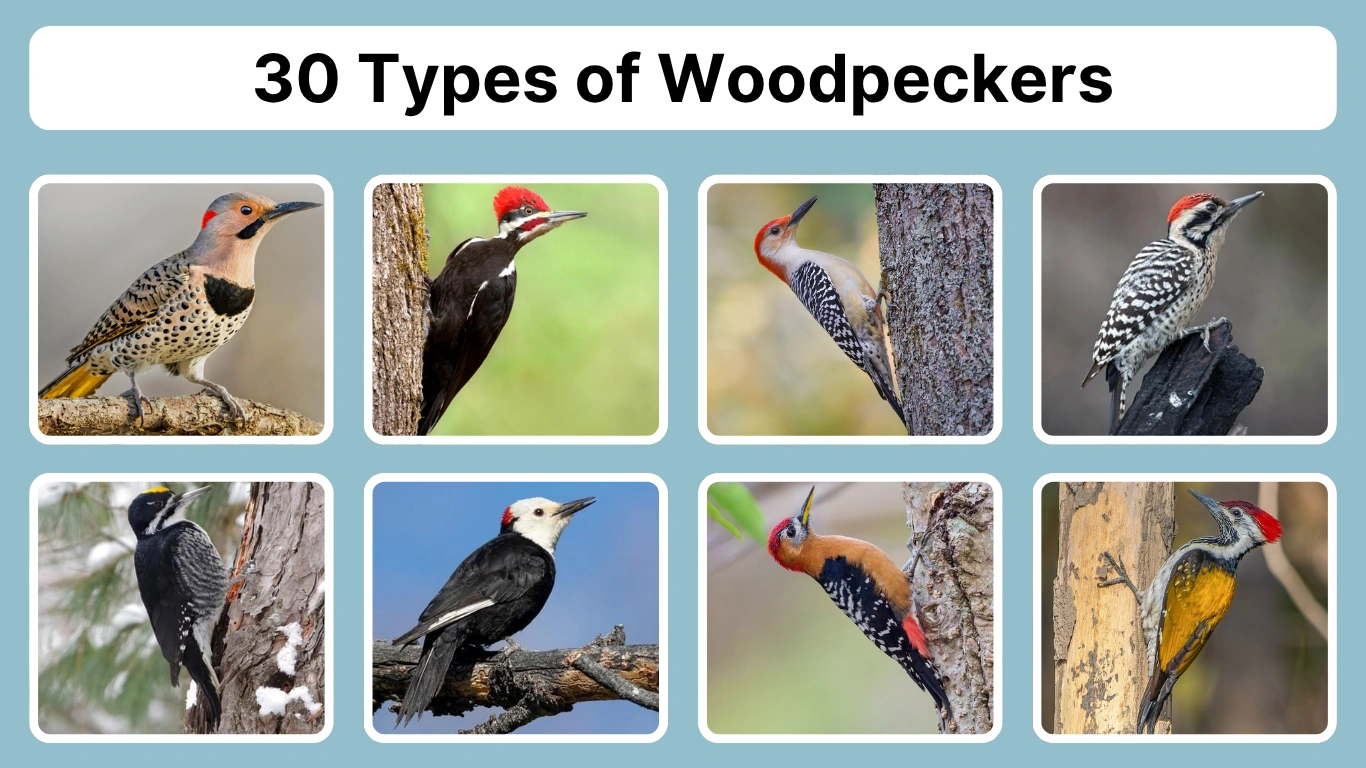
Woodpeckers are among the most fascinating and diverse birds in the avian world. Found across nearly every continent, these birds are instantly recognizable for their strong bills, stiff tails, and rhythmic drumming on tree trunks. From the majestic Pileated Woodpecker of North America to the brightly colored Flamebacks of Asia, woodpeckers come in many shapes, sizes, and colors—each adapted to its own environment and lifestyle.
In this guide, we explore 30 types of woodpeckers from around the globe. Each section provides detailed identification features, behavior, habitat, and range. Whether you’re a birdwatcher, nature lover, or simply curious about these incredible birds, this comprehensive list offers an in-depth look at the most iconic and interesting woodpecker species.
1. Pileated Woodpecker
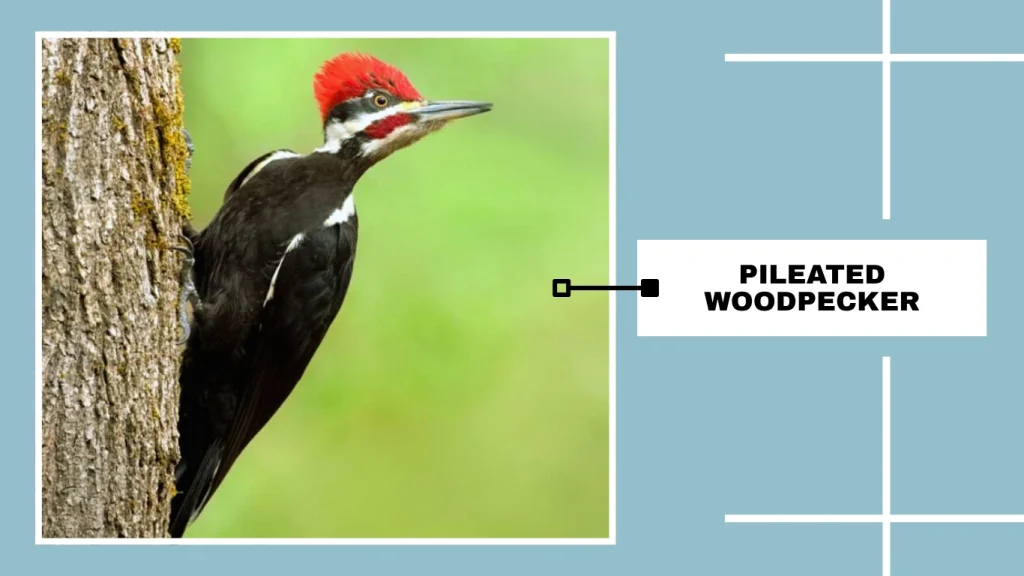
The Pileated Woodpecker is one of the largest and most visually impressive woodpeckers native to North America. Its striking red crest, bold black-and-white coloring, and deep, echoing call make it unmistakable in the forest. These birds are powerful excavators and play a vital role in forest ecosystems by creating nesting cavities used by other wildlife.
Identification
- Coloration: Mostly black with white stripes down the neck and face
- Crest: Distinctive red crest on both sexes
- Facial Markings: Males have a red cheek stripe; females have a black one
- Size: 16–19 inches (40–49 cm) in body length
- Wingspan: 26–30 inches (66–75 cm)
- Weight: Between 9 and 14 ounces (250–400 grams)
- Habitat: Prefers mature forests, wooded parks, and swamps
- Call: Loud, repetitive “kuk-kuk-kuk” and deep drumming sounds
Behavior and Diet
Pileated Woodpeckers feed mainly on carpenter ants, wood-boring beetles, and larvae. They also supplement their diet with wild fruits, berries, and nuts. Their rectangular excavations in dead wood are distinctive and often reused by other birds and mammals for nesting or shelter.
Nesting and Reproduction
Both male and female birds take part in excavating the nest cavity in dead or dying trees. They typically lay 3 to 5 white eggs, and both parents incubate the eggs and care for the young. The nesting cavity is often reused in subsequent seasons or adopted by owls, bats, or other wildlife.
Range and Distribution
The Pileated Woodpecker is found throughout much of Canada, the eastern United States, and parts of the Pacific Northwest. It prefers dense, mature woodlands but may also adapt to large wooded parks and suburban forests.
2. Downy Woodpecker

The Downy Woodpecker is the smallest woodpecker species in North America, but it is also one of the most widespread and familiar. With its checkered black-and-white appearance and cheerful call, it often visits backyard feeders and gardens, making it a favorite among birdwatchers.
Identification
- Coloration: Black and white with checkered wings and white underparts
- Crest: Short black crown; males have a small red patch on the nape
- Facial Markings: White stripe above and below the eye
- Size: 5.5–7 inches (14–18 cm) in length
- Wingspan: 9.5–12 inches (24–30 cm)
- Weight: 0.7–1 ounce (20–28 grams)
- Habitat: Forest edges, parks, orchards, and suburban yards
- Call: High-pitched “pik” and a descending whinny
Behavior and Diet
Downy Woodpeckers forage on tree trunks and branches for insects, especially caterpillars and beetle larvae. They also eat seeds, berries, and suet, often visiting feeders in winter. Their small size allows them to cling to slender stems and twigs that larger woodpeckers avoid.
Nesting and Reproduction
Nesting cavities are excavated in dead trees or limbs. Females lay 3 to 6 eggs. Both parents share incubation and feeding duties. After fledging, the young may follow parents for a few weeks.
Range and Distribution
Found throughout most of North America except deserts and extreme northern areas. They adapt well to human-altered landscapes and are year-round residents in their range.
3. Hairy Woodpecker

Often mistaken for its smaller cousin, the Downy Woodpecker, the Hairy Woodpecker is similar in appearance but has a longer bill and larger body. It is commonly seen in forests and wooded areas across North America.
Identification
- Coloration: Black and white with a clean white underside and checkered black-and-white wings
- Crest: Flat crown; males have a red patch on the nape
- Facial Markings: Prominent white stripe down the back and facial streaks
- Size: 8.5–10 inches (21–26 cm) in length
- Wingspan: 13–16 inches (33–41 cm)
- Weight: 1.4–3.4 ounces (40–95 grams)
- Habitat: Mature forests, wooded suburbs, and parks
- Call: Sharp “peek” and a rapid, intense drum
Behavior and Diet
Hairy Woodpeckers forage for insects under tree bark, often flaking bark off in large pieces. They eat wood-boring beetles, ants, and larvae, along with fruits and nuts. They may visit suet feeders but are more commonly found in deeper woods than the Downy.
Nesting and Reproduction
Nest cavities are excavated in dead trees. The female lays 3 to 6 eggs, and both sexes share nesting duties. The young fledge about four weeks after hatching.
Range and Distribution
Widespread across North America, including forests from Alaska to Mexico. They prefer less human disturbance than Downy Woodpeckers but can still be seen near quiet neighborhoods with mature trees.
4. Northern Flicker

The Northern Flicker is a large, ground-feeding woodpecker recognized for its striking plumage and loud, ringing calls. Unlike most woodpeckers, it often feeds on the ground, especially for ants, its favorite food.
Identification
- Coloration: Brown body with black spots and a white rump
- Crest: Smooth head without a raised crest
- Facial Markings: Red or black mustache stripe (depends on region and sex)
- Size: 11–14 inches (28–36 cm) in length
- Wingspan: 16–21 inches (41–53 cm)
- Weight: 3.5–5.5 ounces (100–160 grams)
- Habitat: Open woodlands, forest edges, and suburban areas
- Call: Loud “wick-a-wick-a-wick” and piercing “kleeer”
Behavior and Diet
Primarily insectivorous, Northern Flickers eat ants, beetles, and other ground-dwelling insects. They also consume fruits and seeds. They often drum on metal objects and trees to communicate during breeding season.
Nesting and Reproduction
They excavate nest cavities in dead or decaying trees. Females lay 5 to 8 eggs, and both parents incubate and feed the chicks.
Range and Distribution
Found throughout most of North America, with Eastern (yellow-shafted) and Western (red-shafted) variations. Common in urban parks, woodlands, and rural areas.
5. Red-bellied Woodpecker

The Red-bellied Woodpecker is a medium-sized woodpecker named for the faint reddish wash on its belly, though its most noticeable feature is the bright red cap and nape seen on males.
Identification
- Coloration: Pale gray face and underparts with black-and-white barred back
- Crest: Bright red crown and nape in males; females lack red on the crown
- Facial Markings: Light face with a reddish blush near the bill
- Size: 9–10.5 inches (23–27 cm) in length
- Wingspan: 13–17 inches (33–43 cm)
- Weight: 2–3.2 ounces (56–91 grams)
- Habitat: Wooded suburbs, forests, and parks
- Call: Harsh “churr” and rolling “kwirr”
Behavior and Diet
Feeds on insects, nuts, seeds, and fruits. Often seen climbing tree trunks and large branches. Frequently visits backyard feeders, especially for suet and sunflower seeds.
Nesting and Reproduction
Both sexes excavate the nest in dead trees or utility poles. They typically raise 4 to 6 young per brood, with both parents sharing duties.
Range and Distribution
Common in the eastern United States, especially in deciduous and mixed forests. Their range has expanded northward in recent decades.
6. Red-headed Woodpecker

The Red-headed Woodpecker is one of the most visually striking woodpeckers in North America. Its bold crimson head, snow-white body, and jet-black wings give it a sharp, tri-colored appearance. Unlike many other woodpeckers, it catches insects in flight and stores food in tree crevices.
Identification
- Coloration: Entire head and throat bright red; body white; wings black with large white patches
- Crest: Smooth, rounded red crown
- Facial Markings: Solid red head and neck, no facial stripes
- Size: 7.5–9.5 inches (19–24 cm) in length
- Wingspan: 16–17 inches (40–43 cm)
- Weight: 2–3.5 ounces (56–100 grams)
- Habitat: Open woodlands, savannas, farmlands, and orchards
- Call: Loud, shrill “queer” or “tchur”
Behavior and Diet
This woodpecker is both a hunter and a gatherer. It feeds on flying insects, nuts, seeds, and fruits, and caches food by wedging it into bark or cracks. It may even cover stored food with bark or wood chips to hide it from other birds.
Nesting and Reproduction
Red-headed Woodpeckers nest in dead trees or utility poles. They usually have one brood per year with 4 to 7 eggs. Both parents share incubation and care.
Range and Distribution
Found mainly in the central and eastern U.S., especially in open forests and areas with dead trees. Populations fluctuate based on food availability.
7. Acorn Woodpecker

The Acorn Woodpecker is easily recognized by its clown-like face, red cap, and energetic social behavior. This species is famous for creating “granaries,” storing thousands of acorns in holes drilled into tree trunks or wooden structures.
Identification
- Coloration: Black upperparts, white forehead and throat, red crown, and yellowish under-chin
- Crest: Rounded red crown (smaller in females)
- Facial Markings: White face with black around the beak and eyes
- Size: 7.5–9 inches (19–23 cm) in length
- Wingspan: 14–17 inches (36–43 cm)
- Weight: 2.3–3.2 ounces (65–90 grams)
- Habitat: Oak woodlands, mixed forests, and suburban areas with oak trees
- Call: Distinctive “waka-waka” and cackling, parrot-like chatter
Behavior and Diet
These birds live in family groups and cooperatively store acorns, often using the same granary tree for generations. Their diet includes acorns, insects, fruits, and sap.
Nesting and Reproduction
Acorn Woodpeckers nest communally, with several birds helping to raise the young. Nests are usually made in large dead trees or utility poles.
Range and Distribution
Found in the western United States, especially California, and throughout parts of Central America. They require oak trees for acorn storage and prefer areas with deadwood for nesting.
8. Gila Woodpecker

The Gila Woodpecker is a desert specialist found in the arid landscapes of the southwestern United States and Mexico. Often seen clinging to saguaro cacti, this species plays an essential role in the Sonoran Desert ecosystem, both as an insect controller and as a cavity maker for other desert animals.
Identification
- Coloration: Tan to light brown body with bold black-and-white barred back
- Crest: Smooth crown; males have a small red patch on top of the head
- Facial Markings: Pale face with black patch around the eye
- Size: 8–10 inches (20–25 cm) in length
- Wingspan: 13–16 inches (33–41 cm)
- Weight: 1.9–2.8 ounces (55–80 grams)
- Habitat: Deserts with cacti, especially saguaro forests
- Call: Harsh, repetitive “churrr” and quick sharp “pik-pik”
Behavior and Diet
Feeds on insects, fruits, seeds, and nectar. Gila Woodpeckers are commonly seen at hummingbird feeders and often forage on the ground or in shrubs. They excavate nesting holes in living saguaro cacti, which later provide shelter for owls, lizards, and other birds.
Nesting and Reproduction
They drill cavities in saguaro cacti or dead trees. The female lays 3 to 5 white eggs, and both parents share incubation and chick-rearing responsibilities.
Range and Distribution
Found mainly in Arizona, southern California, New Mexico, and into northwestern Mexico. They are common in urban desert areas and are well-adapted to human presence.
9. Ladder-backed Woodpecker

The Ladder-backed Woodpecker is a small, agile species of arid habitats. Named for the horizontal black-and-white barring on its back, it’s often seen flitting among desert shrubs and trees in the southwestern United States and Mexico.
Identification
- Coloration: Black-and-white striped back with pale, lightly spotted underparts
- Crest: Males have a red crown patch; females have a black crown
- Facial Markings: Distinct black-and-white stripes on the face
- Size: 6–7.5 inches (15–19 cm) in length
- Wingspan: 13 inches (33 cm) on average
- Weight: 0.7–1.5 ounces (20–42 grams)
- Habitat: Dry woodlands, desert scrub, mesquite groves
- Call: Dry “pik” and chattering rattles
Behavior and Diet
Feeds on insects, especially beetle larvae and ants, and occasionally consumes cactus fruit and seeds. They forage by tapping and flaking bark from branches and trunks in low vegetation.
Nesting and Reproduction
Nests are built in dead limbs or cacti. Females lay 3 to 5 eggs. Both parents incubate and feed the young, which fledge within about three weeks.
Range and Distribution
Widespread throughout the southwestern U.S., especially Texas, New Mexico, Arizona, and parts of Mexico. Prefers arid environments with scattered trees or cacti.
10. Lewis’s Woodpecker

Lewis’s Woodpecker is a unique and colorful woodpecker that behaves more like a flycatcher than a typical tree-tapping bird. With its iridescent plumage and graceful aerial insect-catching, it stands out both visually and behaviorally among North American woodpeckers.
Identification
- Coloration: Glossy green-black upperparts, rosy-pink belly, gray collar, and red face
- Crest: Smooth rounded head with no prominent crest
- Facial Markings: Deep red face with gray nape and collar
- Size: 10–11 inches (25–28 cm) in length
- Wingspan: 19–21 inches (48–53 cm)
- Weight: 3.1–4.9 ounces (88–140 grams)
- Habitat: Open pine forests, burned woodlands, oak groves, and river groves
- Call: Harsh, descending “churrr” and short “chik”
Behavior and Diet
Unlike most woodpeckers, Lewis’s Woodpecker often catches insects midair. It also feeds on acorns, nuts, and fruits, and may store food in tree bark for winter. Its slow, crow-like flight is distinctive.
Nesting and Reproduction
Nests in cavities in dead or decaying trees, often using old nest holes. The female lays 5 to 9 eggs. Both parents take part in incubation and chick rearing.
Range and Distribution
Found in western North America, especially in parts of California, Oregon, Colorado, and British Columbia. Prefers open pine forests and areas recovering from wildfire.
11. Yellow-bellied Sapsucker

The Yellow-bellied Sapsucker is a migratory woodpecker best known for the neat rows of small holes it drills into tree bark to harvest sap. Its feeding habits benefit other species, such as hummingbirds and insects, that also consume the oozing sap.
Identification
- Coloration: Black-and-white patterned back, pale yellowish belly, red forehead; males have a red throat
- Crest: Slightly rounded crown, red on the forehead
- Facial Markings: Distinct black lines on the face and a bold white wing patch
- Size: 7.5–8.5 inches (19–22 cm) in length
- Wingspan: 13–16 inches (33–41 cm)
- Weight: 1.5–2 ounces (43–56 grams)
- Habitat: Deciduous forests, orchards, and wooded swamps
- Call: Nasal “meeow” and irregular drumming
Behavior and Diet
Feeds primarily on tree sap by drilling small holes in rows and returning to sip the sap and eat trapped insects. Also eats fruits, berries, and ants.
Nesting and Reproduction
Excavates cavities in live deciduous trees. Females lay 4 to 6 eggs. Both sexes share incubation and feeding duties.
Range and Distribution
Breeds in Canada and the northeastern U.S.; winters in the southeastern U.S., Mexico, and Central America. Often seen in migration through the central United States.
12. Black-backed Woodpecker

The Black-backed Woodpecker is a specialist of burned forests, where it thrives by feeding on the wood-boring beetle larvae that infest fire-damaged trees. Its black plumage blends seamlessly with charred trunks, offering natural camouflage in its preferred habitat.
Identification
- Coloration: Entire back is black; flanks and belly white with fine black barring
- Crest: Males have a yellow crown patch; females have an all-black crown
- Facial Markings: White facial stripe extending behind the eye
- Size: 9–10 inches (23–26 cm) in length
- Wingspan: 15–16.5 inches (38–42 cm)
- Weight: 2.1–3.1 ounces (60–88 grams)
- Habitat: Burned boreal and coniferous forests
- Call: Sharp “pik” and drumming that’s slower than other woodpeckers
Behavior and Diet
Feeds heavily on wood-boring beetle larvae beneath charred bark. It chips away bark with powerful strikes to uncover its prey. Rarely visits feeders and generally avoids human presence.
Nesting and Reproduction
Excavates cavities in burned or dead conifer trees. Typically lays 3 to 4 eggs. Both parents incubate and feed the young.
Range and Distribution
Found in boreal forests of Canada, Alaska, and the northern Rocky Mountains. Common after forest fires where beetle infestations are abundant.
13. White-headed Woodpecker

The White-headed Woodpecker is a visually distinctive species of the mountainous western United States. Its striking white head and mostly black body set it apart from all other North American woodpeckers.
Identification
- Coloration: White head and underparts; black wings, back, and tail
- Crest: Smooth white crown, no raised crest
- Facial Markings: Entire head bright white with a black neck and body
- Size: 8.5–9 inches (22–23 cm) in length
- Wingspan: 16–17 inches (40–43 cm)
- Weight: 2–2.5 ounces (57–71 grams)
- Habitat: Mountain pine forests, especially in dry, open areas with large cones
- Call: High-pitched “peeek” and soft rattling notes
Behavior and Diet
Feeds primarily on pine seeds, beetles, and ants. Skilled at prying open large pine cones and flaking bark in search of insects. Often seen foraging along branches rather than trunk-drilling.
Nesting and Reproduction
Nests are made in dead pine trees. Both male and female help excavate the cavity and raise the young. Clutches usually contain 3 to 5 eggs.
Range and Distribution
Found in mountainous pine forests of California, Oregon, Washington, and parts of British Columbia and Idaho. Dependent on mature pine stands with large cones.
14. Golden-fronted Woodpecker

The Golden-fronted Woodpecker is a colorful, medium-sized woodpecker found primarily in the southern central United States and Mexico. Its golden-yellow markings and varied calls make it a lively presence in dry woodlands and mesquite groves.
Identification
- Coloration: Pale grayish body with black-and-white barred back
- Crest: Males have a red crown and a golden-yellow forehead; females lack the red crown
- Facial Markings: Golden-yellow nape and nasal tufts
- Size: 8.5–10 inches (22–25 cm) in length
- Wingspan: 16–17 inches (40–43 cm)
- Weight: 2.6–3.5 ounces (74–100 grams)
- Habitat: Mesquite groves, dry woodlands, riparian corridors, and urban parks
- Call: Sharp “churrr” and varied cackles and trills
Behavior and Diet
Feeds on insects, fruits, nuts, and seeds. Known to visit feeders and birdbaths in suburban areas. May store food in tree bark crevices during winter.
Nesting and Reproduction
Nests in cavities of dead trees or cactus trunks. Lays 4 to 7 eggs. Both sexes participate in incubation and chick care.
Range and Distribution
Found in central and southern Texas into Mexico and parts of Central America. Favors arid and semi-arid habitats with scattered trees.
15. Arizona Woodpecker

The Arizona Woodpecker is one of the few brown-plumaged woodpeckers in North America. It’s a secretive resident of oak and pine-oak forests in the southwestern U.S. and Mexico, where it clings quietly to trunks and branches.
Identification
- Coloration: Brown body with white underparts and spotted breast
- Crest: Males have a small red patch on the nape; females lack red
- Facial Markings: White stripe behind the eye; plain brown crown
- Size: 7–8 inches (18–20 cm) in length
- Wingspan: 14 inches (36 cm)
- Weight: 1.9–2.4 ounces (55–68 grams)
- Habitat: Pine-oak and oak woodlands in mountainous terrain
- Call: Soft “peek” and high-pitched trills
Behavior and Diet
Forages on trunks and branches for ants, beetles, and other insects. Sometimes joins mixed foraging flocks in winter. Rarely seen at feeders.
Nesting and Reproduction
Nests in tree cavities excavated in dead limbs or snags. Typically lays 3 to 5 eggs. Both parents share duties.
Range and Distribution
Found in southeastern Arizona, southwestern New Mexico, and through western Mexico. Prefers mid- to high-elevation oak and pine forests.
16. Ivory-billed Woodpecker

The Ivory-billed Woodpecker is one of the most elusive and possibly extinct woodpeckers in North America. Revered for its majestic size and striking appearance, it was historically found in swampy bottomland forests of the southeastern U.S.
Identification
- Coloration: Glossy black with bold white wing stripes; white on lower back
- Crest: Males have a bright red crest; females have a black crest
- Facial Markings: Long white stripe extending from cheek to neck
- Size: 18–20 inches (45–51 cm) in length
- Wingspan: 30 inches (76 cm)
- Weight: 15–20 ounces (425–567 grams)
- Habitat: Swampy old-growth forests and cypress-tupelo wetlands
- Call: Trumpet-like “kent” and loud double-knock drumming
Behavior and Diet
Fed on beetle larvae and other insects under bark, using its powerful chisel-like bill. Known for tearing bark off dead trees in large strips.
Nesting and Reproduction
Nest cavities were built high in dead or dying trees. Typical clutch size was 3 to 5 eggs. Both parents cared for the young.
Range and Distribution
Historically found in the southeastern United States and Cuba. Officially listed as critically endangered, possibly extinct.
17. Nuttall’s Woodpecker

Nuttall’s Woodpecker is a small, active species found mainly in California. Known for its rapid drumming and preference for oak woodlands, this woodpecker is an agile climber and frequent visitor to shaded canopies.
Identification
- Coloration: Black-and-white barred back; white underparts with faint streaks
- Crest: Males have a red crown patch at the rear; females have none
- Facial Markings: Black mask and white stripe above the eye
- Size: 6.5–7.5 inches (16–19 cm) in length
- Wingspan: 13 inches (33 cm)
- Weight: 1–1.6 ounces (28–45 grams)
- Habitat: Oak woodlands, riparian groves, and chaparral
- Call: Sharp “pitik” and quick rattles
Behavior and Diet
Feeds on insects, spiders, and occasionally acorns and berries. Forages by pecking and gleaning on limbs and trunks, often high in the canopy.
Nesting and Reproduction
Nests in tree cavities, especially in dead branches. Lays 3 to 6 eggs. Both sexes participate in nesting duties.
Range and Distribution
Endemic to California and northern Baja California. Strongly associated with oak-rich habitats.
18. Red-cockaded Woodpecker

The Red-cockaded Woodpecker is a rare and federally endangered species known for its unique habitat preference and social nesting behavior. It inhabits mature pine forests in the southeastern U.S. and is highly dependent on living pines with heartwood decay.
Identification
- Coloration: Black-and-white barred back with white cheeks and underparts
- Crest: Lacks a visible crest
- Facial Markings: Males have a small, barely visible red streak (“cockade”) behind the eye
- Size: 7.5–9 inches (19–23 cm) in length
- Wingspan: 14 inches (36 cm)
- Weight: 1.5–1.8 ounces (42–51 grams)
- Habitat: Mature longleaf pine forests
- Call: Raspy “sklit” and high-pitched, descending notes
Behavior and Diet
Feeds on insects, especially ants, beetles, and larvae, along with fruits and pine seeds. Lives in cooperative family groups, with offspring often assisting in raising younger siblings.
Nesting and Reproduction
Excavates nest cavities in living pines infected with red heart fungus, which softens the wood. Clutch size is usually 3 to 4 eggs. Groups maintain cluster territories of cavity trees.
Range and Distribution
Native to the southeastern U.S., including parts of Florida, Georgia, the Carolinas, Alabama, and Texas. Population decline due to loss of old-growth pine habitat.
19. Williamson’s Sapsucker

Williamson’s Sapsucker is a striking, sexually dimorphic woodpecker of western mountain forests. Males and females look so different they were once considered separate species.
Identification
- Coloration:
- Males: Black back, head, and chest with bold white wing patches and a bright red throat
- Females: Brown head, black-and-white barred back, pale belly with a yellow lower abdomen
- Males: Black back, head, and chest with bold white wing patches and a bright red throat
- Crest: Smooth crown, no visible crest
- Facial Markings: Males have a red throat and white facial lines; females have a brown face and white eye stripe
- Size: 8.5–9.5 inches (22–24 cm) in length
- Wingspan: 16 inches (40 cm)
- Weight: 1.6–1.9 ounces (45–54 grams)
- Habitat: High-elevation coniferous forests, especially in the Rockies and Sierra Nevada
- Call: Harsh “waah” and sharp “chak”
Behavior and Diet
Feeds on tree sap by drilling horizontal rows of holes, as well as on ants and beetle larvae. Occasionally eats fruits and berries. Males and females often forage differently.
Nesting and Reproduction
Nests in cavities of dead or decaying trees, often aspen or conifers. Lays 4 to 6 eggs. Both sexes incubate and care for the young.
Range and Distribution
Found in mountainous regions of the western U.S. and southern British Columbia. Prefers mature forests at mid to high elevations.
20. American Three-toed Woodpecker

The American Three-toed Woodpecker is a boreal forest specialist that blends seamlessly into coniferous woodlands. Named for its unique foot structure—three toes instead of the usual four—it’s well adapted for gripping vertical tree trunks.
Identification
- Coloration: Black back with white barring on flanks; white underparts with black barring on sides
- Crest: Males have a yellow crown patch; females have an all-black crown
- Facial Markings: White line from bill across the cheek and neck
- Size: 8.3–9.1 inches (21–23 cm) in length
- Wingspan: 14.6–15.3 inches (37–39 cm)
- Weight: 1.6–2.4 ounces (45–68 grams)
- Habitat: Boreal coniferous forests, especially spruce and fir woodlands
- Call: Soft “pik” and weak trilling drum
Behavior and Diet
Feeds primarily on bark beetle larvae, especially in recently burned or infested forests. Uses its strong bill to flake bark and excavate wood. Rarely visits feeders.
Nesting and Reproduction
Nests in dead or decaying conifer trees. Lays 3 to 5 eggs. Both male and female share incubation and feeding duties.
Range and Distribution
Widespread across boreal Canada, Alaska, and northern U.S. mountain ranges. Prefers remote forests, often in areas recovering from fire or beetle infestation.
21. Strickland’s Woodpecker
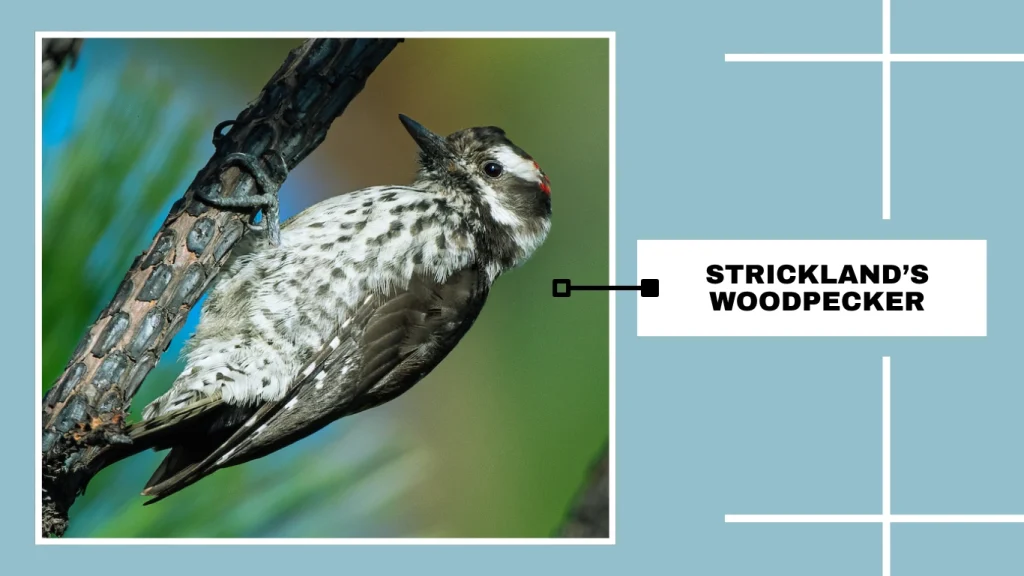
Strickland’s Woodpecker is a quiet, elusive species native to central Mexico. Once considered the same species as Arizona Woodpecker, it is now recognized as distinct, favoring high-elevation pine and oak woodlands.
Identification
- Coloration: Brown upperparts with white underparts streaked with brown
- Crest: Males have a red patch on the nape; females have an entirely brown crown
- Facial Markings: White stripe behind the eye and dark cheek markings
- Size: 7–8 inches (18–20 cm) in length
- Wingspan: About 14 inches (36 cm)
- Weight: Approximately 2 ounces (57 grams)
- Habitat: Montane pine and oak forests of central Mexico
- Call: Soft “pik” and quiet tapping
Behavior and Diet
Feeds on insects, larvae, and some plant material. Forages on tree trunks and branches, moving methodically and quietly through the forest.
Nesting and Reproduction
Nests in tree cavities excavated in dead limbs or trunks. Typical clutch size is 3 to 5 eggs. Both parents assist in raising young.
Range and Distribution
Restricted to central Mexico, especially in highland forests between 6,000 and 9,000 feet elevation. It is non-migratory and usually shy and inconspicuous.
22. Rufous-bellied Woodpecker

The Rufous-bellied Woodpecker is a striking bird found in parts of South and Southeast Asia. Its rich reddish underparts and bold black-and-white upper body make it one of the most colorful woodpeckers in its range.
Identification
- Coloration: Reddish-rufous belly, black-and-white barred upperparts, and white face markings
- Crest: Males have a red crown; females have a black crown
- Facial Markings: Prominent white stripe below the eye and along the cheek
- Size: 7.9–9.1 inches (20–23 cm) in length
- Wingspan: 13–15 inches (33–38 cm)
- Weight: 1.8–2.3 ounces (52–65 grams)
- Habitat: Broadleaf and mixed forests, often near clearings or forest edges
- Call: Loud “kik-kik-kik” and quick drumming
Behavior and Diet
Feeds primarily on insects such as ants and larvae, as well as tree sap. Known to drill shallow sap wells in bark, much like sapsuckers. Often forages along trunks and larger branches.
Nesting and Reproduction
Nest cavities are dug into softwood or partially decayed trees. Clutches typically contain 3 to 5 eggs. Both parents share in nesting duties.
Range and Distribution
Found in the Himalayas, parts of northern India, Nepal, Bhutan, and southeast Asia. Prefers moist forests and upland woodlands at moderate elevations.
23. Great Spotted Woodpecker

The Great Spotted Woodpecker is one of Europe’s most common and easily recognized woodpeckers. Its bold black-and-white pattern and bright red under-tail make it a familiar sight in woodlands and gardens across its range.
Identification
- Coloration: Black back and wings with large white shoulder patches; white belly and red under-tail
- Crest: Smooth black crown
- Facial Markings: Males have a red patch on the nape; juveniles have a red cap
- Size: 8.7–9.8 inches (22–25 cm) in length
- Wingspan: 13–16 inches (34–39 cm)
- Weight: 2.3–3.5 ounces (65–100 grams)
- Habitat: Deciduous and mixed forests, urban parks, gardens
- Call: Loud “kick” and rapid drumming on trunks
Behavior and Diet
Feeds on insects, larvae, nuts, and seeds. Often visits feeders for peanuts or suet. Also known for cracking open cones and occasionally raiding other birds’ nests for eggs or chicks.
Nesting and Reproduction
Excavates nest holes in dead or living trees. Lays 4 to 7 eggs. Both sexes participate in incubation and care of chicks.
Range and Distribution
Widespread across Europe and temperate Asia. Resident year-round, adapting well to both wild and suburban environments.
24. Middle Spotted Woodpecker
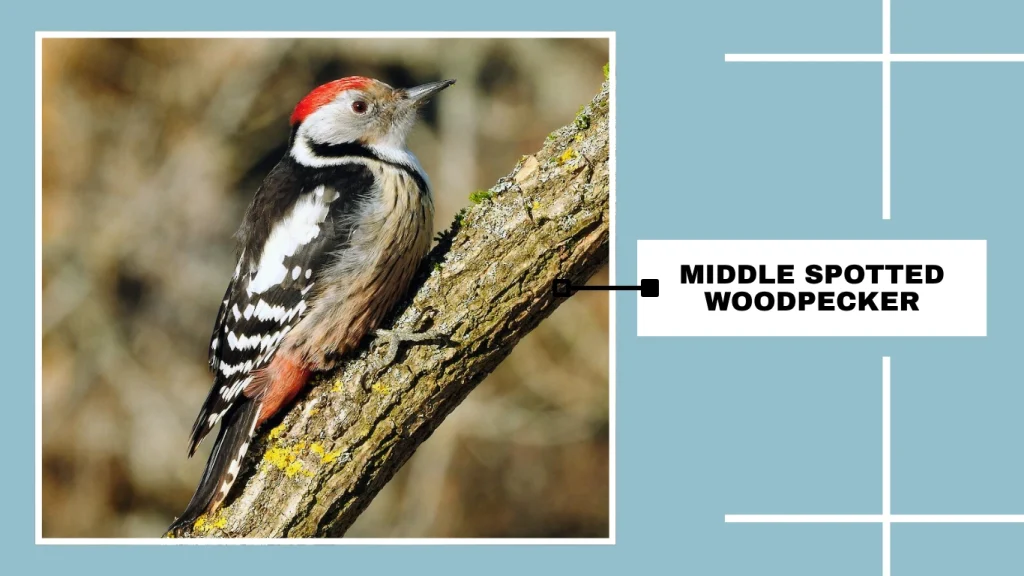
The Middle Spotted Woodpecker is a small and relatively quiet woodpecker native to central and southern Europe. It is closely related to the Great Spotted Woodpecker but distinguished by its pale face and red crown.
Identification
- Coloration: Pale underparts with light streaking; black wings with white bars; red crown
- Crest: Flat red crown in both males and females
- Facial Markings: Pale face without a distinct mustache stripe
- Size: 7.5–8.3 inches (19–21 cm) in length
- Wingspan: 13–14 inches (33–36 cm)
- Weight: 1.4–2 ounces (40–58 grams)
- Habitat: Mature deciduous forests, especially oak-rich woodlands
- Call: Soft nasal “kwee” and quiet tapping
Behavior and Diet
Feeds mainly on insects and their larvae, along with sap, seeds, and nuts. Often seen foraging on upper branches rather than main trunks, using a hopping movement instead of climbing vertically.
Nesting and Reproduction
Excavates nest holes in rotting trunks or branches. Clutches usually contain 4 to 7 eggs. Both sexes share parental responsibilities.
Range and Distribution
Found across parts of central and southern Europe, including France, Germany, Poland, and the Balkans. Prefers old-growth deciduous forests with large oaks.
25. Lesser Spotted Woodpecker

The Lesser Spotted Woodpecker is Europe’s smallest woodpecker species. Despite its name, it’s quite striking, with a barred back and boldly contrasting plumage. It is secretive and often stays high in the canopy, making it easy to overlook.
Identification
- Coloration: Black-and-white barred back; white underparts with fine streaking
- Crest: Males have a bright red crown; females have an all-black crown
- Facial Markings: Fine black mustache stripe and pale face
- Size: 5.5–6.3 inches (14–16 cm) in length
- Wingspan: 11–12 inches (28–30 cm)
- Weight: 0.7–1 ounce (20–29 grams)
- Habitat: Deciduous woodlands, especially alder, birch, and willow groves
- Call: Soft high-pitched “kee-kee-kee” and light drumming
Behavior and Diet
Feeds on wood-boring insects, ants, and spiders, foraging mainly in the upper canopy. Unlike larger woodpeckers, it taps softly and rarely drums loudly.
Nesting and Reproduction
Excavates nest holes in soft, dead wood. Lays 5 to 7 eggs. Both parents help in incubation and feeding.
Range and Distribution
Widespread but declining in parts of Europe and western Asia. Prefers undisturbed woodlands with plenty of deadwood for nesting.
26. Grey-headed Woodpecker

The Grey-headed Woodpecker is a slender, greenish woodpecker found across parts of Europe and Asia. It closely resembles the Green Woodpecker but can be distinguished by its gray head and more reserved behavior.
Identification
- Coloration: Olive-green upperparts, gray head and neck, pale green underparts
- Crest: Males have a small red crown stripe; females lack red entirely
- Facial Markings: Uniform gray face and crown with minimal contrast
- Size: 9.8–11 inches (25–28 cm) in length
- Wingspan: 15–17 inches (38–44 cm)
- Weight: 3.2–4 ounces (90–115 grams)
- Habitat: Deciduous and mixed forests, forest edges, and clearings
- Call: Loud whistling “kleeer” and series of laughing notes
Behavior and Diet
Feeds on ants, beetles, and their larvae, often foraging on the ground like the Green Woodpecker. Also eats fruits and seeds. Generally shy and stays close to tree trunks and shaded areas.
Nesting and Reproduction
Nests in tree cavities, often in dead or decaying trunks. Clutch size ranges from 5 to 7 eggs. Both sexes participate in nest excavation and chick-rearing.
Range and Distribution
Found from central and eastern Europe across Russia to parts of China and Southeast Asia. Prefers quiet woodlands with scattered old trees.
27. Eurasian Green Woodpecker

The Eurasian Green Woodpecker is a large and well-known species throughout Europe and parts of western Asia. Recognized for its laughing call and green plumage, it spends a lot of time feeding on ants on the ground.
Identification
- Coloration: Green back and wings, pale yellow underparts, bright red crown and nape
- Crest: Red crown prominent in both sexes; males have a red mustache stripe
- Facial Markings: Black around the eyes and mustache area, giving a mask-like look
- Size: 12–13 inches (30–34 cm) in length
- Wingspan: 17–18 inches (43–46 cm)
- Weight: 6.2–7.4 ounces (180–210 grams)
- Habitat: Open woodlands, farmlands, orchards, and suburban areas
- Call: Loud, laughing “yaffle” and rolling “klee-klee-klee”
Behavior and Diet
Feeds mostly on ants, which it collects with its long, sticky tongue from ant hills or lawns. Less often seen drumming or climbing trees compared to other woodpeckers.
Nesting and Reproduction
Excavates nest cavities in dead or softwood trees. The female lays 5 to 7 eggs. Both parents care for the young.
Range and Distribution
Widespread throughout Europe, including the UK, Scandinavia, and extending into western Asia. Common in mixed habitats with grassy open areas and trees.
28. Black-rumped Flameback

The Black-rumped Flameback, also known as the Lesser Golden-backed Woodpecker, is a vibrant and noisy species found throughout the Indian subcontinent. Its golden wings, red crest, and striking black markings make it one of the most colorful woodpeckers in Asia.
Identification
- Coloration: Golden-yellow wings, black back and rump, white underparts with dark streaks
- Crest: Males have a bright red crest; females have a black crest with white spots
- Facial Markings: White face with black mustache stripe and dark eye patch
- Size: 9.8–11 inches (25–28 cm) in length
- Wingspan: 16–18 inches (40–46 cm)
- Weight: 2.8–3.7 ounces (80–105 grams)
- Habitat: Deciduous forests, urban parks, groves, and gardens
- Call: Loud, sharp “ki-ki-ki” and shrill rattles
Behavior and Diet
Feeds on ants, termites, wood-boring beetles, and grubs, often seen scaling tree trunks or tapping on utility poles. Also consumes berries and nectar. Frequently seen in pairs or small groups.
Nesting and Reproduction
Nests in tree cavities excavated in deadwood or soft trees. The female lays 2 to 4 eggs. Both parents take part in incubation and feeding duties.
Range and Distribution
Widespread across India, Sri Lanka, Nepal, and parts of Bangladesh and Pakistan. Thrives in both natural forests and human-altered landscapes.
29. Crimson-crested Woodpecker

The Crimson-crested Woodpecker is a large, robust species native to Central and South America. Its vivid red head and powerful bill give it a commanding presence in tropical forests.
Identification
- Coloration: Black upperparts, red head and crest, white facial markings, and pale underparts
- Crest: Both sexes have a prominent red crest, larger in males
- Facial Markings: White stripe from bill to neck, contrasting with red crown
- Size: 12–13 inches (30–33 cm) in length
- Wingspan: 18–20 inches (46–51 cm)
- Weight: 7–9 ounces (200–255 grams)
- Habitat: Tropical lowland and montane forests, forest edges, and plantations
- Call: Loud double knocks and harsh, nasal calls
Behavior and Diet
Feeds mainly on ants and termites, along with fruits and grubs. Drills deeply into tree trunks and often leaves large, jagged holes. Moves deliberately and may remain in one spot for long periods while feeding.
Nesting and Reproduction
Cavity nester in large dead trees or limbs. Clutches contain 2 to 4 eggs. Both parents share incubation and chick care.
Range and Distribution
Found from southern Mexico through Central America and into the Amazon Basin and northern Argentina. Prefers dense tropical forests with mature trees.
30. Lineated Woodpecker

The Lineated Woodpecker is a large, bold bird of Central and South American forests, often confused with the similar-looking Pileated Woodpecker. It features strong contrasts in color, a vivid red crest, and a resonant drumming pattern.
Identification
- Coloration: Black body with white facial stripes and a red crest; males have a red mustache stripe
- Crest: Prominent and pointed red crest on both sexes
- Facial Markings: Distinct white lines run from the bill down the neck
- Size: 11–13 inches (28–33 cm) in length
- Wingspan: 18–20 inches (46–51 cm)
- Weight: 7–8.5 ounces (200–240 grams)
- Habitat: Tropical and subtropical forests, plantations, and wooded savannas
- Call: Deep, laughing “kleeer” and strong, resonant drumming
Behavior and Diet
Feeds primarily on ants, termites, beetle larvae, and grubs found under bark or in rotting wood. Also eats fruits and seeds. It uses its strong bill to chisel into tree trunks, often creating large foraging holes.
Nesting and Reproduction
Nests in high tree cavities, usually in deadwood. Females lay 2 to 4 eggs, with both parents involved in incubation and chick feeding. Nest holes are reused year after year or reclaimed by other forest creatures.
Range and Distribution
Widespread across Central America and much of northern and central South America, including Colombia, Venezuela, Brazil, and Peru. Thrives in a variety of forested habitats from sea level to foothills.