

The red wasp queen is the heart of every colony, responsible for reproduction, nest building, and the survival of her species. These queens are often mistaken for larger worker wasps but can be recognized by their size, shape, and behavior. Understanding how to identify a red wasp queen and her role in the colony helps with safe management and seasonal control.
What Is a Red Wasp Queen?
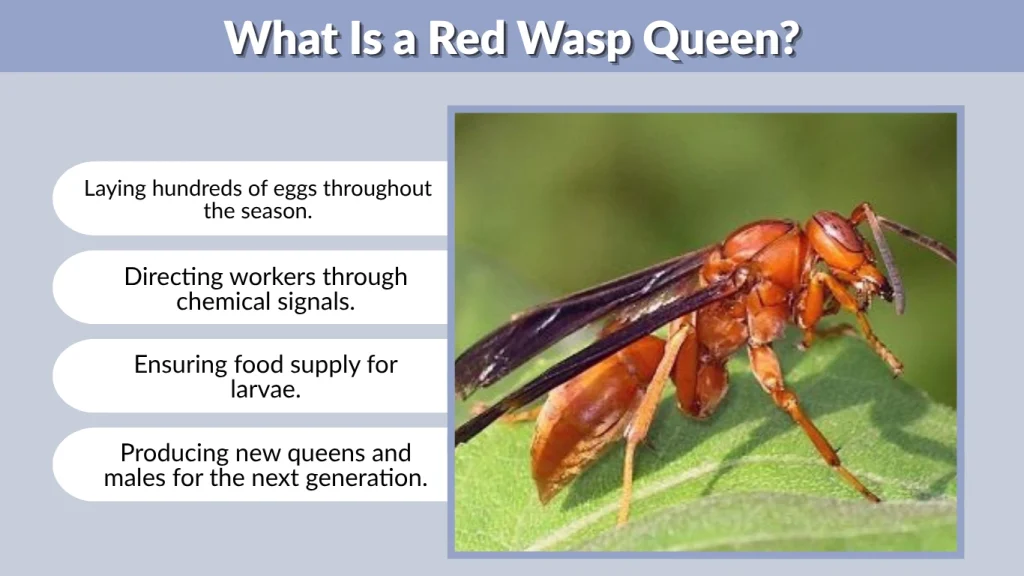
The Role of the Queen
The queen red wasp (Polistes carolina) is the single most important member of her colony. She starts the nest, lays eggs, and produces generations of workers that maintain and defend it. Without her, the colony cannot function. The queen also releases pheromones that keep worker wasps organized and prevent them from reproducing, maintaining a stable hierarchy within the colony.
Her responsibilities include:
- Laying hundreds of eggs throughout the season.
- Directing workers through chemical signals.
- Ensuring food supply for larvae.
- Producing new queens and males for the next generation.
Do Red Wasps Have a Queen?
Yes — like honeybees, red wasps operate under a queen-based system. Each spring, fertilized queens emerge from hibernation and begin building new nests. Once established, she remains in or near the nest while workers forage for food, expand the structure, and protect it. By late summer, the queen may produce new reproductive males and females that will form next year’s colonies.
How to Identify a Red Wasp Queen
Physical Appearance
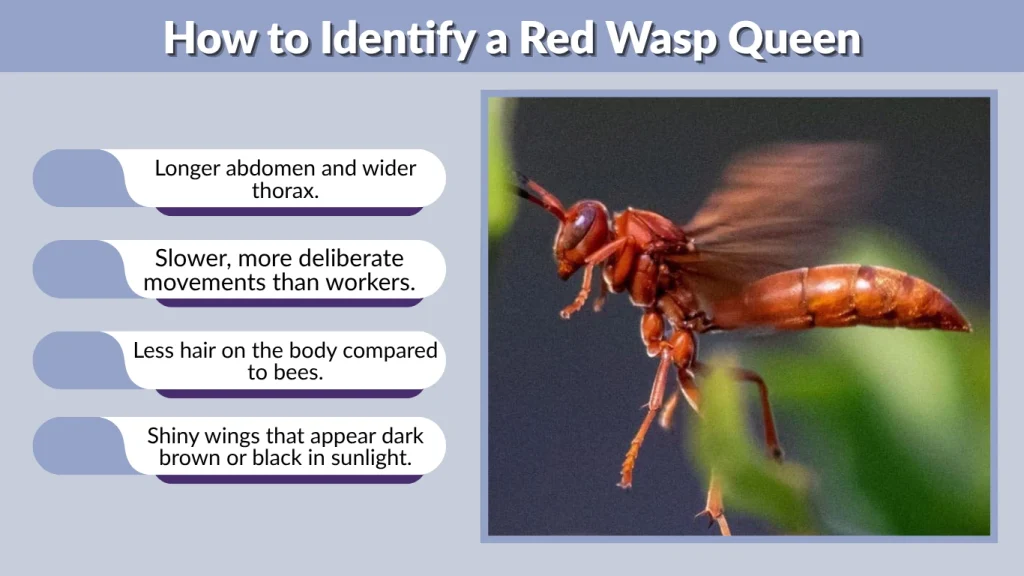
The red wasp queen is larger than the rest of her colony, typically measuring up to 1 inch (25 mm) in length. Her body has a deep reddish-brown hue with darker, almost black wings. The thorax is broader and the abdomen more pronounced, especially near the base where her ovipositor (egg-laying organ) is located.
Key traits include:
- Longer abdomen and wider thorax.
- Slower, more deliberate movements than workers.
- Less hair on the body compared to bees.
- Shiny wings that appear dark brown or black in sunlight.
She often remains stationary on or near the nest, unlike worker wasps that are constantly in flight.
Behavioral Differences
While workers fly in and out collecting nectar, wood fibers, and prey, the queen primarily tends to egg-laying and nest maintenance. If you spot a lone red wasp building the first few cells of a paper nest early in spring, that’s almost always a founding queen establishing her new colony.
Red Paper Wasp Queen vs Worker

The distinction between a red wasp queen and worker can be subtle but noticeable when viewed closely. Size, behavior, and role offer clear indicators.
| Feature | Queen Red Wasp | Worker Red Wasp |
| Size | Larger, up to 1 inch | Smaller, about 0.7 inch |
| Color | Deep red body, dark wings | Lighter red or orange hues |
| Role | Lays eggs, leads colony | Forages, defends nest |
| Activity | Less active, stays near nest | Highly active, flies constantly |
| Aggression | Defends only when threatened | More defensive toward intruders |
Unlike the queen, worker wasps are sterile females that dedicate their lives to collecting food and guarding the nest. The queen’s primary focus remains reproduction, ensuring the survival of the colony through continuous egg production.
Life Cycle of a Queen Red Wasp

Spring: Nest Building and Egg Laying
When temperatures rise in early spring, overwintered queens awaken from hibernation. The red wasp queen begins gathering chewed wood fibers and saliva to build the first cells of a paper-like nest. She lays a few eggs in each cell, which hatch into larvae within days. These larvae will later develop into the first worker generation.
Summer: Colony Expansion
Once workers mature, they take over nest expansion and food collection. The queen stays inside the nest, laying eggs and maintaining colony stability through pheromones. As the nest grows, it can house dozens of workers and hundreds of larvae. During this phase, the colony operates at peak productivity, with the queen rarely leaving her chamber.
Autumn: Reproduction and Colony Decline
By late summer and early autumn, the queen’s focus shifts from worker production to reproduction. She begins laying eggs that develop into males (drones) and future queens. The new queens will mate before winter, while males die shortly after mating. The original queen’s egg-laying slows, and her influence over the colony weakens.
As temperatures drop, the old queen and most workers die off naturally. The new generation of queens leaves the nest to find safe places to overwinter, marking the end of that year’s colony cycle.
Winter: Hibernation and Survival
After mating in fall, young fertilized queens search for shelter in tree bark, leaf litter, hollow logs, or even attic corners. They remain dormant during the cold months, surviving on stored body fat. Hibernation protects them from freezing temperatures and predators.
When spring returns, these overwintered queens emerge to start new nests — continuing the cycle of the red wasp colony. This survival strategy ensures species continuity, even though old nests are never reused the following year.
What Happens When the Queen Dies?

The death of a red wasp queen destabilizes the entire colony. Workers rely on her pheromones to coordinate their activities, and once she dies:
- Workers lose structure and become less productive.
- Nest defense weakens, making it vulnerable to predators.
- No new eggs are laid, so the colony eventually collapses.
In rare cases, a dominant worker may attempt to lay unfertilized eggs, but these develop into males only. Without a fertile queen, the colony cannot sustain itself beyond a few weeks.
Queen Red Wasp Sting and Behavior

Is the Queen’s Sting Worse?
The red wasp queen’s sting is no more venomous than that of a worker, but her larger size means she can deliver more venom with a single sting. Unlike workers, the queen rarely leaves the nest, so stings usually happen during nest disturbance or removal.
Symptoms of a queen’s sting include:
- Sharp, burning pain
- Swelling and redness
- Mild itching or tenderness
First Aid for a Queen Wasp Sting
- Wash the sting area thoroughly with soap and cool water.
- Apply an ice pack to reduce pain and swelling.
- Use calamine lotion or hydrocortisone cream to relieve irritation.
- Take an antihistamine if mild allergic reactions occur.
- Seek medical attention immediately if swelling spreads or breathing becomes difficult.
Red Queen Wasp Identification by Region
Southern U.S. (Texas, Alabama, Georgia)
The typical Red Paper Wasp (Polistes carolina) dominates these regions. Queens here are bright red with dark brown wings and often build nests under roofs, barns, or decks.
Western U.S. (California, Arizona)
Western species sometimes resemble Pepsis wasps — large, dark-bodied, with orange-red wings. They are solitary and prefer arid habitats.
Other Regions
- Florida: Smaller queens appear around gardens and wooded areas, thriving in humid conditions.
- Australia: The so-called “Australian Red Wasp” has similar behavior but belongs to a different Polistes species.
Ecological Role of the Red Wasp Queen
Despite being feared, the red wasp queen is crucial to maintaining ecological balance. She and her offspring:
- Pollinate plants while collecting nectar.
- Control pest insects like spiders, caterpillars, and flies.
- Support biodiversity in gardens and farmlands.
By allowing wasps to thrive away from homes, you can reduce harmful pests naturally while minimizing the need for chemical insecticides.
FAQs
What does a queen red wasp look like?
A queen red wasp is noticeably larger, with a deep red body and dark brown wings. Her thorax is wider, and she has a longer abdomen for egg-laying. Unlike workers, she moves slowly and stays near the nest most of the time.
Where does the red paper wasp queen hibernate?
She hibernates in sheltered spots such as hollow trees, attics, or under bark. Hibernation begins in late fall and lasts until early spring, when the queen awakens to start a new colony.
Can a red wasp colony survive without its queen?
No. The queen’s death causes the colony to collapse because workers cannot reproduce. Without her pheromonal control, the nest becomes disorganized and eventually abandoned.
Is a red wasp queen’s sting more painful than a worker’s?
While the pain intensity is similar, the queen’s sting may inject slightly more venom due to her larger size. Fortunately, queens are not aggressive and usually sting only when directly disturbed.
How can I identify a red paper wasp queen early in spring?
Spotting a single large red wasp building a small paper nest under an eave or ledge is the clearest sign. Early-season solitary nest building is the hallmark behavior of a founding queen.
