

Katydids, grasshoppers, crickets, and locusts all belong to the same insect order—Orthoptera—yet they differ dramatically in shape, sound, behavior, and ecological roles. Because they share long legs, similar body forms, and the ability to produce sound, many people confuse them at first glance. Understanding the differences helps with accurate identification, garden management, and even appreciating their role in nature.
This guide breaks down each insect group, comparing them by appearance, sound, habitat, diet, and behavior.
What Are These Insects? (Orthoptera Overview)
Katydids, grasshoppers, crickets, and locusts all fall under the order Orthoptera, meaning they share several core traits: strong hind legs, segmented bodies, the ability to stridulate (produce sound), and incomplete metamorphosis. Despite these similarities, they belong to different subfamilies and have adapted to unique lifestyles.
Orthopterans differ in wing structure, antenna length, feeding habits, and movement patterns. Grasshoppers and locusts are closely related, while katydids and crickets belong to a long-antennaed lineage. Because of this, katydids tend to resemble leaves and sing at night, while grasshoppers thrive in sunny grasslands and chirp during the day.
Quick Definitions
Grasshopper – A robust insect with short antennae, common in fields and grasslands.
Katydid – A long-antennaed insect with leaflike wings, mostly nocturnal.
Cricket – A dark-colored, flattened insect known for loud nighttime chirping.
Locust – A type of grasshopper that can undergo behavioral changes and form massive swarms.
Katydid vs Grasshopper – Main Differences

Katydids and grasshoppers are the two groups that are most commonly confused. Both have similar body plans and live in vegetated areas, but they can be distinguished by several key traits.
Appearance & Body Structure
The easiest way to tell them apart is by examining antennae and body shape.
- Katydids have extremely long, threadlike antennae—often longer than their own bodies. Their wings resemble green leaves, complete with visible veins, allowing them to camouflage perfectly among foliage.
- Grasshoppers have noticeably short antennae. Their bodies are more upright, with straight wings that fold neatly along the back. They are typically brown, green, or tan, depending on habitat.
Katydids usually appear more delicate and elongated, while grasshoppers look heavier and more muscular.
Sound Production
These insects communicate using a process called stridulation, but the sound and method differ.
- Katydids produce sharp, high-pitched rasping noises that often sound like “ka-ty-did,” which is how they got their name. Their calls are typically made at night.
- Grasshoppers create sound by rubbing their wings together or flicking them during flight, resulting in a buzzing or chirping noise during the day.
The timing of the sound is a major clue: katydids sing after dark, while grasshoppers are daytime musicians.
Behavior & Activity Patterns
- Katydids are nocturnal, hiding during the day and emerging at night to feed or call.
- Grasshoppers are diurnal, actively feeding, flying, and singing in sunlight.
Katydids prefer shrubs, tree branches, and leafy vegetation, whereas grasshoppers spend most of their time in open fields, meadows, or gardens. Their leg strength also differs—grasshoppers are powerful jumpers, while katydids are moderate leapers but excellent climbers.
Grasshopper vs Cricket vs Katydid

These three groups often get lumped together, but they have clear differences in appearance, habitat, and sound.
Body Shape Differences
- Crickets have darker, more cylindrical bodies and flattened shapes that help them hide in burrows or under rocks.
- Katydids have flattened, leaflike wings that blend with vegetation.
- Grasshoppers stand upright with thicker bodies, designed for jumping and flight.
Crickets look more compact and ground-oriented, while katydids resemble leaves and grasshoppers look built for launching into the air.
Sound Differences
- Crickets produce classic chirping sounds by rubbing their wings together. Their calls are rhythmical and most noticeable at night.
- Katydids create higher-pitched, sharper sounds that may resemble buzzing or rapid clicking.
- Grasshoppers produce lower, more mechanical buzzing, often during the day.
Crickets are the loudest and most familiar singers to humans, while katydids dominate nighttime forests with crisp, repeating calls.
Habitat Preferences
- Crickets live in burrows, leaf litter, under stones, or even inside houses where it is dark and moist.
- Katydids stay in shrubs, tree foliage, and garden plants.
- Grasshoppers inhabit open fields, lawns, and meadows.
Crickets often come indoors, grasshoppers stay in sunny open areas, and katydids remain hidden in leaves.
Katydid vs Grasshopper vs Locust

Locusts add another layer of confusion because they look almost identical to grasshoppers. That’s because they are grasshoppers—but with an extreme behavioral twist.
Locusts are grasshoppers capable of entering a gregarious phase, where they congregate, change color, and form massive migrating swarms. Katydids and crickets never exhibit this behavior.
Locust Swarming Explained
- Triggered by rainfall, food abundance, or population density
- Causes grasshoppers to transform into locusts
- Leads to large-scale swarming behavior
- Responsible for historical crop destruction
Grasshoppers and katydids feed individually, but locusts can become agricultural disasters when environmental pressure triggers their swarming phase.
Diet & Feeding Behavior

Even though katydids, grasshoppers, crickets, and locusts all belong to the same order, their diets differ in important ways. These feeding patterns influence where they live, how they interact with plants, and what role they play in local ecosystems.
Katydid Diet
Katydids are primarily leaf eaters, favoring:
- Fresh green leaves
- Soft plant shoots
- Flowers
- Fruit surfaces
Most katydids are herbivores, although a few species supplement their diet with tiny insects or larvae. Their slow eating habits usually cause minimal garden damage unless populations surge.
Grasshopper Diet
Grasshoppers are much heavier feeders than katydids. They consume:
- Broadleaf plants
- Vegetables
- Grasses
- Field crops
Grasshoppers can defoliate plants quickly, especially during hot, dry spells when vegetation becomes scarce.
Cricket Diet
Crickets are omnivores and far less picky:
- Plants
- Fungi
- Dead insects
- Organic debris
This scavenging behavior makes them helpful recyclers in ecosystems, breaking down decaying material.
Locust Diet
Locusts are essentially grasshoppers with overwhelming appetites when in swarm mode. They can consume:
- Massive fields of crops
- Seedlings
- Pasture grasses
- Vegetables and grains
Their ability to eat nearly any vegetation is what makes locust swarms so catastrophic.
Habitat & Distribution
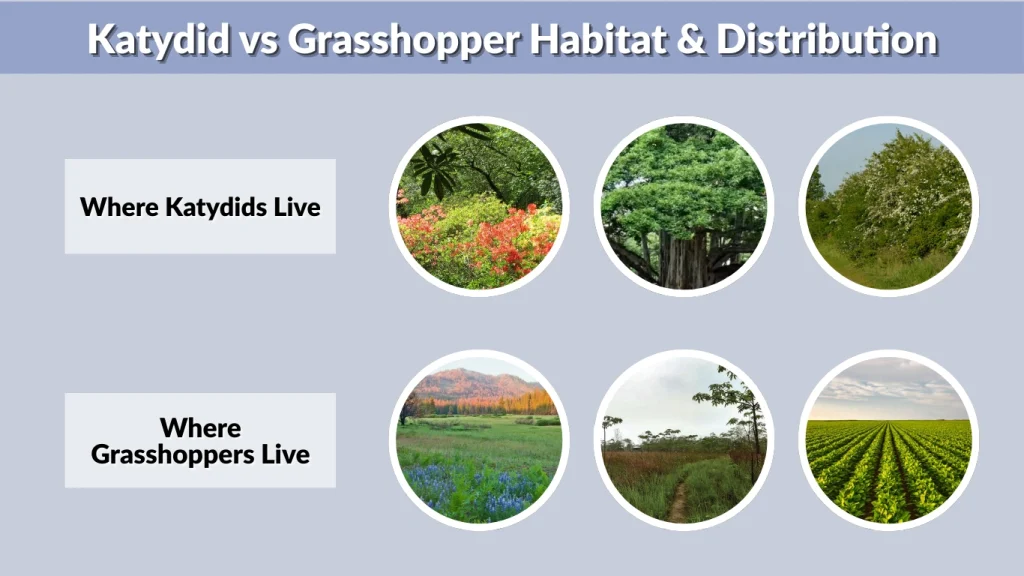
Each insect group has adapted to different environments, contributing to their unique lifestyles.
Where Katydids Live
Katydids thrive in:
- Shrubbery
- Tree canopies
- Hedgerows
- Forest edges
- Dense gardens
They rely on foliage for both food and camouflage, especially during the daytime.
Where Grasshoppers Live
Grasshoppers prefer open, sunny spaces, including:
- Meadows
- Grasslands
- Farmland
- Roadside fields
- Lawns and open gardens
Their short antennae and sturdy bodies help them navigate ground-level vegetation efficiently.
Where Crickets Live
Crickets seek out dark, sheltered, moist areas such as:
- Burrows
- Leaf litter
- Basements or crawl spaces
- Under stones or logs
Because of this preference, crickets often wander into homes or garages.
Where Locusts Live
Locusts are found in regions with a history of drought and sudden rainfall, including:
- Africa
- Middle East
- South Asia
- Australia
- Southwestern United States (limited species)
These environments can trigger the swarming conditions that transform ordinary grasshoppers into locusts.
Movement & Physical Abilities
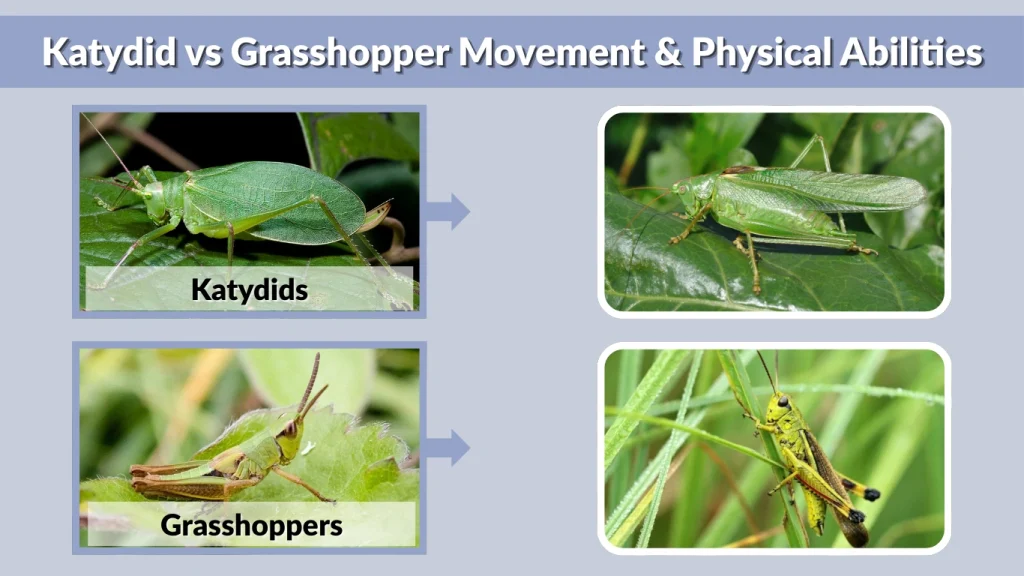
Movement patterns differ across Orthoptera species and play a major role in how they interact with their environment.
Jumping Power
- Grasshoppers are the strongest jumpers thanks to powerful hind legs.
- Katydids can jump but rely more on climbing and camouflage.
- Crickets have moderate jumping abilities suited for escaping predators.
Grasshoppers, with their explosive jumping ability, can escape danger faster than the other groups.
Flight Abilities
- Katydids are surprisingly strong flyers, particularly at night.
- Grasshoppers can fly moderate distances during the day.
- Crickets typically fly short distances or not at all.
- Locusts are exceptional long-distance fliers and can migrate hundreds of miles during plagues.
Locust flight is what allows swarms to spread rapidly across continents.
Sound Production & Communication
All four groups produce sound, but they do so in very different ways, giving each insect a unique acoustic identity.
Katydid Sounds
Katydids create sound using their forewings in a method known as stridulation. Their calls are:
- High-pitched
- Repetitive
- Often sounding like “katy-did, katy-didn’t”
- Used at night to find mates
Their songs help identify them in dense vegetation.
Grasshopper Sounds
Grasshoppers make sound in two ways:
- Rubbing their wings together
- Creating a buzzing noise during flight
These calls are typically heard during the daytime and help males attract females.
Cricket Sounds
Crickets are the most recognizable singers. Their characteristics include:
- Loud, rhythmic chirping
- Wing-to-wing rubbing
- Temperature-influenced chirp speed
- Primarily nighttime calling
Cricket chirps are often used in nature documentaries and summer night ambiance tracks.
Ecological Roles
Even though these insects are often seen as pests, they each contribute important ecological benefits.
Beneficial Aspects
- Crickets help break down organic matter.
- Katydids serve as food for birds, reptiles, and small mammals.
- Grasshoppers aerate soil as they move and feed.
- Locusts help clear old vegetation during non-swarm phases.
All are essential prey items in their ecosystems.
Pest Potential
- Grasshoppers and locusts can damage crops.
- Katydids occasionally chew ornamental plants.
- Crickets can become nuisances inside homes.
Understanding their differences helps guide proper management.
Common Misidentifications
Green Grasshopper vs Katydid
People often confuse these two because they both appear bright green. Quick identification tips:
- Look at the antennae—long = katydid, short = grasshopper
- Examine the wings—leaflike veins = katydid
- Check the habitat—trees = katydid; grass = grasshopper
Katydid Bug vs Grasshopper
The term “katydid bug” is often used casually, but katydids are not true bugs—they are Orthopterans. Grasshoppers have simpler wing structures and broader heads.
Katydid vs Long-Horned Grasshopper
Katydids are long-horned grasshoppers. The term describes their long antennae. However:
- Katydids belong to the family Tettigoniidae
- True grasshoppers belong to the family Acrididae
Their behaviors and habitats differ significantly despite the nickname.
Side-by-Side Comparison Chart
| Feature | Katydid | Grasshopper | Cricket | Locust |
| Antennae | Long | Short | Long | Short |
| Activity | Night | Day | Night | Day |
| Wing Type | Leaflike | Straight | Flat | Straight |
| Body Shape | Slender | Robust | Flat | Robust |
| Sound | High-pitched | Buzz/Chirp | Chirp | Buzz |
| Habitat | Trees | Fields | Burrows | Dry regions |
| Swarming | No | No | No | Yes |
| Diet | Leaves | Plants/grass | Omnivore | Plants |
FAQs
Which is louder—crickets or katydids?
Crickets are louder and more rhythmic, while katydids produce sharper, higher-pitched sounds.
Do katydids bite or sting?
No. Katydids rarely bite and are harmless to humans.
Why do grasshoppers swarm but katydids do not?
Only certain grasshopper species develop the gregarious phase necessary for swarming.
Are katydids harmful to gardens?
Usually only mildly. They nibble leaves but rarely cause major damage.
Do grasshoppers turn into locusts?
Some species of short-horned grasshoppers can transform into locusts when environmental conditions trigger behavioral changes.
