
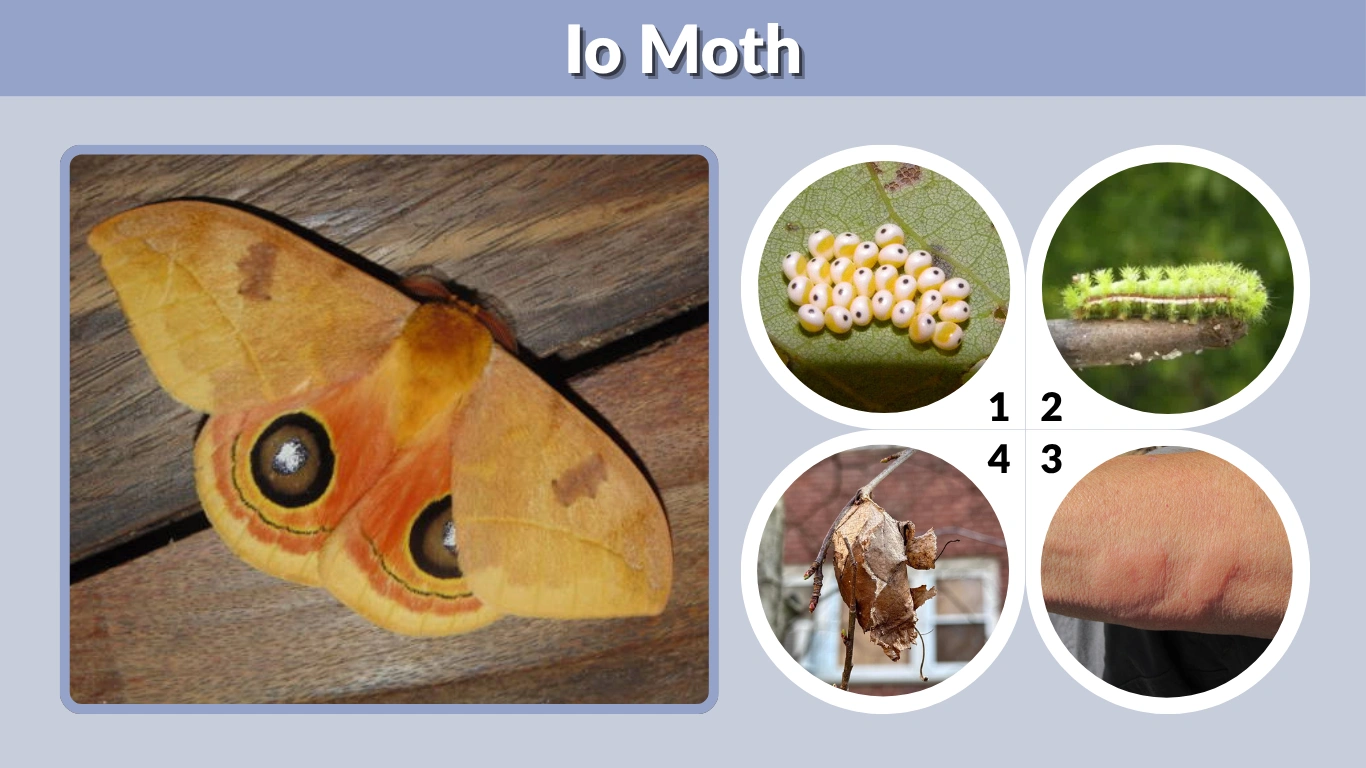
The Io moth (Automeris io) is a striking insect known for its bright colors and defensive caterpillar stage. Found across North America, it belongs to the giant silk moth family and plays an important ecological role. While the adult moth is harmless, the caterpillar is equipped with venomous spines that can cause painful reactions. Understanding its life cycle, habitat, and behavior helps people safely identify and appreciate this unique species without unnecessary risk.
What Is an Io Moth?
The Io moth is a member of the Saturniidae family, commonly known as giant silk moths. It is recognized for its eye-like wing spots and defensive caterpillar stage. Unlike many insects, adult Io moths do not feed and live only to reproduce before completing their short life cycle.
Io Moth Identification
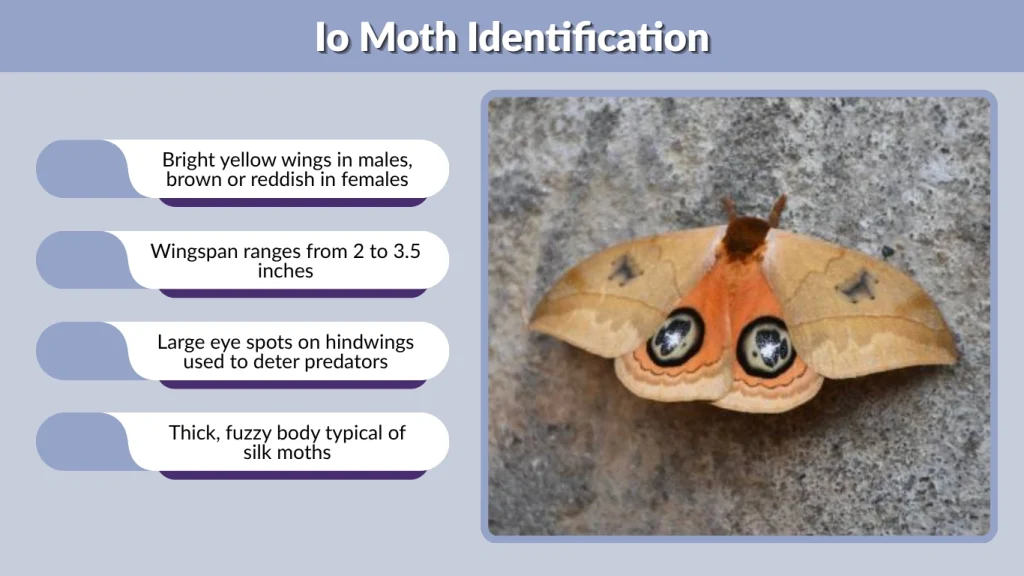
The Io moth can be identified by its color, wing patterns, and body structure. Both adults and caterpillars have distinct features that make them easy to recognize in the wild.
Adult Io Moth Appearance
- Bright yellow wings in males, brown or reddish in females
- Large eye spots on hindwings used to deter predators
- Thick, fuzzy body typical of silk moths
Size and Wingspan
- Wingspan ranges from 2 to 3.5 inches
- Medium-sized compared to other giant silk moths
- Broad wings with noticeable markings
Male vs Female Io Moth
- Males are brighter and more colorful
- Females are larger with darker wings
- Males have feathery antennae for detecting pheromones
Io Moth Life Cycle
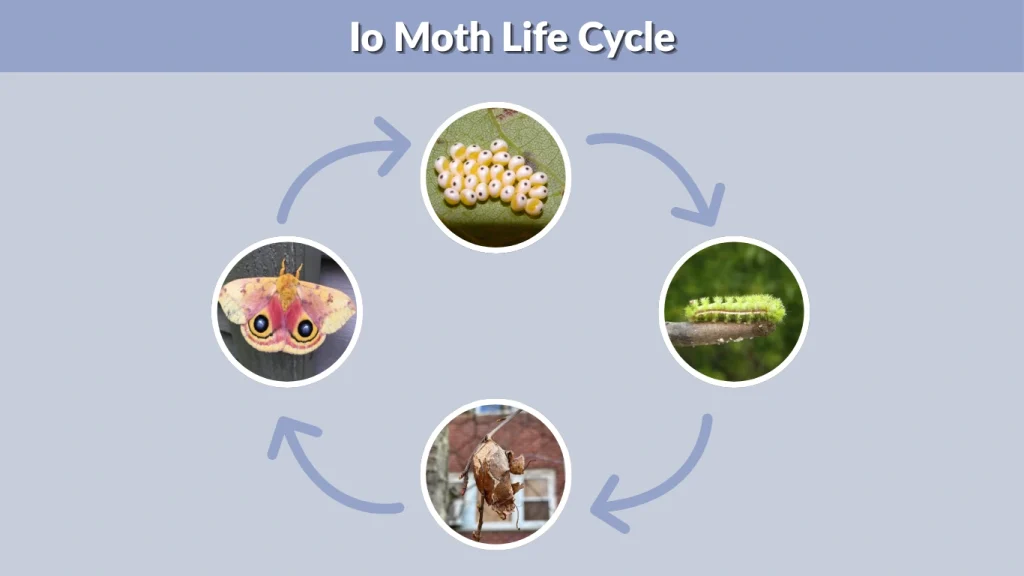
The Io moth undergoes complete metamorphosis, moving through four stages that allow it to grow and adapt to seasonal conditions. Each stage serves a specific purpose in survival and reproduction.
Egg Stage
- Eggs are laid in clusters on host plants
- Hatch within one to two weeks
- Small and pale in color
Caterpillar Stage
- Bright green body with venomous spines
- Lives in groups during early stages
- Grows through several instars
Cocoon and Pupa Stage
- Spins a thin silk cocoon in leaf litter
- Remains protected during colder months
- Transforms into adult inside cocoon
Adult Stage
- Emerges in warm seasons
- Lives for about one week
- Focuses entirely on reproduction
Io Moth Caterpillar Sting
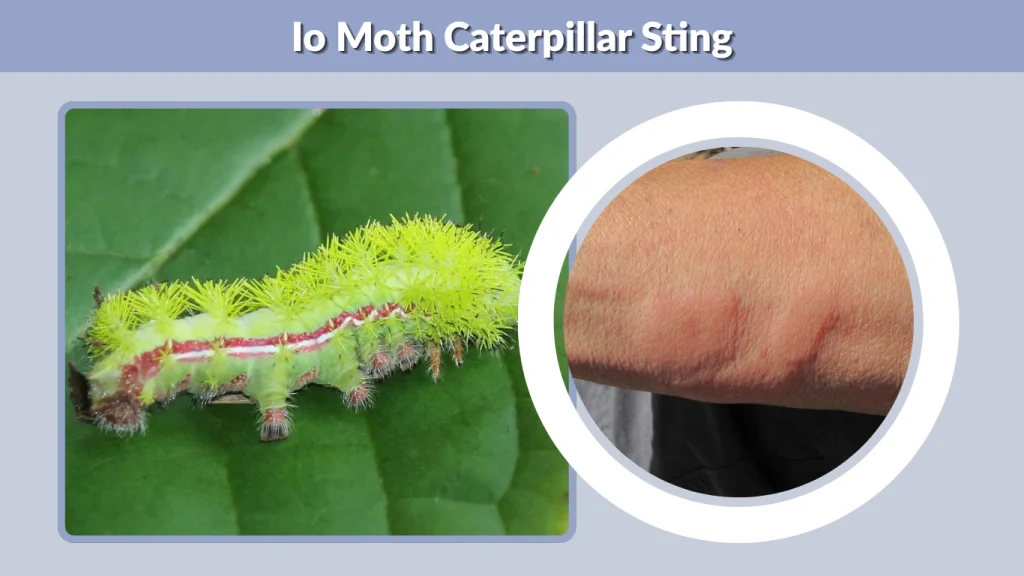
The caterpillar stage is the most important aspect for safety awareness. Its venomous spines act as a defense mechanism against predators and can affect humans upon contact.
Do Io Moth Caterpillars Sting?
- Yes, contact with spines causes a sting
- Spines release venom into the skin
- Acts as a natural defense system
Sting Symptoms
- Immediate burning or stinging sensation
- Redness and swelling at contact site
- Itching or mild rash
Sting Treatment
- Remove spines gently using adhesive tape
- Wash the area with soap and water
- Apply ice or soothing cream
Io Moth Habitat and Range
The Io moth is widely distributed across North America and thrives in areas with abundant vegetation. It adapts well to different environments, including forests, gardens, and suburban landscapes where host plants are available.
Geographic Distribution
The Io moth is commonly found in eastern and southern regions, especially in states like Florida and Texas. It also appears in central areas where suitable climate conditions support its life cycle.
Preferred Habitat
It prefers wooded areas, shrubs, and gardens with a variety of host plants. These environments provide shelter and food for caterpillars, making them ideal for survival and reproduction.
Io Moth Diet
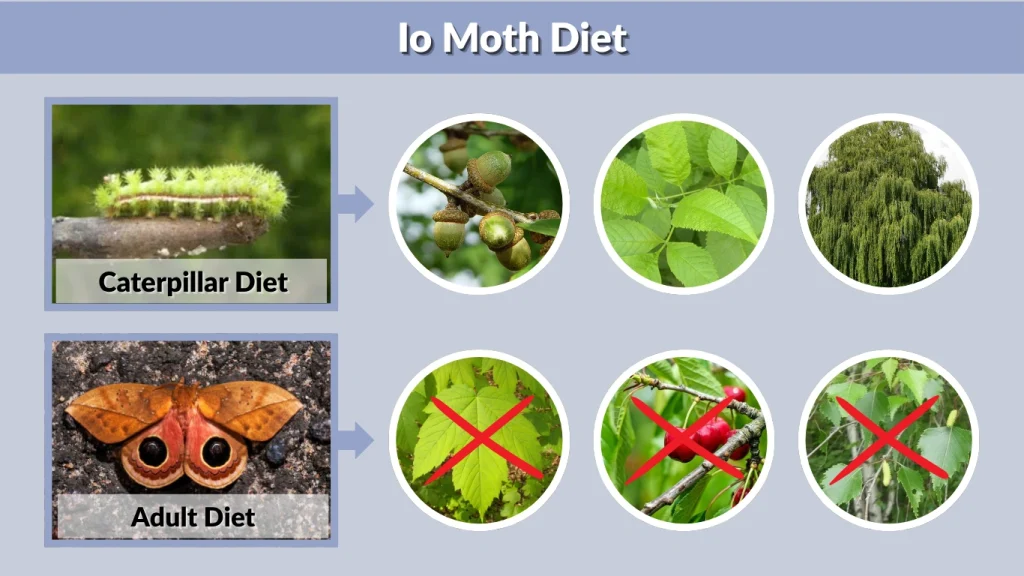
The feeding behavior of the Io moth varies greatly between its life stages. While caterpillars consume large amounts of plant material, adults rely entirely on stored energy.
What Do Adult Io Moths Eat?
Adult Io moths do not eat because they lack functional mouthparts. Their short lifespan is supported by energy stored during the caterpillar stage, allowing them to focus solely on reproduction.
Caterpillar Diet
- Feeds on oak, elm, willow, and hackberry
- Requires fresh leaves daily
- Consumes large amounts to support rapid growth
Io Moth Behavior and Defense
The Io moth relies on a combination of behavioral patterns and physical defenses to survive in the wild. While the adult moth depends on camouflage and visual tricks, the caterpillar uses a more direct defense strategy through its venomous spines.
Nocturnal Activity
Io moths are active primarily at night. They are often attracted to artificial lights, which is why they are commonly spotted near homes. During the day, they remain hidden to avoid predators.
Defense Mechanisms
The caterpillar uses its stinging spines as a primary defense against threats. In contrast, adult moths rely on large eye spots on their wings, which can startle predators and create the illusion of a larger animal.
Are Io Moths Dangerous?
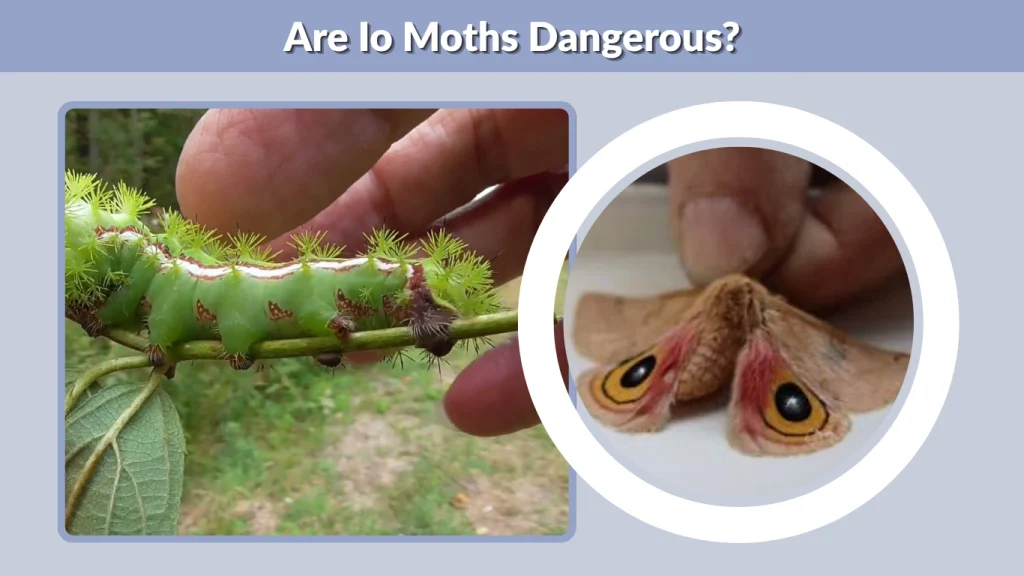
The Io moth is only dangerous during its caterpillar stage. Adult moths are completely harmless and do not have the ability to sting or bite. Understanding this difference helps reduce unnecessary fear while encouraging safe interaction.
Adult Moth Safety
Adult Io moths cannot harm humans. They lack both stingers and functional mouthparts, making them safe to observe closely. Their appearance may seem intimidating, but they pose no real threat.
Caterpillar Risk
The caterpillar can cause a painful sting if touched. While the reaction is usually mild and temporary, it can be more intense for sensitive individuals. Avoid direct contact to prevent irritation.
Io Moth Predators
Io moths face various natural threats throughout their life cycle. Birds and small mammals often prey on caterpillars, while parasitic insects may target them during development. These natural controls help maintain balance in their population.
Io Moth Control and Removal
Managing Io moth caterpillars may be necessary in gardens or landscapes where they appear in large numbers. Proper handling is important to avoid contact with their venomous spines.
How to Control Io Moth Caterpillars
- Remove caterpillars using gloves
- Trim affected leaves or branches
- Encourage natural predators
Are They Garden Pests?
- Can damage plants when populations are high
- Usually not severe enough to cause long-term harm
- Often controlled naturally by predators
Io Moth Symbolism and Meaning
The Io moth is often associated with awareness, caution, and transformation. Its eye-like wing spots symbolize watchfulness, while its stinging caterpillar represents hidden danger. Many interpretations connect it with personal growth and the ability to protect oneself from unseen threats.
Io Moth vs Other Moths
The Io moth is frequently compared with other silk moths due to its similar life cycle but distinct defensive features. These comparisons help highlight what makes it unique among related species.
Io Moth vs Luna Moth
The Io moth is smaller and known for its eye spots, while the Luna moth is green with long tail-like extensions. Unlike the Io caterpillar, Luna caterpillars do not sting, making them less defensive.
Io Moth vs Cecropia Moth
The Cecropia moth is much larger and has bold red and white markings. In contrast, the Io moth is smaller but more defensive due to its venomous caterpillar stage, which sets it apart from most other silk moths.
Interesting Facts About Io Moths
The Io moth has several unique characteristics that make it stand out among insects. These features contribute to its survival and fascination among observers.
- Caterpillars can deliver a painful sting
- Named after a figure from Greek mythology
- Eye spots mimic the eyes of predators
FAQs
Are Io moth caterpillars poisonous?
Yes, Io moth caterpillars have venomous spines that can cause a painful sting. The reaction usually includes burning, redness, and swelling. While not dangerous for most people, individuals with sensitive skin may experience stronger irritation.
What should you do if an Io moth caterpillar stings you?
Remove the spines using adhesive tape, then wash the area with soap and water. Applying ice and antihistamine cream can help reduce swelling and itching. Seek medical attention if symptoms become severe or persistent.
What do Io moth caterpillars eat?
Io moth caterpillars feed on a variety of plants, including oak, elm, willow, and hackberry. They require fresh leaves to grow and develop through their life stages, storing energy for their short adult life.
Are Io moths harmful to humans?
Adult Io moths are completely harmless and cannot sting or bite. Only the caterpillar stage poses a risk due to its venomous spines. With proper awareness and avoidance, they are safe to observe in nature.
