
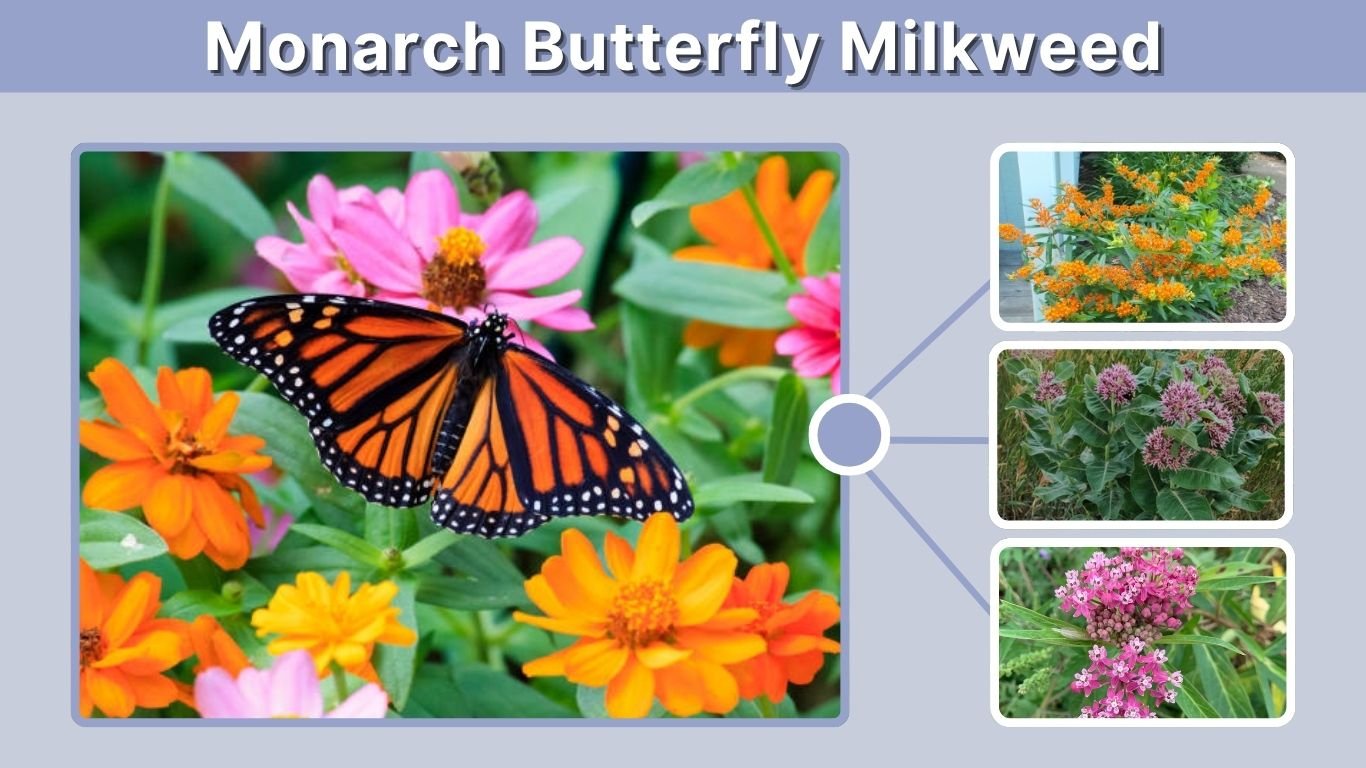
Monarch butterfly milkweed has one of the most important plant–insect relationships in North America. Female monarchs seek milkweed when laying eggs because their caterpillars depend on these plants for food and development. Milkweed also contains natural chemicals that help give monarchs protection from many predators. Gardeners can support monarch populations by growing suitable native milkweed alongside nectar-rich flowers for adults. This guide explains monarch butterfly eggs on milkweed, caterpillar feeding, the best milkweed plants, seeds, planting tips, and the remarkable relationship between monarch butterflies and milkweed.
Why Is Milkweed Important to Monarch Butterflies?
Milkweed is essential to the monarch life cycle because it serves as the larval host plant. Adult monarch butterflies can obtain nectar from many flowering plants, but their caterpillars have a much more specialized diet. In North America, monarch larvae rely on milkweeds in the genus Asclepias and a few closely related plants to grow successfully.
Milkweed Is the Monarch Butterfly Host Plant
A host plant is the plant on which a butterfly lays eggs and its caterpillars feed.
Female monarch butterflies actively search for milkweed before depositing their eggs. Once an egg hatches, the tiny caterpillar begins feeding on the milkweed leaf and continues eating milkweed throughout its larval development.
Monarch Joint Venture notes that monarch caterpillars feed on milkweed while adults use nectar from many different flowering plants. This means a complete monarch garden should include both native milkweed and nectar-producing flowers.
Why Monarch Caterpillars Depend on Milkweed
Milkweed provides more than calories. It contains defensive chemicals called cardenolides, which monarch caterpillars can tolerate and store.
These compounds eventually help make caterpillars and adult monarchs distasteful or toxic to many predators. The butterfly’s famous orange-and-black coloration works as a warning signal associated with this chemical defense.
Milkweed therefore supports both monarch development and an important part of the butterfly’s natural protection strategy.
Monarch Butterfly Eggs on Milkweed
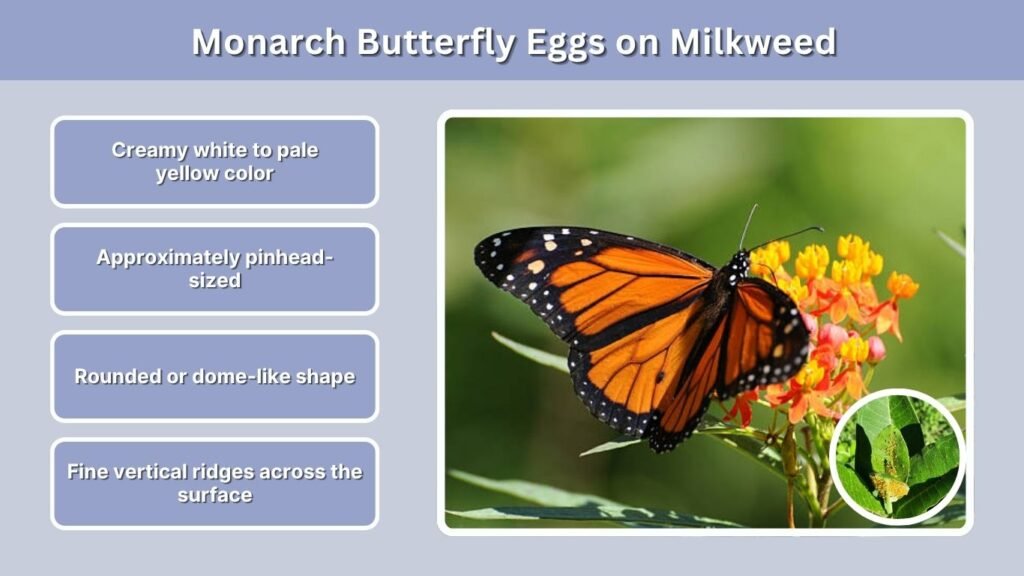
Finding monarch butterfly eggs on milkweed is an exciting indication that an adult female has selected the plant as a nursery for the next generation. Females generally lay eggs individually rather than depositing large clusters. Because the eggs are extremely small, gardeners often need to examine milkweed leaves closely to distinguish them from insects, sap, or other tiny objects.
What Do Monarch Butterfly Eggs Look Like?
Monarch eggs can usually be recognized by these characteristics:
- Creamy white to pale yellow color
- Approximately pinhead-sized
- Rounded or dome-like shape
- Fine vertical ridges across the surface
- Usually attached individually to a leaf
- Frequently placed on the underside of milkweed leaves
Monarch Joint Venture reports that females commonly place individual eggs near the upper portions of milkweed plants. Eggs generally hatch within about three to five days, depending largely on temperature.
Why Monarchs Lay Eggs on Milkweed
Female monarchs do not randomly select plants.
They can detect chemical and physical characteristics of milkweed and use their sensory organs to determine whether a plant is suitable. After finding milkweed, a female typically attaches an egg directly to the plant with a small amount of adhesive.
This careful selection gives the newly hatched caterpillar immediate access to the only type of food it can use during normal larval development.
Monarch Butterfly Caterpillars and Milkweed
The connection between monarch caterpillars and milkweed becomes most obvious after the eggs hatch. A newly emerged caterpillar is tiny, but it grows rapidly while consuming leaves. Milkweed provides food and shelter through approximately two weeks of larval growth, although development speed varies with temperature and environmental conditions.
Do Monarch Caterpillars Only Eat Milkweed?
In North America, monarch caterpillars depend on milkweed and a few closely related plants. They cannot simply switch to parsley, dill, or ordinary garden leaves when milkweed disappears.
If you find a striped caterpillar eating dill, parsley, fennel, or celery, it may instead be a black swallowtail caterpillar, which can resemble a monarch larva.
During its caterpillar stage, a monarch passes through five growth stages known as instars. By the final instar, it has grown dramatically compared with the newly hatched larva.
Does a Monarch Chrysalis Stay on Milkweed?
Not necessarily.
A mature monarch caterpillar often leaves the milkweed plant before forming its chrysalis. It searches for a secure location, creates a silk attachment, hangs in a characteristic J shape, and then transforms into a green chrysalis.
Monarch Joint Venture states that the pupal stage generally lasts about 8 to 15 days before the adult butterfly emerges.
Best Milkweed for Monarch Butterflies
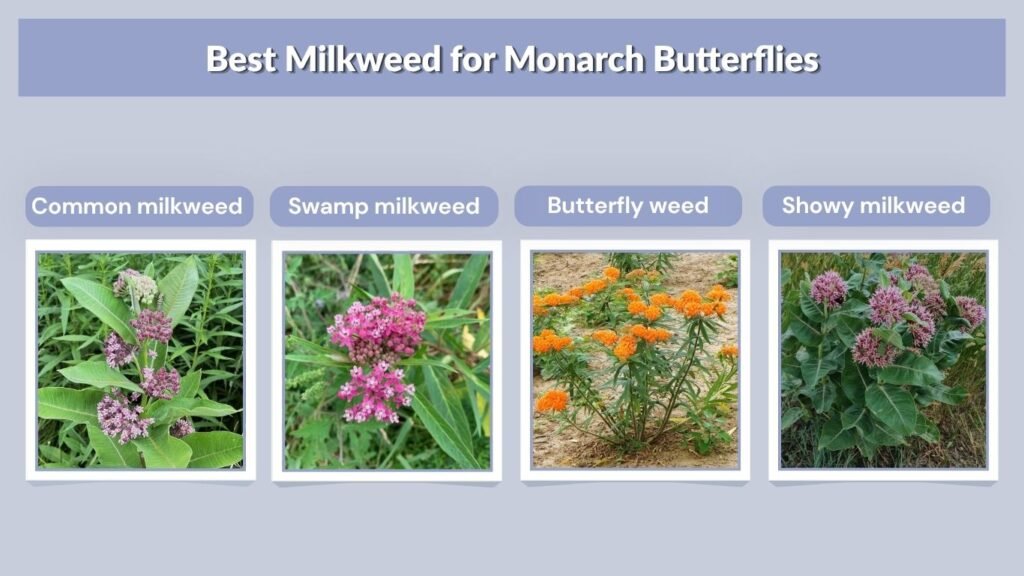
There is no single best milkweed species for every garden. The most appropriate choice depends on geography, soil, moisture, climate, and naturally occurring local species. Conservation groups generally recommend using milkweeds native to your region because they are adapted to local conditions and support the ecological communities found there.
Popular Native Milkweed Plants
Depending on your region, useful species may include:
- Common milkweed (Asclepias syriaca): Widely used by monarchs and able to grow in many soil conditions.
- Swamp milkweed (Asclepias incarnata): Particularly suitable for moist soils, rain gardens, and wetter landscapes.
- Butterfly weed (Asclepias tuberosa): An orange-flowered species suited to sunny areas and relatively dry soil.
- Showy milkweed (Asclepias speciosa): An important western North American host plant with attractive pink flowers.
- Other regional native milkweeds: Numerous species occur across North America and may be better suited to specific local climates.
North America has more than 100 milkweed species, so gardeners should match the plant to their region rather than assuming one species is universally superior.
What About Tropical Milkweed?
Tropical milkweed (Asclepias curassavica) can support monarch caterpillars, but conservation organizations recommend caution where it is not native.
In warm areas, tropical milkweed may remain green throughout winter. Research suggests that this can encourage year-round monarch breeding and may contribute to higher levels of the parasite Ophryocystis elektroscirrha, commonly called OE.
For U.S. gardens, regionally appropriate native milkweed is generally the better conservation choice.
Growing Monarch Butterfly Milkweed From Seeds
Growing milkweed from seed can create long-lasting monarch habitat, although germination requirements vary by species. Some native milkweeds naturally experience winter conditions before germinating in spring. Others may have different requirements, making it important to follow instructions for the particular species rather than treating every milkweed seed identically.
Basic Milkweed Seed Growing Tips
For better results:
- Select a milkweed species native to your region.
- Obtain seed from a reputable regional source when possible.
- Check whether the species requires cold stratification.
- Choose a planting site with suitable sunlight and moisture.
- Avoid excessive fertilizer, especially high-nitrogen fertilizer.
- Give established plants enough room for their mature growth.
- Avoid insecticides on plants intended for monarch habitat.
Some milkweed species may not flower during their first year because they devote substantial energy to developing strong roots. Importantly, monarch females may still lay eggs on milkweed that is not flowering.
Milkweed Pods and Seeds
After successful pollination, milkweed plants develop distinctive seed pods. As the pods mature and open, they release numerous seeds attached to silky fibers that allow wind dispersal.
Milkweed Joint Venture guidance notes that seed pods, technically follicles, open along one side and may release many individual seeds.
Collecting seed responsibly from appropriate plants can help gardeners establish additional native milkweed habitat.
Monarch Butterfly and Milkweed Relationship
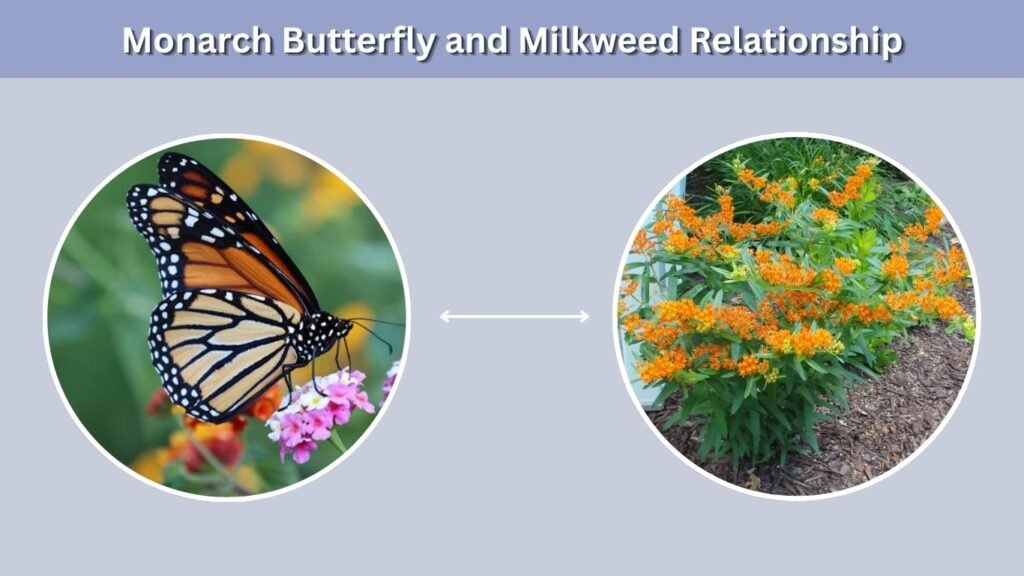
The monarch butterfly and milkweed relationship is highly specialized, but describing it simply as mutualism or commensalism can be misleading. Monarch caterpillars clearly benefit by eating the plant, while the plant loses leaf tissue. Adult monarchs can visit milkweed flowers for nectar and potentially carry pollinia, but monarchs are only one of many insects that visit milkweed flowers.
Is It a Symbiotic Relationship?
In the broad ecological sense, monarchs and milkweed have a close biological association, but their larval relationship is primarily herbivory.
The caterpillar receives food and defensive chemicals while the milkweed experiences feeding damage. This differs from classic mutualism, where both organisms consistently receive a direct benefit.
Their association is nevertheless a fascinating example of evolutionary adaptation because monarchs have developed mechanisms that allow them to consume plants containing chemicals that deter many other herbivores.
Milkweed Also Helps Other Pollinators
Milkweed is valuable beyond monarch conservation.
Its flowers provide nectar for bees, butterflies, moths, wasps, and other insects. Xerces Society notes that native milkweeds support diverse pollinator communities in addition to functioning as monarch host plants.
This makes native milkweed an especially useful addition to wildlife-friendly gardens.
How to Create a Monarch-Friendly Milkweed Garden
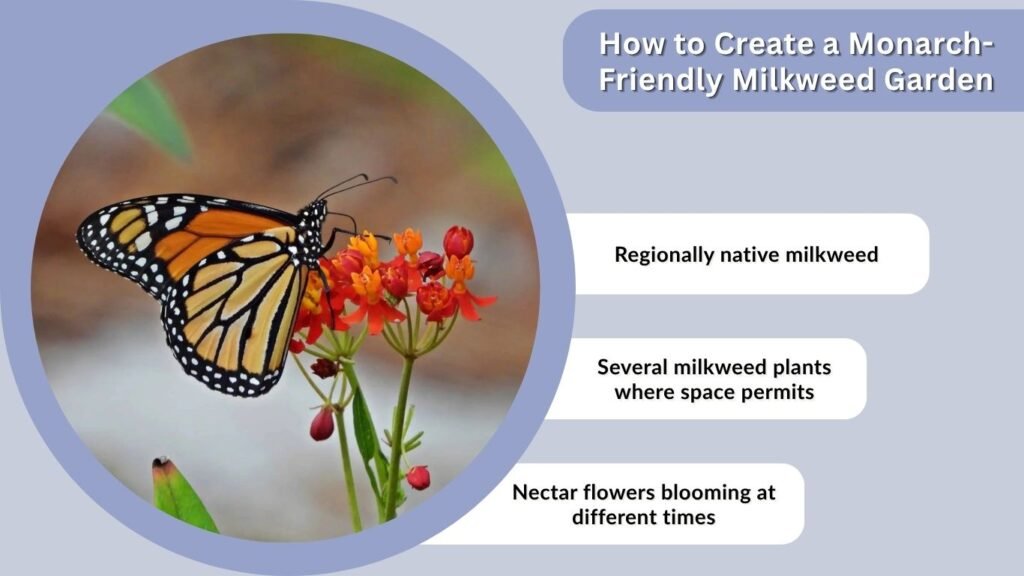
Planting a single milkweed can help, but a broader habitat provides more resources throughout the monarch life cycle. Caterpillars need host plants, while adults need plentiful nectar for reproduction and migration. A pesticide-free garden containing several native plant species can provide a much more complete environment than milkweed alone.
Important Garden Features
A monarch-friendly planting should include:
- Regionally native milkweed
- Several milkweed plants where space permits
- Nectar flowers blooming at different times
- Sunny areas suitable for butterflies
- Protection from unnecessary pesticide exposure
- A variety of native flowering plants
- Appropriate soil and moisture for chosen species
Using plants adapted to local conditions generally improves establishment while creating habitat suited to native insects.
FAQs
Why do monarch butterflies need milkweed?
Monarch butterflies need milkweed primarily because their caterpillars depend on it as a host plant. Female monarchs lay their eggs on milkweed, and the larvae eat its leaves after hatching. Milkweed also provides cardenolides that contribute to the monarch’s chemical defense against many predators.
What do monarch butterfly eggs look like on milkweed?
Monarch eggs are tiny, usually creamy white or pale yellow, and marked with fine vertical ridges. Females typically lay them individually, often on the underside of milkweed leaves. They are approximately the size of a pinhead and generally hatch within three to five days.
What is the best milkweed for monarch butterflies?
The best milkweed is generally a species native to your particular region and suitable for your soil and climate. Common milkweed, swamp milkweed, butterfly weed, and showy milkweed are useful in parts of North America, but recommendations vary geographically. Native, locally sourced plants are preferred.
Do monarch caterpillars eat anything besides milkweed?
Monarch caterpillars in North America rely on milkweeds in the genus Asclepias and a few closely related plants. Adult monarch butterflies have a much broader diet and drink nectar from many kinds of flowers. A caterpillar feeding on parsley or dill is therefore probably another butterfly species.
Does milkweed need flowers to attract monarchs?
No. Milkweed does not need to be blooming for female monarchs to use it as a host plant. Monarchs may lay eggs on young milkweed before flowering and continue using plants after flowers have faded because their caterpillars primarily require the leaves for food.
