
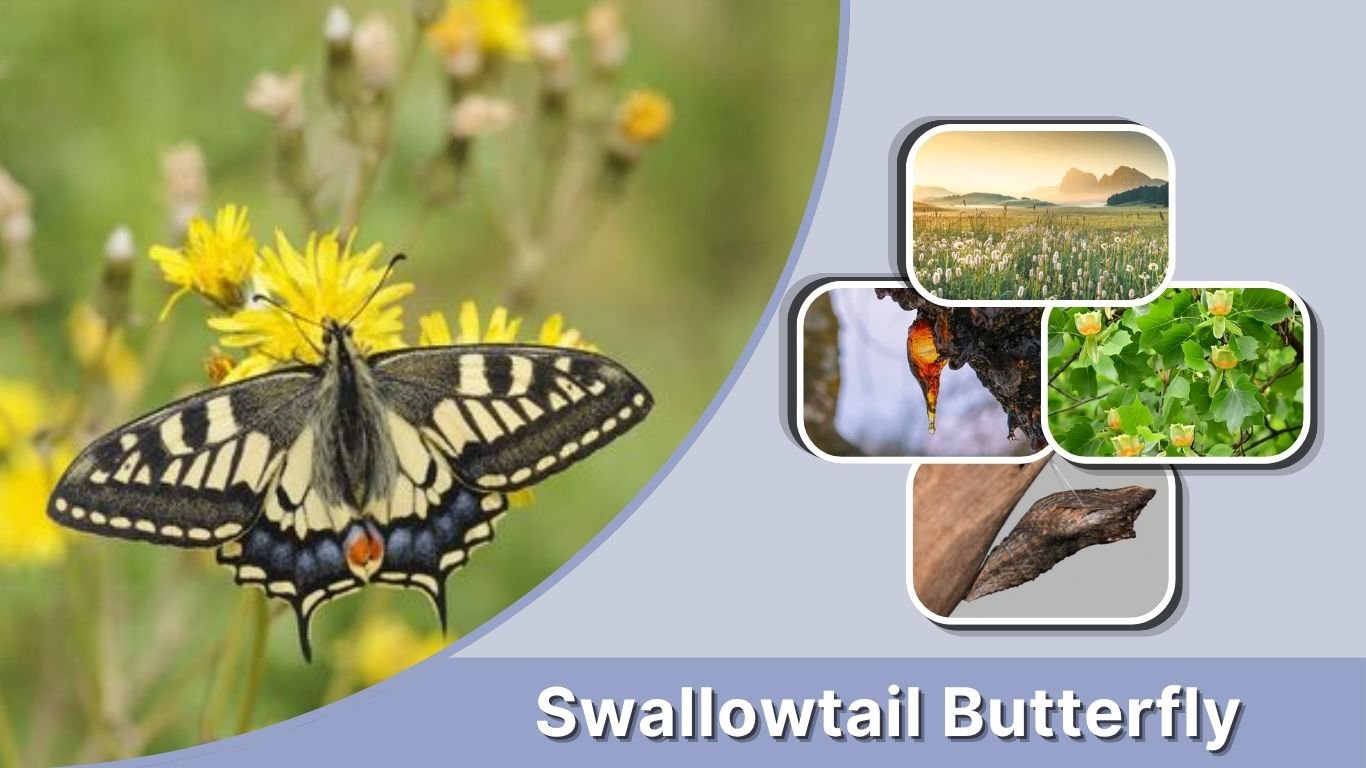
Swallowtail butterflies are among the most recognizable butterflies in the world, known for their large wings, striking colors, and tail-like extensions on the hindwings of many species. They occur in gardens, forests, meadows, wetlands, and other habitats where nectar and suitable host plants are available. Different species may appear yellow, black, blue, green, or patterned with several colors. This guide covers swallowtail butterfly identification, common types, caterpillars, host plants, diet, habitat, life cycle, chrysalis formation, and other fascinating facts.
What Is a Swallowtail Butterfly?
Swallowtail butterflies belong to the family Papilionidae, a widespread group containing hundreds of species. They are especially diverse in tropical regions, although many familiar species live throughout North America, Europe, and Asia. Most are medium to large butterflies with powerful flight. Their name comes from the narrow extensions resembling a swallow bird’s tail that occur on many species’ hindwings.
Swallowtail Butterfly Family
Papilionidae includes famous butterflies such as tiger swallowtails, black swallowtails, giant swallowtails, pipevine swallowtails, zebra swallowtails, and Old World swallowtails.
Not every species actually possesses prominent tails. However, many share other characteristics, including large wings, brightly colored patterns, and distinctive caterpillars.
Adults spend much of their active time searching for nectar, mates, and appropriate plants on which females can lay eggs. Their strong flight allows some species to travel considerable distances between feeding and breeding locations.
Why Swallowtails Are So Recognizable
The combination of size and colorful wing patterns makes swallowtails easier to notice than many smaller butterflies. Some use yellow and black coloration, while others display blue, green, red, orange, or cream markings.
Many species also possess small colored eyespots toward the rear of their wings. These markings may divert a predator’s attention toward the less vulnerable wing margin instead of the butterfly’s head.
Swallowtail Butterfly Identification
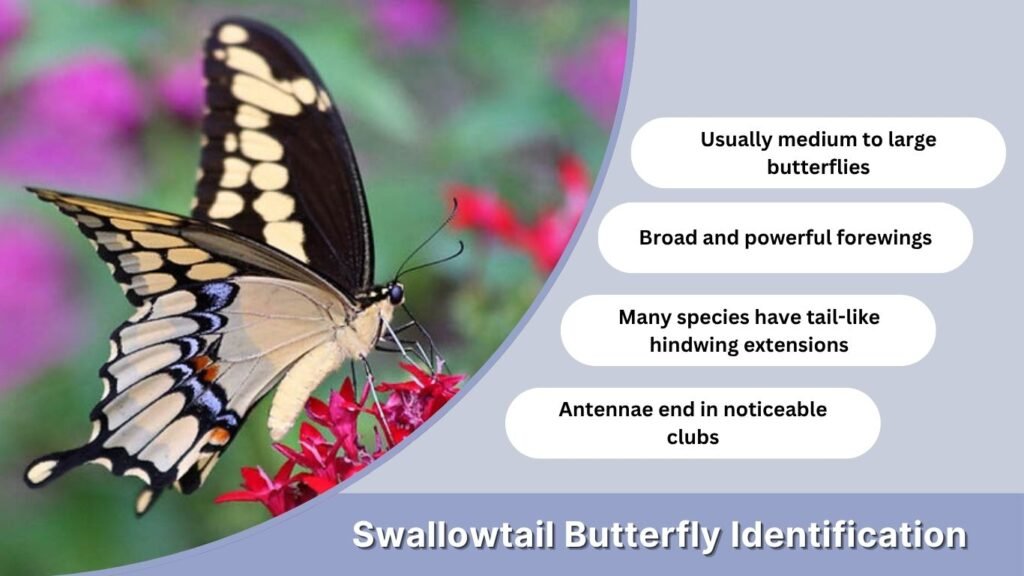
Identification varies because swallowtails include many differently colored species. Looking at overall wing pattern, tail shape, body size, geographic location, and markings on the underside of the wings can help narrow down the species. Males and females may also differ significantly, making sex an important consideration when identifying an unfamiliar swallowtail.
Key Identification Features
- Usually medium to large butterflies
- Broad and powerful forewings
- Many species have tail-like hindwing extensions
- Common colors include yellow, black, blue, green, and orange
- Hindwings may contain colorful spots or crescents
- Antennae end in noticeable clubs
- Adults typically have slender bodies compared with moths
- Wings are often held upright when resting
- Flight can be strong, rapid, and highly maneuverable
Male vs. Female Swallowtail Butterfly
Male and female swallowtails may look nearly identical in some species but dramatically different in others.
For example, male Eastern Tiger Swallowtails are normally yellow with black tiger-like stripes. Females may also be yellow, but some occur in a dark form that appears almost black.
Black Swallowtails show another useful difference. Males generally have more prominent yellow spots, whereas females usually display stronger blue coloration across the hindwings.
Common Types of Swallowtail Butterflies
Numerous swallowtail species occur worldwide, and several rank among the most familiar garden butterflies. Color alone is not always reliable because unrelated species can look surprisingly similar. Host plants, geographic range, wing markings, and tail shape often provide better identification clues.
Popular Swallowtail Butterfly Types
- Black Swallowtail: Mostly black with yellow spots and blue markings on the hindwings.
- Eastern Tiger Swallowtail: Large yellow butterfly with bold black tiger stripes.
- Giant Swallowtail: One of North America’s largest butterflies, with dark wings crossed by yellow bands.
- Zebra Swallowtail: Distinctive white-and-black butterfly with long hindwing tails.
- Pipevine Swallowtail: Mostly black with iridescent blue hindwings.
- Spicebush Swallowtail: Dark butterfly with blue or greenish hindwing markings.
- Western Tiger Swallowtail: Yellow and black species common in western North America.
- Two-Tailed Swallowtail: Large yellow butterfly distinguished by two tails on each hindwing.
- Anise Swallowtail: Yellow-and-black western species associated with plants in the carrot family.
- Old World Swallowtail: Widely distributed species recognizable by yellow wings with black patterns.
Yellow and Black Swallowtail Butterflies
A large yellow butterfly with black stripes is often assumed to be a Tiger Swallowtail, but several swallowtails share yellow-and-black coloration.
Eastern Tiger, Western Tiger, Two-Tailed, Anise, and Old World Swallowtails can all display combinations of these colors.
Location is therefore important. Eastern Tiger Swallowtails occur mainly in eastern North America, while Western Tiger Swallowtails are associated more strongly with western regions.
Swallowtail Butterfly Caterpillars and Host Plants
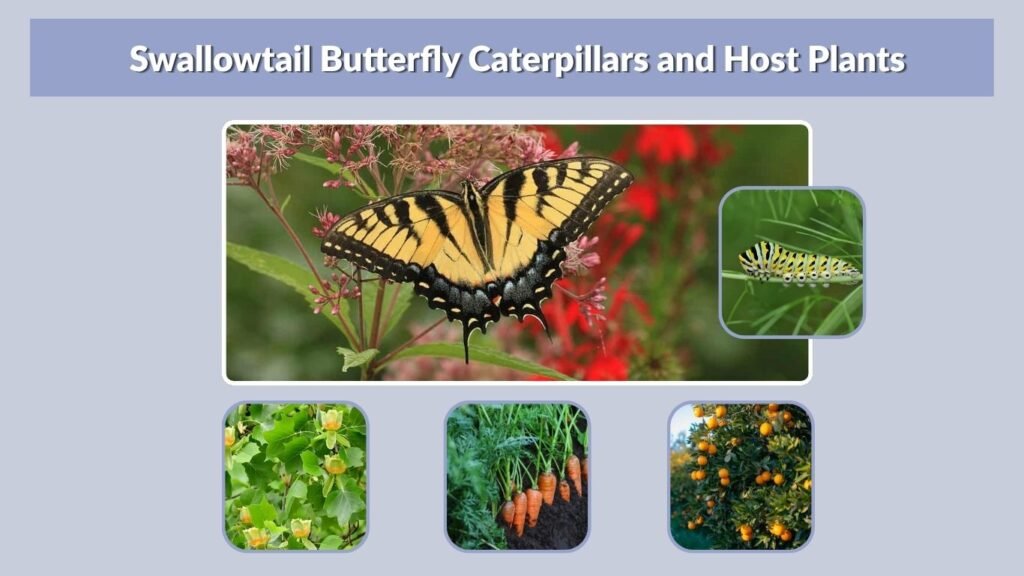
Swallowtail caterpillars can look completely different from the adults they eventually become. Each species depends on particular groups of host plants for larval development. Female butterflies therefore choose egg-laying locations carefully. Understanding these relationships is especially useful for gardeners who want to support swallowtails throughout their entire life cycle instead of simply attracting visiting adults.
Common Swallowtail Host Plants
- Black Swallowtail: Parsley, dill, fennel, carrot, and Queen Anne’s lace
- Eastern Tiger Swallowtail: Tulip tree, wild cherry, magnolia, ash, and willow
- Giant Swallowtail: Citrus, prickly ash, rue, and related plants
- Zebra Swallowtail: Pawpaw
- Pipevine Swallowtail: Pipevines
- Spicebush Swallowtail: Spicebush and sassafras
- Anise Swallowtail: Fennel, anise, parsley, and other carrot-family plants
What Do Swallowtail Caterpillars Eat?
Caterpillars eat leaves from their particular host plants. They do not simply feed on any convenient garden plant.
Black Swallowtail caterpillars, for example, are commonly found eating parsley, dill, or fennel. Zebra Swallowtail caterpillars are closely dependent on pawpaw.
Young larvae eat repeatedly as they grow and shed their skin several times. This feeding stage provides the energy needed to reach the chrysalis stage.
Many swallowtail caterpillars possess an unusual defensive organ called an osmeterium. When threatened, the caterpillar can extend this fork-shaped organ and release a strong odor that may discourage predators.
Swallowtail Butterfly Life Cycle
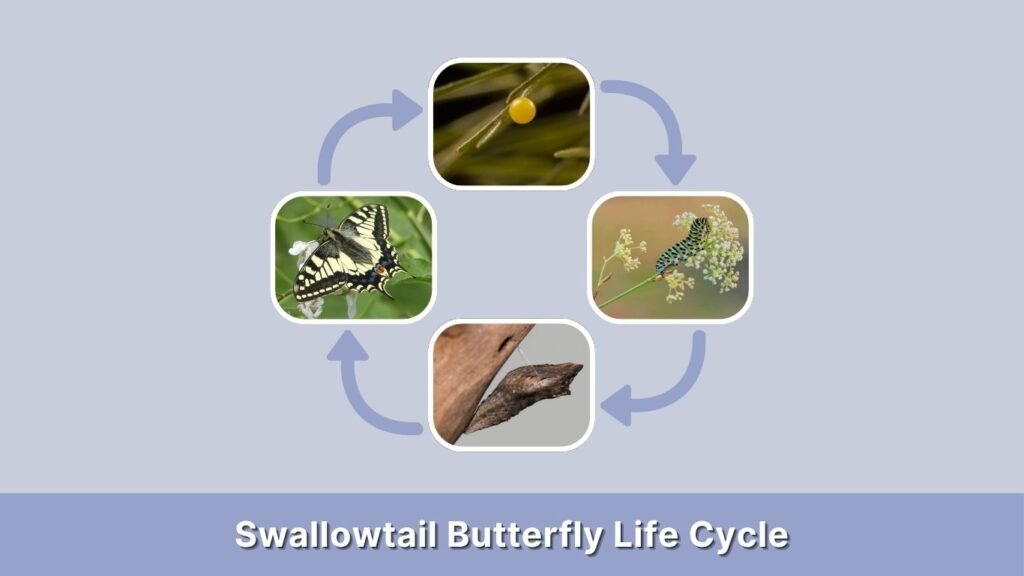
Like other butterflies, swallowtails undergo complete metamorphosis through four major stages: egg, larva, pupa, and adult. The length of the entire process depends on species, temperature, season, and climate. Some species produce multiple generations during a warm year, while others have fewer generations or spend winter protected within the chrysalis stage.
Egg and Caterpillar Stage
A female searches for the correct host plant before depositing her eggs. Depending on the species, eggs may be placed individually or occasionally in small groups.
After hatching, the caterpillar immediately begins feeding. As it grows, it passes through several developmental stages called instars and molts between each one.
Interestingly, young caterpillars may look very different from mature larvae. Giant Swallowtail caterpillars, for instance, resemble bird droppings, providing camouflage against predators.
Swallowtail Butterfly Chrysalis
When fully grown, the caterpillar stops feeding and searches for a secure location. It attaches itself to a stem, branch, wall, or another surface using silk.
Unlike many other butterflies that hang upside down, swallowtail pupae are usually supported upright by a silk girdle around the body.
Inside the chrysalis, dramatic transformation takes place as larval structures are reorganized into the adult butterfly. Depending on conditions, the adult may emerge within weeks, or the chrysalis may remain dormant through winter.
Adult Butterfly Stage
When development is complete, the adult breaks out of the chrysalis. Its wings initially appear soft and folded.
The butterfly pumps fluid into the wing veins, allowing them to expand. After the wings harden, it can begin flying.
Adults focus mainly on feeding, mating, and reproduction. Their lifespan varies by species and season, but many individual adult swallowtails live for several weeks.
What Do Swallowtail Butterflies Eat?
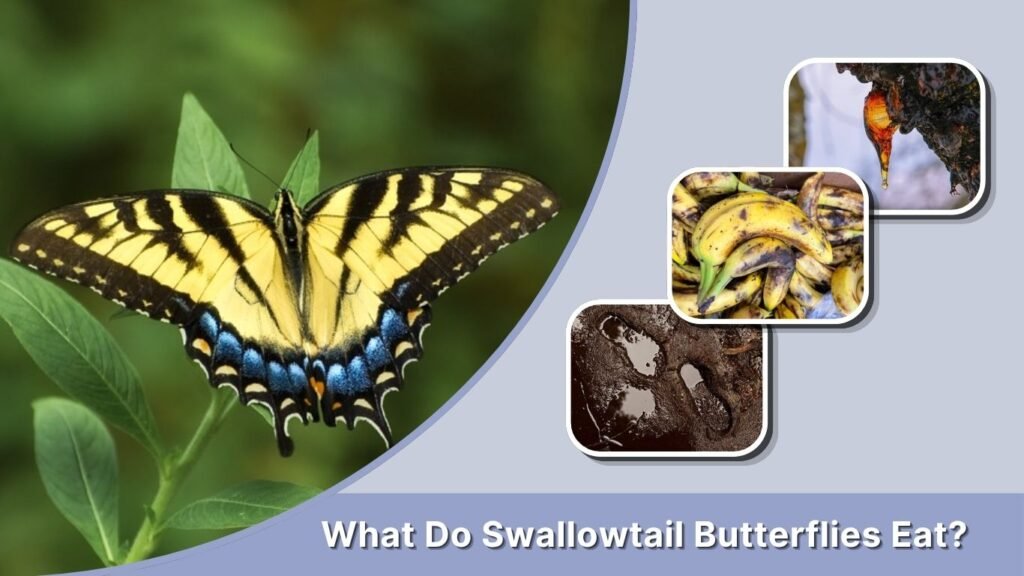
Adult swallowtails consume a very different diet from their caterpillars. Instead of chewing leaves, adults use a long coiled mouthpart called a proboscis to drink liquid food. Flower nectar is their most familiar energy source, although some species obtain minerals and nutrients from additional sources.
Adult Food Sources
- Flower nectar
- Mud and moist soil
- Mineral-rich puddles
- Tree sap
- Overripe fruit
- Other naturally occurring liquids
Male swallowtails are sometimes seen gathering in groups on moist soil, a behavior known as puddling. They absorb water containing salts and minerals that can be important for reproduction.
Flowers That Attract Swallowtails
Swallowtails often visit brightly colored flowers that provide accessible nectar. Gardens containing a succession of blooming plants can offer food through much of the butterfly season.
They frequently visit plants such as milkweed, zinnia, lantana, phlox, coneflower, verbena, and butterfly bush where these plants are appropriate for the local region.
Swallowtail Butterflies Habitat and Behavior
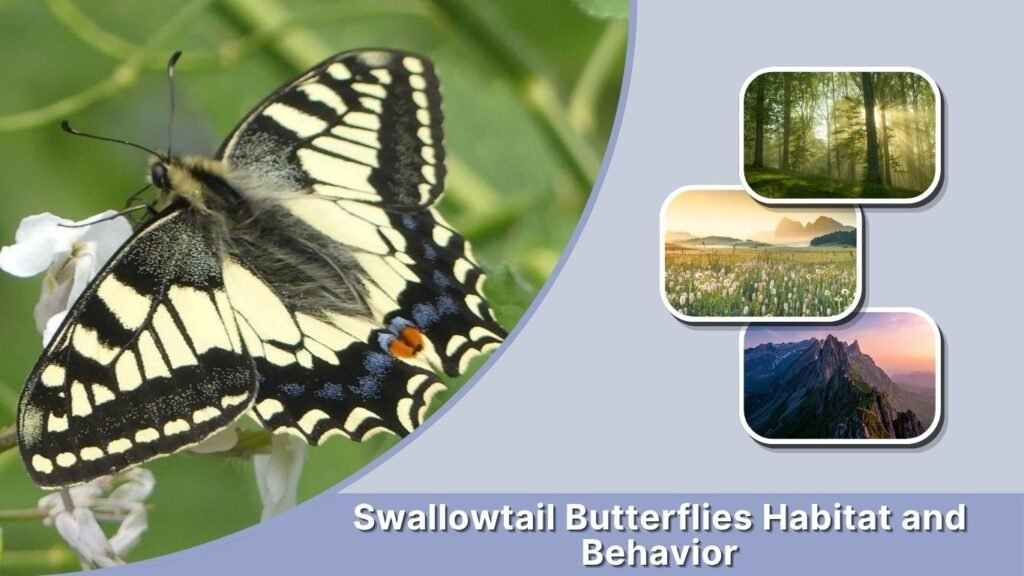
Swallowtail butterflies occupy diverse habitats because different species depend on different host plants. Forests, woodland edges, meadows, wetlands, gardens, mountains, roadsides, and suburban landscapes can all support them. A suitable habitat must provide larval host plants as well as enough nectar sources for adults.
Flight and Daily Behavior
Swallowtails are generally active during daylight and often become most noticeable on warm, sunny days. Their powerful wings allow them to move rapidly among flowers and escape many predators.
Some species spend much of their time high in trees, while others regularly visit gardens and open fields.
Males may patrol territories or travel along routes where females are likely to appear. Adults also spend time basking in sunlight to warm their flight muscles before becoming fully active.
How to Attract Swallowtail Butterflies
A butterfly-friendly garden should support both adults and caterpillars. Planting only nectar flowers may attract temporary visitors, but providing appropriate host plants allows swallowtails to reproduce and complete their entire life cycle within the landscape.
Creating a Swallowtail-Friendly Garden
- Grow native nectar-rich flowers.
- Plant host plants used by local swallowtail species.
- Provide flowers from spring through fall.
- Avoid unnecessary insecticide applications.
- Include sunny areas where butterflies can bask.
- Maintain some protection from strong winds.
- Provide shallow damp soil for puddling.
- Allow caterpillars to feed on designated host plants.
A garden with both nectar and host plants can support multiple generations while also providing opportunities to observe eggs, caterpillars, chrysalises, and adult butterflies.
FAQs
What is a swallowtail butterfly?
A swallowtail is a butterfly belonging to the family Papilionidae. Many species have tail-like projections on their hindwings and are known for their large size and colorful wing patterns.
What do swallowtail butterfly caterpillars eat?
They eat specific host plants depending on their species. Black Swallowtail caterpillars commonly eat parsley, dill, and fennel, while Zebra Swallowtails depend strongly on pawpaw.
How long does a swallowtail butterfly live?
Adult lifespan varies by species and environmental conditions, but many swallowtails live for several weeks as adults. The complete life cycle is longer when egg, caterpillar, chrysalis, and overwintering stages are included.
Is a yellow swallowtail always a Tiger Swallowtail?
No. Several species can be yellow and black, including Eastern Tiger, Western Tiger, Two-Tailed, Anise, and Old World Swallowtails. Location and wing patterns help distinguish them.
What is the difference between a cocoon and a chrysalis?
Swallowtail butterflies form a chrysalis, or pupa, rather than a moth-like silk cocoon. The chrysalis is the developmental stage in which the caterpillar transforms into an adult butterfly.
