
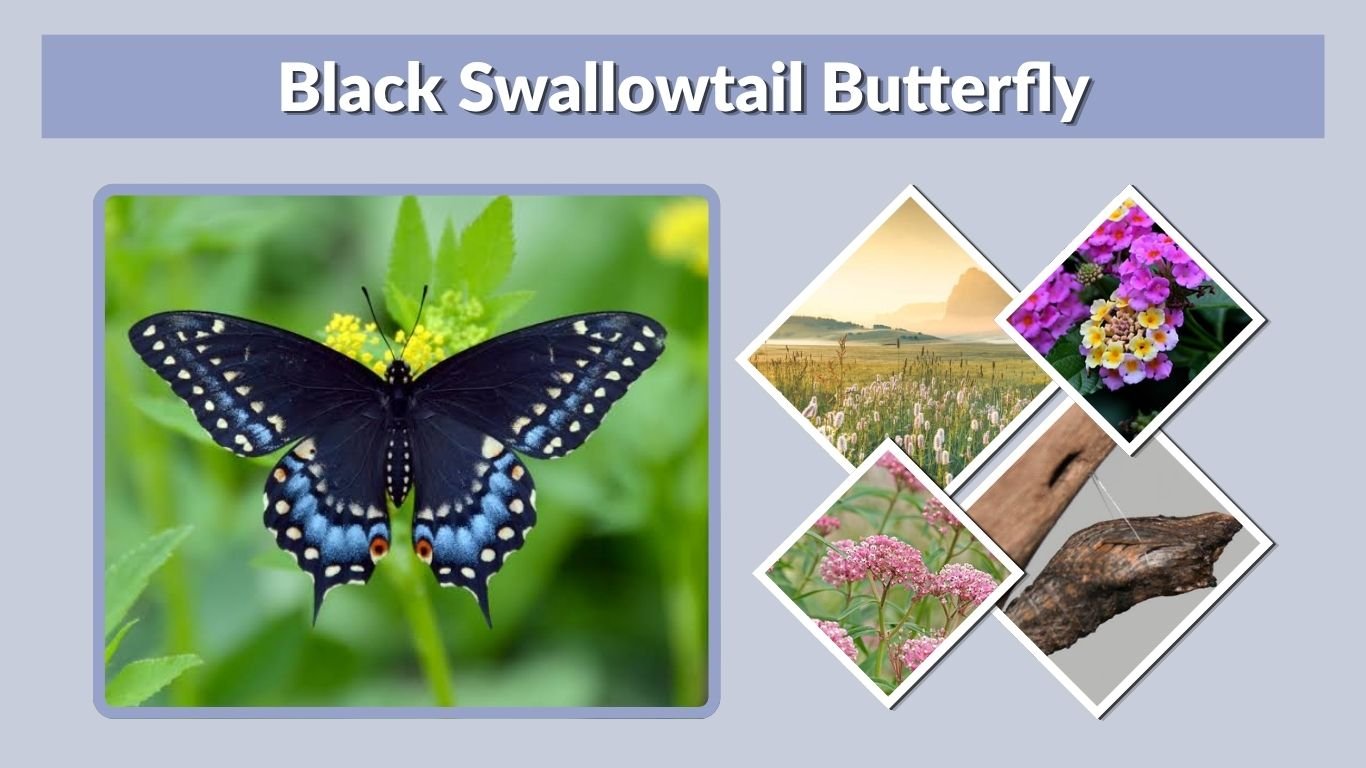
The Black Swallowtail butterfly is a striking North American species known for its dark wings, colorful spots, and distinctive tail-like hindwings. Often seen in gardens, fields, roadsides, and open landscapes, it is closely associated with plants such as parsley, dill, fennel, and Queen Anne’s lace. Its caterpillars are just as recognizable as the adults, with green bodies and bold black bands. This guide covers Black Swallowtail identification, habitat, host plants, diet, caterpillar stages, life cycle, male and female differences, lifespan, and meaning.
What Is a Black Swallowtail Butterfly?
The Black Swallowtail, scientifically known as Papilio polyxenes, is a member of the swallowtail family Papilionidae. It is widely distributed across much of North America and is one of the most familiar swallowtails found in gardens. Although adults appear mostly black, close inspection reveals yellow, blue, orange, and sometimes red markings that help distinguish males from females and separate this species from similar butterflies.
Black Swallowtail Identification
Adult Black Swallowtails are medium to large butterflies with broad wings and characteristic tails extending from each hindwing.
- Wingspan is commonly about 2.5 to 4 inches.
- Wings are mainly black.
- Males usually have prominent rows of yellow spots.
- Females generally show stronger blue coloration on the hindwings.
- Orange-red eyespots occur near the hindwing tails.
- Each hindwing has a noticeable tail-like projection.
- The body is dark with small pale markings.
- Wings may show cream or yellow spotting along their margins.
Black Swallowtail vs. Similar Butterflies
Several butterflies can be confused with the Black Swallowtail. Female Eastern Tiger Swallowtails may occur in a dark form, while Pipevine Swallowtails and Spicebush Swallowtails can also appear mostly black with blue hindwings.
Black Swallowtails are usually distinguished by their yellow spotting pattern, orange-red eyespot, and relatively short hindwing tails. Geographic location and nearby host plants can also provide useful clues.
Male vs. Female Black Swallowtail Butterfly
Male and female Black Swallowtails share the same basic wing shape but differ noticeably in coloration. These differences become easiest to see when the butterfly rests with its wings open. Sex is especially useful when distinguishing a female Black Swallowtail from other dark-colored swallowtail species that use similar habitats.
Male Black Swallowtail
Male Black Swallowtails generally have more obvious yellow markings. A broad row of yellow spots runs across both the forewings and hindwings, creating a brighter overall appearance.
Their blue hindwing coloration is usually less extensive than in females. Males often spend considerable time flying through open areas while searching for receptive females.
Female Black Swallowtail
Females typically have smaller or less prominent yellow spots and a much stronger band of iridescent blue across the hindwings.
Their dark-and-blue coloration may resemble Pipevine Swallowtails, which can provide some protection because predators may hesitate before attacking butterflies that resemble chemically defended species.
Females spend significant time searching for suitable host plants where their caterpillars can feed after hatching.
Black Swallowtail Host Plants
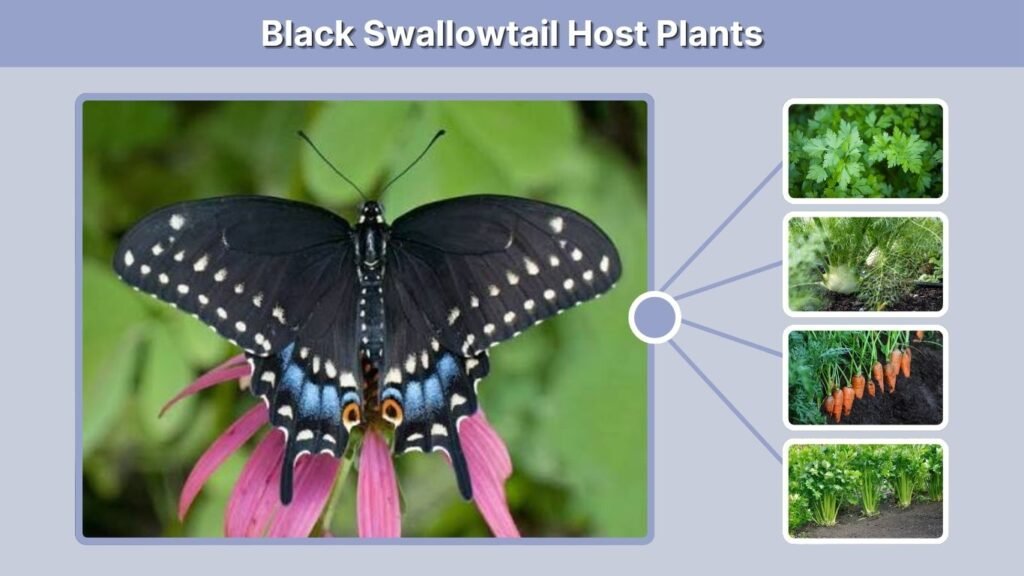
Host plants are essential to the Black Swallowtail life cycle because females lay eggs only on plants suitable for their larvae. Most commonly used plants belong to the carrot family, Apiaceae. Gardeners often discover caterpillars feeding on herbs before realizing these plants are functioning as butterfly nurseries.
Common Black Swallowtail Host Plants
- Parsley
- Dill
- Fennel
- Carrot
- Queen Anne’s lace
- Celery
- Parsnip
- Rue
- Golden Alexander
- Other related Apiaceae plants
Why Host Plants Matter
Adult butterflies can feed from many flowers, but their caterpillars have much narrower dietary requirements. A female therefore uses chemical and physical cues to determine whether a plant is suitable before placing an egg.
Gardens containing parsley, dill, or fennel may attract egg-laying females. Caterpillars can consume noticeable amounts of foliage, but many gardeners intentionally grow extra host plants so both people and butterflies have enough.
Black Swallowtail Butterfly Caterpillar
The Black Swallowtail caterpillar changes dramatically as it grows. Young larvae look very different from mature caterpillars, which can confuse people who encounter different developmental stages on the same type of plant.
Caterpillar Identification
- Young caterpillars are mostly dark with a white patch.
- Early stages may resemble bird droppings.
- Older caterpillars become green.
- Mature larvae have black transverse bands.
- Yellow or orange dots appear within the dark bands.
- Caterpillars have a smooth, thick body.
- A fork-shaped orange defensive organ can emerge behind the head.
Orange Horns on the Caterpillar
The orange structures sometimes described as “horns” are actually an organ called an osmeterium.
When disturbed, the caterpillar everts this forked structure from behind its head. It releases a strong odor that may discourage ants, wasps, birds, and other predators.
The osmeterium normally remains hidden, so people often notice it only after touching or disturbing the caterpillar.
Black Swallowtail Butterfly Life Cycle
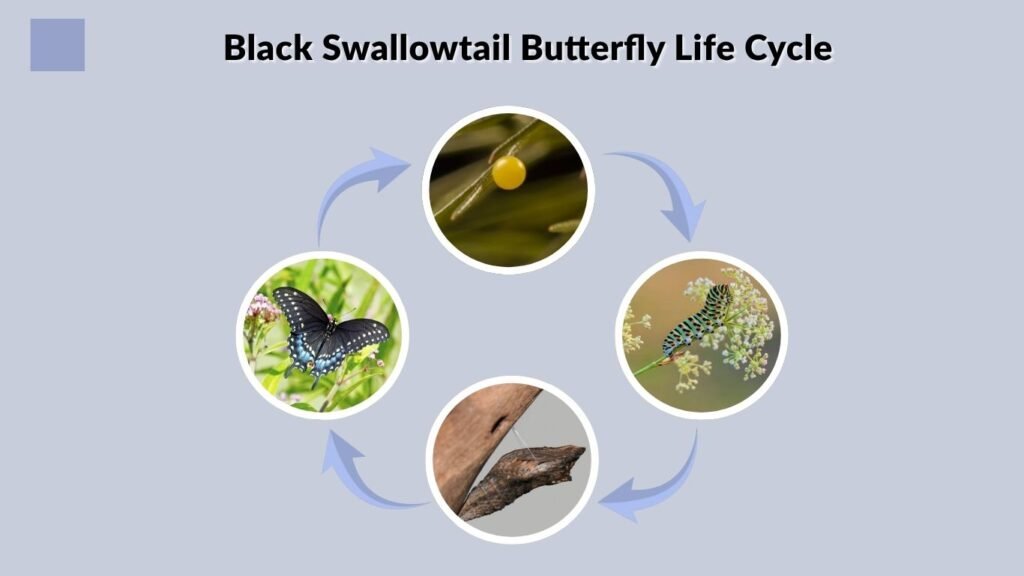
The Black Swallowtail undergoes complete metamorphosis with four major developmental stages: egg, larva, pupa, and adult. The time required to complete the cycle depends heavily on temperature, season, and geographic region. Several generations may occur during a long warm season, while the final generation can remain in the chrysalis stage through winter.
Egg to Caterpillar
Females normally place individual eggs on the leaves or stems of suitable host plants. Eggs are small, round, and pale when first laid.
After hatching, the tiny caterpillar begins eating its host plant and grows rapidly. It passes through several stages known as instars, shedding its outer skin between each stage.
Its appearance gradually changes from dark and bird-dropping-like to the familiar green, black, and yellow-striped mature caterpillar.
Chrysalis Stage
Once fully grown, the caterpillar stops feeding and wanders away from its feeding area to find a protected pupation site.
It attaches itself to a stem, branch, fence, wall, or another firm surface. A silk pad anchors the rear of the body, while a thin silk girdle supports the chrysalis around its middle.
The chrysalis may appear green or brown, which provides excellent camouflage against surrounding vegetation or woody surfaces.
During warm weather, an adult may emerge after a relatively short pupal period. Chrysalises formed late in the season may enter diapause and remain dormant through winter.
Adult Stage
When metamorphosis is complete, the butterfly emerges from the chrysalis with soft, folded wings.
It pumps fluid through the wing veins until the wings expand to their full size. After they harden and dry, the butterfly can fly.
Adults then begin searching for nectar, mates, and breeding habitat, allowing the life cycle to start again.
What Does a Black Swallowtail Butterfly Eat?
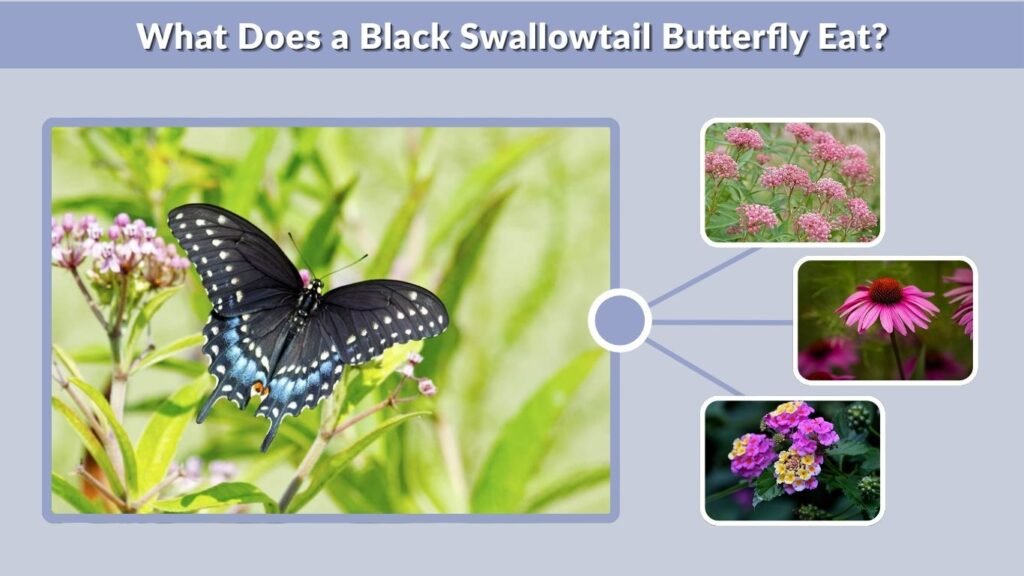
The diet changes completely between the caterpillar and adult stages. Caterpillars chew plant foliage, while adults cannot chew leaves. Instead, butterflies use a long coiled proboscis to drink liquid food, particularly flower nectar. Gardens that combine larval host plants with nectar-producing flowers can therefore support every stage of the species.
Adult Food Sources
- Flower nectar
- Milkweed
- Zinnia
- Coneflower
- Phlox
- Lantana
- Verbena
- Thistle
- Other nectar-rich flowers
Caterpillar Food
Black Swallowtail caterpillars mainly eat plants in the carrot family. Parsley, dill, fennel, Queen Anne’s lace, carrot tops, and similar plants provide the leaves they need for growth.
They may eat rapidly during later stages because their bodies must accumulate enough energy for pupation and adult development.
Black Swallowtail Butterfly Habitat and Range
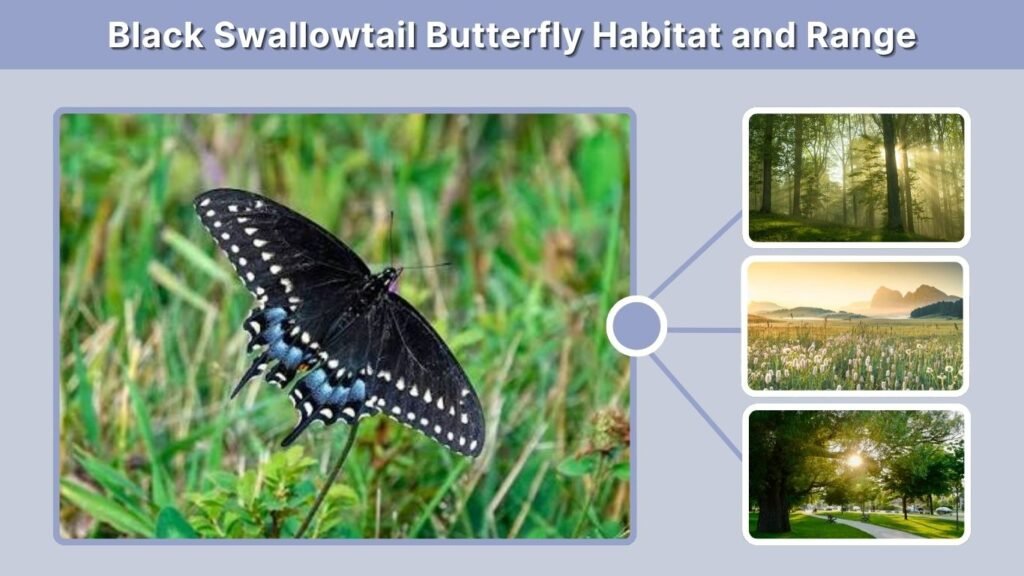
Black Swallowtails occur across much of eastern and central North America and extend into parts of the western United States, Mexico, and neighboring regions. They adapt well to open landscapes and frequently occur near people because gardens can provide both larval host plants and adult nectar sources.
Where Black Swallowtails Live
They are commonly found in gardens, fields, meadows, roadsides, parks, farms, and open woodland edges.
Unlike butterflies strongly associated with dense forests, Black Swallowtails often thrive in disturbed or managed landscapes where members of the carrot family grow.
Adults tend to favor sunny areas containing abundant flowering plants. Males may gather around elevated locations while searching for females, while females spend more time investigating vegetation for egg-laying sites.
Black Swallowtail Lifespan and Behavior
The lifespan of a Black Swallowtail varies according to temperature, season, and developmental timing. The adult portion of its life is relatively short compared with the entire egg-to-adult cycle. Individuals that overwinter as chrysalises can effectively remain in development for months before emerging when suitable spring conditions return.
How Long Does a Black Swallowtail Live?
An adult Black Swallowtail often lives for several weeks. During that period, it must feed, avoid predators, locate mates, and reproduce.
The total life cycle is considerably longer because it includes time spent as an egg, caterpillar, and chrysalis.
Late-season individuals can spend the entire winter as pupae. Their development resumes when temperatures and day length become favorable.
Black Swallowtail Butterfly Meaning
Butterflies have acquired many symbolic meanings in art, culture, and personal interpretation. The Black Swallowtail is frequently associated with transformation because of its dramatic change from caterpillar to butterfly. Its dark coloration has also contributed to symbolic interpretations involving transition, mystery, resilience, or new beginnings.
Spiritual and Symbolic Meaning
There is no scientific evidence that seeing a Black Swallowtail predicts events or carries a universal spiritual message. Such meanings come from cultural traditions and personal beliefs rather than butterfly biology.
For some people, the butterfly represents transformation, renewal, adaptation, or personal growth. Others simply appreciate its appearance and use it as inspiration in artwork, tattoos, photography, and garden design.
FAQs
Is a Black Swallowtail butterfly poisonous?
Adult Black Swallowtails are not considered dangerous to people and do not sting or bite. Their caterpillars use defensive odors rather than harmful attacks when disturbed.
What is the host plant for a Black Swallowtail?
Common host plants include parsley, dill, fennel, carrot, Queen Anne’s lace, parsnip, and several other plants in the carrot family.
What does a Black Swallowtail caterpillar look like?
Mature caterpillars are usually green with black bands containing yellow or orange spots. Younger caterpillars are darker and may resemble bird droppings.
What is the difference between male and female Black Swallowtails?
Males typically display larger and brighter yellow spots, while females generally have more extensive iridescent blue coloration across the hindwings.
How long does a Black Swallowtail butterfly live?
The adult usually survives for several weeks, although environmental conditions influence lifespan. The complete life cycle is longer, especially when the chrysalis overwinters before producing an adult.
