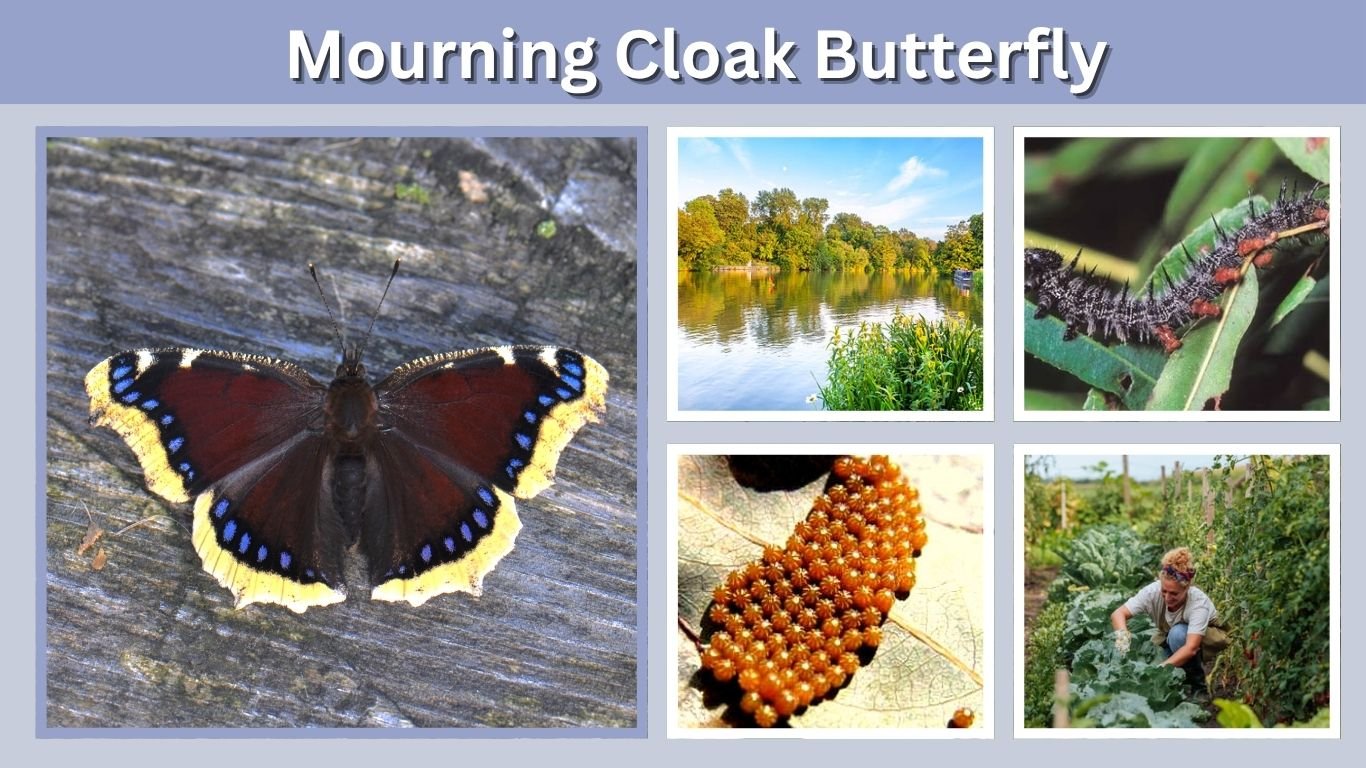
The mourning cloak butterfly (Nymphalis antiopa) is a beautiful butterfly recognized by its dark maroon wings, pale yellow edges, and bright blue spots. Found throughout much of North America and parts of Europe and Asia, this butterfly is especially interesting because of its long lifespan and ability to survive winter as an adult. Understanding the mourning cloak butterfly’s identification, habitat, caterpillar, host plants, life cycle, and symbolism can help nature enthusiasts appreciate this remarkable species.
Mourning Cloak Butterfly Identification
The mourning cloak butterfly belongs to the Nymphalidae family, commonly known as brush-footed butterflies. Its unusual wing colors and distinctive flight pattern make it relatively easy to identify. Unlike many colorful butterflies, this species has predominantly dark wings with contrasting light borders.
Physical Appearance and Size
- Scientific Name: Nymphalis antiopa
- Family: Nymphalidae
- Wingspan: Approximately 2.25–4 inches (5.7–10.1 cm).
- Wing Color: Dark reddish-brown to purplish-black.
- Wing Edges: Broad yellow or cream-colored borders.
- Distinctive Markings: Bright blue spots along the inner edges of the yellow bands.
- Underside: Dark grayish-brown with irregular patterns that provide camouflage.
The mourning cloak is sometimes described as a black butterfly with yellow or white edges. Its pale borders can appear almost white as the wings age.
Male vs. Female Mourning Cloak Butterfly
Male and female mourning cloak butterflies look remarkably similar. Both have dark wings, pale borders, and blue markings, making identification by appearance alone difficult.
Males are particularly territorial during breeding season. They often perch in sunny locations and chase other butterflies away while waiting for potential mates.
Mourning Cloak Butterfly Habitat and Range
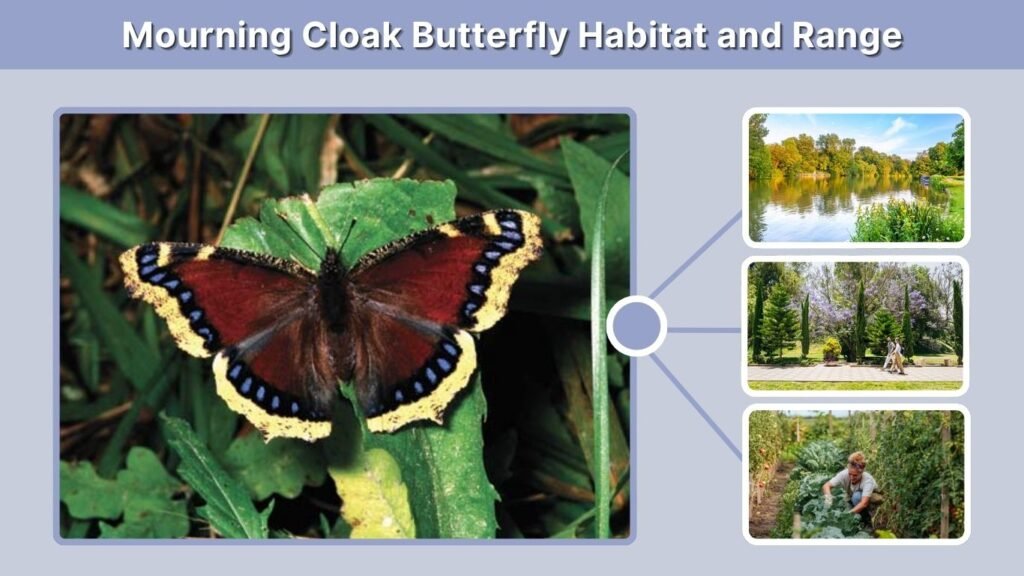
Mourning cloak butterflies inhabit diverse environments, from wooded areas to suburban gardens. Their distribution is closely associated with the availability of suitable host trees and sheltered places for overwintering.
Where Do Mourning Cloak Butterflies Live?
These butterflies occur across much of North America, including Canada, Alaska, California, Colorado, Michigan, Minnesota, and Wisconsin. They also inhabit temperate regions of Europe and Asia.
Common habitats include deciduous forests, woodland edges, riverbanks, parks, and gardens. They are particularly common around willow and poplar trees.
During winter, adults shelter beneath loose bark, inside tree cavities, or in protected crevices.
What Do Mourning Cloak Butterflies Eat?
Adult mourning cloak butterflies primarily consume tree sap and fermented fruit rather than flower nectar.
Their diet includes sap from oak and other trees, overripe fruit, and occasional flower nectar. They may also visit damp soil for dissolved minerals.
Their feeding habits make them different from many familiar garden butterflies that regularly visit flowers.
Mourning Cloak Butterfly Host Plants
Female mourning cloaks lay eggs on trees that provide food for their developing caterpillars.
Important host plants include:
- Willow trees
- American elm
- Cottonwood
- Aspen
- Poplar
- Paper birch
- Hackberry
Willows and poplars are especially important host plants. Young caterpillars feed on their leaves and may consume significant amounts of foliage when present in large groups.
Mourning Cloak Butterfly Life Cycle
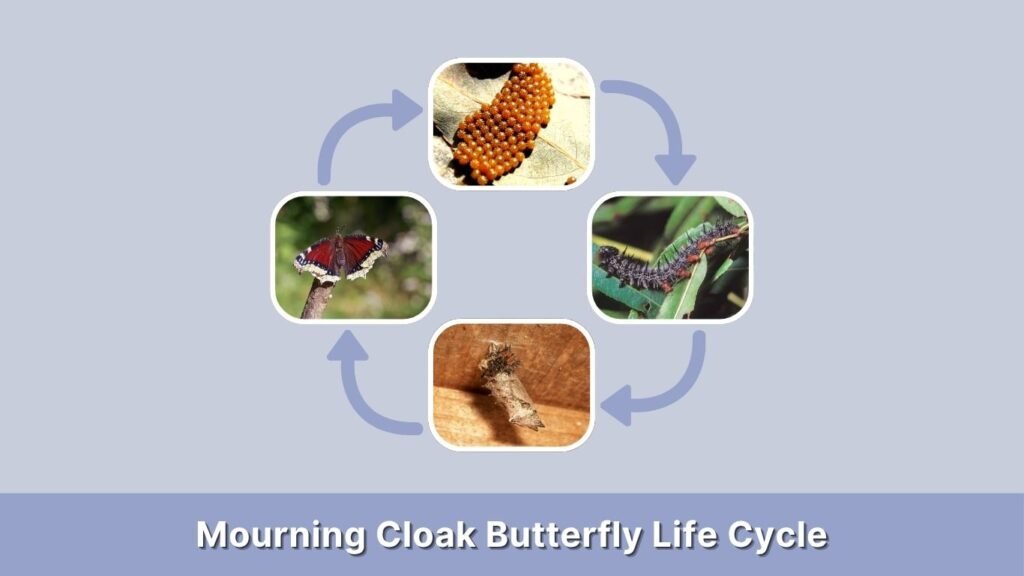
The mourning cloak butterfly undergoes complete metamorphosis, developing through four stages: egg, larva, pupa, and adult. Unlike many butterfly species, mourning cloaks generally survive the winter as adults and begin reproducing when warmer spring weather arrives.
1. Mourning Cloak Butterfly Eggs
Female mourning cloaks lay clusters of small, pale eggs around twigs of suitable host plants.
These eggs may darken before hatching. After emerging, the young larvae begin feeding on nearby leaves.
The clustered arrangement allows newly hatched caterpillars to remain together during their early development.
2. Mourning Cloak Butterfly Caterpillar
Mourning cloak caterpillars are sometimes called spiny elm caterpillars because of their appearance and feeding habits.
They have black bodies with small white spots, reddish-orange markings along their backs, and numerous branched black spines.
Young caterpillars often feed together in groups, sometimes within loose silk webs. As they mature, they consume more foliage and eventually search for suitable places to pupate.
3. Mourning Cloak Butterfly Chrysalis
Once fully grown, the caterpillar forms a chrysalis, which is the pupal stage of development.
The chrysalis is typically grayish or brownish, with pointed projections that help disguise its shape.
It hangs vertically from a silk attachment while the insect transforms into an adult butterfly.
4. Adult Butterfly and Lifespan
Adult mourning cloak butterflies can survive approximately 10–11 months, making them among North America’s longest-lived butterflies.
Many adults enter a period of summer dormancy called aestivation before becoming active again in autumn.
They then spend winter in sheltered locations and emerge during warm spring weather to reproduce.
Mourning Cloak Butterfly Meaning and Symbolism
The mourning cloak butterfly has attracted attention because of its unusual appearance and symbolic associations. Although its dark wings may suggest sadness, people often connect this butterfly with positive themes such as renewal, perseverance, and transformation.
Why Is It Called a Mourning Cloak Butterfly?
The name comes from the butterfly’s resemblance to traditional dark mourning garments.
Its velvety wings resemble a dark cloak, while the pale yellow borders resemble decorative trim.
In the United Kingdom, this species is also known as the Camberwell beauty.
Mourning Cloak Butterfly Spiritual Meaning
In personal and spiritual interpretations, mourning cloak butterflies may symbolize transformation, resilience, remembrance, and new beginnings.
Their ability to survive winter and reappear in spring makes them a natural symbol of endurance and renewal.
However, these meanings are cultural or personal interpretations rather than scientifically established characteristics of the butterfly.
Are Mourning Cloak Butterflies Poisonous?
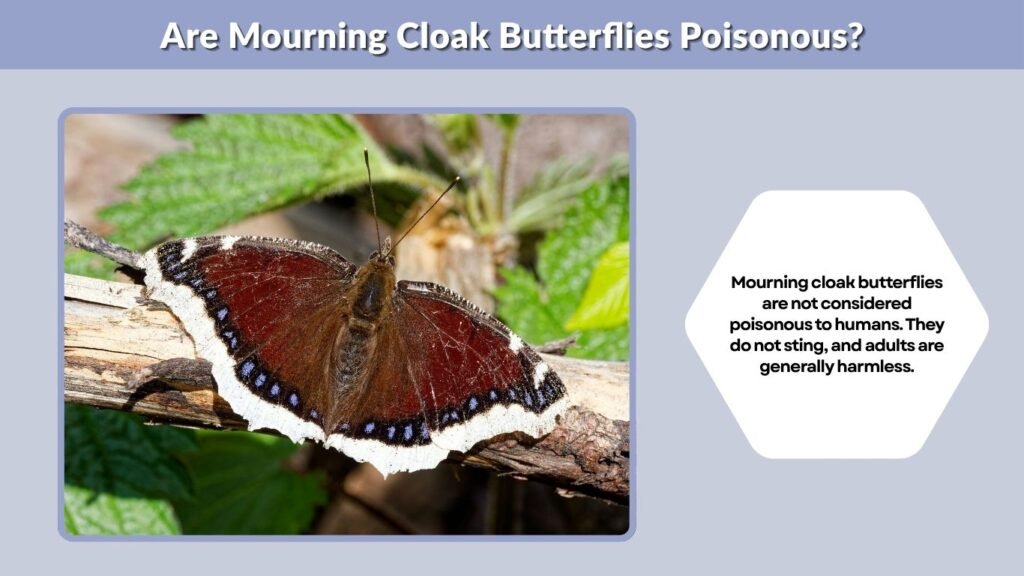
Mourning cloak butterflies are not considered poisonous to humans. They do not sting, and adults are generally harmless.
Their caterpillars also lack venomous stinging structures, although their stiff spines may cause mechanical irritation when handled.
The safest approach is to observe both caterpillars and adults without unnecessarily touching or disturbing them.
How to Attract Mourning Cloak Butterflies
Providing suitable host trees is one of the most effective ways to support mourning cloak butterflies.
Native willows, poplars, and other appropriate trees offer food for developing caterpillars.
Preserving safe patches of loose bark, reducing unnecessary pesticide applications, and maintaining natural woodland habitat can also support their survival.
FAQs
1. How Long Do Mourning Cloak Butterflies Live?
Mourning cloak butterflies can live approximately 10–11 months as adults, significantly longer than many other butterfly species. Their exceptional lifespan is partly related to their ability to overwinter in protected locations and become active again when spring temperatures rise.
2. Are Mourning Cloak Butterfly Caterpillars Poisonous?
Mourning cloak caterpillars are not considered poisonous or venomous to humans. However, their bodies are covered with numerous stiff spines that may cause minor skin irritation through physical contact. Avoid handling them directly, especially if you have sensitive skin.
3. Do Mourning Cloak Butterflies Hibernate?
Yes. Mourning cloak butterflies overwinter as adults, usually sheltering beneath tree bark or in protected crevices. They enter a dormant state during cold weather but may briefly become active on unusually warm winter days. This allows them to appear very early in spring.
4. Are Mourning Cloak Butterflies Endangered?
Mourning cloak butterflies are not considered globally endangered. They have a widespread distribution across North America and Eurasia. However, their populations may be uncommon in certain regions, and local habitat destruction, pesticide exposure, and loss of host plants can affect their numbers.
5. What Does Seeing a Mourning Cloak Butterfly Mean?
Seeing a mourning cloak butterfly may simply indicate suitable habitat and seasonal activity. Some people also associate the butterfly with resilience, transformation, remembrance, or personal growth. These symbolic meanings vary between individuals and traditions and should not be confused with biological facts.