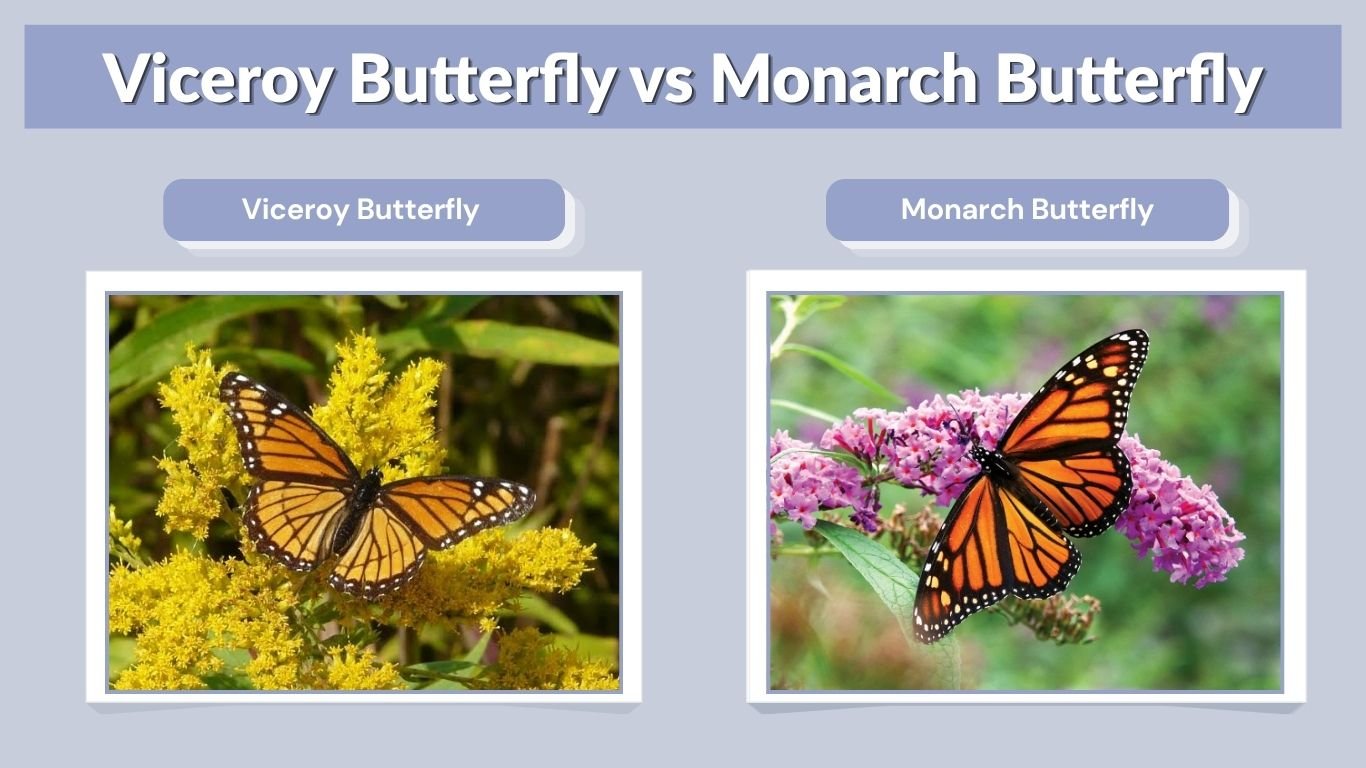
The viceroy butterfly vs monarch comparison is fascinating because these two butterflies look remarkably similar. Both have bright orange wings, black veins, and white spots, making identification challenging for beginners. However, they differ in wing markings, body size, caterpillar appearance, habitat, and migration habits. Although they belong to the same butterfly family, they are distinct species. Understanding these differences helps butterfly enthusiasts identify them and appreciate their unique relationship in nature.
Viceroy Butterfly vs Monarch: Quick Comparison
The monarch butterfly (Danaus plexippus) and viceroy butterfly (Limenitis archippus) belong to the Nymphalidae family. Despite their similar appearance, they are only distantly related within that family. Their physical characteristics and behavior provide several reliable identification clues.
| Feature | Monarch Butterfly | Viceroy Butterfly |
| Scientific name | Danaus plexippus | Limenitis archippus |
| Wingspan | 3.4–4.9 inches | 2.5–3.4 inches |
| Wing color | Orange and black | Orange to reddish-orange and black |
| Black hindwing line | Absent | Present |
| Caterpillar | Yellow, black, and white stripes | Brown, greenish, and white markings |
| Host plants | Milkweed | Willow, poplar, cottonwood |
| Flight | Slow, floating glides | Quicker, less regular flight |
| Migration | Many populations migrate | Does not make long-distance seasonal migrations |
| Chemical defense | Cardenolides from milkweed | Defensive compounds associated with host plants |
7 Key Differences Between Monarch and Viceroy Butterflies
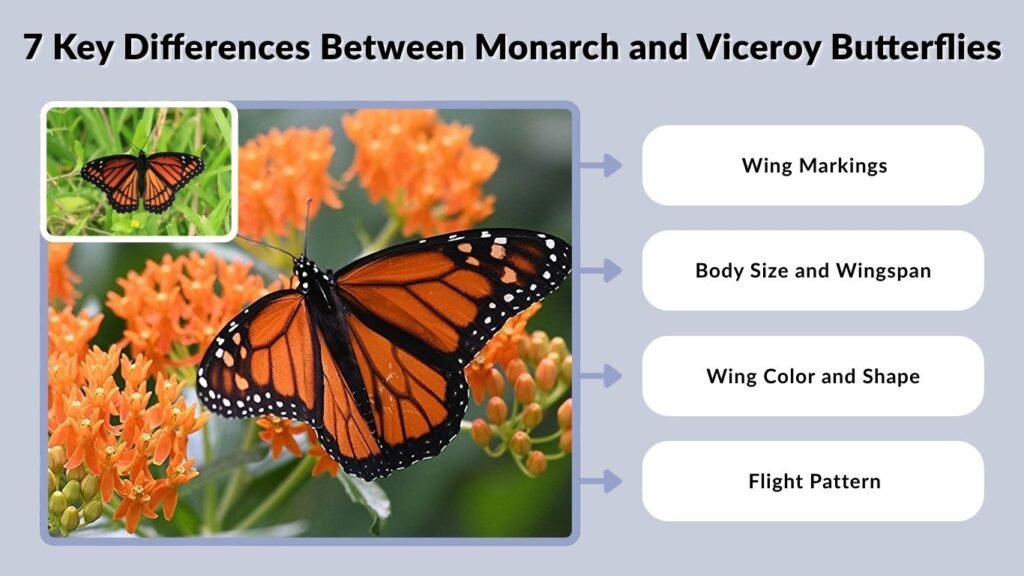
Although their orange-and-black coloration makes these butterflies easy to confuse, careful observation reveals important differences. The most useful identification characteristics include hindwing markings, wingspan, flight pattern, and caterpillar appearance.
1. Wing Markings
The easiest way to identify a viceroy butterfly is by examining its hindwings. Viceroys have a distinctive curved black line crossing the veins of each hindwing.
Monarch butterflies lack this extra crossing line. Their wings instead show a network of black veins separating large orange sections. This feature is generally the most dependable distinction between the two species.
2. Body Size and Wingspan
Monarch butterflies are generally larger than viceroys.
A typical monarch has a wingspan of approximately 3.4–4.9 inches, whereas a viceroy measures about 2.5–3.4 inches.
However, individual sizes vary, and large viceroys may resemble smaller monarchs. Therefore, size should be considered alongside wing markings rather than used alone.
3. Wing Color and Shape
Both butterflies display orange wings with contrasting black markings and small white spots around the borders.
Monarch wings are typically bright orange with prominent black veins and relatively smooth margins.
Viceroy wings can appear more reddish or mahogany-colored, depending on their geographic population. Their hindwing edges are also somewhat more scalloped.
4. Flight Pattern
Monarch butterflies are known for their graceful, floating flight. They often alternate several wingbeats with extended glides, especially when traveling across open spaces.
Viceroys generally fly more quickly and irregularly, using shorter glides between wingbeats.
However, flight behavior depends on weather conditions and activity, making wing patterns more reliable for identification.
5. Habitat and Distribution
Monarch butterflies occupy grasslands, meadows, gardens, and other environments where milkweed and nectar-producing flowers are available.
Viceroy butterflies prefer wetter habitats, including riverbanks, marshes, pond edges, and woodland areas containing willow or poplar trees.
Both occur across extensive regions of North America, and their habitats sometimes overlap.
6. Caterpillar Appearance
Monarch caterpillars have distinct yellow, black, and white bands around their bodies. They also possess two pairs of long, flexible black filaments.
Viceroy caterpillars appear completely different. Their irregular brown, greenish, and white markings resemble bird droppings, providing camouflage against predators.
Their unusual appearance makes the caterpillars much easier to distinguish than the adults.
7. Migration and Winter Survival
Many North American monarch butterflies undertake extraordinary seasonal migrations. Eastern migratory populations travel to central Mexico, while western populations primarily overwinter along the California coast.
Viceroy butterflies do not perform comparable long-distance migrations.
Instead, viceroys in colder regions overwinter as partially developed caterpillars inside protective shelters made from leaves.
Monarch and Viceroy Butterfly Mimicry
The relationship between monarch and viceroy butterflies represents an important example of evolutionary adaptation. Their similar appearance helps discourage predators by reinforcing the association between bright wing coloration and unpleasant-tasting prey.
Why Do Viceroy Butterflies Mimic Monarchs?
Both species possess chemical defenses that make them distasteful to certain predators, particularly birds.
Monarch caterpillars obtain defensive cardenolides from milkweed plants. Viceroys develop different chemical defenses associated with feeding on plants such as willow.
Their shared orange-and-black appearance encourages predators to avoid both species after an unpleasant experience.
Batesian vs. Müllerian Mimicry
Scientists once considered the viceroy a harmless imitation of the chemically protected monarch. This relationship was described as Batesian mimicry.
However, research established that viceroys themselves are distasteful to birds.
Consequently, their relationship is now generally recognized as Müllerian mimicry, where two genuinely defended species share similar warning signals and benefit from predator avoidance.
Monarch vs Viceroy: Host Plants and Life Cycle
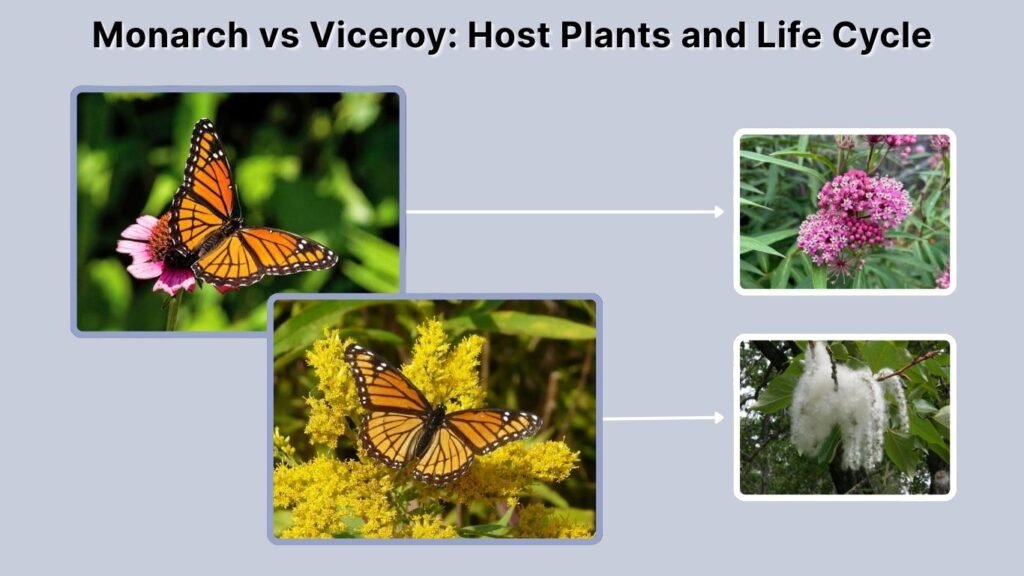
Although both butterflies undergo complete metamorphosis through egg, caterpillar, chrysalis, and adult stages, their developmental requirements differ significantly. Host plants are particularly important because each species depends on different vegetation for caterpillar survival.
Monarch Butterfly Host Plants
Monarch caterpillars depend on milkweed species for food. Female monarchs generally lay eggs individually on milkweed leaves or stems.
After hatching, the caterpillars consume the foliage and accumulate defensive chemicals.
Adult monarchs primarily drink nectar from flowers, obtaining energy for reproduction and migration.
Viceroy Butterfly Host Plants
Viceroy caterpillars feed primarily on willow, cottonwood, and poplar trees.
Female viceroys lay eggs individually, often near the tips of host plant leaves.
The developing caterpillars use their mottled coloration to blend into their surroundings. Adults consume flower nectar but may also feed on decaying fruit, animal droppings, and carrion.
FAQs
1. What Is the Main Difference Between a Monarch and Viceroy Butterfly?
The most noticeable difference is the black line crossing each viceroy’s hindwing. Monarch butterflies do not have this marking. Viceroys are also generally smaller than monarchs, although their sizes overlap. Examining the hindwing pattern is usually the easiest way to distinguish them accurately.
2. Are Monarch and Viceroy Butterflies Closely Related?
Monarchs and viceroys belong to the same butterfly family, Nymphalidae, but occupy different subfamilies. Monarchs belong to Danainae, while viceroys belong to Limenitidinae. Their similar wing coloration developed through evolutionary processes associated with predator avoidance rather than because they are closely related species.
3. Are Viceroy Butterflies Poisonous Like Monarchs?
Both species possess chemical defenses that make them unpalatable to many birds. Monarchs obtain cardenolides from milkweed, while viceroys acquire different defensive substances associated with their host plants. However, toxicity varies by predator and population, and neither butterfly is considered dangerous to humans through ordinary observation.
4. Why Do Viceroy Butterflies Look Like Monarch Butterflies?
Viceroys resemble monarchs because similar warning colors provide protection against predators. Birds that associate orange-and-black butterflies with an unpleasant taste may avoid both species. This relationship is called Müllerian mimicry because both butterflies possess genuine defenses rather than one being an entirely harmless imitation.
5. Do Viceroy Butterflies Migrate Like Monarchs?
Viceroy butterflies do not undertake the extensive seasonal migrations associated with North American monarchs. Instead, they remain within their general geographic regions and survive cold winters as caterpillars in protective leaf shelters. Monarch migration patterns vary by population, with many traveling significant distances to overwintering locations.