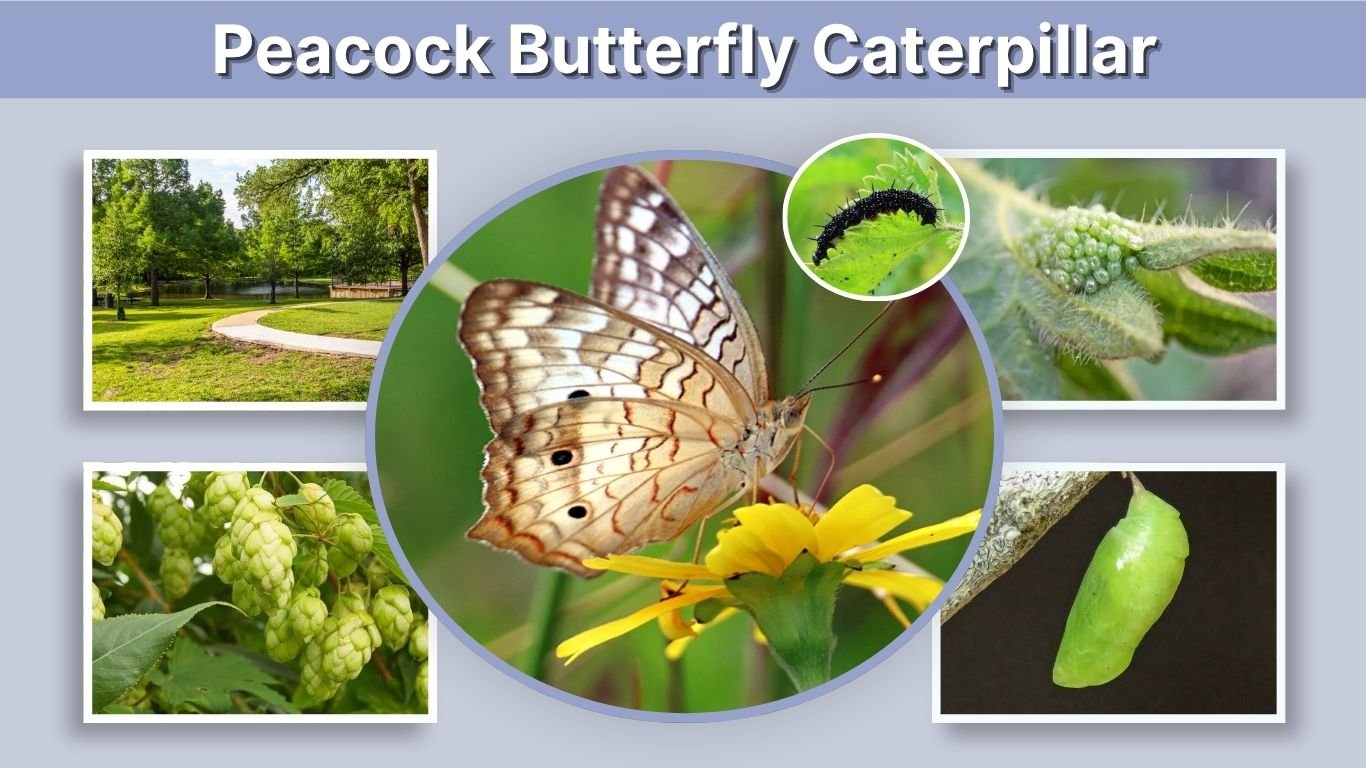
The peacock butterfly caterpillar is a fascinating insect known for its jet-black body, tiny white spots, and sharp-looking spines. Commonly found feeding on nettle plants across the UK and Europe, this caterpillar eventually transforms into the colorful peacock butterfly (Aglais io). Although its appearance may seem intimidating, it is generally harmless to humans. Understanding its identification, preferred food plants, habitat, life cycle, and care requirements helps explain the remarkable transformation of this beautiful butterfly.
Peacock Butterfly Caterpillar Identification
The common peacock butterfly caterpillar belongs to the Nymphalidae family, commonly called brush-footed butterflies. Its appearance changes significantly as it grows, making identification easier during later developmental stages. Mature caterpillars have a distinctive dark appearance with numerous spines along their bodies. They are frequently found together on nettle plants, particularly during the warmer months.
Physical Characteristics
- Scientific Name: Aglais io
- Family: Nymphalidae
- Body Color: Shiny black with numerous tiny white spots.
- Length: Approximately 35–42 mm when fully grown.
- Spines: Rows of branching black spines along the body.
- Head: Black, with small spine-like projections.
- Legs: Dark true legs and lighter-colored abdominal prolegs.
- Host Plants: Primarily stinging nettles.
- Habitat: Gardens, grasslands, woodland edges, and hedgerows.
Mature caterpillars have a striking appearance resembling a black body covered with tiny stars. Their spines help discourage predators, while their dark coloration makes them distinctive against green leaves.
Can Peacock Butterfly Caterpillars Be Brown?
Peacock butterfly caterpillars are typically black when mature. Newly hatched larvae may initially appear greenish with darker heads before their coloration develops.
A caterpillar that appears brown might belong to another butterfly or moth species. Lighting conditions, age, and photographs can also influence how dark the caterpillar appears.
The chrysalis, however, can be brown, gray, or green, which sometimes leads to confusion during identification.
What Do Peacock Butterfly Caterpillars Eat?
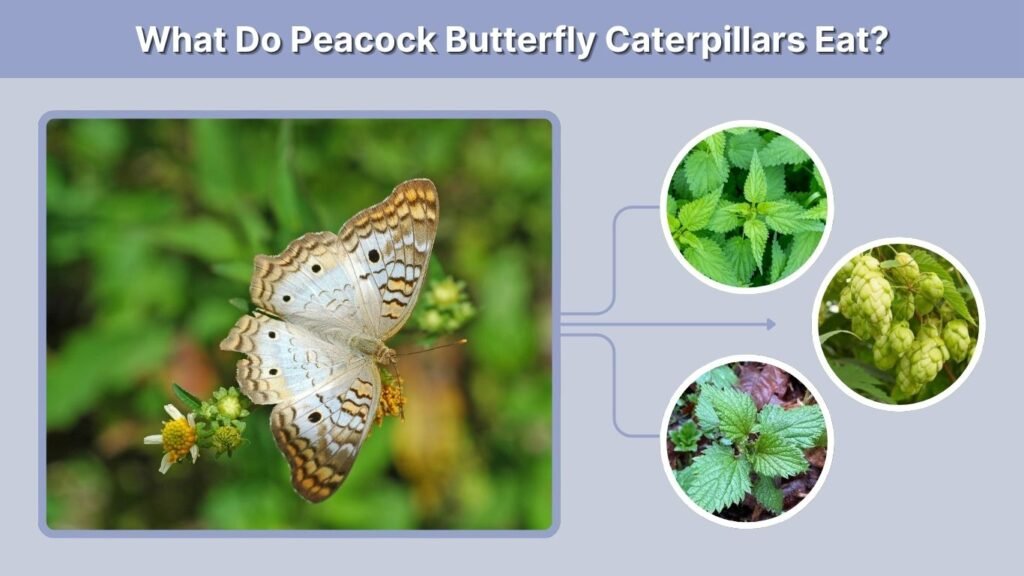
Peacock butterfly caterpillars are herbivorous insects that depend on specific host plants for survival. Unlike adult butterflies that feed on nectar, caterpillars consume plant leaves to obtain energy and nutrients. Their preferred food source is stinging nettle, a common wild plant found throughout Europe. Suitable host plants are essential for successful growth and development.
Common Food and Host Plants
The most important food plants include:
- Stinging Nettle (Urtica dioica): The primary food source for peacock butterfly caterpillars.
- Small Nettle (Urtica urens): Another nettle species that can support developing larvae.
- Hop (Humulus lupulus): An alternative host plant occasionally used by this species.
Stinging nettle is especially important because female butterflies often select healthy patches for egg laying. Young caterpillars begin feeding shortly after hatching and continue consuming leaves until they are ready to pupate.
Why Do Peacock Butterfly Caterpillars Prefer Nettles?
Nettles provide both nutrition and a suitable environment for caterpillar development. Female butterflies typically choose sunny, sheltered nettle patches where leaves are abundant.
Young larvae also construct silk webs around their feeding areas, offering communal shelter. As the caterpillars grow, they move between leaves and consume increasing amounts of foliage.
Preserving nettle patches can therefore help maintain healthy local peacock butterfly populations.
Peacock Butterfly Caterpillar Life Cycle
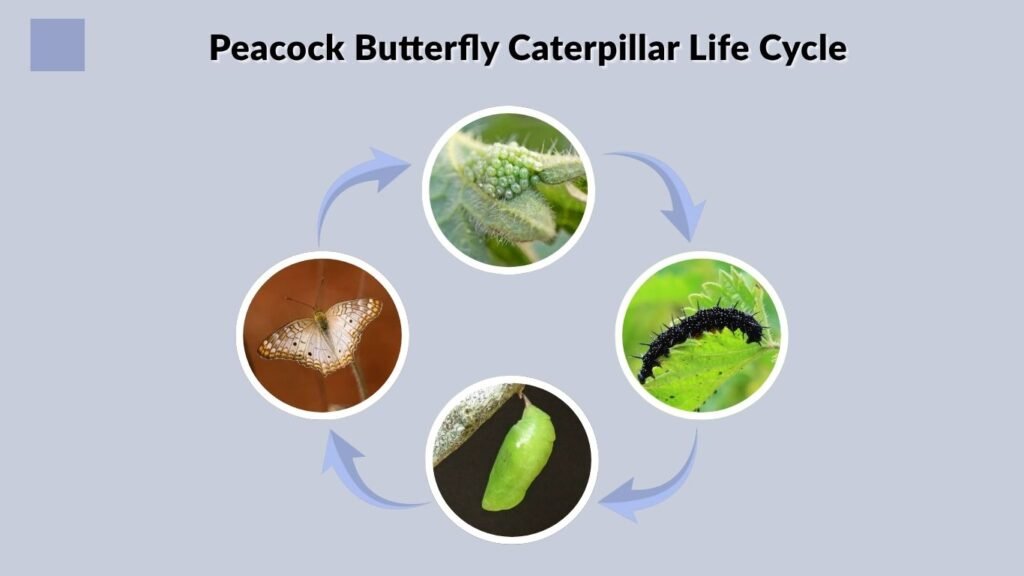
The peacock butterfly undergoes complete metamorphosis, developing through four stages: egg, larva, pupa, and adult butterfly. Each stage involves important biological changes. Developmental timing varies depending on temperature and seasonal conditions. In much of the UK, eggs are laid during spring, caterpillars develop through late spring and summer, and the resulting adult butterflies may survive through winter.
1. Egg Stage
Female peacock butterflies usually deposit clusters of small green eggs on nettle leaves.
A single female can lay hundreds of eggs, often placing them together on a suitable host plant. The eggs generally hatch within one to three weeks, depending on environmental temperatures.
2. Caterpillar Stage
Newly hatched caterpillars initially remain together, feeding on nearby nettle leaves.
They create communal silk webs that provide shelter from environmental conditions and some predators. During growth, the larvae repeatedly shed their skins as their bodies increase in size.
Mature caterpillars become black with tiny white markings and branching spines.
3. Chrysalis Stage
Once fully grown, the caterpillar leaves its feeding group and searches for a suitable location to pupate.
It attaches itself to vegetation and transforms into a chrysalis. The chrysalis may appear gray, brown, or green, allowing it to blend with surrounding plants.
Inside, the developing insect undergoes the physical changes needed to become a butterfly.
4. Adult Butterfly Stage
After approximately two to four weeks in the chrysalis, an adult peacock butterfly emerges, although timing varies with conditions.
The adult has reddish-brown wings decorated with large, colorful eyespots. These markings help discourage predators by creating the appearance of larger eyes.
Peacock butterflies commonly overwinter as adults, emerging again during warmer spring weather.
Are Peacock Butterfly Caterpillars Poisonous?
The black body and numerous spines of the peacock butterfly caterpillar can make it appear dangerous. However, the common peacock butterfly caterpillar is not recognized as a medically significant venomous species. Its spines primarily serve a defensive purpose. Nevertheless, unnecessary handling should be avoided to protect both the insect and the person handling it.
Can Peacock Butterfly Caterpillars Sting?
Common peacock butterfly caterpillars do not possess specialized venomous stinging spines like those found on certain moth caterpillars.
Their spines may cause minor mechanical irritation if handled roughly. Additionally, the stinging nettles on which they live can cause painful skin irritation.
For safe observation, avoid touching unknown caterpillars and examine them without disturbing their host plants.
Are Peacock Butterfly Caterpillars Safe for Pets?
Peacock butterfly caterpillars are not generally considered a serious poisoning hazard for cats or dogs.
However, pets should not be encouraged to eat caterpillars or chew nettles. Plant irritation, digestive upset, or reactions to other misidentified insects are possible.
Keeping pets away from unfamiliar caterpillars is the safest approach.
Where Do Peacock Butterfly Caterpillars Live?
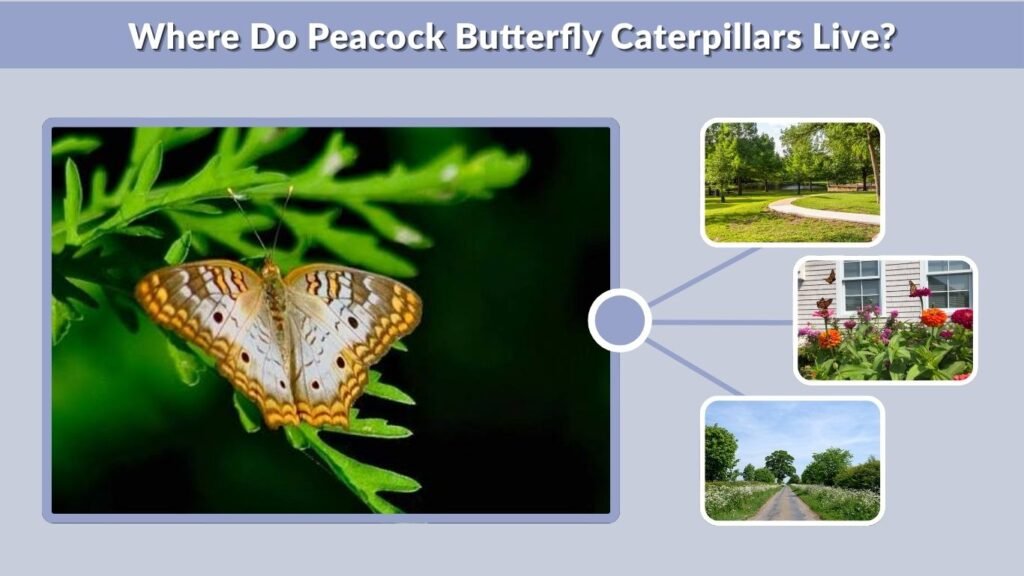
Peacock butterfly caterpillars occur throughout much of Europe and parts of temperate Asia. Their distribution closely follows the availability of suitable nettle patches. They generally prefer locations with abundant vegetation, sunlight, and some shelter from strong winds. These conditions help provide sufficient food and suitable temperatures for successful development.
Peacock Butterfly Caterpillars in the UK
The common peacock butterfly is widespread across the United Kingdom.
Its caterpillars can frequently be found in gardens, woodland clearings, roadsides, parks, and field margins where nettles grow.
They are particularly noticeable from late spring through summer, depending on seasonal weather. Finding clusters of black caterpillars on nettle leaves is a useful identification clue.
Are Peacock Butterfly Caterpillars Found in Texas?
The European peacock butterfly (Aglais io) is not a native species of Texas.
However, Texas has other butterflies with peacock in their common names, including the white peacock butterfly (Anartia jatrophae), which occurs in southern areas.
These are separate species with different geographic ranges and host plant requirements.
How to Care for a Peacock Butterfly Caterpillar
Peacock butterfly caterpillars depend on appropriate food plants and suitable environmental conditions. While observing them outdoors is generally preferable, temporary care may sometimes be necessary when a caterpillar is found in a disturbed location. Maintaining a clean, well-ventilated environment and supplying the correct food can help prevent unnecessary stress.
Essential Caterpillar Care Tips
- Provide fresh, pesticide-free nettle leaves from the correct host plant.
- Keep the caterpillar in a ventilated enclosure with sufficient space.
- Remove wilted leaves and droppings regularly.
- Avoid direct, intense sunlight and overheating.
- Do not handle the caterpillar unnecessarily.
- Provide suitable twigs or vegetation for pupation.
- Avoid disturbing the chrysalis during transformation.
If a caterpillar is healthy and feeding naturally outdoors, leaving it undisturbed is usually the best option. Avoid transporting caterpillars outside their native range.
White Peacock vs. Common Peacock Butterfly Caterpillar
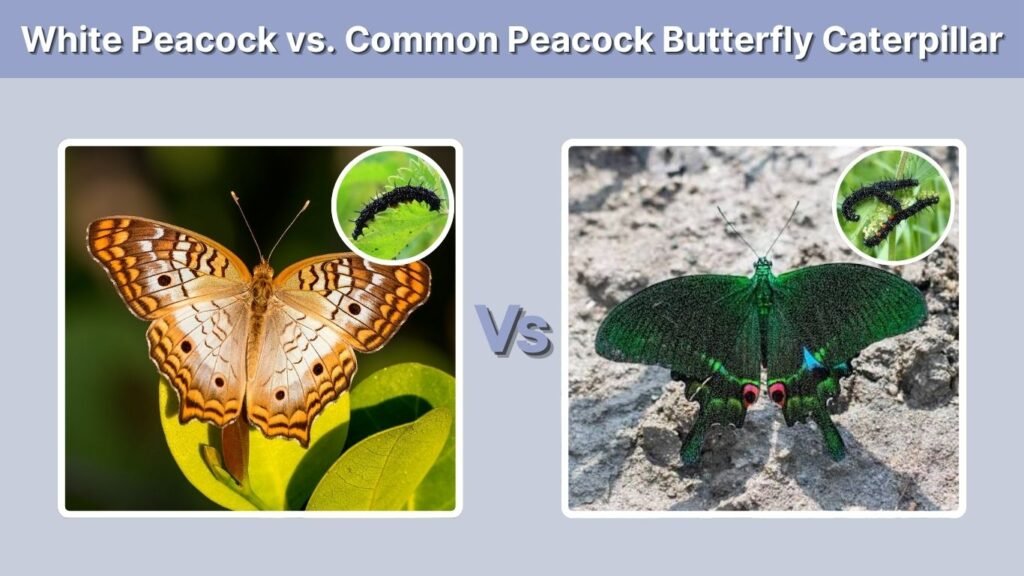
Although their names are similar, the white peacock butterfly and common peacock butterfly are different species. Both belong to the Nymphalidae family, and their larvae share some physical characteristics. However, their preferred food plants, geographical ranges, and adult appearances differ significantly.
| Feature | Common Peacock | White Peacock |
| Scientific name | Aglais io | Anartia jatrophae |
| Caterpillar color | Black with white spots | Black with white spots |
| Spines | Black and branching | Black and branching |
| Main host plants | Nettles | Frogfruit, water hyssop |
| Distribution | Europe and Asia | Americas |
| Adult wings | Reddish with colorful eyespots | Creamy white with brown markings |
The white peacock caterpillar feeds on plants such as frogfruit and water hyssop, especially in moist habitats. In contrast, the common peacock caterpillar primarily feeds on nettles.
The great peacock moth (Saturnia pyri) is another different species. Despite its name, it is a moth, not a butterfly, and its mature caterpillar is predominantly green.
FAQs
1. What Does a Peacock Butterfly Caterpillar Turn Into?
A common peacock butterfly caterpillar transforms into an adult peacock butterfly (Aglais io). The adult has reddish-brown wings with large, colorful eyespots that help deter predators.
2. How Long Does a Peacock Butterfly Caterpillar Take to Transform?
The complete development period varies with temperature and food availability. After the caterpillar finishes growing, the chrysalis stage generally lasts approximately two to four weeks before the adult butterfly emerges.
3. Can Peacock Butterfly Caterpillars Eat Plants Other Than Nettles?
Yes. Although stinging nettle is their primary host plant, common peacock butterfly caterpillars can also feed on small nettle and occasionally hop. They should not be fed random garden plants.
4. Are Peacock Butterfly Caterpillars Dangerous to Touch?
Common peacock butterfly caterpillars are not known to have medically significant venomous spines. Nevertheless, direct handling is best avoided because their spines may cause minor irritation, and nearby nettles can sting.
5. Do Peacock Butterfly Caterpillars Live in Groups?
Yes. Young peacock butterfly caterpillars frequently live in groups and create protective silk webs around nettle leaves. As they mature, they spread out and eventually separate to form individual chrysalises.