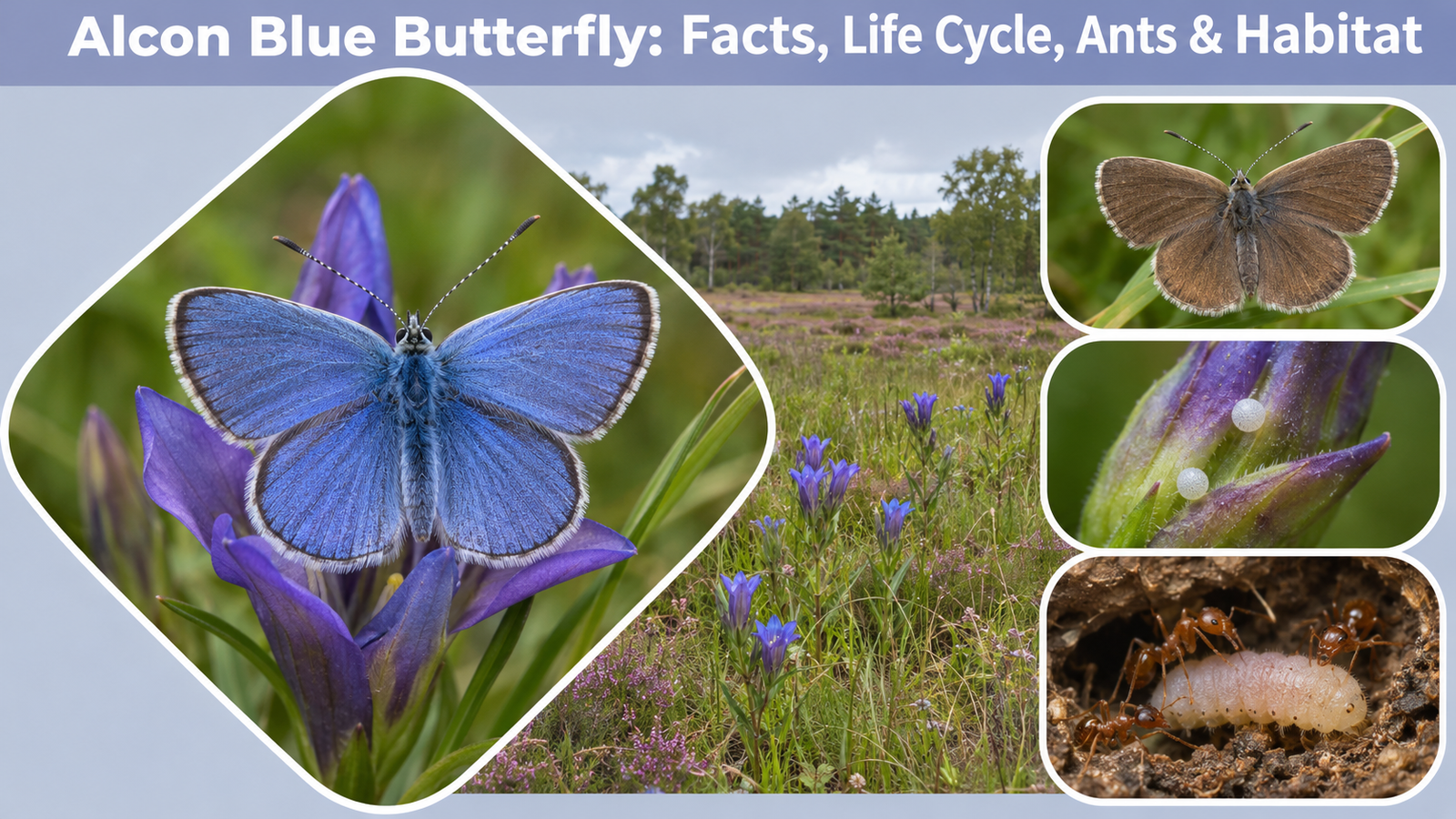
The Alcon blue butterfly (Phengaris alcon) is one of Europe’s most fascinating butterflies, known for its beautiful blue wings and unusual relationship with ants. Unlike most butterflies, its caterpillars spend much of their development inside ant colonies, where worker ants feed and protect them. This remarkable survival strategy makes the species particularly interesting to scientists and nature enthusiasts. However, habitat destruction, climate change, and declining host plants threaten many populations. This guide explores Alcon blue butterfly identification, habitat, life cycle, lifespan, ant relationships, and conservation.
What Is an Alcon Blue Butterfly?
The Alcon blue butterfly is a small European butterfly belonging to the family Lycaenidae. Its scientific name is Phengaris alcon, although older publications sometimes use Maculinea alcon. It is best known for its extraordinary life cycle, which depends on both gentian plants and particular species of ants.
How to Identify an Alcon Blue Butterfly
Alcon blue butterflies have several distinctive physical characteristics:
- Blue Upper Wings: Males have blue upper wings with relatively narrow, dark borders.
- Brown Female Wings: Females are predominantly dark brown, often with blue coloring near their wing bases.
- Grayish Undersides: Both sexes have grayish-brown wing undersides decorated with black spots.
- Black Wing Markings: The underside displays characteristic curved rows of dark spots.
- Small Body: Adults have slender bodies, delicate antennae, and relatively small wings.
- Limited Flight: Adults generally remain close to suitable breeding habitats.
Alcon Blue Butterfly Size
The Alcon blue butterfly typically has a wingspan of approximately 25–40 millimeters, or about 1–1.6 inches.
Females may appear slightly larger than males. However, size varies among populations and environmental conditions. Despite its modest size, this butterfly has one of the most specialized life cycles among European insects.
Where Do Alcon Blue Butterflies Live?
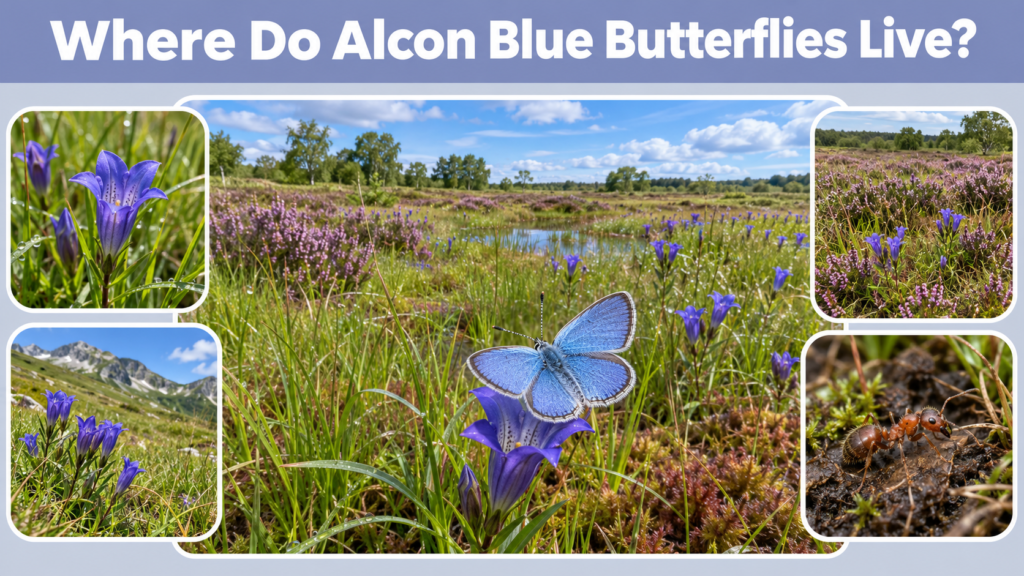
Alcon blue butterflies inhabit selected areas of Europe and parts of Asia. Their populations are often scattered because they require specific environmental conditions to survive.
Unlike butterflies that can reproduce on many different plants, Alcon blues need suitable gentian plants growing near compatible ant colonies. This makes their distribution highly dependent on local habitat quality.
Alcon Blue Butterfly Habitat
The species occupies several natural environments, including:
- Wet heathlands with low-growing vegetation.
- Moist meadows containing marsh gentians.
- Nutrient-poor grasslands with suitable host ants.
- Mountain grasslands supporting particular gentian species.
- Peatland margins and other specialized open habitats.
These habitats must provide suitable conditions for both the butterfly’s food plants and the ants that raise its caterpillars.
Alcon Blue Butterfly Range and Distribution
Alcon blue butterflies occur in countries including the Netherlands, Belgium, Germany, France, Poland, Hungary, Austria, Switzerland, and parts of southern and eastern Europe.
The species also extends into parts of Asia. Some populations occupy lowland wetlands, while others live in drier or mountainous environments.
In Hungary and other Central European countries, suitable grasslands support locally specialized populations. The Alcon blue is not considered an established native breeding species in the United Kingdom.
Alcon Blue Butterfly and Ants: An Unusual Relationship
One of the most remarkable facts about the Alcon blue butterfly is its dependence on ants.
Its caterpillars begin life feeding on gentian plants but later enter the nests of Myrmica ants. Inside these colonies, they receive food and protection from worker ants that mistake them for their own young.
This relationship is known as social parasitism.
How Do Alcon Blue Caterpillars Trick Ants?
After developing on their host plants, young caterpillars drop to the ground and wait for suitable ants to discover them.
The caterpillars produce chemical signals that resemble those of ant larvae. Consequently, worker ants may carry them into their underground nests.
Once inside, the caterpillars continue their deception. They receive attention and nourishment intended for the ants’ own offspring, allowing them to develop while avoiding many dangers outside.
Why Do Ants Take Care of Alcon Blue Butterflies?
The ants care for Alcon blue caterpillars because the caterpillars imitate important signals used within the colony.
Besides chemical mimicry, research has demonstrated acoustic mimicry. The caterpillars and pupae produce sounds that can resemble signals associated with queen ants.
These signals may influence how workers respond to the intruders. As a result, caterpillars can receive privileged treatment, sometimes at the expense of the colony’s own young.
Are Alcon Blue Butterflies Parasites?
Yes. Alcon blue caterpillars are social parasites because they exploit the resources of ant colonies without providing an equivalent benefit.
They generally depend on worker ants for feeding, although some may also consume ant broods.
Importantly, this parasitic relationship occurs during the immature stages. Adult butterflies leave the ant colonies after emerging and live independently.
Alcon Blue Butterfly Life Cycle

The Alcon blue butterfly undergoes complete metamorphosis, progressing through egg, caterpillar, pupa, and adult stages.
However, its development is unusual because the caterpillar spends much of its life underground with ants. Depending on the population, development may take approximately one or two years.
1. Egg Stage
Female Alcon blue butterflies lay small, whitish eggs on the flower buds of suitable gentian plants.
Common host plants include marsh gentian (Gentiana pneumonanthe) and cross gentian (Gentiana cruciata), depending on the local population.
2. Caterpillar Stage
After hatching, the caterpillars feed inside gentian flowers, consuming developing seeds and other plant tissues.
They remain on the plants during their early development before dropping to the ground.
3. Adoption by Ants
Suitable Myrmica worker ants discover the caterpillars and may carry them into their nests.
Chemical and acoustic mimicry allow the caterpillars to survive among the ants, where they receive food and protection.
4. Pupal Stage
After growing inside the colony, the caterpillars form pupae.
They remain underground while their bodies transform into adult butterflies.
5. Adult Butterfly Stage
Newly emerged butterflies must quickly escape the ant nest.
Once outside, their wings expand and harden. The adults then search for mates, beginning another generation.
How Long Do Alcon Blue Butterflies Live?
Adult Alcon blue butterflies have remarkably short lifespans, often averaging approximately three to five days in studied populations.
Actual longevity varies with weather, habitat conditions, and local populations. Some individuals survive longer.
However, the complete life cycle is considerably longer because caterpillars spend months or even nearly two years developing inside ant nests.
Adults devote their brief lives primarily to mating and laying eggs.
Dutch Alcon Blue Butterfly: Why Did It Disappear?
The Dutch Alcon blue butterfly has an important conservation history. A distinctive population historically associated with coastal dune habitats in the Netherlands disappeared during the twentieth century.
Often referred to as the Dutch Alcon blue, this local form was described as Maculinea alcon arenaria.
Is the Dutch Alcon Blue Butterfly Extinct?
The historic Dutch Alcon blue population associated with Meijendel disappeared by 1979.
However, the broader Alcon blue species is not extinct. Other populations of Phengaris alcon continue to survive in the Netherlands and elsewhere in Europe.
Scientists have also questioned whether the historic Dutch form should be treated as a separate subspecies or as a locally specialized population of the same species.
What Caused the Dutch Alcon Blue Butterfly’s Extinction?
Its disappearance was associated with several interconnected ecological pressures:
- Habitat Degradation: Changes to coastal dune environments reduced suitable breeding conditions.
- Host Plant Decline: The loss of suitable gentian plants disrupted egg-laying and early caterpillar development.
- Ant Dependency: Changes affecting compatible host ants prevented caterpillars from completing their development.
- Environmental Changes: Human alteration of the landscape gradually weakened the specialized ecosystem supporting the population.
The disappearance demonstrates how vulnerable butterflies can become when their survival depends on several closely connected species.
Alcon Blue Butterfly Conservation Efforts
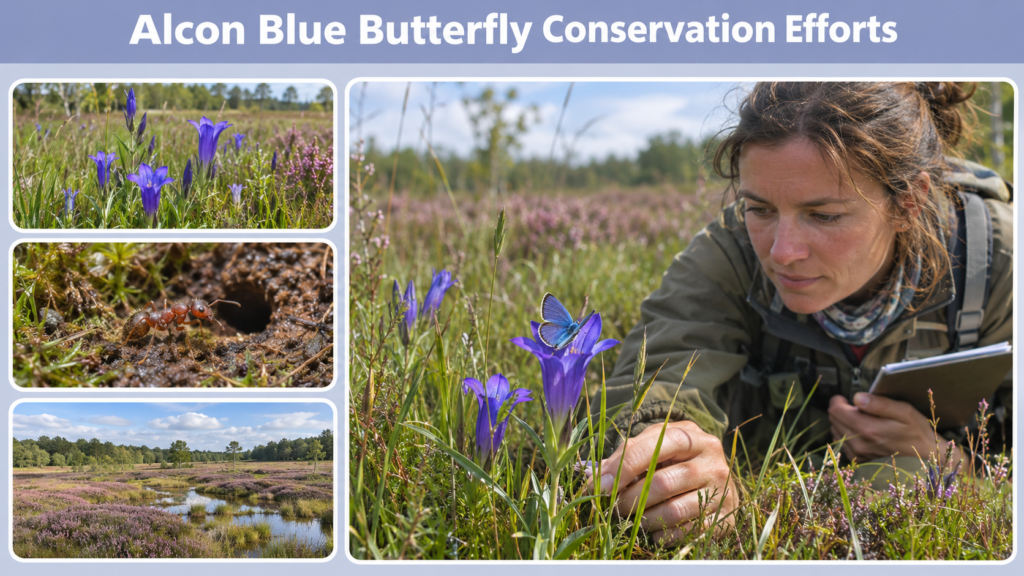
Although Alcon blue butterflies remain present across parts of Europe, many local populations face serious conservation challenges.
Habitat fragmentation, agricultural intensification, vegetation changes, drought, and declining host plants can reduce breeding success.
Effective conservation requires protecting the entire ecological system rather than focusing on butterflies alone.
Important conservation measures include:
- Restoring wet heathlands and natural grasslands.
- Protecting marsh gentian and other host plants.
- Maintaining suitable habitats for Myrmica ants.
- Preventing excessive vegetation growth in breeding areas.
- Protecting natural water levels and reducing drought impacts.
- Monitoring isolated populations and restoring connections between habitats.
Protecting both gentians and host ants is essential for maintaining viable populations.
Alcon Blue Butterfly in Our Planet
The Alcon blue butterfly gained international attention through Netflix’s Our Planet documentary series.
Its remarkable relationship with ants appears in Season 1, Episode 5, “From Deserts to Grasslands.”
The documentary shows caterpillars entering ant nests, imitating colony signals, and receiving care from workers.
It also highlights the remarkable moment when an adult butterfly emerges and escapes the underground colony.
This sequence demonstrates why protecting entire ecosystems is essential for preserving specialized wildlife.
FAQs
1. Are Alcon Blue Butterflies Rare?
Alcon blue butterflies are uncommon in many parts of their range because they require specific gentian plants and compatible ant colonies. Although the species survives across several European countries, some populations are small, isolated, or declining. Their rarity varies considerably between regions and habitats.
2. Do Alcon Blue Butterfly Caterpillars Eat Ants?
Alcon blue caterpillars primarily exploit ant colonies by receiving food from worker ants. However, some caterpillars may also consume ant brood. Their feeding behavior differs between populations and conditions. This unusual relationship makes the species an example of social parasitism.
3. What Is the Scientific Name of the Dutch Alcon Blue Butterfly?
The historic Dutch Alcon blue was described as Maculinea alcon arenaria. Today, the wider Alcon blue species is generally called Phengaris alcon. The distinct taxonomic status of the extinct Dutch population has been questioned because closely related Alcon blue populations still survive elsewhere.
4. What Is the Mountain Alcon Blue Butterfly?
The mountain Alcon blue refers to a form associated with drier, often mountainous grasslands. It has historically been called Phengaris rebeli or Maculinea rebeli. Its classification relative to Phengaris alcon has been debated, with some researchers treating the forms as ecological variants of one species.
5. Are Alcon Blue Butterflies Threatened by Wasps?
Yes. Certain parasitoid wasps, including Ichneumon eumerus and closely related forms, can attack developing Alcon blue butterflies inside ant nests. Their larvae develop using the butterfly as a host. This relationship adds another remarkable layer to the complex interactions among butterflies, ants, plants, and parasitoids.