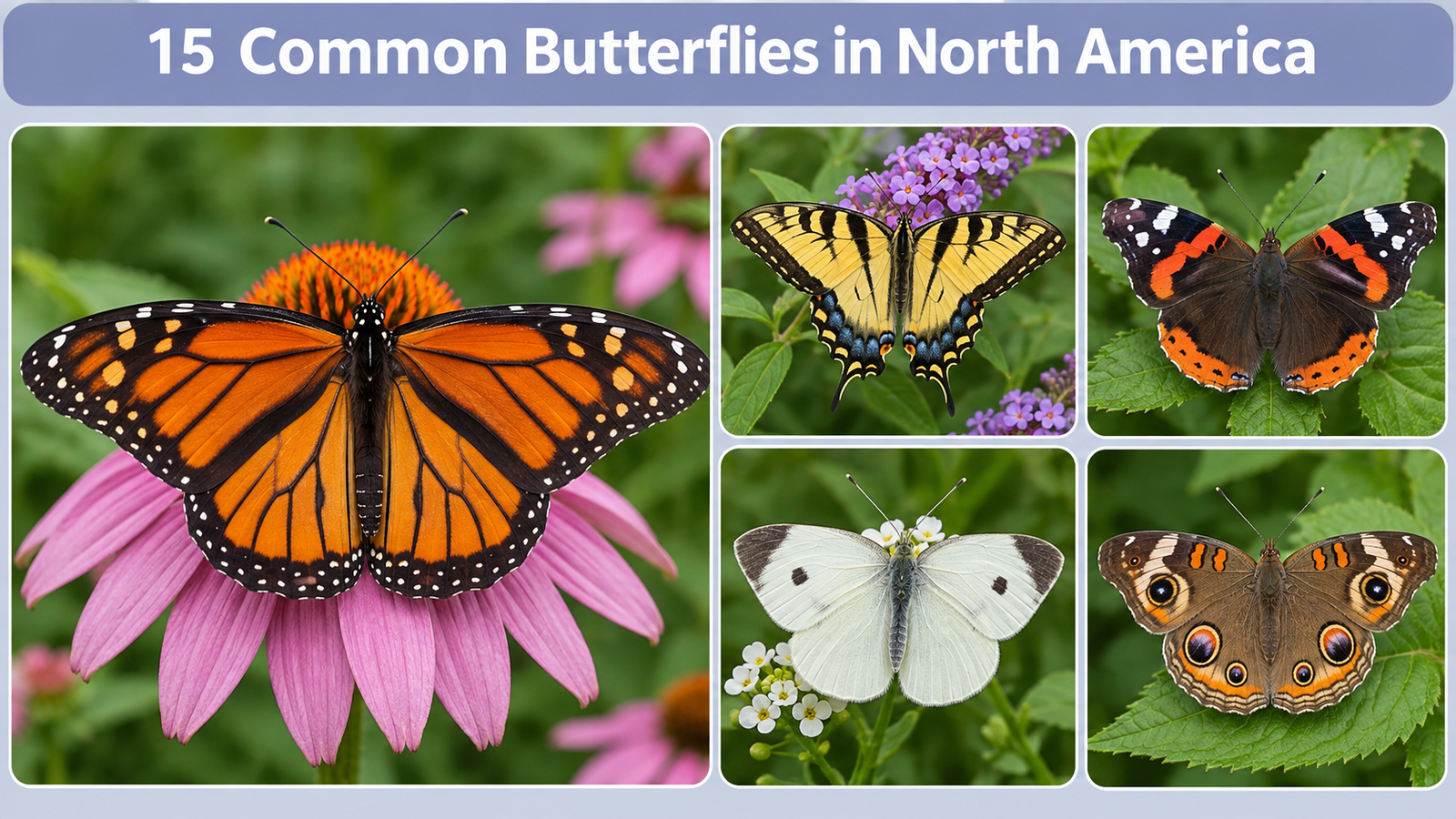
North America is home to butterflies you can spot almost anywhere outdoors, from cabbage whites in vegetable gardens to swallowtails along woodland trails. Color is an easy first clue, but it only takes you so far. Two orange butterflies can look nearly identical until you notice a black line crossing the hindwing of one. To identify the butterflies around you, pay attention to wing shape, spots, bands, and the markings visible when the wings close. Here are 15 common North American butterflies, along with the features to check and the habitats where you’re most likely to see them.
1. Monarch Butterfly

The monarch is one of North America’s most recognizable butterflies. Its bright orange wings stand out over meadows and gardens, and some monarch populations make long seasonal migrations. If you see one from a distance, wait for it to land. The back wings hold the clearest clue for separating it from a viceroy.
How to Identify It
Look for orange wings with bold black veins and broad black borders dotted with white. The veins divide the orange surface into distinct sections, giving the wings a stained-glass appearance.
Check the hindwing for a curved black line cutting across those veins. The monarch lacks the crossband found on a viceroy, so this feature is more useful than comparing size or shade of orange.
Where to Find It
Look for adults in gardens, meadows, fields, and along roadsides with blooming nectar plants. When a monarch stops to feed, you may get a clear view of the wings as it moves around a flower.
Check milkweed if you want to find eggs or caterpillars. Monarch caterpillars feed on milkweed, while adults collect nectar from many kinds of flowers.
2. Viceroy Butterfly
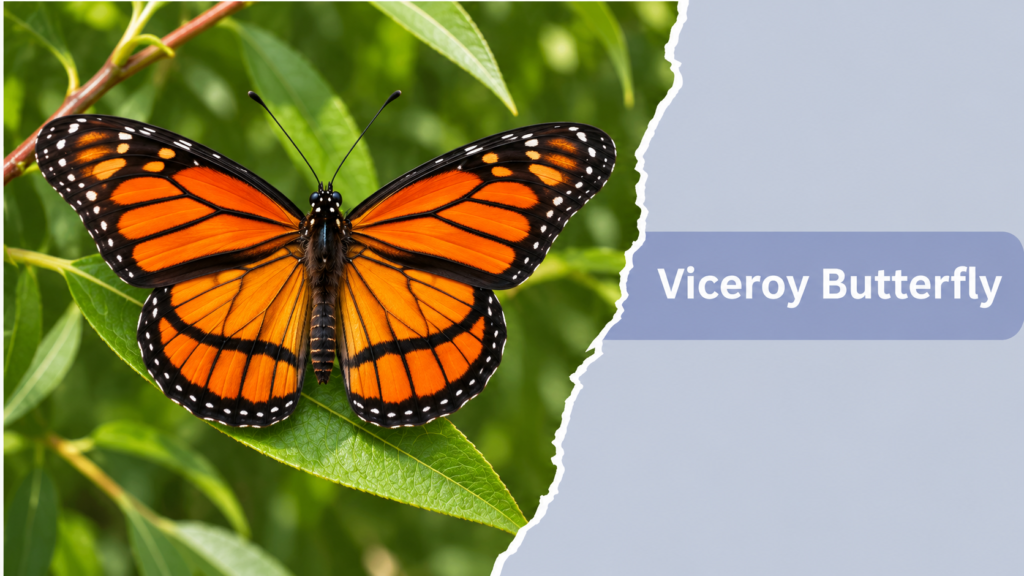
The viceroy shares the monarch’s orange wings, dark veins, and white-spotted borders. It often looks smaller, but size is hard to judge when the butterfly is moving. Once it settles, look closely at the rear half of the wings.
How to Identify It
The viceroy’s best field mark is a curved black band crossing the veins of each orange hindwing. The band sits inside the outer border and is easiest to check when the butterfly holds its wings open.
If the wings are partly closed, try looking from the side. A clear photo of the hindwing can help you trace the crossband and distinguish it from the veins that run outward toward the wing edge.
Where to Find It
Search along pond edges, streams, wet meadows, and other open areas with damp ground. Willows are worth noting because they’re among the plants that viceroy caterpillars feed on.
You may also see adults visiting flowers in nearby clearings. If you’re choosing between a viceroy and a monarch, use the habitat to guide your search and the hindwing band to confirm the identification.
3. Painted Lady Butterfly

The painted lady is a widespread butterfly that turns up in open areas, including gardens in towns and cities. It often pauses on flowers long enough to show both sides of its wings. The closed-wing view is especially useful when another orange butterfly looks like a close match.
How to Identify It
The upper wings are orange, black, and white. Look for white spots near the dark forewing tips and dark spots scattered across the orange parts of the wings.
When it closes its wings, check the mottled underside of the hindwing for several small eyespots. The American lady typically has two large eyespots in the same general area.
Where to Find It
Look in sunny gardens, fields, vacant lots, and roadsides with flowers. A patch with several blooms is a good place to watch because a painted lady may move from one flower to the next.
If you’re trying to identify one, take a side photo while it feeds. Include the whole hindwing so you can compare the number and size of its eyespots later.
4. American Lady Butterfly
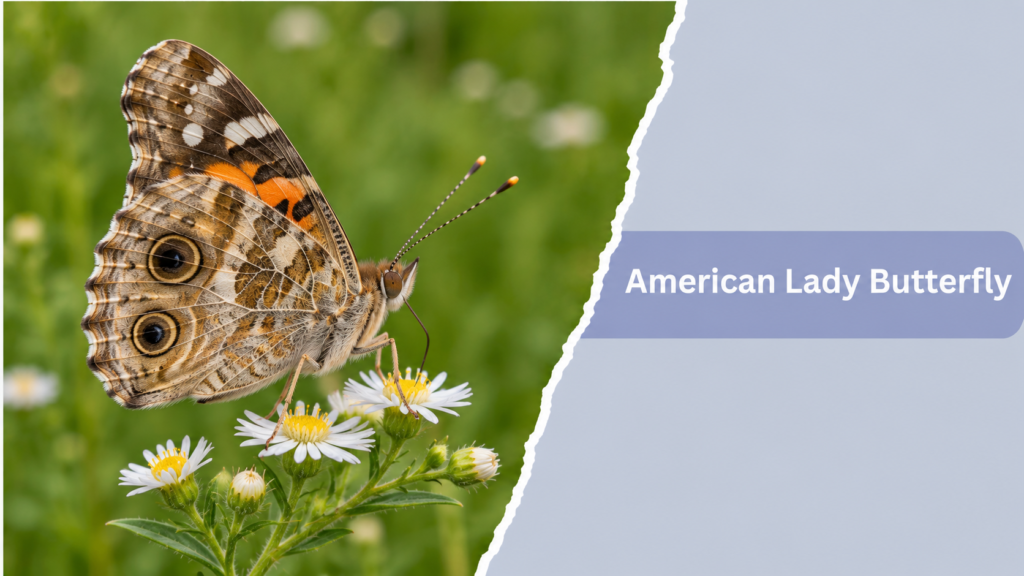
An American lady can look much like a painted lady from above. Both have orange wings with dark markings, and both visit flowers in open areas. The difference becomes easier to see when one closes its wings and gives you a clear view of the underside.
How to Identify It
Look for two large eyespots on the underside of each hindwing. They stand out against the mottled background and are easier to recognize than the smaller differences on the upper wings.
Try to see the entire hindwing. If a flower petal hides one of the eyespots, the visible part of the pattern may give you an incomplete picture.
Where to Find It
Check sunny gardens, open fields, and flower-lined trails. Look for adults pausing on blossoms or resting on low vegetation where you can approach slowly from the side.
If it flies away before you see the markings, watch where it lands next. A short move to another flower can put it at a better angle for identification.
5. Red Admiral Butterfly
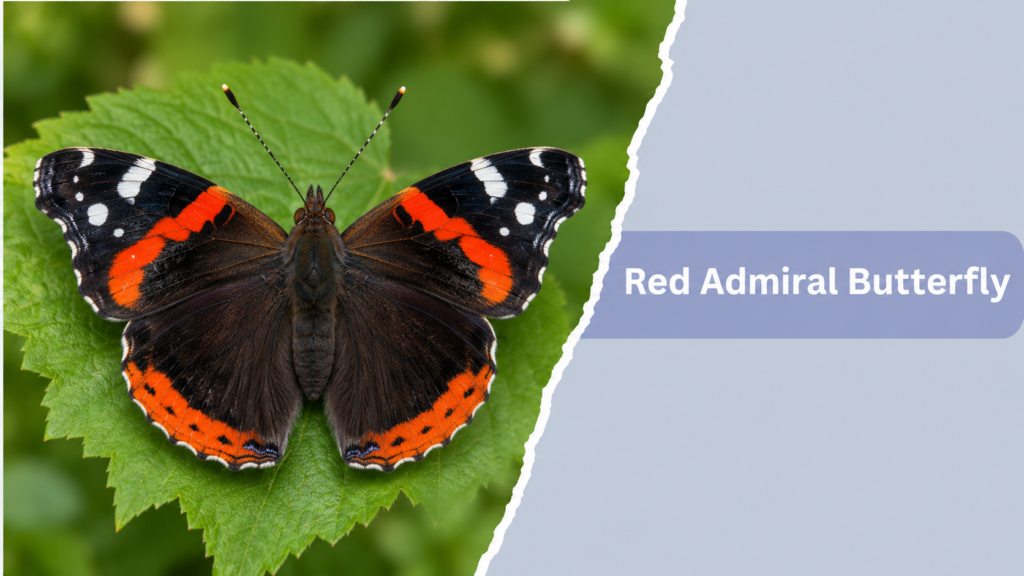
The red admiral’s wing bands are easy to spot when it opens its wings. Once the wings close, its muted underside can blend with bark or dried leaves. You may first notice the butterfly when it takes off from a perch and flashes its bright colors.
How to Identify It
Look for a broad red-orange band across each dark forewing and a cluster of white spots near the tip. A second red-orange band follows the outer edge of each hindwing.
The combination of dark wings, white tip spots, and bright bands helps separate the red admiral from butterflies with more extensive orange coloring. An open-wing view shows the pattern best.
Where to Find It
Search gardens, parks, and sunny woodland edges. Red admirals visit flowers, but they also settle on tree trunks, leaves, and other surfaces where they can be easy to miss with their wings closed.
If one repeatedly makes short flights and comes back to the same perch, watch from a distance. You may get a better look the next time it lands.
6. Common Buckeye Butterfly
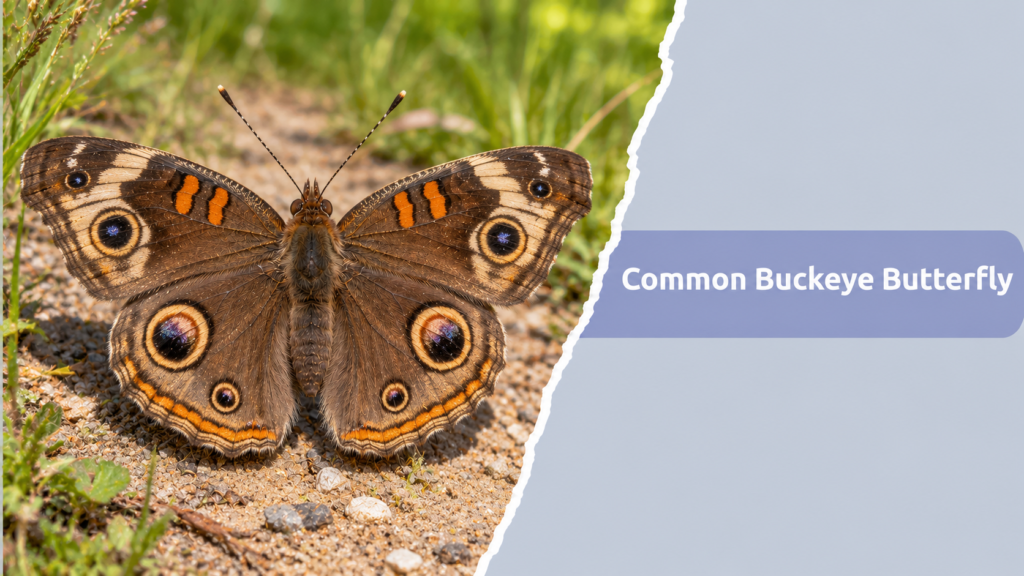
The common buckeye stands out for its prominent eyespots. It’s a butterfly worth looking for below flower height, since it may settle on low vegetation or bare ground. On a sunny trail, you might spot the wing markings before you notice the butterfly’s brown background color.
How to Identify It
Look for large eyespots on the brown forewings and hindwings. The forewings also show short orange bars and a pale band near a prominent eyespot.
Check the overall arrangement of the markings when the wings are open. Several butterflies have eyespots, but the buckeye’s combination of large spots, orange bars, and a pale forewing band gives you more to work with.
Where to Find It
Search sunny fields, roadsides, open trails, and areas with low-growing plants. Scan patches of bare soil and the edges of paths as well as nearby flowers.
A buckeye resting in the sun may spread its wings flat. That posture gives you a clear view of the forewing bands and the eyespots on both sets of wings.
7. Mourning Cloak Butterfly
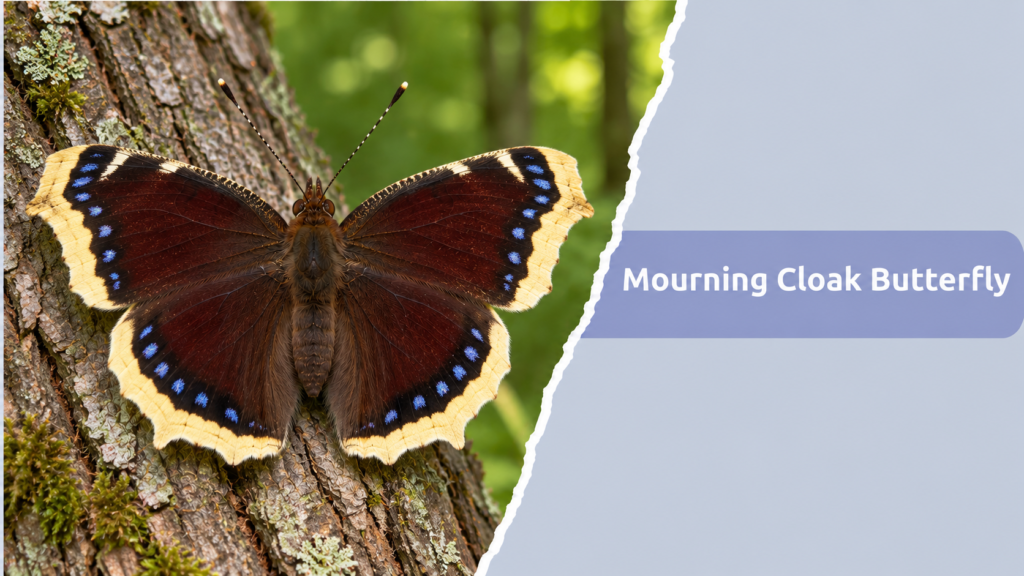
The mourning cloak is a dark butterfly with a broad pale border that’s visible when its wings are open. It’s also one of the butterflies you may see on a mild day early in spring. Look carefully at sunlit trunks and branches, where its closed wings provide camouflage.
How to Identify It
The upper wings are deep maroon-brown with a wide cream or pale yellow border. Just inside that border is a row of blue spots, which you may need to see up close.
With the wings closed, the butterfly looks much darker. If you can only see the underside, watch for it to open its wings so you can check the border and blue spots together.
Where to Find It
Look in wooded parks, along streams, and on sunny paths through woodland. Adults overwinter and may become active during warm spells before many other butterflies appear.
Pay attention to tree trunks as well as flowers. Mourning cloaks may feed on tree sap, so a spot with little in bloom can still be worth checking.
8. Eastern Tiger Swallowtail

The eastern tiger swallowtail is a large butterfly commonly seen in the eastern part of North America. The familiar yellow form is easy to recognize in flight. Some females are mostly dark, so an open-wing view can help when the expected yellow color isn’t visible.
How to Identify It
On the yellow form, look for four broad black stripes on each forewing and long tails extending from the hindwings. Blue markings may be visible near the hindwing edges, particularly on females.
Dark females can resemble other dark swallowtails. Check for faint tiger stripes in good light and compare the hindwing markings before making an identification.
Where to Find It
Watch flowering gardens, woodland edges, sunny clearings, and streamside paths. This butterfly may pass overhead or glide by quickly, so look at both low flowers and the space above them.
If you see a similar yellow, striped butterfly in western North America, compare it with the western tiger swallowtail. Location helps narrow the choices before you examine the markings.
9. Black Swallowtail
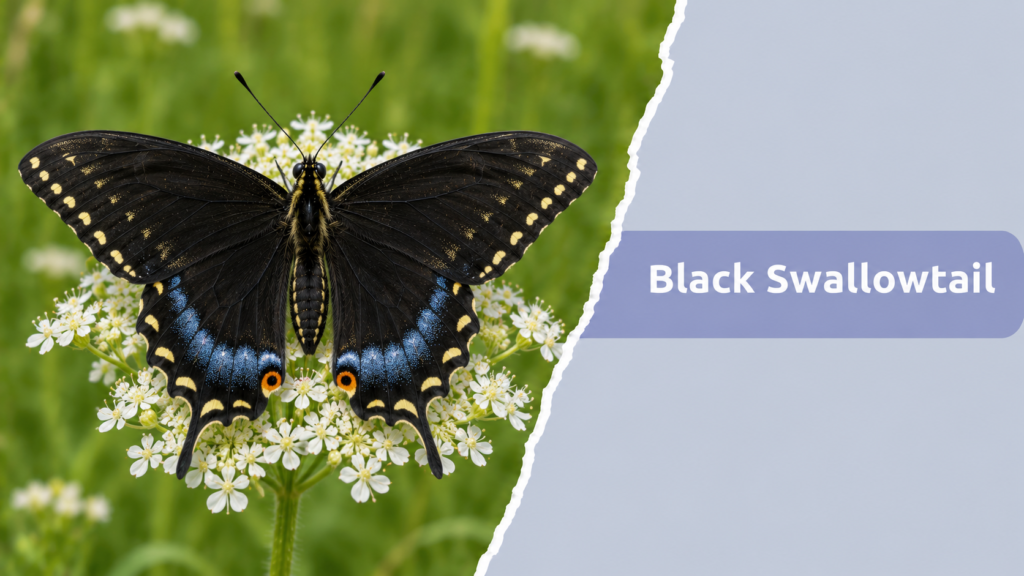
The black swallowtail is a familiar garden visitor in much of eastern and central North America. Adults visit flowers, while females may stop on herbs to lay eggs. If you grow parsley, dill, or fennel, you might notice the caterpillars before you spot a butterfly.
How to Identify It
Look for black wings with rows of yellow spots and tails on the hindwings. Each hindwing has an orange eyespot near its inner rear corner, close to the body.
Males generally show more yellow on the upper wings. Females often show more blue on the hindwings, so check the position of the spots as well as the amount of blue.
Where to Find It
Search sunny gardens, fields, meadows, and other open areas. Adults may stop at nectar flowers or fly low as they pass through a patch of vegetation.
To look for caterpillars, inspect the leaves and stems of dill, parsley, and fennel. These plants can help you find signs of the species even when the adults aren’t flying.
10. Cabbage White Butterfly

The cabbage white is a familiar sight around vegetable gardens and urban parks. It’s small enough to overlook when it lands, but its pale wings are easy to follow as it flutters over low plants. A look at the upper wings helps distinguish it from other pale butterflies.
How to Identify It
Look for white upper wings and dark tips on the forewings. Males usually show one dark spot on each forewing, while females usually show two.
The underside can look cream or pale yellow. If the butterfly looks yellow with its wings closed, wait for a glimpse of the upper surface before comparing it with a sulphur.
Where to Find It
Check gardens, parks, farms, and other open areas. Adults often fly through vegetable plots where cabbage, broccoli, and related plants provide food for their caterpillars.
Watch sunny gaps between plants or low flowers along paths. A cabbage white may land briefly, so take a photo while you have a clear view.
11. Clouded Sulphur Butterfly
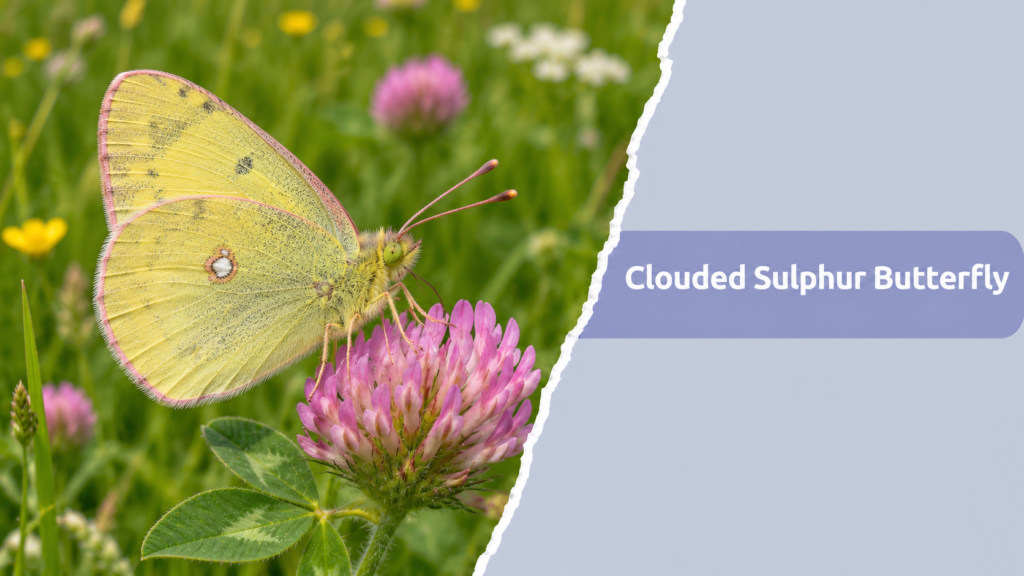
The clouded sulphur is a yellow butterfly often seen flying low across lawns and fields. It usually settles with its wings closed, which can make it hard to separate from the similar orange sulphur. Notice the underside first, then watch for a brief glimpse of the upper wings.
How to Identify It
Look for a yellowish underside and a small pale spot on the hindwing. These are useful clues for recognizing a sulphur, though the spot alone won’t separate all similar species.
If the butterfly opens its wings briefly, check for orange on the upper surface. Clouded and orange sulphurs can be difficult to distinguish from a distant view, especially in bright sunlight.
Where to Find It
Look over clover patches, lawns, and sunny fields with low flowers. You may see several sulphurs moving through the same area, particularly when plenty of plants are blooming.
Follow one individual until it lands. That makes it easier to connect the colors you noticed in flight with the markings you can see at rest.
12. Eastern Tailed-Blue
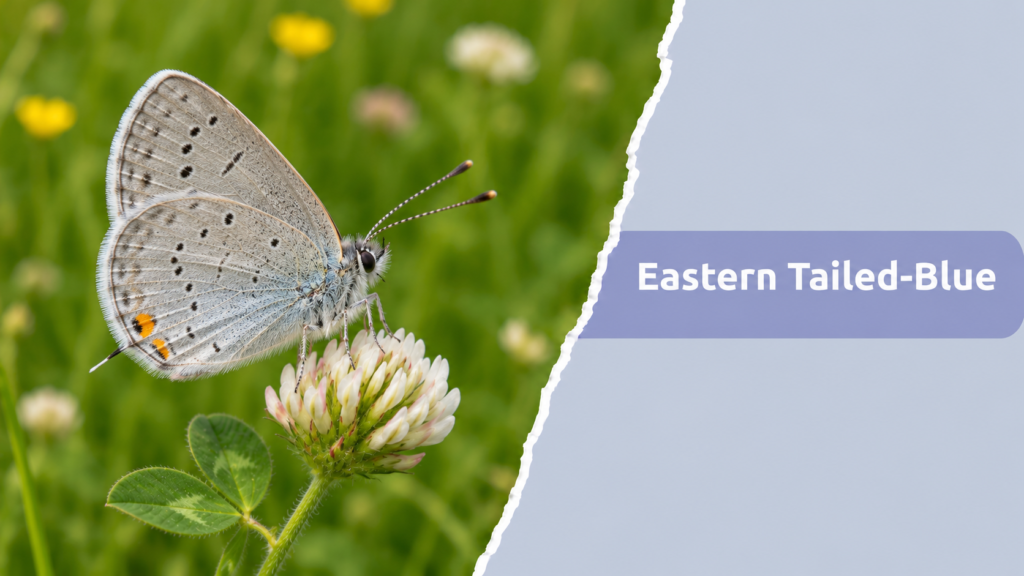
The eastern tailed-blue is easy to miss because it stays close to the ground. A male may flash blue as it flies, then seem to disappear when it lands and folds its wings. Look closely at low flowers to see the markings that make this small butterfly recognizable.
How to Identify It
Males usually have blue upper wings, while females often look darker. Both have a pale gray underside marked with small dark spots.
Look near the rear edge of the hindwing for a tiny tail and orange markings. A side-view photo is helpful because the tail can be hard to distinguish from a nearby blade of grass or flower stem.
Where to Find It
Check lawns, sunny meadows, grassy paths, and other open areas across much of eastern North America. Pay particular attention to flowers that sit just above the ground.
If you notice a small blue butterfly landing, watch the spot rather than looking for the blue color again. Once the wings close, its gray underside may blend into the plants around it.
13. Gray Hairstreak
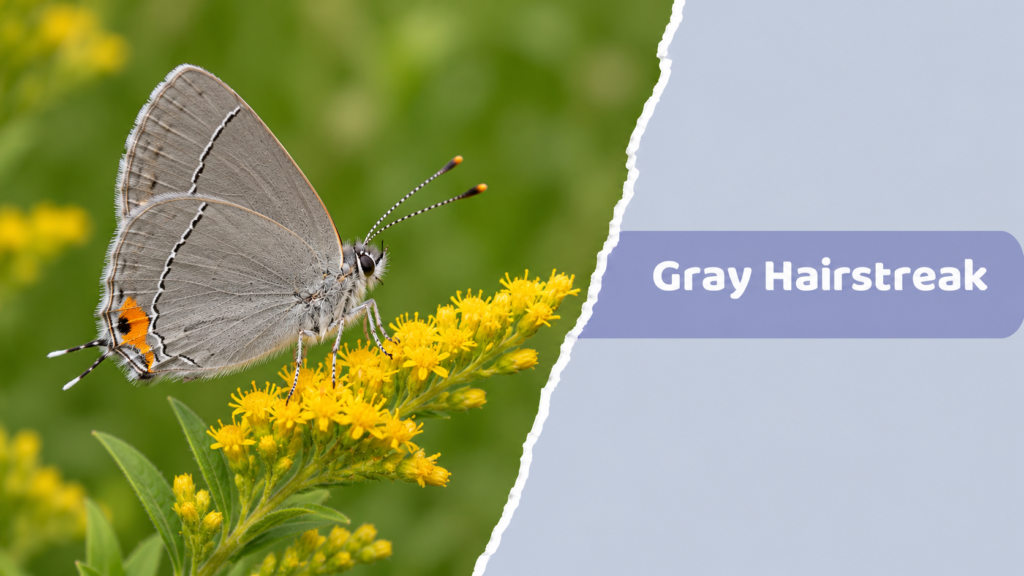
The gray hairstreak is another small butterfly that’s easiest to study from the side. Its gray underside looks plain at a glance, but a closer view reveals a fine line, tiny tails, and a spot of orange near the rear corner of the hindwing.
How to Identify It
Look for a thin line of dark and pale markings across the gray underside. Near the rear corner of the hindwing, check for a short tail and a distinct orange spot.
Eastern tailed-blues also have small tails and orange markings. Compare the pattern across the rest of the underside to see whether it has scattered spots or the hairstreak’s more continuous line.
Where to Find It
Search sunny gardens, open fields, and roadsides with flowers. Gray hairstreaks are small enough to disappear among clustered blooms, so look at the outer edges of flower heads.
Try to photograph the lower edge of the hindwing while the butterfly feeds. That view captures the tail and orange spot together without needing the butterfly to open its wings.
14. Pearl Crescent
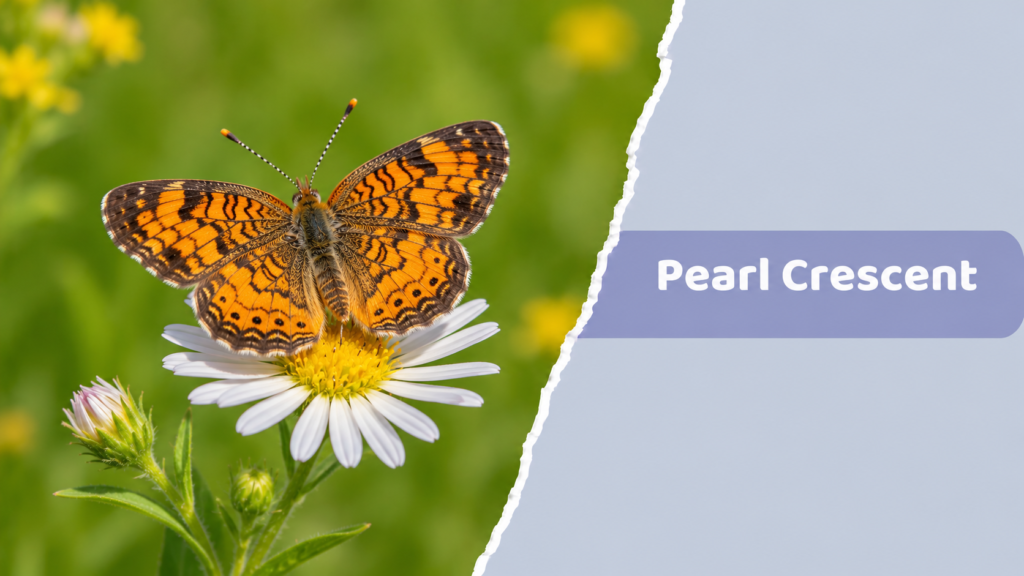
The pearl crescent is a small orange butterfly that often flies low over open ground. Several closely related crescents look similar, so a quick view from above may only get you as far as the group. Look for a resting butterfly that lets you see the underside as well.
How to Identify It
The upper wings are orange with dark, web-like markings and dark edges. Look for a pale crescent-shaped mark near the outer edge of the hindwing underside, the feature that gives the butterfly its name.
If other crescents occur in your area, compare the full wing pattern. A good view of where the pale mark sits and how the surrounding markings are arranged is more useful than color alone.
Where to Find It
Check sunny fields, open trails, and roadsides with low-growing flowers. Pearl crescents may settle close to the ground, so scan the edges of paths as you walk.
When you see one, try to photograph it from above and from the side. Having both views makes it easier to compare with other local crescents later.
15. Silver-Spotted Skipper
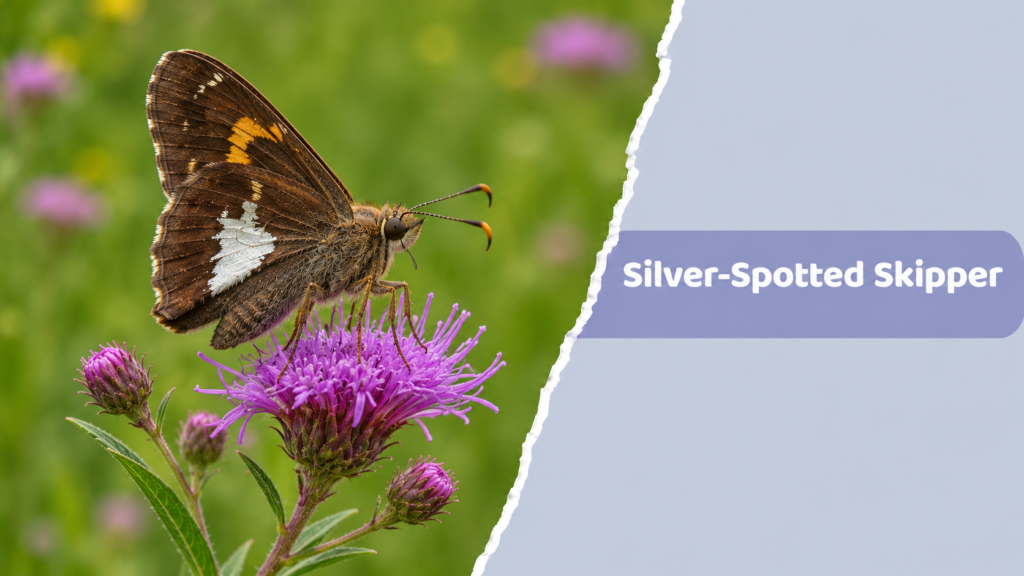
The silver-spotted skipper may look like a blur as it darts between flowers. Once it lands, it’s one of the easier brown skippers to recognize. Its bright hindwing patch is visible from the side, so you can often identify it without waiting for the wings to open.
How to Identify It
Look for a large silvery-white patch on the underside of the brown hindwing. The patch stands out clearly against the surrounding brown and is the most useful feature to check.
If the wings open, you may also see a golden-orange patch on each forewing. Its stout body and quick flight are helpful supporting clues when the silver patch is temporarily hidden.
Where to Find It
Watch flowers in gardens, woodland openings, and along sunny trails. Skippers may move quickly through an area but pause to feed when they come across a good cluster of flowers.
If one flies away before you can see its markings, keep watching the same group of flowers. It may return or settle on another bloom nearby.
Frequently Asked Questions
Which butterflies are common in North American gardens?
Cabbage whites, painted ladies, red admirals, monarchs, and silver-spotted skippers are familiar garden visitors. The species you’ll see depend on where you live, what’s flowering, and which caterpillar host plants grow nearby.
How can you tell a monarch from a viceroy?
Look at the hindwing. A viceroy has a curved black line crossing the wing veins. Both butterflies have dark outer borders, so check for the extra line inside the border.
What is a large yellow butterfly with black stripes?
It may be a tiger swallowtail. Look for long hindwing tails, then compare the tiger swallowtails found in your region.
Can you identify a butterfly with its wings closed?
Yes. The underside often shows eyespots, wing bands, or pale patches that are easier to see from the side. Try to photograph the entire hindwing, including its outer edge.
When is the best time to look for butterflies?
Warm, sunny conditions are a good starting point. On cooler days, try late morning or early afternoon. During very hot weather, check flowers and sheltered spots earlier in the day.