
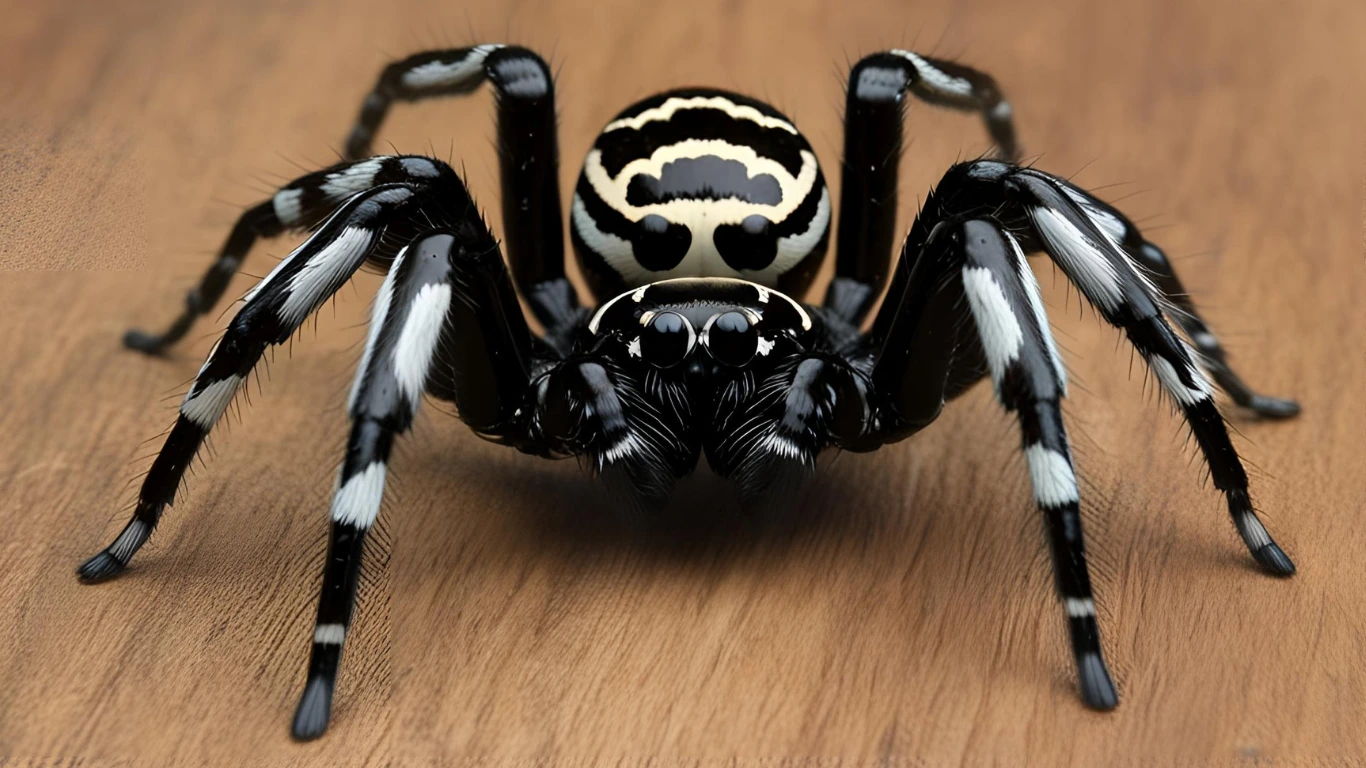
The Zebra Spider, known scientifically as Salticus scenicus, is a small yet eye-catching jumping spider recognized for its bold black and white stripes. These unique markings give it a zebra-like appearance, making it one of the most easily identified spiders in homes and gardens. Despite its tiny size, this spider is an agile hunter with excellent vision and curious behavior, often seen exploring walls, windowsills, and sunny outdoor surfaces.
1. Scientific Classification

The Zebra Spider belongs to the family Salticidae, commonly known as jumping spiders. This family is known for its members’ excellent vision and ability to leap several times their body length. Salticus scenicus is one of the most widespread and recognizable species within this group due to its striking striped appearance and frequent presence around human habitats.
Scientific Name
- Species: Salticus scenicus
- Genus: Salticus
- Family: Salticidae
- Order: Araneae
- Class: Arachnida
Other Common Names
Although widely referred to as the “Zebra Spider,” this spider is sometimes called the striped jumping spider or simply a jumping zebra spider due to its energetic movement and distinctive look. In some regions, it may be mistakenly identified as other small jumping spiders with similar markings.
2. Physical Identification

The Zebra Spider may be small in size, but its bold appearance makes it stand out. This spider’s body is marked with black and white horizontal stripes, giving it a distinct zebra-like look. Combined with its large eyes and jerky movements, it’s one of the easiest spiders to identify—especially for people unfamiliar with arachnids.
Appearance
Zebra Spiders are compact and slightly flattened, allowing them to move easily across vertical surfaces like walls and window panes. Their coloration consists of black or dark brown as the base color, with contrasting white or light gray stripes that run across the top of the body and head. These markings often appear fuzzy or broken due to the short, dense hairs covering the spider.
They have eight legs, also banded in black and white, though not as clearly striped as the body. The front two legs are slightly thicker and used for sensing and grabbing prey.
Size
Adult Zebra Spiders are quite small:
- Females typically measure 6–9 mm in length
- Males are slightly smaller, around 5–6 mm
Their size often makes them hard to notice at first, but once spotted, their behavior and striping catch the eye.
Eye Placement and Vision
Zebra Spiders belong to the jumping spider family, which is known for having some of the best vision among all spiders. They have eight eyes, with the two large front eyes giving them a near-3D view of their surroundings. These eyes are forward-facing, giving them a cute, binocular look and allowing them to stalk prey with impressive accuracy.
Their side and rear eyes help detect movement and depth, which is vital for navigating surfaces and judging jump distances.
3. Habitat and Range
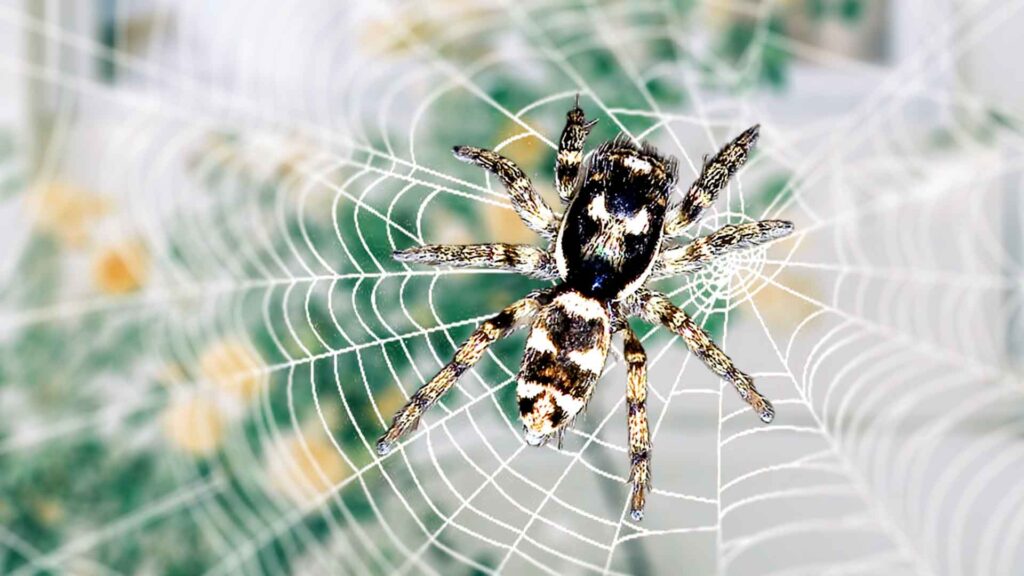
Zebra Spiders are remarkably adaptable and thrive in a wide variety of environments. Their small size and excellent hunting skills make them perfectly suited to both natural and human-made settings. While many spiders avoid human contact, Zebra Spiders are often found near people, especially in sunny locations where prey is abundant.
Natural and Urban Environments
These spiders are commonly seen:
- On tree bark, rocks, and garden plants
- Around window sills, door frames, and garden walls
- Inside sheds, garages, and even homes—especially near light sources where insects gather
They prefer dry, open surfaces where their vision isn’t obstructed, which allows them to spot and hunt prey effectively. You’ll often find them basking in the sun or lurking near crevices, ready to leap at unsuspecting insects.
Geographic Distribution
Zebra Spiders are native to Europe but have spread widely:
- Europe: Found throughout the continent, from gardens to city buildings
- North America: Common in the United States and Canada, particularly in temperate zones
- Asia: Seen in parts of Central and Western Asia
- Other regions: Introduced to some parts of the world due to global trade and travel
Their wide distribution is a testament to their adaptability and resilience in both wild and urban environments.
4. Behavior and Movement

Zebra Spiders are known for their active and curious behavior, which sets them apart from many other spider species. Unlike web-dwelling spiders that sit and wait for prey, Zebra Spiders are visual hunters that use their excellent eyesight and powerful legs to stalk and pounce on their targets.
Active Hunting
Instead of spinning webs to catch insects, Zebra Spiders rely on patience and precision. They carefully observe their surroundings and creep slowly toward their prey, often stopping to assess distance and movement. Once within striking range, they leap forward with surprising speed and accuracy to capture the insect using their front legs and fangs.
This style of hunting is both efficient and fascinating to watch. It’s also why they’re often described as “cat-like” in their movements—stalking, pausing, and pouncing with confidence.
Movement Style
Zebra Spiders move in a jerky, twitchy way, which is common among jumping spiders. They use short, quick steps and can rotate their bodies rapidly to follow movement or focus their vision. They also anchor themselves with silk draglines, which act like safety ropes in case a jump goes wrong.
Their jumping ability is remarkable—they can leap several times their body length thanks to internal hydraulic pressure that rapidly extends their legs.
Interaction with Humans
Despite their boldness in the insect world, Zebra Spiders are shy around humans. However, they’re also extremely curious. Many people report seeing them “watching” or turning to face them, which is not an illusion—these spiders are aware of their surroundings and often respond to motion.
They rarely run away in fear and may even approach slowly to observe movement, especially if you’re still.
5. Diet and Hunting

Zebra Spiders are efficient predators that rely on stealth, vision, and speed rather than webs to capture their prey. Their diet consists mainly of small insects, and they play a valuable role in natural pest control around homes and gardens.
What They Eat
Zebra Spiders feed on a variety of small insects and arthropods. Common prey includes:
- Flies
- Mosquitoes
- Moths
- Ants
- Aphids
- Small beetles
They are opportunistic hunters and will go after any small insect they can overpower. This makes them beneficial to humans, as they help reduce pest populations naturally.
Hunting Technique
Using their exceptional eyesight, Zebra Spiders locate prey from a distance. They approach slowly and cautiously, often stopping to assess the target. When ready, they leap forward and grab the insect with their front legs while delivering a quick venomous bite to subdue it.
They don’t use webs to trap prey but will spin short silk draglines for stability while moving and jumping. These draglines act like safety tethers and help the spider recover if a jump fails.
Feeding Behavior
Once the prey is caught, the spider injects digestive enzymes and sucks out the liquefied contents. Feeding typically takes place in a sheltered area or near where the prey was captured. After feeding, the spider often retreats to a nearby crevice or shaded area to rest.
Zebra Spiders are solitary and territorial when it comes to food. They hunt during the daytime and rely heavily on good lighting to locate and stalk prey accurately.
6. Life Cycle and Reproduction

The life cycle of a Zebra Spider is short but eventful, typically lasting about one year. During this time, they go through several stages, from egg to adult, with noticeable changes in size and behavior. Their reproduction process is especially fascinating, involving visual courtship displays and careful communication between males and females.
Mating Behavior
Mating usually takes place in the warmer months, often in spring or early summer. The male Zebra Spider performs a complex courtship dance to attract a female. He raises and waves his front legs, sometimes displaying iridescent body parts, and moves in a zig-zag or jerky pattern to signal he is a potential mate—not prey.
If the female is receptive, she remains still and allows the male to approach. Mating is quick and careful, as males risk being attacked if the female is not fully cooperative or misinterprets the display.
Egg-Laying and Development
After mating, the female lays her eggs in a silk sac, usually hidden in a protected spot such as under bark, behind wall crevices, or beneath stones. She may guard the egg sac until the spiderlings hatch, showing a surprising degree of maternal care for a spider.
The young spiders, called spiderlings, emerge after a few weeks and begin to hunt soon after their first molt. They look like miniature adults but may lack fully developed coloration. As they grow, they go through several molts, shedding their exoskeleton to accommodate body expansion.
Lifespan
Zebra Spiders typically live for about one year, though some may survive a bit longer in controlled environments or under ideal conditions. Males often die shortly after mating, while females may live longer if conditions allow for another reproductive cycle.
Their active life is brief but packed with hunting, exploration, and—when it comes to reproduction—strategic precision and display.
7. Are Zebra Spiders Dangerous? (Bite and Symptoms)
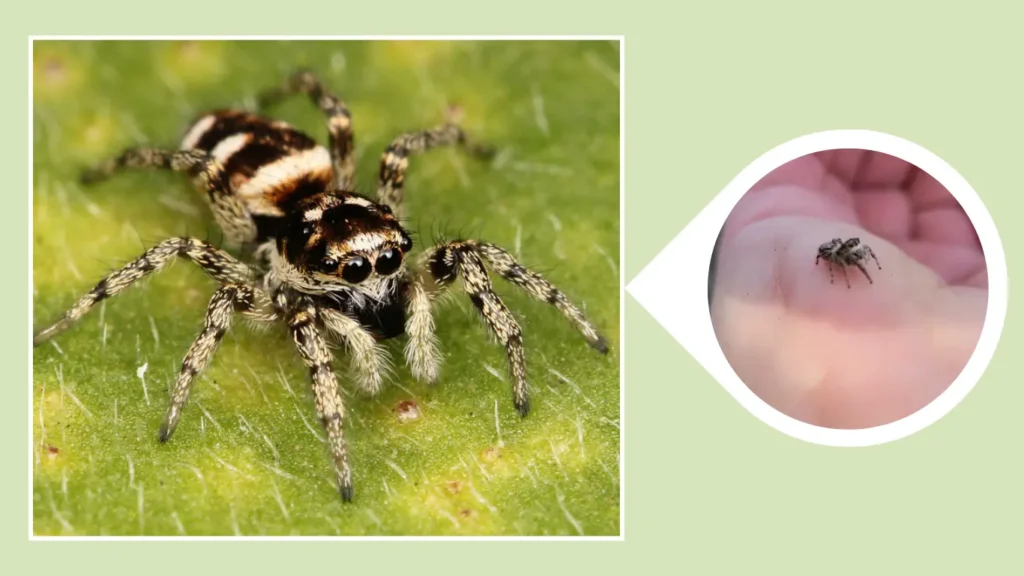
Despite their active hunting style and confident movements, Zebra Spiders are completely harmless to humans. These tiny spiders do possess venom, but it is used exclusively to subdue small insect prey—not for defense against larger threats like people.
Do Zebra Spiders Bite?
Zebra Spiders are not aggressive and rarely bite, even when handled. They are more likely to run away or freeze when threatened. A bite may only occur if the spider is accidentally pressed against the skin or feels cornered. In such rare cases, the bite is generally mild and medically insignificant.
Bite Symptoms
For the few people who may experience a Zebra Spider bite, the symptoms are usually very minor and may include:
- A small red bump
- Mild itching or irritation
- Slight swelling at the bite site
These effects usually fade within a few hours without any treatment. Serious allergic reactions are extremely rare and have not been commonly reported with Zebra Spider bites.
Zebra Spiders pose no threat to humans or pets. Their venom is not harmful to anything larger than a small insect. In fact, they’re considered beneficial spiders because they help control flies, gnats, and other household pests. Their curious behavior and harmless nature make them more fascinating than fearsome.
8. Zebra Spider as a Pet

Zebra Spiders have gained popularity among spider enthusiasts and casual nature lovers for their friendly behavior, small size, and captivating hunting style. While they’re not as common in the pet trade as tarantulas or exotic jumpers, they can still be kept successfully in captivity with simple care requirements.
Can You Keep a Zebra Spider as a Pet?
Yes, Zebra Spiders can be kept as low-maintenance pets. Due to their small size and harmless nature, they are ideal for observation. They don’t require large enclosures and are more interesting to watch than many web-building spiders because of their active, curious movements.
Enclosure Setup
A small clear container (around 1–2 liters in size) with good ventilation is enough to house a Zebra Spider. Include:
- Vertical surfaces like bark or pieces of cardboard
- A few hiding spots
- A secure lid to prevent escape
- A soft-bristled paintbrush or straw for gentle handling or cleaning
They do not require special lighting or heat as long as they’re kept at normal room temperature (18–25°C / 64–77°F).
Feeding
Zebra Spiders eat live small insects such as:
- Fruit flies
- Pinhead crickets
- Small moths or gnats
Feeding once every 2–3 days is sufficient. Always remove uneaten prey after a day to prevent stress or contamination.
Handling and Interaction
Zebra Spiders aren’t aggressive and can be observed up close, but due to their size and agility, handling is not recommended unless done with extreme care. They can easily jump away or be injured. Observing them through the container or allowing them to explore a small, safe surface is the best approach.
Interesting Facts
1. They Can See in Almost Every Direction
Zebra Spiders have eight eyes arranged to give them a nearly 360-degree field of vision. Their large central eyes provide sharp forward vision, while the smaller side and rear eyes help detect movement from all angles.
2. They Don’t Spin Webs to Hunt
Unlike most spiders, Zebra Spiders don’t use webs to catch prey. Instead, they actively stalk and pounce on their targets like tiny predators, making them more similar to cats than traditional web-weavers.
3. They Use Silk as a Safety Line
Even though they don’t use webs for hunting, Zebra Spiders use silk to anchor themselves when they jump. This “dragline” acts like a bungee cord, catching them if they miss a leap or fall.
4. They Are Naturally Curious
Zebra Spiders are known to turn and face humans or objects that move near them. This isn’t aggression—they’re simply curious and use their excellent vision to study their surroundings closely.
5. They Help Control Pests
Because they feed on flies, mosquitoes, and other small insects, Zebra Spiders play a helpful role in natural pest control. Having them around gardens or homes can actually reduce the number of annoying bugs.
FAQs
What does a Zebra Spider bite look like?
In rare cases when a bite occurs, it may appear as a small red bump, similar to a mild insect bite. It typically causes minor irritation and fades quickly without treatment.
Can Zebra Spiders see color?
Yes, Zebra Spiders have excellent vision and can detect colors. Their large forward-facing eyes give them sharp, binocular vision that helps them hunt with precision.
How long do Zebra Spiders live?
Most Zebra Spiders live for about one year. Males usually die shortly after mating, while females may live slightly longer, especially if they produce multiple egg sacs.
Do Zebra Spiders build webs?
They don’t spin webs to catch prey. Instead, they hunt actively and only use silk to create resting spots or egg sacs. They also use a silk dragline for safety while jumping.
Are Zebra Spiders poisonous or venomous?
Zebra Spiders are venomous to their prey (insects) but not dangerous to humans. Their venom is mild and only used to immobilize small insects during hunting.
Summary
Zebra Spiders are small, striped jumping spiders known for their bold appearance, active hunting style, and harmless nature. With excellent eyesight and fascinating behaviors, they’re commonly found on walls, windows, and gardens across Europe, North America, and parts of Asia. Although they have venom for catching prey, they pose no threat to humans and are even kept as tiny, low-maintenance pets. Their zebra-like pattern, curiosity, and insect-control benefits make them a welcome guest in many environments.
