
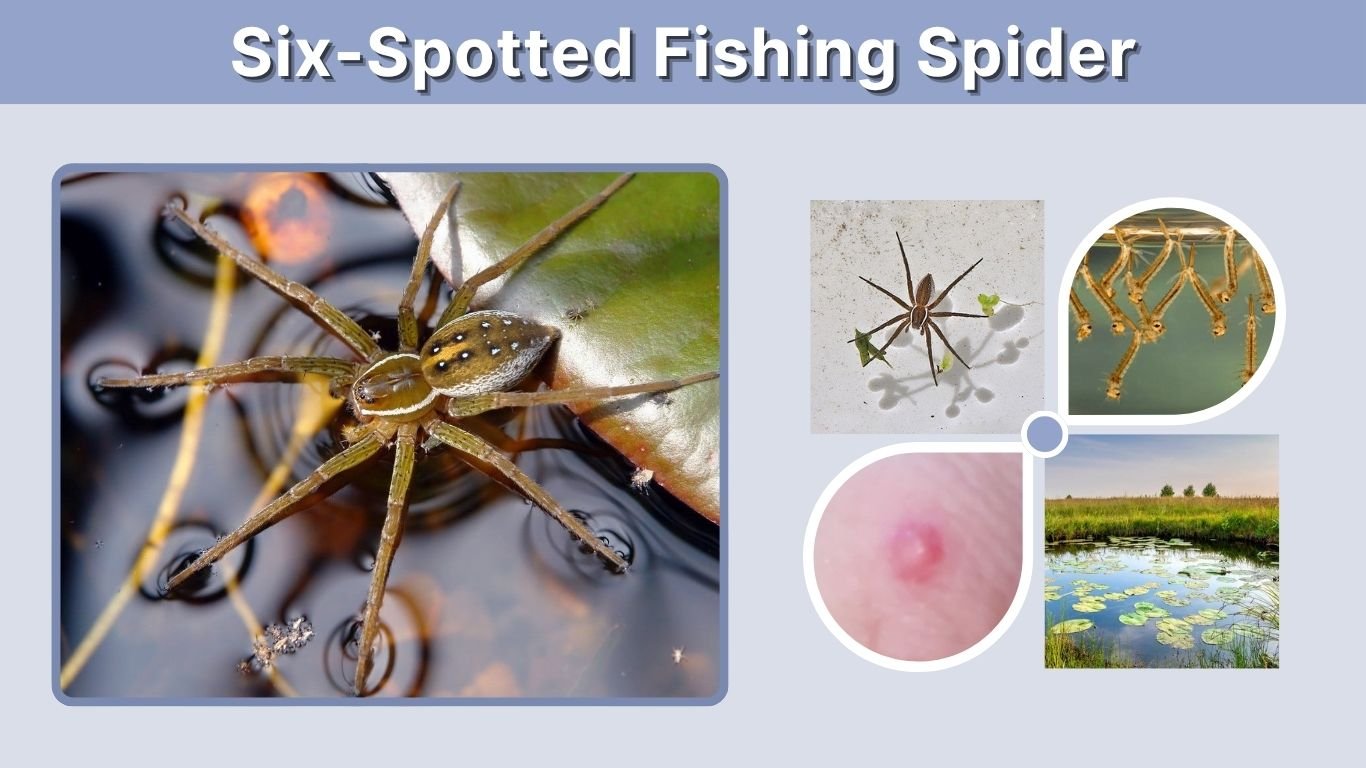
The six-spotted fishing spider is a large, semi-aquatic spider commonly seen around ponds, lakes, wetlands, docks, and slow-moving streams. It can walk across water, dive below the surface, and capture aquatic insects, tadpoles, and occasionally small fish.
Despite its impressive size and hunting abilities, this spider is shy and not considered dangerous to humans. It usually escapes into the water when disturbed rather than standing its ground.
What Is a Six-Spotted Fishing Spider?
The six-spotted fishing spider, scientifically named Dolomedes triton, is a member of the fishing spider family Dolomedidae. It is native to North America and parts of Central and South America.
Unlike orb-weavers and other web-building spiders, it does not create a large capture web. Instead, it hunts actively along the edges of calm water, using vibrations to locate prey.
| Feature | Description |
| Scientific name | Dolomedes triton |
| Family | Dolomedidae |
| Color | Brown, gray, olive, or reddish brown |
| Female body length | Usually 17–26 mm |
| Male body length | Usually 9–13 mm |
| Main habitat | Ponds, lakes, wetlands, and slow streams |
| Diet | Aquatic insects, tadpoles, and small fish |
| Risk to humans | Low |
Why Is It Called Six-Spotted?
The name can be confusing because the most noticeable pale spots are usually on top of the abdomen. These spiders commonly have several white or light-blue spots on their backs.
However, the name “six-spotted” actually refers to six dark spots on the sternum—the underside of the front section of the body. Those spots may sometimes merge and become difficult to distinguish.
What Does a Six-Spotted Fishing Spider Look Like?
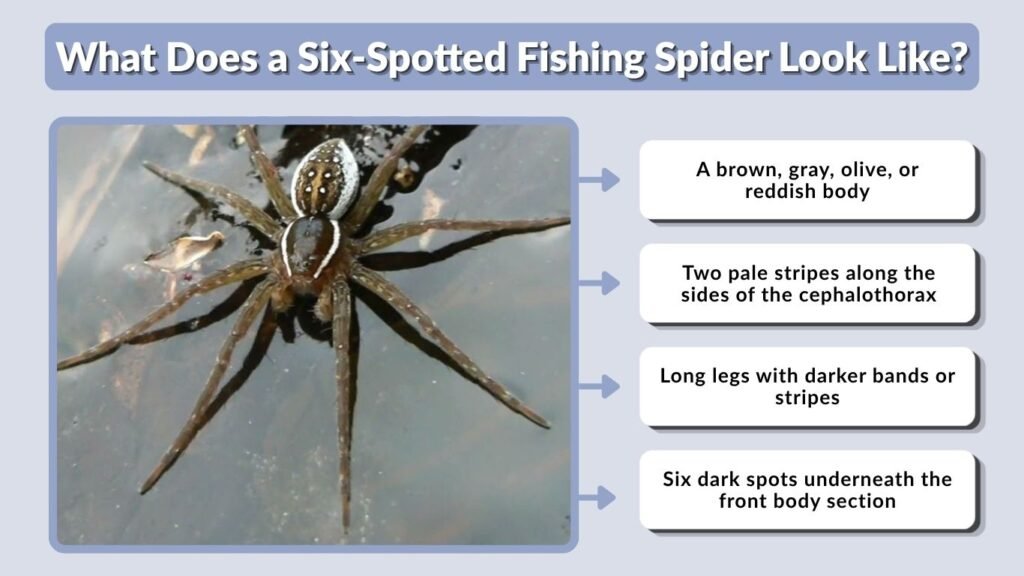
The spider has an elongated body, long legs, and bold pale markings. Its coloring provides camouflage among wet vegetation, mud, tree bark, lily pads, and wooden docks.
Main Identification Features
Look for the following characteristics:
- A brown, gray, olive, or reddish body
- Two pale stripes along the sides of the cephalothorax
- Paired white or bluish spots on the abdomen
- Long legs with darker bands or stripes
- A narrow body compared with many wolf spiders
- Six dark spots underneath the front body section
The spider’s upper markings vary. Some individuals have bright white stripes and spots, while others appear much darker and less patterned.
Six-Spotted Fishing Spider vs Wolf Spider
Six-spotted fishing spiders are frequently mistaken for wolf spiders because both have large bodies, long legs, and brown coloring.
Fishing spiders are more strongly associated with water. They are commonly seen resting on docks, rocks, lily pads, shoreline vegetation, and the surface of ponds. Wolf spiders are primarily ground hunters, although some can also occur near water.
The eye arrangement is another important difference, but examining a living spider’s eyes at close range is neither easy nor necessary.
Six-Spotted Fishing Spider Size
Female six-spotted fishing spiders are noticeably larger than males. Adult females usually have a body length of approximately 17 to 26 millimeters, or about 0.7 to 1 inch. Exceptionally large females may exceed 30 millimeters.
Males normally measure around 9 to 13 millimeters in body length. When the long legs are included, a large female can appear several inches wide.
A small individual is not necessarily a juvenile. It may be an adult male, as male fishing spiders are often much smaller and more slender than females.
Six-Spotted Fishing Spider Habitat
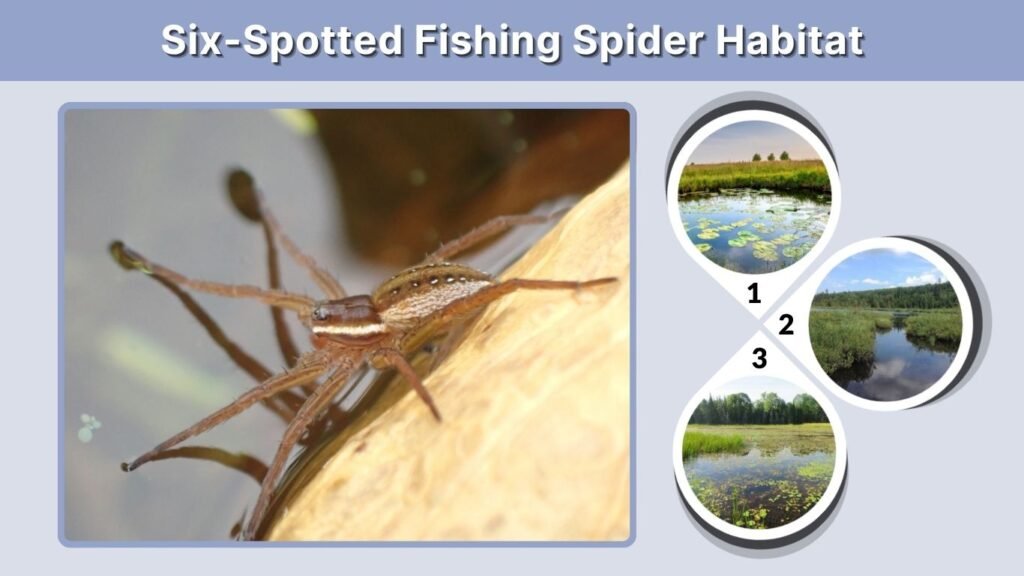
Six-spotted fishing spiders live close to freshwater, particularly calm or slow-moving water with abundant vegetation.
Common habitats include:
- Ponds
- Lakes
- Marshes
- Wetlands
- Slow-moving streams
- Quiet river edges
- Boat docks
- Lily pads
- Reeds and shoreline plants
They often rest with their back legs supported by land or vegetation and their front legs touching the water. This position allows them to sense vibrations produced by nearby prey.
Six-Spotted Fishing Spider Range
The species occurs across much of the United States and southern Canada, although it is encountered less frequently in parts of the Rocky Mountains and Great Plains. Its broader range also reaches into moist areas of Central and South America.
Six-spotted fishing spiders can be found in states including:
- Michigan
- Maine
- Ohio
- North Carolina
- Georgia
- Florida
- Texas
- South Carolina
- New Mexico
Their presence in a state does not mean they occur everywhere. Suitable ponds, wetlands, slow streams, and vegetated shorelines are necessary.
The six-spotted fishing spider is not considered a native Australian spider. Australia has other large semi-aquatic spiders, but reports of this particular species there may result from misidentification.
How Does a Six-Spotted Fishing Spider Walk on Water?
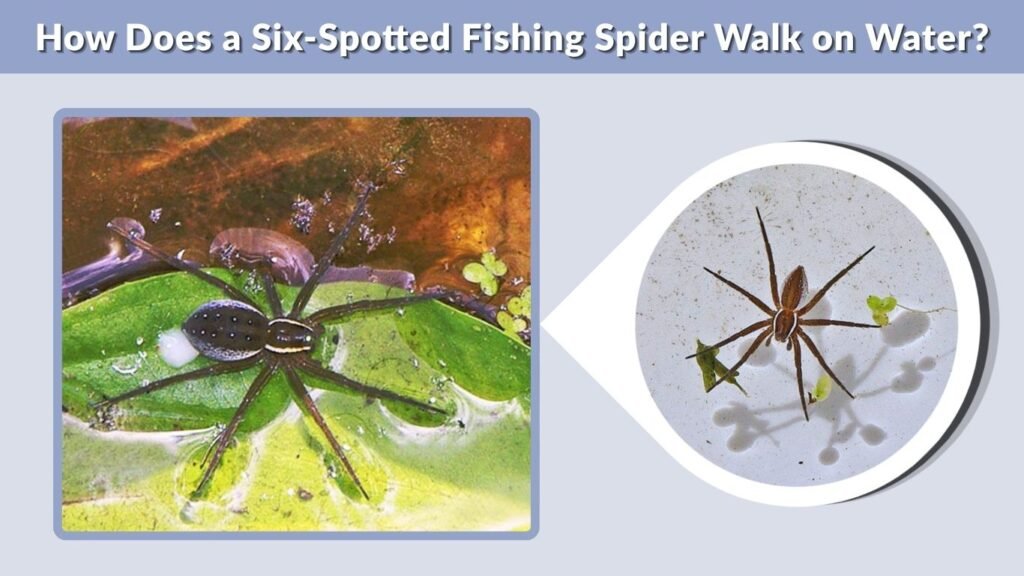
The spider distributes its weight across long, water-resistant legs without breaking the water’s surface tension. Small dimples form where each foot touches the surface, allowing the spider to stand, glide, or run across the water.
Sensitive hairs on its legs detect waves produced by insects and other small animals. The spider uses the direction and strength of these vibrations to locate potential prey, much as a web-building spider detects movement in silk.
Can It Dive Underwater?
Yes. A six-spotted fishing spider can dive beneath the surface to escape danger or capture prey. Air trapped among the fine hairs covering its body helps it breathe temporarily while submerged.
Sources report that fishing spiders can remain underwater for approximately 30 to 45 minutes under suitable conditions. They may dive several inches beneath the surface before returning to vegetation or a shoreline structure.
What Does a Six-Spotted Fishing Spider Eat?
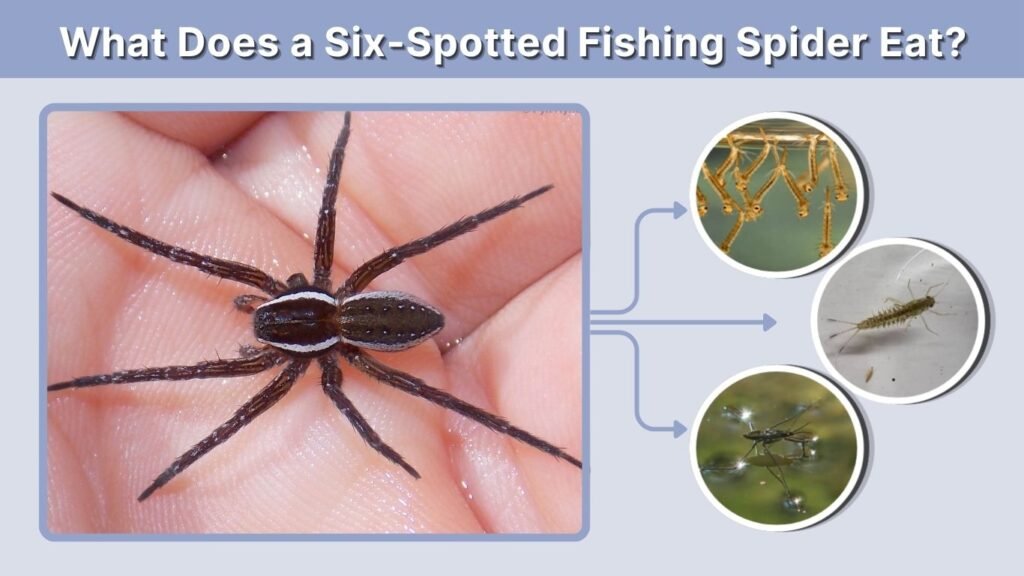
This spider is an active predator that feeds mainly on animals living on, above, or immediately beneath the water.
Its diet may include:
- Mosquito larvae
- Mayflies
- Water striders
- Aquatic insect larvae
- Dragonflies and damselflies
- Tadpoles
- Small frogs
- Small fish
- Other spiders
It detects prey through water vibrations, moves rapidly toward the source, and uses its front legs and venomous bite to capture it. Insects are more common prey than fish, despite the spider’s name.
Does the Six-Spotted Fishing Spider Build a Web?
It does not build a traditional web to catch food. Water functions much like a hunting web because vibrations reveal the location of struggling insects or other prey.
Females do use silk during reproduction. A female creates an egg sac, carries it in her jaws, and later places it inside a protective nursery web among leaves or vegetation. She remains nearby to guard the eggs and newly hatched spiderlings.
Is the Six-Spotted Fishing Spider Poisonous?
The six-spotted fishing spider is not poisonous. Poisonous animals cause harm when touched or eaten, while venomous animals inject venom through a bite or sting.
Like almost all spiders, the six-spotted fishing spider is venomous because it uses venom to immobilize prey. However, its venom is not regarded as medically significant to most people.
It does not hunt humans and usually escapes when approached.
Does the Six-Spotted Fishing Spider Bite?
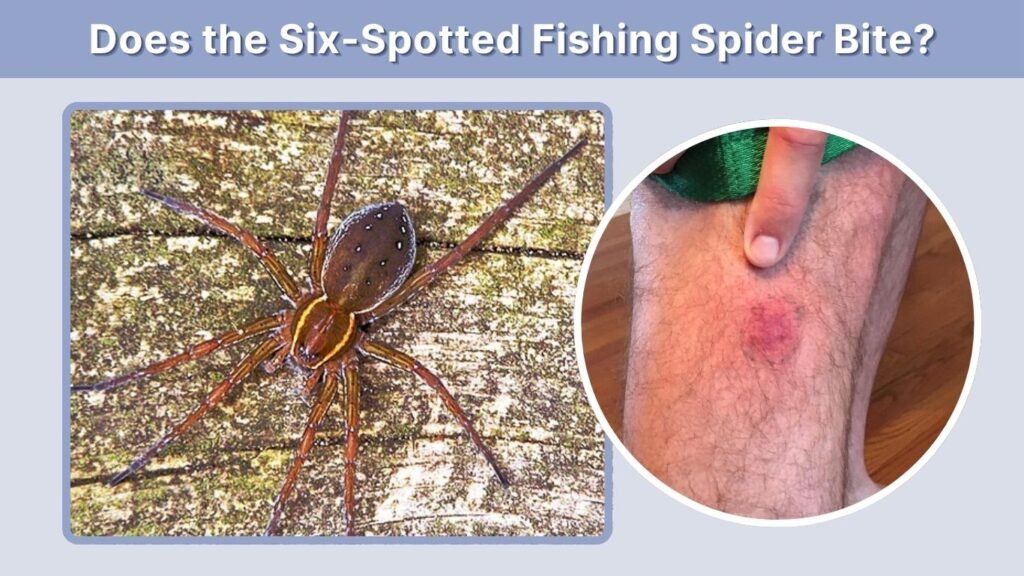
A six-spotted fishing spider can bite, but bites are uncommon. The spider is shy and is most likely to bite when trapped against the skin, squeezed, picked up, or repeatedly disturbed.
A bite may cause:
- Immediate pain
- Local redness
- Mild swelling
- Itching
- Temporary tenderness
The discomfort has been compared with a bee sting and normally remains localized.
Wash a suspected bite with soap and water and apply a cool compress. Medical attention is appropriate if pain becomes severe, swelling continues spreading, signs of infection develop, or the person experiences breathing difficulty, dizziness, or widespread hives.
Female, Male, and Juvenile Fishing Spiders
Female six-spotted fishing spiders are larger and have broader abdomens, particularly when carrying eggs. Males are smaller, more slender, and have enlarged reproductive structures near the mouth called pedipalps.
Juveniles resemble miniature adults but may have lighter coloring and less distinct markings. As they grow, they molt repeatedly and gradually develop their mature pattern.
Male spiders must approach females carefully during courtship because an unreceptive or hungry female may attack and eat the male. After mating, the female produces and guards her egg sac and spiderlings.
Six-Spotted Fishing Spider Lifespan
Precise lifespan data for Dolomedes triton are limited. Fishing spiders commonly complete a life cycle lasting around two years in temperate regions, surviving colder periods in protected locations before becoming mature during warmer months. Adults are commonly visible from late spring through early fall.
FAQs
Are six-spotted fishing spiders dangerous?
No. They are not considered dangerous to humans. They possess venom for capturing prey but are shy and rarely bite. Most encounters end with the spider running across the water or diving beneath the surface.
How big can a six-spotted fishing spider get?
Females generally measure 17 to 26 millimeters in body length, although some exceed 30 millimeters. Their long legs make them appear much larger. Males usually measure only 9 to 13 millimeters.
Where do six-spotted fishing spiders live?
They live near ponds, lakes, wetlands, slow streams, and vegetated shorelines. They are commonly found on docks, rocks, lily pads, reeds, and plants extending over calm water.
Can six-spotted fishing spiders swim?
They can move across the water’s surface, propel themselves using their legs, and dive underwater. Water-resistant hairs help prevent sinking, while trapped air allows them to remain submerged temporarily.
Should you remove a six-spotted fishing spider?
Removal is rarely necessary outdoors because the spider controls insects and is part of the aquatic food web. A spider found inside can be covered with a container, gently transferred onto stiff paper, and released near suitable water.