
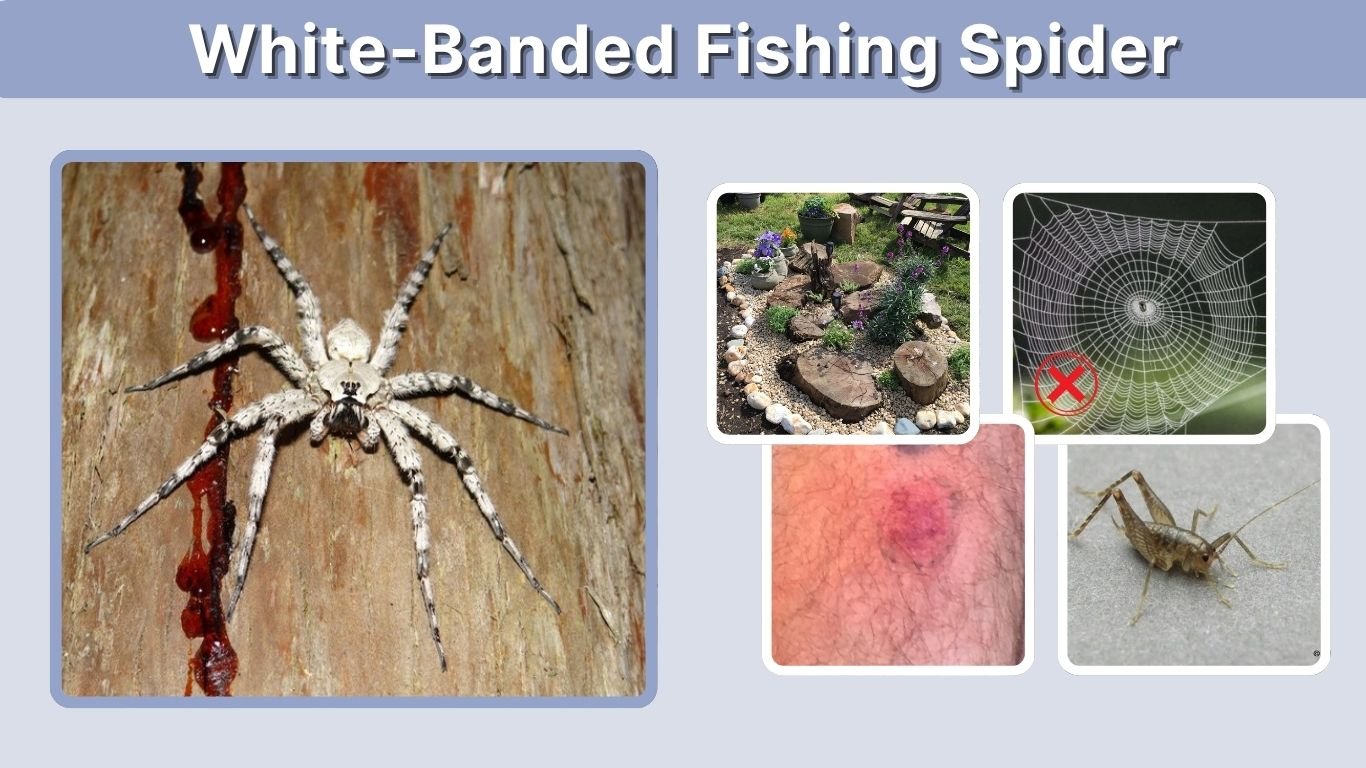
The white-banded fishing spider is a large, well-camouflaged spider found mainly in the eastern and central United States. Its mottled white, gray, brown, and occasionally green coloring allows it to blend into lichen-covered tree trunks, wooden structures, rocks, and leaf litter.
Despite its size, the spider is not considered dangerous to humans. It is an active hunter that feeds primarily on insects and other small invertebrates. Unlike many fishing spiders, it may be found on trees or buildings some distance from open water.
What Is a White-Banded Fishing Spider?
The scientific name of the white-banded fishing spider is Dolomedes albineus. It belongs to the family Dolomedidae, a group of large hunting spiders commonly called fishing spiders or raft spiders.
The species does not build a large web to trap prey. Instead, it waits on bark, vegetation, docks, walls, or the ground and rushes forward when an insect comes within reach.
| Feature | Description |
| Scientific name | Dolomedes albineus |
| Family | Dolomedidae |
| Female body length | About 23 mm |
| Male body length | About 18 mm |
| Color | White, gray, brown, black, or mossy green |
| Range | Eastern United States to central Texas |
| Diet | Mainly insects and other invertebrates |
| Risk to humans | Low |
What Does a White-Banded Fishing Spider Look Like?
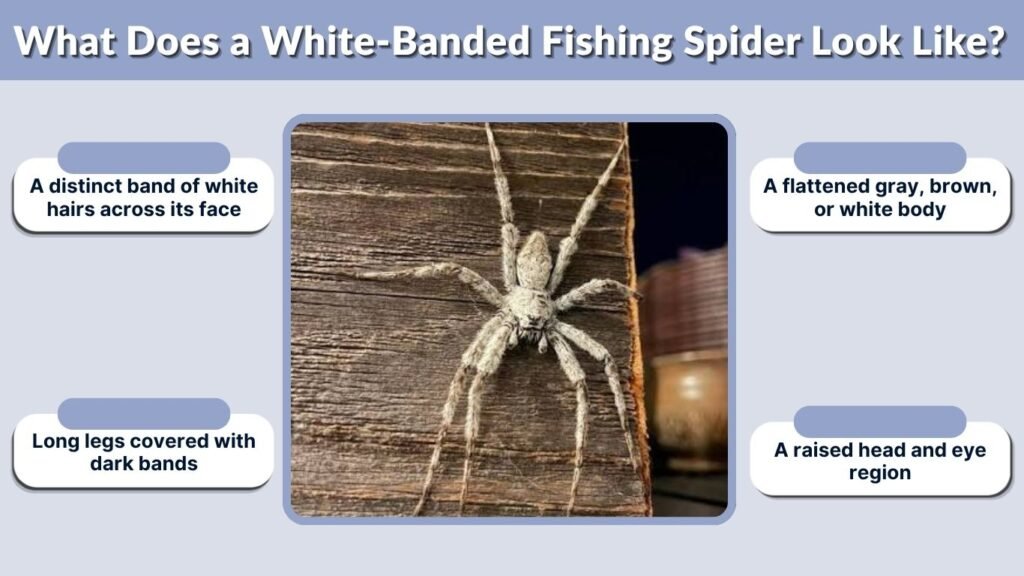
This species has a flattened body, eight long legs, and a mottled pattern that closely resembles lichen or tree bark. The exact color varies greatly between individuals.
Some appear almost white, while others are dark gray, brown, black and white, or greenish. This variation can make the species difficult to recognize from color alone.
Main Identification Features
A white-banded fishing spider may have:
- A distinct band of white hairs across its face
- A flattened gray, brown, or white body
- Long legs covered with dark bands
- Coarse white hairs on the legs and abdomen
- A raised head and eye region
- Irregular markings that resemble bark or lichen
- A broad, oval abdomen
The white facial band is one of the most useful identification features, although it is not equally visible in every individual. Some spiders have nearly white heads, while others display very muted markings.
Why Does It Sometimes Look Completely White?
A white fishing spider is not necessarily an unusual or separate species. Individual white-banded fishing spiders can naturally range from dark brown to pale gray or almost white.
Their pale hairs and irregular markings help them disappear against lichen-covered trees and weathered wood. Lighting, age, a recent molt, and the background can also make a spider appear whiter in photographs.
White-Banded Fishing Spider Size
The white-banded fishing spider is among the larger spiders found within its range. An adult female has a body length of approximately 23 millimeters, or just under one inch. An adult male measures around 18 millimeters.
These measurements exclude the legs. When the legs are fully extended, a large spider may have a span of several inches, making it appear much larger than its actual body size.
Females generally have broader abdomens, particularly when carrying eggs. Males tend to look slimmer and have enlarged pedipalps near the mouth when fully mature.
White-Banded Fishing Spider Habitat
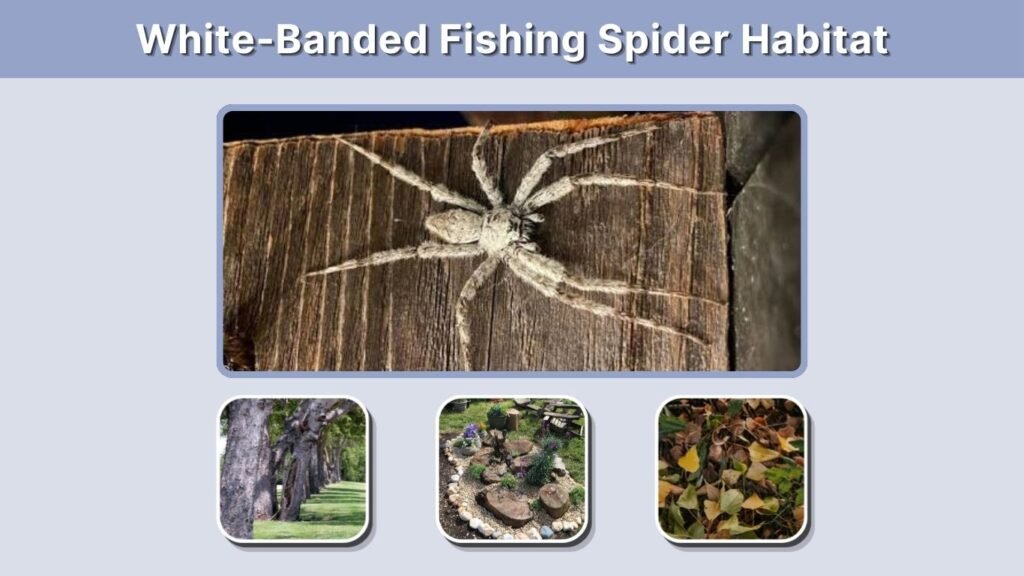
White-banded fishing spiders occur in wooded areas, swamps, wetlands, forests, and places near ponds or slow-moving water. However, they are less closely restricted to shorelines than some other members of their genus.
They are frequently observed on:
- Tree trunks
- Cypress trees
- Wooden walls
- Bridges and docks
- Fences
- Sheds and cabins
- Rocks and logs
- Leaf litter
- Exterior house walls
Both the white-banded and dark fishing spiders are regularly found away from water. A spider resting on a wall or tree does not necessarily indicate that a pond or stream is immediately nearby.
Their flattened shape and camouflage allow them to remain nearly invisible while resting against bark.
White-Banded Fishing Spider Range
The species is native to the United States. Its documented range extends through much of the eastern United States and westward into central Texas. Records are especially common in the Southeast, where warm forests, wetlands, and cypress swamps provide suitable habitat.
White-banded fishing spiders may be encountered in states such as:
- Florida
- Georgia
- Alabama
- Mississippi
- Louisiana
- Texas
- North Carolina
- South Carolina
- Tennessee
- Maryland
Their distribution is not uniform. They are more likely to appear where trees, moisture, prey, and sheltered resting places are available.
White-Banded Fishing Spiders in Florida and Texas
Florida provides extensive wetlands and warm forests suitable for several fishing spider species. White-banded fishing spiders may rest on tree trunks, wooden structures, exterior walls, and vegetation near water. The species’ white facial hairs and bark-like camouflage are particularly useful for identification.
In Texas, the species occurs mainly in the central and eastern portions of the state. It may appear in mixed forests, wooded properties, damp areas, or buildings surrounded by suitable habitat.
What Do White-Banded Fishing Spiders Eat?
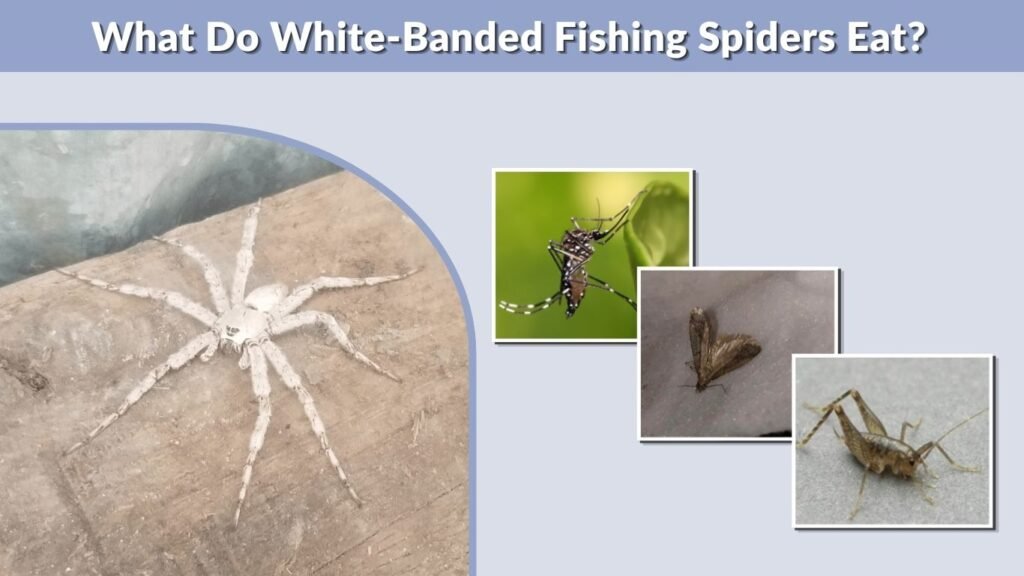
White-banded fishing spiders are active predators. They do not rely on a traditional capture web and instead chase or ambush prey.
Their diet may include:
- Flies
- Moths
- Crickets
- Beetles
- Grasshoppers
- Cockroaches
- Aquatic insects
- Other spiders
- Small tadpoles
- Tiny fish
Fishing spiders are capable of catching small vertebrates, including fish and frogs, but invertebrates form the majority of their diet.
A spider found on a house may therefore be hunting insects attracted to outdoor lights.
Can a White-Banded Fishing Spider Walk on Water?
Like other fishing spiders, Dolomedes albineus has water-resistant hairs on its legs and body. These hairs help distribute its weight across the water’s surface and prevent it from immediately sinking.
The spider can detect vibrations created by struggling insects and may move across the surface to capture them. Fishing spiders can also submerge to escape predators or pursue prey, carrying a thin layer of trapped air around their bodies.
However, the white-banded species is often seen on trees and structures rather than actively fishing on open water.
Does the White-Banded Fishing Spider Build a Web?
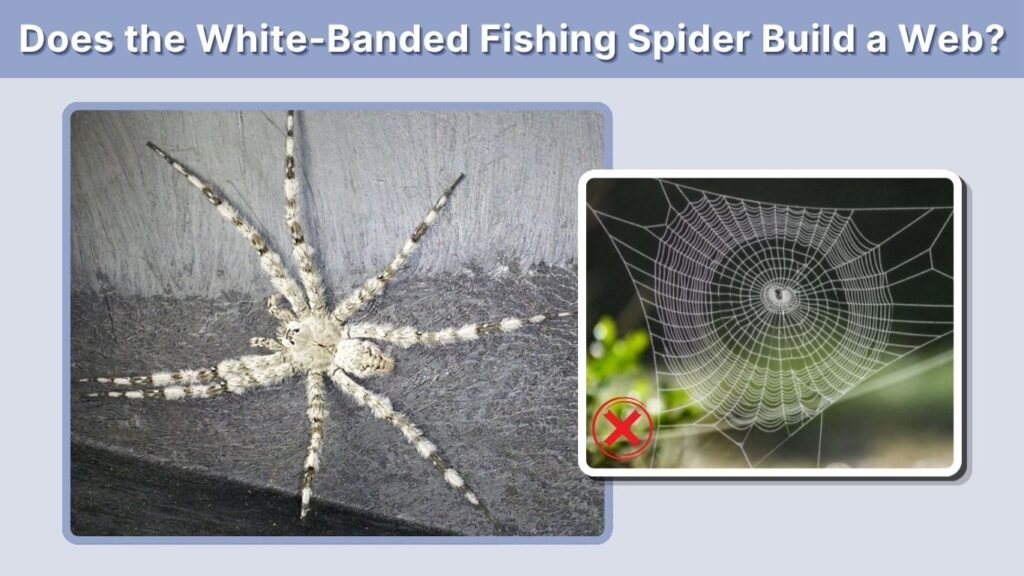
It does not build a large orb web or cobweb for catching insects. Instead, it hunts without a capture web.
Silk is still important during reproduction. A female fishing spider carries her egg sac beneath her body using her mouthparts. Before the eggs hatch, she attaches the sac within a protective nursery web and remains nearby to guard the spiderlings.
A round white object held beneath a female’s head is probably an egg sac, not prey. This differs from wolf spiders, which attach egg sacs to the rear of the abdomen.
Is the White-Banded Fishing Spider Poisonous?
The white-banded fishing spider is not poisonous. A poisonous animal causes harm when it is eaten or touched, whereas a venomous animal injects venom through a bite or sting.
Like most spiders, this species is technically venomous because it uses venom to immobilize prey. However, very few spiders have venom considered medically significant to humans, and the white-banded fishing spider is not regarded as one of them.
Its venom is intended for insects and other small prey—not for hunting people.
Does a White-Banded Fishing Spider Bite?
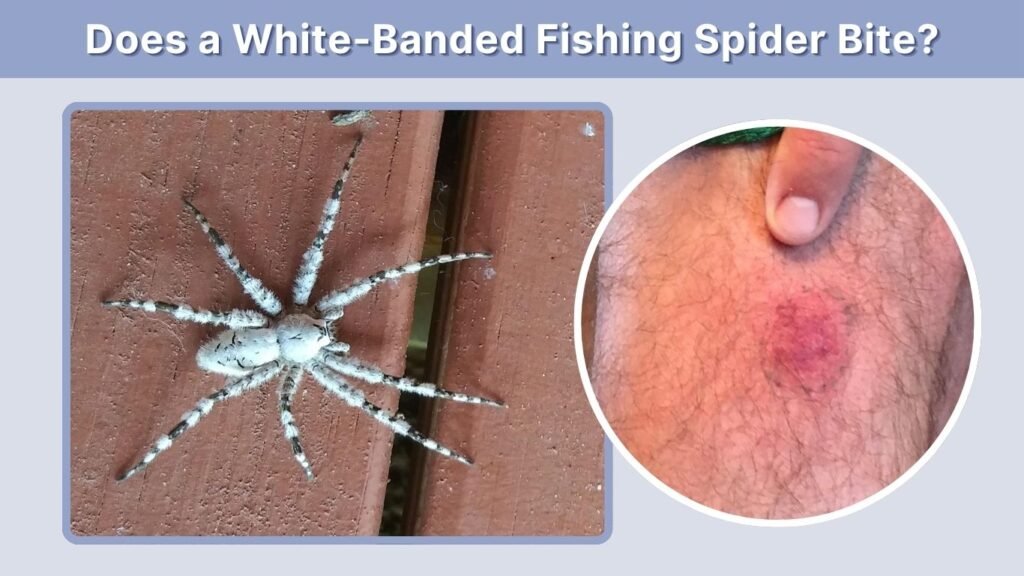
A white-banded fishing spider is physically capable of biting, but bites are uncommon. The spider is shy and normally tries to run away when disturbed.
A defensive bite is most likely when the spider is:
- Picked up by hand
- Trapped inside clothing
- Pressed against the skin
- Protecting an egg sac
- Prevented from escaping
A bite could cause temporary pain, redness, mild swelling, itching, or tenderness. These symptoms would usually remain localized.
Wash a suspected bite with soap and water and apply a cool compress. Seek medical care if pain becomes severe, swelling spreads, the wound shows signs of infection, or breathing difficulty, dizziness, or widespread hives develop.
Female vs Male White-Banded Fishing Spider
Female and male white-banded fishing spiders share similar markings, but mature females are generally larger and more heavily built.
| Feature | Female | Male |
| Body length | About 23 mm | About 18 mm |
| Abdomen | Broader and rounder | Narrower and slimmer |
| Pedipalps | Thin and leg-like | Enlarged at the tips |
| Egg care | Carries and guards egg sac | Does not carry eggs |
| Overall build | Larger and heavier | Smaller and more slender |
Juveniles resemble smaller adults but may have paler coloring and less distinct markings. They grow through repeated molts before reaching maturity.
How to Remove One Safely
Removal is usually unnecessary when the spider is outdoors. It helps control insects and generally avoids people.
To remove one from inside:
- Place a wide container over the spider.
- Slide stiff paper underneath it.
- Carry the covered container outdoors.
- Release it near trees or sheltered vegetation.
Avoid grabbing or crushing it with bare hands. Sealing gaps around doors, windows, vents, and siding can prevent spiders from wandering indoors.
FAQs
Are white-banded fishing spiders dangerous?
No. They are not considered medically dangerous to humans. They possess venom for capturing prey but are shy and unlikely to bite unless trapped, squeezed, or handled.
How large is a white-banded fishing spider?
Females have bodies measuring approximately 23 millimeters, while males measure about 18 millimeters. Their long legs can produce a total span of several inches.
Where do white-banded fishing spiders live?
They occur mainly in the eastern and central United States. They inhabit forests, swamps, wooded wetlands, tree trunks, docks, walls, and other sheltered locations, sometimes far from visible water.
Why is the spider black and white?
The contrasting pattern helps it blend into tree bark, lichen, and weathered wood. Individuals vary considerably and may appear black and white, gray, brown, pale cream, or mossy green.
Should I kill a white-banded fishing spider?
Killing it is unnecessary. The spider controls insects and poses little risk. An unwanted indoor spider can be captured with a container and released outside without direct handling.