
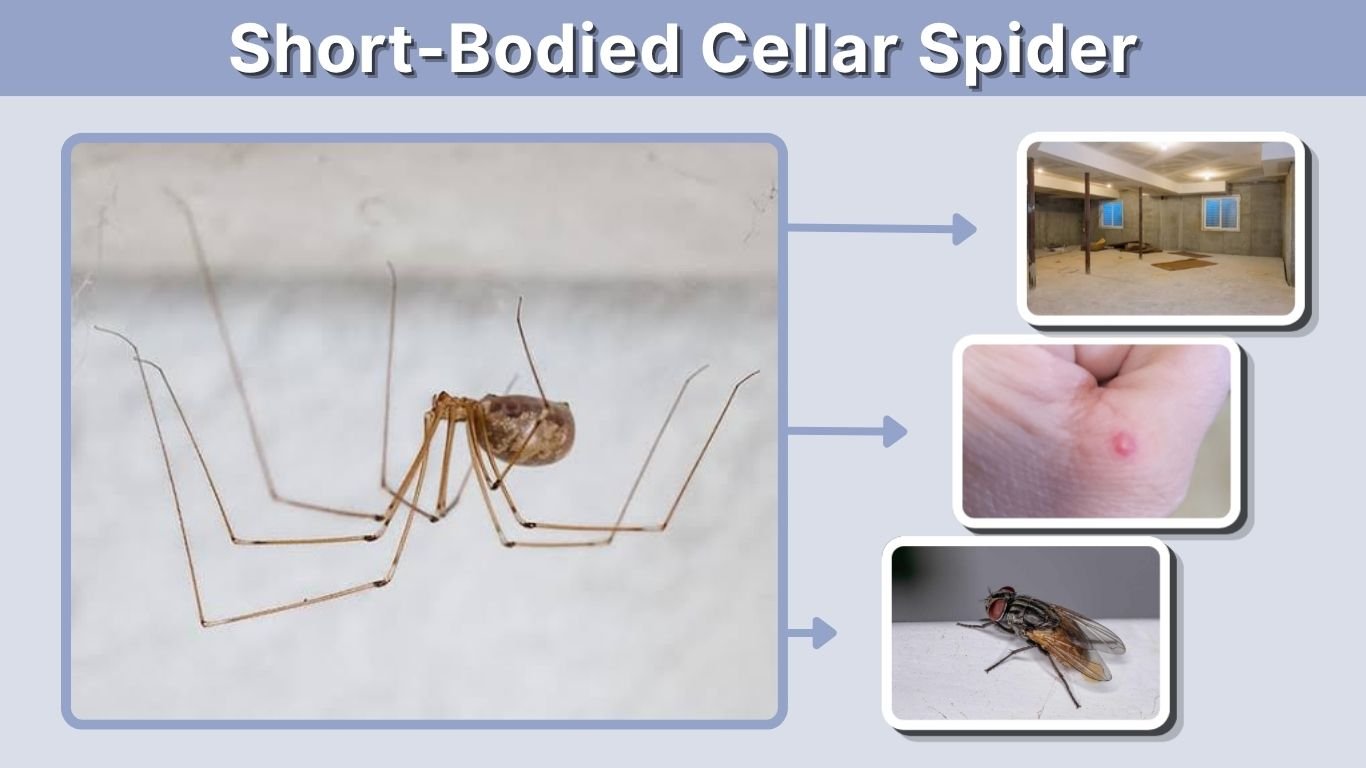
The short-bodied cellar spider is a small indoor spider recognized by its rounded abdomen and long, delicate legs. It commonly builds loose webs in ceiling corners, basements, garages, bathrooms, crawl spaces, and other quiet areas.
Although its thin legs and unusual body shape can make it look alarming, the short-bodied cellar spider is not considered dangerous to people. It usually remains in its web, where it captures flies, mosquitoes, moths, and other small arthropods.
What Is a Short-Bodied Cellar Spider?
The short-bodied cellar spider is scientifically known as Physocyclus globosus. It belongs to the cellar spider family Pholcidae, the same family as several spiders commonly called daddy longlegs spiders. Its scientific name is currently recognized as an accepted species by the World Spider Catalog.
Unlike the long-bodied cellar spider, this species has a relatively short, wide, and rounded abdomen. However, it still has the extremely thin legs typical of cellar spiders.
| Feature | Short-bodied cellar spider |
|---|---|
| Scientific name | Physocyclus globosus |
| Family | Pholcidae |
| Body shape | Short, rounded abdomen |
| Color | Pale tan, gray, or light brown |
| Web type | Loose, irregular cobweb |
| Common habitat | Buildings, caves, basements, and corners |
| Risk to humans | Not considered medically dangerous |
What Does a Short-Bodied Cellar Spider Look Like?
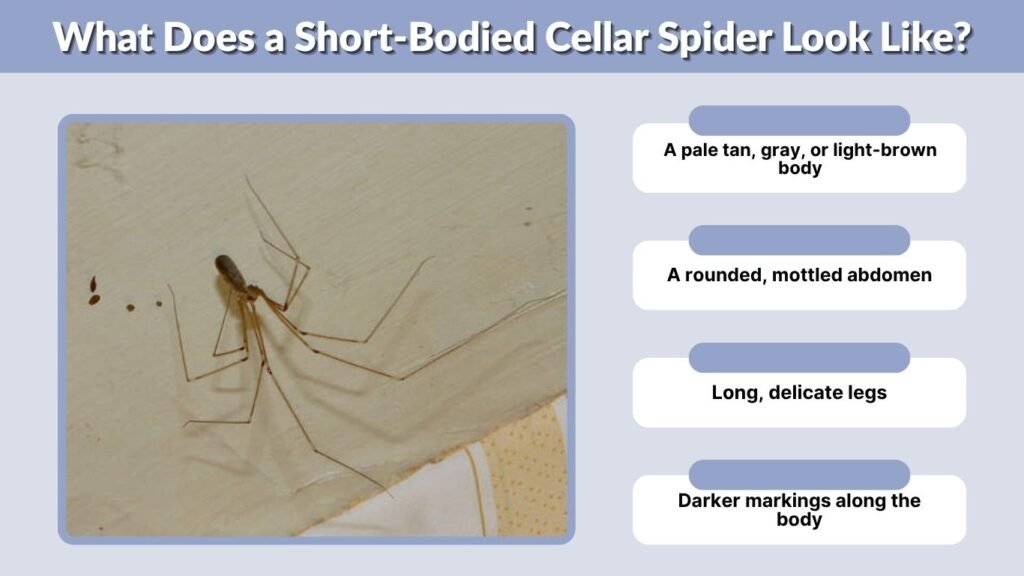
The spider has a compact body surrounded by eight long, slender legs. Its abdomen is generally rounded or slightly oval rather than long and cylindrical.
Identification Features
A short-bodied cellar spider commonly has:
- A pale tan, gray, or light-brown body
- A rounded, mottled abdomen
- Long, delicate legs
- Darker markings along the body
- Closely grouped eyes
- Fine hairs or bands on the legs
- A small body compared with its total leg span
Cellar spiders generally have small globular or elongated bodies with pale coloring and thin legs. The short-bodied form is noticeably more compact than familiar long-bodied species.
The spider may resemble a harvestman, which is also commonly called a daddy longlegs. However, harvestmen have a single fused-looking body and do not build capture webs. A cellar spider has two recognizable body sections and produces silk.
Short-Bodied vs Long-Bodied Cellar Spider
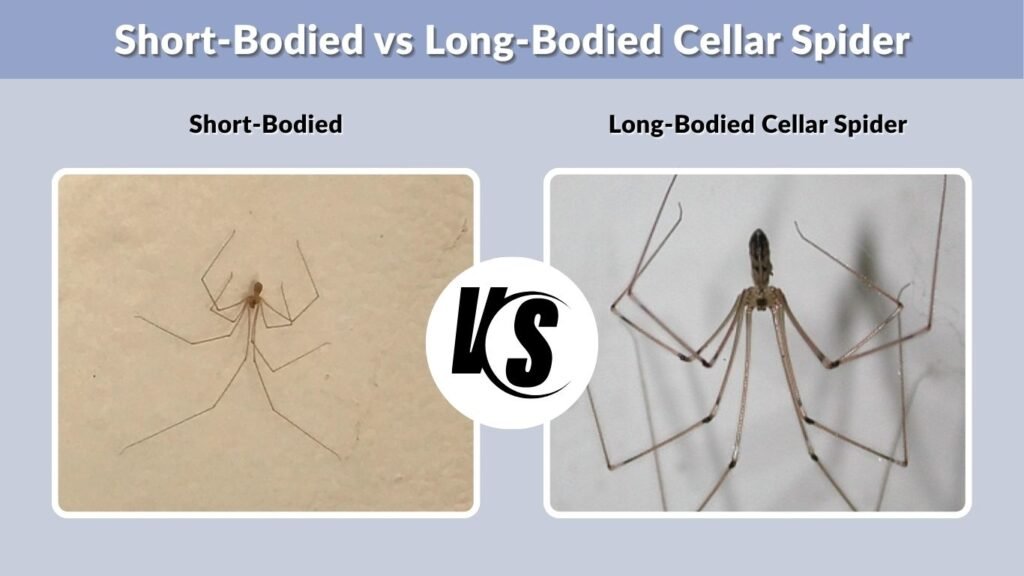
Both species belong to the same spider family and often occupy similar places inside buildings. Their main difference is the shape of the abdomen.
| Feature | Short-bodied cellar spider | Long-bodied cellar spider |
|---|---|---|
| Abdomen | Short, broad, and rounded | Narrow and elongated |
| Overall appearance | Compact body with long legs | Tiny stretched body with extremely long legs |
| Web | Loose and irregular | Loose and irregular |
| Indoor locations | Corners, basements, garages | Corners, basements, ceilings |
| Danger | Not considered dangerous | Not considered dangerous |
The short-bodied species can look heavier because of its rounded abdomen, especially in mature females. However, its actual body remains small.
Where Do Short-Bodied Cellar Spiders Live?
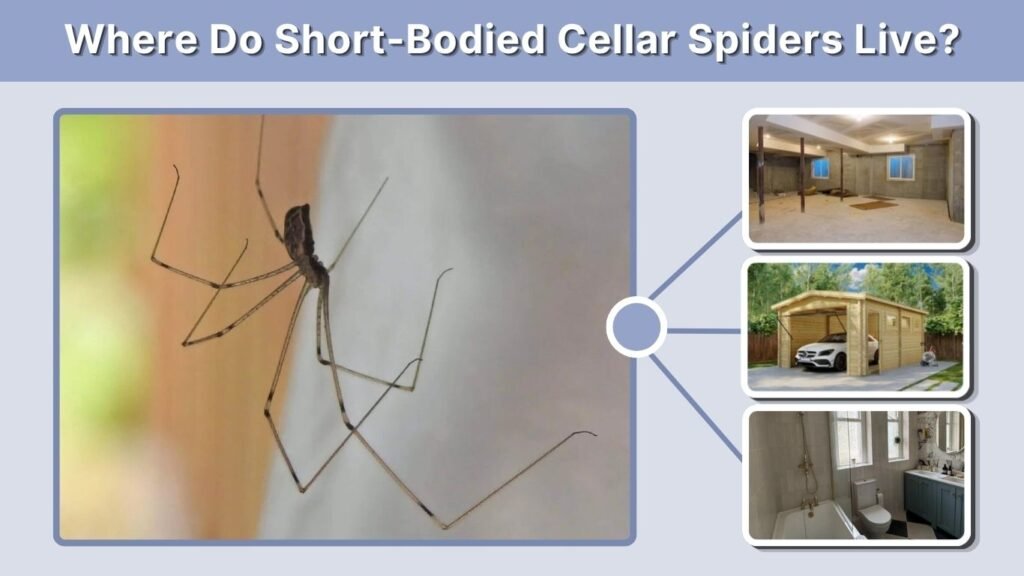
Short-bodied cellar spiders are strongly associated with warm environments and human-made structures. The species is native to North America but has been introduced to numerous regions, including parts of Africa, Asia, Australia, Europe, and Pacific islands.
Common Indoor Habitats
They may build webs in:
- Basements and cellars
- Garages and sheds
- Bathrooms
- Crawl spaces
- Ceiling corners
- Behind furniture
- Around pipes
- Near windows
- Beneath shelves
- Inside warehouses
Cellar spiders prefer areas where webs are unlikely to be disturbed. They commonly place their irregular cobwebs where walls and ceilings meet or behind objects that are rarely moved.
They may also inhabit caves, tunnels, rock shelters, and protected outdoor structures in warm climates. A behavioral study of Physocyclus globosus observed large numbers living around walls and ceilings inside tunnels in Panama.
Why Does a Short-Bodied Cellar Spider Look White?
A short-bodied cellar spider may sometimes appear white, cream, or nearly transparent. Its normal color is usually pale tan, yellowish, gray, or light brown, but indoor lighting can make its thin legs and lightly pigmented body look white.
A newly molted spider may also appear unusually pale because its fresh exoskeleton has not yet hardened or darkened. Young spiderlings are generally lighter and more translucent than mature adults.
A completely white spider is not necessarily a separate species. Body pattern, abdominal shape, leg structure, and web location are more useful for identification than color alone.
Short-Bodied Cellar Spider Web
The spider creates a messy, three-dimensional web rather than a symmetrical circular web. It normally hangs upside down beneath the silk while waiting for prey.
Cellar spiders continuously add silk instead of regularly replacing the entire web. Over time, abandoned webs can collect dust and become noticeable around ceilings and corners. When prey becomes trapped, the spider may shake or vibrate the web, helping entangle the animal further.
Rapid web vibration is also a defensive behavior. It can blur the spider’s outline and make it more difficult for a predator to attack.
What Do Short-Bodied Cellar Spiders Eat?
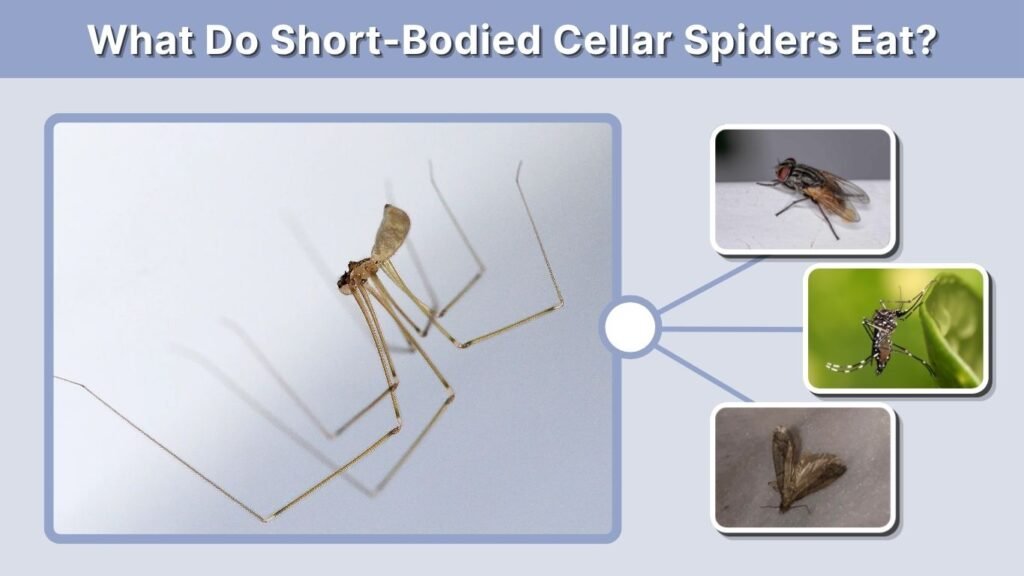
Short-bodied cellar spiders feed on insects and other arachnids captured in their webs. They help reduce small indoor pests and are generally considered beneficial predators.
Their prey may include:
- Flies
- Mosquitoes
- Small moths
- Gnats
- Ants
- Small beetles
- Other spiders
- Crawling household insects
They do not feed on clothing, wood, furniture, plants, or stored food. A large number of cellar spiders may indicate that an area provides plenty of insect prey.
Do Short-Bodied Cellar Spiders Bite?
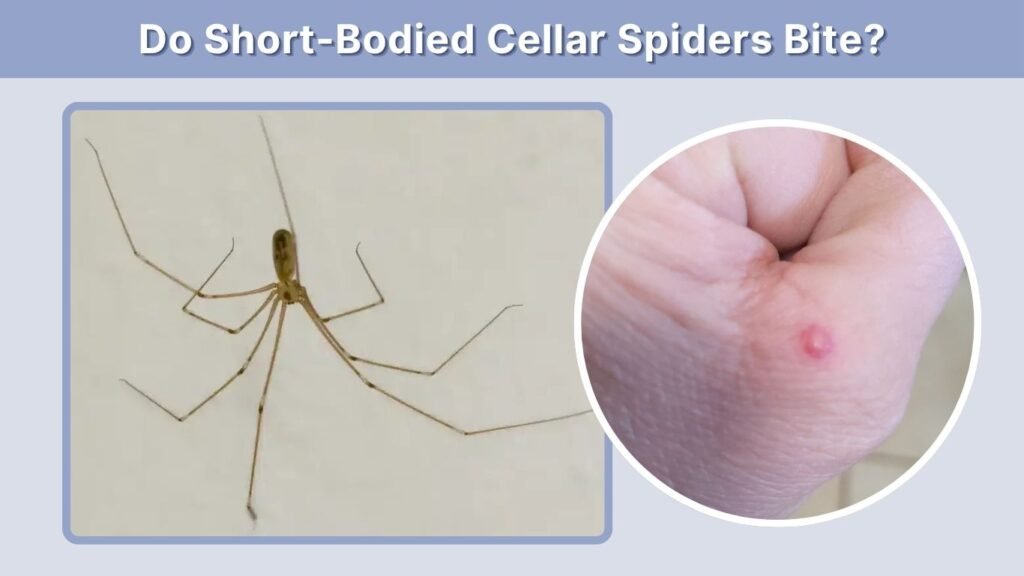
Short-bodied cellar spiders are not aggressive and bites are considered unlikely. They normally remain in their webs or retreat when disturbed.
Like most true spiders, they possess venom for subduing small prey. However, cellar spiders are not recognized as a significant human health hazard, and their venom is not considered medically dangerous.
A spider may potentially bite if it becomes trapped against the skin or is handled roughly. Any reaction would usually be expected to remain minor, although individual sensitivity can vary.
Possible Bite Symptoms
A minor spider bite could cause:
- Brief discomfort
- Mild redness
- Localized itching
- A small swollen area
- Temporary tenderness
Because many skin irritations are incorrectly blamed on spiders, a bite should not be diagnosed from a red bump alone. Mosquitoes, fleas, mites, bed bugs, skin infections, and allergic reactions can create similar marks.
Wash a suspected bite with soap and water. Seek medical advice if swelling spreads, pain becomes severe, signs of infection develop, or the person experiences breathing difficulty.
Is the Short-Bodied Cellar Spider Poisonous?
The short-bodied cellar spider is not poisonous. “Poisonous” describes something harmful when eaten or touched, while spiders use venom delivered through their fangs.
It is technically venomous because it uses venom to capture prey, but its venom is not known to create a serious health threat to humans. The popular claim that cellar spiders possess extremely powerful venom but cannot bite people is an unsupported myth.
Their fangs and venom are adapted for small insects, not for attacking humans.
Reproduction and Egg Sacs
Female short-bodied cellar spiders carry their eggs in their mouthparts rather than hiding them inside a thick silk sac attached to the web. The eggs appear as a loose cluster held beneath the spider’s body.
A female short-bodied cellar spider may produce approximately 10 to 27 eggs in one case. After hatching, the young may remain around the mother briefly before moving into nearby sections of the web.
This behavior can make a female look as though she is carrying a small white ball beneath her head.
How to Remove Short-Bodied Cellar Spiders
A few cellar spiders can be left alone because they consume indoor insects. Removal may be helpful when webs accumulate or numerous spiders appear.
Effective control methods include:
- Vacuuming spiders, webs, and egg clusters
- Removing old webs regularly
- Reducing clutter in basements and garages
- Sealing cracks around doors and windows
- Installing door sweeps
- Repairing damaged screens
- Reducing insects that serve as food
- Moving outdoor lights away from entrances
Vacuuming and removing webs can reduce numbers quickly. Sealing gaps and controlling prey insects provide better long-term results than repeatedly spraying visible spiders.
FAQs
Are short-bodied cellar spiders dangerous?
No. They are not considered a meaningful health hazard. They are shy web-building spiders that mainly prey on insects and other small arthropods. Bites are unlikely and are not known to cause serious medical effects.
Can short-bodied cellar spiders bite humans?
They may be physically capable of biting, but bites are rare because the spiders are not aggressive. Handling or pressing one against the skin could increase the chance of a defensive bite.
Why are short-bodied cellar spiders in my house?
Your house may provide warmth, shelter, undisturbed corners, and insect prey. They frequently occupy basements, bathrooms, garages, crawl spaces, and areas behind furniture or equipment.
Should I kill short-bodied cellar spiders?
Killing them is usually unnecessary. They help catch flies, mosquitoes, moths, and other indoor arthropods. Unwanted spiders can be vacuumed or captured in a container and removed.
Is a white short-bodied cellar spider dangerous?
No. Pale coloring does not indicate that the spider is more dangerous. Lighting, age, natural variation, or a recent molt can make the body appear white or translucent.