

Huntsman spiders and wolf spiders are two of the most frequently mistaken spider species, especially due to their large size, hairy appearance, and fast movements. While they both seem intimidating, they are not aggressive and serve important roles in natural pest control. Still, these two spiders have major differences in appearance, behavior, hunting techniques, and interaction with humans. This article will help you clearly distinguish between them.
Huntsman Spider vs Wolf Spider
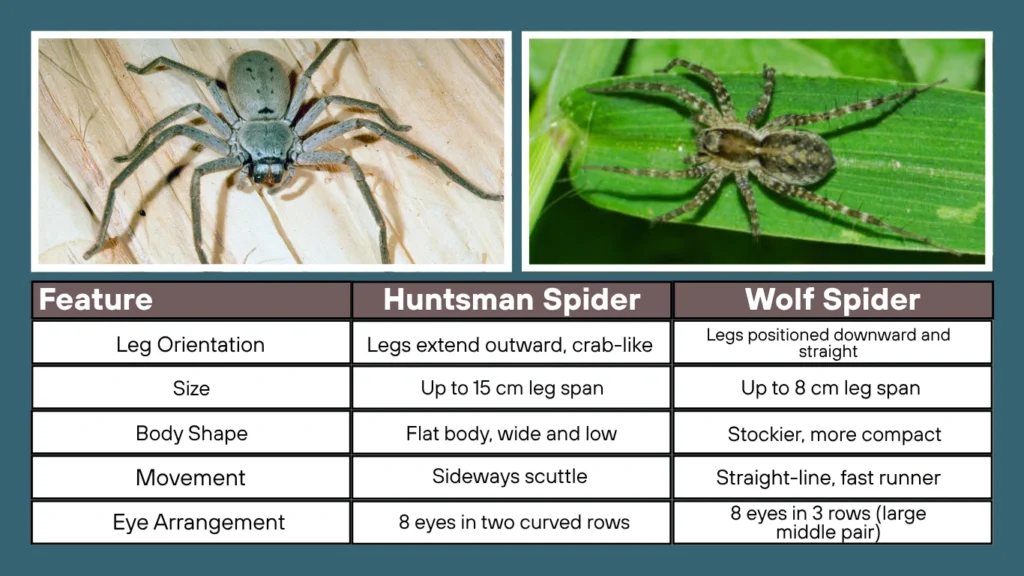
| Feature | Huntsman Spider (Sparassidae family) | Wolf Spider (Lycosidae family) |
| Leg Orientation | Legs extend outward, crab-like | Legs positioned downward and straight |
| Size | Up to 15 cm leg span | Up to 8 cm leg span |
| Body Shape | Flat body, wide and low | Stockier, more compact |
| Movement | Sideways scuttle | Straight-line, fast runner |
| Eye Arrangement | 8 eyes in two curved rows | 8 eyes in 3 rows (large middle pair) |
| Web Use | No web, active hunter | No web, active hunter |
| Habitat | Indoors, under bark, walls | Outdoors, leaf litter, gardens |
| Maternal Care | Carries egg sac under body | Carries egg sac, babies ride on back |
| Venom | Mild, causes pain and swelling | Mild, similar to a bee sting |
| Common Regions | Australia, Asia, Africa, tropics | Worldwide (especially North America) |
Appearance and Structure

Body Shape and Size
- Huntsman Spider: Known for their wide leg span (up to 15 cm), flat body, and crab-like stance. Their legs extend outward, helping them squeeze into narrow spaces.
- Wolf Spider: Usually smaller, with a thicker body and shorter legs. They’re bulkier in appearance but don’t spread out as wide as huntsmans.
Leg Position and Movement
- Huntsman: Legs are twisted and extend sideways, enabling a sideways scuttle—similar to a crab.
- Wolf Spider: Legs are held directly under the body and point forward. They run straight and fast, not sideways.
Eyes and Identification
Eye Arrangement
- Huntsman Spider: Has eight eyes in two slightly curved rows. Their vision is moderate—enough for detecting movement.
- Wolf Spider: Has eight eyes arranged in three distinct rows:
- Four small eyes on the bottom row
- Two large eyes in the middle
- Two medium eyes on top
Their large central eyes shine when exposed to light, especially at night.
- Four small eyes on the bottom row
Hunting Style and Behavior

Web Use
Neither spider spins a web for catching prey. Both are active hunters, relying on their speed and stealth to ambush or chase down insects and small invertebrates.
Hunting Behavior
- Huntsman: Prefers to wait in hiding spots (behind curtains, wall cracks, or bark) and ambush prey using a burst of sideways speed.
- Wolf Spider: Roams at ground level and actively hunts using eyesight and speed. Often hunts at night and uses vibrations to locate prey.
Habitat and Range
Where They Live
- Huntsman Spider: Found in tropical and subtropical areas, especially in Australia, Southeast Asia, Africa, and even parts of the U.S. They often come indoors, hiding behind furniture or wall crevices.
- Wolf Spider: Found worldwide, particularly in gardens, grasslands, forests, and sometimes indoors. They prefer ground-level habitats, like under rocks, logs, or leaf litter.
Indoor vs Outdoor Preference
- Huntsman spiders are more likely to be spotted indoors, especially in warm climates.
- Wolf spiders are mostly outdoor spiders but may enter homes in colder months or when hunting.
Maternal Behavior
Huntsman Spider
Female huntsmans carry their egg sac under their body, held by the spinnerets. They guard it carefully and may become defensive if approached. After hatching, spiderlings disperse quickly.
Wolf Spider
Wolf spider mothers are unique—they carry the egg sac attached to their spinnerets, and once hatched, baby spiders climb onto her back and stay there for several days before venturing out.
Venom and Bite
Huntsman Bite
- Rare, but if provoked, they can bite.
- Symptoms:
- Moderate pain
- Swelling
- Mild nausea or headache in some cases
Not considered dangerous to healthy adults.
- Moderate pain
Wolf Spider Bite
- Only bites in self-defense, usually if handled.
- Symptoms:
- Pain similar to a bee sting
- Redness, swelling, itching
No necrosis or serious side effects in most cases.
- Pain similar to a bee sting
Key Visual and Behavioral Differences
| Trait | Huntsman Spider | Wolf Spider |
| Movement | Sideways crawl | Straight, quick run |
| Common in homes | Yes, especially in tropics | Less often, prefers outdoors |
| Leg appearance | Long and angled outward | Thick, bent under body |
| Eye glow at night | No | Yes |
| Bite danger | Mild and rare | Mild and rare |
FAQs
1. Which is more likely to enter your home—wolf spider or huntsman?
Huntsman spiders are more likely to enter homes, especially in tropical areas. They hide in curtains, behind mirrors, or on walls. Wolf spiders prefer the outdoors but may enter basements or ground-floor rooms occasionally.
2. Are huntsman spiders more dangerous than wolf spiders?
Not really. Both have mild venom and rarely bite unless provoked. Huntsman spiders look more intimidating due to their size, but their bite is not considered medically significant.
3. Can wolf spiders and huntsman spiders climb walls?
Huntsman spiders can easily climb vertical surfaces, including walls and ceilings. Wolf spiders can climb but prefer to stay close to the ground and are more often seen running on floors or soil.
4. What should I do if I find a huntsman spider in my home?
Stay calm. They’re not aggressive. Use a container and a stiff piece of paper to gently trap and release it outside. Avoid using your hands. They’re beneficial for pest control and eat cockroaches and insects.
5. Do both spiders help control insect populations?
Yes! Both huntsman and wolf spiders are natural pest controllers, feeding on cockroaches, flies, beetles, and other insects. Despite their frightening appearance, they are actually helpful to have around.