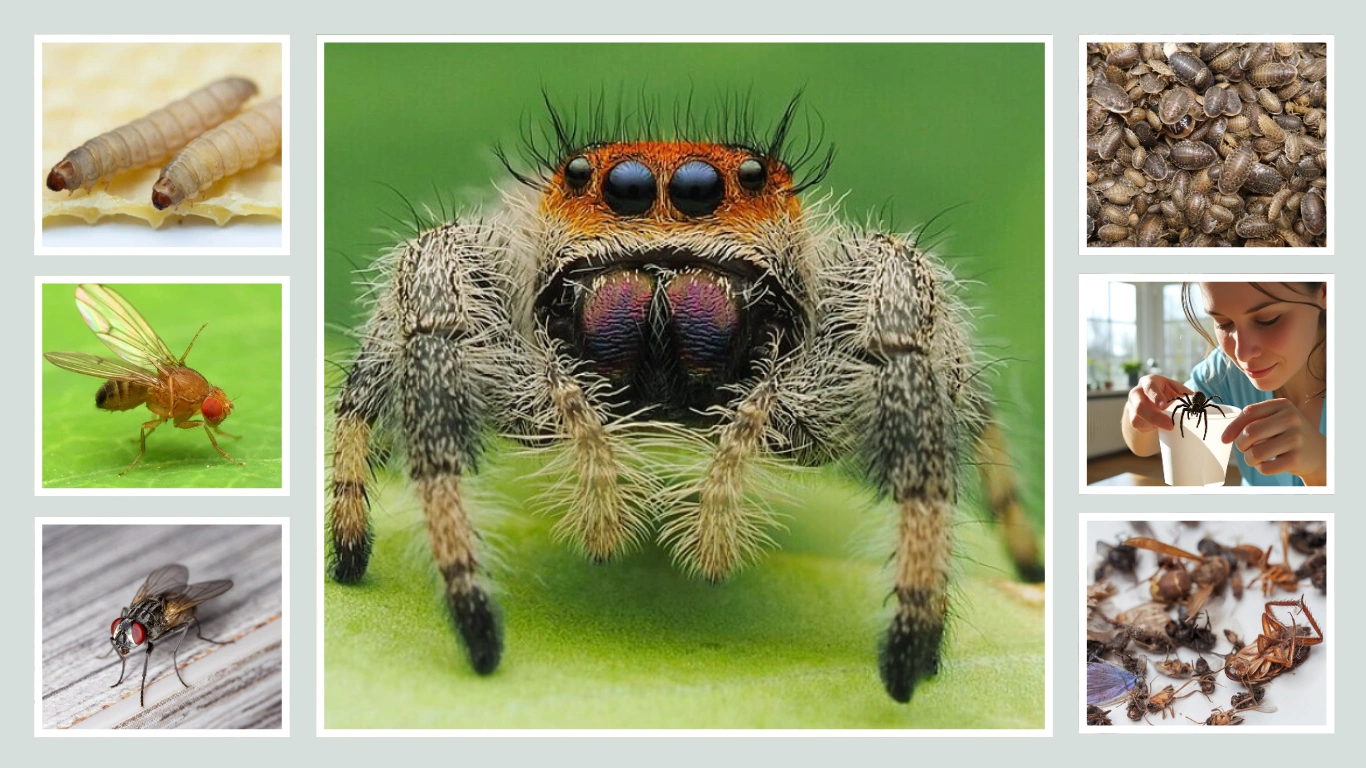
Jumping spiders are small, intelligent predators that fascinate both scientists and pet owners. Known for their excellent vision and curious personalities, these spiders are best known for actively hunting their prey instead of trapping it in webs. But what if you want to feed your pet jumping spider and don’t have live prey on hand? Will a jumping spider eat a dead insect? In this article, we’ll dive deep into this question and list 13 insects that are safe and beneficial for jumping spiders—whether live or pre-killed.
Will Jumping Spiders Eat Dead Insects?

Natural Behavior in the Wild
In the wild, jumping spiders (family Salticidae) rely heavily on their vision to detect movement. They are diurnal hunters, meaning they hunt during the day when they can see clearly. Unlike web-building spiders that wait for prey to come to them, jumping spiders actively stalk and pounce on live, moving targets.
Because of this, they usually do not eat dead insects found on the ground. A dead bug doesn’t move, doesn’t trigger their predatory instincts, and may already be decomposing. Their hunting strategy depends entirely on seeing and responding to motion.
Captive Behavior: Can They Be Trained to Eat Dead Insects?
In captivity, the situation changes a little. Pet jumping spiders can sometimes learn to accept pre-killed insects if they are offered in the right way. The key is freshness and presentation.
If the dead insect is:
- Freshly killed (within minutes)
- Soft-bodied and moist
- Wiggled gently with tweezers to simulate movement
… then some jumping spiders may accept it.
This can be very helpful if you’re running low on live feeders or want to avoid the risk of live prey harming your spider (e.g., aggressive crickets).
Risks of Feeding Dead Insects
Feeding your spider dead insects isn’t risk-free. There are several important safety factors to consider:
- Decomposition begins quickly. Within hours, bacteria can grow and harm your spider if the prey is left inside the enclosure.
- Hard-bodied insects, like adult beetles or roaches, may be difficult for spiders to consume unless freshly molted.
- Wild-caught dead insects may carry pesticides or parasites.
- Mold and mites may spread in the enclosure if dead prey is left too long.
If you feed dead insects, always observe closely and remove uneaten prey within an hour.
13 Insects That Are Good for Jumping Spiders

Whether live or freshly killed, the following insects are among the best choices for feeding your jumping spider. Some can be offered dead with careful presentation, while others are better served alive.
1. Fruit Flies
These are ideal for spiderlings and small adult jumpers. They’re soft-bodied, easy to raise at home, and can be offered alive or freshly killed. If dead, hold them with tweezers and mimic movement.
2. House Flies
Jumping spiders love hunting flies due to their speed and visibility. They’ll sometimes accept freshly dead flies—especially if you keep the wings on for realism. Great source of protein and hydration.
3. Small Crickets
Crickets are high in nutrition but should always be offered in the correct size (smaller than the spider’s body). If dead, they should be gut-loaded and freshly killed. Use tweezers to offer them slowly.
4. Waxworms
These are excellent for feeding dead or alive. Waxworms are soft, juicy, and don’t pose a threat to the spider. Many jumpers will eagerly drink from a cut waxworm if offered on a clean surface.
5. Mealworms (Chopped)
Whole mealworms are tough and often avoided. But when chopped into small pieces, the soft inside becomes accessible. Make sure to remove the hard head before offering.
6. Dubia Roach Nymphs
These are a popular feeder choice. Nymphs are soft-bodied and nutritious. If you need to feed one dead, kill it right before offering and present with motion using tweezers.
7. Mosquitoes
Small and easy for jumpers to handle, mosquitoes can be offered live or freshly killed. Just ensure they’re clean and not from an area with disease risk. Wild-caught ones should be avoided unless necessary.
8. Moths
Tiny moths are high in soft tissue and easy to digest. Be cautious of scales (dust on their wings), as they may cause irritation. Offer them live when possible, or fresh if dead.
9. Gnats
These tiny insects are good for young jumpers and easy to find indoors or outside. Dead gnats aren’t usually accepted unless offered creatively—such as on a moist surface or mimicked movement.
10. Springtails
Used more often for spiderlings, these micro-insects can be fed alive in bioactive enclosures. Dead ones are not effective since they’re too small to present realistically without movement.
11. Aphids
Common in garden plants, aphids are easy to collect. Jumping spiders will happily eat them live. If dead, they should be extremely fresh and offered immediately—otherwise they dry out quickly.
12. Baby Grasshoppers
Tiny hoppers can be chased and eaten easily. If feeding dead, ensure they are soft-bodied and recently killed. Remove quickly if ignored.
13. Ants (Selective)
Ants are tricky. Some jumping spiders eat them, others avoid them due to formic acid. Only offer small, non-aggressive species. Avoid ants with strong defensive bites or chemical sprays.
How to Offer Dead Insects to Jumping Spiders

Feeding dead insects successfully is all about timing, freshness, and technique. Here’s how to do it right:
1. Use Tweezers or Feeding Tools
Gently dangle or tap the insect near the spider to mimic movement. Some spiders will leap at it out of instinct. Avoid scaring them with fast or jerky motions.
2. Prepare the Insect
For larger prey like waxworms or mealworms, cut them in half to expose the soft insides. For flies or crickets, kill them gently just before feeding. Don’t offer dry or stiff bugs.
3. Watch for Response
Some spiders simply refuse dead food. If the spider backs away, hides, or shows no interest, remove the insect and try again later with live prey or a different type.
4. Keep It Clean
Remove any uneaten insect within 30–60 minutes. Dead bugs attract bacteria, mold, and mites. Clean the enclosure if any fluids or residue are left behind.
Final Thoughts
Jumping spiders prefer live prey—there’s no question about that. Their hunting instincts are tied closely to movement and visual cues. However, in captivity, some jumping spiders can be trained or coaxed into eating freshly killed insects, especially if the prey is soft-bodied and offered in a realistic way.
If you need to feed dead insects occasionally, focus on freshness, safety, and proper feeding methods. The 13 insects listed in this article are among the best choices for keeping your spider well-fed and healthy.
Just remember: always observe your spider’s behavior, and if they’re not interested in a dead meal, go back to live feeding. In the end, nothing beats the thrill of the hunt—for both the spider and the curious keeper watching it.