
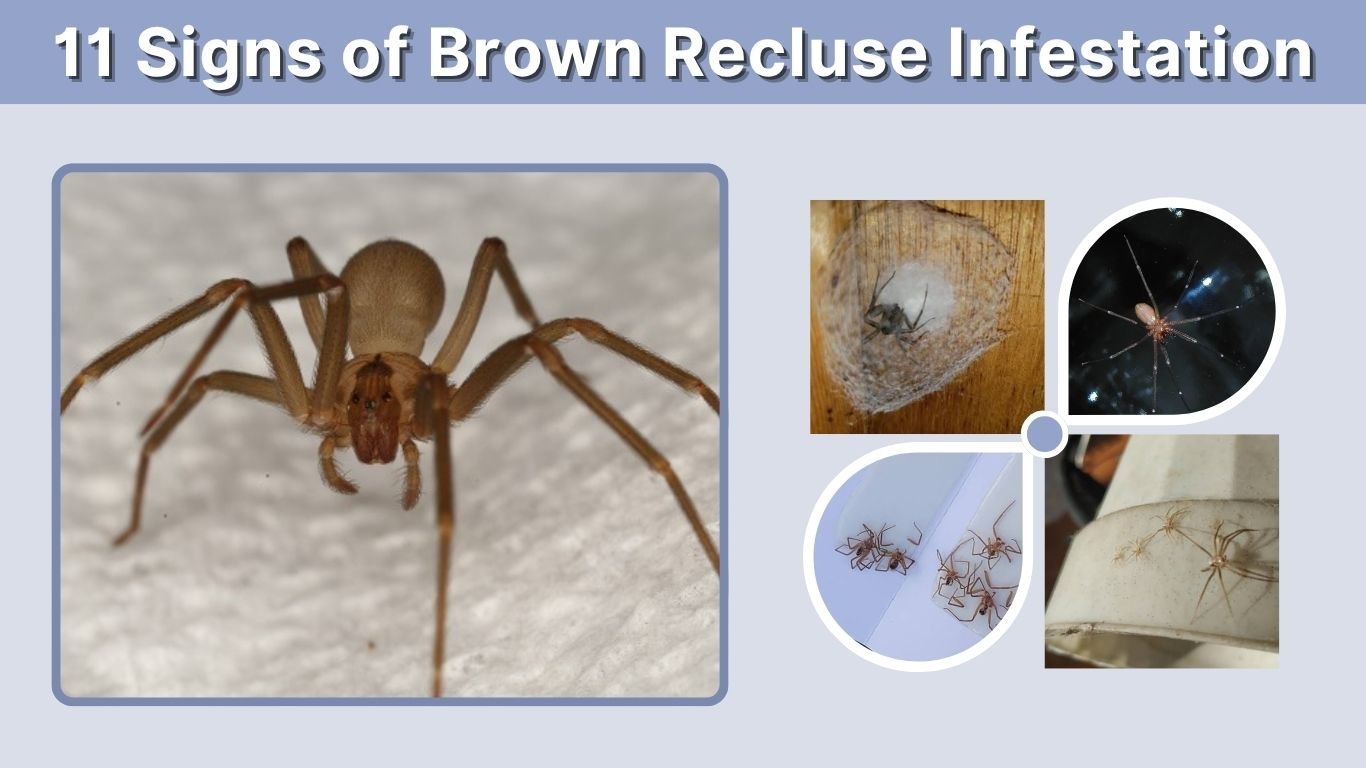
A brown recluse infestation can be hard to notice because these spiders hide during the day and move mostly at night. They do not build big, obvious webs like many house spiders. Instead, they prefer dark, dry, quiet spaces such as closets, basements, attics, storage boxes, furniture, wall gaps, and cluttered rooms. This guide explains 11 signs of brown recluse infestation, where to inspect, and what to do if you find them.
Brown Recluse Infestation: Quick Keyword Analysis
The main search intent behind “11 signs of brown recluse infestation” is practical and safety-focused. People want to know whether they have one spider, several spiders, or a real indoor infestation. Brown recluse spiders are secretive, so the signs are often subtle. University of Kentucky Extension notes that brown recluse spiders are difficult to eradicate because many dark, undisturbed areas inside buildings can serve as hiding places.
| Searcher Wants to Know | Best Answer to Include |
| How to identify infestation | List clear signs and hiding places |
| Where they hide | Closets, attics, basements, boxes, furniture |
| What webs look like | Loose, hidden retreats, not big capture webs |
| Whether egg sacs are a sign | Yes, egg sacs can mean breeding activity |
| What to do next | Inspect, trap, declutter, seal, call pros if needed |
11 Signs of Brown Recluse Infestation
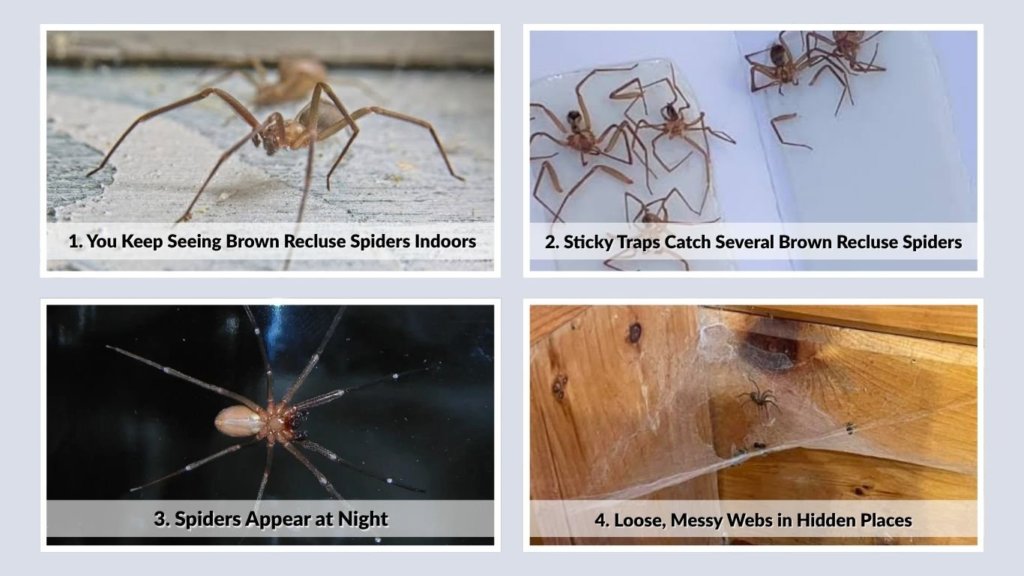
A single spider does not always mean a heavy infestation, but repeated signs should be taken seriously. Brown recluse spiders can live in homes for long periods if they have shelter, prey insects, and undisturbed hiding places.
1. You Keep Seeing Brown Recluse Spiders Indoors
The most obvious sign is repeated sightings of spiders that match brown recluse features. Brown recluses are usually tan to dark brown, have long thin legs, and may have a dark violin-shaped marking on the front body section. They are also unusual because they have six eyes arranged in three pairs, not eight eyes like most spiders.
Do not identify by color alone. Many harmless spiders are brown. If possible, capture one safely in a jar or on a glue trap for professional identification.
2. Sticky Traps Catch Several Brown Recluse Spiders
Sticky traps are one of the best ways to confirm brown recluse activity. University of Kentucky Extension recommends flat glue traps placed in corners, along baseboards, wall-floor junctions, behind furniture, and near clutter because brown recluse spiders travel in these areas.
One spider on a trap may be incidental. Several spiders from different rooms, or repeated captures over several weeks, suggest a stronger infestation.
3. Spiders Appear at Night
Brown recluse spiders are mostly nocturnal. Texas A&M notes that they come out at night to hunt insect prey and usually build inconspicuous webs in protected sites.
If you see flat brown spiders crossing floors at night, especially in basements, bedrooms, closets, or storage rooms, that may indicate indoor activity. Night sightings are more concerning when combined with sticky-trap captures.
4. Loose, Messy Webs in Hidden Places
Brown recluse spiders do not make large round webs to catch flying insects. Their webs are usually hidden retreats used for resting and egg laying. Texas A&M describes brown recluse webs as inconspicuous and built in protected sites such as dark corners, boxes, or under debris.
Look for small, loose, grayish or off-white silk patches in corners, under furniture, behind boxes, and inside cluttered storage areas.
5. Egg Sacs in Dark Sheltered Areas
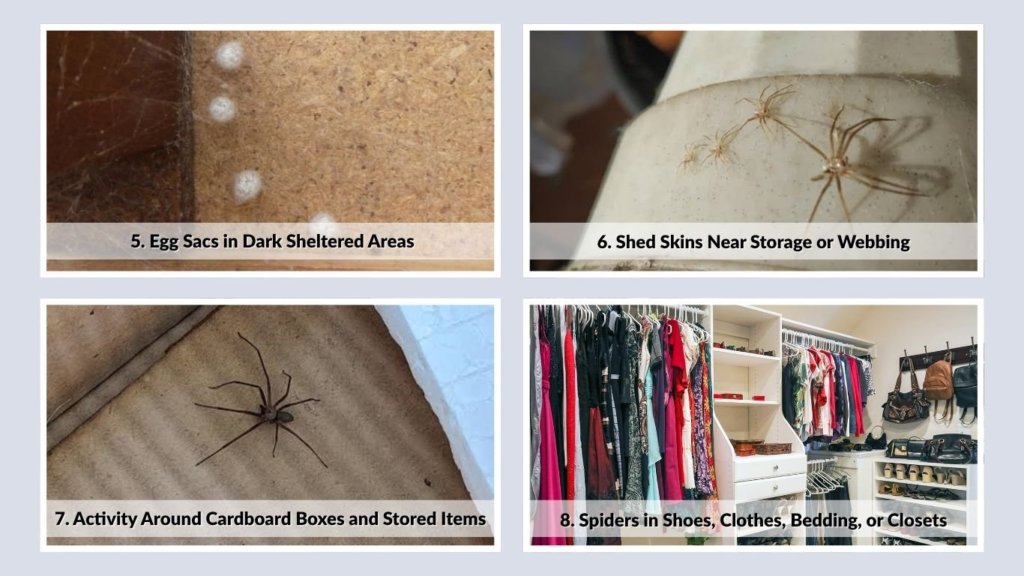
Egg sacs are a serious sign because they show breeding activity. Alabama Cooperative Extension says a female brown recluse lays about 40 to 50 tiny yellow eggs inside a sticky silken sac less than an inch wide, and one female can produce several sacs during summer.
Brown recluse egg sacs are usually hidden, not hanging in open webs. Check storage boxes, attics, garages, closets, and furniture undersides carefully.
6. Shed Skins Near Storage or Webbing
Growing spiders molt and leave shed skins behind. University of Kentucky Extension says spiders, egg sacs, and distinctive shed skins are often found in infested garages, attics, basements, and crawl spaces along joists, sills, rafters, and under rolled insulation.
Shed skins near loose webbing, egg sacs, or repeated spider sightings may indicate an established population rather than one wandering spider.
7. Activity Around Cardboard Boxes and Stored Items
Brown recluse spiders like quiet storage areas. Texas A&M notes they are frequently found in and around boxes stored in closets and attics, and recommends tightly taping stored boxes shut to remove nesting opportunities.
Old cardboard boxes, paper stacks, unused decorations, stored clothing, and rarely moved household goods are high-risk areas. Replace cardboard with sealed plastic bins where possible.
8. Spiders in Shoes, Clothes, Bedding, or Closets
Brown recluse spiders may hide in items that sit undisturbed. Oklahoma State University lists closets, old clothes, shoes, household goods, under furniture, behind pictures, and other quiet indoor spaces as common hiding sites.
Finding spiders in clothing or shoes is especially important because bites can happen when a spider is trapped against the skin. Shake out shoes, gloves, towels, and clothes in rooms where activity is suspected.
9. Brown Recluse Activity in Basements, Attics, Garages, or Crawl Spaces
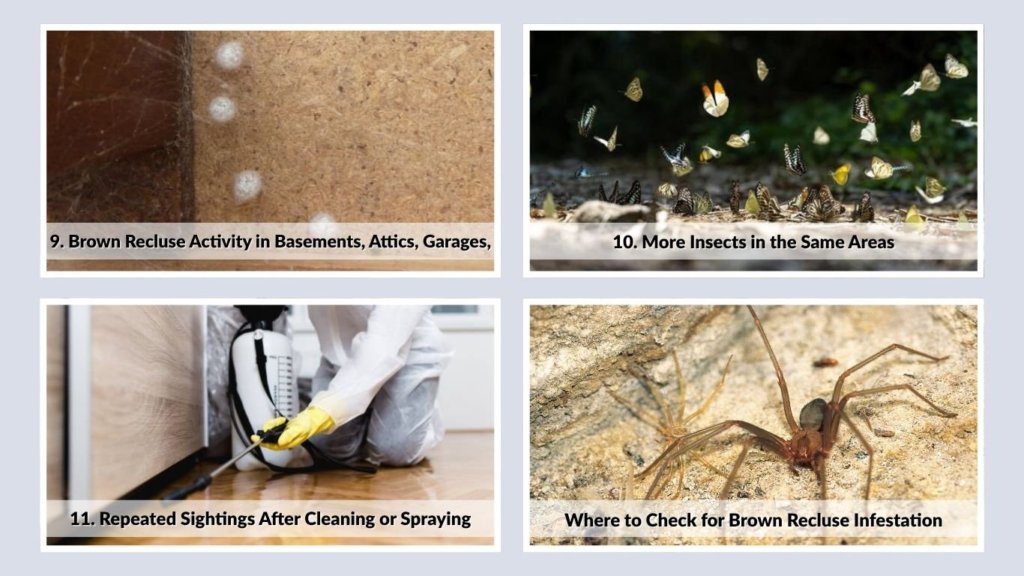
Infestations often start or remain strongest in low-traffic spaces. University of Kentucky Extension says likely hiding spots include crevices, corners, wall-floor junctions, garages, attics, basements, crawl spaces, behind clutter, and stored items.
If sticky traps catch spiders in these areas, inspect nearby boxes, insulation, joists, rafters, baseboards, and stored materials.
10. More Insects in the Same Areas
Brown recluse spiders eat insects. Texas A&M explains that when large numbers of brown recluse spiders are present in a building, it usually means insect prey such as crickets, silverfish, or cockroaches are also abundant.
Seeing many dead insects, crickets, roaches, silverfish, or other crawling pests in storage areas may support a spider infestation because it means food is available.
11. Repeated Sightings After Cleaning or Spraying
A serious brown recluse problem may continue even after basic cleaning or casual pesticide spraying. University of Kentucky Extension states that infestations are difficult to control and professional treatment is often best because the spiders hide in many inaccessible places, including wall voids, concrete block foundations, ducts, registers, and behind baseboards.
If spiders keep appearing after basic DIY steps, the hidden population may be larger than what you see.
Where to Check for Brown Recluse Infestation
Brown recluse spiders prefer dark, dry, undisturbed places. Do not reach blindly into boxes, shoes, insulation, wood piles, or dark corners. Wear gloves, long sleeves, and closed shoes when inspecting.
| Area | What to Look For |
| Closets | Spiders, webs, egg sacs, shed skins |
| Basements | Sticky-trap captures, webs, dead insects |
| Attics | Egg sacs, shed skins, spiders near rafters |
| Garages | Spiders under boxes, tools, wood, debris |
| Bedrooms | Spiders near beds, closets, clothes, shoes |
| Furniture | Webs under chairs, couches, tables |
| Crawl spaces | Webs, spiders, prey insects |
| Storage boxes | Hidden retreats, egg sacs, shed skins |
Oklahoma State University says careful inspection of attics, exposed rafters, ceiling joists, basements, closets, boxes, and household goods may reveal old and active infestation sites.
How to Confirm Brown Recluse Infestation
The best confirmation method is a combination of correct spider identification and sticky-trap monitoring. Colorado State University warns that many brown spiders are misidentified as brown recluses, and the quickest positive ID clue is the eye pattern: three pairs of eyes arranged in a semicircle.
Confirmation Checklist
Use this checklist:
- Capture a spider safely for ID
- Check for six eyes in three pairs
- Look for plain brown legs without bands
- Look for a plain abdomen without patterns
- Place sticky traps along walls and corners
- Track how many spiders are caught weekly
- Inspect nearby clutter and storage areas
- Confirm whether brown recluse spiders live in your region
Outside the normal range, many “brown recluse infestations” turn out to be lookalike spiders. CSU notes that brown recluse spiders are extremely rare in Colorado, and many brown spiders there are mistaken for recluses.
What to Do If You Find Signs of Infestation
Start with inspection, sanitation, and monitoring. Do not rely only on random spraying because hidden spiders and egg sacs may remain.
Practical Control Steps
- Place flat sticky traps along walls, corners, closets, and under furniture.
- Remove clutter from basements, attics, garages, and closets.
- Store items in sealed plastic bins instead of cardboard.
- Vacuum corners, baseboards, under furniture, and storage areas.
- Seal cracks around doors, vents, baseboards, windows, and utility openings.
- Move firewood, lumber, and debris away from the house foundation.
- Reduce prey insects such as crickets, roaches, and silverfish.
- Call a pest control professional for repeated captures or egg sacs.
Illinois Department of Public Health says sticky traps can help pinpoint brown recluse “hotspots,” and placing many traps in an average home is not excessive when trying to locate activity.
Brown Recluse Bite Safety
Brown recluse spiders are not aggressive, but bites can happen when the spider is trapped against skin in clothing, bedding, or shoes. Oklahoma State University says the bite is usually painless at first, then burning may develop, followed by a small pimple or blister; not every bite becomes an ulcer, but medical attention is recommended if a brown recluse bite is suspected.
To reduce bite risk, shake out shoes and clothes, keep beds away from walls in infested rooms, avoid leaving clothes on the floor, and wear gloves when moving stored items.
FAQs
What is the first sign of a brown recluse infestation?
The first sign is often repeated spider sightings or several brown recluse spiders caught on sticky traps. Loose hidden webs, shed skins, and egg sacs are stronger signs of an established infestation.
How many brown recluse spiders mean infestation?
There is no exact number, but repeated sightings, multiple sticky-trap captures, egg sacs, and shed skins usually suggest more than one wandering spider. Heavy infestations can contain many spiders in a small area.
Where do brown recluse spiders hide during the day?
They hide in dark, quiet, undisturbed places such as closets, basements, attics, garages, boxes, furniture, wall-floor junctions, baseboards, crawl spaces, shoes, clothes, and stored items.
Do brown recluse spiders make nests?
They do not make social nests like ants or wasps. They make hidden silk retreats and egg sacs in protected areas. These retreats may be found in boxes, dark corners, or under debris.
Should I call pest control for brown recluse infestation?
Yes, if you keep finding spiders, egg sacs, or repeated sticky-trap captures. Brown recluse infestations can be difficult to eliminate because spiders hide in cracks, voids, clutter, attics, crawl spaces, and wall gaps.