


Parrots are among the most vibrant and intelligent birds in the world, admired for their dazzling feathers, clever mimicry, and lively personalities. Across rainforests, savannas, and tropical woodlands, over 350 species of parrots showcase an extraordinary array of colors and characteristics. In this guide, we’ll explore 45 of the most colorful parrot species—from the bold reds of macaws to the bright greens of lovebirds and the striking blues of lorikeets. Each section includes the bird’s name, key identification details, natural habitat, behavior, and diet, helping you discover the unique charm of every feathered beauty on the list. Whether you’re a birdwatcher, parrot owner, or simply fascinated by nature’s palette, this collection highlights the incredible diversity of parrots across the globe.
1. Scarlet Macaw Parrot
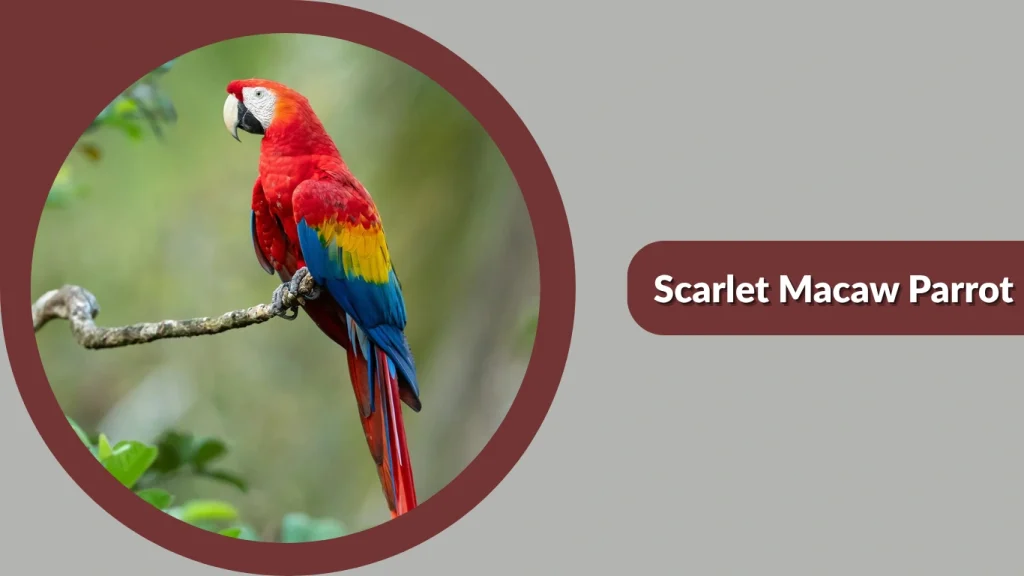
The Scarlet Macaw (Ara macao) is one of the most visually stunning and widely recognized parrots in the world. Known for its striking red plumage accented with yellow and blue, this large, intelligent bird thrives in tropical rainforests of Central and South America. Its majestic presence, vibrant colors, and loud calls make it a favorite among bird lovers and a symbol of the exotic wild.
Identification
- Body Length: 32 to 36 inches (81 to 91 cm)
- Wingspan: Up to 3 feet (approximately 1 meter)
- Weight: 900 to 1,130 grams (2 to 2.5 pounds)
- Color Pattern:
- Bright red head, neck, and body
- Yellow band across the middle of the wings
- Blue flight feathers and tail
- White, featherless facial patch with thin red feather lines
- Bright red head, neck, and body
- Beak: Pale horn-colored upper mandible, black lower mandible
- Eyes: Yellow in adults, darker in juveniles
- Legs: Gray
Natural Habitat
Scarlet Macaws are primarily found in humid, lowland tropical forests—especially in riverine and canopy zones. They prefer unbroken stretches of rainforest but may also adapt to partially disturbed woodlands. Their range stretches from southeastern Mexico through Central America and into parts of South America, including Peru, Ecuador, Colombia, Bolivia, and Brazil.
Behavior & Personality
Scarlet Macaws are extremely social birds. In the wild, they form lifelong pair bonds and are often seen flying in pairs or small family groups. They are highly vocal, using a variety of loud squawks and screams for communication, territory marking, and bonding.
These parrots are also exceptionally intelligent. They can mimic sounds and words, solve puzzles, and require lots of mental stimulation. In captivity, they form strong attachments to humans but can become bored and destructive if not properly engaged.
Diet and Feeding
In their natural environment, Scarlet Macaws feed on a wide variety of seeds, nuts, fruits, and berries. They are also known to consume clay at mineral-rich riverbanks—thought to neutralize toxins found in some of the seeds they eat.
2. Blue-and-yellow Macaw Parrot
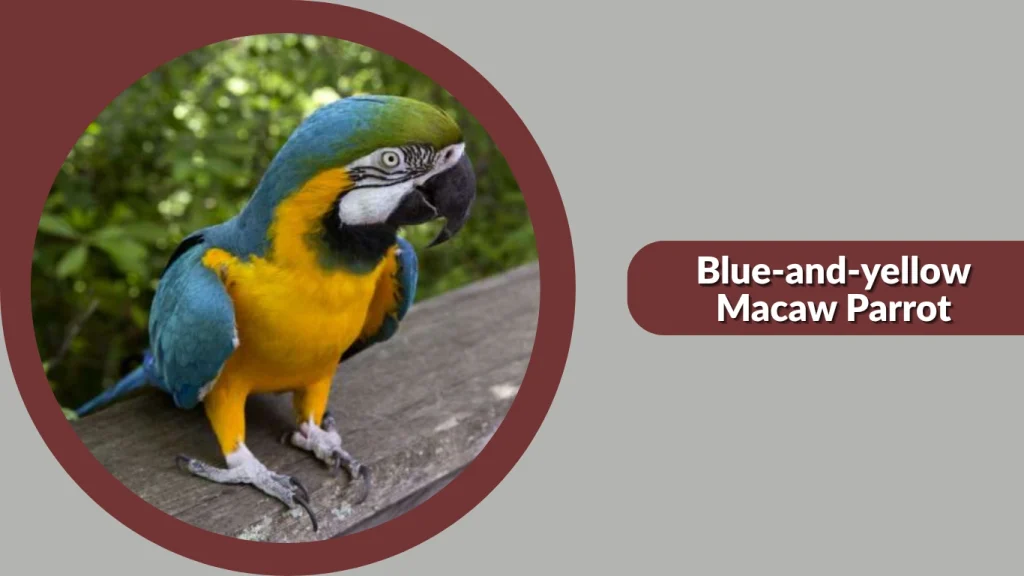
The Blue-and-yellow Macaw (Ara ararauna) is a large, vividly colored parrot known for its deep blue wings and back, bright yellow underparts, and striking green forehead. This popular species is native to South America and is often seen in the wild and in aviaries due to its stunning appearance and trainable personality.
Identification
- Body Length: 30 to 34 inches (76 to 86 cm)
- Wingspan: Around 40 to 45 inches (100 to 115 cm)
- Weight: 900 to 1,200 grams
- Color Pattern:
- Bright cobalt-blue back, wings, and tail
- Rich yellow chest and belly
- Greenish forehead transitioning into blue crown
- White face patch with black feather lines
- Bright cobalt-blue back, wings, and tail
- Beak: Large, black, curved beak
- Eyes: Pale yellow
- Legs: Gray to black
Natural Habitat
These macaws inhabit forests, woodlands, and swamps of South America, particularly near rivers and open spaces. Their range includes Venezuela, Brazil, Bolivia, Colombia, and Paraguay. They are most abundant in the Amazon Basin.
Behavior & Personality
Blue-and-yellow Macaws are intelligent, loud, and social. They bond closely with mates or owners, enjoy vocalizing, and often perform acrobatic flights. Their strong beaks allow them to crack open hard nuts, and their mimicking skills make them popular in training and entertainment.
Diet and Feeding
They primarily consume fruits, seeds, nuts, and berries. In the wild, they may also ingest clay from riverbanks, believed to counteract dietary toxins.
3. Green-winged Macaw Parrot
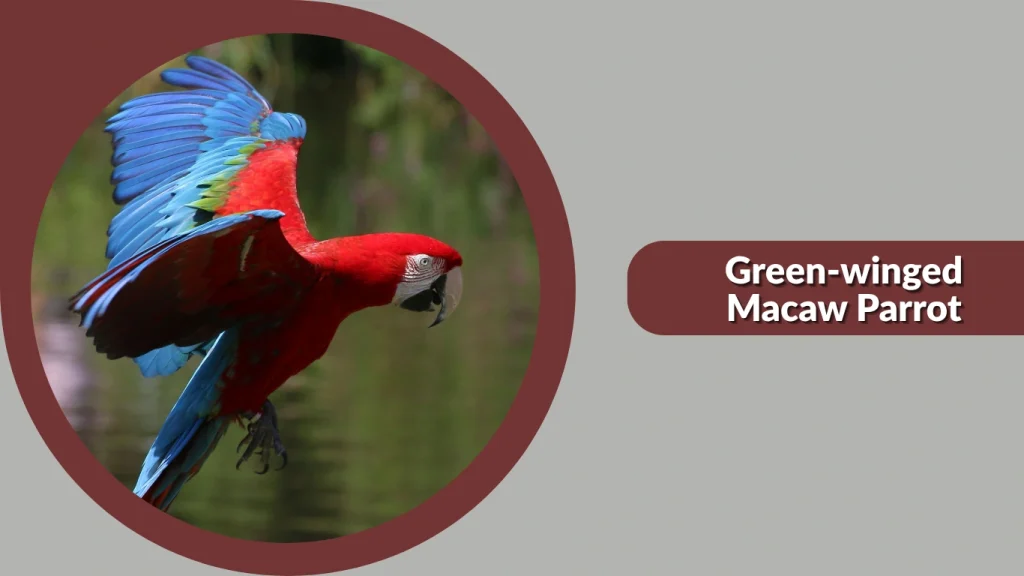
The Green-winged Macaw (Ara chloropterus), also called the Red-and-green Macaw, is one of the largest and most powerful macaws. Though similar in size and shape to the Scarlet Macaw, it can be distinguished by the presence of green wing feathers and red lines around the eye.
Identification
- Body Length: 35 to 37 inches (89 to 95 cm)
- Wingspan: 49 to 52 inches (125 to 132 cm)
- Weight: 1,200 to 1,700 grams
- Color Pattern:
- Deep red head, neck, and body
- Broad green band across the upper wings
- Blue lower wings and tail
- White facial skin with fine red feather lines
- Deep red head, neck, and body
- Beak: Powerful, ivory upper beak with black lower beak
- Eyes: Yellow in adults, dark gray in juveniles
- Legs: Gray
Natural Habitat
Green-winged Macaws are native to the forests and woodlands of northern and central South America. Their range extends through Panama, Colombia, Venezuela, Brazil, Bolivia, and Paraguay.
Behavior & Personality
They are calm, gentle, and affectionate, often forming deep bonds with their partners. Although quieter than some other macaws, they are still capable of loud calls and are quick learners with problem-solving ability.
Diet and Feeding
Their diet includes a variety of nuts, seeds, fruits, berries, and sometimes bark. They frequently visit clay licks, which are believed to help with digestion and toxin removal.
4. Hyacinth Macaw Parrot
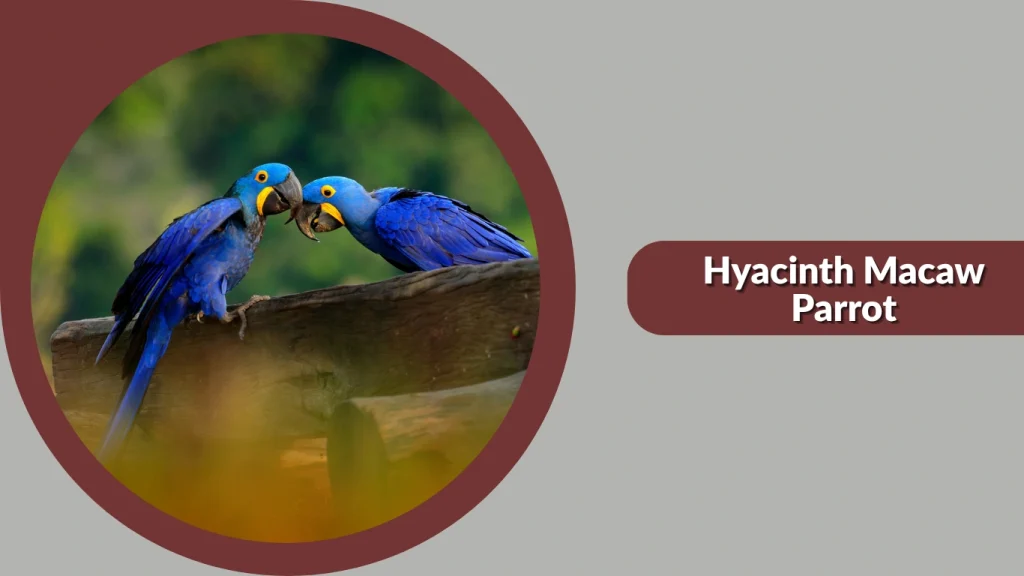
The Hyacinth Macaw (Anodorhynchus hyacinthinus) is the largest flying parrot species in the world. Known for its magnificent cobalt-blue plumage and yellow facial skin, it is a majestic bird of the South American wetlands and woodlands. Despite its size and power, it is gentle and often described as affectionate and curious.
Identification
- Body Length: 39 to 42 inches (99 to 107 cm)
- Wingspan: Up to 60 inches (152 cm)
- Weight: 1,400 to 1,700 grams
- Color Pattern:
- Entire body is rich cobalt-blue
- Bright yellow ring around the eyes
- Yellow patch near the lower mandible
- Entire body is rich cobalt-blue
- Beak: Enormous, black, and extremely strong
- Eyes: Dark brown with yellow orbital skin
- Legs: Dark gray
Natural Habitat
Hyacinth Macaws are found in the open woodlands, palm swamps, and savannas of central and eastern South America, especially in Brazil’s Pantanal, Paraguay, and eastern Bolivia.
Behavior & Personality
Despite their intimidating size, they are calm and affectionate birds. They are intelligent, enjoy social interaction, and use their massive beaks to crack open very hard nuts, especially from palm trees.
Diet and Feeding
Their diet largely consists of palm nuts, particularly from acuri and bocaiuva palms, along with fruits and seeds. They often forage in small family groups and rely on specific tree species for both food and nesting.
5. Military Macaw Parrot
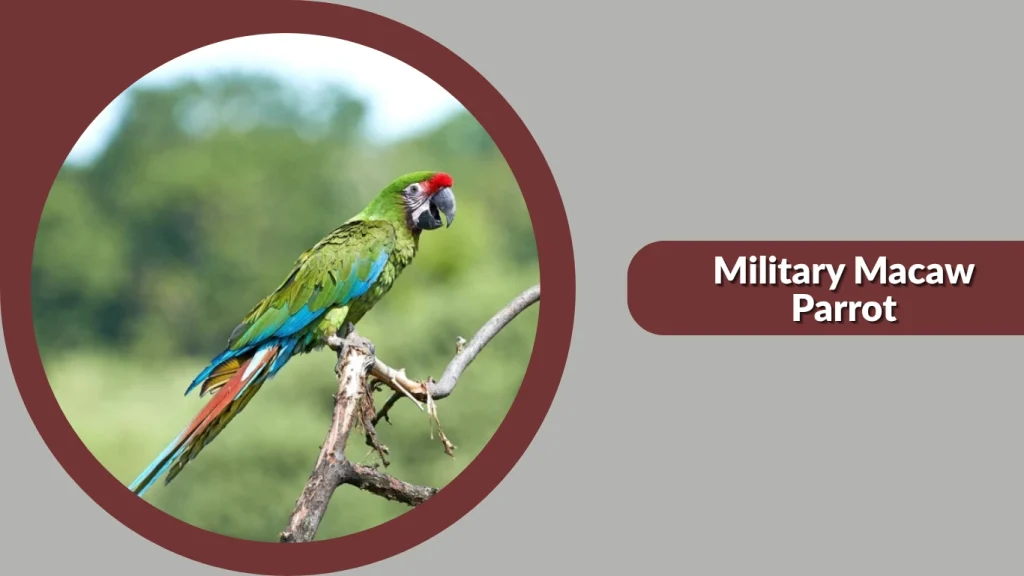
The Military Macaw (Ara militaris) is a medium to large parrot known for its predominantly green plumage and bold red forehead. Its name originates from the military-green coloration of its feathers. These birds inhabit forested areas and are more subtle in appearance compared to other macaws, yet still beautiful and intelligent.
Identification
- Body Length: 27 to 33 inches (70 to 85 cm)
- Wingspan: Approximately 40 inches (101 cm)
- Weight: 900 to 1,100 grams
- Color Pattern:
- Olive-green body
- Bright red forehead
- Blue flight feathers and tail tip
- Light blue on lower back
- Olive-green body
- Beak: Black, strong, and curved
- Eyes: Pale yellow
- Legs: Gray
Natural Habitat
Military Macaws inhabit subtropical and tropical forests, especially along mountain slopes and canyons. They are found in Mexico, Colombia, Venezuela, Ecuador, Bolivia, and Argentina, though populations are scattered and declining.
Behavior & Personality
They are intelligent, curious, and slightly quieter than other macaws. Known for their problem-solving skills, Military Macaws can form strong pair bonds and display loyal behavior toward mates or caretakers.
Diet and Feeding
These birds feed on seeds, fruits, berries, nuts, and various plant matter. In the wild, they travel in pairs or flocks to forage and are highly dependent on forest ecosystems.
6. Red-fronted Macaw Parrot
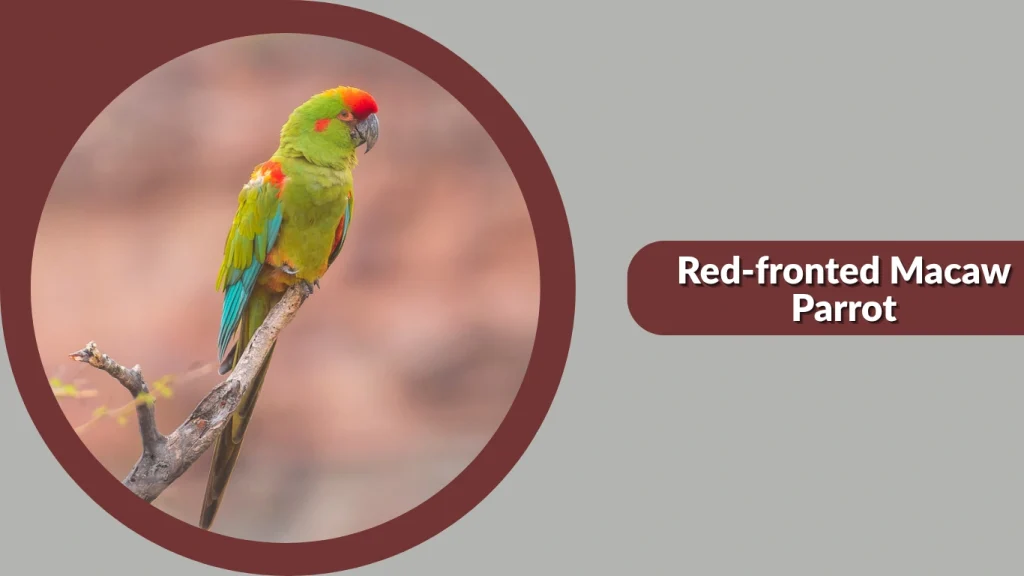
The Red-fronted Macaw (Ara rubrogenys) is a medium-sized macaw known for its distinctive red forehead and olive-green body. It is an endangered species endemic to a small region in Bolivia, where it inhabits arid, rocky valleys—an unusual habitat for a macaw.
Identification
- Body Length: 21 to 24 inches (53 to 60 cm)
- Wingspan: Around 30 inches (76 cm)
- Weight: 500 to 600 grams
- Color Pattern:
- Olive-green body
- Bright red forehead and front crown
- Red patches on shoulders and underwings
- Blue flight feathers and tail tip
- Olive-green body
- Beak: Pale gray to ivory
- Eyes: Orange to yellow in adults
- Legs: Gray
Natural Habitat
Unlike most macaws, the Red-fronted Macaw lives in semi-desert mountainous areas with cliffs and sparse vegetation. It is found only in a small region of south-central Bolivia.
Behavior & Personality
These birds are highly social and typically seen in small flocks. They form strong pair bonds and communicate with a variety of harsh screeches. Despite their dry habitat, they are highly dependent on seasonal fruits and crops, sometimes clashing with local agriculture.
Diet and Feeding
Their natural diet consists of cactus fruits, seeds, pods, and cultivated crops such as corn and peanuts. Due to habitat loss and limited food sources, their populations are under significant threat.
7. Great Green Macaw Parrot
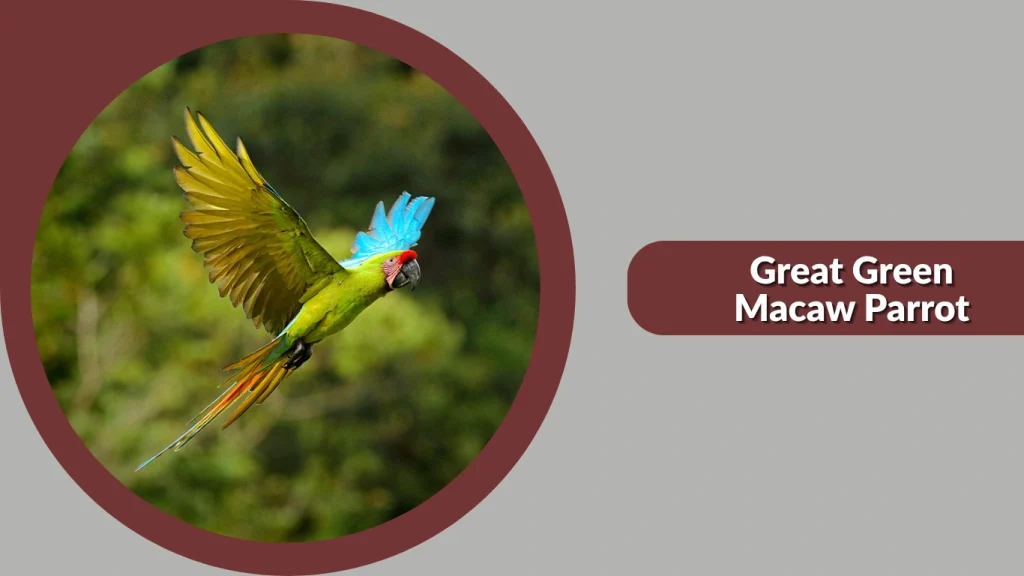
The Great Green Macaw (Ara ambiguus), also known as Buffon’s Macaw, is one of the largest macaw species. It is named for its mostly green plumage and is critically endangered due to habitat destruction in Central and South America.
Identification
- Body Length: 33 to 36 inches (85 to 91 cm)
- Wingspan: Approximately 44 to 48 inches (112 to 122 cm)
- Weight: 1,200 to 1,500 grams
- Color Pattern:
- Bright green body
- Red forehead
- Blue lower back, flight feathers, and tail tip
- Pink facial skin with red feather lines
- Bright green body
- Beak: Large and black
- Eyes: Yellow in adults
- Legs: Gray
Natural Habitat
This macaw inhabits humid tropical lowland forests, especially in tall emergent trees of Costa Rica, Nicaragua, Colombia, Ecuador, and western Panama. It is highly dependent on specific tree species for nesting.
Behavior & Personality
Great Green Macaws are intelligent and social, usually forming monogamous pairs or small family groups. They have a powerful voice and often call while flying. Their survival depends on unbroken forest canopy and specific nesting trees.
Diet and Feeding
Their diet includes seeds, fruits, nuts, and especially almonds from the mountain almond tree (Dipteryx panamensis). The decline of this key food source is one of the primary reasons for their endangered status.
8. Blue-headed Parrot
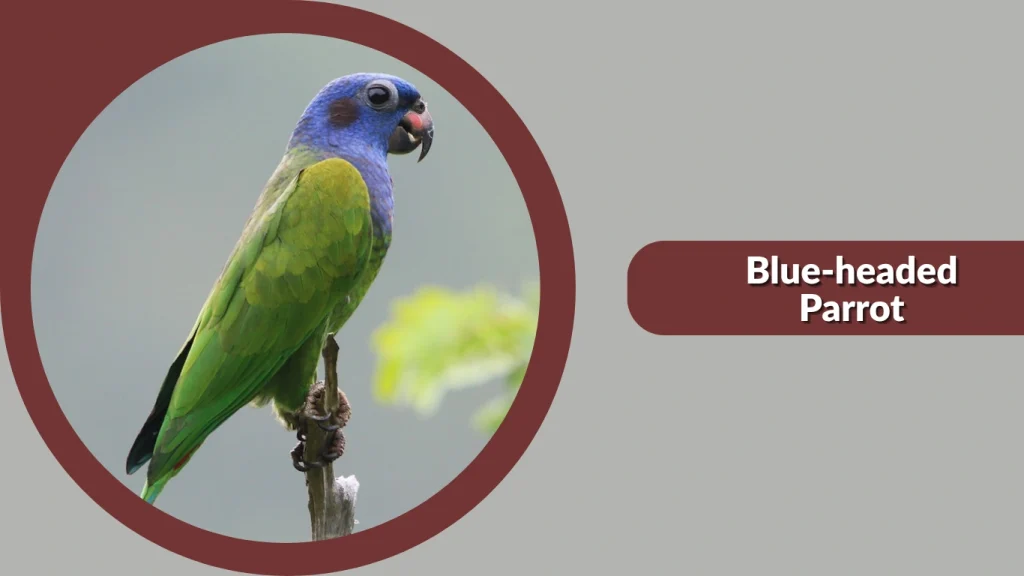
The Blue-headed Parrot (Pionus menstruus) is a medium-sized parrot recognized by its vivid blue head contrasting with a green body. Native to Central and South America, it is a popular companion bird due to its calm temperament and adaptability.
Identification
- Body Length: 11 to 12 inches (28 to 30 cm)
- Wingspan: Around 18 inches (45 cm)
- Weight: 220 to 290 grams
- Color Pattern:
- Deep blue head and neck
- Green body and wings
- Red under tail coverts
- Blue tinge on chest and tail
- Deep blue head and neck
- Beak: Gray with a slight orange tint at the base
- Eyes: Dark brown with white eye rings
- Legs: Gray
Natural Habitat
Blue-headed Parrots inhabit tropical lowland forests, river edges, plantations, and open woodlands. They are widespread in countries such as Costa Rica, Brazil, Colombia, and Ecuador.
Behavior & Personality
These parrots are intelligent, quiet, and less demanding compared to larger parrot species. They form small flocks in the wild and communicate using soft calls. They are playful but not overly vocal, making them suitable for quieter environments.
Diet and Feeding
They eat a wide range of seeds, fruits, berries, and blossoms. In captivity, a balanced diet includes pellets, fresh fruits, vegetables, and occasional nuts.
9. Sun Conure
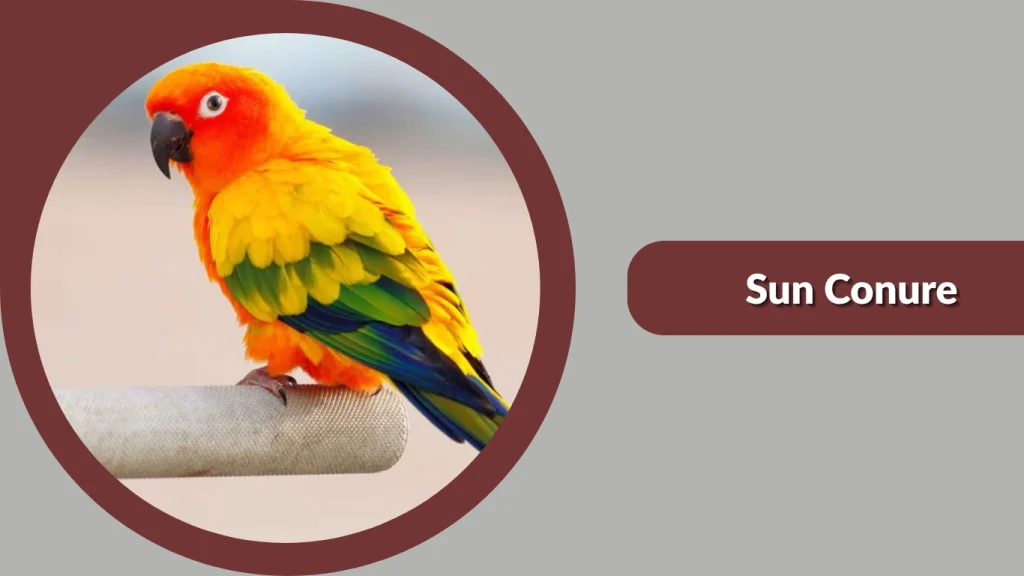
The Sun Conure (Aratinga solstitialis), also known as the Sun Parakeet, is a small, brilliantly colored parrot famous for its striking yellow-orange plumage and affectionate nature. It is native to northeastern South America and is a favorite among bird enthusiasts.
Identification
- Body Length: 11 to 12 inches (28 to 30 cm)
- Wingspan: Around 20 inches (50 cm)
- Weight: 100 to 130 grams
- Color Pattern:
- Bright yellow body
- Orange-red face and belly
- Green on wings and tail
- Blue flight feathers
- Bright yellow body
- Beak: Black and curved
- Eyes: Dark brown
- Legs: Gray
Natural Habitat
Sun Conures inhabit tropical forests, coastal woodlands, and savannas of northeastern South America, particularly in countries like Brazil, Guyana, and Venezuela.
Behavior & Personality
They are extremely social, playful, and affectionate birds, often forming strong bonds with humans. However, they are also very loud and vocal, with a high-pitched call used to maintain flock contact.
Diet and Feeding
Their diet includes fruits, seeds, nuts, flowers, and insects. In captivity, they require a balanced mix of formulated pellets, fruits, vegetables, and occasional seeds.
10. Jenday Conure

The Jenday Conure (Aratinga jandaya) is a small and vividly colored parrot known for its close resemblance to the Sun Conure. It is native to northeastern Brazil and is admired for its bold orange, green, and yellow plumage.
Identification
- Body Length: 11 to 12 inches (28 to 30 cm)
- Wingspan: Around 6 inches (15 cm) across each wing
- Weight: 120 to 140 grams
- Color Pattern:
- Bright orange head and upper chest
- Yellow lower chest and belly
- Green wings and back
- Blue flight feathers and tail tip
- Bright orange head and upper chest
- Beak: Black, curved
- Eyes: Dark with white eye rings
- Legs: Gray
Natural Habitat
Jenday Conures inhabit forests, woodlands, and transitional zones near northeastern Brazil. They are typically seen in pairs or small groups.
Behavior & Personality
They are energetic, affectionate, and love to engage in human interaction. Jenday Conures are also noisy birds, often emitting high-pitched squawks to communicate within flocks.
Diet and Feeding
They feed on seeds, fruits, nuts, berries, and blossoms. In captivity, a mix of pellets, fruits, leafy greens, and seeds keeps them healthy and active.
11. Nanday Conure
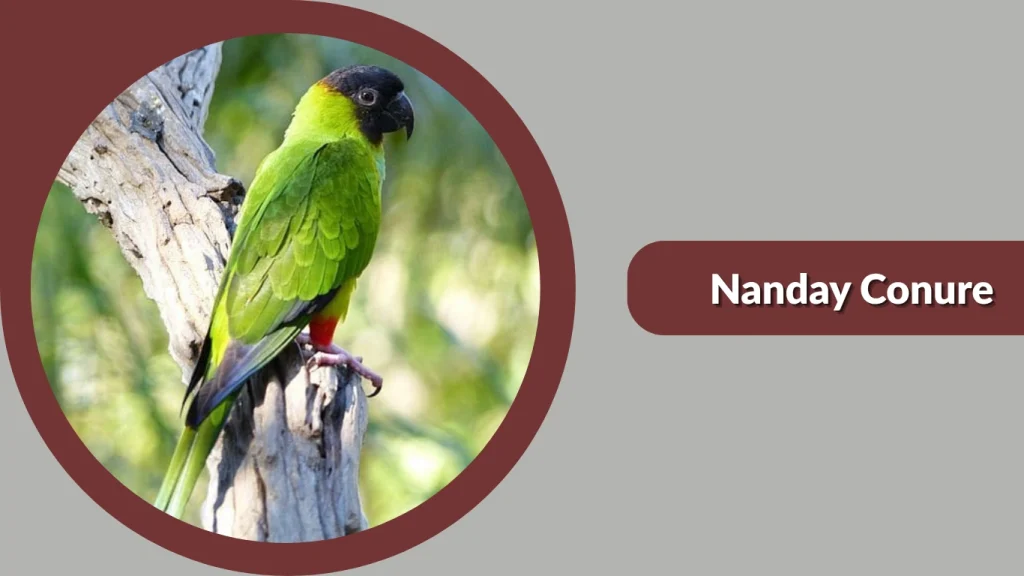
The Nanday Conure (Aratinga nenday), also known as the Black-hooded Parakeet, is a striking medium-sized parrot recognized by its black facial mask. It is native to parts of South America and has established wild flocks in Florida and California.
Identification
- Body Length: 11 to 12 inches (28 to 30 cm)
- Wingspan: Around 18 inches (45 cm)
- Weight: 120 to 150 grams
- Color Pattern:
- Bright green body
- Black head and face
- Blue-tinted flight feathers
- Red patches on legs
- Long blue-green tail
- Bright green body
- Beak: Large, black, and hooked
- Eyes: Brown with white eye rings
- Legs: Gray
Natural Habitat
They live in savannas, palm groves, open forests, and urban areas across Paraguay, Argentina, and Bolivia. Escaped pets have also created feral populations in the U.S.
Behavior & Personality
Nanday Conures are intelligent, noisy, and curious. They enjoy climbing and exploring and tend to bond strongly with one person. Though loud, they can mimic words and sounds.
Diet and Feeding
Their wild diet consists of seeds, berries, fruits, and agricultural crops. In captivity, they need pellets, fresh fruits, vegetables, and nuts to maintain nutrition.
12. Rainbow Lorikeet
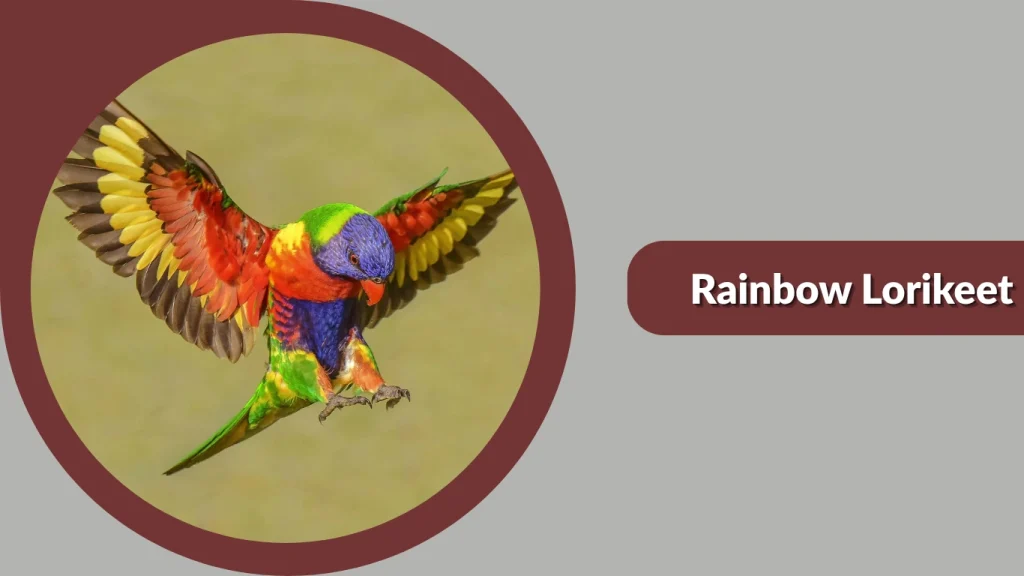
The Rainbow Lorikeet (Trichoglossus moluccanus) is one of the most colorful parrots in the world, featuring a vibrant mix of blue, green, red, yellow, and orange plumage. Native to Australia and nearby islands, this energetic bird is known for its playful nature and brush-tipped tongue used to feed on nectar.
Identification
- Body Length: 10 to 12 inches (25 to 30 cm)
- Wingspan: Around 6 to 7 inches (15 to 18 cm) per wing
- Weight: 120 to 150 grams
- Color Pattern:
- Deep blue head and belly
- Bright orange-red breast
- Yellow-green collar
- Green wings, back, and tail
- Red-orange beak
- Deep blue head and belly
- Beak: Curved and reddish-orange
- Eyes: Reddish with dark pupils
- Legs: Gray
Natural Habitat
Rainbow Lorikeets are found along the eastern seaboard of Australia, from northern Queensland to South Australia, as well as in Indonesia, Papua New Guinea, and parts of the Pacific Islands. They favor rainforests, coastal bushlands, and suburban gardens.
Behavior & Personality
These parrots are highly social and usually travel in pairs or noisy flocks. Known for their acrobatics and curiosity, Rainbow Lorikeets are also bold and unafraid of human presence. Their constant activity and loud calls make them a vibrant addition to the canopy or backyard.
Diet and Feeding
Rainbow Lorikeets have specialized brush-tipped tongues for feeding on nectar and pollen from flowers. They also consume soft fruits like papaya, mango, apples, and berries. In captivity, they require a nectar replacement diet along with fresh fruits and vegetables.
13. Red-collared Lorikeet
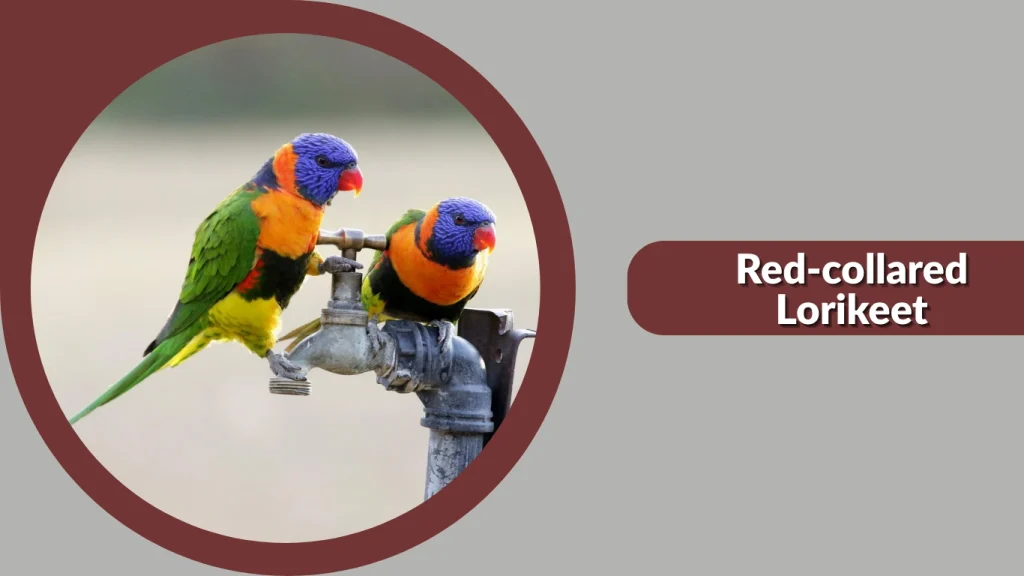
The Red-collared Lorikeet (Trichoglossus rubritorquis) is a close relative of the Rainbow Lorikeet but distinguished by the striking red band around its neck. It is native to northern Australia and is often seen in woodlands and savannas.
Identification
- Body Length: 10 to 12 inches (25 to 30 cm)
- Wingspan: Approximately 6.5 inches (17 cm) per wing
- Weight: 120 to 160 grams
- Color Pattern:
- Blue head and belly
- Bright orange-red breast
- Distinct red collar behind the head
- Green wings, back, and tail
- Orange-red beak
- Blue head and belly
- Beak: Curved and orange-red
- Eyes: Orange-red
- Legs: Gray
Natural Habitat
Red-collared Lorikeets inhabit northern Australia, particularly in eucalyptus woodlands, coastal forests, and savannas. They are commonly found from the Kimberley region across to Queensland.
Behavior & Personality
Highly active and vocal, these lorikeets often form large, noisy flocks. They are known for their rapid, acrobatic flight and strong bonding with mates. In urban areas, they readily adapt to garden feeders and flowering trees.
Diet and Feeding
They rely primarily on nectar and pollen, using their specialized tongues. They also eat soft fruits, blossoms, and occasionally insects. In captivity, a formulated lorikeet diet and fresh fruit are essential for their health.
14. Scaly-breasted Lorikeet
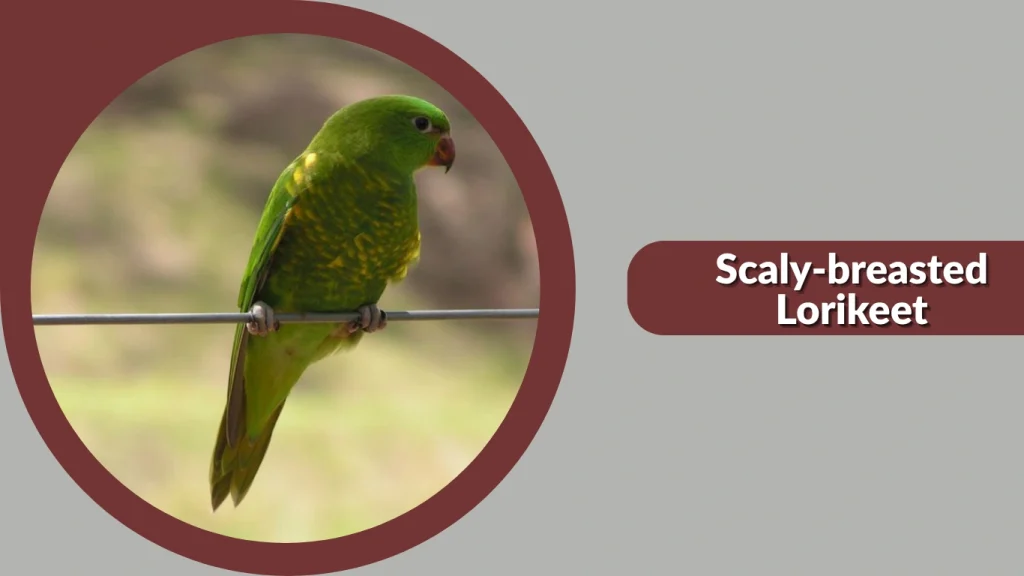
The Scaly-breasted Lorikeet (Trichoglossus chlorolepidotus) is a medium-sized parrot known for its bright green plumage and distinctive yellow scalloped markings on the chest and neck. Native to eastern Australia, it is often found feeding in flowering trees and gardens.
Identification
- Body Length: 9 to 10 inches (23 to 26 cm)
- Wingspan: Approximately 6 inches (15 cm) per wing
- Weight: 85 to 110 grams
- Color Pattern:
- Bright green body and wings
- Yellow “scaly” markings on chest, neck, and face
- Red-orange beak
- Blue tinge around the vent area
- Bright green body and wings
- Beak: Curved, reddish-orange
- Eyes: Orange-red
- Legs: Gray
Natural Habitat
Scaly-breasted Lorikeets inhabit open forests, woodlands, and urban parks along the eastern coast of Australia, especially in Queensland and New South Wales. They are often seen in flowering eucalyptus trees.
Behavior & Personality
They are highly active, social birds that often travel in pairs or noisy flocks. Their high-pitched calls and fast, direct flight make them noticeable in both rural and urban settings. Scaly-breasted Lorikeets are also very playful and can become tame around humans.
Diet and Feeding
Their diet consists mainly of nectar and pollen, complemented by fruits, berries, and blossoms. They forage acrobatically in tree canopies, often hanging upside down to reach flowers.
15. Dusky Lory
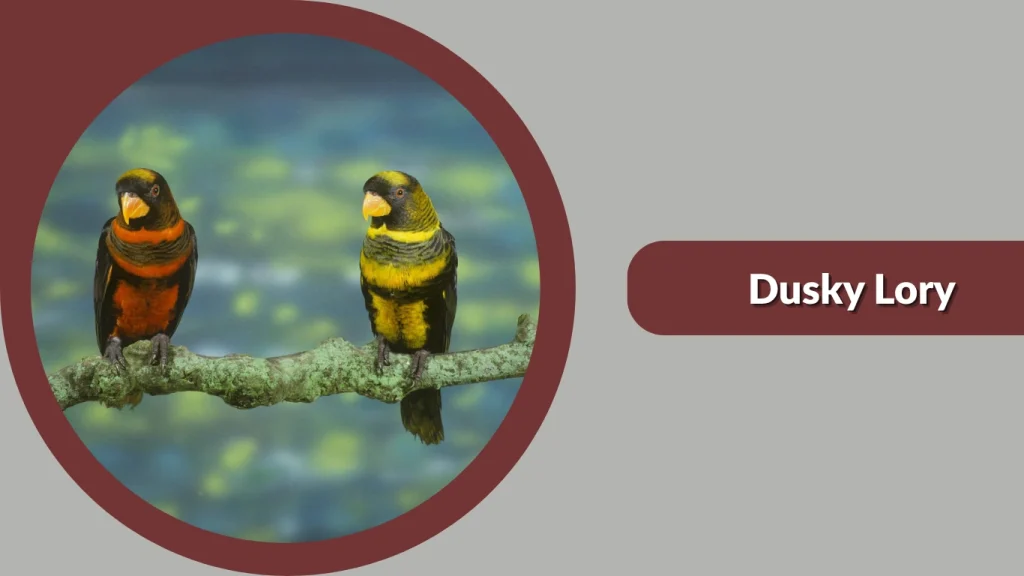
The Dusky Lory (Pseudeos fuscata) is a medium-sized parrot known for its dark, earthy-toned plumage and vibrant orange highlights. Native to New Guinea and surrounding islands, this lory stands out for its color variation and lively personality.
Identification
- Body Length: 9 to 10 inches (23 to 26 cm)
- Wingspan: Around 14 to 16 inches (35 to 40 cm)
- Weight: 200 to 250 grams
- Color Pattern:
- Chocolate-brown head, back, and chest
- Orange and yellow underparts
- Bright orange wing patches
- Dark bluish or purplish undertones
- Chocolate-brown head, back, and chest
- Beak: Bright orange
- Eyes: Reddish-orange
- Legs: Gray to dark gray
Natural Habitat
Dusky Lories inhabit tropical and subtropical lowland forests, forest edges, and plantations in New Guinea and nearby islands. They are often found in small groups or flocks feeding on flowering trees.
Behavior & Personality
They are highly energetic, playful, and inquisitive parrots. Known for their clown-like antics, Dusky Lories are social and vocal, making a variety of squawks and whistles. Their intelligence and curiosity make them engaging companions, though they require lots of mental stimulation.
Diet and Feeding
Dusky Lories primarily feed on nectar, pollen, and soft fruits. They use their specialized brush-tipped tongues to extract nectar from flowers. In captivity, they need a nectar-based diet and should not be given standard parrot seeds.
16. Chattering Lory

The Chattering Lory (Lorius garrulus) is a medium-sized, vibrantly colored parrot known for its brilliant red plumage and loud, expressive voice. Native to Indonesia’s northern Maluku Islands, this species is endangered due to habitat loss and the pet trade.
Identification
- Body Length: 12 inches (30 cm)
- Wingspan: Around 18 inches (45 cm)
- Weight: 200 to 250 grams
- Color Pattern:
- Deep crimson red head, chest, and underparts
- Green wings and back
- Yellow on wing bends
- Dark blue on lower back and thighs
- Deep crimson red head, chest, and underparts
- Beak: Bright orange
- Eyes: Orange-red
- Legs: Gray
Natural Habitat
Chattering Lories inhabit lowland tropical forests, coconut plantations, and secondary growth across Halmahera and other northern Maluku Islands. They prefer areas rich in flowering and fruiting trees.
Behavior & Personality
As their name suggests, these lories are extremely vocal, often producing chattering, whistling, and screeching sounds. They are affectionate, playful, and thrive on interaction. Their intelligence and energy make them entertaining but demanding pets.
Diet and Feeding
They feed mainly on nectar, pollen, fruits, and flowers. In captivity, they require a specialized nectar-based diet, supplemented with fresh soft fruits such as papaya, banana, grapes, and mango.
17. Black-capped Lory

The Black-capped Lory (Lorius lory) is a striking parrot known for its glossy black cap and vivid red, purple, and blue body. It is one of the most colorful and heavily patterned lories, native to the lowland forests of New Guinea.
Identification
- Body Length: 12 inches (30 cm)
- Wingspan: Around 16 to 18 inches (40 to 46 cm)
- Weight: 250 to 280 grams
- Color Pattern:
- Shiny black head and crown
- Deep red neck, chest, and belly
- Violet-blue lower belly
- Green and blue wings
- Yellow underwing coverts
- Shiny black head and crown
- Beak: Bright orange
- Eyes: Orange
- Legs: Dark gray
Natural Habitat
These lories are found in lowland rainforests and coastal forests throughout western and central New Guinea and nearby islands. They are typically seen in small, noisy flocks.
Behavior & Personality
Black-capped Lories are intelligent, playful, and very vocal. They are known to mimic sounds and engage in interactive behavior. Their affectionate and active nature requires enrichment, socialization, and space to thrive.
Diet and Feeding
Their diet consists primarily of nectar and pollen, supplemented with tropical fruits, berries, and blossoms. In captivity, they need a nectar replacement diet along with fresh fruits and soft vegetables daily. Avoid seeds and hard nuts, which can harm their digestive systems.
18. Eclectus Parrot
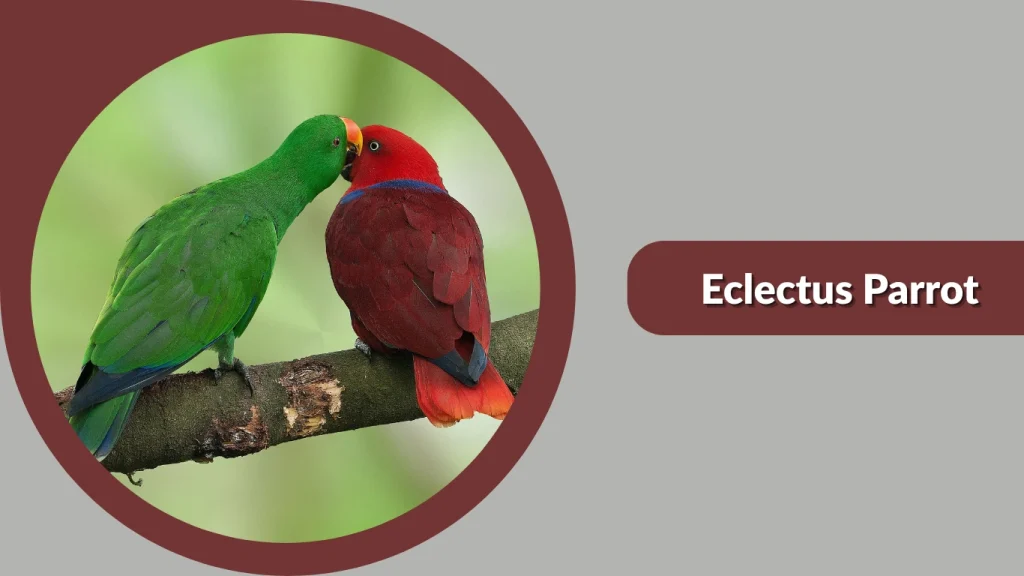
The Eclectus Parrot (Eclectus roratus) is one of the most sexually dimorphic parrot species, meaning males and females look strikingly different. Males are bright green, while females are deep red and purple. Native to the Solomon Islands, New Guinea, northeastern Australia, and nearby islands, this parrot is not only beautiful but also gentle and intelligent.
Identification
- Body Length: 17 to 20 inches (43 to 51 cm)
- Wingspan: Around 28 inches (71 cm)
- Weight: 380 to 600 grams
- Color Pattern:
- Male: Bright green body, red and blue flanks, orange upper beak
- Female: Crimson red head and body, dark blue to purple belly, black beak
- Male: Bright green body, red and blue flanks, orange upper beak
- Beak: Males have bright orange/yellow beaks, females have black
- Eyes: Yellowish to orange in adults
- Legs: Gray
Natural Habitat
Eclectus Parrots inhabit rainforests, forest edges, and coastal scrublands. They are found throughout the Solomon Islands, parts of Indonesia, Papua New Guinea, and northern Australia, especially in tall canopy forests.
Behavior & Personality
These parrots are calm, thoughtful, and known for their quiet intelligence. They are less noisy than other parrots and communicate using soft, expressive calls. Eclectus Parrots are sensitive and do best in peaceful environments.
Diet and Feeding
Their diet includes a variety of tropical fruits, leafy greens, flowers, buds, and seeds. In captivity, they require a high-fiber, low-fat diet rich in fresh fruits, vegetables, and sprouted grains.
19. Alexandrine Parakeet

The Alexandrine Parakeet (Psittacula eupatria) is a large parakeet known for its green body, long tail, and distinctive maroon shoulder patches. Named after Alexander the Great, who introduced them to Europe, they are native to the Indian subcontinent and parts of Southeast Asia.
Identification
- Body Length: 22 to 24 inches (56 to 61 cm), including long tail
- Wingspan: Around 6 to 7 inches (15 to 18 cm) per wing
- Weight: 200 to 300 grams
- Color Pattern:
- Green body with blue-gray sheen on cheeks
- Maroon shoulder patches
- Pinkish-black neck ring (in mature males)
- Yellow-green tail with blue hues
- Green body with blue-gray sheen on cheeks
- Beak: Large, red-orange
- Eyes: Pale yellow
- Legs: Gray
Natural Habitat
They inhabit forests, agricultural lands, urban parks, and gardens across India, Sri Lanka, Nepal, Pakistan, Myanmar, and parts of Southeast Asia. They have also established feral populations in several European and Middle Eastern cities.
Behavior & Personality
Alexandrine Parakeets are intelligent, alert, and capable of mimicry. They form strong bonds with their owners and can be affectionate but need early socialization. They are also active flyers and require ample space.
Diet and Feeding
They feed on fruits, seeds, nuts, flowers, grains, and cultivated crops. In captivity, a varied diet of fresh vegetables, fruits, pellets, and sprouted seeds is essential for their health.
20. Indian Ringneck Parakeet
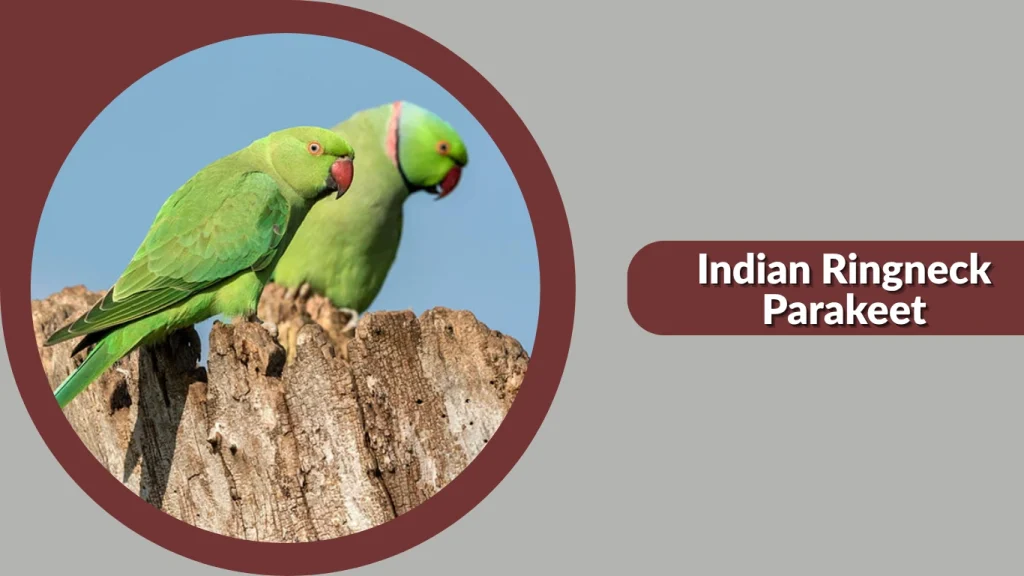
The Indian Ringneck Parakeet (Psittacula krameri) is a medium-sized parrot known for its elegant appearance, talking ability, and distinct neck ring. Native to the Indian subcontinent, it is a popular pet and has also formed feral colonies around the world.
Identification
- Body Length: 16 inches (40 cm), including tail
- Wingspan: Approximately 6 to 7 inches (15 to 18 cm) per wing
- Weight: 120 to 140 grams
- Color Pattern:
- Bright green body
- Males have a black and pink neck ring
- Long, pointed green tail
- Red beak with slight orange tint
- Bright green body
- Beak: Curved, red
- Eyes: Pale yellow
- Legs: Gray
Natural Habitat
Indian Ringnecks inhabit forests, farmlands, and urban gardens across India, Pakistan, Nepal, and Bangladesh. Feral populations are now found in the UK, the Middle East, and the U.S.
Behavior & Personality
They are intelligent, independent, and excellent talkers. These birds are active and curious, with a playful but sometimes aloof temperament. They do best with consistent handling and interaction.
Diet and Feeding
They consume fruits, seeds, grains, berries, and blossoms. In captivity, they thrive on pellets, fresh fruits, leafy greens, and occasional seeds.
21. Plum-headed Parakeet
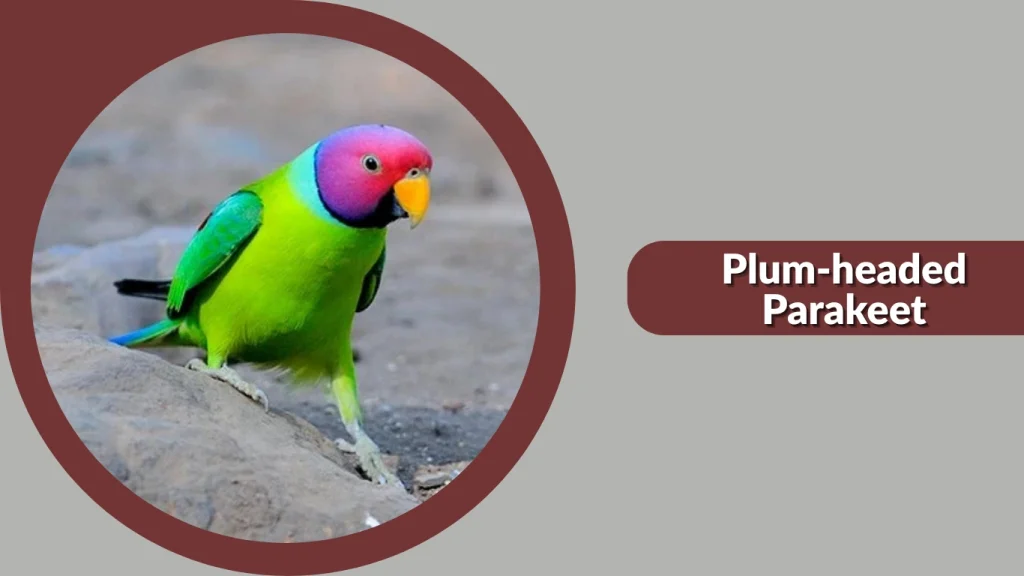
The Plum-headed Parakeet (Psittacula cyanocephala) is a slender, graceful parrot native to the Indian subcontinent, known for the male’s rich plum-purple head and elegant green body. It is quieter than many other parakeets and valued for its gentle temperament.
Identification
- Body Length: 13 inches (33 cm), including tail
- Wingspan: Around 16 inches (40 cm)
- Weight: 60 to 80 grams
- Color Pattern:
- Male: Plum-colored head, bluish nape, green body
- Female: Grayish-blue head with less vibrant tones
- Red shoulder patches
- Yellow-green tail with blue tips
- Male: Plum-colored head, bluish nape, green body
- Beak: Orange-red
- Eyes: Pale yellow
- Legs: Gray
Natural Habitat
Plum-headed Parakeets are found in forests, groves, and farmlands across India, Nepal, Bhutan, and Sri Lanka. They are also common in rural and suburban areas.
Behavior & Personality
These parakeets are calm, social, and not overly noisy. They bond well with humans when raised with care and are capable of mimicking a few words or sounds. Their quieter nature makes them ideal for calm environments.
Diet and Feeding
They feed on fruits, seeds, berries, grains, and blossoms. In captivity, a diet of pellets, fresh fruits, vegetables, and minimal seeds supports their health and feather condition.
22. Rosy-faced Lovebird

The Rosy-faced Lovebird (Agapornis roseicollis), also known as the Peach-faced Lovebird, is a small, vividly colored parrot recognized for its rosy-pink face and energetic personality. Native to arid regions of southwestern Africa, it’s one of the most popular lovebirds in aviculture.
Identification
- Body Length: 6 to 7 inches (15 to 18 cm)
- Wingspan: Around 4 inches (10 cm) per wing
- Weight: 45 to 60 grams
- Color Pattern:
- Bright green body
- Peach to rosy-pink face and upper chest
- Blue lower back and rump
- Tail with blue and green hues
- Bright green body
- Beak: Ivory-colored, slightly hooked
- Eyes: Brown
- Legs: Gray
Natural Habitat
These lovebirds inhabit dry savannas, scrublands, and woodlands of southwestern Africa, especially Angola and Namibia. They adapt well to arid climates and are often seen around water sources.
Behavior & Personality
Rosy-faced Lovebirds are social, noisy, and highly active. They thrive in pairs or small flocks and form strong pair bonds. Though small, they have bold personalities and require mental stimulation and interaction.
Diet and Feeding
They consume seeds, berries, fruits, and vegetation. In captivity, a balanced mix of small seeds, pellets, chopped vegetables, and fruits is essential for health.
23. Fischer’s Lovebird
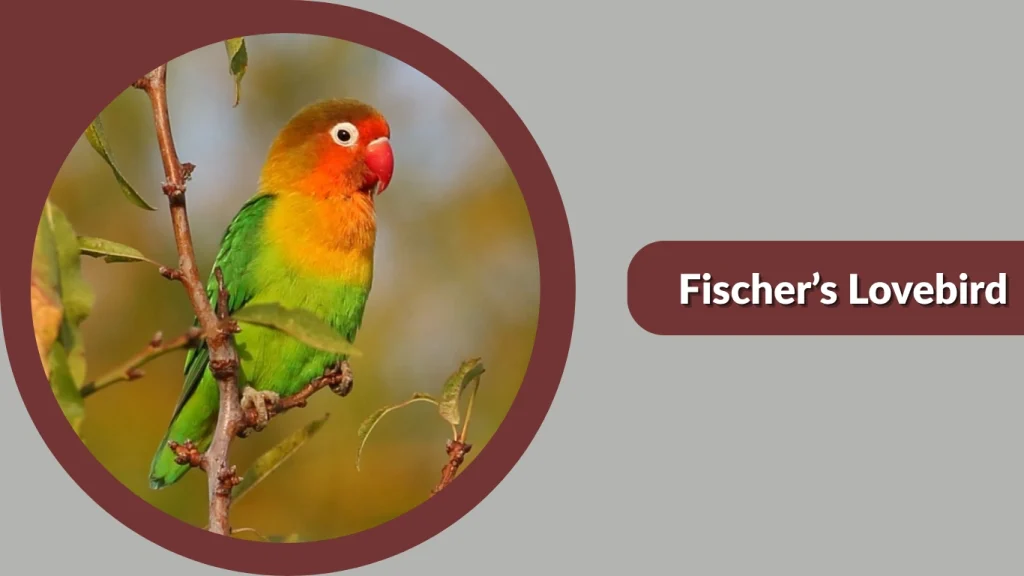
Fischer’s Lovebird (Agapornis fischeri) is a brightly colored, small parrot native to central Africa. It is easily recognized by its orange face, green body, and blue tail. These birds are affectionate, energetic, and extremely popular among bird keepers.
Identification
- Body Length: 5.5 to 6 inches (14 to 15 cm)
- Wingspan: Around 4 inches (10 cm) per wing
- Weight: 40 to 55 grams
- Color Pattern:
- Orange face and throat
- Green body and wings
- Blue lower back and tail
- Yellowish upper chest
- Orange face and throat
- Beak: Red, slightly curved
- Eyes: Brown with white eye-rings
- Legs: Gray
Natural Habitat
Fischer’s Lovebirds are found in grasslands and savanna regions of northern Tanzania. They gather in flocks and are dependent on water, often found near streams and watering holes.
Behavior & Personality
They are highly social and often kept in pairs to prevent loneliness. Fischer’s Lovebirds are playful, vocal, and bond closely with mates. Without enough stimulation, they may become territorial or anxious.
Diet and Feeding
Their diet includes seeds, fruits, vegetables, and flowers. In captivity, a seed and pellet base diet supplemented with leafy greens, corn, apples, and berries keeps them healthy and active.
24. Masked Lovebird
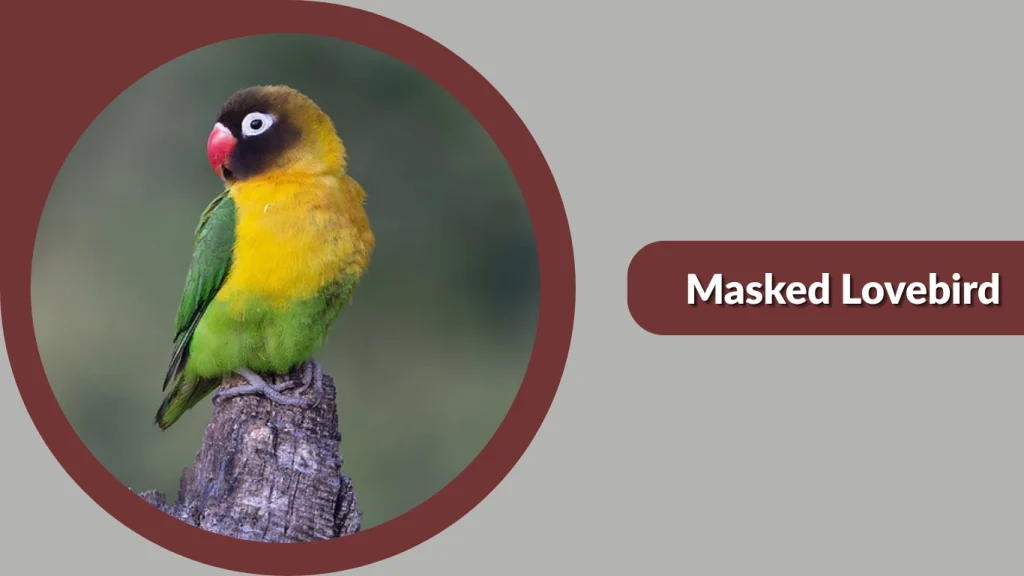
The Masked Lovebird (Agapornis personatus), also called the Yellow-collared Lovebird, is a small parrot species named for its jet-black facial mask. Native to northeastern Tanzania, this species is widely bred in captivity and admired for its striking contrast in colors.
Identification
- Body Length: 5.5 to 6 inches (14 to 15 cm)
- Wingspan: Around 4 inches (10 cm) per wing
- Weight: 40 to 55 grams
- Color Pattern:
- Black head and face
- Bright yellow collar and chest
- Green body and wings
- Blue rump
- Black head and face
- Beak: Red, short, and curved
- Eyes: Brown with bold white eye-rings
- Legs: Gray
Natural Habitat
Masked Lovebirds inhabit dry savanna and woodland areas in northeastern Tanzania. They prefer regions near water and have also adapted to agricultural lands and villages.
Behavior & Personality
These birds are lively, social, and can be quite noisy. They are affectionate in pairs and often observed engaging in mutual preening. In groups, they show strong social bonds and enjoy climbing, chewing, and exploring.
Diet and Feeding
They feed on grass seeds, fruits, vegetables, and grains. Captive diets should include small parrot pellets, millet, sprouted seeds, and chopped fruits and greens.
25. Peach-faced Lovebird
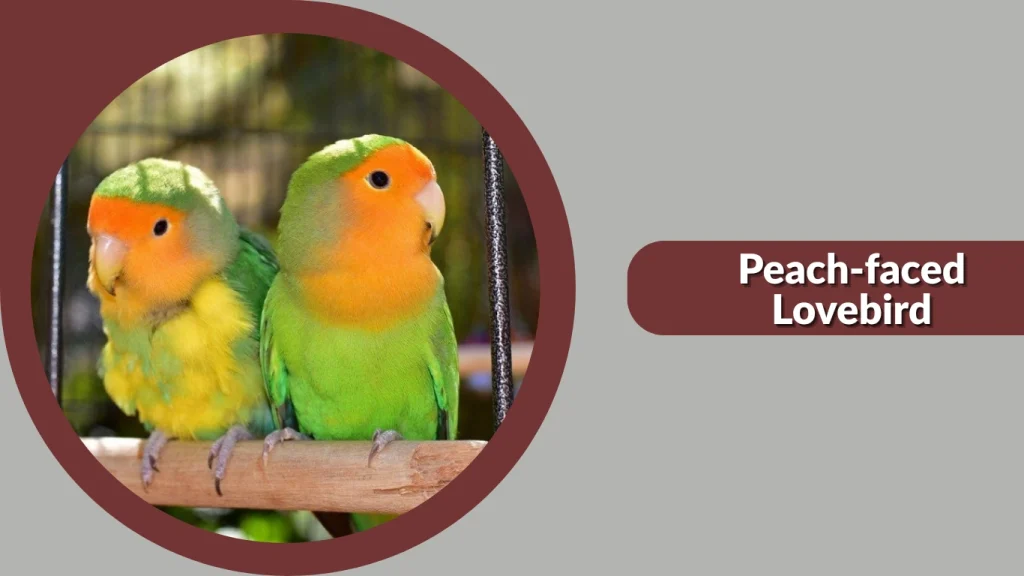
The Peach-faced Lovebird (Agapornis roseicollis), a common name variant of the Rosy-faced Lovebird, is known for its colorful plumage and strong pair bonding. It is one of the most widely bred lovebird species.
Identification
- Body Length: 6 to 7 inches (15 to 18 cm)
- Wingspan: Around 10 inches (25 cm)
- Weight: 45 to 60 grams
- Color Pattern:
- Bright green body
- Peach to pink face
- Blue rump and tail highlights
- Variable mutations in captivity (e.g., lutino, blue, pied)
- Bright green body
- Beak: Ivory or horn-colored
- Eyes: Dark brown
- Legs: Gray
Natural Habitat
Native to the dry areas of southwestern Africa, including Angola and Namibia, they thrive in desert edges and dry shrublands and are also common in urban areas.
Behavior & Personality
These lovebirds are highly social and thrive with interaction. Though small, they are bold, active, and known for their strong personalities. Without a mate or enough stimulation, they may become noisy or destructive.
Diet and Feeding
Their diet includes seeds, berries, fruit, and greens. In captivity, they require a mix of high-quality pellets, millet, chopped vegetables, and fruits for optimal health.
26. Red-lored Amazon

The Red-lored Amazon (Amazona autumnalis) is a medium-sized Amazon parrot known for its vivid green plumage and characteristic red patch on the forehead. Native to Central and South America, it is highly intelligent and social.
Identification
- Body Length: 12 to 13 inches (30 to 34 cm)
- Wingspan: Around 16 to 18 inches (40 to 46 cm)
- Weight: 310 to 480 grams
- Color Pattern:
- Green body
- Bright red patch on the forehead
- Yellow cheeks
- Blue streaks behind the eyes
- Red and blue in flight feathers
- Green body
- Beak: Horn-colored
- Eyes: Orange-red
- Legs: Gray
Natural Habitat
They inhabit lowland forests, woodlands, and mangroves across eastern Mexico, Central America, and northern South America. They prefer areas with abundant fruiting trees.
Behavior & Personality
Red-lored Amazons are intelligent, social, and can mimic human speech well. They bond closely with caretakers and thrive in enriched environments. While generally calm, they can be assertive if bored or neglected.
Diet and Feeding
Their diet includes fruits, seeds, nuts, berries, and blossoms. In captivity, offer pellets, leafy greens, sweet fruits, and minimal sunflower or safflower seeds.
27. Blue-fronted Amazon
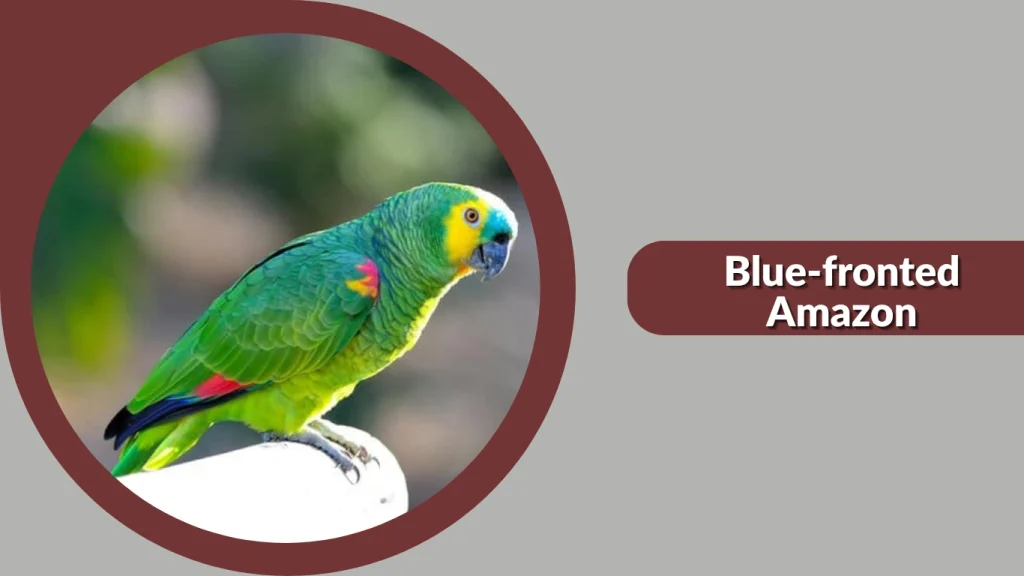
The Blue-fronted Amazon (Amazona aestiva) is one of the most popular Amazon parrots kept as a pet, named for the turquoise-blue patch on its forehead. Native to South America, it is known for its expressive personality and talking ability.
Identification
- Body Length: 15 to 17 inches (38 to 43 cm)
- Wingspan: Around 20 inches (50 cm)
- Weight: 300 to 550 grams
- Color Pattern:
- Bright green body
- Blue patch above the beak (forehead)
- Yellow cheeks and crown
- Red patches on wings
- Bright green body
- Beak: Black or grayish
- Eyes: Orange
- Legs: Gray
Natural Habitat
Found in savannas, forests, and palm groves of Brazil, Paraguay, Bolivia, and Argentina. They are often seen in flocks around fruiting trees and near rivers.
Behavior & Personality
Highly vocal, affectionate, and social, these parrots love attention and require stimulation. They are capable of mimicking speech and enjoy play and interaction with humans.
Diet and Feeding
They consume seeds, fruits, nuts, and vegetables. In captivity, a mix of pellets, fresh produce, legumes, and limited nuts ensures a balanced diet.
28. Yellow-headed Amazon
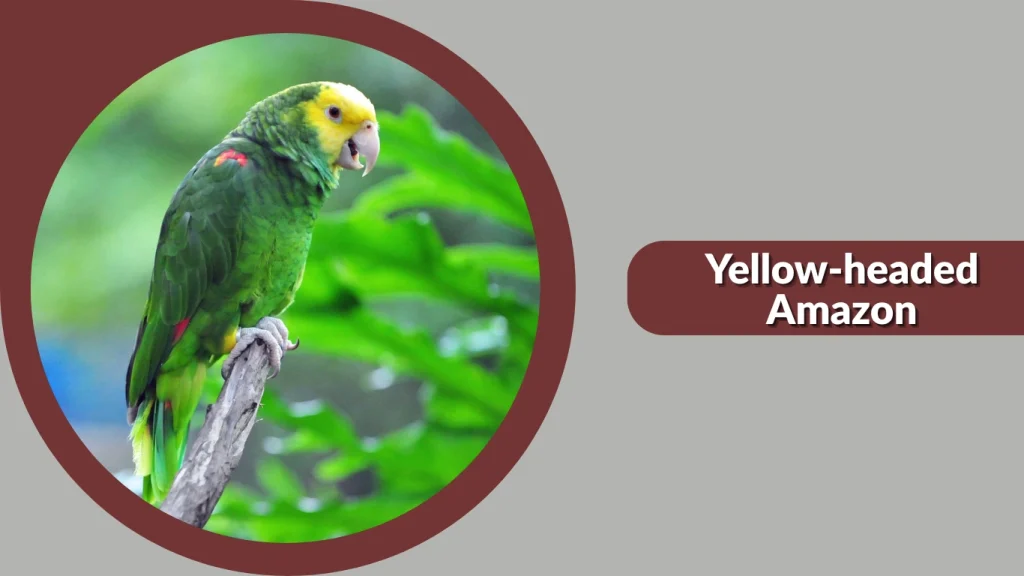
The Yellow-headed Amazon (Amazona oratrix) is a striking parrot species recognized for its vivid yellow head and strong vocal abilities. Native to Central America and parts of Mexico, it is considered one of the best talking parrots.
Identification
- Body Length: 15 to 17 inches (38 to 43 cm)
- Wingspan: Around 20 inches (50 cm)
- Weight: 400 to 500 grams
- Color Pattern:
- Bright green body
- Bright yellow head and neck
- Red wing speculum (visible during flight)
- Some blue tinges near tail and crown
- Bright green body
- Beak: Ivory-colored
- Eyes: Orange
- Legs: Gray
Natural Habitat
They are native to coastal mangroves, deciduous forests, and savanna regions of Mexico, Belize, and northern Honduras. Populations are declining due to habitat destruction and capture.
Behavior & Personality
Yellow-headed Amazons are affectionate, expressive, and highly intelligent. They form strong bonds with caregivers and have a wide vocal range, making them superb mimics. They need consistent social interaction and enrichment.
Diet and Feeding
They eat fruits, nuts, seeds, berries, and blossoms in the wild. In captivity, they need a variety of vegetables, fruits, pellets, and limited fatty seeds.
29. Lilac-crowned Amazon
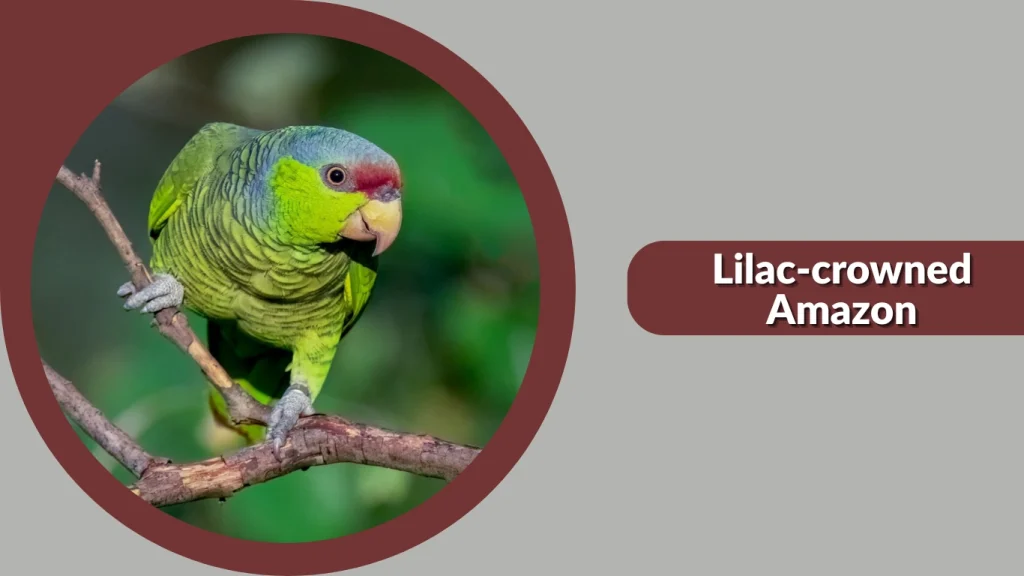
The Lilac-crowned Amazon (Amazona finschi) is a medium-sized Amazon parrot known for its lilac or purplish crown and mild temperament. Endemic to Mexico’s Pacific slopes, it is both a wild and companion species.
Identification
- Body Length: 13 to 14 inches (33 to 35 cm)
- Wingspan: Around 16 to 18 inches (40 to 46 cm)
- Weight: 300 to 400 grams
- Color Pattern:
- Green body
- Purple-lilac crown
- Maroon forehead
- Red edge on wings
- Blue tinge on cheeks
- Green body
- Beak: Pale horn-colored
- Eyes: Orange
- Legs: Gray
Natural Habitat
This species inhabits dry tropical forests, scrublands, and coastal woodlands along western Mexico. It often nests in tree cavities and forages in flocks.
Behavior & Personality
Lilac-crowned Amazons are gentle, quieter than other Amazons, and enjoy interacting with humans. They are playful and intelligent, though not as commonly kept as pets as their louder cousins.
Diet and Feeding
Their diet includes seeds, fruits, nuts, flowers, and vegetables. In captivity, a diet rich in pellets, fresh greens, and fruits like apples and bananas is ideal.
30. Mealy Amazon

The Mealy Amazon (Amazona farinosa) is one of the largest Amazon parrots, named for the “mealy” or powdery-white appearance on its green feathers. Native to Central and South America, it is a calm and quiet species despite its size.
Identification
- Body Length: 15 to 17 inches (38 to 43 cm)
- Wingspan: Around 20 inches (50 cm)
- Weight: 540 to 700 grams
- Color Pattern:
- Dull green body with whitish “mealy” bloom on the back and neck
- Blue and red hints on crown and tail
- Red patch on wing edge (less prominent than in other Amazons)
- Dull green body with whitish “mealy” bloom on the back and neck
- Beak: Horn-colored
- Eyes: Orange
- Legs: Gray
Natural Habitat
They are found in humid tropical forests, savannas, and secondary woodlands throughout Central America and the northern regions of South America, especially in the Amazon Basin.
Behavior & Personality
Mealy Amazons are known for their even temper and quiet nature. They can be affectionate and tolerant but still require social interaction and toys to prevent boredom. Though capable of speech, they are not as vocal as other Amazon species.
Diet and Feeding
Their natural diet includes fruits, seeds, berries, nuts, and leaves. In captivity, a balanced mix of formulated pellets, fresh vegetables, fruits, and occasional healthy seeds is ideal.
31. White-fronted Amazon
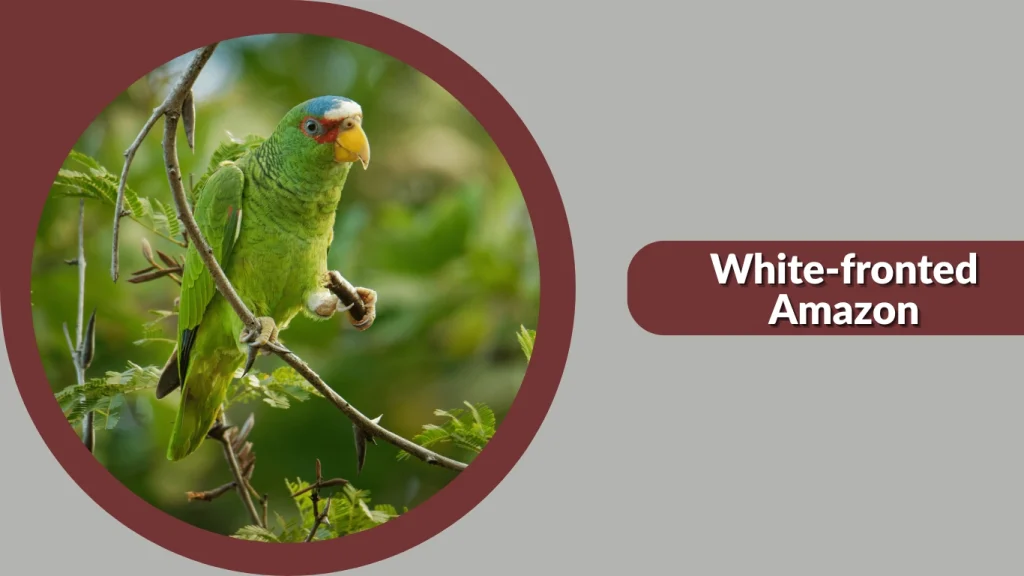
The White-fronted Amazon (Amazona albifrons), also called the White-fronted Parrot, is the smallest of the Amazon parrots. It is named for the white patch of feathers on its forehead and is native to Mexico and Central America.
Identification
- Body Length: 10 inches (26 cm)
- Wingspan: Around 14 to 16 inches (35 to 40 cm)
- Weight: 200 to 250 grams
- Color Pattern:
- Green body
- White forehead
- Red around the eyes and shoulders
- Blue on the crown
- Males have red on their wing bend, females typically do not
- Green body
- Beak: Horn-colored
- Eyes: Orange-yellow
- Legs: Gray
Natural Habitat
This parrot inhabits dry forests, open woodlands, and agricultural regions from western Mexico through Central America. It adapts well to semi-arid environments.
Behavior & Personality
White-fronted Amazons are social, energetic, and quick learners. They form tight pair bonds and can mimic sounds and words. They are often more active and playful than larger Amazons, making them suitable for smaller homes.
Diet and Feeding
Their diet includes seeds, berries, fruits, flowers, and some crops. In captivity, they thrive on pellets, fresh greens, apples, melons, and a variety of chopped vegetables.
32. Orange-winged Amazon
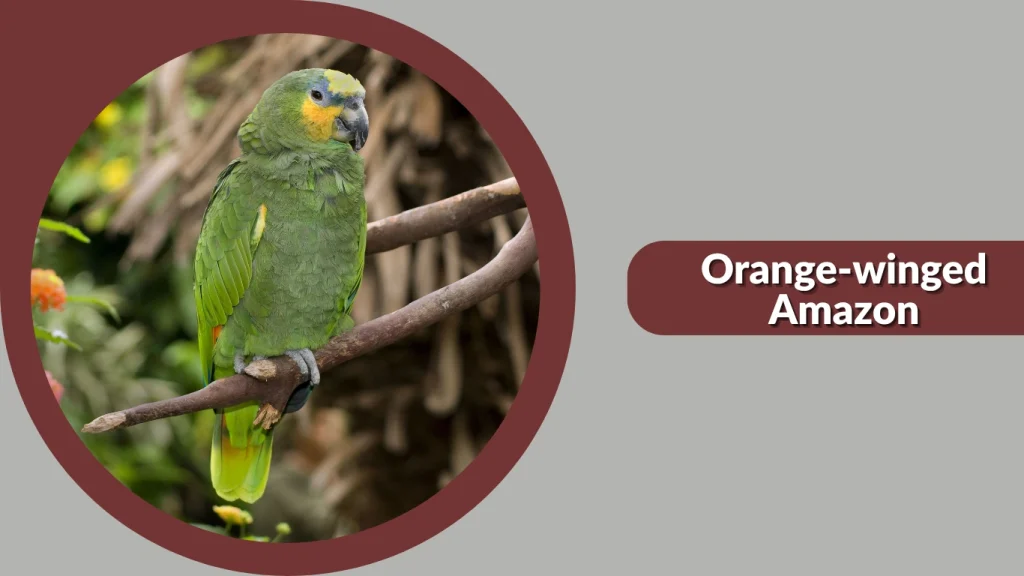
The Orange-winged Amazon (Amazona amazonica) is a medium-sized parrot known for the subtle orange patches on its wings and cheeks. Common throughout its range in South America, it’s a hardy, adaptable bird both in the wild and in captivity.
Identification
- Body Length: 12 to 13 inches (30 to 33 cm)
- Wingspan: Around 16 to 18 inches (40 to 46 cm)
- Weight: 340 to 490 grams
- Color Pattern:
- Green body
- Blue feathers on forehead and crown
- Orange on wings and underwings (often only visible in flight)
- Yellowish tint on cheeks
- Green body
- Beak: Grayish with horn-colored tip
- Eyes: Orange
- Legs: Gray
Natural Habitat
They inhabit forests, savannas, mangroves, and urban areas across northern and central South America, especially in the Amazon Basin and Guianas.
Behavior & Personality
Orange-winged Amazons are intelligent, moderately vocal, and often gentle. They may become noisy during breeding season but are typically easygoing. They are social birds that enjoy interaction and puzzle toys.
Diet and Feeding
Their natural diet includes fruits, nuts, seeds, berries, and blossoms. In captivity, they should be fed pellets, leafy greens, carrots, apples, and small amounts of unsalted nuts.
33. Spectacled Parrotlet
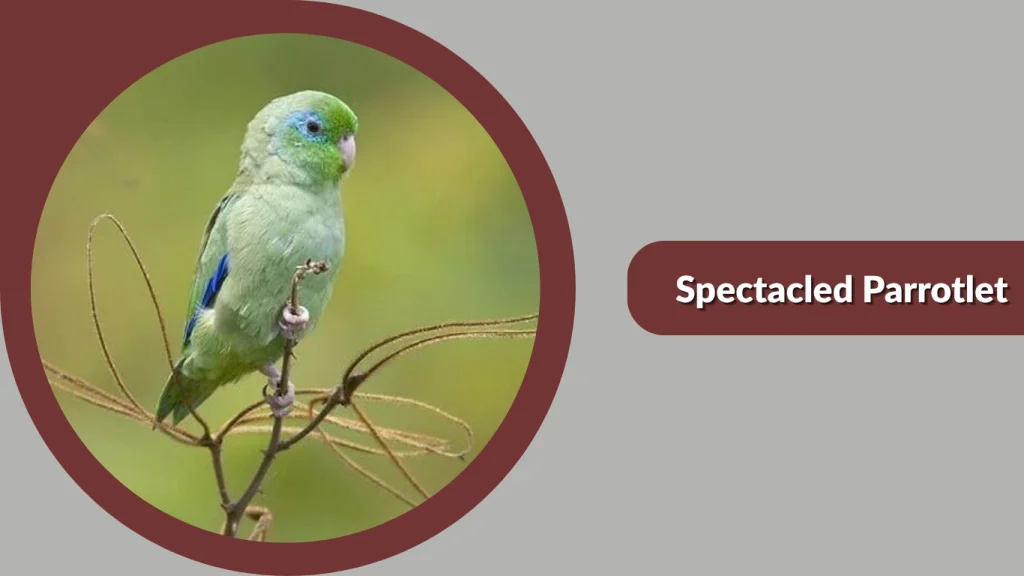
The Spectacled Parrotlet (Forpus conspicillatus) is a tiny, bold parrot known for the ring of pale feathers around its eyes, giving a “spectacled” appearance. Native to Colombia and Panama, it is a popular pet due to its small size and vibrant personality.
Identification
- Body Length: 4.5 to 5 inches (11 to 13 cm)
- Wingspan: Around 9 inches (23 cm)
- Weight: 25 to 35 grams
- Color Pattern:
- Bright green body
- Pale blue on wings and rump (males)
- Distinct pale feather ring around the eyes
- Females are generally all green with less blue
- Bright green body
- Beak: Pale ivory
- Eyes: Dark with pale eye-rings
- Legs: Gray-pink
Natural Habitat
Spectacled Parrotlets inhabit tropical and subtropical forests, woodlands, and scrub in Colombia and Panama. They often nest in tree hollows and travel in small flocks.
Behavior & Personality
Despite their size, these parrotlets are assertive and full of energy. They are curious, affectionate, and can be trained easily. Though not strong talkers, they communicate with chirps and whistles.
Diet and Feeding
They eat seeds, fruits, blossoms, and greens. In captivity, they thrive on a base of pellets, millet, chopped vegetables, and occasional soft fruits like pear and banana.
34. Pacific Parrotlet

The Pacific Parrotlet (Forpus coelestis) is a tiny, vibrant green parrot native to western South America. It is one of the most popular parrotlet species in aviculture, known for its bold personality and manageable size.
Identification
- Body Length: 4.5 to 5.5 inches (11 to 14 cm)
- Wingspan: Around 9 inches (23 cm)
- Weight: 25 to 33 grams
- Color Pattern:
- Bright green body
- Males have blue streaks on wings, rump, and behind eyes
- Females lack most blue markings
- Various color mutations exist (blue, yellow, turquoise)
- Bright green body
- Beak: Pale horn-colored
- Eyes: Dark brown
- Legs: Grayish-pink
Natural Habitat
They are native to arid and semi-humid regions of western Ecuador and northern Peru. They inhabit open woodlands, scrublands, and agricultural fields.
Behavior & Personality
Pacific Parrotlets are fearless, curious, and often sassy despite their small size. They bond closely with their human companions and enjoy interactive toys and activities. They are relatively quiet and low-maintenance.
Diet and Feeding
They eat grass seeds, fruits, berries, and leaves in the wild. In captivity, offer a pellet-based diet with fresh vegetables, sprouted seeds, and soft fruits like apple or papaya.
35. Yellow-faced Parrotlet
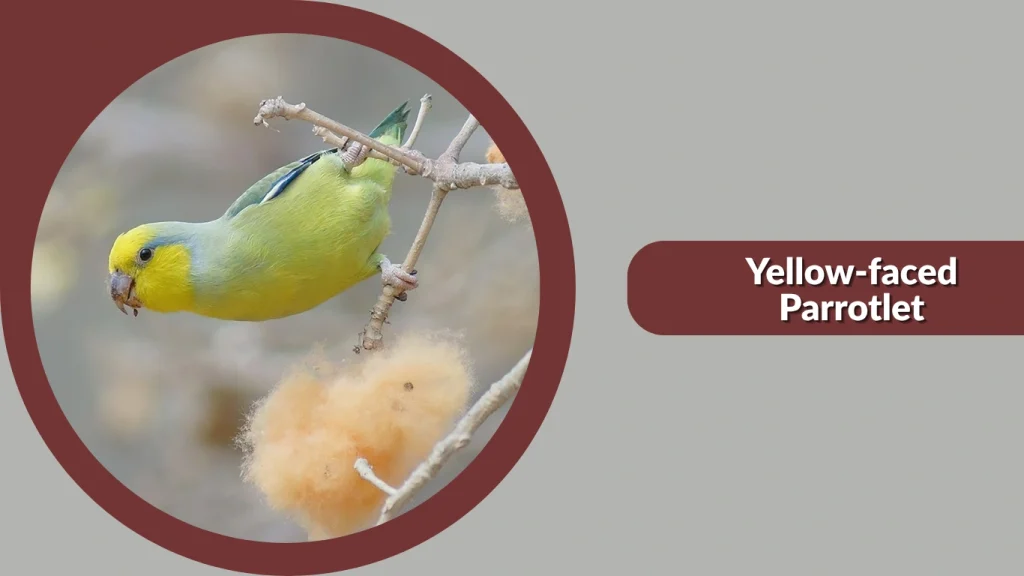
The Yellow-faced Parrotlet (Forpus xanthops) is a rare and endangered parrotlet species found only in Peru. It is named for the distinct yellow coloring on its face and underparts.
Identification
- Body Length: 5 to 5.5 inches (13 to 14 cm)
- Wingspan: Around 9 to 10 inches (23 to 25 cm)
- Weight: 28 to 32 grams
- Color Pattern:
- Green body
- Yellow face and breast
- Blue streaks on wings (males only)
- Females have duller yellow
- Green body
- Beak: Pale pinkish-horn
- Eyes: Dark
- Legs: Pinkish-gray
Natural Habitat
This species is native to dry, deciduous forests and arid scrublands in northwestern Peru, particularly in the Marañón Valley. Its range is limited and fragmented.
Behavior & Personality
Yellow-faced Parrotlets are social and form small flocks. They are alert, active, and communicate with rapid, high-pitched chirps. Their gentle nature and rarity make them valued in conservation programs.
Diet and Feeding
In the wild, they feed on seeds, fruits, blossoms, and buds. In captivity, a diet of fine pellets, leafy greens, soft vegetables, and fruit slices supports their health and reproduction.
36. Brown-hooded Parrot
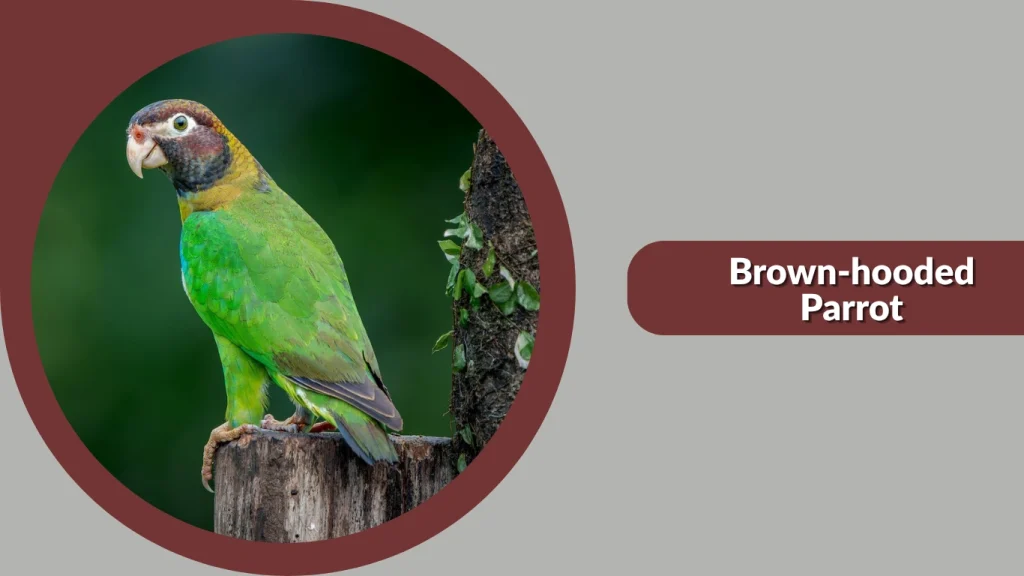
The Brown-hooded Parrot (Pyrilia haematotis) is a medium-sized parrot native to Central America, recognized by its rich brown head and red ear patches. It is less flashy than some tropical parrots but admired for its gentle demeanor and subtle beauty.
Identification
- Body Length: 8.5 to 9.5 inches (22 to 24 cm)
- Wingspan: Around 16 inches (41 cm)
- Weight: 200 to 230 grams
- Color Pattern:
- Olive green body
- Chocolate-brown head and neck
- Red patch behind the eye (ear region)
- Blue-tinted wings
- Blue under tail
- Olive green body
- Beak: Pale horn with darker base
- Eyes: Brown
- Legs: Gray
Natural Habitat
They inhabit humid lowland forests, forest edges, and secondary growth from southern Mexico through Panama. Brown-hooded Parrots are most active in the canopy, often seen flying in small flocks.
Behavior & Personality
These parrots are calm and relatively quiet. They are social and often forage in small family groups. In captivity, they are affectionate, gentle, and intelligent, though not particularly known for mimicking.
Diet and Feeding
Their wild diet includes fruits, berries, seeds, blossoms, and occasional insects. In captivity, they benefit from pellets, fresh greens, tropical fruits, and grains such as cooked quinoa or oats.
37. Red-bellied Parrot
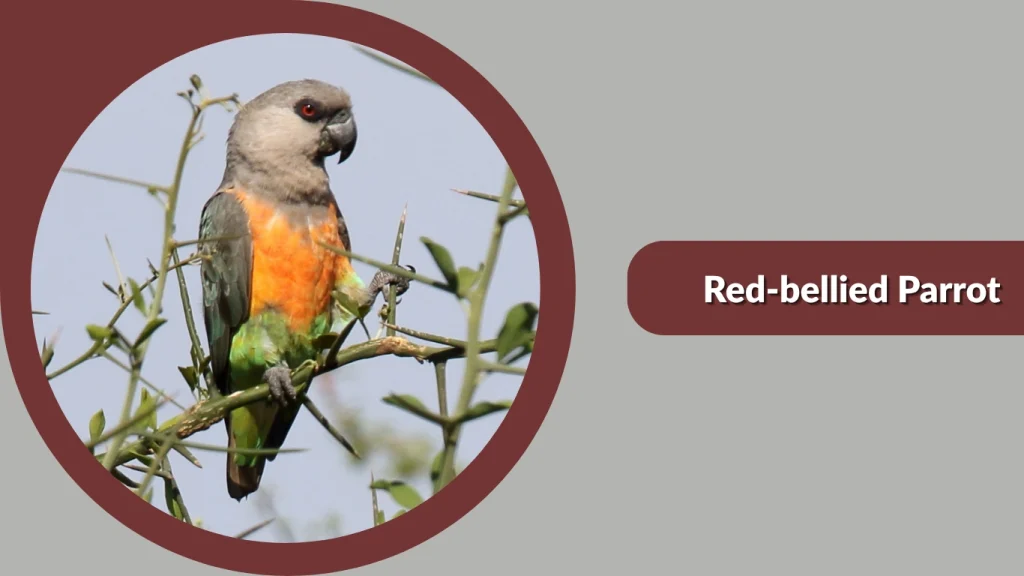
The Red-bellied Parrot (Poicephalus rufiventris) is a small to medium parrot native to East Africa, named for the male’s bright red-orange belly. It’s a sexually dimorphic species with males and females displaying different colors.
Identification
- Body Length: 8.5 to 9 inches (22 to 23 cm)
- Wingspan: Around 14 inches (36 cm)
- Weight: 120 to 150 grams
- Color Pattern:
- Male: Gray head, greenish back, bright orange-red belly
- Female: Duller, greenish-yellow belly
- Both have yellow underwings
- Male: Gray head, greenish back, bright orange-red belly
- Beak: Grayish-black, strong
- Eyes: Orange-yellow
- Legs: Gray
Natural Habitat
They are found in savanna woodlands and dry acacia habitats across Ethiopia, Somalia, Kenya, and Tanzania. They prefer areas with scattered trees and are often observed in small flocks.
Behavior & Personality
Red-bellied Parrots are playful, alert, and relatively quiet. They are intelligent and can be trained to talk or perform tricks with proper bonding. They form strong connections with caregivers and enjoy mental stimulation.
Diet and Feeding
Their diet includes seeds, fruits, nuts, and grains. In captivity, they thrive on pellets, almonds, fresh vegetables (like spinach and carrots), and soft fruits like melon, papaya, or banana.
38. Senegal Parrot
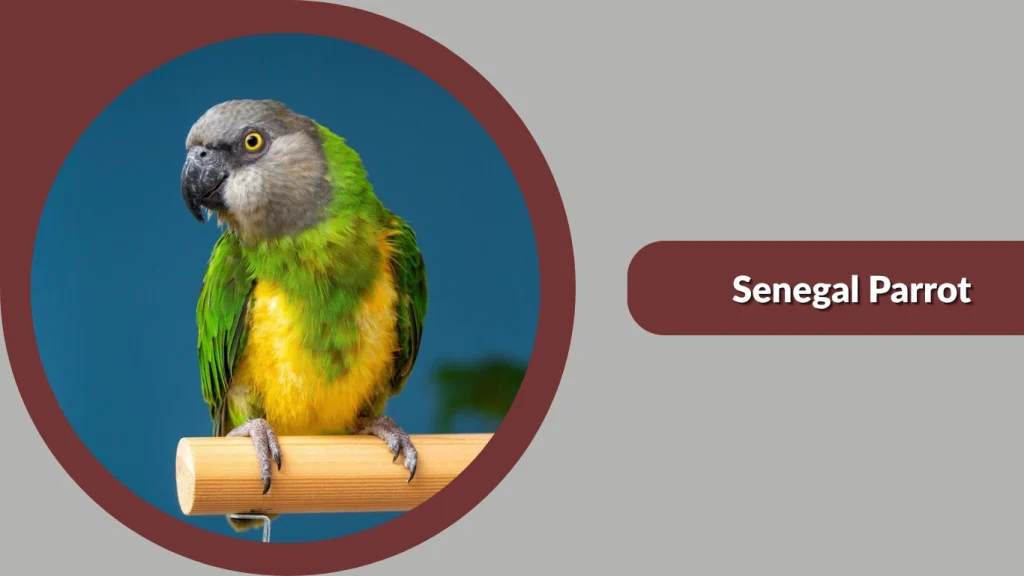
The Senegal Parrot (Poicephalus senegalus) is a small, stocky African parrot prized for its calm demeanor and charming personality. Native to West Africa, it is one of the most popular species in the Poicephalus genus for aviculture.
Identification
- Body Length: 9 to 10 inches (23 to 25 cm)
- Wingspan: Around 6 inches (15 cm) per wing
- Weight: 120 to 170 grams
- Color Pattern:
- Gray head and neck
- Bright yellow-orange or yellow-green belly (V-shaped patch)
- Green back and upper chest
- Yellow underwings
- Gray head and neck
- Beak: Dark gray to black
- Eyes: Bright yellow-orange
- Legs: Gray
Natural Habitat
Senegal Parrots inhabit dry savanna, woodlands, and agricultural areas across western Africa, including Senegal, Ghana, and Nigeria. They often forage in cultivated areas and roost in tree cavities.
Behavior & Personality
Senegal Parrots are calm, quiet, and affectionate, often forming a close bond with one person. They are intelligent, playful, and capable of learning tricks and a few words. Their lower noise level makes them ideal for apartment living.
Diet and Feeding
Their wild diet consists of seeds, fruits, blossoms, and grains. In captivity, they require a variety of vegetables (leafy greens, carrots, bell peppers), pellets, and fruits like apple, mango, or berries. Limit high-fat seeds like sunflower.
39. Meyer’s Parrot
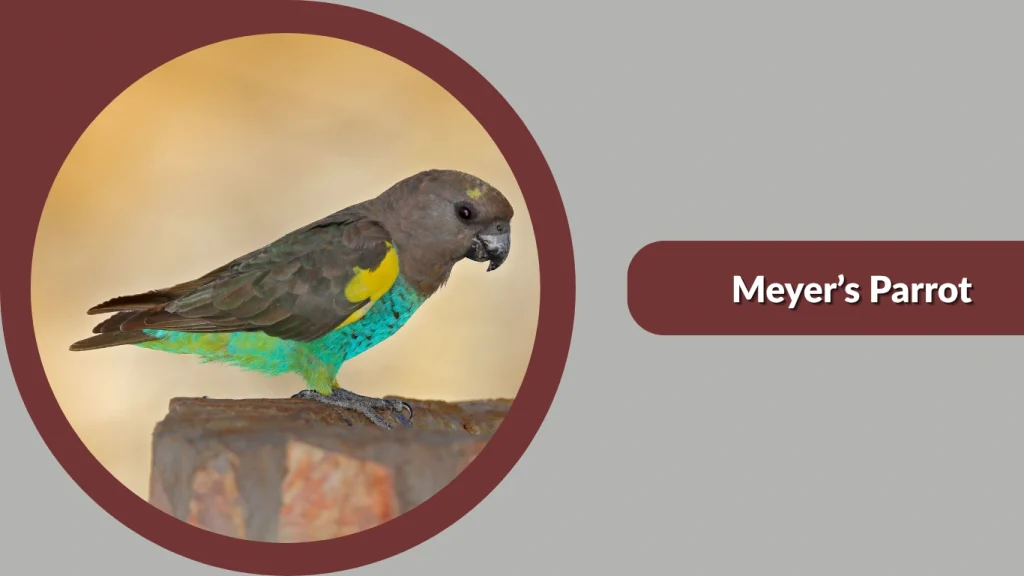
The Meyer’s Parrot (Poicephalus meyeri), also called the Brown Parrot, is a gentle, easygoing species from sub-Saharan Africa. Known for its muted colors and friendly nature, it’s a favored companion for those seeking a quiet, manageable parrot.
Identification
- Body Length: 8.5 to 9 inches (22 to 23 cm)
- Wingspan: Around 14 inches (35 cm)
- Weight: 100 to 130 grams
- Color Pattern:
- Brownish-gray head and upper chest
- Green body
- Bright yellow shoulder patches
- Turquoise-blue rump and tail feathers
- Brownish-gray head and upper chest
- Beak: Black
- Eyes: Orange-yellow
- Legs: Gray
Natural Habitat
They live in woodland, savanna, and baobab tree regions across Angola, Namibia, Tanzania, and Zimbabwe. They favor areas with seasonal rainfall and are often seen in pairs or small flocks.
Behavior & Personality
Meyer’s Parrots are peaceful, affectionate, and content to spend time observing or gently interacting. They are less demanding than larger parrots and known for their even temperament and minimal noise.
Diet and Feeding
Their diet includes seeds, nuts, berries, fruits, and occasionally flowers. In captivity, a healthy mix of pellets, cooked grains, leafy vegetables, and fresh fruits like banana, pear, or kiwi supports their well-being.
40. Yellow-collared Lovebird
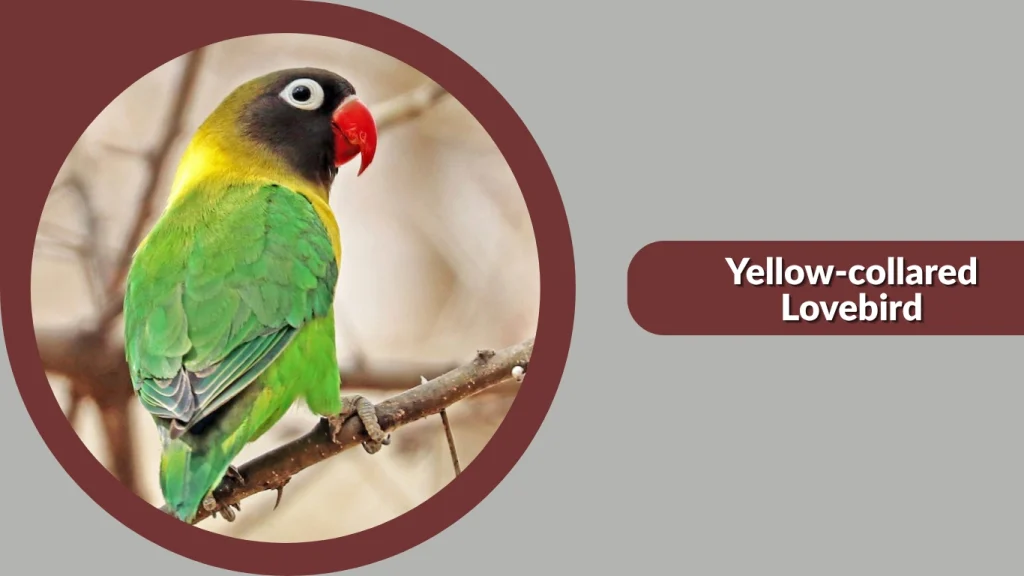
The Yellow-collared Lovebird (Agapornis personatus), often called the Masked Lovebird, is a small, striking parrot native to northeastern Tanzania. Its bright yellow collar and dark facial mask give it a bold and distinctive look.
Identification
- Body Length: 5.5 to 6 inches (14 to 15 cm)
- Wingspan: Around 10 inches (25 cm)
- Weight: 40 to 55 grams
- Color Pattern:
- Black face and forehead
- Bright yellow collar extending around the neck
- Vibrant green body
- Blue or greenish-blue rump and tail
- Black face and forehead
- Beak: Bright red
- Eyes: Dark brown with white eye rings
- Legs: Gray
Natural Habitat
These lovebirds inhabit dry savannas, woodlands, and scrublands in Tanzania. They often nest in tree hollows or even abandoned nests and have also adapted to cultivated farmlands.
Behavior & Personality
Yellow-collared Lovebirds are extremely active, vocal, and social. They form strong bonds and display affectionate behaviors like mutual preening. While not typically strong talkers, they communicate with high-pitched squeaks and chirps.
Diet and Feeding
Their diet consists of grass seeds, grains, berries, fruits, and small greens. In captivity, they do well on a balanced mix of small parrot pellets, millet, fresh spinach, and slices of apple or grape.
41. Budgerigar (Wild Type)
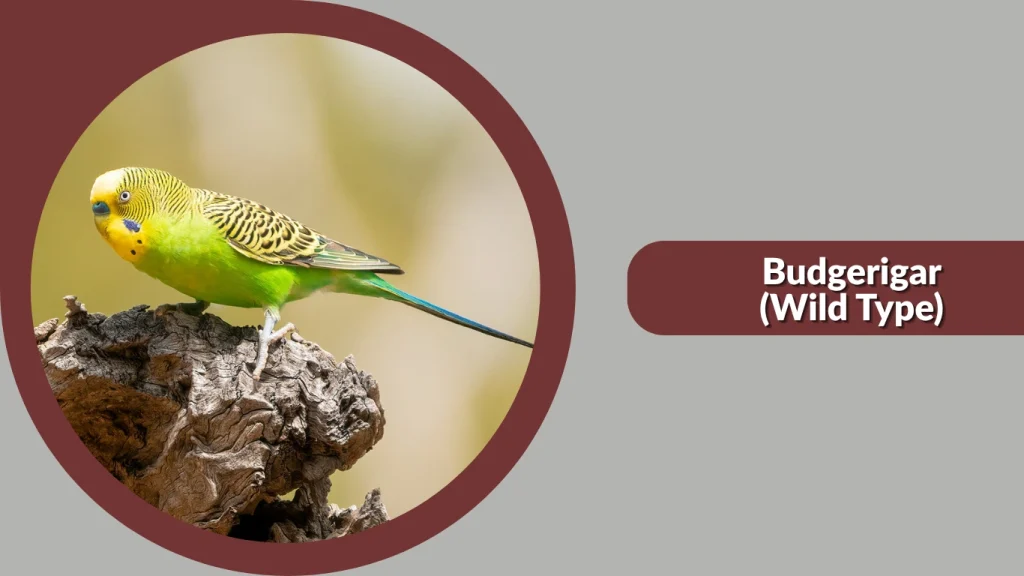
The Budgerigar (Melopsittacus undulatus), often called the “budgie,” is a small parrot native to Australia. In its wild form, it sports a green and yellow plumage with black scalloped markings, built for camouflage in arid grasslands.
Identification
- Body Length: 7 to 8 inches (18 to 20 cm)
- Wingspan: Around 12 inches (30 cm)
- Weight: 25 to 35 grams
- Color Pattern:
- Bright green chest and belly
- Yellow face with black scalloped markings
- Black and yellow striped wings and back
- Blue cheek patches and tail feathers
- Bright green chest and belly
- Beak: Pale bluish or gray, slightly curved
- Eyes: Black with white irises in adults
- Legs: Bluish-gray
Natural Habitat
Wild budgies inhabit the open grasslands, dry scrub, and semi-arid areas of inland Australia. They live in flocks and are nomadic, moving in search of water and seeding grasses.
Behavior & Personality
Budgerigars are cheerful, intelligent, and highly social. They are capable of mimicking speech and thrive on interaction. In the wild, they form massive flocks and communicate constantly with chirps and calls.
Diet and Feeding
Their diet consists mainly of grass seeds and occasionally fresh greens. In captivity, a mix of quality seed blend, pellets, spinach, broccoli, and soft fruits like kiwi or pear keeps them healthy and active.
42. Australian King Parrot

The Australian King Parrot (Alisterus scapularis) is a striking, medium-to-large parrot found in eastern Australia. Males are known for their brilliant red heads and chests, while females display more subdued green tones, making this species sexually dimorphic.
Identification
- Body Length: 16 to 18 inches (40 to 45 cm)
- Wingspan: Around 22 inches (55 cm)
- Weight: 210 to 270 grams
- Color Pattern:
- Male: Bright red head, chest, and lower belly; green back and wings; blue rump
- Female: Entire head and chest are green with red belly
- Both sexes have blue-black tail feathers and yellowish eyes
- Male: Bright red head, chest, and lower belly; green back and wings; blue rump
- Beak: Male has orange-red; female has grayish-black
- Eyes: Yellow-orange in adults
- Legs: Gray
Natural Habitat
They are commonly found in coastal and mountain forests of eastern Australia, from Cooktown (Queensland) to Victoria. They often forage in tree canopies and around homes and parks.
Behavior & Personality
King Parrots are gentle, quiet, and curious. Though shy in the wild, captive individuals become affectionate with time and can bond closely with owners. They are not great talkers but are trainable and enjoy social play.
Diet and Feeding
In the wild, they feed on seeds, berries, fruits, nuts, blossoms, and sometimes insects. Captive diets should include parrot pellets, fresh fruit (apple, banana, pomegranate), vegetables (corn, carrot), and occasional sunflower or safflower seeds.
43. Crimson Rosella
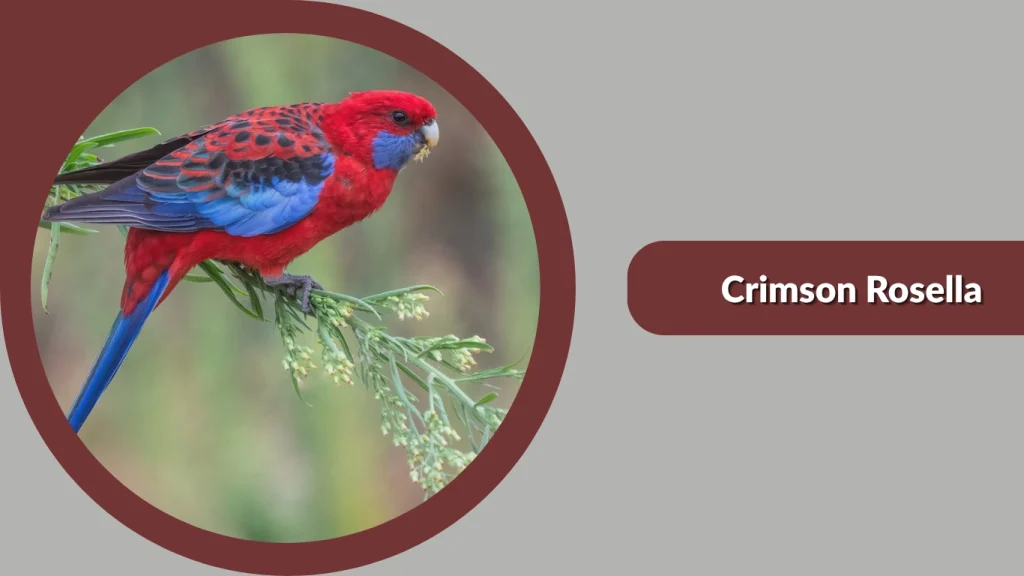
The Crimson Rosella (Platycercus elegans) is a medium-sized, vividly colored parrot native to eastern and southeastern Australia. It is known for its brilliant red and blue plumage and melodic calls.
Identification
- Body Length: 13 to 15 inches (33 to 38 cm)
- Wingspan: Around 16 inches (41 cm)
- Weight: 130 to 170 grams
- Color Pattern:
- Adults: Bright crimson red head and body
- Blue cheeks, shoulders, and tail
- Black scalloping on back and wings
- Juveniles are green with red and blue patches
- Adults: Bright crimson red head and body
- Beak: Pale ivory
- Eyes: Dark brown
- Legs: Gray
Natural Habitat
Crimson Rosellas inhabit coastal forests, alpine woodlands, and gardens throughout southeastern Australia and Tasmania. They are commonly seen in flocks feeding in treetops and occasionally on the ground.
Behavior & Personality
These parrots are inquisitive, calm, and moderately vocal. While not known for mimicry, they can learn whistles and engage with human caretakers. They may be shy at first but warm up with time and gentle interaction.
Diet and Feeding
They eat seeds, berries, nuts, nectar, fruits, and insects. In captivity, offer a diet of small parrot pellets, chopped greens, cooked beans, and soft fruits like berries, kiwi, or mango. Avoid fatty seed mixes.
44. Eastern Rosella

The Eastern Rosella (Platycercus eximius) is a brilliantly colored parrot native to southeastern Australia and Tasmania. Its scalloped plumage and vivid mix of red, yellow, green, and blue make it one of the most visually striking rosellas.
Identification
- Body Length: 11 to 12 inches (28 to 30 cm)
- Wingspan: Around 16 inches (40 cm)
- Weight: 90 to 120 grams
- Color Pattern:
- Bright red head and upper chest
- White cheeks
- Yellow chest blending into a greenish-yellow belly
- Green back with black scalloping
- Bright blue wings and tail
- Bright red head and upper chest
- Beak: Pale ivory
- Eyes: Dark brown
- Legs: Gray
Natural Habitat
Eastern Rosellas inhabit open woodlands, forest edges, farmlands, and suburban parks. They are commonly seen in southeastern Australia, including New South Wales, Victoria, and Tasmania.
Behavior & Personality
They are active, alert, and can be cautious around humans. While not known for speaking abilities, they have clear, bell-like calls and whistles. With patient handling, they become friendly and enjoy perching and gentle play.
Diet and Feeding
In the wild, they consume seeds, fruits, blossoms, insects, and grasses. In captivity, a mix of parrot seed, formulated pellets, fresh greens (spinach, dandelion), and fruits (grapes, apple, banana) keeps them healthy.
45. Western Rosella
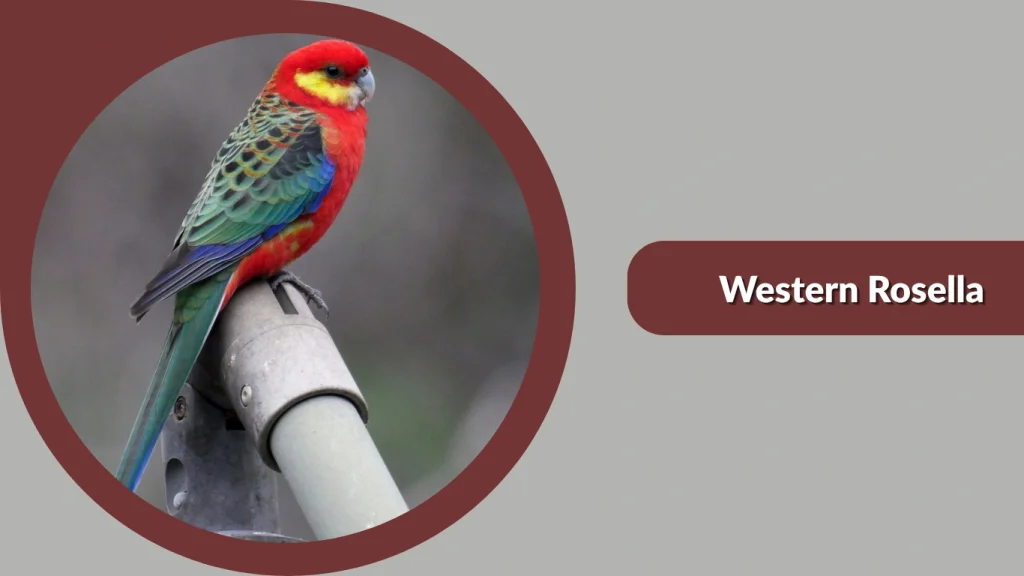
The Western Rosella (Platycercus icterotis) is the smallest and most subdued of the rosella species. Native to southwestern Australia, it is recognized by its soft red head and yellow-cheeked face, giving it a gentler appearance than its eastern relatives.
Identification
- Body Length: 10 to 11 inches (25 to 28 cm)
- Wingspan: Around 14 inches (36 cm)
- Weight: 80 to 100 grams
- Color Pattern:
- Red head and chest
- Yellow cheeks
- Green back with black scalloping
- Blue wing coverts
- Greenish-blue tail
- Red head and chest
- Beak: Pale gray to ivory
- Eyes: Brown
- Legs: Gray
Natural Habitat
Western Rosellas are found in forested and coastal scrub areas of southwestern Australia, especially in eucalyptus woodlands and farmlands. They often feed on the ground or in low shrubs.
Behavior & Personality
They are calm, quiet, and relatively shy birds. Though not as interactive as other parrots, they are peaceful and adapt well to aviary life. They form close pair bonds and are less prone to aggression.
Diet and Feeding
In the wild, their diet consists of seeds, grass, fruits, and small invertebrates. In captivity, a blend of finch or parrot seed mix, leafy greens, corn, berries, and vitamin-rich fruits like melon and papaya is recommended.