





Doves are symbols of peace, love, and grace in cultures around the world. Their soft calls, gentle presence, and delicate plumage make them some of the most admired birds in both the wild and captivity. From vibrant fruit doves of Southeast Asia to ground-dwelling species in Africa and the Americas, doves are incredibly diverse in color, size, and behavior.
In this guide, we explore 30 of the most beautiful dove species across the globe—each with its unique charm and habitat. Whether you’re a bird enthusiast, nature photographer, or just captivated by their elegance, these dove species are sure to leave you in awe of their natural beauty.
1. Mourning Dove
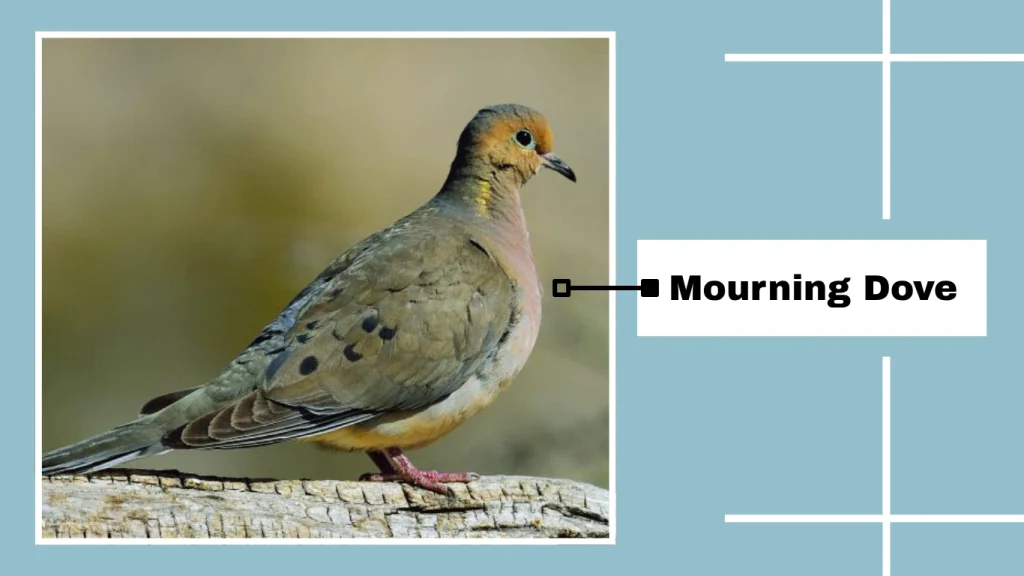
The Mourning Dove is one of the most widespread and gentle-looking dove species in North America. Known for its soft, mournful cooing and graceful flight, it’s often seen perched on telephone wires, rooftops, and tree branches. Its subtle beauty, with earthy tones and a slender body, makes it a favorite among birdwatchers and backyard enthusiasts.
Identification
- Coloration: Light brown to buff-gray overall with black spots on the wings
- Tail: Long and pointed with white outer tail feathers
- Size: About 9–13 inches (23–33 cm) in length
- Wingspan: 17–18 inches (43–46 cm)
- Weight: 4–6 ounces (112–170 grams)
- Eyes: Dark with a blue orbital ring
- Bill: Thin, black
- Legs: Short, pinkish-red
- Voice: Soft, sad-sounding coo-oo-oo
- Habitat: Open fields, roadsides, suburban areas, and farmlands
Behavior and Diet
Mourning Doves are ground foragers, feeding primarily on seeds such as millet, sunflower, and cracked corn. They rarely scratch the soil and prefer open ground. They are known for their fast, darting flight and may take off with a sharp whistling of wings when startled.
Nesting and Reproduction
They build flimsy platform nests in trees, shrubs, or on building ledges. The female typically lays two white eggs per clutch, often nesting several times per year. Both parents share incubation and chick-rearing responsibilities.
Range and Distribution
Found throughout the United States, southern Canada, Mexico, and parts of Central America, the Mourning Dove thrives in open or semi-open habitats. It’s a year-round resident in most of its range and migrates only in the northernmost areas.
2. Eurasian Collared Dove

The Eurasian Collared Dove is a pale, elegant bird recognized by the distinct black collar on the back of its neck. Originally native to Asia and Europe, it has rapidly expanded its range and is now a common sight across much of North America. Its calm demeanor and soft, rhythmic cooing make it a peaceful presence in urban and rural settings.
Identification
- Coloration: Pale gray to pinkish-tan body with slightly darker flight feathers
- Collar: Narrow black crescent on the back of the neck, edged with white
- Size: 12–14 inches (30–35 cm) in length
- Wingspan: 18–22 inches (45–56 cm)
- Weight: 6–7 ounces (170–200 grams)
- Eyes: Reddish-brown with pale orbital skin
- Bill: Black and slender
- Legs: Reddish-pink
- Voice: Three-part “coo-COO-coo” call
- Habitat: Suburban neighborhoods, farms, and woodland edges
Behavior and Diet
These doves are often seen perched on wires, rooftops, or in trees. They feed mostly on seeds and grains and often visit bird feeders. They are known for their strong flying ability and rapid wingbeats.
Nesting and Reproduction
Eurasian Collared Doves nest in trees, buildings, or utility poles. Their nests are made of twigs and are loosely built. They may breed year-round in warm climates, often raising multiple broods annually.
Range and Distribution
Originally from the Indian subcontinent, this species spread to Europe and has now colonized much of North America. It prefers semi-open environments and adapts well to human presence.
3. White-winged Dove

The White-winged Dove is a medium-sized dove known for the white edges on its wings, which flash brilliantly in flight. Native to the southwestern United States, Mexico, and Central America, it thrives in desert environments and urban areas with plenty of trees and shrubs.
Identification
- Coloration: Light brownish-tan body with dark wingtips
- Wing Markings: Distinct white stripe across each wing, visible when perched and in flight
- Size: 11–12 inches (28–30 cm) in length
- Wingspan: 18–22 inches (46–56 cm)
- Weight: 5–7 ounces (140–200 grams)
- Eyes: Deep red with blue orbital skin
- Bill: Short and black
- Legs: Pink
- Voice: Repetitive “who-cooks-for-you” hooting call
- Habitat: Desert scrub, saguaro groves, urban gardens, and mesquite woodlands
Behavior and Diet
White-winged Doves feed on grains, seeds, and fruits—especially fond of saguaro cactus fruit in the wild. They often forage on the ground but are also seen feeding in trees. Their flight is strong and direct with quick wingbeats.
Nesting and Reproduction
Nests are built in trees, shrubs, or cactus. Females usually lay two eggs per clutch and may nest multiple times during the breeding season. They are attentive parents and share incubation duties.
Range and Distribution
Common in the southwestern U.S., Mexico, Central America, and parts of the Caribbean. In recent decades, they have expanded northward, adapting to city parks and residential areas.
4. Spotted Dove
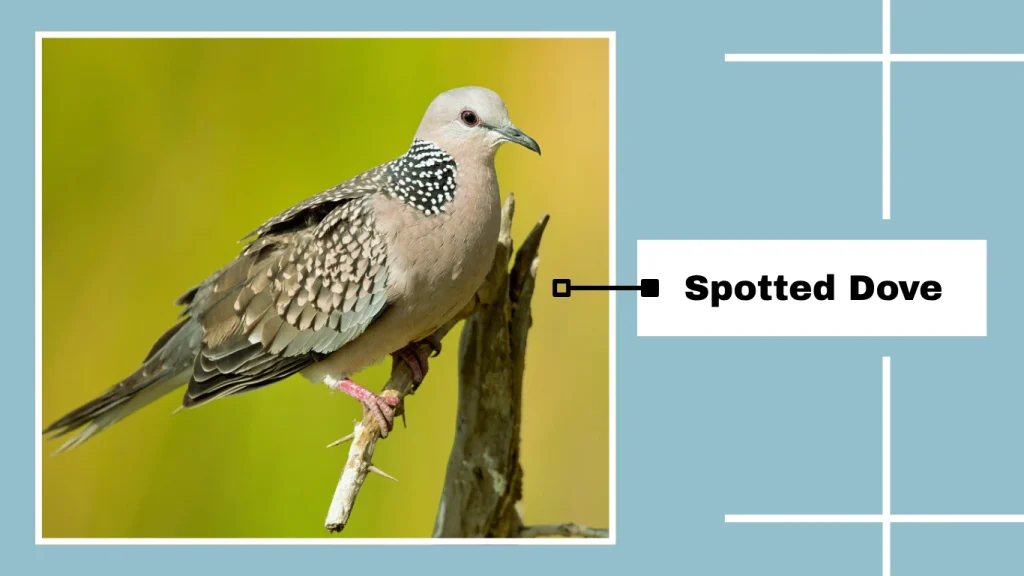
The Spotted Dove is a graceful and slender dove native to Asia but introduced to several other regions worldwide. It is easily recognized by its soft, gray-brown body and the distinctive black patch on the neck speckled with white spots.
Identification
- Coloration: Light brown upperparts with pinkish-gray underparts
- Neck Marking: Black patch with white spots on the sides of the neck
- Size: 11–13 inches (28–33 cm) in length
- Wingspan: Around 18 inches (45 cm)
- Weight: 5–6 ounces (140–170 grams)
- Eyes: Dark with bluish eye-ring
- Bill: Slender and black
- Legs: Reddish
- Voice: Soft, rolling “coo-coo-croo”
- Habitat: Parks, gardens, farmlands, and open woodlands
Behavior and Diet
These birds feed mainly on seeds and small insects. They prefer foraging on the ground and are often seen walking calmly in pairs or small groups.
Nesting and Reproduction
Spotted Doves build simple twig nests in trees or shrubs. They lay two white eggs per clutch and may raise several broods per year.
Range and Distribution
Native to the Indian subcontinent and Southeast Asia, the Spotted Dove has spread to Australia, Indonesia, and Hawaii, adapting well to human-altered environments.
5. Zebra Dove
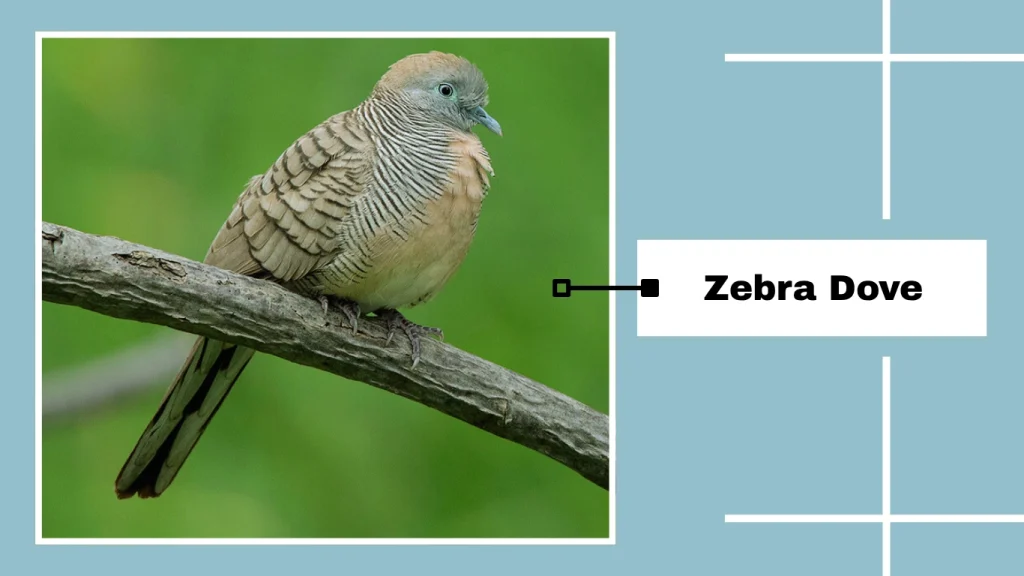
The Zebra Dove is a small, delicate bird admired for its intricate feather patterns and peaceful demeanor. It is commonly seen in Southeast Asia and has been introduced to various Pacific islands.
Identification
- Coloration: Pale brown with black-and-white barring on the neck, breast, and belly
- Tail: Long and narrow with white tips
- Size: 8–9 inches (20–23 cm) in length
- Wingspan: About 10–12 inches (25–30 cm)
- Weight: 2–3 ounces (56–85 grams)
- Eyes: Blue-gray with light blue orbital skin
- Bill: Short and grayish
- Legs: Pinkish
- Voice: Rapid, pleasant “coo-coo-coo” in soft tones
- Habitat: Gardens, lawns, farmlands, and open country
Behavior and Diet
Zebra Doves forage mostly on the ground, feeding on grass seeds, small invertebrates, and grit. They are very tame and often allow humans to approach closely.
Nesting and Reproduction
They build small nests in low shrubs, trees, or even sheltered ground locations. Two white eggs are laid, and both parents incubate them.
Range and Distribution
Native to Indonesia, Malaysia, and the Philippines, they have also been introduced to Hawaii and other Pacific islands where they are now widespread.
6. Diamond Dove

The Diamond Dove is a petite and beautifully patterned dove native to Australia. Known for its delicate size and silvery-gray plumage adorned with white spots, it is a favorite among aviary enthusiasts. Despite its fragile appearance, it is a hardy bird that thrives in arid and semi-arid environments.
Identification
- Coloration: Pale gray body with chestnut-tinged wings and bright white speckles (“diamonds”)
- Eyes: Red or orange with a vivid red orbital ring
- Size: 7.5–8 inches (19–20 cm) in length
- Wingspan: 10–12 inches (25–30 cm)
- Weight: Around 1 ounce (28–40 grams)
- Tail: Long and wedge-shaped, dark gray to black with white tips
- Bill: Short, dark gray
- Legs: Pinkish
- Voice: Soft, mournful coos—slow and melodious
- Habitat: Dry scrublands, open savannah, and river edges
Behavior and Diet
Diamond Doves are mostly ground feeders, consuming small seeds, grit, and occasional insects. They are gentle and social, often found in pairs or small flocks. Their dainty appearance and soft calls make them a calming presence in any environment.
Nesting and Reproduction
They build minimal nests using grasses and twigs, typically placed in low bushes or shrubs. The female lays two small white eggs, with both parents involved in incubation and feeding.
Range and Distribution
Found throughout central and northern Australia, especially near water sources. Though wild populations prefer dry regions, they are widely kept and bred in captivity worldwide.
7. Ring-necked Dove
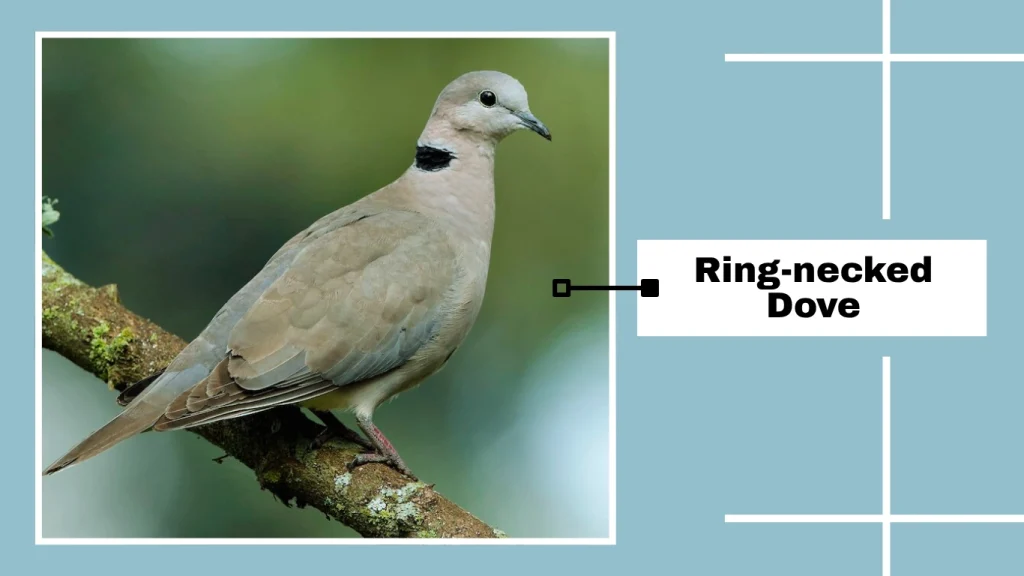
The Ring-necked Dove, also known as the African Collared Dove, is a medium-sized, pale dove with a noticeable black half-collar on the back of the neck. Known for its calm nature and adaptability, it is often found near human settlements across sub-Saharan Africa and parts of the Middle East.
Identification
- Coloration: Pale gray or buff body with slightly pinkish chest
- Neck Ring: Thin black band across the nape
- Size: 10–12 inches (25–30 cm) in length
- Wingspan: 15–17 inches (38–43 cm)
- Weight: 4–6 ounces (120–170 grams)
- Eyes: Brown with bluish-gray orbital skin
- Bill: Slender and dark
- Legs: Reddish-pink
- Voice: Repeated “coo-coo-roo” with a soothing rhythm
- Habitat: Woodlands, savannas, farmlands, and urban gardens
Behavior and Diet
Feeds mostly on the ground, preferring seeds, grains, and small fruits. They are often seen perched on rooftops, fences, and tree branches, calmly observing their surroundings.
Nesting and Reproduction
Nests are simple platforms of twigs placed in trees or on buildings. Females lay two white eggs, and both parents participate in incubation and feeding.
Range and Distribution
Widespread across much of sub-Saharan Africa and introduced in some areas of the Middle East. Adaptable and often coexists with humans in cities and villages.
8. Laughing Dove
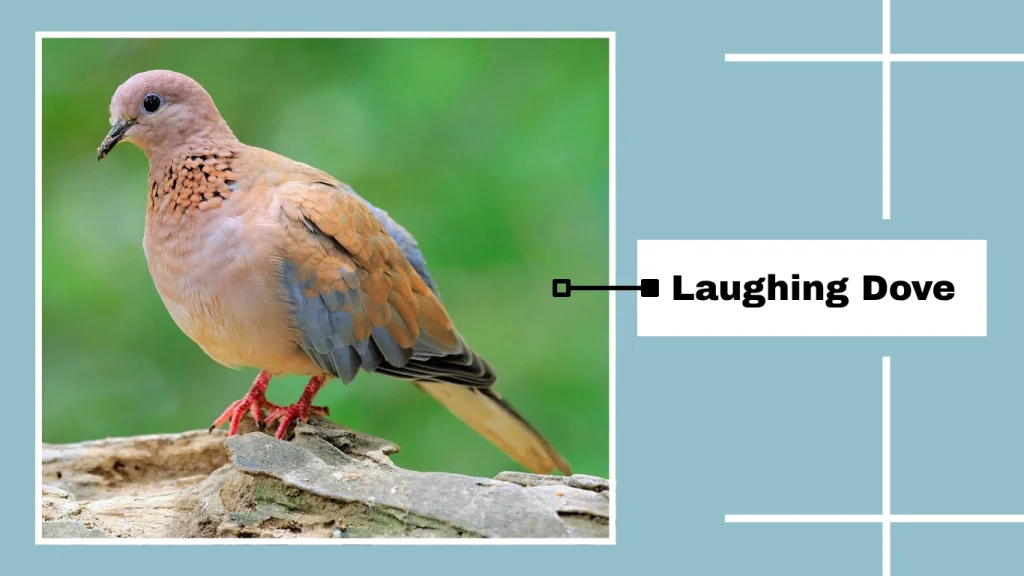
The Laughing Dove is a slender, graceful bird recognized for its soft, warm coloration and cheerful, chuckling call. It gets its name from its unique vocalization, which resembles human laughter. Native to Africa and parts of Asia, it thrives in both wild and urban environments.
Identification
- Coloration: Pinkish-brown body with bluish-gray wings and a rufous breast
- Neck Pattern: Distinctive scaly black-and-white spotted patch on the throat
- Size: 9–10 inches (23–25 cm) in length
- Wingspan: 14–16 inches (36–40 cm)
- Weight: 3.5–5 ounces (100–140 grams)
- Eyes: Dark with blue-gray orbital ring
- Bill: Slender, black
- Legs: Reddish
- Voice: Soft, bubbly “coo-coo-coo-cooroo” that resembles laughter
- Habitat: Open scrub, gardens, farmland, and towns
Behavior and Diet
Laughing Doves are typically seen in pairs or small groups, walking gently on the ground in search of seeds and grains. They are shy but peaceful and well adapted to human presence.
Nesting and Reproduction
Their nests are flimsy platforms made of twigs, built in trees, shrubs, or even on building ledges. Females lay two white eggs per clutch, and both parents incubate and feed the chicks.
Range and Distribution
Found widely across sub-Saharan Africa, the Middle East, and the Indian subcontinent. Their adaptability has allowed them to establish in urban, semi-arid, and rural environments.
9. Inca Dove

The Inca Dove is a small, charming species with intricately patterned feathers that resemble a mosaic. Native to the southwestern United States, Mexico, and parts of Central America, this dove is often seen in backyards, city parks, and desert towns.
Identification
- Coloration: Light brown to tan with feathers edged in black, giving a scaly appearance
- Tail: Long and squared with white outer edges visible in flight
- Size: 6.5–9 inches (16–23 cm) in length
- Wingspan: About 11–12 inches (28–30 cm)
- Weight: 1.5–2 ounces (45–60 grams)
- Eyes: Brown with bare reddish skin around the eyes
- Bill: Slender and dark
- Legs: Pink
- Voice: Thin, high-pitched “croo-croo” or whistling notes
- Habitat: Dry urban areas, open fields, gardens, and desert towns
Behavior and Diet
These doves forage mostly on the ground, feeding on small seeds and grains. They are gentle and quiet, often seen basking in the sun or huddling together for warmth in colder weather.
Nesting and Reproduction
Inca Doves build loose nests of twigs and grasses in shrubs, trees, or on ledges. They can breed year-round in warm climates and often raise multiple broods. Both parents participate in caring for the young.
Range and Distribution
Common in the southwestern United States down through Mexico and parts of Central America. Adaptable to urban and arid habitats with easy access to food and shelter.
10. Turtle Dove
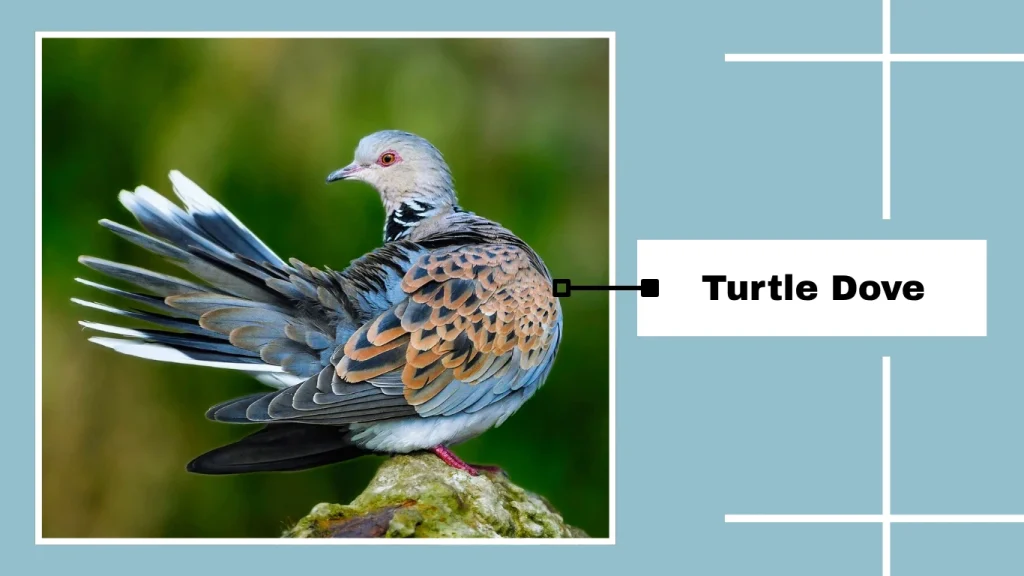
The Turtle Dove is a symbol of peace and love in many cultures, celebrated in literature, art, and song. With its soft colors, gentle cooing, and elegant posture, this migratory dove is a beloved visitor to gardens and hedgerows during the spring and summer months in Europe and parts of Asia and Africa.
Identification
- Coloration: Warm cinnamon-brown upperparts with black and white streaks on the neck
- Underparts: Pale pinkish-gray chest and belly
- Size: 10.5–11 inches (27–28 cm) in length
- Wingspan: 19–22 inches (48–56 cm)
- Weight: 4.5–6 ounces (130–170 grams)
- Eyes: Bright orange with a red orbital ring
- Bill: Black and slender
- Legs: Reddish
- Voice: Deep, rhythmic “turrr-turrr” purring call
- Habitat: Woodland edges, hedgerows, farmlands, and open countryside
Behavior and Diet
Turtle Doves feed mainly on seeds from grasses and weeds. They forage mostly on the ground and are typically seen in pairs or small flocks. Known for their graceful flight and gentle nature, they are shy and often retreat when approached.
Nesting and Reproduction
They build fragile nests in dense shrubs or trees, usually laying two eggs per clutch. Nesting season occurs in late spring and summer, with both parents involved in raising the chicks.
Range and Distribution
A migratory species, the Turtle Dove breeds across Europe and western Asia and winters in sub-Saharan Africa. Sadly, its population has declined significantly due to habitat loss and hunting, making conservation efforts critical.
11. Peaceful Dove
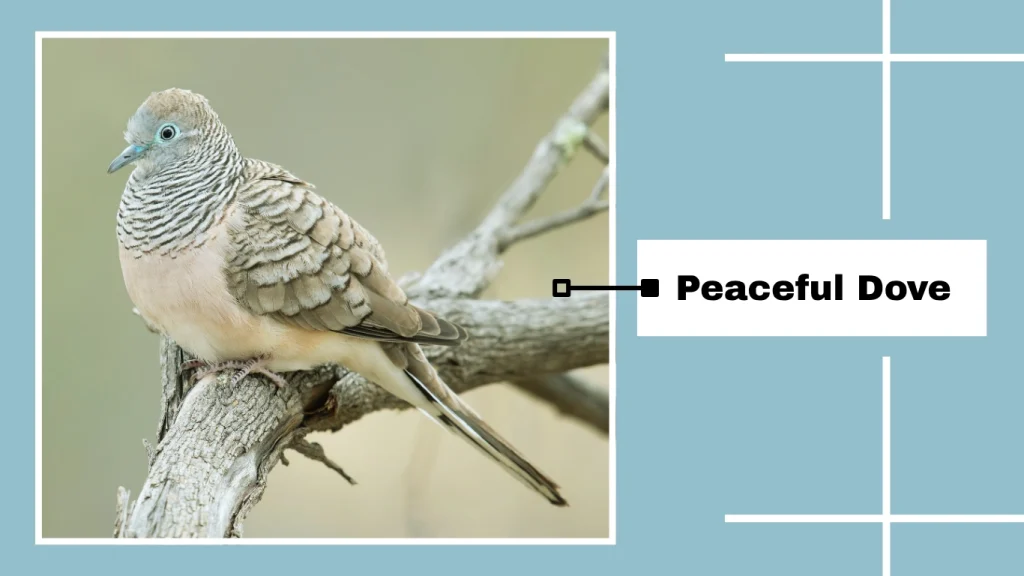
The Peaceful Dove is a dainty and soft-voiced bird native to Australia and parts of Papua New Guinea. It is well-named for its calm demeanor, subtle coloring, and gentle presence in both forests and gardens.
Identification
- Coloration: Pale gray upperparts with fine black barring, bluish-gray face and breast
- Neck: Slight bluish sheen with no collar
- Size: 8–9 inches (20–23 cm) in length
- Wingspan: Around 12–14 inches (30–36 cm)
- Weight: 2–2.5 ounces (60–75 grams)
- Eyes: Pale blue-gray with light orbital skin
- Bill: Slender, dark gray
- Legs: Pinkish to gray
- Voice: Repetitive, soft “doodle-doo-doodle” cooing
- Habitat: Forest clearings, gardens, bushland, and urban areas
Behavior and Diet
Peaceful Doves are ground feeders, eating mainly small seeds. They often move in pairs or small flocks and are known for their tame behavior, especially in quiet neighborhoods and parks.
Nesting and Reproduction
Their nests are small and often built low in trees or shrubs. Females usually lay two eggs, and both parents take turns incubating and feeding the chicks.
Range and Distribution
Widespread across eastern and northern Australia, and found in parts of Papua New Guinea and nearby islands. They are adaptable and commonly seen in residential gardens and public green spaces.
12. Bar-shouldered Dove
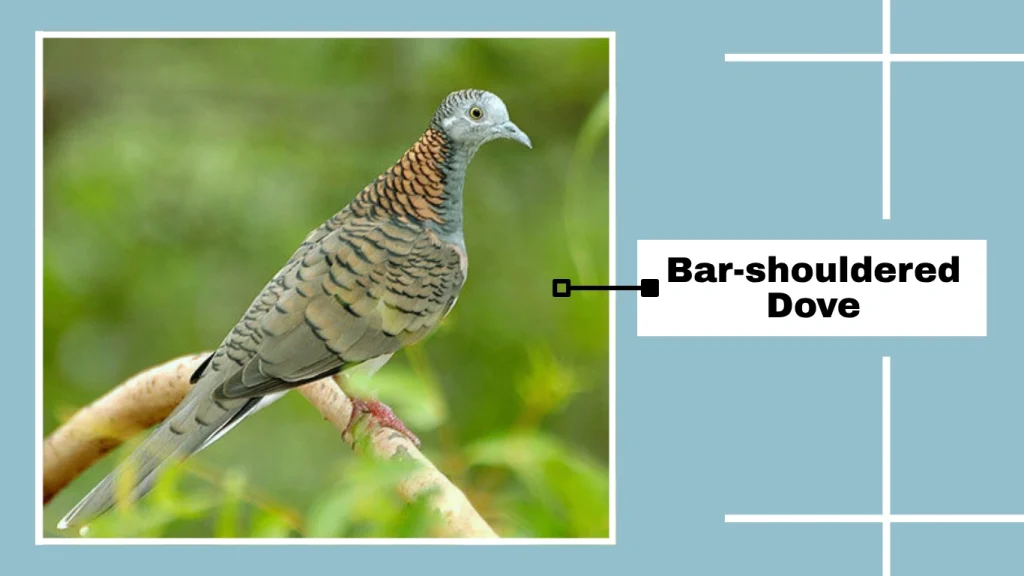
The Bar-shouldered Dove is a strikingly patterned bird native to Australia and southern New Guinea. Its name comes from the distinct copper-colored bands across its wings, which shimmer beautifully in sunlight.
Identification
- Coloration: Bluish-gray head, chestnut shoulders with black barring, and pinkish underparts
- Neck: Iridescent bluish and copper feathering
- Size: 10–12 inches (26–30 cm) in length
- Wingspan: About 16 inches (40 cm)
- Weight: 4.5–5.5 ounces (130–160 grams)
- Eyes: Orange to red with a bare blue orbital ring
- Bill: Slender and grayish
- Legs: Pinkish-red
- Voice: Repeated “cook-a-wook” or “coo-wuk” notes
- Habitat: Coastal scrubs, woodlands, riverbanks, and suburban parks
Behavior and Diet
Feeds mainly on the ground, consuming seeds, grains, and small invertebrates. Usually seen in pairs or small groups, walking slowly and deliberately while foraging.
Nesting and Reproduction
Bar-shouldered Doves build flimsy nests using twigs in trees or shrubs. They typically lay two eggs and raise multiple broods in warm regions.
Range and Distribution
Found along the eastern and northern coasts of Australia, and also in southern New Guinea. They prefer moist, densely vegetated areas but adapt well to gardens and urban settings.
13. Cape Turtle Dove

The Cape Turtle Dove, also called the Ring-necked Dove in some regions, is a common and elegant dove found across southern Africa. Known for its distinctive black neck ring and gentle cooing, it thrives in both rural and urban environments.
Identification
- Coloration: Pale grayish-brown with a light pink flush on the chest
- Neck Ring: Prominent black band across the nape
- Size: 11–12 inches (28–30 cm) in length
- Wingspan: 17–20 inches (43–50 cm)
- Weight: 5–6.5 ounces (140–185 grams)
- Eyes: Dark with pale blue orbital skin
- Bill: Thin and black
- Legs: Pink
- Voice: Familiar rhythmic “coo-coo-coo-ooo” often repeated several times
- Habitat: Open woodlands, farmlands, gardens, and savannas
Behavior and Diet
Feeds primarily on seeds and occasionally insects. It is often seen walking or hopping on the ground in open areas and is tolerant of human activity.
Nesting and Reproduction
Nests are flimsy platforms placed in trees or shrubs. Two white eggs are laid per clutch, with shared parental care throughout incubation and feeding.
Range and Distribution
Widespread throughout southern and eastern Africa, especially common in South Africa, Zimbabwe, Botswana, and surrounding regions. It adapts well to farmlands and suburban areas.
14. White-tipped Dove

The White-tipped Dove is a medium-sized, ground-dwelling bird found in the southern United States, Mexico, Central America, and parts of South America. It is named for the distinctive white edges on its tail feathers, which are visible in flight.
Identification
- Coloration: Pale gray to grayish-brown with a pinkish wash on the chest
- Tail: Broad with white tips on the outer feathers
- Size: 10–11 inches (26–28 cm) in length
- Wingspan: About 15–17 inches (38–43 cm)
- Weight: 5–6 ounces (140–170 grams)
- Eyes: Dark with bright red orbital skin
- Bill: Slender and black
- Legs: Reddish-pink
- Voice: Soft, mournful “whooo-oo-oo”
- Habitat: Forest edges, dry woodlands, thickets, and scrub
Behavior and Diet
Spends most of its time on the ground, foraging for seeds, berries, and insects. Shy and secretive, it often flushes quickly with a noisy burst of wings if startled.
Nesting and Reproduction
Builds a simple twig nest in low shrubs or small trees. The female lays two white eggs, and both parents participate in raising the young.
Range and Distribution
Common from southern Texas through Mexico, Central America, and into northern South America. Prefers dry and semi-open woodland habitats.
15. Common Ground Dove
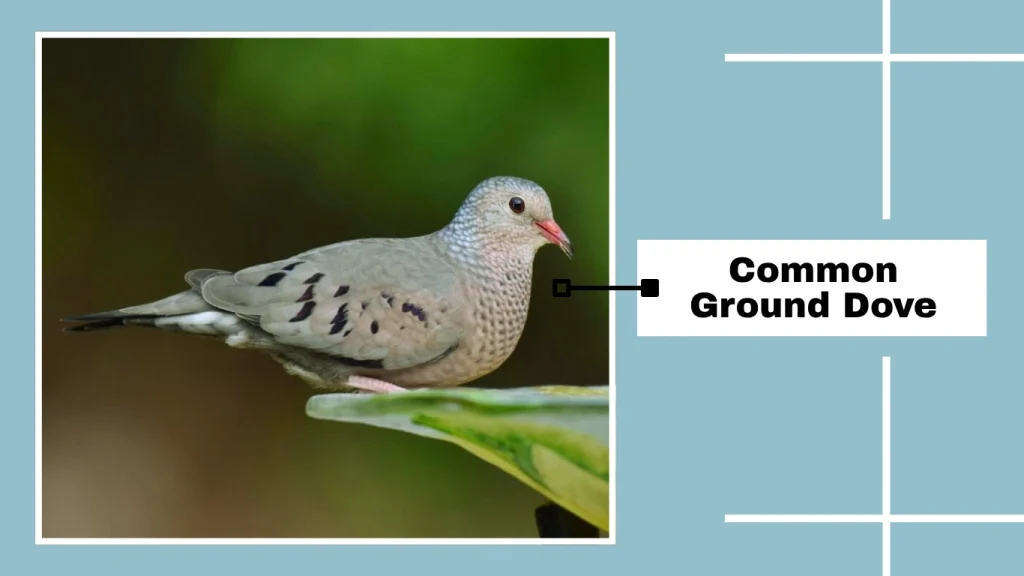
The Common Ground Dove is one of the smallest dove species in North America. Despite its size, it has a strong presence due to its distinctive scaly appearance and fluttery, fast flight. It’s often found in open fields and dry brush.
Identification
- Coloration: Brownish-gray body with a scaly pattern on the head, neck, and chest
- Wings: Rusty-red patches visible in flight
- Size: 6.5–7.5 inches (17–19 cm) in length
- Wingspan: 10–12 inches (25–30 cm)
- Weight: 1–1.2 ounces (28–35 grams)
- Eyes: Dark with bluish orbital skin
- Bill: Small, short, and two-toned (black tip, yellowish base)
- Legs: Pink
- Voice: Repeated, soft “woot-woot-woot” rising and falling
- Habitat: Grasslands, deserts, scrub, and open woodlands
Behavior and Diet
Feeds on small seeds and grains while walking on the ground. Very tame and slow-moving, often blends into its surroundings. May huddle together in cooler weather.
Nesting and Reproduction
Nests on the ground or in low vegetation, using grasses and twigs. Typically lays two white eggs per clutch. Both sexes care for the eggs and chicks.
Range and Distribution
Found in the southern United States, Mexico, Central America, and the Caribbean. Especially common in warm, dry habitats.
16. Ruddy Ground Dove

The Ruddy Ground Dove is a small, warm-toned dove native to Central and South America. Males display a rich rufous coloration, while females are more subdued, making them well-camouflaged in dry, open landscapes.
Identification
- Coloration:
- Male: Reddish-brown with darker wingtips
- Female: Grayish-brown with pale underparts
- Male: Reddish-brown with darker wingtips
- Size: 6.5–7.5 inches (16–19 cm) in length
- Wingspan: Around 11 inches (28 cm)
- Weight: 1.3–1.8 ounces (38–52 grams)
- Eyes: Dark with a pale orbital ring
- Bill: Short, dark gray
- Legs: Pink
- Voice: Monotonous, repeated “coo-coo-coo”
- Habitat: Farmlands, open country, city parks, and gardens
Behavior and Diet
Typically forages on the ground for seeds and small grains. Often seen in small flocks or loose groups, moving cautiously and quickly when disturbed.
Nesting and Reproduction
Builds a simple nest in low trees or shrubs. Lays two small white eggs per clutch. Nests multiple times in warm regions with ample food.
Range and Distribution
Common throughout Central America and much of South America, especially in dry, open, or semi-urban habitats.
17. Blue-headed Quail-Dove
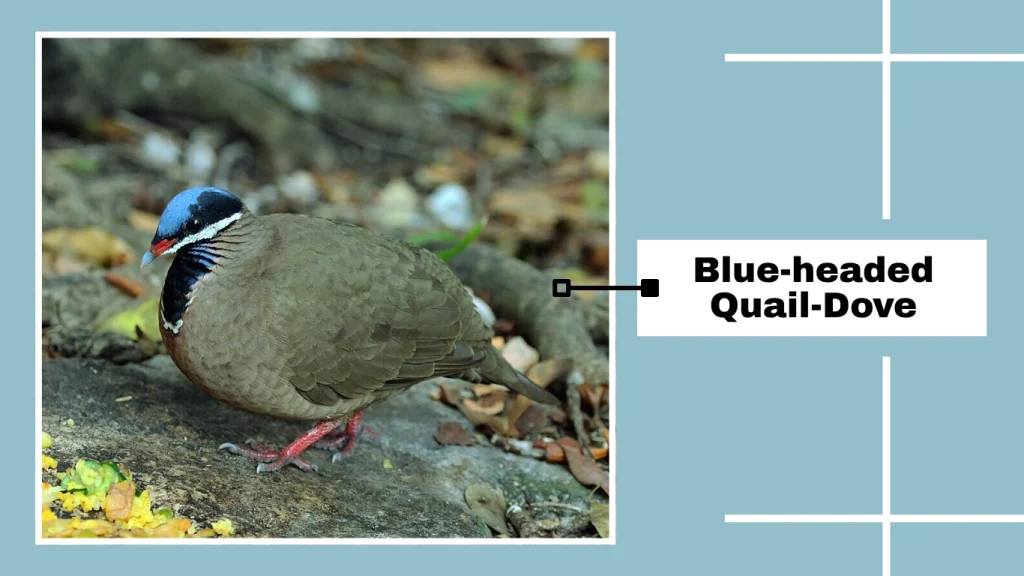
The Blue-headed Quail-Dove is a rare and stunning dove species found only in Cuba. With its rich plumage and glowing blue crown, it is one of the most visually striking ground-dwelling doves in the world.
Identification
- Coloration: Chestnut-brown body with iridescent blue crown and nape
- Facial Markings: Black face with white lines extending from eye to nape
- Size: 10–11 inches (26–28 cm) in length
- Wingspan: Around 17 inches (43 cm)
- Weight: 5–6 ounces (140–170 grams)
- Eyes: Brown
- Bill: Slender, dark gray
- Legs: Reddish
- Voice: Low, deep cooing notes, often uttered from the ground
- Habitat: Moist forests, undergrowth, and dense thickets
Behavior and Diet
Shy and elusive, they walk slowly through dense foliage in search of fallen fruits, seeds, and insects. Rarely seen in open areas.
Nesting and Reproduction
Nest low to the ground in thick vegetation. The nest is well-hidden, and the female lays one to two white eggs. Breeding success is impacted by habitat loss and predation.
Range and Distribution
Endemic to Cuba, especially in protected forest regions. Populations are declining due to habitat destruction, making it a conservation concern.
18. Emerald-spotted Wood Dove
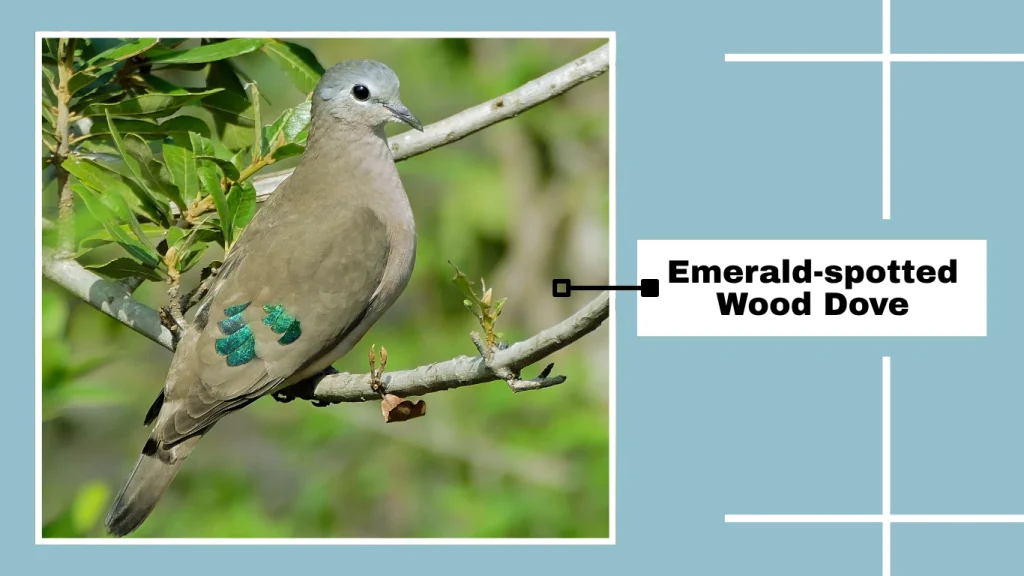
The Emerald-spotted Wood Dove is a small and beautiful species native to sub-Saharan Africa. It is best recognized by its subtle earth-toned feathers and the brilliant green metallic spots on its wings, which shimmer in the sunlight.
Identification
- Coloration: Grayish-brown upperparts with pinkish underparts
- Wing Markings: Iridescent green spots on each wing
- Size: 8–9 inches (20–23 cm) in length
- Wingspan: About 12–14 inches (30–36 cm)
- Weight: 2–2.5 ounces (60–75 grams)
- Eyes: Dark with a light gray orbital ring
- Bill: Short, dark with a slightly curved tip
- Legs: Reddish-pink
- Voice: Soft, rhythmic series of “coo-coo-coo” notes
- Habitat: Woodlands, savannas, scrub, and riparian zones
Behavior and Diet
Spends most of its time on the ground, foraging for small seeds, fallen fruits, and grains. Quiet and solitary, it blends easily into shaded areas under trees.
Nesting and Reproduction
Builds a small, flimsy nest of twigs in shrubs or low trees. Females usually lay two white eggs, and both parents help incubate and care for the chicks.
Range and Distribution
Widespread across sub-Saharan Africa, particularly in lightly wooded and riparian areas. Common in both natural habitats and cultivated landscapes.
19. Tambourine Dove
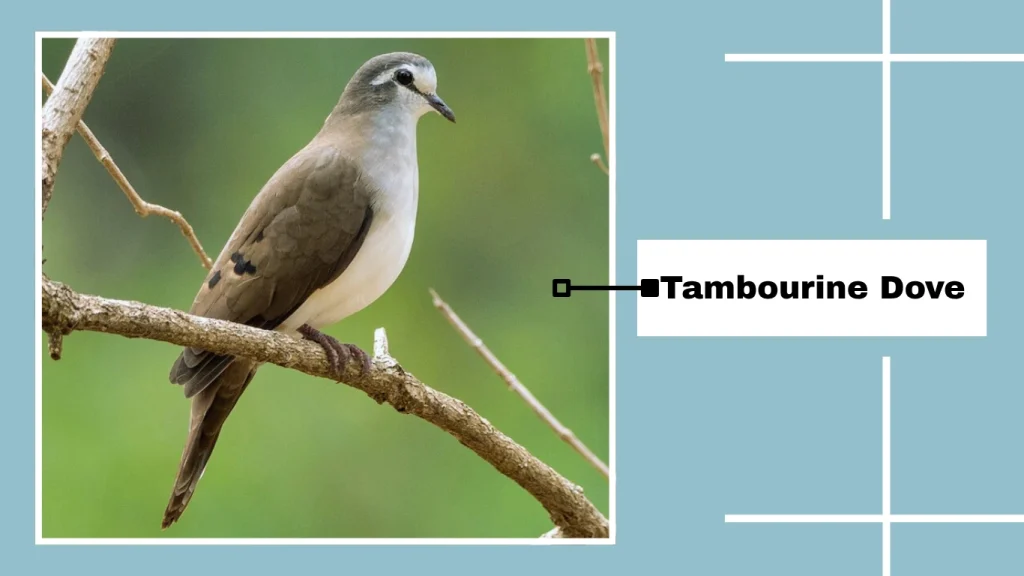
The Tambourine Dove is a graceful and rare forest dove known for its soft plumage and musical call. Named after its distinct drumming-like cooing, it inhabits the dense forests of Africa, often remaining hidden in the undergrowth.
Identification
- Coloration: Males are mostly white below with soft pinkish-gray upperparts; females are browner overall
- Markings: Black eye stripe and dark wing edges
- Size: 8–9 inches (20–23 cm) in length
- Wingspan: 12–14 inches (30–36 cm)
- Weight: 2–2.5 ounces (60–75 grams)
- Eyes: Dark, with subtle orbital skin
- Bill: Black and slender
- Legs: Dark pink to reddish
- Voice: Repeated rhythmic “tumbling” coos resembling a tambourine roll
- Habitat: Dense tropical and subtropical forests, thick vegetation near water
Behavior and Diet
Secretive and quiet, they forage alone or in pairs, mainly on the forest floor. Their diet includes seeds, fruits, and small insects.
Nesting and Reproduction
Nests are built low in the underbrush using rootlets and twigs. The female typically lays two eggs, and both sexes share incubation duties.
Range and Distribution
Found in forested areas across central, eastern, and parts of southern Africa. Difficult to spot due to their quiet habits and preference for dense cover.
20. Pink-headed Fruit Dove

The Pink-headed Fruit Dove is one of the most visually captivating doves in the world, boasting a vibrant pink head that contrasts beautifully with its deep green body. Native to Indonesia, this species inhabits humid mountain forests and is known for its quiet nature and fruit-based diet.
Identification
- Coloration: Bright pink head and throat, emerald green back and wings, yellow undertail, and pale grayish belly
- Size: 10–11 inches (26–28 cm) in length
- Wingspan: Around 16 inches (40 cm)
- Weight: 4–5 ounces (115–140 grams)
- Eyes: Dark with a light orbital ring
- Bill: Pale green with a dark tip
- Legs: Reddish-pink
- Voice: Soft, low “coo-coo” notes, rarely heard
- Habitat: Montane and submontane rainforests, often above 1,000 meters
Behavior and Diet
This species feeds primarily on figs and other small fruits, foraging quietly in the canopy. It is elusive and often detected only by its bright coloring or a glimpse through dense foliage.
Nesting and Reproduction
Nests are made of twigs and placed in trees or shrubs, typically well hidden. The female usually lays a single white egg. Little is known about their breeding behavior due to their secretive nature.
Range and Distribution
Found in the forested highlands of Sumatra and Java. Although it has a relatively restricted range, it is fairly common in suitable habitats but threatened by habitat loss.
21. Orange-breasted Green Pigeon (Dove-like appearance)
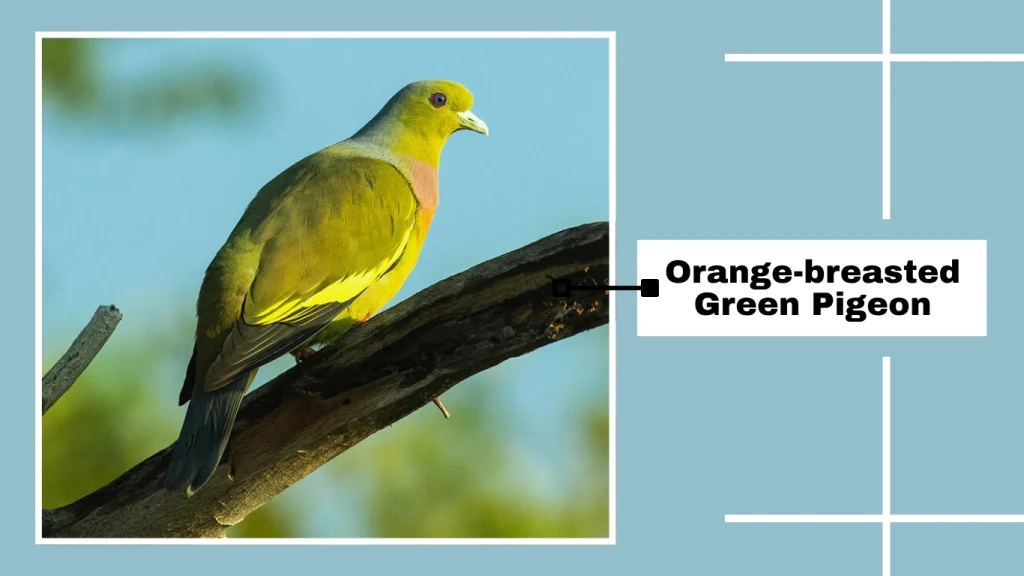
The Orange-breasted Green Pigeon, while technically a pigeon, has a graceful build and soft coloration often associated with fruit doves. Its colorful plumage and tranquil behavior make it a visual delight in the forests of South and Southeast Asia.
Identification
- Coloration: Olive green upperparts, vibrant orange breast, yellow belly, and grayish crown
- Wings: Dark with yellowish margins
- Size: 10–11 inches (25–28 cm) in length
- Wingspan: About 16–18 inches (40–46 cm)
- Weight: 5–6 ounces (140–170 grams)
- Eyes: Reddish-orange with a bare yellow orbital ring
- Bill: Pale blue with a yellow tip
- Legs: Pinkish
- Voice: Soft, nasal whistles or trills
- Habitat: Forests, orchards, bamboo thickets, and fig groves
Behavior and Diet
Feeds mainly on figs and other fruits, often foraging in small, quiet flocks. Prefers the upper canopy and is well-camouflaged among the leaves.
Nesting and Reproduction
Nests in trees using fine twigs and vines. The female usually lays one or two white eggs. Breeding habits are discreet and not easily observed.
Range and Distribution
Widespread across India, Nepal, Bangladesh, Myanmar, Thailand, and parts of Malaysia and Indonesia. Most commonly found in lowland and foothill forests.
22. Rose-crowned Fruit Dove
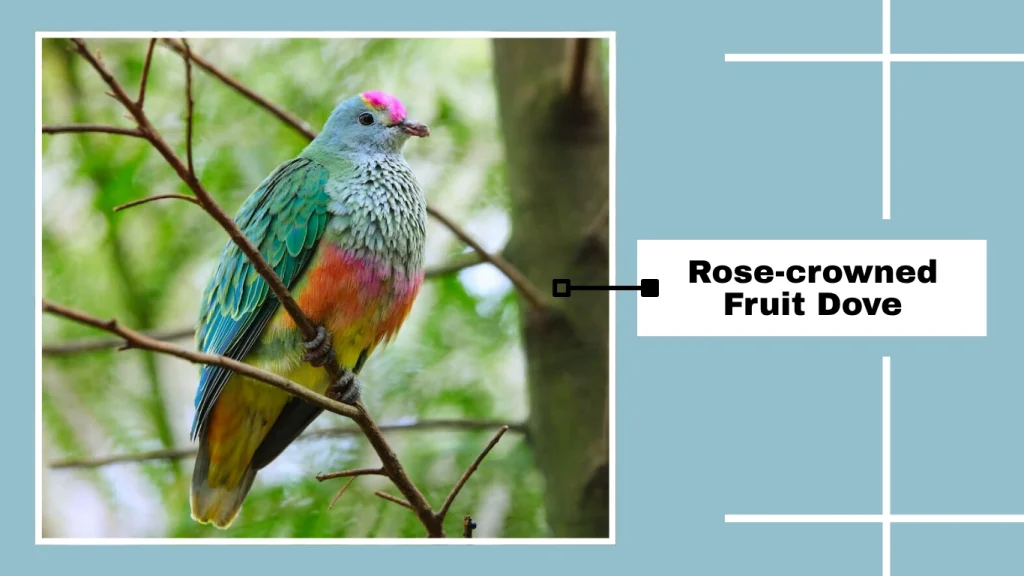
The Rose-crowned Fruit Dove is a breathtakingly beautiful species with a soft green body and a radiant pink crown. Native to Australia and nearby islands, it thrives in rainforest canopies where it feeds on fruits and figs. Its colorful appearance helps it blend into the foliage despite its vivid crown.
Identification
- Coloration: Bright green plumage with a pale gray chest and a distinctive rose-pink patch on the crown
- Accents: Yellow-orange belly and blue-gray shoulder patches
- Size: 8–9 inches (20–23 cm) in length
- Wingspan: About 14 inches (35 cm)
- Weight: 3–3.5 ounces (85–100 grams)
- Eyes: Orange with a narrow blue orbital ring
- Bill: Pale green with yellowish base
- Legs: Pinkish
- Voice: Low, soft “woo-oo” notes, often repeated at intervals
- Habitat: Tropical and subtropical rainforests, mostly in coastal and lowland regions
Behavior and Diet
Feeds primarily on rainforest fruits, especially native figs, and berries. It forages high in the canopy and is often solitary or in pairs. Its plumage provides excellent camouflage among leaves and fruits.
Nesting and Reproduction
Builds a platform nest of twigs high in trees. Usually lays one white egg per clutch. Both male and female share incubation and chick-feeding duties.
Range and Distribution
Found in northeastern Australia, including Queensland and Cape York Peninsula, and nearby islands such as the Torres Strait Islands. Prefers undisturbed rainforest habitats but can be found near fruiting trees in semi-urban areas.
23. Wonga Pigeon
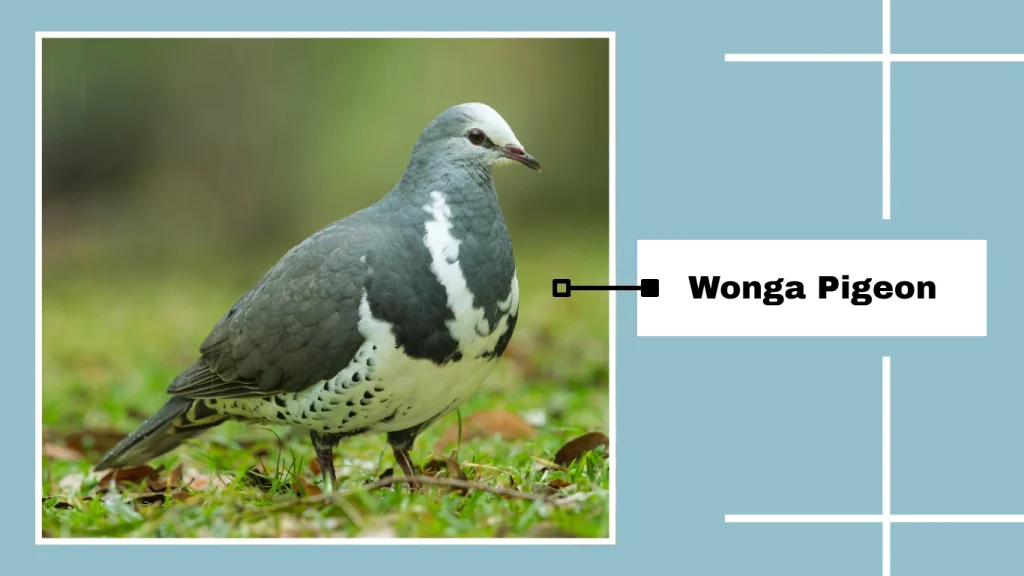
The Wonga Pigeon is a large, ground-dwelling pigeon native to the eastern rainforests of Australia. Known for its stocky build and clean white chest patterned with dark spots, it’s often heard before it’s seen due to its deep, resonant call.
Identification
- Coloration: Slate-gray upperparts with a bright white belly and chest decorated with V-shaped markings
- Size: 14–16 inches (36–41 cm) in length
- Wingspan: Around 20–22 inches (51–56 cm)
- Weight: 15–18 ounces (425–500 grams)
- Eyes: Dark with a reddish orbital ring
- Bill: Short and black
- Legs: Reddish-pink
- Voice: Deep, repetitive “whoop…whoop” echoing calls
- Habitat: Dense rainforests, wet sclerophyll forests, and gullies
Behavior and Diet
Feeds on fallen seeds, berries, and small fruits. It walks slowly on the forest floor, retreating quietly into thick cover if disturbed. Its cryptic behavior and forest-floor lifestyle make it hard to spot.
Nesting and Reproduction
Nests are built in low trees or shrubs using twigs and sticks. Typically lays two white eggs per clutch. Both parents share all nesting responsibilities.
Range and Distribution
Endemic to eastern Australia, especially from southern Queensland to Victoria. It prefers sheltered forest environments and is rarely found in open areas.
24. Nicobar Pigeon
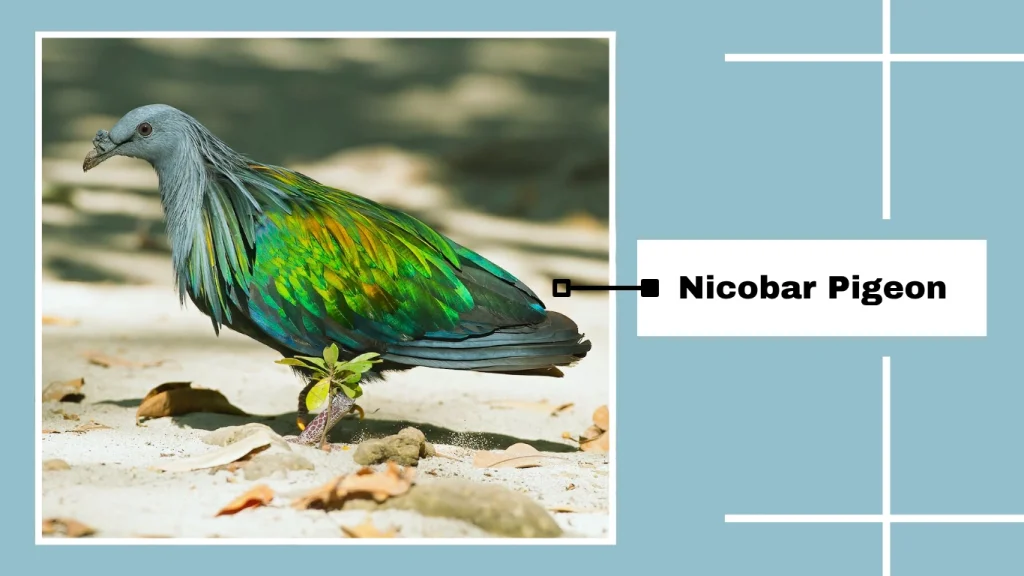
The Nicobar Pigeon is among the most dazzling and exotic-looking pigeons in the world. With shimmering metallic green, bronze, and blue feathers and a long, lacy mane, it stands out dramatically from typical doves and pigeons. This species is considered the closest living relative of the extinct Dodo.
Identification
- Coloration: Iridescent green, blue, and copper plumage with a contrasting gray head and upper neck
- Neck: Long ornamental hackles resembling a glossy mane
- Size: 16–17 inches (40–43 cm) in length
- Wingspan: About 20–22 inches (50–56 cm)
- Weight: 19–22 ounces (540–620 grams)
- Eyes: Dark reddish-brown
- Bill: Black with a noticeable black knob at the base
- Legs: Reddish with stout toes
- Voice: Low, guttural cooing or grunting sounds
- Habitat: Coastal forests, mangroves, and small offshore islands
Behavior and Diet
Feeds on seeds, fruits, buds, and small invertebrates. Forages both in trees and on the ground, typically in flocks. Calm and sociable, it often roosts communally in large numbers.
Nesting and Reproduction
Nests are built in trees, often above mangroves, using twigs and leaves. The female usually lays one white egg. Both sexes help incubate and feed the chick.
Range and Distribution
Found on small islands and coastal areas from the Andaman and Nicobar Islands through Southeast Asia to the Solomon Islands. Classified as Near Threatened due to habitat loss and trapping.
25. Luzon Bleeding-heart Dove

The Luzon Bleeding-heart Dove is a hauntingly beautiful species native to the Philippines, known for the vivid red patch on its chest that resembles a bleeding wound. Despite its somber name, it is a shy, gentle bird that spends most of its time quietly foraging on the forest floor.
Identification
- Coloration: Pale gray face and underparts, dark slate wings and back
- Markings: Striking red “bleeding” spot in the center of the white chest
- Size: 10–12 inches (25–30 cm) in length
- Wingspan: 16–18 inches (40–46 cm)
- Weight: 5–6 ounces (140–170 grams)
- Eyes: Dark with reddish orbital skin
- Bill: Short and dark gray
- Legs: Pink to reddish
- Voice: Low, mournful “coo-woo” or hooting notes
- Habitat: Lowland and foothill forests, particularly in dense undergrowth
Behavior and Diet
Extremely secretive and solitary, they feed on fallen fruits, seeds, and small invertebrates. Their cryptic plumage allows them to remain hidden while foraging on the ground.
Nesting and Reproduction
Constructs a loose twig nest in low trees or shrubs. Typically lays a single white egg. The species is poorly studied due to its elusive behavior.
Range and Distribution
Endemic to Luzon Island in the Philippines. Populations are declining due to deforestation and trapping, making them a priority for conservation efforts.
26. Mindanao Bleeding-heart Dove

The Mindanao Bleeding-heart Dove is another rare and exquisitely marked dove endemic to the Philippines. Like its Luzon relative, it features a vivid red patch on the chest, giving the appearance of a bleeding heart. This elusive forest bird is critically endangered and rarely seen in the wild.
Identification
- Coloration: Pale gray to bluish-gray underparts, dark slate-gray wings and back
- Markings: Brilliant red patch in the center of the chest resembling a bloodstain
- Size: 10–11 inches (25–28 cm) in length
- Wingspan: Approximately 16–17 inches (40–43 cm)
- Weight: 5–6 ounces (140–170 grams)
- Eyes: Dark with faint orbital skin
- Bill: Short and dark gray
- Legs: Pinkish-red
- Voice: Very soft, low cooing—almost inaudible
- Habitat: Undisturbed lowland and mid-montane tropical forests with dense undergrowth
Behavior and Diet
Extremely shy and ground-dwelling, this dove forages quietly for seeds, fruits, and insects. It is rarely seen in the open and often freezes or flees silently when disturbed.
Nesting and Reproduction
Builds a simple nest of twigs in low vegetation. Very little is known about its breeding habits due to its secretive nature and declining population.
Range and Distribution
Endemic to the island of Mindanao in the Philippines. It has a patchy distribution and is listed as Critically Endangered, facing threats from deforestation and habitat degradation.
27. Grey-fronted Green Pigeon
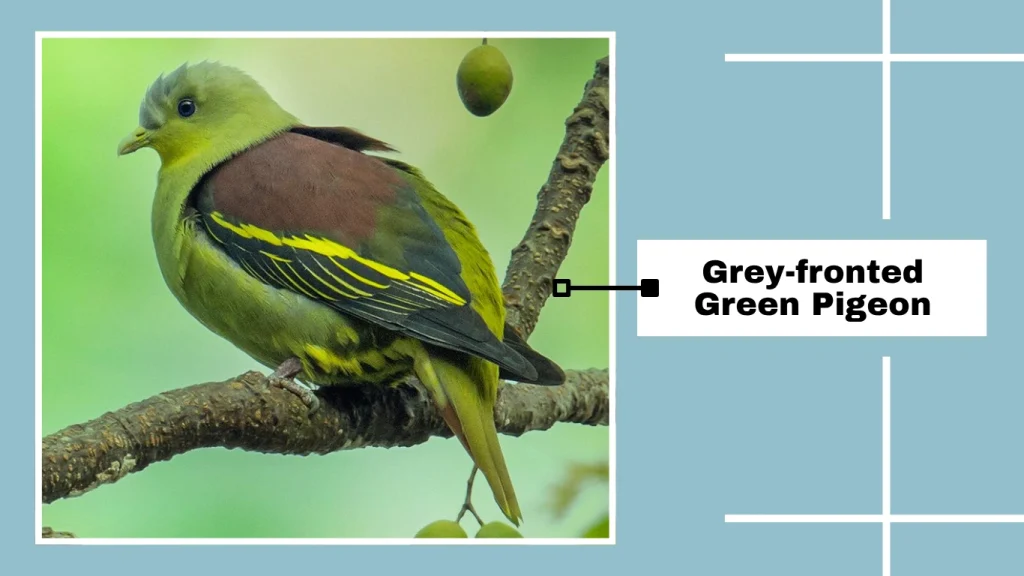
The Grey-fronted Green Pigeon is a small, striking pigeon known for its subtle color contrasts and calm behavior. Native to South and Southeast Asia, it inhabits tropical forests and feeds mostly in the canopy, blending beautifully among the leaves.
Identification
- Coloration: Olive-green body with a pale gray forehead and crown
- Accents: Yellow belly and vent, chestnut undertail coverts
- Size: 9–10 inches (23–25 cm) in length
- Wingspan: Around 16 inches (40 cm)
- Weight: 4–5 ounces (115–140 grams)
- Eyes: Reddish-orange with a narrow orbital ring
- Bill: Pale bluish base with yellow tip
- Legs: Pinkish-red
- Voice: Soft, whistling or nasal calls in short bursts
- Habitat: Evergreen and deciduous forests, often near fig trees and fruiting trees
Behavior and Diet
Feeds mainly on fruits and figs high in the canopy. Usually found in pairs or small flocks, they remain still and are easily overlooked among dense leaves.
Nesting and Reproduction
Nests are built in trees using fine twigs. The female lays one or two eggs. Breeding behavior is discreet and typically occurs during the rainy season.
Range and Distribution
Found in India, Nepal, Bhutan, Bangladesh, Myanmar, and parts of Southeast Asia. Its population is stable, though it relies heavily on intact forest ecosystems.
28. Victoria Crowned Pigeon
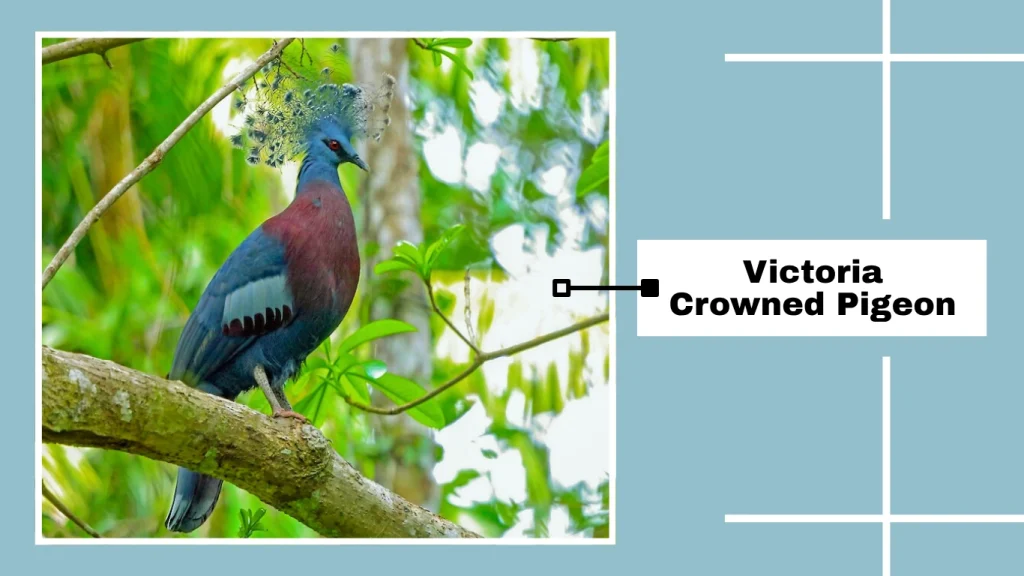
The Victoria Crowned Pigeon is one of the largest and most majestic pigeon species in the world. Named after Queen Victoria, this regal bird is instantly recognizable by its ornate, lacy blue crest and striking crimson eyes. It walks with a calm, royal grace through New Guinea’s tropical forests.
Identification
- Coloration: Powdery blue body with a deep maroon chest and lighter blue shoulders
- Crest: Elegant fan-like crest with delicate, lacy plumes tipped in white
- Size: 28–30 inches (70–75 cm) in length
- Wingspan: About 30–36 inches (76–91 cm)
- Weight: 5.5–7.7 pounds (2.5–3.5 kg)
- Eyes: Vivid crimson red
- Bill: Slender and black
- Legs: Pale gray with pink joints
- Voice: Deep, resonant “boom” and a soft, short “coo”
- Habitat: Lowland rainforests and swampy forest edges
Behavior and Diet
Feeds mostly on fallen fruits, seeds, and the occasional invertebrate. Moves slowly on the forest floor in small family groups. Very calm and unafraid of people in the wild, making them easy targets for hunters.
Nesting and Reproduction
Builds a well-constructed nest in low tree branches using sticks and leaves. The female lays a single white egg, and both parents care for the chick. Breeding is often timed with the fruiting season.
Range and Distribution
Endemic to northern New Guinea. Although relatively common in protected forests, it is considered Near Threatened due to habitat loss and hunting for its feathers and meat.
29. Senegal Dove (Laughing Dove subspecies)

The Senegal Dove, considered a subspecies or regional form of the Laughing Dove, is a small, charming bird commonly found in West Africa. It shares the soft, chuckling call of its relatives and is often seen walking quietly in towns and villages.
Identification
- Coloration: Pale pinkish-brown head and chest, light gray underparts, and scaly black-and-white patch on the sides of the neck
- Size: 9–10 inches (23–25 cm) in length
- Wingspan: About 14–16 inches (36–41 cm)
- Weight: 3.5–5 ounces (100–140 grams)
- Eyes: Dark brown with a narrow orbital ring
- Bill: Short and black
- Legs: Pinkish
- Voice: Soft, bubbling coos or chuckling “coo-coo-croo”
- Habitat: Gardens, farmlands, open savannas, and urban spaces
Behavior and Diet
Feeds on the ground in search of small seeds and grains. It is quiet, tame, and frequently found in human settlements, often perching on rooftops or walking along pathways.
Nesting and Reproduction
Builds a fragile nest in trees, shrubs, or building structures. Typically lays two white eggs. Both parents share the responsibility of incubation and feeding.
Range and Distribution
Widespread across West Africa, especially in countries like Senegal, Mali, and Ghana. Adaptable to various environments and often seen near human activity.
30. Senegal Green Pigeon
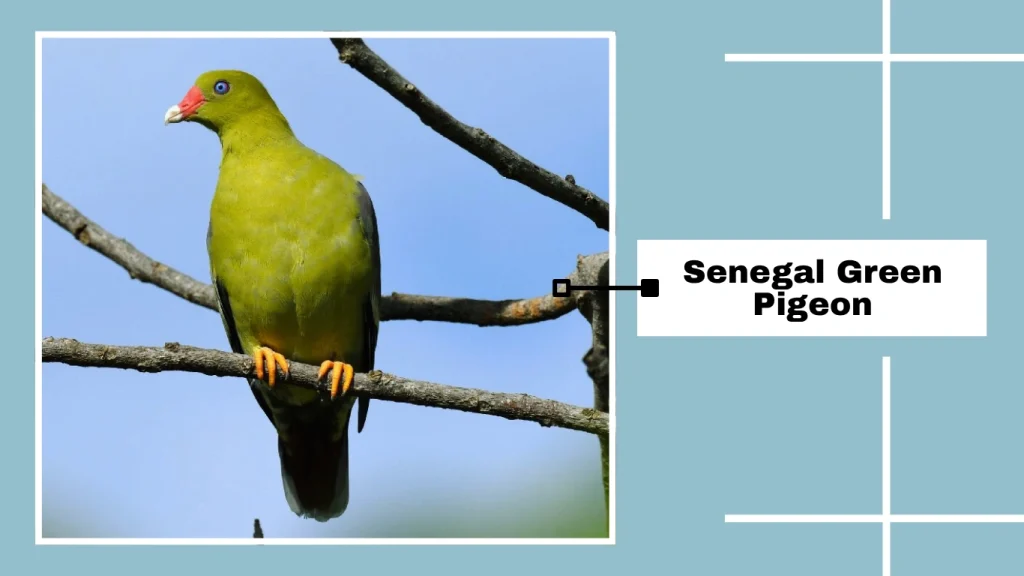
The Senegal Green Pigeon is a vibrant and agile fruit dove found across much of sub-Saharan Africa. With its lime-green plumage and acrobatic feeding behavior, this species blends seamlessly into leafy canopies and plays an important role in seed dispersal.
Identification
- Coloration: Bright green body with a grayish head and upper chest, and maroon wing patches
- Underparts: Yellowish vent and undertail
- Size: 9–10 inches (23–25 cm) in length
- Wingspan: About 15–17 inches (38–43 cm)
- Weight: 4–5 ounces (115–140 grams)
- Eyes: Bright red with a narrow yellow orbital ring
- Bill: Red base with a yellow tip
- Legs: Red or orange
- Voice: Soft, nasal whistles and short, mellow trills
- Habitat: Open woodlands, savannas, riverine forests, and fig-rich areas
Behavior and Diet
Primarily frugivorous, feeding on figs and other soft fruits while hanging upside down or climbing through branches. Often seen in pairs or small groups, moving swiftly and quietly among the treetops.
Nesting and Reproduction
Builds a small twig nest in the fork of a tree branch. The female typically lays two white eggs. Both male and female share incubation and chick-rearing duties.
Range and Distribution
Found widely across West, Central, and East Africa, including countries like Senegal, Nigeria, Uganda, and Kenya. Prefers regions with scattered trees and abundant fruit-bearing vegetation.
This completes the set of 30 types of beautiful doves. Let me know if you’d like them compiled, categorized, or formatted for a specific article layout.