






Wrens are small, energetic birds known for their lively songs, upright tails, and curious personalities. With over 80 species worldwide, these birds thrive in a wide range of habitats—from dense tropical forests and arid deserts to backyard shrubs and mountain slopes. In this guide, we explore 20 types of wrens from North, Central, and South America, highlighting their unique features, calls, nesting behavior, and preferred environments. Whether you’re a birdwatcher, nature lover, or simply curious, this list offers a glimpse into the charming diversity of one of the world’s most vocal and adaptable bird families.
1. House Wren

The House Wren is a small, energetic songbird widely distributed across North and South America. Known for its bubbly and complex song, this wren thrives in a variety of habitats and is often seen darting around gardens, backyards, and woodlands. Its adaptability and lively behavior make it a favorite among birdwatchers.
Identification
- Coloration: Plain brown overall with slightly paler underparts
- Markings: Fine barring on wings and tail; faint eyebrow
- Size: 4.3–5.1 inches (11–13 cm)
- Wingspan: 5.9–6.7 inches (15–17 cm)
- Weight: 0.3–0.4 ounces (10–12 grams)
- Bill: Thin and slightly curved
- Tail: Short, often held upright
- Call: Sharp “churr” or “chek” notes and a rich, gurgling song
Behavior and Diet
House Wrens are active foragers, flitting through low shrubs and undergrowth as they search for insects and spiders. They’re territorial and may aggressively chase away other birds, especially during nesting season.
Nesting and Reproduction
They nest in cavities, including birdhouses, tree holes, or crevices. The male builds several starter nests, and the female chooses one to finish and lay 5–8 eggs. Both parents feed the chicks after hatching.
Range and Habitat
This species breeds across most of North America and migrates to Central and South America during the winter. They adapt well to human environments and are common in suburban yards, parks, and forest edges.
2. Carolina Wren
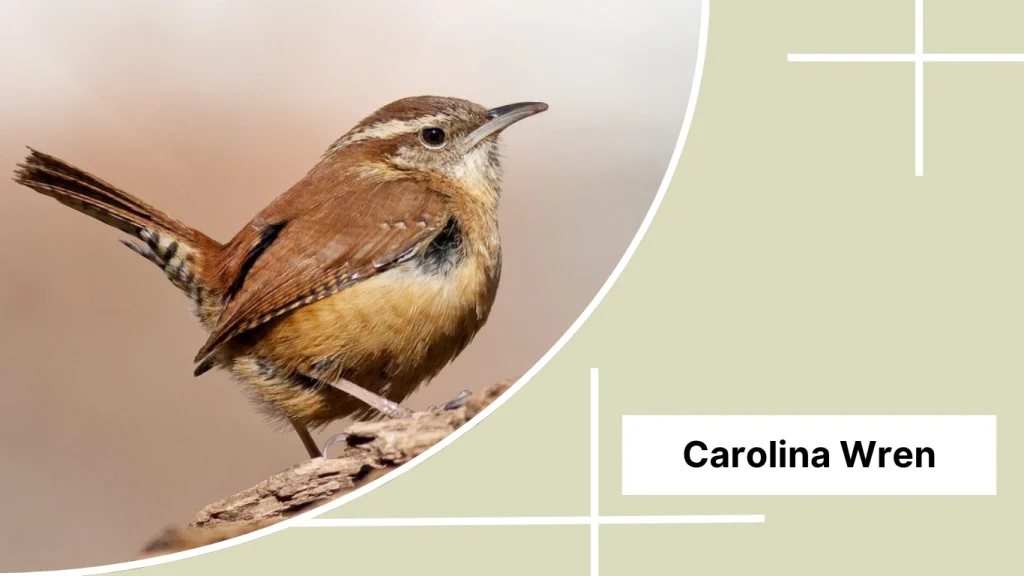
The Carolina Wren is a bold, loud, and curious songbird found year-round in the southeastern United States. Despite its small size, it boasts a big voice and an even bigger personality. With a rich cinnamon color and a signature white eyebrow stripe, this wren is a familiar and beloved presence in wooded areas, gardens, and porches.
Identification
- Coloration: Rich reddish-brown upperparts with warm buffy underparts
- Markings: Bold white eyebrow stripe; faint barring on wings and tail
- Size: 4.7–5.5 inches (12–14 cm)
- Wingspan: 11.4 inches (29 cm)
- Weight: 0.6–0.8 ounces (18–22 grams)
- Bill: Long, slightly curved and slender
- Tail: Rounded and often held upright
- Call: Loud “teakettle-teakettle-teakettle” song with varied trills and chips
Behavior and Diet
Carolina Wrens are highly active and curious birds that explore every crevice in their territory. They feed mainly on insects and spiders but will also eat seeds and suet, especially during colder months. Pairs form strong bonds and stay together year-round, often for life.
Nesting and Reproduction
Nests are bulky domes made of twigs, moss, leaves, and feathers, commonly tucked into tree hollows, hanging baskets, mailboxes, or any sheltered corner near human homes. The female lays 3–7 eggs and incubates them while the male brings food. Both parents help raise the chicks.
Range and Habitat
Found throughout the southeastern U.S. and increasingly moving northward, Carolina Wrens prefer dense vegetation in forests, thickets, and suburban gardens. They are non-migratory and are especially noticeable in winter due to their vocal presence.
3. Winter Wren

The Winter Wren is a tiny but incredibly vocal bird with a complex and musical song that seems too powerful for its size. Found mostly in dense, moist forests, this wren stays close to the ground, flitting among roots, logs, and leaf litter. Its cryptic coloring and secretive behavior make it a challenging yet rewarding bird to observe.
Identification
- Coloration: Dark brown overall with a slightly rufous tone
- Markings: Heavily barred flanks, wings, and tail; short white eyebrow stripe
- Size: 3.1–4.3 inches (8–11 cm)
- Wingspan: 4.7–6.3 inches (12–16 cm)
- Weight: 0.3–0.4 ounces (8–12 grams)
- Bill: Short and thin
- Tail: Very short and usually held upright
- Call: A long, bubbly, and complex song with up to 100 notes
Behavior and Diet
Winter Wrens forage close to the ground, searching for insects, beetles, and spiders in dark, mossy areas. They are very secretive and blend in well with their surroundings. Despite their shy behavior, males sing frequently during breeding season to claim territory.
Nesting and Reproduction
Males build multiple dome-shaped nests near the forest floor. The female selects one and lines it with soft materials before laying 5–7 eggs. The male continues to sing and defend the territory while the female incubates.
Range and Habitat
Winter Wrens breed in coniferous and mixed forests across northern North America and migrate to southern U.S. states in winter. In Europe and Asia, the Eurasian Wren occupies a similar ecological niche. They prefer moist, tangled understories near fallen logs and thick roots.
4. Marsh Wren

The Marsh Wren is a vocal and elusive bird of wetland habitats, known for its gurgling song and secretive nature. Active and energetic, this wren is typically seen darting through reeds and cattails. Its elaborate nest construction and aggressive behavior during breeding season make it a fascinating species to observe.
Identification
- Coloration: Warm brown upperparts with a black-and-white streaked back
- Underparts: Pale grayish or buffy
- Markings: White eyebrow stripe; no wing bars
- Size: 4.3–5.1 inches (11–13 cm)
- Wingspan: 5.5 inches (14 cm)
- Weight: 0.3–0.4 ounces (9–12 grams)
- Bill: Thin and slightly curved
- Tail: Short and cocked
- Call: A mechanical, buzzing trill often described as insect-like
Behavior and Diet
Marsh Wrens feed mostly on insects and spiders, gleaned from wetland vegetation. They are highly territorial and will destroy the eggs of other birds nesting nearby. Males often build several nests (called “dummy nests”) to attract a mate and discourage competitors.
Nesting and Reproduction
The male constructs multiple domed nests woven from reeds and grasses above water in dense vegetation. The female chooses one to line and lay her eggs, typically 4–6. Both parents help feed the chicks once they hatch.
Range and Habitat
Marsh Wrens inhabit freshwater and brackish marshes across North America. They breed in northern regions and migrate to southern states and Mexico for winter. These birds stay low in reeds and cattails, often heard before seen.
5. Sedge Wren

The Sedge Wren is a small, secretive bird found in grassy wetlands and sedge meadows. It is closely related to the Marsh Wren but differs in appearance, vocalizations, and preferred habitat. Its erratic breeding behavior and scattered distribution make it a unique and challenging species to study.
Identification
- Coloration: Brown upperparts with black-and-white streaking
- Underparts: Pale buff to whitish
- Markings: Pale eyebrow stripe; faint barring on wings
- Size: 4.3–4.7 inches (11–12 cm)
- Wingspan: 6 inches (15 cm)
- Weight: 0.3–0.4 ounces (9–11 grams)
- Bill: Short and thin
- Tail: Short and held upright
- Call: Dry, rattling trill often repeated from concealed perches
Behavior and Diet
Sedge Wrens are shy and elusive, usually hiding in tall grasses. They feed on small insects and spiders and are more active at dawn and dusk. Their behavior is nomadic, with breeding populations shifting from year to year depending on habitat conditions.
Nesting and Reproduction
Males build multiple nests among sedges and grasses, suspended just above ground level. The female selects one for laying 5–8 eggs. Their nests are enclosed and made from woven grasses and plant stems.
Range and Habitat
Sedge Wrens breed in scattered patches across central and eastern North America. They favor wet, grassy meadows, sedge fields, and edges of marshes. In winter, they migrate to the southeastern U.S. and parts of Mexico, remaining hidden in dense grass.
6. Bewick’s Wren

Bewick’s Wren is a slender, active songbird known for its long tail, bold facial markings, and varied, melodic song. Once widespread in the eastern U.S., its population has declined there but remains stable in the western and southern states. It thrives in dry, brushy habitats and is often seen flicking its tail as it explores underbrush.
Identification
- Coloration: Warm grayish-brown upperparts with lighter underparts
- Markings: Bold white eyebrow stripe; dark barring on tail
- Size: 5.1 inches (13 cm)
- Wingspan: 7 inches (18 cm)
- Weight: 0.3–0.4 ounces (8–12 grams)
- Bill: Thin, slightly decurved
- Tail: Long and expressive, often flicked up or side to side
- Call: Clear and musical, often includes a series of whistles, trills, and chirps
Behavior and Diet
Bewick’s Wrens are inquisitive and quick-moving, often found hopping through shrubs and thickets while searching for insects and larvae. They frequently flick their tails and give alarm calls when startled. Pairs stay together year-round and defend territories vigorously.
Nesting and Reproduction
They nest in cavities or man-made structures like nest boxes, eaves, or open pipes. Nests are cup-shaped and built with sticks and grasses. Females lay 5–7 eggs, and both parents care for the young.
Range and Habitat
Found in the western and south-central U.S., Bewick’s Wrens inhabit dry scrublands, wooded ravines, and urban gardens. They have largely disappeared from the eastern U.S., possibly due to competition with House Wrens.
7. Cactus Wren
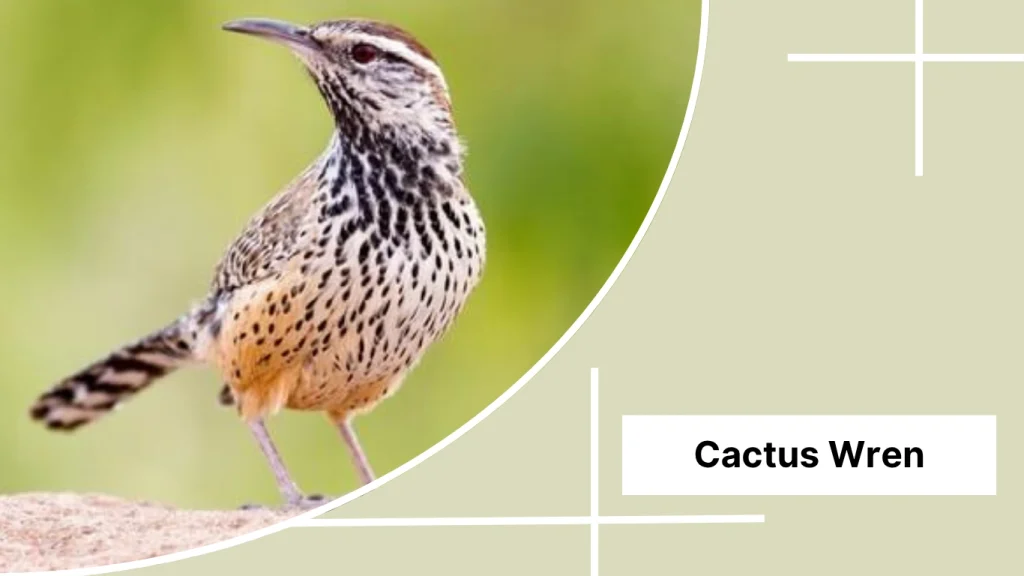
The Cactus Wren is the largest wren species in the United States, well-adapted to desert environments. It is the state bird of Arizona and is easily recognized by its speckled plumage, bold white eyebrows, and loud, raspy voice. This wren builds conspicuous nests in cactus plants, offering protection from predators.
Identification
- Coloration: Brown upperparts with heavy white and black spotting
- Underparts: Whitish with black spots on the breast
- Markings: Distinct white eyebrow stripe
- Size: 7.1–8.7 inches (18–22 cm)
- Wingspan: 10–11 inches (25–28 cm)
- Weight: 1.1–1.7 ounces (32–47 grams)
- Bill: Long, curved, and heavy
- Tail: Long with white corners, often held low
- Call: Harsh, mechanical “jar-jar-jar” notes
Behavior and Diet
Cactus Wrens forage in the open desert, flipping over debris to find insects, ants, and spiders. They are territorial, aggressive when defending nests, and often travel in pairs or family groups. Their behavior is bold and less secretive than other wrens.
Nesting and Reproduction
Nests are bulky, football-shaped structures made from grasses, feathers, and plant fibers, often placed in cholla, prickly pear, or other thorny vegetation. The female lays 3–6 eggs, and multiple broods may be raised in a season.
Range and Habitat
This species inhabits arid regions of the southwestern U.S. and northern Mexico. It prefers desert scrub, cactus thickets, and dry open land with scattered bushes. Cactus Wrens are permanent residents and do not migrate.
8. Rock Wren
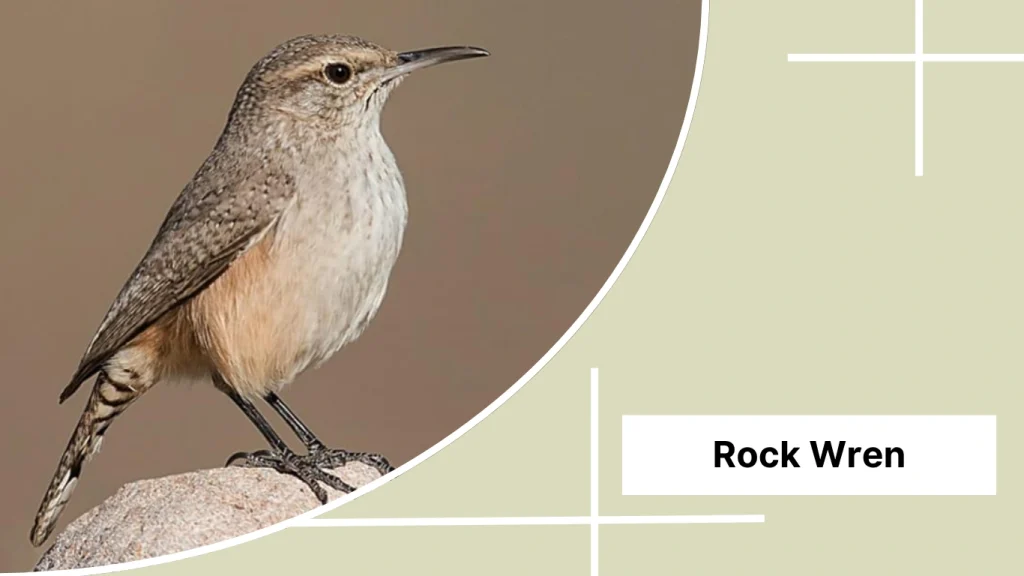
The Rock Wren is a small but tough bird built for rocky, barren environments in the western United States. With its muted coloring and high-pitched song, this species blends into its surroundings yet delivers a charming presence through constant movement and song.
Identification
- Coloration: Gray-brown upperparts with faint speckling
- Underparts: Pale with fine barring on belly and flanks
- Markings: Pale eyebrow and subtle streaks
- Size: 4.9–5.9 inches (12.5–15 cm)
- Wingspan: 8.7–9.8 inches (22–25 cm)
- Weight: 0.5–0.7 ounces (15–20 grams)
- Bill: Long and slightly curved
- Tail: Short, slightly rounded with dark bars
- Call: Sharp “chek” and high whistled songs
Behavior and Diet
Rock Wrens are agile climbers, often hopping and bobbing on boulders while foraging for insects. They’re solitary or found in pairs, and males sing persistently to defend territory. They often perch on rocks or walls to sing and scan for food.
Nesting and Reproduction
They construct cup-shaped nests in rock crevices, often at the base of cliffs or within stone piles. Males sometimes create a “walkway” of small stones leading to the nest. Females lay 4–6 eggs and raise the young in secluded rocky spots.
Range and Habitat
Rock Wrens breed across dry, rocky areas of the western U.S., Mexico, and parts of Canada. They inhabit canyons, cliffs, rock outcrops, and dry hillsides. Some northern populations migrate southward in winter, while others remain year-round.
9. Canyon Wren
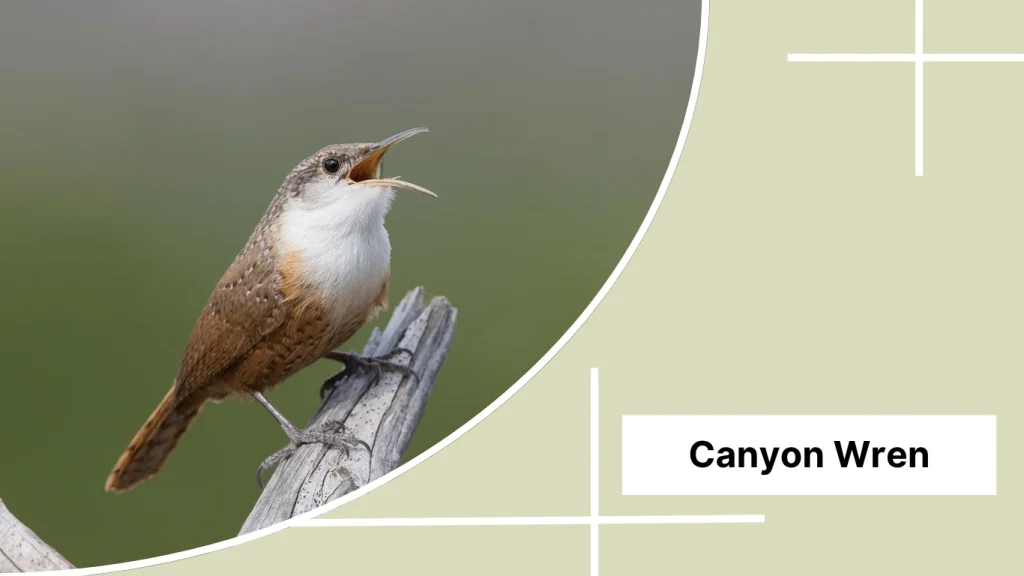
The Canyon Wren is a small, elusive bird known for its hauntingly beautiful song that echoes through rocky canyons and desert cliffs. Despite its discreet behavior, the bird’s cascading whistle often gives away its presence. It is built for life among vertical rock faces and rugged terrain.
Identification
- Coloration: Rusty-cinnamon underparts with grayish-brown upperparts
- Markings: White throat and upper chest; fine barring on tail and wings
- Size: 4.3–6.1 inches (11–15.5 cm)
- Wingspan: 7.5–9 inches (19–23 cm)
- Weight: 0.3–0.7 ounces (9–20 grams)
- Bill: Long, thin, and slightly curved
- Tail: Medium-length with rounded tip and fine barring
- Call: Beautiful descending whistle that sounds like a falling series of notes
Behavior and Diet
Canyon Wrens cling effortlessly to cliff faces and boulders, foraging for spiders, insects, and other arthropods. They move with precision and confidence across steep surfaces, often unseen but easily heard.
Nesting and Reproduction
They build cup-shaped nests in rock crevices or under ledges, well-concealed in narrow cracks. Nests are made of grasses, moss, bark, and feathers. The female lays 4–6 eggs, and both parents feed the young.
Range and Habitat
Found throughout the western U.S. and Mexico, Canyon Wrens prefer steep-walled canyons, cliffs, rocky slopes, and escarpments. Their range includes arid and semi-arid habitats, and they are mostly non-migratory.
10. Pacific Wren

The Pacific Wren is a tiny, energetic forest bird with an enormous voice. Formerly lumped with the Winter Wren, it now stands as its own species in the Pacific Northwest. Its rich, cascading song and dense, mossy woodland habitat make it a favorite among birders.
Identification
- Coloration: Dark brown with rufous tones
- Markings: Fine barring on belly, flanks, wings, and tail; faint pale eyebrow
- Size: 3.5–4.3 inches (9–11 cm)
- Wingspan: 5.5 inches (14 cm)
- Weight: 0.3 ounces (8–10 grams)
- Bill: Short and fine
- Tail: Very short, often cocked upright
- Call: Long, elaborate, trilling song made of multiple phrases
Behavior and Diet
Pacific Wrens stay close to the forest floor, weaving through roots, ferns, and logs. They feed on tiny insects and spiders and can be heard singing even on overcast or rainy days. Males sing frequently to defend territory and attract mates.
Nesting and Reproduction
Nests are hidden in roots, tree stumps, mossy crevices, or even nest boxes. The male builds several dome-shaped nests, and the female chooses one to line and use. She lays 5–6 eggs, incubates them, and both parents feed the young.
Range and Habitat
This species is found along the Pacific coast from Alaska to California, primarily in coniferous and mixed forests. It prefers moist, moss-covered woods and riparian areas. In winter, some populations move to lower elevations.
11. Eurasian Wren

The Eurasian Wren is one of the most widespread small birds across Europe and parts of Asia. Known for its round body, upright tail, and bubbling song, it’s a common yet charismatic presence in forests, gardens, and even mountain slopes.
Identification
- Coloration: Warm brown with subtle speckling and barring
- Markings: Fine dark barring on flanks, tail, and wings
- Size: 3.7–4.3 inches (9.5–11 cm)
- Wingspan: 5.9–6.7 inches (15–17 cm)
- Weight: 0.3–0.4 ounces (8–12 grams)
- Bill: Short and slender
- Tail: Short and typically held upright
- Call: Loud, explosive song for such a tiny bird—includes trills and rattles
Behavior and Diet
It is very active and often stays low, hopping through leaf litter and shrubs. It feeds on insects, spiders, and larvae. Males can sing up to 700 times per hour during the breeding season, making them surprisingly loud for their size.
Nesting and Reproduction
Males build several ball-shaped nests with side entrances in holes, roots, or walls. The female selects one, lines it, and lays 5–8 eggs. These birds are often polygamous, with one male mating with multiple females.
Range and Habitat
The Eurasian Wren occurs across Europe, parts of North Africa, and much of temperate Asia. It prefers forests, woodlands, gardens, and hedgerows. Northern populations migrate southward in winter, while southern ones are mostly resident.
12. Rufous-and-white Wren

The Rufous-and-white Wren is a striking neotropical bird known for its rich chestnut coloring and clear whistling duets. Found in Central and South America, this species prefers forest edges and second-growth woodlands where it can stay well hidden while delivering melodious calls.
Identification
- Coloration: Rich rufous upperparts and white underparts
- Markings: Prominent white eyebrow; faint grayish barring on flanks
- Size: 6.3–6.7 inches (16–17 cm)
- Wingspan: Approximately 9–10 inches (23–25 cm)
- Weight: 0.6–0.8 ounces (18–22 grams)
- Bill: Long, straight, and slightly pointed
- Tail: Medium length, carried horizontally
- Call: Loud, clear, whistled duets often performed by mated pairs
Behavior and Diet
This wren forages quietly in the lower to middle levels of the forest, searching for insects, spiders, and small arthropods. Though not shy, it is often overlooked due to its preference for cover. Mated pairs stay close together and are often heard calling back and forth.
Nesting and Reproduction
The nest is an enclosed ball of sticks and plant fibers placed in shrubs or tree branches. Both male and female help construct the nest. The female lays 2–4 eggs and both parents tend to the chicks.
Range and Habitat
Found from southern Mexico through Panama and into northwestern South America, the Rufous-and-white Wren prefers dry forest edges, secondary growth, and scrubby clearings. It thrives in disturbed but shrubby landscapes.
13. Banded Wren

The Banded Wren is a large, boldly marked tropical wren found primarily in Central America. Its black-and-white facial pattern and barred tail give it a distinctive appearance. Known for its loud, fluty songs, it lives in dry forests and scrublands.
Identification
- Coloration: Brown upperparts with buffy underparts
- Markings: Black-and-white facial pattern; boldly barred wings and tail
- Size: 6.3–6.7 inches (16–17 cm)
- Wingspan: Roughly 9 inches (23 cm)
- Weight: 0.7–1.0 ounces (20–28 grams)
- Bill: Strong and slightly downcurved
- Tail: Long and heavily barred
- Call: Loud, flute-like whistles, often performed in duets or choruses
Behavior and Diet
Banded Wrens are active and social, often found in pairs or family groups. They forage through low branches and ground cover for insects and other small invertebrates. Despite their size, they move swiftly and can be hard to spot in dense vegetation.
Nesting and Reproduction
Nests are bulky dome-shaped structures with a side entrance, built from grasses and lined with finer materials. They are usually placed in shrubs or tangled vines. The female lays 3–5 eggs and both parents assist in feeding.
Range and Habitat
This species is native to western Mexico through Honduras and Nicaragua. It prefers tropical dry forests, thornscrub, and open woodlands with dense underbrush, typically below 1,500 meters elevation.
14. Bay Wren
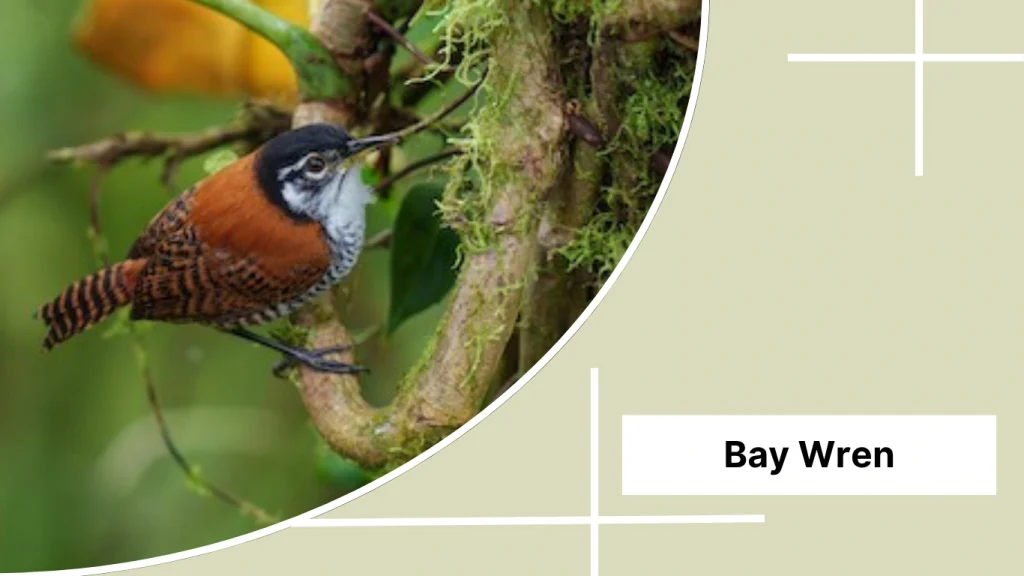
The Bay Wren is a compact, richly colored bird with a bright voice and complex duet singing. Found in lowland tropical regions, it stays close to thick tangles of vegetation near water and is known for its rich rufous plumage and streaked back.
Identification
- Coloration: Deep chestnut brown with a black-and-white streaked back
- Markings: White chin and barred flanks; red eyes
- Size: 4.7–5.5 inches (12–14 cm)
- Wingspan: Approx. 7.5 inches (19 cm)
- Weight: 0.4–0.6 ounces (12–18 grams)
- Bill: Short and slightly curved
- Tail: Short, with faint barring
- Call: Complex warbles, trills, and rich duets between pairs
Behavior and Diet
Bay Wrens are secretive and rarely stray far from dense cover. They forage low in tangled vines and thickets, feeding on insects, spiders, and caterpillars. Mated pairs often sing in synchronized duets to maintain territory.
Nesting and Reproduction
They build large domed nests of woven plant material in dense shrubs, often overhanging water. Nests are typically hidden deep in thickets. The female lays 3–4 eggs and both parents participate in feeding the chicks.
Range and Habitat
Bay Wrens are distributed from southern Mexico through Central America to northwestern South America. They prefer lowland forests, mangroves, river edges, and thick secondary growth.
15. Spot-breasted Wren

The Spot-breasted Wren is a tropical songbird with warm brown tones and a speckled chest. It is most often heard before seen, as it stays hidden in dense thickets and forest understory. Its song is clear and whistled, often performed in pairs.
Identification
- Coloration: Rich brown upperparts with buffy underparts
- Markings: Bold black spots on breast and flanks; white eyebrow
- Size: 4.7–5.5 inches (12–14 cm)
- Wingspan: Around 7.5 inches (19 cm)
- Weight: 0.4–0.6 ounces (12–17 grams)
- Bill: Short and slender
- Tail: Short and rounded
- Call: Rich, whistled notes repeated clearly and melodiously
Behavior and Diet
These wrens forage in pairs or small groups through low vegetation and leaf litter, feeding on insects and spiders. They are shy but highly vocal, and their calls help maintain contact in dense forest growth.
Nesting and Reproduction
They construct large ball-like nests with side entrances, typically placed in shrubs or vines. The nest is made from plant fibers and grass. The female lays 3–5 eggs, with both parents involved in raising the chicks.
Range and Habitat
Spot-breasted Wrens range from southern Mexico through Central America to Colombia. They prefer humid lowland forests, thickets, plantations, and brushy clearings near water.
16. Rufous-breasted Wren

The Rufous-breasted Wren is a vibrant and melodic bird found in the humid forests of Central and South America. It is known for its richly colored plumage and impressive song duets performed by mated pairs deep within the forest understory.
Identification
- Coloration: Deep rufous breast and belly with dark brown upperparts
- Markings: White eyebrow; black-and-white barring on wings and tail
- Size: 5.5–6.3 inches (14–16 cm)
- Wingspan: Approximately 8–9 inches (20–23 cm)
- Weight: 0.6–0.8 ounces (18–22 grams)
- Bill: Slightly decurved and slim
- Tail: Moderately long and barred
- Call: Duet calls with clear, whistled notes and fast-paced trills
Behavior and Diet
This species stays low in dense foliage and tangled vines, feeding on spiders, beetles, ants, and small invertebrates. It’s more often heard than seen, and mated pairs communicate constantly through song.
Nesting and Reproduction
Their nests are ball-shaped with side entrances, built low in shrubs or vines using rootlets, moss, and leaves. Females lay 2–4 eggs, and both adults share parenting duties.
Range and Habitat
Rufous-breasted Wrens are found from eastern Honduras through northern South America, especially in lowland tropical forests and forest edges. They prefer thick undergrowth and moist woodland.
17. Whiskered Wren

The Whiskered Wren is a reclusive bird of humid mountain forests. Its name comes from its prominent facial markings that resemble “whiskers,” and it is recognized by its bubbly, musical song and habit of remaining hidden in tangles of vines and moss.
Identification
- Coloration: Rich brown upperparts with pale buff underparts
- Markings: Broad white eyebrow and whisker stripe; dark barring on wings and tail
- Size: 5.1–5.5 inches (13–14 cm)
- Wingspan: About 7.5–8.5 inches (19–22 cm)
- Weight: 0.5–0.6 ounces (14–17 grams)
- Bill: Short, straight, and pointed
- Tail: Rounded and often carried down
- Call: Fast and sweet series of whistles and gurgling phrases
Behavior and Diet
The Whiskered Wren is shy and stays deep in tangled forest vegetation, foraging on the ground and in low bushes for insects and other invertebrates. It’s more often heard than seen.
Nesting and Reproduction
Its nest is a domed structure made of moss, leaves, and grass, placed in low, hidden spots. The female lays 2–4 eggs. Both parents participate in feeding the chicks.
Range and Habitat
This wren inhabits montane forests from Costa Rica through western Colombia and Ecuador. It is most commonly found in dense secondary growth and humid cloud forests at mid-elevations.
18. Plain Wren

The Plain Wren is a small, unassuming bird that lives up to its name in appearance but not in personality. Though modest in color, it is very vocal and social, often found in thick vegetation near water. Its sweet duets with its mate are a hallmark of its behavior.
Identification
- Coloration: Warm brown upperparts with lighter, buffy underparts
- Markings: Faint or absent eyebrow; unmarked breast and flanks
- Size: 4.7–5.1 inches (12–13 cm)
- Wingspan: Around 7–8 inches (18–20 cm)
- Weight: 0.4–0.5 ounces (11–14 grams)
- Bill: Short, slim, and slightly curved
- Tail: Short and rounded
- Call: Soft, clear whistles sung in coordinated duets between pairs
Behavior and Diet
Plain Wrens stay hidden in thickets, scrub, and tangled vines, often close to ground level. They forage for insects, caterpillars, spiders, and other small arthropods. Pairs are territorial and communicate frequently with call-and-response songs.
Nesting and Reproduction
Their nests are enclosed, football-shaped structures made of plant fibers, typically placed in dense vegetation. The female lays 2–4 eggs. Males often build extra “dummy” nests nearby, possibly for display or as decoys.
Range and Habitat
This species is native to Central America, particularly from Honduras to Panama. It prefers humid lowland thickets, forest edges, and shrubby riverbanks, especially areas with thick understory vegetation.
19. Buff-breasted Wren

The Buff-breasted Wren is a colorful and lively tropical species known for its bold face markings, warm plumage, and loud, echoing song. Found across much of South America, it thrives in shrubby clearings, woodland edges, and overgrown fields.
Identification
- Coloration: Rich brown upperparts with buffy-orange breast and belly
- Markings: Prominent white eyebrow and dark eye-line; lightly barred wings and tail
- Size: 5.5–6.3 inches (14–16 cm)
- Wingspan: 8–9 inches (20–23 cm)
- Weight: 0.6–0.8 ounces (17–23 grams)
- Bill: Medium-length, strong, and slightly downcurved
- Tail: Moderately long, barred, and held horizontally or slightly raised
- Call: Loud, cheerful whistles and trills, often performed as duets
Behavior and Diet
Buff-breasted Wrens forage low in dense brush or tangled scrub, feeding on insects, beetles, ants, and spiders. They are highly vocal and social, often moving in pairs or family groups while calling constantly.
Nesting and Reproduction
Nests are domed and built in thick vegetation, low to the ground or in shrubs. They are constructed from grass, roots, and fine twigs. Females lay 3–5 eggs. Both parents assist in incubation and chick rearing.
Range and Habitat
This species ranges from Panama through northern and central South America, including Colombia, Venezuela, Brazil, and Peru. It favors forest edges, secondary growth, clearings, and shrub-dominated habitats near water.
20. Happy Wren
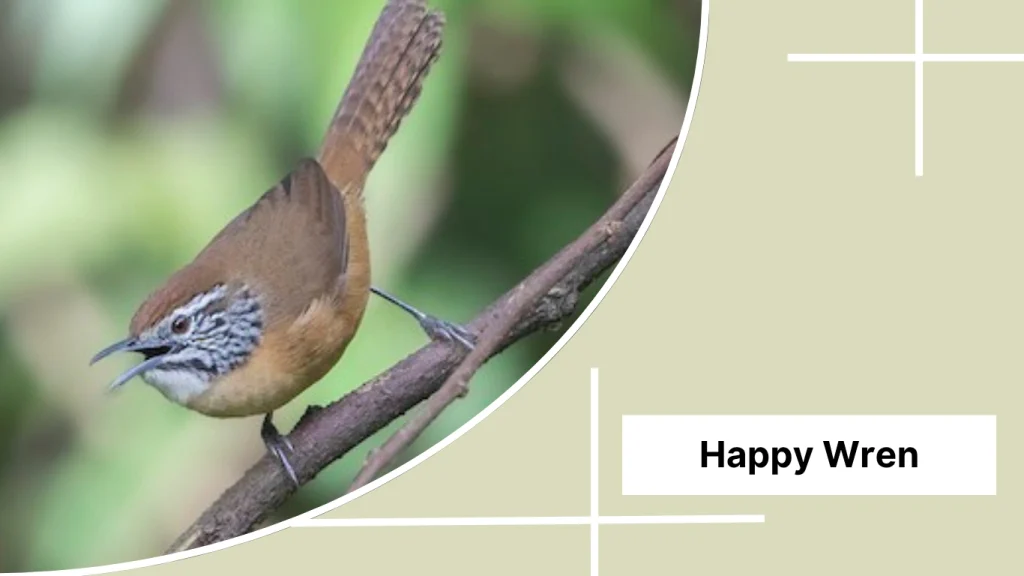
The Happy Wren is a lively and well-named species native to the tropical regions of Mexico and Central America. It is known for its cheerful song, active foraging behavior, and cooperative social structure, often moving in family groups through dense undergrowth.
Identification
- Coloration: Warm brown upperparts and buff underparts
- Markings: Distinct white eyebrow stripe and dark eye-line; faint barring on flanks
- Size: 4.7–5.1 inches (12–13 cm)
- Wingspan: Approximately 7–8 inches (18–20 cm)
- Weight: 0.4–0.5 ounces (11–14 grams)
- Bill: Short, slightly curved and pointed
- Tail: Short and carried upright
- Call: A fast-paced series of cheerful whistles and gurgles, often sung in chorus
Behavior and Diet
Happy Wrens are very social and usually seen in pairs or family groups. They move actively through dense vegetation, flicking their tails and calling frequently. Their diet consists of small insects, spiders, and larvae found in leaf litter and shrubs.
Nesting and Reproduction
They build domed nests with side entrances made from plant fibers, moss, and leaves. Nests are usually placed in thick bushes, low trees, or even abandoned buildings. The female lays 3–4 eggs. Family members may help in feeding the chicks.
Range and Habitat
The Happy Wren is found from western Mexico through Guatemala and Honduras. It prefers tropical deciduous forests, dry scrublands, and dense underbrush, especially near streams or shaded ravines. It’s often heard before seen due to its lively song and secretive habits.