
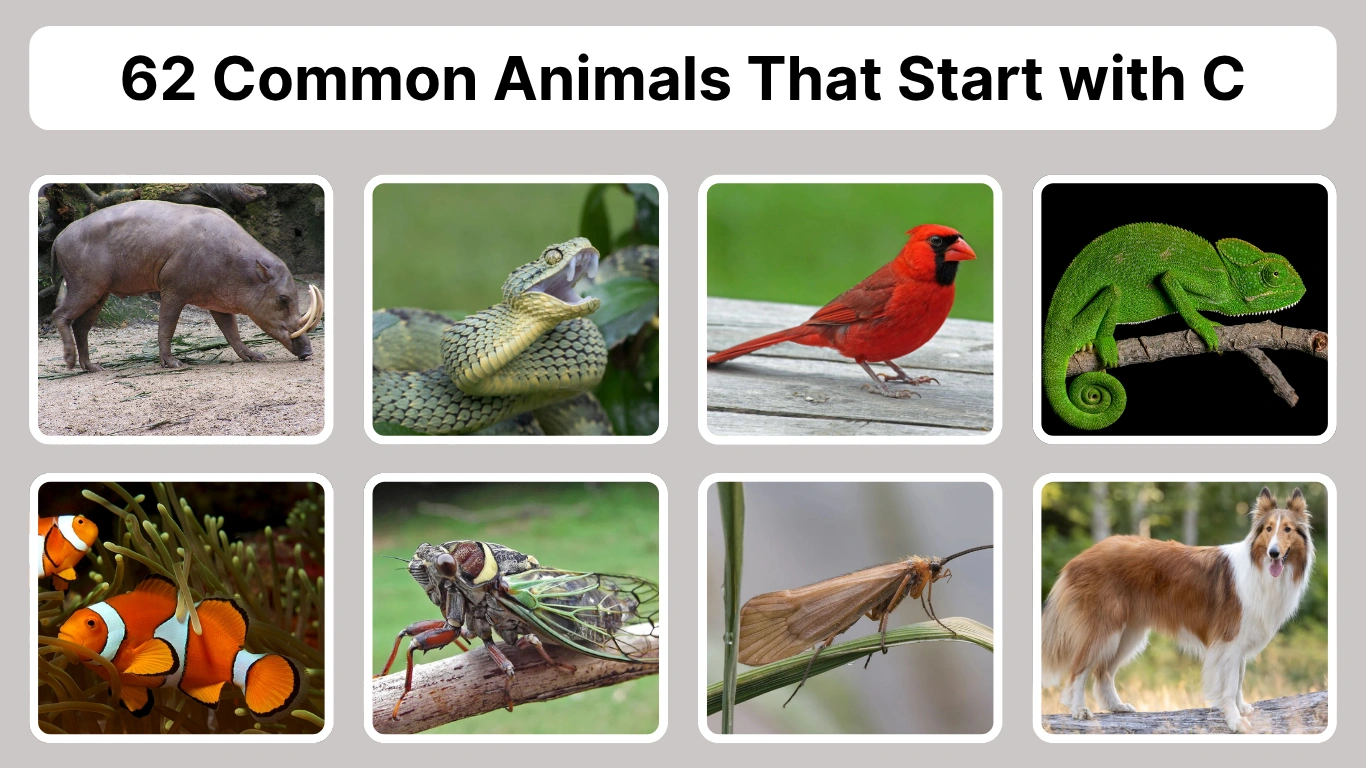
From cuddly cockapoos to elusive clouded leopards, the animal kingdom is packed with creatures whose names begin with the letter C. This guide features 62 diverse animals—organized into 10 themed groups for easy exploration. You’ll discover mammals, birds, reptiles, sea creatures, insects, and more, each paired with descriptions and identification insights to help you learn about their unique traits, behaviors, and natural habitats.
Mammals That Start with C
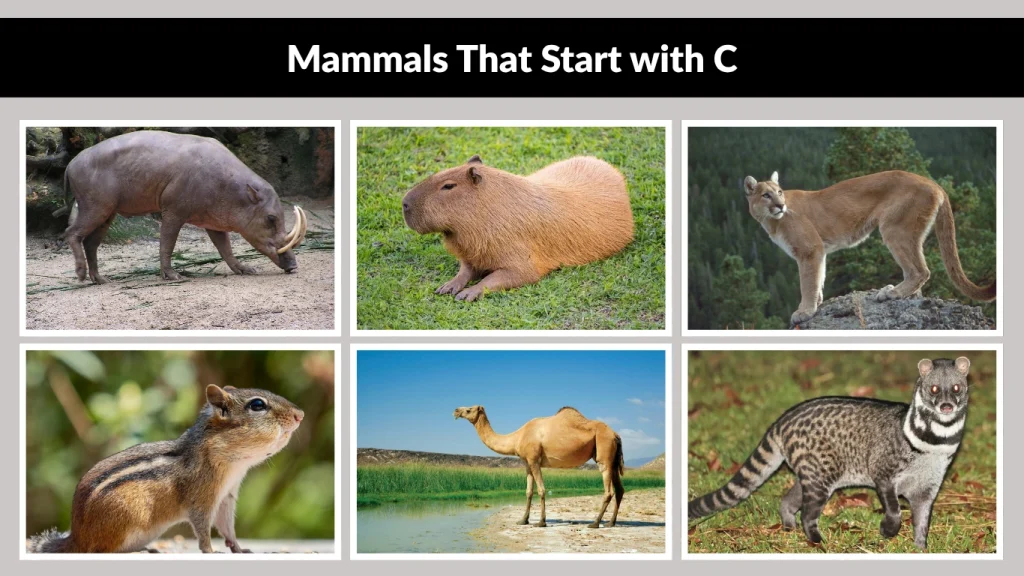
Mammals are warm-blooded animals with fur or hair and typically give birth to live young. In this group, we highlight six well-known mammals whose names begin with the letter C. These animals come from diverse environments—deserts, forests, mountains, and plains—and represent a wide range of sizes, behaviors, and adaptations.
1. Cougar
The cougar, also known as the mountain lion or puma, is a large cat with a tawny coat and powerful limbs. It is a stealthy, solitary predator.
Native to the Americas, cougars prefer mountainous and forested areas where they can stalk deer and other prey with silent agility.
2. Capybara
The capybara is the world’s largest rodent, with a barrel-shaped body and webbed feet perfect for swimming. It lives in large social groups.
Native to South America, it prefers riversides and wetlands, grazing on grasses and lounging in water to stay cool and escape predators.
3. Cheetah
Cheetahs are sleek, spotted big cats known for their incredible speed, capable of sprinting up to 70 mph in short bursts.
They hunt during the day on African savannas, using sight rather than smell, and rely on bursts of speed to catch antelope and hares.
4. Chipmunk
Chipmunks are small, striped rodents with cheek pouches used to store food for later. They are energetic and quick on their feet.
Found in forests and backyards across North America, chipmunks dig burrows and spend much of the day gathering seeds and nuts.
5. Camel
Camels are large desert mammals with long legs and one or two humps for fat storage. They are well adapted to dry, harsh environments.
Used by humans for transport and milk, camels can survive weeks without water, thanks to their unique metabolism and water conservation abilities.
6. Civet
Civets are small, cat-like mammals with long bodies, pointed snouts, and nocturnal habits. They mark territory with a musky scent.
Native to Asia and Africa, they feed on fruit, insects, and small animals. One species is known for producing coffee beans through digestion.
Birds That Start with C
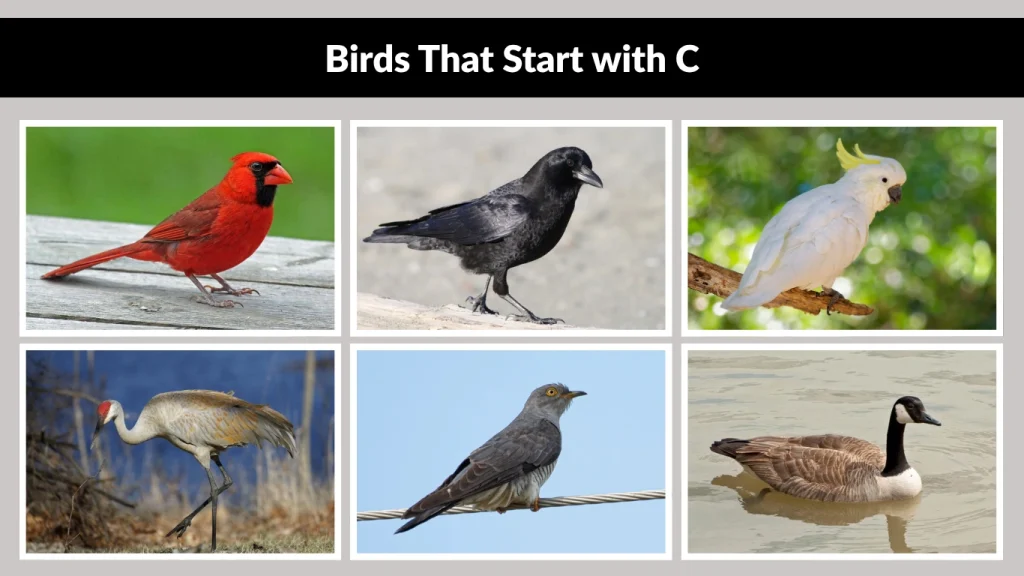
Birds are warm-blooded, feathered creatures with beaks and strong vision, most known for their ability to fly. This group includes six birds beginning with the letter C. From colorful songbirds to large waders, these birds thrive in forests, wetlands, and even urban areas around the world.
7. Cardinal
Cardinals are bright red songbirds known for their crest-topped heads and strong beaks. Males are vivid red, while females are more muted.
Found across North America, they’re popular in backyard feeders and are easily recognized by their rich, whistling songs.
8. Crow
Crows are intelligent, black-feathered birds with strong problem-solving skills and the ability to mimic sounds. They thrive in diverse habitats.
They live in large social groups and are omnivores, feeding on insects, fruit, carrion, and even garbage in cities.
9. Cockatoo
Cockatoos are medium to large parrots with expressive crests and curved beaks. They are social, loud, and highly intelligent.
Native to Australia and nearby islands, they bond deeply with mates or humans and can live for several decades in captivity.
10. Crane
Cranes are tall, elegant birds with long legs and necks, known for their graceful movements and elaborate mating dances.
They live in wetlands and open plains across many continents and feed on plants, small animals, and insects.
11. Cuckoo
Cuckoos are known for laying their eggs in the nests of other birds, leaving others to raise their young. They have distinct calls.
These birds are found worldwide and are often heard more than seen, especially during spring and summer breeding seasons.
12. Canada Goose
The Canada goose is a large migratory bird with a black head, long neck, and white cheek patch. They fly in V-formations.
They’re common in North America, nesting near ponds and lakes, and are known for their loud honking and seasonal migrations.
Reptiles and Amphibians That Start with C
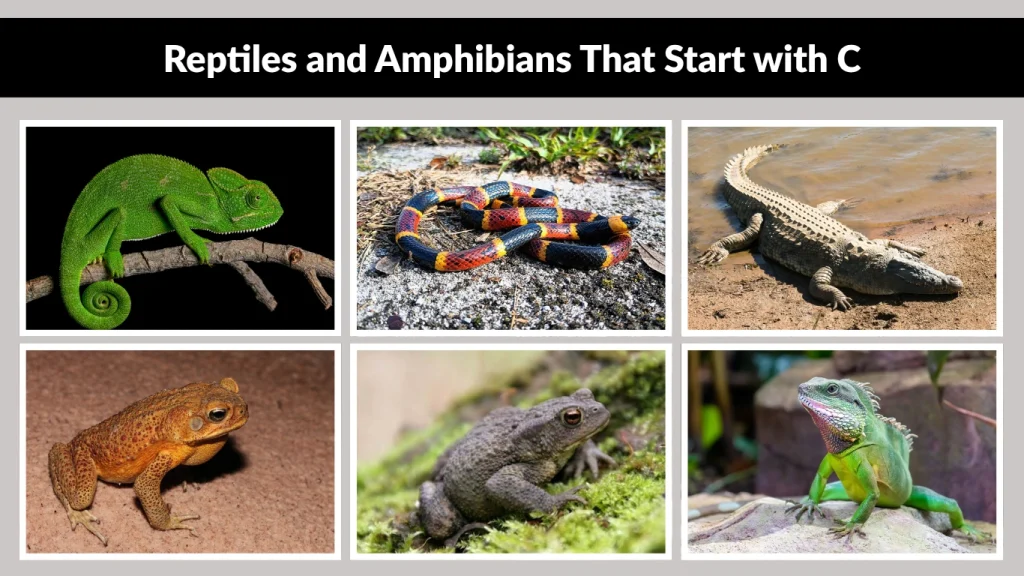
Reptiles and amphibians are cold-blooded animals that thrive in a variety of environments—from deserts to rainforests. This group features six species beginning with the letter C, each with unique behaviors, appearances, and survival adaptations.
13. Chameleon
Chameleons are tree-dwelling lizards known for their ability to change color and their independently moving eyes. They have long, sticky tongues for catching insects.
Native to Africa and Madagascar, they use color changes not just for camouflage but also for communication and temperature regulation.
14. Coral Snake
Coral snakes are small, brightly colored snakes with red, yellow, and black bands. They are venomous and shy, rarely seen in the open.
Found in the Americas, they often hide under leaves or logs and deliver neurotoxic venom through a fixed front fang bite.
15. Crocodile
Crocodiles are large aquatic reptiles with powerful jaws, scaly bodies, and muscular tails. They are top predators in rivers and wetlands.
Found in tropical regions across Africa, Asia, and the Americas, they ambush prey with stealth and can live over 70 years.
16. Cane Toad
Cane toads are large, warty amphibians with toxic skin secretions that deter predators. They have spread widely as invasive pests.
Originally from Central and South America, they were introduced to Australia to control pests, but now threaten native species and ecosystems.
17. Common Toad
The common toad is a brownish amphibian with dry, warty skin and a slow, lumbering movement. It returns to water to breed.
Widespread in Europe and parts of Asia, it feeds on insects, worms, and slugs and is mostly active at night.
18. Chinese Water Dragon
The Chinese water dragon is a bright green lizard with a long tail and crest-like spines running down its back.
Native to Southeast Asia, it thrives near rivers and streams and uses both swimming and climbing to escape threats.
Fish That Start with C
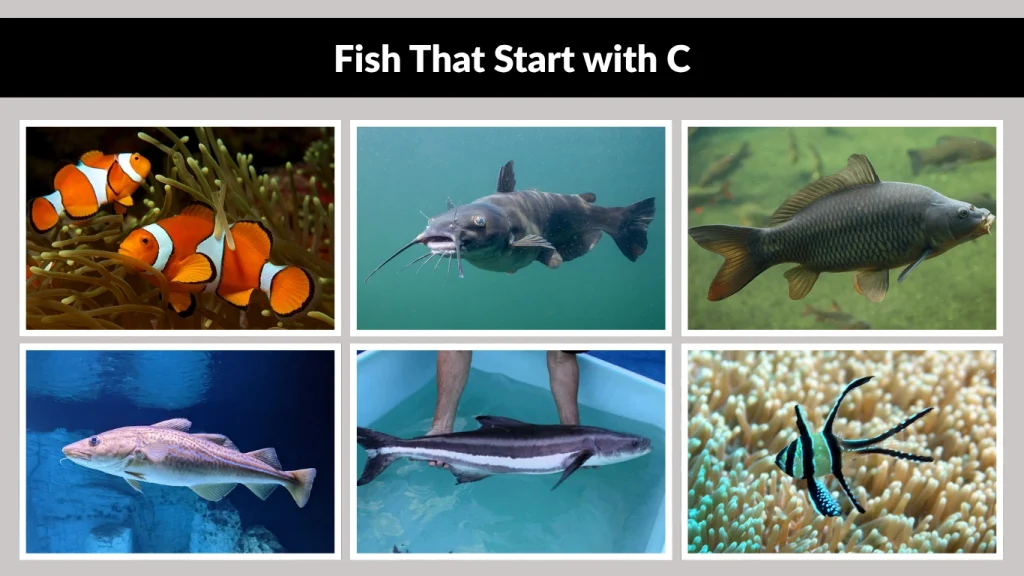
Fish are aquatic animals with gills and fins, adapted to life in saltwater or freshwater. This group includes six fish species that begin with the letter C. From bright reef dwellers to large river swimmers, these fish vary in color, behavior, and ecological importance.
19. Clownfish
Clownfish are small, orange-and-white striped fish that live in sea anemones, forming a mutualistic relationship. They’re also known from Finding Nemo.
Native to the Indo-Pacific region, they are popular in saltwater aquariums and are known for their bold personality despite their small size.
20. Catfish
Catfish are bottom-dwelling fish named for the whisker-like barbels around their mouths. They thrive in both freshwater and saltwater habitats.
They vary in size from a few inches to several feet long and are important both as food and as scavengers in aquatic ecosystems.
21. Carp
Carp are hardy freshwater fish often found in ponds, rivers, and lakes. Some, like koi, are ornamental, while others are invasive.
They feed on vegetation and small invertebrates and are known for stirring up sediments, which can impact water quality.
22. Cod
Cod are large, cold-water fish prized for their flaky white flesh and commercial value in global fisheries.
They are found in the North Atlantic and are known for forming large schools and playing a major role in marine food chains.
23. Cobia
Cobia are fast-growing, torpedo-shaped fish with dark brown bodies and white undersides. They are powerful swimmers and strong fighters.
They inhabit warm coastal waters and are popular among sport fishers for their size and taste, often caught near reefs and wrecks.
24. Cardinalfish
Cardinalfish are small, nocturnal reef fish with bright colors and big eyes that help them see in low light.
Often found in groups hiding in coral crevices during the day, they emerge at night to feed on plankton and small invertebrates.
Insects That Start with C
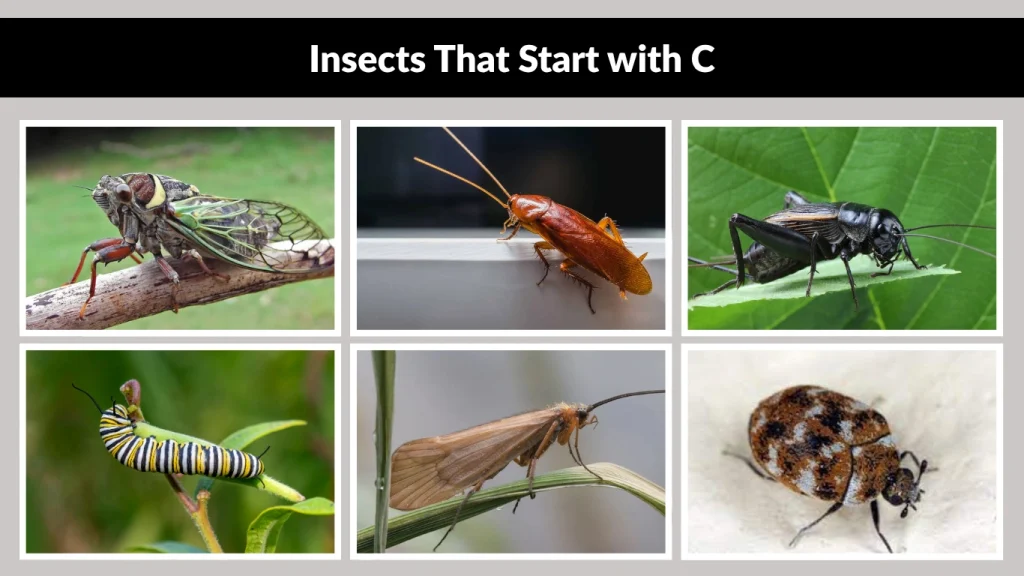
Insects are the most diverse group of animals on Earth, with six legs, segmented bodies, and a wide range of roles in ecosystems. This group features six insects starting with the letter C—from buzzing pests to important pollinators and camouflaged creatures.
25. Cicada
Cicadas are large, loud insects known for their buzzing calls and long underground nymph stages that can last 13 or 17 years.
They emerge in large numbers, shed their skins, and sing from trees, creating one of nature’s most distinct summer sounds.
26. Cockroach
Cockroaches are resilient, flat-bodied insects that scurry quickly and thrive in warm, dark environments—especially human homes.
Though many see them as pests, they play a role in breaking down organic waste and have existed since prehistoric times.
27. Cricket
Crickets are chirping insects with long antennae and powerful hind legs for jumping. Males produce sound by rubbing their wings together.
They’re often active at night and are found in grasslands, forests, and gardens, where they feed on plants and small insects.
28. Caterpillar
Caterpillars are the larval stage of butterflies and moths. They have soft, segmented bodies and consume large amounts of leaves.
They undergo metamorphosis, spinning cocoons or forming chrysalises before emerging as winged adults in one of nature’s most stunning transformations.
29. Caddisfly
Caddisflies are moth-like aquatic insects whose larvae build protective cases from sand, sticks, or other debris.
They live in freshwater streams and are indicators of water quality, often forming part of fly-fishing bait due to their abundance.
30. Carpet Beetle
Carpet beetles are tiny, round insects with colorful, speckled shells. Their larvae feed on natural fibers like wool and silk.
They are common in homes and museums and can cause damage to clothing, rugs, and preserved biological specimens if left unchecked.
Arachnids and Crustaceans That Start with C
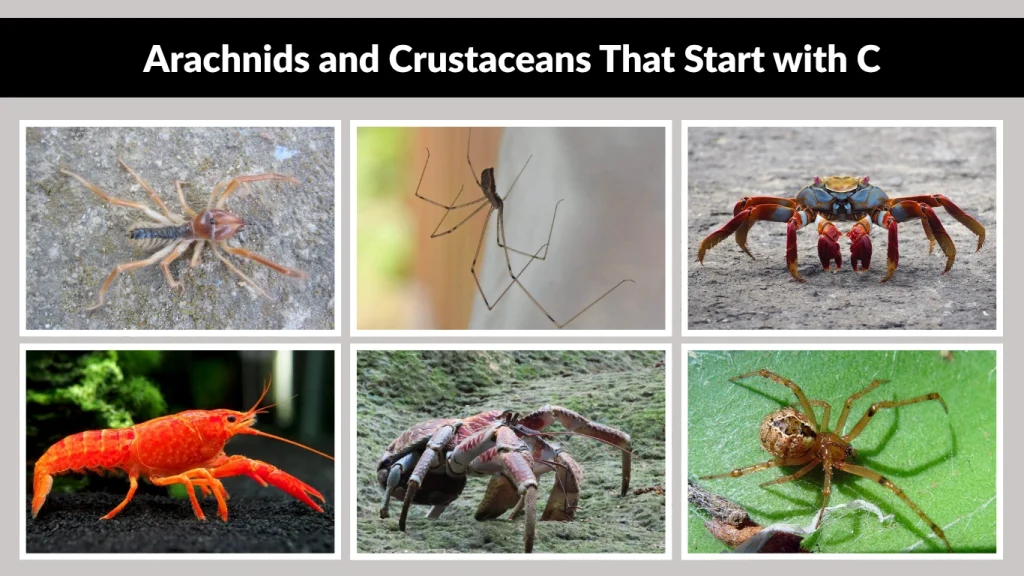
Arachnids and crustaceans are invertebrates with exoskeletons and jointed limbs. While arachnids like spiders live mostly on land, crustaceans like crabs thrive in aquatic habitats. This group includes six species starting with the letter C, ranging from web-builders to bottom crawlers.
31. Camel Spider
Despite its name, the camel spider is neither a true spider nor a scorpion, but it belongs to its own order of arachnids.
Found in desert regions, it has large jaws and runs quickly to capture prey like insects and small reptiles.
32. Cellar Spider
Cellar spiders are thin-legged, long-bodied arachnids often seen hanging upside-down in quiet corners of basements and ceilings.
They’re harmless to humans and feed on other spiders and insects, helping to keep pest populations under control.
33. Crab
Crabs are crustaceans with broad shells, sideways walk, and pincers used for defense and feeding. They range in size and color.
Found in oceans, rivers, and even on land, crabs are scavengers that play a vital role in aquatic food chains.
34. Crayfish
Also known as crawfish or crawdads, crayfish are freshwater crustaceans that resemble small lobsters. They have strong claws and a segmented body.
They hide under rocks in streams and ponds and feed on plants, insects, and detritus while also serving as food for fish and birds.
35. Coconut Crab
The coconut crab is the world’s largest land-dwelling arthropod, with powerful claws capable of cracking coconuts.
Found on Pacific islands, it’s mostly nocturnal and climbs trees with ease. Despite its size, it’s rarely seen due to its shy nature.
36. Comb-Footed Spider
Comb-footed spiders are small web-builders that include species like the common house spider and the venomous black widow.
They have a comb of tiny hairs on their rear legs used to spin tangled, sticky webs in corners, crevices, and undisturbed spaces.
Farm and Domestic Animals That Start with C
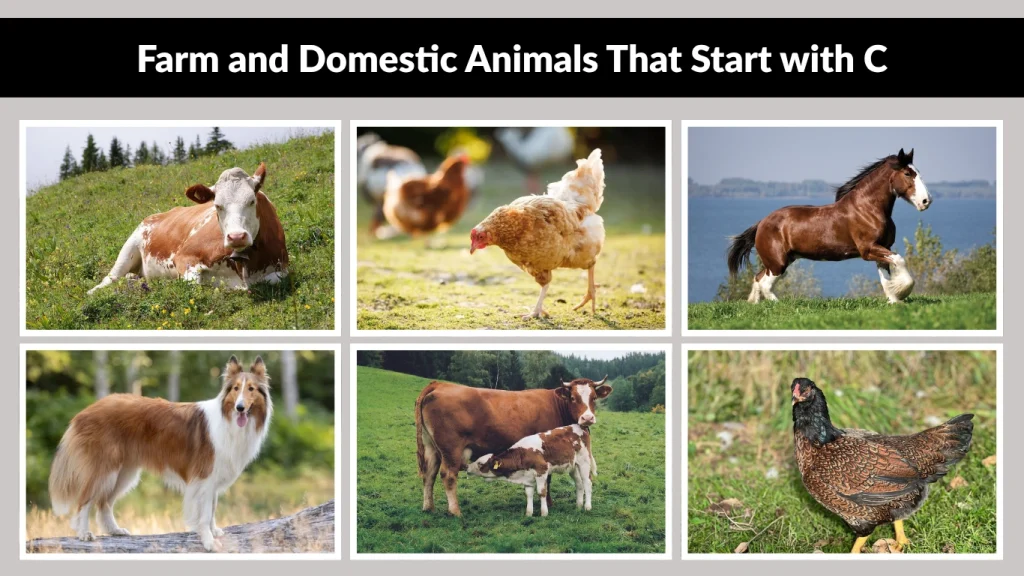
Farm and domestic animals are raised by humans for companionship, labor, food, or other resources. This group highlights six animals starting with the letter C, found in homes, barns, and pastures around the world.
37. Cow
Cows are large, hoofed mammals bred for milk, meat, and leather. They are social, grazing animals with a complex digestive system.
Domesticated worldwide, cows have been essential to agriculture for thousands of years and are revered in some cultures.
38. Chicken
Chickens are flightless birds raised primarily for their eggs and meat. They have a comb on their head and scratch the ground for food.
They’re one of the most widespread domestic animals, thriving in both rural and urban backyard farms across the globe.
39. Clydesdale Horse
Clydesdales are large draft horses known for their strength, feathered hooves, and calm demeanor. They are often used for parades and heavy farm work.
Originating in Scotland, they became famous in advertising and continue to symbolize power and reliability in equine breeding.
40. Collie
The Collie is a loyal and intelligent dog breed originally developed for herding sheep. It has a long, elegant coat and pointed snout.
Made popular by the fictional Lassie, collies are gentle with families and thrive in environments where they can stay active.
41. Calf
A calf is a young cow or bull, typically under one year old. Calves rely on their mother’s milk in early life stages.
They’re raised on farms for dairy, meat, or future breeding and are often tagged and tracked for herd management.
42. Cornish Hen
Cornish hens are a small breed of chicken bred for tender meat and often served whole as a gourmet poultry dish.
Despite their name, they’re not young chickens but a specific cross-breed that matures quickly and is prized in culinary settings.
Sea and Ocean Creatures That Start with C
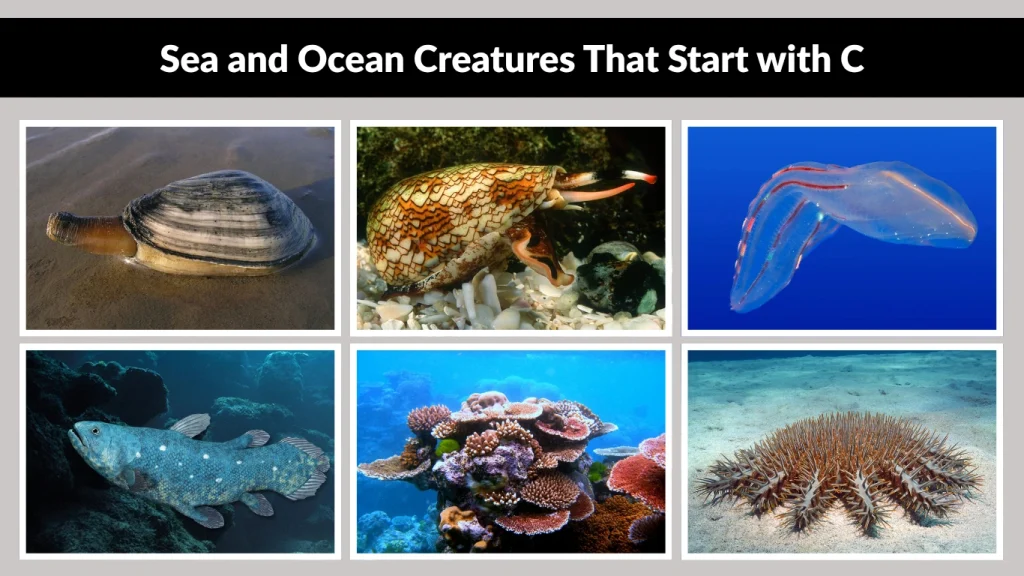
The ocean is full of strange and spectacular creatures adapted to life beneath the waves. This group introduces six sea animals starting with the letter C, including filter feeders, jellyfish, and deep-sea dwellers that thrive in diverse marine environments.
43. Clam
Clams are soft-bodied mollusks with two hinged shells that they use for protection. They burrow into sand or mud on the seafloor.
They filter plankton and nutrients from the water and are a vital part of many coastal ecosystems and seafood cuisines.
44. Cone Snail
Cone snails are slow-moving sea snails with beautifully patterned shells and a venomous harpoon-like tooth for hunting.
Though small, some species can deliver a powerful sting that can be dangerous to humans, making them both fascinating and feared.
45. Comb Jelly
Comb jellies are gelatinous marine animals with rows of tiny cilia that scatter light into rainbow colors as they swim.
Though they look like jellyfish, they belong to a separate phylum and are harmless, feeding on plankton with sticky tentacles.
46. Coelacanth
Once thought extinct, coelacanths are deep-sea fish with lobed fins and a lineage dating back over 400 million years.
They are considered living fossils and have helped scientists understand the evolution of vertebrates from sea to land.
47. Coral
Corals are tiny marine animals that live in colonies and build calcium carbonate structures—forming reefs over thousands of years.
They provide shelter for thousands of marine species and are essential for ocean biodiversity, though threatened by warming seas and pollution.
48. Crown-of-Thorns Starfish
This spiny starfish preys on coral polyps and can damage entire reef systems when overpopulated. It has venomous spines for protection.
Native to the Indo-Pacific, it plays a natural role in coral health but becomes destructive when its numbers grow unchecked.
Animals by Region That Start with C
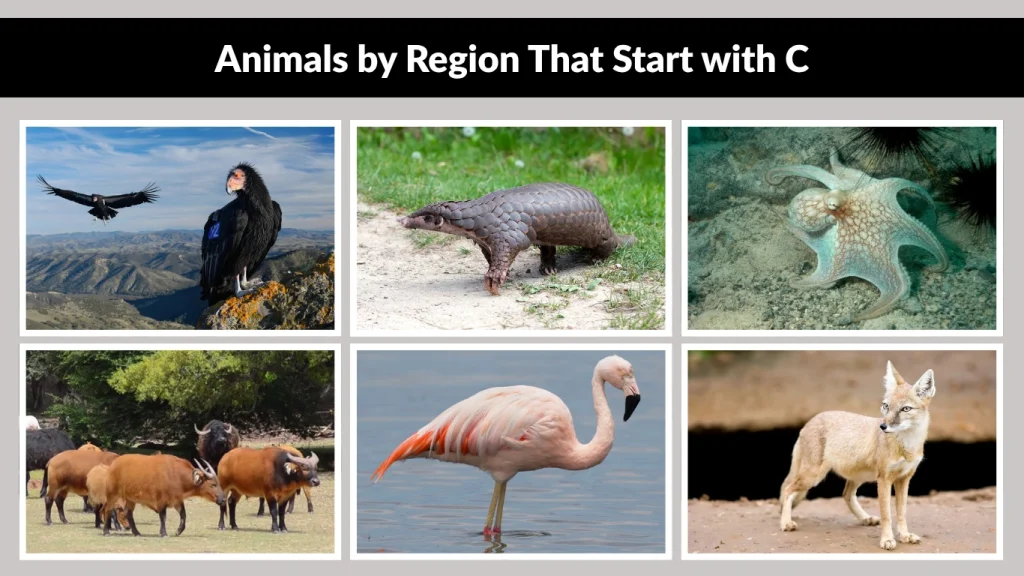
Many animals are closely associated with specific regions and have adapted to unique climates and habitats. This group features six species that begin with the letter C, each representing the biodiversity of its native environment—from mountains to tropical reefs.
49. California Condor
The California condor is one of the world’s largest flying birds, with a wingspan over 9 feet and a bald head suited for scavenging.
Once nearly extinct, it now soars again over the canyons of the western U.S. thanks to intensive conservation and breeding programs.
50. Chinese Pangolin
This scaly, nocturnal mammal is found in China’s forests and grasslands. It rolls into a ball when threatened, using its tough keratin scales as armor.
Pangolins are endangered due to illegal hunting for meat and traditional medicine, despite their role in controlling ant and termite populations.
51. Caribbean Reef Octopus
This colorful, nocturnal octopus lives in shallow coral reefs throughout the Caribbean Sea. It changes color and texture to blend in.
It’s intelligent and solitary, hunting crabs and shrimp with precision using its eight strong arms and excellent camouflage.
52. Congo Buffalo
Also called the forest buffalo, this smaller, reddish version of the African buffalo roams Central African rainforests in small herds.
It feeds on grass and shrubs and prefers dense vegetation. Unlike savanna buffaloes, it is more secretive and less aggressive.
53. Chilean Flamingo
The Chilean flamingo is a tall wading bird with pale pink feathers and long legs, often seen feeding in salty lagoons.
It filters algae and small crustaceans from the water with its specialized beak and breeds in large colonies across South America.
54. Corsac Fox
The corsac fox is a small, pale-furred fox native to the open steppes of Central Asia. It is agile and highly adaptable.
It feeds on small mammals and insects and is able to survive extreme temperatures by digging burrows and reducing activity in harsh weather.
Unique or Rare Animals That Start with C
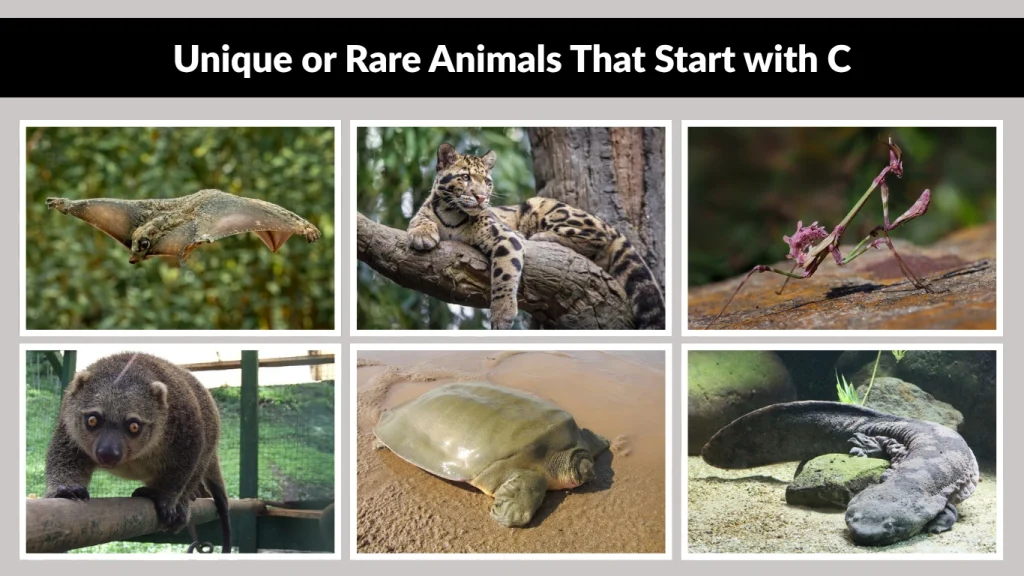
Some animals are known not for how common they are, but for their rarity, strange features, or evolutionary significance. This final group includes eight unique or lesser-known species starting with the letter C—each one remarkable in its own way.
55. Colugo
The colugo, or “flying lemur,” is a gliding mammal with a large skin membrane that allows it to soar between trees.
Native to Southeast Asia, it’s nocturnal and feeds on leaves and fruit. Despite its name, it is neither a lemur nor a true flyer.
56. Clouded Leopard
This elusive wild cat has large cloud-shaped spots and long canine teeth, adapted for hunting in dense forests.
Found in Southeast Asia, it’s skilled at climbing and rarely seen in the wild due to its solitary nature and shrinking habitat.
57. Conehead Mantis
The conehead mantis is a stick-like insect with an elongated head and a leaf-shaped body that provides perfect camouflage.
It stays motionless among vegetation, waiting to ambush prey with its spiny forelegs. It’s mostly found in Mediterranean regions.
58. Cuscus
The cuscus is a slow-moving, tree-dwelling marsupial with large eyes, woolly fur, and a prehensile tail.
Native to Australia and Papua New Guinea, it’s a nocturnal herbivore that feeds on leaves, fruit, and flowers.
59. Cambodian Giant Turtle
Also known as the Cantor’s giant softshell turtle, this critically endangered reptile has a broad, flat body and spends most of its time buried in sand.
It’s native to Southeast Asian rivers and is rarely seen, making it a symbol of freshwater conservation efforts.
60. Chinese Giant Salamander
This is the world’s largest amphibian, growing up to 6 feet long. It has wrinkled skin and breathes mostly through its skin.
Native to cool, fast-moving streams in China, it is critically endangered due to habitat loss and overharvesting.
61. California Kingsnake
This non-venomous snake is known for its striking black-and-white or brown-and-cream banded pattern. It constricts its prey, including other snakes.
Native to the western U.S., it’s popular in the pet trade and admired for its calm temperament and adaptability.
62. Cockapoo
The cockapoo is a crossbreed between a Cocker Spaniel and a Poodle, known for its affectionate nature and curly, low-shedding coat.
It’s a popular companion dog due to its intelligence, playful personality, and suitability for allergy-sensitive homes.