



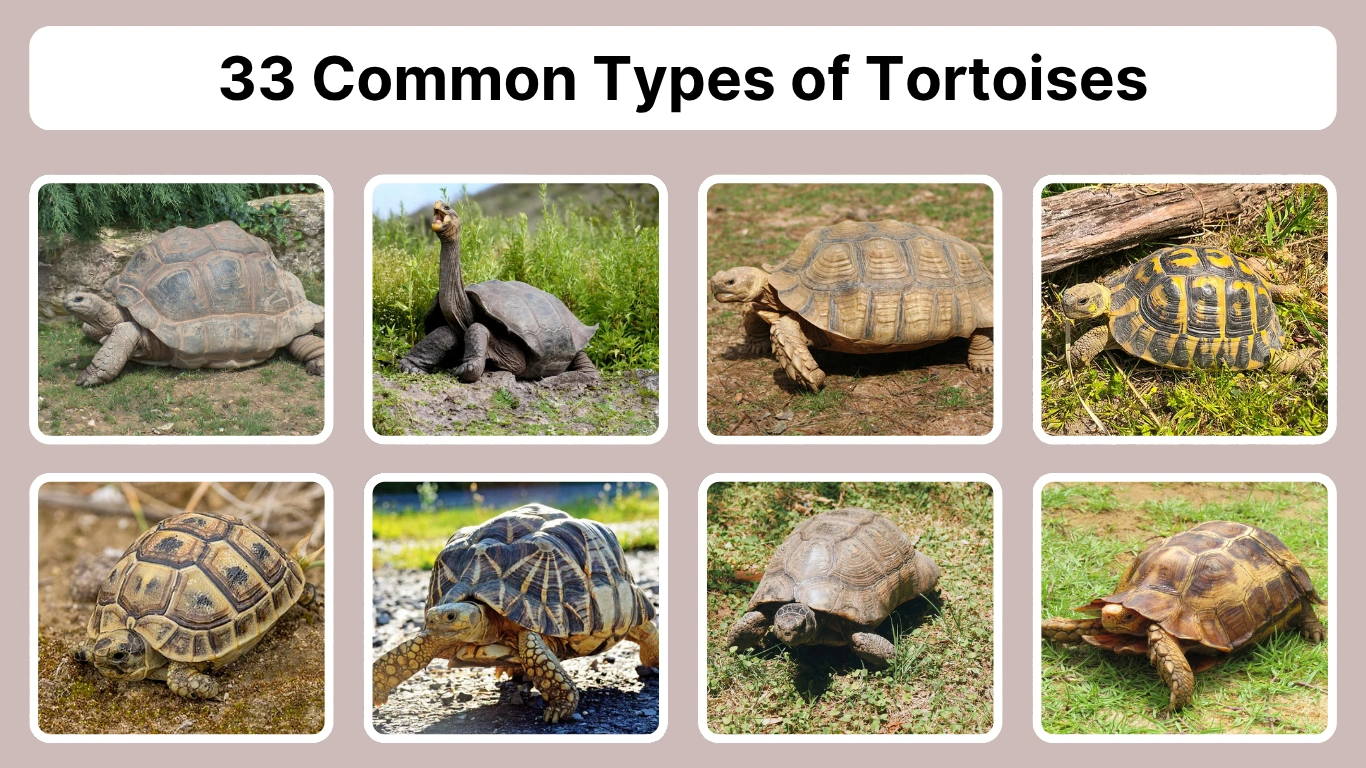
Tortoises are among the oldest living land animals on Earth, known for their slow movements, long lifespans, and tough, domed shells. Found across continents from the deserts of Africa to the rainforests of South America, each species has adapted uniquely to its environment. In this guide, you’ll discover 33 types of tortoises, each described with key identification features, natural habitat, and behavioral traits.
Whether you’re a reptile enthusiast, pet owner, or simply curious about these gentle creatures, this comprehensive list will help you explore the incredible diversity of the tortoise world — one species at a time.
1. Aldabra Giant Tortoise

The Aldabra giant tortoise (Aldabrachelys gigantea) is one of the largest tortoise species in the world, native to the Aldabra Atoll in the Seychelles. These majestic reptiles are known for their massive size, dome-shaped shells, and slow-paced but long-lived lifestyle, often reaching over 100 years of age. They are herbivores and play a vital role in shaping the island ecosystem by dispersing seeds and grazing vegetation.
Identification
- Scientific Name: Aldabrachelys gigantea
- Shell Shape: High-domed, often brown or gray
- Size: Up to 4 feet (122 cm) in length
- Weight: Can exceed 500 pounds (225 kg)
- Lifespan: 80–120 years, sometimes more
- Native Range: Aldabra Atoll, Seychelles
- Diet: Grasses, leaves, and woody plants
- Color: Dark gray to black skin with a brown shell
Habitat and Distribution
The Aldabra giant tortoise is endemic to the Aldabra Atoll, a coral atoll in the Indian Ocean. The atoll’s flat terrain and grassy areas provide an ideal habitat for these tortoises. They are also found in wildlife reserves and zoos worldwide as part of conservation efforts.
Behavior and Lifestyle
These tortoises are primarily diurnal and spend much of their day grazing and basking in the sun. They are solitary but tolerant of other tortoises and are known for their slow but deliberate movements. Despite their size, they can be surprisingly agile when foraging.
2. Galápagos Tortoise

The Galápagos tortoise (Chelonoidis niger complex) is a famous giant tortoise species native to the Galápagos Islands. These tortoises are iconic for their large size, long necks, and slow metabolism. They played a crucial role in Charles Darwin’s theory of evolution and remain a symbol of the islands today.
Identification
- Scientific Name: Chelonoidis niger (species complex)
- Shell Shape: Varies – domed or saddleback depending on the island
- Size: Up to 5 feet (150 cm) in length
- Weight: Up to 600 pounds (272 kg)
- Lifespan: 100–150 years or more
- Native Range: Galápagos Islands, Ecuador
- Diet: Cactus, grasses, fruits, and leaves
- Color: Dark brown to black shell and skin
Habitat and Distribution
These tortoises inhabit a variety of ecosystems on the Galápagos Islands, ranging from arid lowlands to humid highlands. Saddleback tortoises are often found in drier areas, while domed tortoises tend to live in more vegetated, moist regions.
Behavior and Lifestyle
Galápagos tortoises are mostly solitary and spend their days slowly foraging and resting. Their long necks help them reach higher vegetation, especially in areas with limited food sources. They can survive months without food or water due to fat reserves and slow metabolism.
3. African Spurred Tortoise (Sulcata)

The African spurred tortoise, also known as the Sulcata tortoise, is the largest mainland tortoise and the third-largest overall. Native to the southern edge of the Sahara Desert, it is well-adapted to arid environments and is popular in the pet trade due to its hardy nature.
Identification
- Scientific Name: Centrochelys sulcata
- Shell Shape: Broad, domed, with serrated edges in young individuals
- Size: 24–36 inches (60–90 cm)
- Weight: 80–200 pounds (36–91 kg)
- Lifespan: 50–100 years
- Native Range: Sahel region of Africa (south of the Sahara)
- Diet: Grasses, weeds, cactus pads
- Color: Light brown to yellowish-tan shell with pale skin
Habitat and Distribution
African spurred tortoises are found across the Sahel, stretching from Senegal to Ethiopia. They prefer dry savannas and scrublands and dig deep burrows to escape the extreme desert heat.
Behavior and Lifestyle
These tortoises are known for their burrowing behavior, sometimes digging tunnels over 10 feet long. They are territorial, especially males, and can be surprisingly active and strong. Though shy with humans, they show curiosity and awareness in familiar settings.
4. Indian Star Tortoise

The Indian star tortoise is a small to medium-sized tortoise native to India and Sri Lanka, known for its striking star-like shell patterns. These beautiful markings help with camouflage in dry, grassy habitats.
Identification
- Scientific Name: Geochelone elegans
- Shell Shape: Highly domed with distinct star-like radiating patterns
- Size: 6–12 inches (15–30 cm)
- Weight: 2–6 pounds (0.9–2.7 kg)
- Lifespan: 30–80 years
- Native Range: India, Sri Lanka, and parts of Pakistan
- Diet: Grasses, fruits, and leafy vegetables
- Color: Dark brown or black shell with yellow star patterns
Habitat and Distribution
This tortoise inhabits dry scrub forests, grasslands, and semi-arid zones. It is typically found in areas with seasonal rainfall and warm temperatures.
Behavior and Lifestyle
The Indian star tortoise is mostly shy and secretive, becoming active during cooler parts of the day. It prefers hiding under vegetation or in burrows and can remain inactive during dry periods. It is a slow-moving but resilient species well-suited to its arid habitat.
5. Hermann’s Tortoise

Hermann’s tortoise is a small, hardy tortoise native to southern Europe. It’s a popular choice among reptile enthusiasts due to its manageable size, gentle nature, and attractive shell.
Identification
- Scientific Name: Testudo hermanni
- Shell Shape: Oval, domed shell with clear markings
- Size: 5–10 inches (13–25 cm)
- Weight: 2–7 pounds (0.9–3.2 kg)
- Lifespan: 50–90 years
- Native Range: Southern Europe (Spain, Italy, Balkans)
- Diet: Leaves, flowers, and fruits
- Color: Yellow and black patterned shell with tan skin
Habitat and Distribution
Hermann’s tortoise is commonly found in Mediterranean forests, rocky hillsides, and scrublands. It prefers warm, dry environments with ample sun and shelter.
Behavior and Lifestyle
This tortoise is diurnal and enjoys basking in the sun. It hibernates during colder months and is very active during spring and summer. Hermann’s tortoises are known to be curious and can adapt well to captive environments.
6. Russian Tortoise

The Russian tortoise is a small, hardy tortoise species well-known in the pet trade. It thrives in harsh, arid climates and is adapted to extreme temperatures and long periods of dormancy.
Identification
- Scientific Name: Agrionemys horsfieldii (also known as Testudo horsfieldii)
- Shell Shape: Round and domed, usually smooth-edged
- Size: 5–10 inches (13–25 cm)
- Weight: 1–3 pounds (0.5–1.4 kg)
- Lifespan: 40–80 years
- Native Range: Central Asia (Russia, Afghanistan, Pakistan, Iran)
- Diet: Grasses, leafy greens, and flowers
- Color: Tan to olive shell with dark brown markings
Habitat and Distribution
Russian tortoises are found in dry steppes, rocky deserts, and sandy hills. They live in regions with hot summers and cold winters and spend much of their time in burrows to avoid temperature extremes.
Behavior and Lifestyle
This tortoise is active during short warm periods in spring and early summer. It is a strong digger and hibernates for several months annually. Despite its small size, it is bold, curious, and often recognized for its lively personality in captivity.
7. Leopard Tortoise
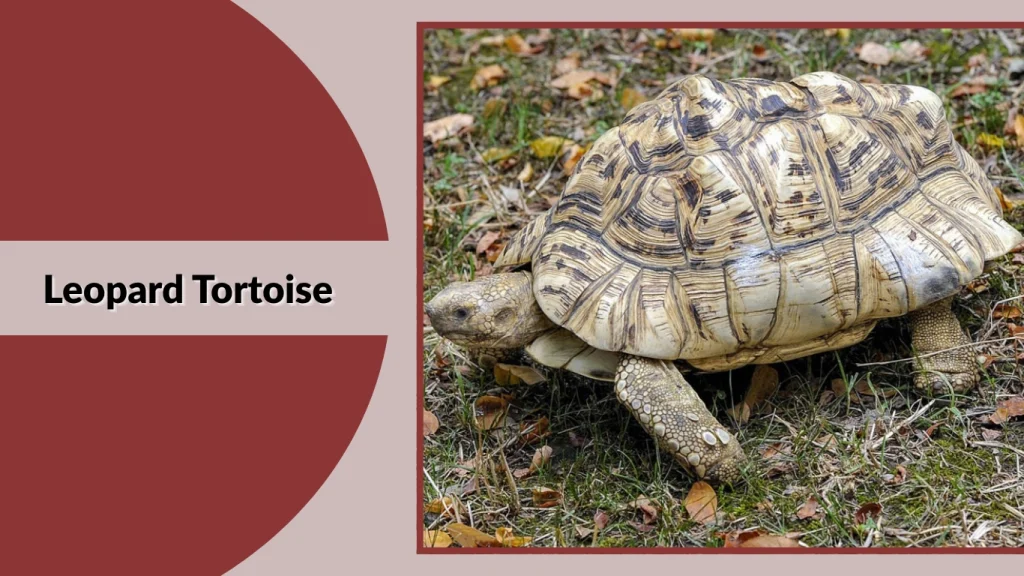
The leopard tortoise is a large and attractive species, named for the spotted or blotched patterns on its shell. It is the fourth-largest tortoise species and is native to the savannas of eastern and southern Africa.
Identification
- Scientific Name: Stigmochelys pardalis
- Shell Shape: High-domed and often slightly flattened in older individuals
- Size: 16–28 inches (40–70 cm)
- Weight: 40–120 pounds (18–54 kg)
- Lifespan: 50–100 years
- Native Range: Eastern and southern Africa
- Diet: Grasses, weeds, succulents
- Color: Yellow or tan shell with black or brown markings resembling leopard spots
Habitat and Distribution
This tortoise is commonly found in grasslands, shrublands, and semi-arid regions. It prefers areas with low humidity but access to water and shade for temperature regulation.
Behavior and Lifestyle
Leopard tortoises are mostly solitary and spend much of their time grazing. They are not strong burrowers and rely on shade and water for cooling. While generally slow and calm, they can move surprisingly fast when alarmed or exploring new territory.
8. Greek Tortoise

The Greek tortoise, also known as the spur-thighed tortoise, is a small to medium-sized species native to parts of southern Europe, North Africa, and the Middle East. It is known for its domed shell and adaptability to various habitats.
Identification
- Scientific Name: Testudo graeca
- Shell Shape: Rounded, highly domed with large scales on the front legs
- Size: 5–10 inches (13–25 cm)
- Weight: 2–5 pounds (0.9–2.3 kg)
- Lifespan: 50–100 years
- Native Range: Southern Europe, North Africa, and Western Asia
- Diet: Grasses, leaves, and flowers
- Color: Yellow-brown shell with dark blotches and light skin
Habitat and Distribution
Greek tortoises are found in dry, grassy areas, scrublands, and rocky hillsides. They prefer warm climates and often shelter under bushes or in burrows to escape heat.
Behavior and Lifestyle
These tortoises are diurnal and active during spring and early summer. They hibernate in colder months and aestivate during extreme heat. They are solitary, territorial, and known for being alert and responsive to their environment.
9. Red-footed Tortoise

The red-footed tortoise is a medium-sized tropical tortoise native to South America. It’s known for the red or orange scales on its limbs and head, giving it a distinct appearance.
Identification
- Scientific Name: Chelonoidis carbonarius
- Shell Shape: Elongated, slightly domed with a flared rear edge
- Size: 10–16 inches (25–40 cm)
- Weight: 15–30 pounds (7–14 kg)
- Lifespan: 40–60 years
- Native Range: Northern South America, including Brazil, Venezuela, and surrounding countries
- Diet: Fruits, flowers, fungi, and occasional animal matter
- Color: Dark brown to black shell with yellowish patches; red/orange markings on legs and head
Habitat and Distribution
This tortoise inhabits tropical rainforests, savannas, and dry forests. It prefers warm, humid environments and often shelters under vegetation or in shallow burrows.
Behavior and Lifestyle
Red-footed tortoises are more social than many other tortoises and can be seen in small groups. They are crepuscular, most active during early morning and late afternoon. Their diet is more varied due to their omnivorous tendencies, and they are strong walkers with good stamina.
10. Yellow-footed Tortoise

The yellow-footed tortoise is closely related to the red-footed tortoise and shares a similar tropical habitat in South America. It is slightly larger and distinguished by the yellow or orange scales on its limbs.
Identification
- Scientific Name: Chelonoidis denticulatus
- Shell Shape: Elongated and domed with slightly serrated edges
- Size: 15–28 inches (38–70 cm)
- Weight: 20–40 pounds (9–18 kg)
- Lifespan: 50–60 years
- Native Range: Amazon Basin – Brazil, Colombia, Venezuela, Ecuador, Peru, and Bolivia
- Diet: Fruits, mushrooms, leaves, and occasional carrion
- Color: Dark shell with yellowish-brown markings; yellow/orange scales on legs
Habitat and Distribution
This tortoise is native to humid tropical rainforests, particularly in the Amazon Basin. It prefers dense vegetation and is often found near fallen logs or leaf litter for cover.
Behavior and Lifestyle
Yellow-footed tortoises are shy, slow-moving, and spend most of their time foraging. They are omnivorous and take advantage of seasonal fruit drops. Their strong sense of smell helps them locate food in dense forest environments.
11. Burmese Star Tortoise

The Burmese star tortoise is a critically endangered species native to dry regions of Myanmar. It is admired for its beautiful star-patterned shell and is part of major conservation and breeding efforts.
Identification
- Scientific Name: Geochelone platynota
- Shell Shape: High-domed with pronounced star-like radiating lines
- Size: 10–12 inches (25–30 cm)
- Weight: 3–8 pounds (1.4–3.6 kg)
- Lifespan: 50–70 years
- Native Range: Central Myanmar (Burma)
- Diet: Grasses, weeds, flowers, and fruit
- Color: Dark shell with vivid yellow star patterns
Habitat and Distribution
The Burmese star tortoise lives in dry deciduous forests and scrublands with a warm climate and seasonal rainfall. It uses burrows and shaded areas to avoid the midday heat.
Behavior and Lifestyle
This tortoise is active during cooler times of the day and remains hidden during extreme heat. It is primarily herbivorous and enjoys grazing on native grasses. Though once near extinction, it is now slowly rebounding due to conservation breeding programs.
12. Egyptian Tortoise

The Egyptian tortoise is one of the smallest tortoise species in the world and is native to arid regions of North Africa. Its compact size and pale coloration help it survive in hot desert environments.
Identification
- Scientific Name: Testudo kleinmanni
- Shell Shape: High-domed and oval, smooth with a flat underside
- Size: 3–5 inches (8–13 cm)
- Weight: 0.3–1 pound (140–450 grams)
- Lifespan: 70–100 years
- Native Range: Libya, Egypt, and parts of Israel
- Diet: Dried grasses, herbs, and succulents
- Color: Pale yellow to sandy with light brown markings
Habitat and Distribution
This tortoise is found in deserts and semi-arid coastal areas. Its light shell blends with the sandy environment, providing camouflage from predators and protection from intense sunlight.
Behavior and Lifestyle
The Egyptian tortoise is most active in the early morning or late afternoon, avoiding the harsh midday heat. It is solitary and tends to hide under shrubs or in small burrows to regulate its body temperature.
13. Pancake Tortoise

The pancake tortoise is unique among tortoises due to its flat, flexible shell. This adaptation allows it to squeeze into tight rock crevices to escape predators in its rocky East African habitat.
Identification
- Scientific Name: Malacochersus tornieri
- Shell Shape: Flat, soft, and flexible with radiating patterns
- Size: 6–7 inches (15–18 cm)
- Weight: 0.8–1.1 pounds (350–500 grams)
- Lifespan: 30–50 years
- Native Range: Kenya, Tanzania, and parts of Zambia
- Diet: Grasses, dry leaves, and flowers
- Color: Light brown shell with dark radiating lines
Habitat and Distribution
Pancake tortoises live in rocky outcrops and savanna landscapes. They prefer dry, open regions with loose soil and large boulders or rocky shelters where they can hide quickly.
Behavior and Lifestyle
Unlike most tortoises, they are fast and agile climbers. They rely on speed and hiding rather than a hard shell for defense. Their flexible body and social behavior make them very different from other tortoise species.
14. Radiated Tortoise

The radiated tortoise is a visually stunning species native to Madagascar, known for its brilliant star-like shell pattern. It is one of the most ornate tortoises in the world.
Identification
- Scientific Name: Astrochelys radiata
- Shell Shape: High-domed with a smooth, glossy texture
- Size: 12–16 inches (30–41 cm)
- Weight: 12–35 pounds (5.4–16 kg)
- Lifespan: 40–100 years
- Native Range: Southern Madagascar
- Diet: Grasses, succulents, fruits, and flowers
- Color: Black shell with bright yellow radiating star patterns
Habitat and Distribution
Radiated tortoises live in dry forests and scrublands of southern Madagascar. They prefer areas with seasonal rainfall, abundant vegetation, and sandy or loamy soils.
Behavior and Lifestyle
They are mostly active during the morning and late afternoon, grazing on grasses and fruits. They are slow-moving and highly alert, often retracting into their shell at the first sign of danger. Their striking appearance makes them targets for the illegal pet trade.
15. Elongated Tortoise

The elongated tortoise is a forest-dwelling species found in parts of South and Southeast Asia. Its stretched shell helps it move easily through dense vegetation and underbrush.
Identification
- Scientific Name: Indotestudo elongata
- Shell Shape: Long and narrow with a smooth dome
- Size: 10–14 inches (25–35 cm)
- Weight: 6–10 pounds (2.7–4.5 kg)
- Lifespan: 40–60 years
- Native Range: India, Nepal, Myanmar, Thailand, Laos, Vietnam, and Cambodia
- Diet: Fruits, fallen leaves, mushrooms, and insects
- Color: Yellow-brown shell with darker patches; yellow face
Habitat and Distribution
This tortoise lives in moist deciduous forests, bamboo thickets, and forest edges. It prefers shaded, humid environments and often stays hidden beneath leaf litter.
Behavior and Lifestyle
Elongated tortoises are secretive and nocturnal or crepuscular in nature. They are solitary and shy, coming out mainly to forage during cooler hours. They rely on camouflage and a calm demeanor to avoid threats in the wild.
16. Marginated Tortoise

The marginated tortoise is the largest European tortoise species, recognized by the flared, skirt-like rear edge of its shell. It is native to mountainous regions of southern Europe.
Identification
- Scientific Name: Testudo marginata
- Shell Shape: High-domed with a wide, flared rear edge
- Size: 10–14 inches (25–35 cm), occasionally up to 15 inches
- Weight: 7–11 pounds (3–5 kg)
- Lifespan: 100+ years
- Native Range: Greece, Italy, and the Balkans
- Diet: Grasses, herbs, and leafy greens
- Color: Dark brown to black shell with light borders
Habitat and Distribution
This species inhabits rocky hillsides, scrublands, and forest edges in Mediterranean climates. It prefers sunny, elevated areas with dry soil and plenty of vegetation.
Behavior and Lifestyle
Marginated tortoises are active during the day and especially in spring and early summer. They hibernate in winter and can tolerate cooler temperatures better than some other species. Males can be territorial and display ramming behaviors during breeding season.
17. Forsten’s Tortoise

Forsten’s tortoise is a lesser-known forest species from Indonesia. It has a slightly flattened shell and is adapted to the humid conditions of tropical forest floors.
Identification
- Scientific Name: Indotestudo forstenii
- Shell Shape: Elongated and slightly flattened with uneven scutes
- Size: 10–14 inches (25–35 cm)
- Weight: 5–10 pounds (2.3–4.5 kg)
- Lifespan: 40–60 years
- Native Range: Sulawesi and nearby Indonesian islands
- Diet: Fruits, leaves, mushrooms, and flowers
- Color: Yellow-brown shell with dark blotches; pale yellow head
Habitat and Distribution
This tortoise lives in tropical rainforests and moist lowland habitats. It seeks shelter under dense vegetation, logs, and natural debris to stay cool and hidden.
Behavior and Lifestyle
Forsten’s tortoise is quiet, secretive, and mostly active in low light conditions. It is not a strong burrower but will rest under cover during hot periods. It thrives in humid environments and requires consistent moisture to remain healthy.
18. Travancore Tortoise

The Travancore tortoise is a medium-sized forest tortoise native to the Western Ghats of India. It is adapted to dense, moist forest environments and is less commonly seen in the wild.
Identification
- Scientific Name: Indotestudo travancorica
- Shell Shape: Oval and domed with slightly flattened top
- Size: 12–14 inches (30–36 cm)
- Weight: 6–8 pounds (2.7–3.6 kg)
- Lifespan: 40–60 years
- Native Range: Western Ghats, India
- Diet: Leaves, fruits, flowers, and fallen vegetation
- Color: Dark brown to black shell with irregular markings
Habitat and Distribution
This species inhabits evergreen and moist deciduous forests of southern India, particularly in hilly or mountainous regions with high rainfall and dense vegetation.
Behavior and Lifestyle
Travancore tortoises are shy and slow-moving, spending much of their time under leaf litter or low shrubs. They are primarily herbivorous and forage during the cooler parts of the day, avoiding open sunny areas.
19. Angulate Tortoise

The angulate tortoise is a small and distinctive species native to South Africa. It is recognizable by the single nuchal (neck) shield and the sharply angled edge of its shell.
Identification
- Scientific Name: Chersina angulata
- Shell Shape: Oval with a distinct, flared rear and angled edges
- Size: 6–10 inches (15–25 cm)
- Weight: 2–5 pounds (0.9–2.3 kg)
- Lifespan: 30–50 years
- Native Range: South Africa and Namibia
- Diet: Grasses, succulents, and flowers
- Color: Light brown or tan shell with dark blotches
Habitat and Distribution
This tortoise is found in arid coastal scrub, fynbos, and semi-desert habitats. It prefers sandy or rocky soils with access to shelter and vegetation.
Behavior and Lifestyle
Angulate tortoises are active during the morning and late afternoon. Males can be territorial and engage in head-bobbing and ramming behavior. They are adapted to dry climates and often hide under rocks or shrubs to avoid extreme heat.
20. Speckled Padloper Tortoise

The speckled padloper tortoise is the smallest known tortoise species in the world. Native to South Africa, it is a rare and elusive tortoise that lives in rocky, arid environments.
Identification
- Scientific Name: Homopus signatus
- Shell Shape: Flat and oval with a finely speckled pattern
- Size: 2.4–4 inches (6–10 cm)
- Weight: 3–5 ounces (85–140 grams)
- Lifespan: 20–40 years
- Native Range: South Africa
- Diet: Small leaves, flowers, and succulents
- Color: Light brown shell with dark speckles; pale skin
Habitat and Distribution
Speckled padlopers are found in rocky outcrops and arid scrublands in the Western Cape. They use cracks and crevices for shelter and are well-camouflaged in their environment.
Behavior and Lifestyle
These tiny tortoises are shy and secretive, active mainly in the cooler hours of the day. They avoid open areas and move quickly to hide among rocks when threatened. Their small size makes them vulnerable, but their agility and camouflage help them survive.
21. Kleinmann’s Tortoise

Also known as the Negev tortoise or Egyptian tortoise (closely related but often classified separately), Kleinmann’s tortoise is critically endangered and native to arid parts of North Africa and the Middle East.
Identification
- Scientific Name: Testudo kleinmanni
- Shell Shape: Oval and domed with a smooth, compact build
- Size: 3–5 inches (8–13 cm)
- Weight: 0.3–1 pound (140–450 grams)
- Lifespan: 50–100 years
- Native Range: Libya, Egypt, Israel
- Diet: Dry grasses, herbs, and desert plants
- Color: Sandy yellow shell with minimal dark markings
Habitat and Distribution
This tortoise lives in arid deserts and coastal dunes, preferring soft, sandy soils and dry, hot climates. It often shelters under shrubs and in shallow scrapes.
Behavior and Lifestyle
Kleinmann’s tortoise is crepuscular, most active during dawn and dusk. It is highly sensitive to temperature and hides during extreme heat. Despite its rarity, it is still affected by habitat loss and illegal pet trade.
22. Babcock’s Leopard Tortoise

Babcock’s leopard tortoise is a subspecies of the larger leopard tortoise and is commonly found in southern and eastern Africa. It is known for its bold, spotted shell patterns.
Identification
- Scientific Name: Stigmochelys pardalis babcocki
- Shell Shape: High-domed and slightly flared at the rear
- Size: 12–18 inches (30–46 cm)
- Weight: 30–50 pounds (13–23 kg)
- Lifespan: 50–100 years
- Native Range: Southern and eastern Africa
- Diet: Grasses, weeds, succulents, and fruits
- Color: Yellow to tan shell with black or dark brown blotches
Habitat and Distribution
This tortoise inhabits open grasslands, savannas, and semi-arid regions. It prefers areas with access to vegetation, soft soil, and shade.
Behavior and Lifestyle
Babcock’s leopard tortoise is diurnal and spends most of its day grazing. It is generally calm and solitary, but males may show aggression during the mating season. It does not burrow but may use natural shelters to escape the heat.
23. South African Leopard Tortoise

This is another regional form of the leopard tortoise, typically larger and with slightly different patterns compared to the Babcock’s variety. It is native to the southernmost regions of Africa.
Identification
- Scientific Name: Stigmochelys pardalis pardalis
- Shell Shape: Tall, domed with minimal rear flare
- Size: 16–24 inches (40–61 cm)
- Weight: 40–70 pounds (18–32 kg)
- Lifespan: 50–100 years
- Native Range: South Africa, Botswana, Namibia
- Diet: Grasses, cactus pads, and broad-leaf plants
- Color: Cream or yellowish shell with dark, faded blotches
Habitat and Distribution
South African leopard tortoises live in dry bushveld, karoo, and savanna regions. They prefer warm, dry climates with seasonal rainfall and scattered vegetation.
Behavior and Lifestyle
These tortoises are solitary, strong walkers, and more active during cooler parts of the day. They can survive long periods without water and are often seen during or after rainfall when food is more abundant.
24. Forest Hinged Tortoise

The forest hinged tortoise is a secretive, medium-sized tortoise found in central and western African rainforests. It gets its name from a hinge on the back of its shell that allows partial closure for protection.
Identification
- Scientific Name: Kinixys erosa
- Shell Shape: Elongated and slightly flattened with a rear hinge
- Size: 7–12 inches (18–30 cm)
- Weight: 3–6 pounds (1.4–2.7 kg)
- Lifespan: 30–50 years
- Native Range: Central and West Africa
- Diet: Fallen fruits, fungi, invertebrates, and leaves
- Color: Dark brown to black shell with lighter markings
Habitat and Distribution
This species inhabits lowland tropical rainforests, often near streams, swamps, or other moist environments with dense ground cover.
Behavior and Lifestyle
Forest hinged tortoises are shy and elusive, active mostly during the rainy season. They are crepuscular or nocturnal, hiding under logs and leaves during the day. The rear hinge provides added shell protection when threatened.
25. Manouria Emys (Asian Giant Tortoise)

The Manouria emys, or Asian giant tortoise, is one of the largest tortoise species in Asia and the only one known to nest above ground. It is divided into two subspecies: Manouria emys emys and Manouria emys phayrei.
Identification
- Scientific Name: Manouria emys
- Shell Shape: Oval and domed with rough, raised scutes
- Size: 20–24 inches (50–61 cm)
- Weight: 50–80 pounds (23–36 kg)
- Lifespan: 60–80 years
- Native Range: Northeast India, Myanmar, Thailand, Malaysia, and Sumatra
- Diet: Fruits, mushrooms, leaves, and bamboo shoots
- Color: Dark brown to black shell; yellowish-brown skin
Habitat and Distribution
This tortoise inhabits tropical rainforests, mountain slopes, and forested hills. It prefers cool, moist environments with high humidity and dense vegetation.
Behavior and Lifestyle
Manouria emys is mostly terrestrial but loves to wallow in muddy or wet areas. It is slow-moving, deliberate, and often active during cooler times of day. Notably, it creates large surface nests out of vegetation, a unique trait among tortoises.
26. Manouria Impressa (Impressed Tortoise)
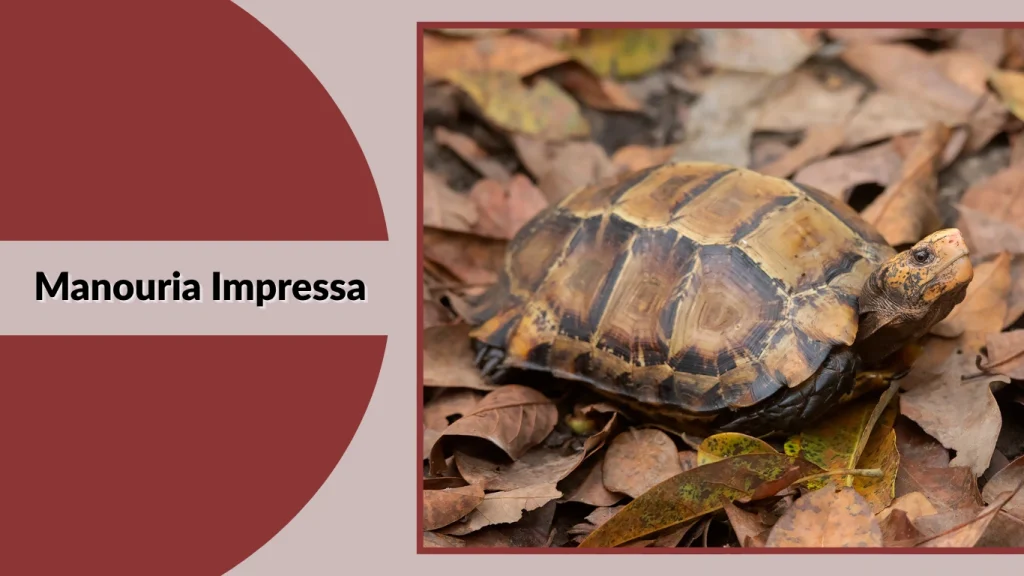
The impressed tortoise is a rare, forest-dwelling species found in mountainous regions of Southeast Asia. It is known for its attractive shell, which appears “impressed” or sunken between the scutes.
Identification
- Scientific Name: Manouria impressa
- Shell Shape: Elongated with sunken centers on each scute
- Size: 12–14 inches (30–35 cm)
- Weight: 6–10 pounds (2.7–4.5 kg)
- Lifespan: 40–60 years
- Native Range: Myanmar, Thailand, Laos, Vietnam, and southern China
- Diet: Mushrooms, fallen fruits, and leaves
- Color: Golden to yellow-brown shell with light brown skin
Habitat and Distribution
This tortoise inhabits moist, high-elevation forests between 1,000–2,000 meters above sea level. It favors cool, shaded areas with rich undergrowth and organic matter.
Behavior and Lifestyle
The impressed tortoise is elusive and rarely seen in the wild. It is solitary and shy, typically foraging during damp, overcast weather. Its preference for fungi makes it quite different from most herbivorous tortoises.
27. Texas Tortoise

The Texas tortoise is a small North American tortoise found in the southern parts of Texas and northeastern Mexico. It is the only native tortoise species in Texas.
Identification
- Scientific Name: Gopherus berlandieri
- Shell Shape: Oval and flattened with prominent growth rings
- Size: 8–10 inches (20–25 cm)
- Weight: 3–6 pounds (1.4–2.7 kg)
- Lifespan: 40–60 years
- Native Range: Southern Texas and northeastern Mexico
- Diet: Cactus pads, grasses, wildflowers, and fruits
- Color: Brown to tan shell with light tan skin
Habitat and Distribution
This species inhabits dry scrublands, thorny brush areas, and sandy soils. It is most commonly found in the Tamaulipan thornscrub and desert-edge regions.
Behavior and Lifestyle
Texas tortoises are active in spring and fall, especially after rainfall. They are not strong diggers but use existing burrows or shelter under vegetation. They are gentle, slow-paced creatures, often seen grazing near cactus and low brush.
28. Gopher Tortoise

The gopher tortoise is a burrowing tortoise native to the southeastern United States. It plays a crucial ecological role by creating burrows that shelter many other species.
Identification
- Scientific Name: Gopherus polyphemus
- Shell Shape: Flattened, oval with visible growth rings
- Size: 9–15 inches (23–38 cm)
- Weight: 8–15 pounds (3.6–6.8 kg)
- Lifespan: 40–80 years
- Native Range: Southeastern United States (Florida, Georgia, Alabama, etc.)
- Diet: Grasses, legumes, fruits, and wildflowers
- Color: Tan to gray-brown shell with yellowish skin
Habitat and Distribution
Gopher tortoises live in dry, sandy uplands like pine flatwoods, scrublands, and coastal dunes. Their deep burrows provide refuge from extreme weather and predators.
Behavior and Lifestyle
They are excellent diggers, capable of digging burrows over 30 feet long. These burrows are used by hundreds of other species, earning them the title of “keystone species.” Gopher tortoises are diurnal and primarily active in spring and fall.
29. Sonoran Desert Tortoise
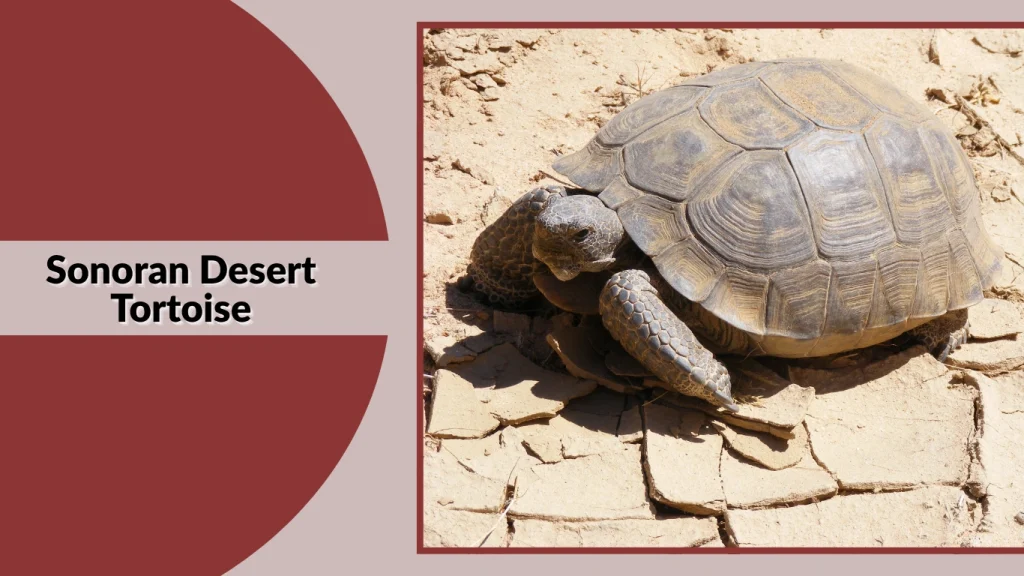
The Sonoran desert tortoise is a desert-adapted tortoise found in the southwestern United States and northwestern Mexico. It is a close relative of the Mojave desert tortoise but considered a distinct species or subspecies by some experts.
Identification
- Scientific Name: Gopherus morafkai
- Shell Shape: Domed and elongated with rough, ridged scutes
- Size: 9–15 inches (23–38 cm)
- Weight: 8–15 pounds (3.6–6.8 kg)
- Lifespan: 50–80 years
- Native Range: Arizona, Sonora (Mexico), and parts of New Mexico
- Diet: Desert grasses, cactus pads, wildflowers, and fruits
- Color: Brown to gray shell with lighter skin
Habitat and Distribution
This tortoise inhabits rocky hillsides, desert scrub, and cactus-dominated landscapes. It uses natural rock crevices and shallow burrows to avoid desert heat.
Behavior and Lifestyle
Sonoran desert tortoises are most active during the monsoon season. They are solitary, slow-moving, and adapted to long periods without water. They spend much of the year in shelter, emerging only when conditions are ideal.
30. Bolson Tortoise

The Bolson tortoise is the largest North American tortoise species, native to the Chihuahuan Desert of northern Mexico. It is one of the rarest tortoises in the world and a focus of active conservation programs.
Identification
- Scientific Name: Gopherus flavomarginatus
- Shell Shape: Broad, domed with distinct growth rings
- Size: 14–18 inches (35–46 cm)
- Weight: 15–30 pounds (6.8–13.6 kg)
- Lifespan: 80–100+ years
- Native Range: Northern Mexico (Chihuahua, Durango, Coahuila)
- Diet: Desert grasses, shrubs, and cacti
- Color: Brown to tan shell with yellowish margins
Habitat and Distribution
This species is found in arid grasslands and desert flats in the Bolsón de Mapimí region. It uses deep burrows to escape the heat and maintain humidity.
Behavior and Lifestyle
Bolson tortoises are diurnal and spend much of their life underground. They are slow-growing and long-lived, emerging mainly during the rainy season to feed and mate. Their populations are very limited due to habitat destruction and past overcollection.
31. Chaco Tortoise

The Chaco tortoise, also known as the Argentine tortoise, is a South American species that resembles the yellow-footed tortoise but has a more subdued appearance and slightly different habitat preferences.
Identification
- Scientific Name: Chelonoidis chilensis
- Shell Shape: Oval and moderately domed
- Size: 10–18 inches (25–46 cm)
- Weight: 6–15 pounds (2.7–6.8 kg)
- Lifespan: 40–60 years
- Native Range: Argentina, Paraguay, and Bolivia
- Diet: Dry grasses, cactus, flowers, and fruits
- Color: Light brown to gray shell with darker blotches
Habitat and Distribution
This tortoise inhabits dry scrublands, Chaco forests, and grasslands with sandy or loamy soil. It is well adapted to hot, dry conditions and uses shallow burrows or dense vegetation for cover.
Behavior and Lifestyle
Chaco tortoises are active during cooler parts of the day and after rain. They are solitary, calm creatures that spend most of their time grazing or resting. Their coloration helps them blend in with the dry, brushy surroundings.
32. Geometric Tortoise

The geometric tortoise is a critically endangered and highly distinctive species native to a small region in South Africa. Its striking, geometric-patterned shell makes it one of the most visually unique tortoises in the world.
Identification
- Scientific Name: Psammobates geometricus
- Shell Shape: Small, domed with bold geometric patterns
- Size: 4–6 inches (10–15 cm)
- Weight: 0.8–1.3 pounds (350–600 grams)
- Lifespan: 30–50 years
- Native Range: Western Cape, South Africa
- Diet: Indigenous grasses and wildflowers
- Color: Black shell with bright yellow geometric lines
Habitat and Distribution
This tortoise is restricted to renosterveld and fynbos habitats in the Western Cape. It relies on specific native plants and is extremely sensitive to habitat loss and fire.
Behavior and Lifestyle
The geometric tortoise is secretive and active mainly during mild, moist conditions. It hides under shrubs and tall grasses and is rarely seen in the wild. Its camouflage and cautious behavior are key survival traits.
33. Hingeback Tortoise

Hingeback tortoises are a group of African tortoises named for the flexible hinge on the rear of their shells. There are several species, with the most well-known being the Bell’s hingeback tortoise.
Identification
- Scientific Name: Kinixys belliana (commonly referenced species)
- Shell Shape: Oval and elongated with a movable rear section
- Size: 6–10 inches (15–25 cm)
- Weight: 2–4 pounds (0.9–1.8 kg)
- Lifespan: 20–50 years
- Native Range: Central and southern Africa
- Diet: Leaf litter, fruits, fungi, and invertebrates
- Color: Brown to dark shell with lighter streaks or patches
Habitat and Distribution
Hingeback tortoises are found in forests, savannas, and humid grasslands. They prefer shaded environments with lots of ground cover and decaying plant matter.
Behavior and Lifestyle
These tortoises are shy and mostly nocturnal or crepuscular. They use the hinged rear shell to close off their body when threatened. Their diet is varied, and they are more omnivorous than most tortoises, often feeding on mushrooms and insects.