
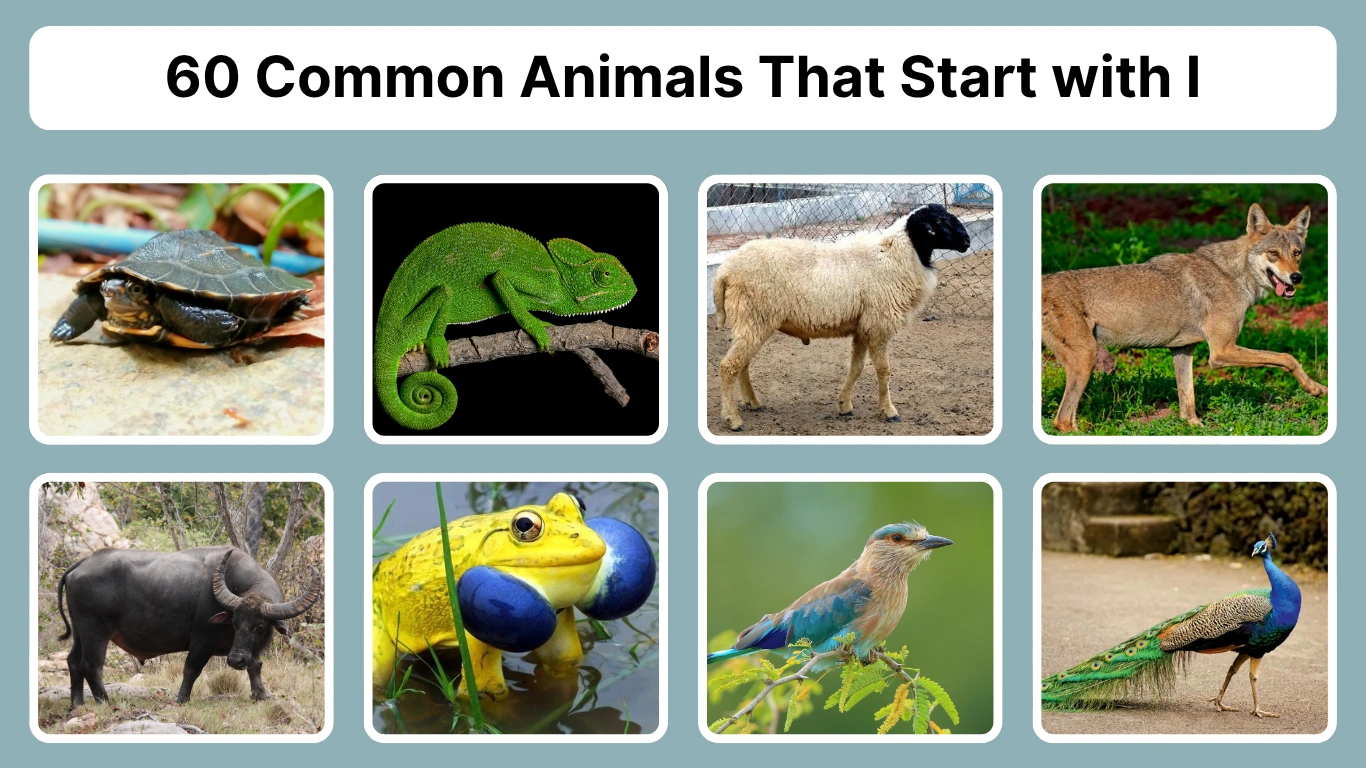
Animals with names starting with the letter “I” come from diverse habitats—from deep oceans and dense forests to farms and freshwater ponds. This list explores 60 such animals, categorized into 10 unique groups including mammals, birds, reptiles, insects, and more. Each group features six animals with short, easy-to-read descriptions. Whether you’re curious or studying, this guide offers a fun way to discover lesser-known and popular species alike.
Sure! Here’s the complete content for the first group titled “Mammals That Start with I” following your structure:
Mammals That Start with I
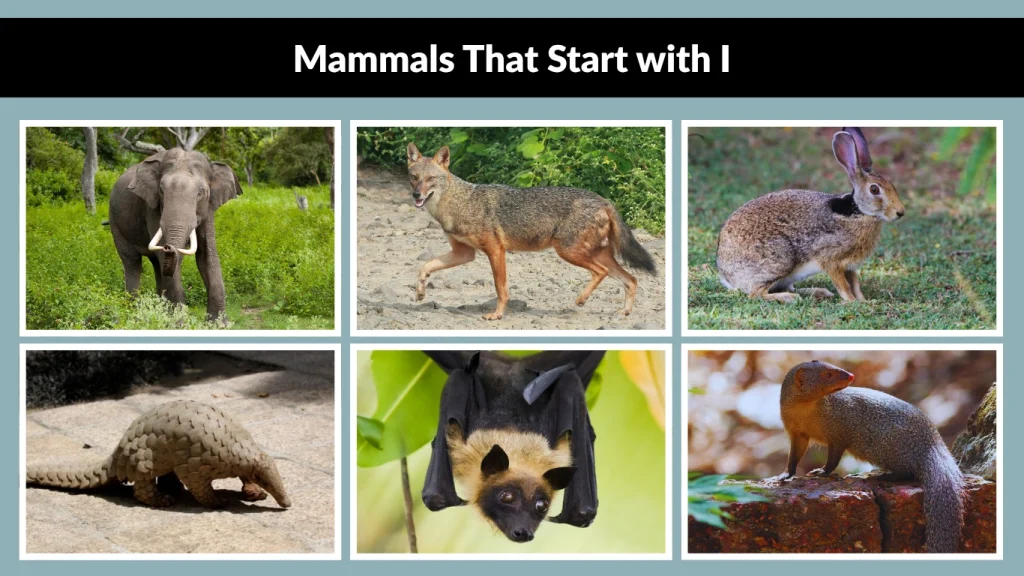
Many mammals have names beginning with the letter “I”, especially those native to India. These creatures vary in size, habitat, and behavior—from large land animals to agile tree-dwellers. Below are six mammals that start with the letter I, each with a brief overview of their characteristics.
1. Indian Elephant
The Indian elephant is a subspecies of the Asian elephant and is known for its intelligence and strength. Found mostly in forested regions of India, it plays a crucial role in both nature and culture.
This elephant has smaller ears than its African cousin but is equally majestic. They are herbivores and roam in herds, often near water sources.
2. Indian Jackal
The Indian jackal is a wild canid commonly found across the Indian subcontinent. It adapts well to various habitats including forests, grasslands, and even villages.
Known for its sharp instincts and nocturnal behavior, it often scavenges and occasionally hunts small animals. Jackals are also featured in many Indian folk tales.
3. Indian Hare
The Indian hare, also called the black-naped hare, is a fast, nimble creature often seen in open grasslands and farmland. It has long ears and strong hind legs built for speed.
These hares are mostly active at dusk and dawn, feeding on grass and other plants. Their camouflage helps them escape predators.
4. Indian Pangolin
Covered in protective scales, the Indian pangolin is a nocturnal mammal known for its unique appearance. It feeds almost exclusively on ants and termites.
Using its long, sticky tongue, it digs into insect nests. Though harmless to humans, it is often hunted illegally for its scales, making it a threatened species.
5. Indian Flying Fox
One of the largest bat species in the world, the Indian flying fox feeds on fruits and nectar. It plays an important role in pollination and seed dispersal.
These bats roost in large colonies on trees during the day and fly out at night in search of food. Despite myths, they are gentle creatures.
6. Indian Grey Mongoose
The Indian grey mongoose is a small, agile predator famous for its ability to fight and kill venomous snakes like cobras. It has sharp teeth and quick reflexes.
Often seen near human settlements, it feeds on rodents, birds, and insects. This mongoose is fearless and highly adaptable to different environments.
Certainly! Here’s the next group:
Birds That Start with I

Birds whose names begin with the letter “I” are mostly native to Asia, particularly the Indian subcontinent. These birds come in striking colors, sing melodious tunes, and have diverse roles in their ecosystems. Below are six interesting birds that start with the letter I.
7. Indian Peafowl
Also known as the blue peacock, the Indian peafowl is the national bird of India and famous for its vivid plumage and graceful courtship dance. The male’s long tail feathers, marked with shimmering eyespots, make it truly iconic.
Peafowls are omnivorous and often found near villages, forests, and fields. They use loud calls and elaborate displays to attract mates and warn of danger.
8. Indian Cuckoo
The Indian cuckoo is a shy, forest-dwelling bird best known for its haunting, repetitive call that echoes during the summer. It is often heard before it is seen.
This cuckoo is a brood parasite—it lays its eggs in other birds’ nests. The host birds raise the cuckoo chick, which usually hatches first and dominates the nest.
9. Indian Vulture
This large, mostly bald-headed bird was once a common sight across India, feeding on animal carcasses and helping keep ecosystems clean. Sadly, its population has declined drastically.
The sharp drop in numbers is linked to poisoning from veterinary drugs used in cattle. Now critically endangered, conservation efforts are underway to save it.
10. Indian Roller
Famed for its dazzling blue wings and aerial acrobatics during flight, the Indian roller is often seen perched on wires or trees in open areas. It’s a favorite among birdwatchers.
Despite its bright colors, it feeds mainly on insects, frogs, and small reptiles. The roller gets its name from its display flight during the breeding season.
11. Indian Paradise Flycatcher
This elegant bird has long, flowing tail feathers—especially in males—that trail behind in flight. Its colors can vary from pure white to rich chestnut, depending on the region and sex.
It lives in wooded habitats and feeds on flying insects, catching them mid-air with graceful agility. These birds migrate seasonally and are a joy to spot.
12. Imperial Woodpecker
The Imperial woodpecker, believed to be extinct or critically endangered, was once the largest woodpecker in the world. It lived in mountainous pine forests in Mexico.
It had a striking black-and-white body with a large crest. Due to deforestation and hunting, its population collapsed, and it hasn’t been reliably seen in decades.
Here’s the third group:
Reptiles That Start with I
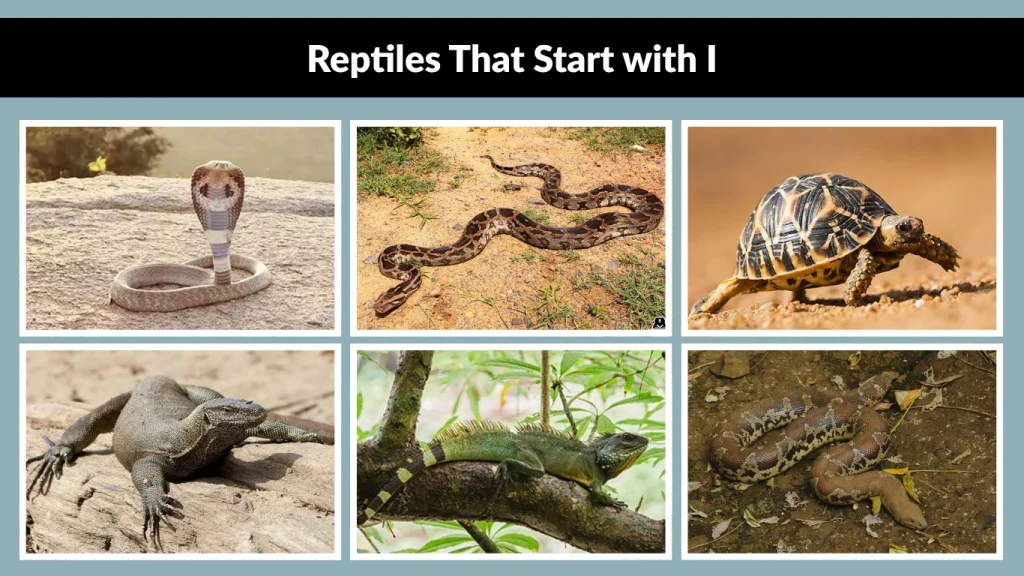
Reptiles that begin with the letter “I” are often native to India and Southeast Asia. These creatures range from venomous snakes to gentle tortoises and show incredible adaptations to their environments. Below are six reptiles starting with the letter I.
13. Indian Cobra
The Indian cobra is one of the most recognized venomous snakes in South Asia. It’s known for its hood, which it flares when threatened, often displaying an eye-like pattern.
Although feared, it plays a vital role in controlling rodent populations. Cobras usually avoid humans but may strike if provoked or cornered.
14. Indian Rock Python
This massive, non-venomous snake can grow up to 20 feet in length. It is a constrictor, meaning it kills its prey by squeezing rather than biting.
Found near water bodies and forests, it feeds on birds, mammals, and reptiles. Despite its size, it’s generally slow-moving and shy in nature.
15. Indian Star Tortoise
Easily recognized by the star-like patterns on its shell, the Indian star tortoise is popular in the pet trade. It’s a slow, land-dwelling herbivore that feeds on grass and fruit.
Native to dry regions and scrublands, it is protected under Indian law due to overcollection and habitat loss. It leads a mostly solitary and peaceful life.
16. Indian Monitor Lizard
A large and powerful lizard, the Indian monitor is a skilled predator that feeds on insects, rodents, and even small snakes. It’s active during the day and can run fast when threatened.
Though it looks intimidating, it poses no harm to humans. It’s often found in forests, villages, and agricultural fields across the subcontinent.
17. Indo-Chinese Water Dragon
This green, semi-aquatic lizard is native to Southeast Asia’s forests and riverbanks. It has a long tail, strong limbs, and can often be seen basking on tree branches.
Water dragons are excellent swimmers and often dive into water to escape predators. They feed on insects, small fish, and fruit.
18. Indian Sand Boa
The Indian sand boa is a thick-bodied, non-venomous snake that lives mostly underground. It prefers sandy or loose soil, where it digs and hides during the day.
Harmless to humans, it preys on small mammals and reptiles. Sadly, it is often killed or captured due to myths and superstitions about its magical powers.
Here is the next group:
Amphibians That Start with I
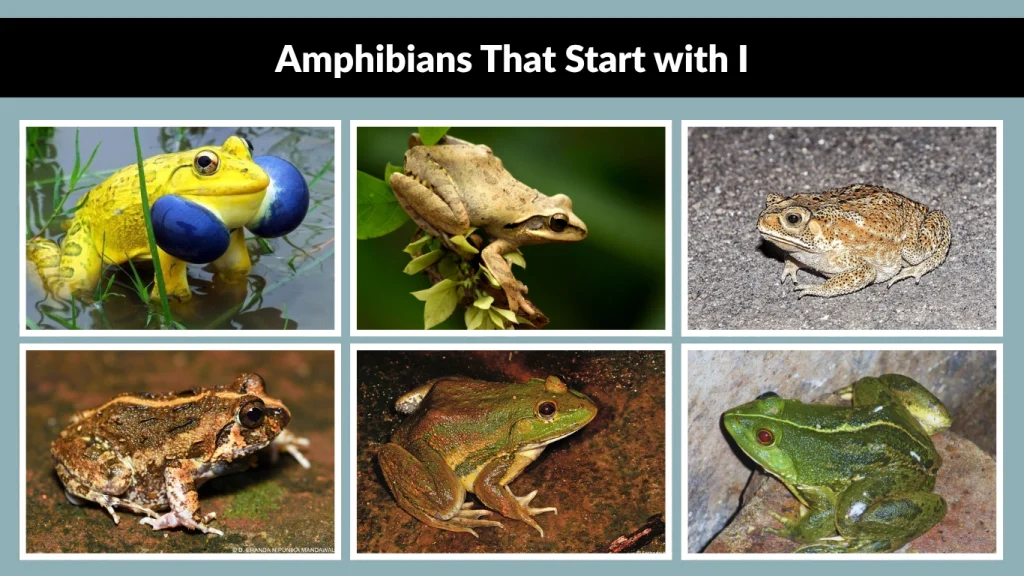
Amphibians starting with the letter “I” are usually found in warm, moist regions of South Asia. These creatures live part of their lives in water and part on land. They are essential to ecosystems and indicators of environmental health. Below are six such amphibians.
19. Indian Bullfrog
The Indian bullfrog is a large, colorful amphibian often seen during the monsoon season. Males develop bright yellow skin and blue vocal sacs when calling for mates.
It inhabits ponds, paddy fields, and wetlands, feeding on insects, small frogs, and even birds. Despite its size, it can leap far and swim efficiently.
20. Indian Tree Frog
This small, green frog spends most of its time in trees and bushes. Its sticky toe pads help it cling to leaves and branches with ease.
It comes alive during rains, croaking loudly in chorus. Indian tree frogs lay their eggs in water, where the tadpoles grow before becoming adults.
21. Indian Toad
The Indian toad, also known as the common Indian toad, has dry, bumpy skin and prefers moist environments. It’s often seen hopping around gardens and near lights at night.
Feeding on insects, it helps control pest populations. Its defensive glands secrete a bitter substance that deters predators.
22. Indian Burrowing Frog
This frog has short limbs and a rounded body, perfect for digging into soft soil. It spends much of its life underground and emerges mostly during heavy rains.
It lives in grasslands and farmland, where it feeds on termites and other soil insects. Its calls are low and often go unnoticed.
23. Indian Skittering Frog
Named for its habit of quickly skittering across water surfaces, this frog is a strong swimmer and jumper. It’s found in lakes, rivers, and marshes.
Its greenish-brown body blends well into aquatic vegetation. The Indian skittering frog is active both day and night, hunting insects near water.
24. Indian Pond Frog
Common in freshwater bodies across India, the Indian pond frog is adaptable and survives even in man-made ponds. It has smooth skin and a wide mouth.
These frogs are often heard croaking loudly in the evening. They feed on flies, mosquitoes, and small aquatic creatures, contributing to a balanced ecosystem.
Here’s the next group:
Fish That Start with I
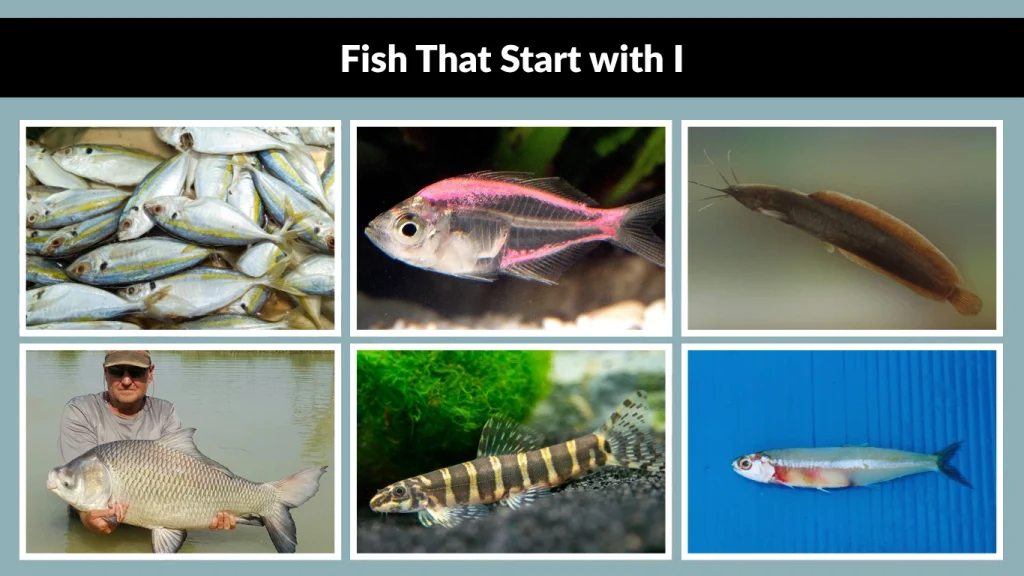
Several fish species start with the letter “I,” especially those native to the Indian Ocean and freshwater rivers of South Asia. These fish range from popular commercial species to lesser-known natives, each playing a role in aquatic ecosystems. Below are six fish that begin with I.
25. Indian Mackerel
The Indian mackerel is a fast-swimming, silvery fish found abundantly in the Indian Ocean. It is highly valued for its flavor and is a staple in many coastal diets.
These fish move in large schools and feed on plankton. They are an important part of marine food chains and commercial fisheries.
26. Indian Glassy Fish
Known for its transparent body, the Indian glassy fish allows you to see its bones and organs. It’s a small freshwater species popular in aquariums.
They are peaceful and prefer to live in groups. In the wild, they inhabit slow-moving rivers and feed on small insects and larvae.
27. Indian Catfish
This bottom-dwelling freshwater fish is widespread across South Asia. It has whisker-like barbels that help it sense food in muddy waters.
Indian catfish are hardy and can survive in low-oxygen environments. They’re farmed for food and also fished in the wild for local consumption.
28. Indian Carp
The Indian carp refers to several large freshwater species, like rohu and catla, that are commonly farmed. These fish are crucial to aquaculture in India.
They grow quickly and feed on plankton and plant matter. Indian carp support the livelihoods of millions through fisheries and farming.
29. Indian Loach
The Indian loach is a slender, bottom-dwelling fish found in rivers and streams. It has a peaceful temperament and is known for cleaning algae in aquariums.
With barbels near its mouth, it scours riverbeds for food. It thrives in soft, flowing water and is often active at night.
30. Indian Anchovy
A small, oily fish found in coastal waters, the Indian anchovy is known for its strong flavor. It is commonly dried, salted, or used in curries and pickles.
They form dense schools and feed on plankton. Anchovies also serve as an important food source for larger fish and marine birds.
Here is the next group:
Insects That Start with I

Insects that start with the letter “I” may not be widely known, but many play important roles in pollination, decomposition, and pest control. These insects are often found in forests, gardens, and farms across Asia and other parts of the world. Here are six interesting insect species beginning with I.
31. Indian Meal Moth
The Indian meal moth is a common pest in kitchens and food storage areas. It’s known for infesting grains, cereals, and dried fruits.
Adults have brownish wings with coppery tips. Though harmless to humans, their larvae contaminate food, making them a major concern for households.
32. Indian Moon Moth
With its pale green wings and long tails, the Indian moon moth is one of the most beautiful silk moths. It is mostly active at night and does not feed as an adult.
Its caterpillar feeds on the leaves of trees like mango and guava. These moths are admired for their size and striking appearance.
33. Indian Red Admiral
This butterfly has bold red bands across dark wings, making it easy to recognize. The Indian red admiral is fast-flying and often visits gardens.
It feeds on nectar and helps with pollination. Caterpillars feed on nettles and other wild plants, contributing to biodiversity.
34. Indian Fruit Fly
A tiny but troublesome insect, the Indian fruit fly lays its eggs inside fruits, where larvae cause internal decay. It’s a serious agricultural pest.
It targets mangoes, guavas, and other soft fruits. Farmers use traps and sanitation to control its population and reduce crop losses.
35. Indian Honeybee
The Indian honeybee is smaller than the European variety but just as industrious. It builds hives in tree hollows, buildings, or open rock faces.
These bees are vital pollinators for crops and wild plants. Their honey is also harvested by local beekeepers for consumption and trade.
36. Indian Stick Insect
Well-camouflaged to resemble twigs or sticks, the Indian stick insect is a master of disguise. It’s a peaceful herbivore that feeds on leaves.
It remains motionless for hours, making it hard for predators to spot. These insects are often found in forests and bushy gardens.
Here is the next group:
Marine Animals That Start with I
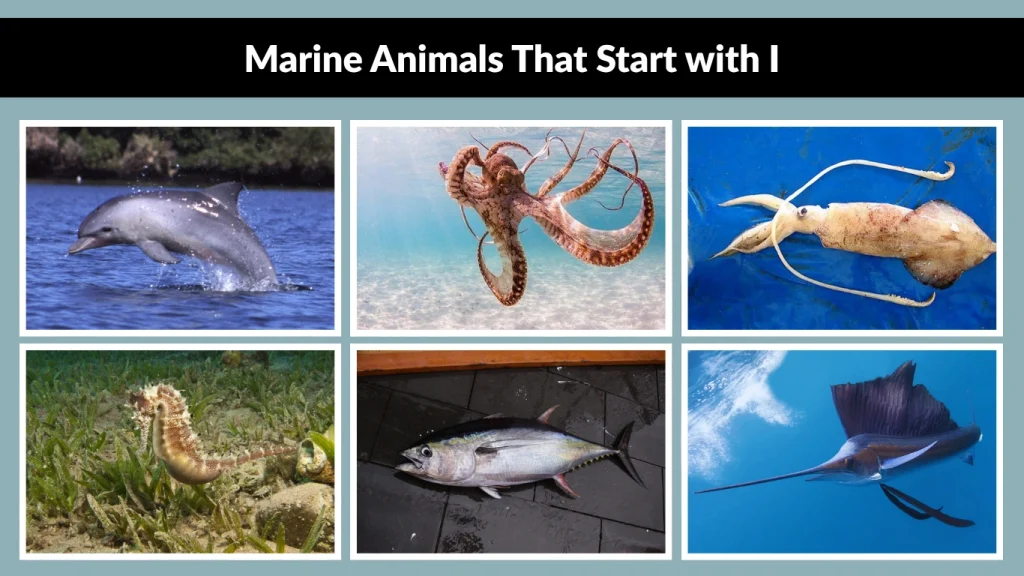
The ocean is home to many species whose names begin with “I,” especially in the Indian and Indo-Pacific regions. These marine animals range from swift predators to delicate, slow-moving creatures, each contributing to the richness of marine biodiversity. Here are six such marine animals.
37. Indo-Pacific Bottlenose Dolphin
This intelligent and social dolphin species is found in warm coastal waters of the Indo-Pacific region. They use echolocation to navigate and hunt.
Often seen in pods, they feed on fish and squid. These dolphins are playful, curious around boats, and sometimes leap from the water in elegant arcs.
38. Indian Ocean Octopus
Found in coral reefs and rocky crevices, the Indian Ocean octopus is a master of camouflage. It can change its skin color and texture within seconds.
It uses its arms and beak to capture prey like crabs and small fish. Octopuses are highly intelligent, capable of problem-solving and escaping predators.
39. Indian Ocean Squid
This fast-swimming cephalopod uses jet propulsion to move through water. It’s known for its ability to shoot ink when threatened.
Found in deep and coastal waters, the Indian Ocean squid plays a key role in the food chain, feeding on shrimp and being preyed on by larger fish.
40. Indian Ocean Seahorse
These delicate marine creatures have horse-shaped heads and curled tails. The Indian Ocean seahorse is often found clinging to sea grasses or corals.
Unlike most animals, the male seahorse carries the babies in a pouch. They are poor swimmers but rely on stealth and camouflage to survive.
41. Indian Ocean Tuna
The Indian Ocean is home to several tuna species, including skipjack and yellowfin. These fish are prized for their speed and strength.
Tuna are migratory and can cover thousands of miles. They play a major role in global fisheries and are crucial to ocean ecosystems.
42. Indo-Pacific Sailfish
With its long, pointed bill and large dorsal fin, the sailfish is one of the fastest fish in the ocean. It uses bursts of speed to catch prey.
Sailfish hunt small schooling fish and are known for their spectacular leaps. They are also a favorite among sport fishers for their power and beauty.
Here is the next group:
Mythical or Extinct Animals That Start with I
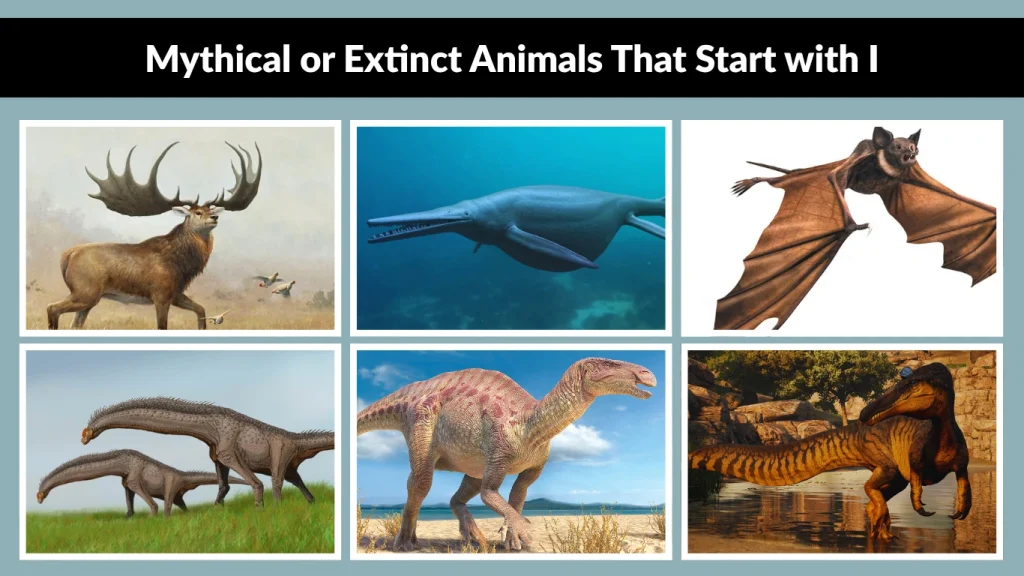
Some animals that begin with the letter “I” are either extinct or belong to the world of prehistoric times and myths. These creatures spark curiosity and imagination, offering glimpses into ancient ecosystems or cultural folklore. Below are six such animals starting with “I.”
43. Irish Elk
The Irish elk was one of the largest deer species to ever live. Its massive antlers could span up to 12 feet across, making it a truly majestic animal.
Despite the name, it wasn’t exclusive to Ireland. It roamed across Eurasia during the Ice Age but went extinct due to climate change and habitat loss.
44. Ichthyosaurus
Ichthyosaurus was a dolphin-like marine reptile that lived during the Mesozoic era. It had a streamlined body and sharp teeth for catching fish.
Though it resembled a fish, it was a reptile that gave birth to live young. Fossils show it was a fast swimmer and highly adapted to ocean life.
45. Icaronycteris
Icaronycteris is one of the earliest known species of bat, dating back to about 50 million years ago. Its fossil was found with fully developed wings.
This ancient bat had sharp teeth and likely fed on insects. It shows that bats evolved flight and echolocation quite early in their history.
46. Isisaurus
Isisaurus was a long-necked, plant-eating dinosaur that lived in what is now India during the Late Cretaceous period. It was a type of titanosaur.
It had a unique, upright posture compared to other sauropods. Fossils suggest it may have lived in semi-arid environments and moved in herds.
47. Iguanodon
Iguanodon was one of the first dinosaurs ever discovered and named. It was a large herbivore with a thumb spike likely used for defense.
It walked on both two and four legs and lived during the Early Cretaceous. Iguanodon fossils have been found in Europe, Asia, and North America.
48. Ichthyovenator
Ichthyovenator, meaning “fish hunter,” was a spinosaurid dinosaur from prehistoric Laos. It had a unique double sail on its back and a long snout.
Its crocodile-like jaws suggest it fed on fish and small animals. It lived near rivers and lakes, using its sail perhaps for display or thermoregulation.
Here is the next group:
Domesticated or Farm Animals That Start with I
Some domesticated or farm animals that start with the letter “I” are native to the Indian subcontinent or have names tied to their regional origin. These animals are raised for food, labor, milk, or companionship and contribute significantly to rural livelihoods. Here are six such animals.
49. Indian Cow
The Indian cow is a sacred and vital part of Indian agriculture and culture. It is primarily raised for milk, manure, and sometimes labor in farming.
These cows are known for their calm nature and resilience in hot climates. Different native breeds, like Gir and Sahiwal, are prized for their milk quality.
50. Indian Buffalo
Often larger than cows, Indian buffaloes are powerful draft animals and high milk producers. They are especially common in rural India and Southeast Asia.
Buffalo milk is thicker and creamier than cow milk. Breeds like Murrah and Jafarabadi are well-known and support dairy industries across the region.
51. Indian Goat
Goats are among the most adaptable farm animals and are raised for meat, milk, and skin. Indian goat breeds like Jamunapari and Black Bengal are widely reared.
These goats can survive on minimal resources and are often kept by small-scale farmers. They thrive in both dry and humid conditions.
52. Indian Chicken
The Indian chicken includes both native desi breeds and improved poultry types. They are raised for eggs and meat, especially in backyard systems.
Breeds like Aseel are known for their strength and fighting abilities, while others are kept for their egg-laying capabilities and resilience.
53. Indian Duck
Raised in wetland and coastal areas, Indian ducks are a valuable source of eggs and meat. They forage naturally and require less feed than chickens.
Popular breeds like Indian Runner ducks are excellent layers. Ducks also help control pests by eating insects in paddy fields.
54. Indian Sheep
Indian sheep are raised for wool, meat, and skin in different regions of the country. Breeds like Deccani and Marwari are suited to arid and semi-arid zones.
They graze on open fields and require minimal care. Sheep farming provides income to many rural households, especially in dryland farming systems.
Here is the final group:
Lesser-Known or Unique Animals That Start with I
Not all animals that start with the letter “I” are well-known. Some are rare, region-specific, or simply not often featured in popular media. These lesser-known species include small mammals, reptiles, and fish that display fascinating traits. Here are six unique animals that start with I.
55. Indian Bush Rat
The Indian bush rat is a small rodent found in fields and wooded areas across South Asia. It is active mostly at night and feeds on seeds and grains.
Though often overlooked, it plays a role in seed dispersal and soil aeration. In rural areas, it’s considered a pest to stored crops and grains.
56. Indian Wolf
Smaller and leaner than its European cousin, the Indian wolf is adapted to dry grasslands and open forests. It usually forms small packs for hunting.
This wolf feeds on rodents, hares, and deer. Due to habitat loss and conflict with humans, its numbers have declined, making conservation efforts important.
57. Indian Long-Eared Hedgehog
This tiny hedgehog is known for its large ears and spiny coat. It is nocturnal and uses its excellent hearing to detect insects and small prey.
Found in dry, scrubby regions, it curls into a ball when threatened. Its solitary lifestyle and elusive nature make it rarely seen in the wild.
58. Indian Pipefish
A close relative of seahorses, the Indian pipefish has a long, slender body and a tubular snout. It swims slowly, mimicking seaweed for camouflage.
These fish are found in shallow coastal waters and estuaries. Like seahorses, males carry the fertilized eggs in a special pouch until they hatch.
59. Indian Chameleon
The Indian chameleon is a master of camouflage, capable of changing its skin color based on mood, temperature, or surroundings. It has a long tongue for catching insects.
Found in trees and shrubs, it moves with a slow, rocking motion. Its independently rotating eyes give it a wide field of view to spot prey.
60. Indian Black Turtle
This freshwater turtle has a dark shell and is found in rivers, ponds, and tanks across the Indian subcontinent. It feeds on aquatic plants, insects, and small fish.
Though shy, it surfaces often for air and basking. It’s considered sacred in some parts of India and is protected under wildlife conservation laws.