


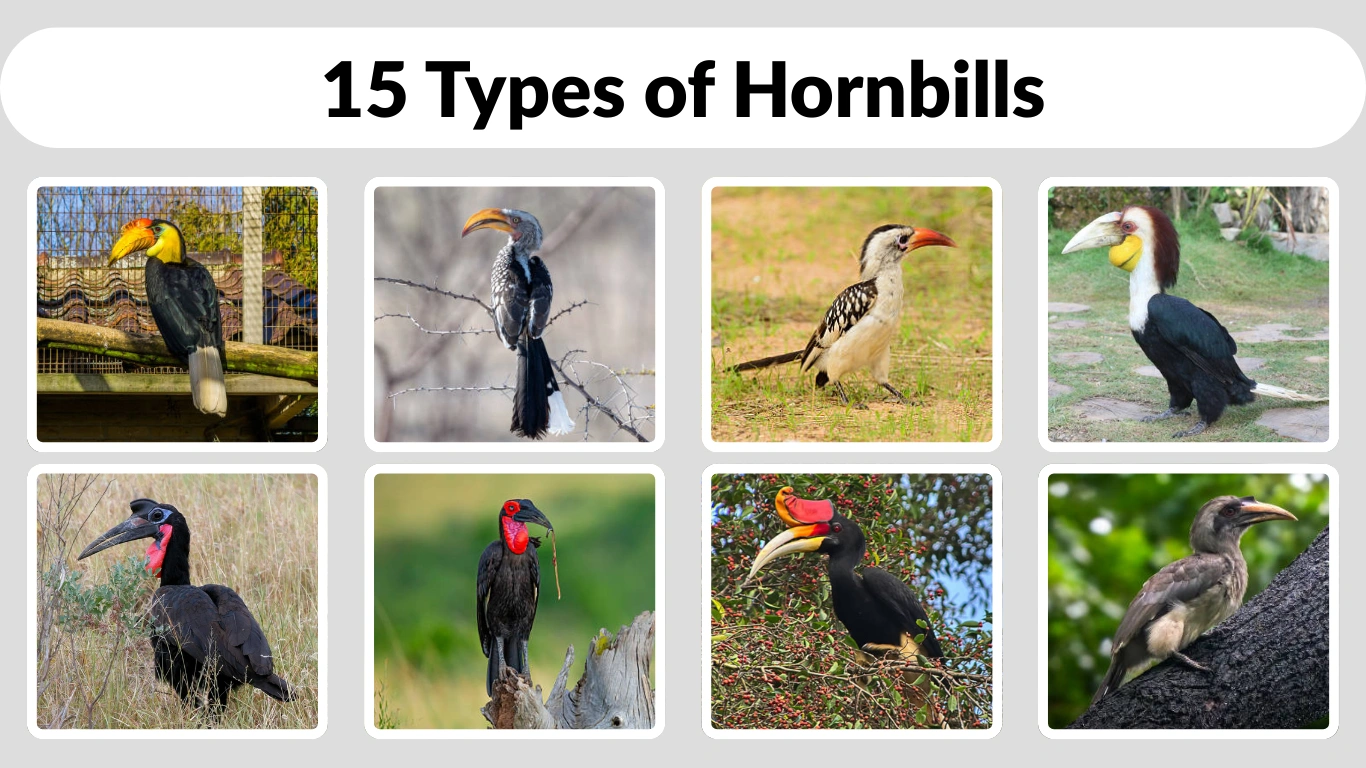
Hornbills are remarkable birds known for their massive bills, striking casques, and essential role as seed dispersers in African and Asian ecosystems. This guide explores 15 distinct hornbill species, highlighting their unique features, natural habitats, behaviors, and diets. From forest giants like the Great Hornbill to ground-dwelling species of Africa, these profiles offer a clear understanding of the diversity and ecological importance of hornbills worldwide.
1. Great Hornbill
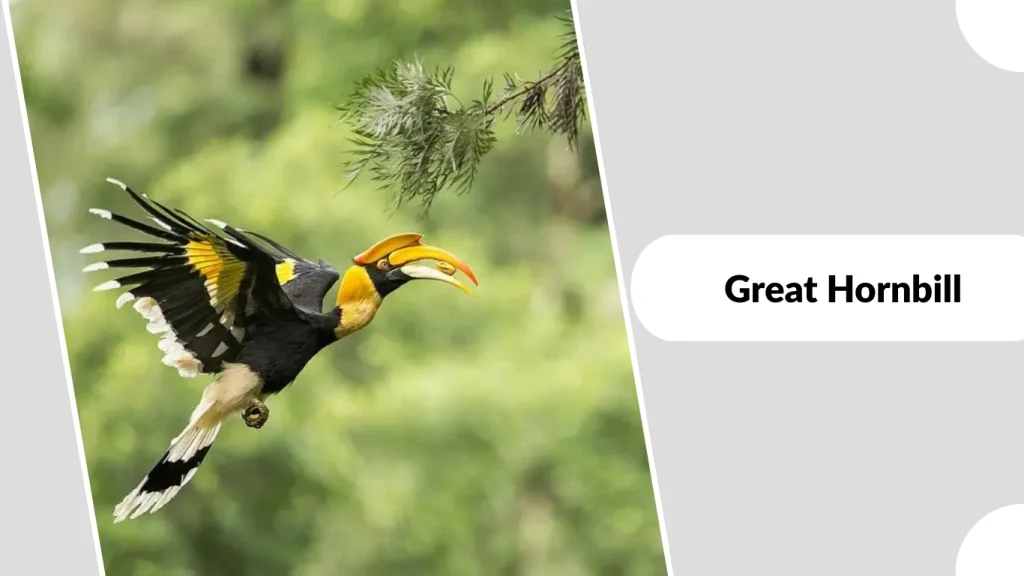
The Great Hornbill (Buceros bicornis) is one of the largest and most iconic hornbill species, famous for its massive yellow-and-black casque and powerful wingbeats. Found in the forests of South and Southeast Asia, it is a symbol of rainforest biodiversity.
Identification
- Large, curved yellow bill with a prominent casque
- Black and white plumage with a striking yellow throat patch
- Broad wings with loud, whooshing flight sounds
- Red eyes in males, white eyes in females
- Strong neck and heavy build
Habitat
Great Hornbills inhabit dense tropical and subtropical forests, preferring tall, mature trees for nesting. Their range extends across India, Nepal, Bhutan, Myanmar, Thailand, Malaysia, and Indonesia. They rely on large forest areas for feeding and breeding.
Behaviors
They are diurnal, social birds often seen in pairs or small groups. Great Hornbills are known for their unique nesting behavior: the female seals herself inside a tree cavity using mud and fruit pulp, leaving only a small slit through which the male provides food. Their deep calls and wingbeats are often heard far before they are seen.
Diet
Great Hornbills are primarily frugivores, feeding heavily on figs and other fruits. They also eat insects, small reptiles, and small mammals when available. Their fruit consumption plays a crucial ecological role in seed dispersal throughout tropical forests.
2. Rhinoceros Hornbill
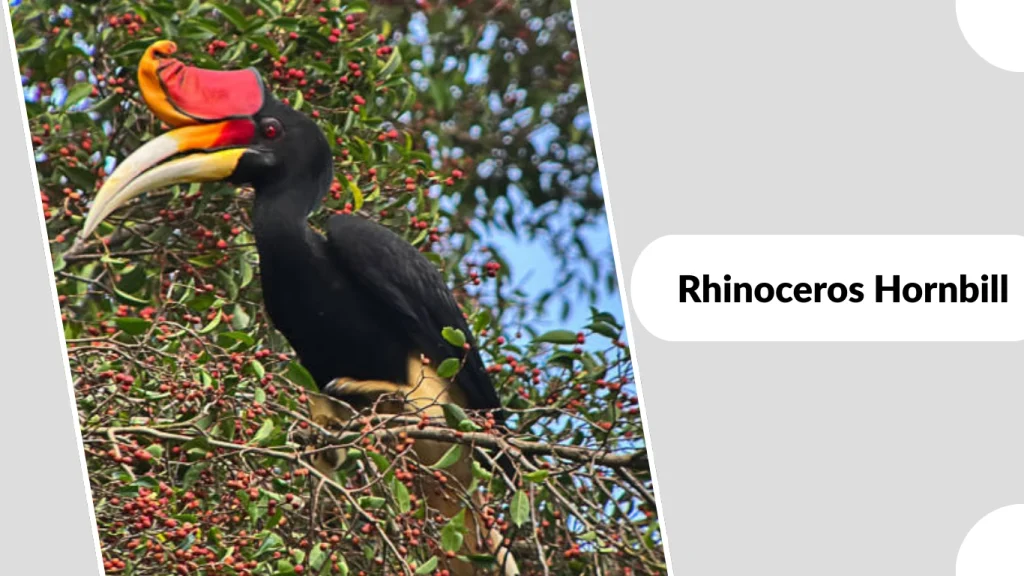
The Rhinoceros Hornbill (Buceros rhinoceros) is one of Southeast Asia’s most striking hornbill species, known for its large orange-red casque shaped like an upward-curving horn. Revered in local cultures, it is a key species of rainforest ecosystems.
Identification
- Bright orange-red upward-curving casque
- White tail with a black band across the center
- Glossy black body with white thighs
- Large, curved yellow bill
- Strong wings and long tail
Habitat
Rhinoceros Hornbills inhabit the lowland and montane rainforests of Malaysia, Thailand, Sumatra, Borneo, and southern Myanmar. They prefer dense, old-growth forest with abundant fruiting trees and suitable nesting cavities.
Behaviors
They are monogamous and exhibit cooperative nesting behaviors similar to other large hornbills. The female seals herself in a tree cavity during nesting, relying on the male to bring food through a narrow opening. Rhinoceros Hornbills are powerful fliers with loud wingbeats and are often observed traveling long distances in search of fruit.
Diet
Their diet is mainly frugivorous, especially figs, but they also consume insects, small reptiles, and occasionally small mammals. Their feeding habits make them essential seed dispersers in Southeast Asian tropical forests.
3. Indian Grey Hornbill
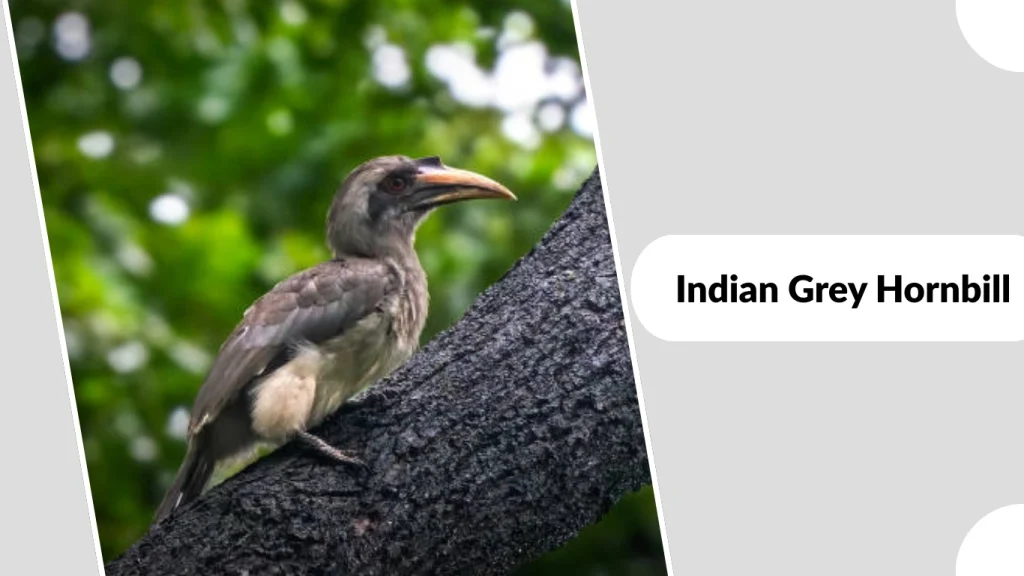
The Indian Grey Hornbill (Ocyceros birostris) is a medium-sized hornbill commonly seen across the Indian subcontinent. Known for its grey plumage and distinctive casque, it adapts well to both forests and urban environments.
Identification
- Grey body with lighter underparts
- Long, curved bill with a small dark casque
- Red eyes with a pale eye-ring
- White-tipped tail feathers
- Slender build and strong flight
Habitat
Indian Grey Hornbills inhabit deciduous forests, scrublands, orchards, and urban green spaces throughout India, Nepal, and parts of Bangladesh. They favor areas with tall trees for nesting and abundant fruiting plants.
Behaviors
They are social and often seen in pairs or small groups. Indian Grey Hornbills are active and vocal, producing sharp, repetitive calls. Their nesting behavior involves sealing the female inside a tree cavity while the male provides food until the chicks are partly grown.
Diet
Their diet consists primarily of fruits—especially figs—along with insects, small reptiles, and flower nectar. Their fruit-eating habits make them important seed dispersers in both wild and urban landscapes.
4. African Grey Hornbill
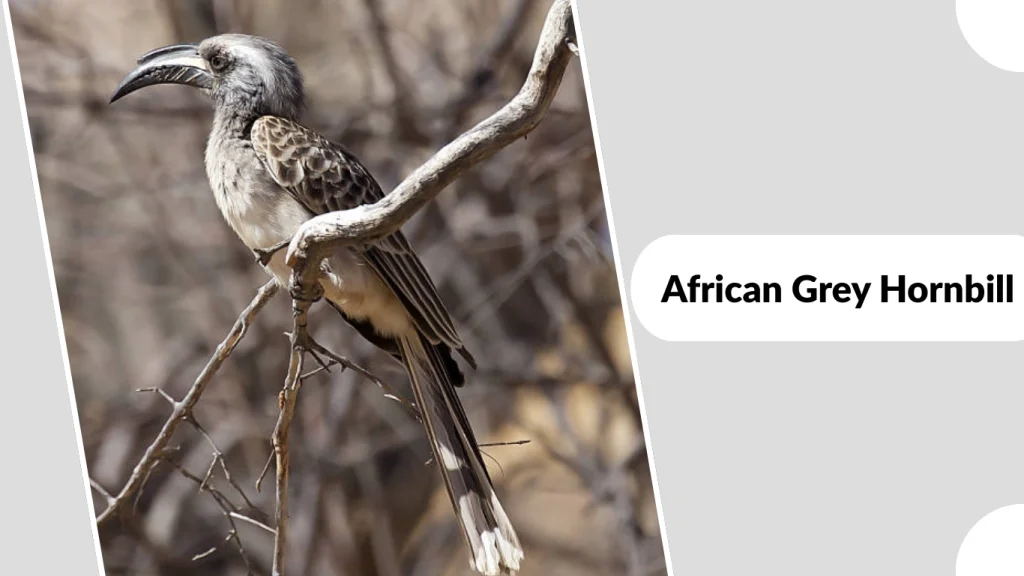
The African Grey Hornbill (Lophoceros nasutus) is a slender, widespread hornbill found across sub-Saharan Africa. Recognizable by its long, thin bill and agile flight, it thrives in savannas, woodlands, and semi-arid regions.
Identification
- Grey plumage with white belly
- Long, slender black bill with a modest casque
- White eyebrow stripe and dark facial markings
- Black-and-white tail pattern
- Lightweight, streamlined body
Habitat
African Grey Hornbills inhabit savannas, dry woodlands, thorn scrub, and open forests from West Africa to East and southern Africa. They adapt well to seasonal environments and are often seen near villages and agricultural areas.
Behaviors
These hornbills are active and agile, commonly flying between scattered trees while foraging. They are typically seen in pairs or small family groups. Their calls are loud and piping, used to communicate across open landscapes. Like most hornbills, the female seals herself in a nest cavity during breeding.
Diet
Their diet includes fruits, insects, seeds, small reptiles, and occasionally bird eggs. They forage both in trees and on the ground, showing more dietary flexibility than many other hornbill species.
5. Southern Ground Hornbill
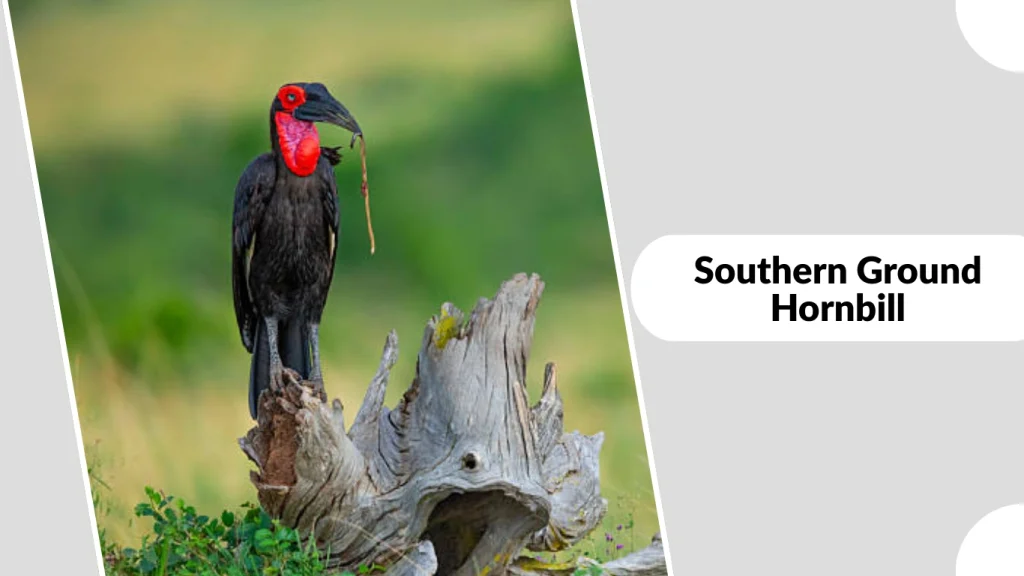
The Southern Ground Hornbill (Bucorvus leadbeateri) is the largest hornbill species and one of Africa’s most distinctive birds. Known for its striking red facial skin and terrestrial lifestyle, it plays an important role in savanna ecosystems.
Identification
- Black plumage with vivid red or orange facial and throat skin
- Massive black bill with slight casque
- Long legs adapted for walking
- Large wings but prefers ground movement
- White primary feathers visible in flight
Habitat
Southern Ground Hornbills inhabit savannas, open woodlands, and grasslands across southern and eastern Africa. They prefer regions with scattered trees, which offer suitable nesting sites in large tree cavities or cliffs.
Behaviors
They are highly social and live in cooperative family groups. Unlike most hornbills, they spend most of their time on the ground, walking long distances while foraging. Their deep, booming calls can carry for miles. During breeding, helpers assist the dominant pair in raising chicks.
Diet
Their diet includes insects, snakes, lizards, small mammals, frogs, and occasionally carrion. They actively hunt prey on the ground, making them more carnivorous compared to many other hornbill species.
6. Northern Ground Hornbill
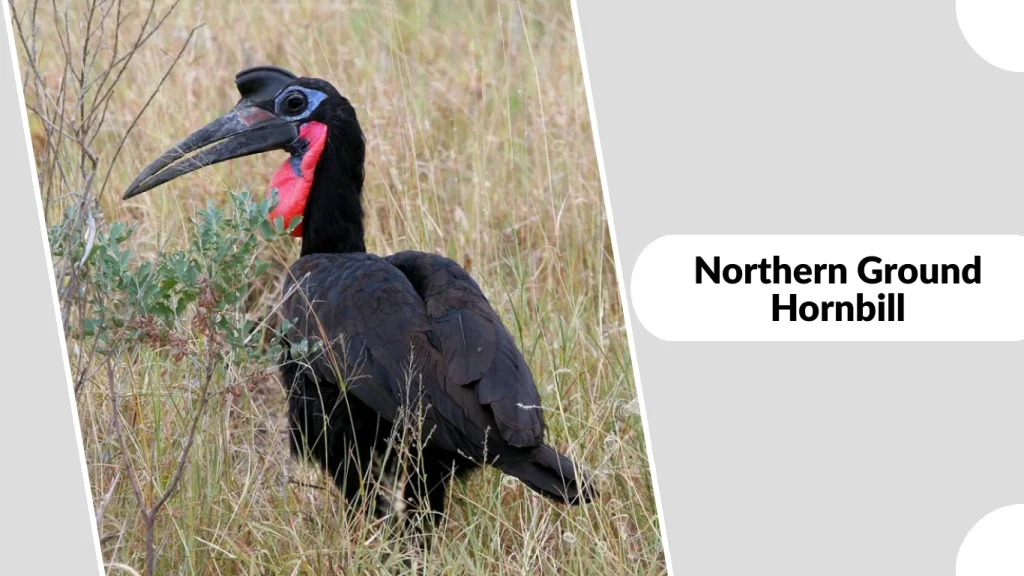
The Northern Ground Hornbill (Bucorvus abyssinicus) is a large, terrestrial hornbill native to the savannas and dry woodlands of northern Africa. Distinguished by its blue facial skin and impressive size, it is a close relative of the Southern Ground Hornbill.
Identification
- Black plumage with bright blue facial and throat skin (males show red throat patch)
- Large, curved black bill with a prominent casque
- Long, powerful legs for ground movement
- White primary feathers visible in flight
- Robust, heavy body
Habitat
Northern Ground Hornbills inhabit dry savannas, open grasslands, and lightly wooded regions across countries like Ethiopia, Sudan, Uganda, and Kenya. They prefer open areas with scattered trees that provide nesting cavities and vantage points.
Behaviors
These hornbills are diurnal and highly social, living in family groups that cooperate in raising young. They spend most of their time walking across the ground searching for prey. Their deep, booming vocalizations help maintain group cohesion and defend territory.
Diet
Their diet is primarily carnivorous, consisting of insects, snakes, toads, small mammals, and other ground-dwelling creatures. They actively hunt rather than forage, using their strong bills to capture and dispatch prey.
7. Oriental Pied Hornbill
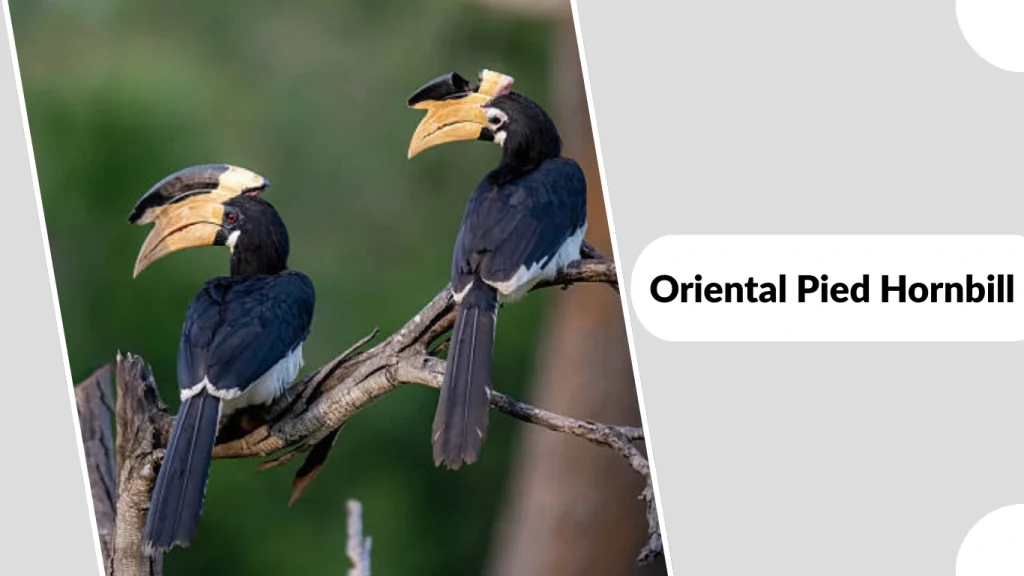
The Oriental Pied Hornbill (Anthracoceros albirostris) is a medium-sized, adaptable hornbill commonly found in Southeast Asia. Known for its contrasting black-and-white plumage and flexible habitat preferences, it often thrives near human settlements.
Identification
- Black body with white belly and tail tips
- Yellowish bill with a prominent but relatively small casque
- White spots on the wings in some subspecies
- Pale facial skin and dark red or brown eyes
- Medium-sized build with agile flight
Habitat
Oriental Pied Hornbills inhabit tropical forests, mangroves, plantations, and urban green spaces across India, Thailand, Malaysia, Singapore, and Indonesia. Their ability to adapt to disturbed habitats makes them more widespread than many hornbill species.
Behaviors
They are vocal, social birds often seen in pairs or small flocks. Their calls are loud and varied, echoing through forest canopies. During breeding, the female seals herself in a tree cavity while the male provides food. They frequently visit fruiting trees and may forage near human areas.
Diet
Their diet includes fruits, figs, insects, small reptiles, and bird eggs. Oriental Pied Hornbills are flexible feeders, allowing them to thrive in both pristine forests and urban environments.
8. Malabar Pied Hornbill
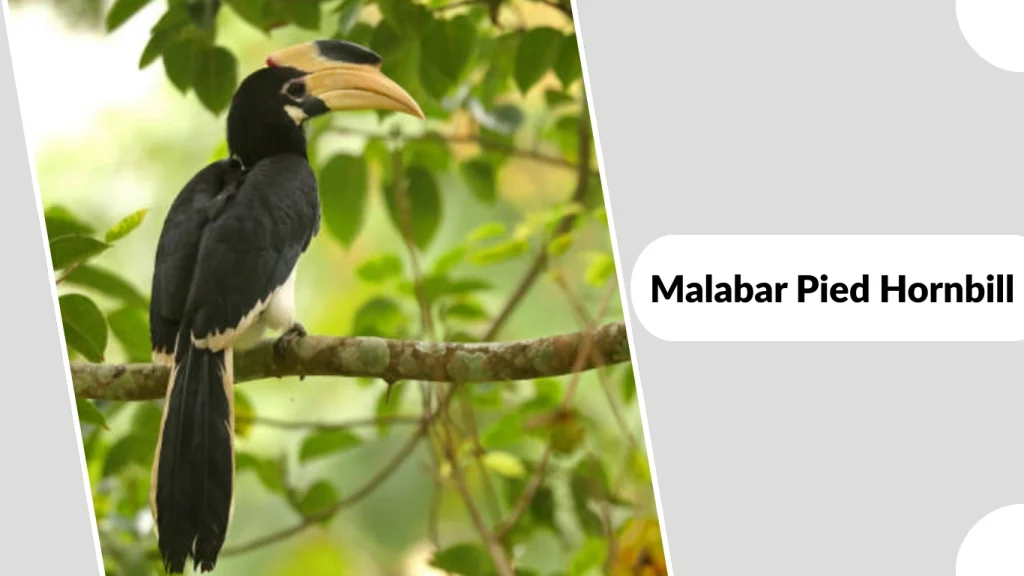
The Malabar Pied Hornbill (Anthracoceros coronatus) is a striking hornbill species native to the forests of India and Sri Lanka. Known for its contrasting black-and-white plumage and large yellow-black casque, it is closely associated with fruit-rich habitats.
Identification
- Black body with white belly and tail markings
- Large yellow bill with a distinctive black casque
- White facial patches and red eyes
- Broad wings adapted for strong flight
- Medium-to-large size with elegant appearance
Habitat
Malabar Pied Hornbills inhabit moist deciduous forests, riverine areas, groves, and fruit-rich woodlands of the Western Ghats, central India, and Sri Lanka. They require large trees for nesting and prefer regions with abundant fig and fruiting species.
Behaviors
They are social birds often seen in pairs or small flocks. Their vocalizations are loud and repetitive, carrying across forest landscapes. Like other hornbills, the female seals herself inside a tree cavity during breeding while the male supplies food. They travel widely in search of fruiting trees.
Diet
Their diet consists mainly of figs, berries, and other fruits, but they also consume insects, small mammals, and bird eggs when needed. They play a crucial ecological role as seed dispersers in Indian forest ecosystems.
9. Wreathed Hornbill
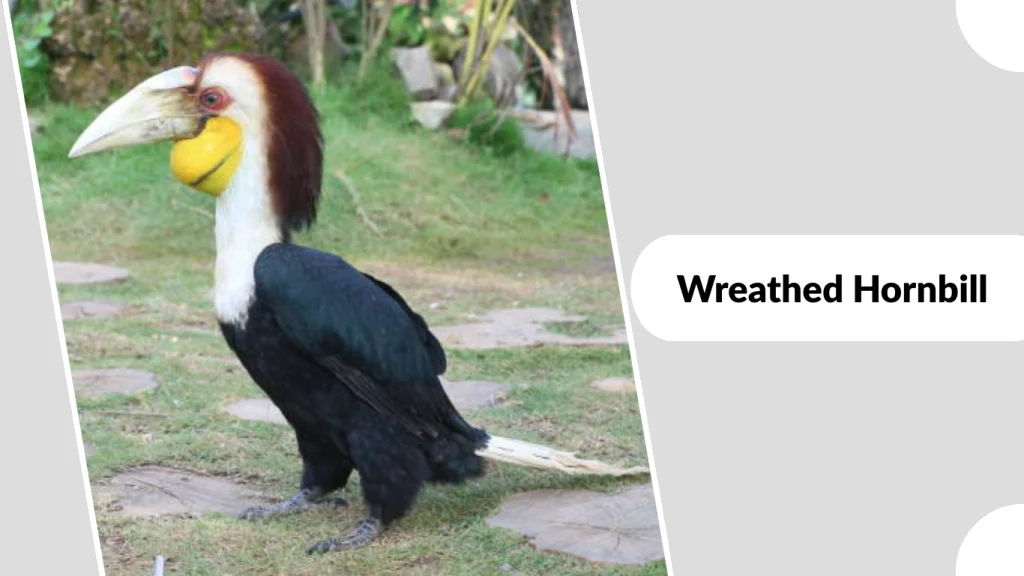
The Wreathed Hornbill (Rhyticeros undulatus) is a large, elegant hornbill distinguished by the wavy ridges—or “wreaths”—on its casque. Found across Southeast Asia, it is known for its striking coloration and strong, soaring flight.
Identification
- Large yellow bill with multiple ridged “wreaths” on the casque
- Black body with white tail and chestnut-colored nape
- Bare blue facial skin (deeper blue in males)
- Long wings and graceful flight
- Distinctive throat pouch, often bright blue
Habitat
Wreathed Hornbills inhabit evergreen forests, foothills, and lowland tropical forests from India and Bhutan through Myanmar, Thailand, Laos, Vietnam, Malaysia, and Indonesia. They rely on tall trees for nesting and feeding, making them sensitive to deforestation.
Behaviors
They are strong fliers, often seen soaring over forest canopies in pairs or small flocks. Their calls are loud, resonant, and echo across valleys. During breeding, the female seals herself inside a nest cavity, receiving food from the male until the chicks are large enough to break out.
Diet
Their diet consists mainly of fruits—especially figs—along with insects, small reptiles, and occasional small animals. They are vital seed dispersers, helping maintain the health and diversity of tropical forests.
10. Helmeted Hornbill
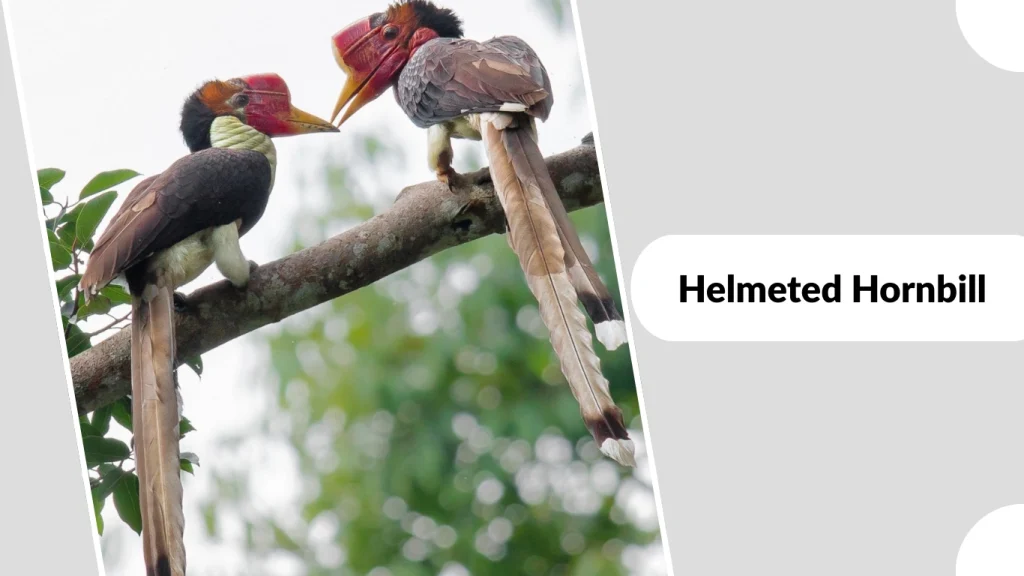
The Helmeted Hornbill (Rhinoplax vigil) is a unique and critically endangered hornbill species known for its solid casque—unlike any other hornbill—and loud, echoing calls that carry across Southeast Asian forests. Its casque has historically made it a target for illegal trade.
Identification
- Solid ivory-like casque extending along the bill
- Black body with white tail feathers tipped in black
- Bare wrinkled throat skin (red in males, blue in females)
- Large wings with powerful flight
- Long central tail feathers forming a distinctive shape
Habitat
Helmeted Hornbills inhabit lowland rainforests in Thailand, Myanmar, Malaysia, Sumatra, and Borneo. They require large, old-growth trees for nesting and are extremely sensitive to habitat loss, making them one of the most vulnerable hornbill species.
Behaviors
Known for their dramatic “cackling” call that crescendos into a loud whooping sound, Helmeted Hornbills are highly territorial. Males engage in aerial jousting, colliding casques mid-air during territorial disputes. Their nesting follows the typical hornbill pattern—females seal themselves inside tree cavities for protection.
Diet
They feed primarily on figs but also consume insects, small reptiles, and other fruits. Their strong dependence on fig trees makes them key seed dispersers in rainforest ecosystems.
11. Silvery-cheeked Hornbill
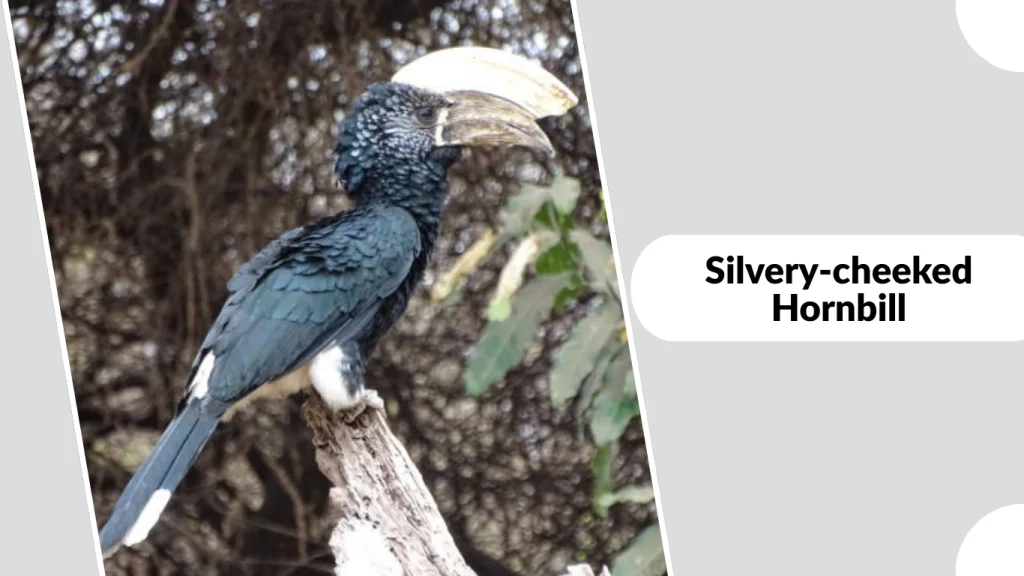
The Silvery-cheeked Hornbill (Bycanistes brevis) is a striking African hornbill known for its speckled head, powerful bill, and deep, resonant calls. Found primarily in eastern Africa, it favors forest edges and mountainous woodlands.
Identification
- Large cream-colored bill with prominent casque
- Silvery, speckled feathers on the head and face
- Black body with white rump and underparts
- Long tail and strong wings
- Robust size with noticeable facial patterning
Habitat
Silvery-cheeked Hornbills inhabit montane forests, forest edges, and mixed woodlands across Ethiopia, Kenya, Tanzania, and northern Mozambique. They prefer areas with tall trees suitable for nesting and abundant fruiting plants.
Behaviors
These hornbills are social and often seen in pairs or small flocks. They produce deep croaking calls that echo across valleys. They follow traditional hornbill nesting behavior, with females sealed in tree cavities during breeding. They may travel long distances in search of fruit.
Diet
Their diet consists mainly of fruits—especially figs—along with insects, small animals, and seeds. They play a major role in seed dispersal within African forest ecosystems.
12. Trumpeter Hornbill
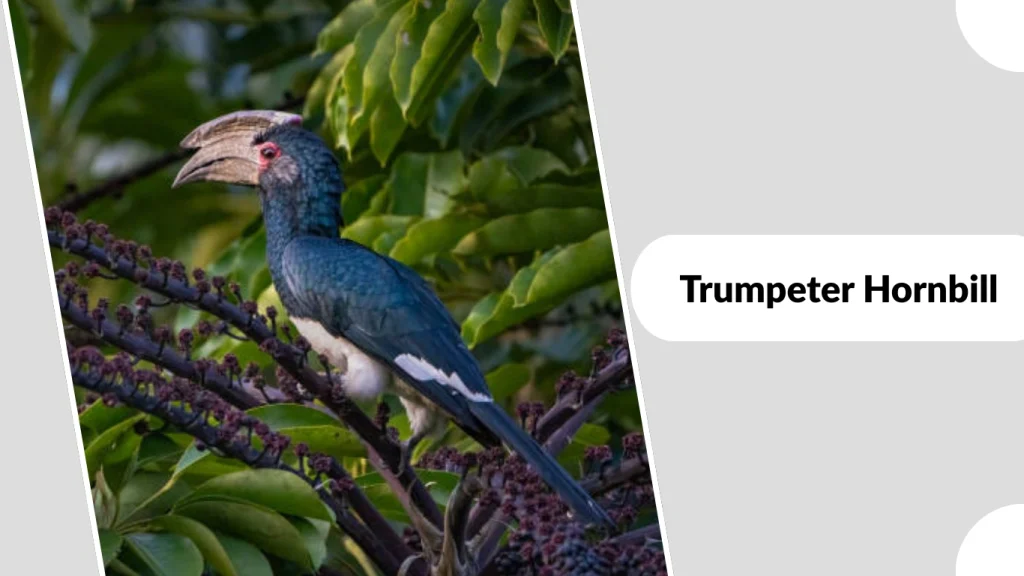
The Trumpeter Hornbill (Bycanistes bucinator) is a medium-sized African hornbill known for its loud, trumpet-like calls and playful group behavior. It is commonly found in humid forests and riverine woodlands of southern and eastern Africa.
Identification
- Black body with white belly and undertail
- Pale bill with a modest casque
- Bright red facial skin around the eyes
- Long tail with white tips
- Graceful wings and agile flight
Habitat
Trumpeter Hornbills inhabit coastal forests, riverine woodlands, and moist evergreen forests across South Africa, Mozambique, Zimbabwe, Zambia, Tanzania, and Kenya. They prefer regions with dense canopy cover and abundant fruiting trees.
Behaviors
They are highly social, often traveling in small, noisy flocks. Their signature sound—a loud, trumpeting call—echoes through forests. Like other hornbills, females seal themselves in nesting cavities. These birds are playful and active, frequently engaging in aerial displays.
Diet
Their diet consists mainly of fruits and figs, but they also consume insects, small reptiles, and seeds. They regularly visit fruiting trees and contribute significantly to seed dispersal.
13. Red-billed Hornbill
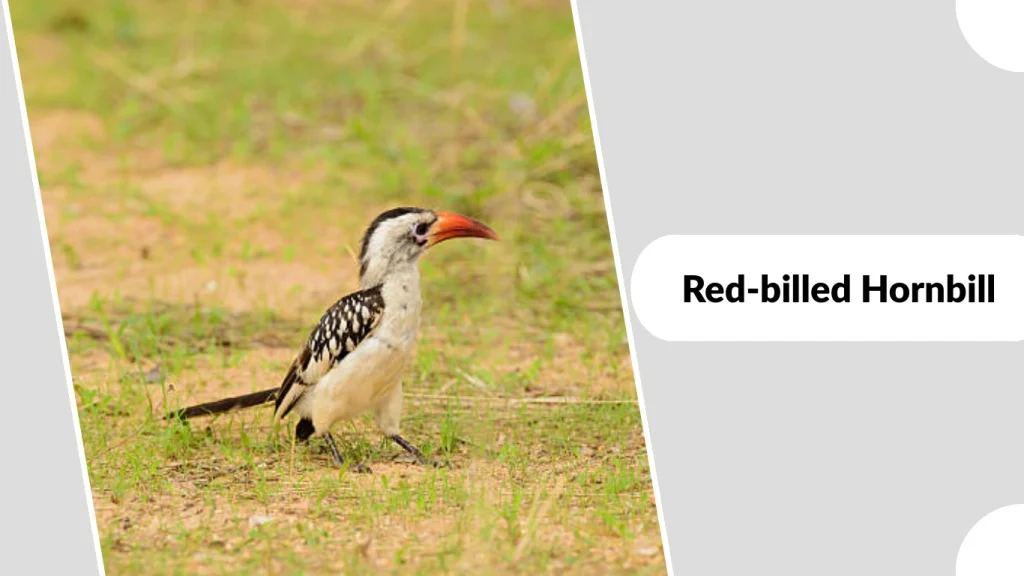
The Red-billed Hornbill (Tockus erythrorhynchus) is a small, charismatic hornbill recognized by its bright red bill and lively behavior. Found widely across sub-Saharan Africa, it is one of the most familiar hornbill species in open habitats.
Identification
- Long, slender red bill with slight curve
- Grey and white plumage with black wing markings
- White belly and black tail with white tips
- Pale face with minimal casque
- Small, lightweight build
Habitat
Red-billed Hornbills inhabit savannas, dry woodlands, bushlands, and semi-arid regions across East, Central, and Southern Africa. They often forage near villages and are highly tolerant of human presence.
Behaviors
They are active, curious, and often seen in small groups or pairs. Red-billed Hornbills forage on the ground, hopping energetically as they search for insects. They nest in tree cavities where the female seals herself inside using mud and fruit pulp. Their calls are sharp and repetitive.
Diet
Their diet includes insects, seeds, small reptiles, fruits, and occasionally small mammals. They frequently hunt insects stirred up by grazing animals, showing opportunistic feeding behavior.
14. Yellow-billed Hornbill
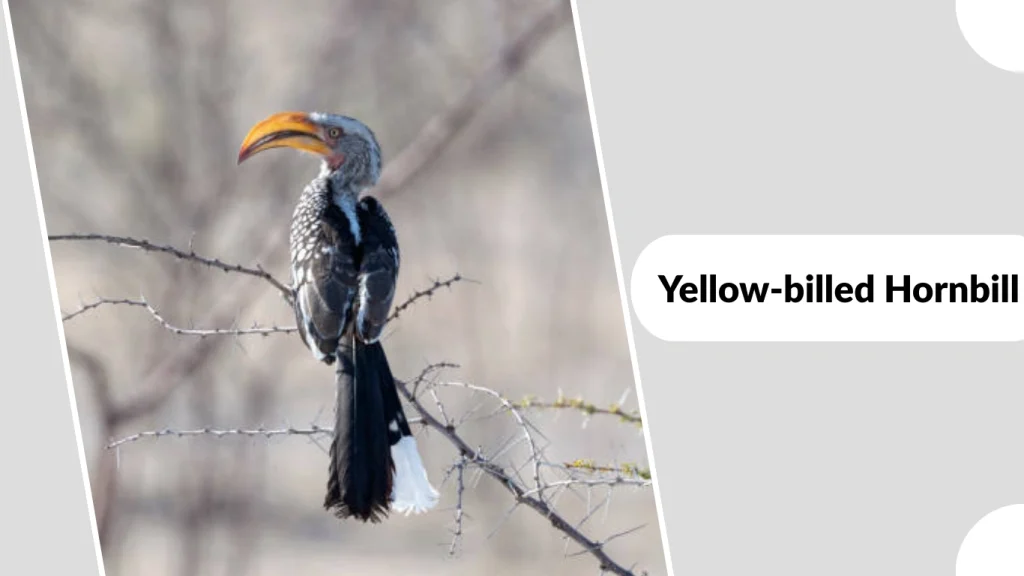
The Yellow-billed Hornbill (Tockus leucomelas) is a distinctive hornbill species native to southern Africa, easily recognized by its bright yellow bill and comical expressions. It is commonly seen in dry savannas and bushlands.
Identification
- Bright yellow, slightly curved bill
- Black-and-white streaked plumage
- White belly and dark wings
- Red facial skin around the eyes
- Slim, lightweight build
Habitat
Yellow-billed Hornbills inhabit dry savannas, acacia woodlands, and bushveld regions across Namibia, Botswana, Zimbabwe, South Africa, and Mozambique. They prefer open areas with scattered trees and shrubs for nesting and foraging.
Behaviors
They are curious, active birds frequently seen searching for food on the ground. Yellow-billed Hornbills often form pairs or small groups and are known for their loud, cackling calls. Their breeding behavior includes the female sealing herself inside a tree cavity while the male provides food.
Diet
Their diet consists of insects, seeds, fruits, small reptiles, and even scorpions. They are opportunistic feeders and may follow larger animals to capture prey disturbed by movement.
15. Knobbed Hornbill

The Knobbed Hornbill (Rhyticeros cassidix) is a vibrant hornbill species native to Indonesia, easily recognized by the prominent “knob” on the male’s casque. This colorful bird is a symbol of Sulawesi’s rich biodiversity.
Identification
- Bright yellow bill with a large casque featuring a distinct knob (especially in males)
- Deep blue throat skin (blue in males, turquoise in females)
- Black body with chestnut-colored nape and upper back
- White tail with black tips
- Broad wings and strong flight
Habitat
Knobbed Hornbills inhabit lowland and montane rainforests on the Indonesian islands of Sulawesi and nearby smaller islands. They rely on tall, mature trees for nesting and roosting, making them highly dependent on intact forest ecosystems.
Behaviors
They are diurnal, social hornbills often seen in pairs or small flocks. Males perform impressive aerial displays during courtship. Like many hornbills, females seal themselves into a tree cavity for nesting while the male brings food. Their calls are loud and echo through dense forests.
Diet
Their diet consists mostly of fruits—especially figs—along with insects, small reptiles, and occasionally small animals. They are vital seed dispersers in Sulawesi’s rainforest ecosystems.
FAQs
1. Why do hornbills seal their nests?
Female hornbills seal themselves inside tree cavities using mud, fruit pulp, and droppings to stay protected from predators during egg incubation. The male provides food through a small slit until the chicks are old enough for the female to break out.
2. What is the purpose of a hornbill’s casque?
The casque serves multiple roles depending on the species—amplifying calls, reinforcing the bill, attracting mates, and aiding in species recognition. In some species like the Helmeted Hornbill, the casque is solid and used in aerial battles.
3. Are hornbills important to their ecosystems?
Yes. Hornbills are major seed dispersers, especially for fig trees and large-fruited plants. By spreading seeds across forests, they help maintain healthy, diverse ecosystems and support reforestation.
4. Where do hornbills live?
Hornbills are found across Africa and Asia, inhabiting rainforests, savannas, woodlands, and mountainous regions. Some species prefer dense tropical forests, while others thrive in open, dry habitats.
5. Why are some hornbill species endangered?
Habitat loss, illegal wildlife trade, and hunting have greatly reduced populations of several species, especially the Helmeted Hornbill. Deforestation removes their nesting trees, making them highly vulnerable. Conservation programs focus on habitat protection and reducing poaching.