




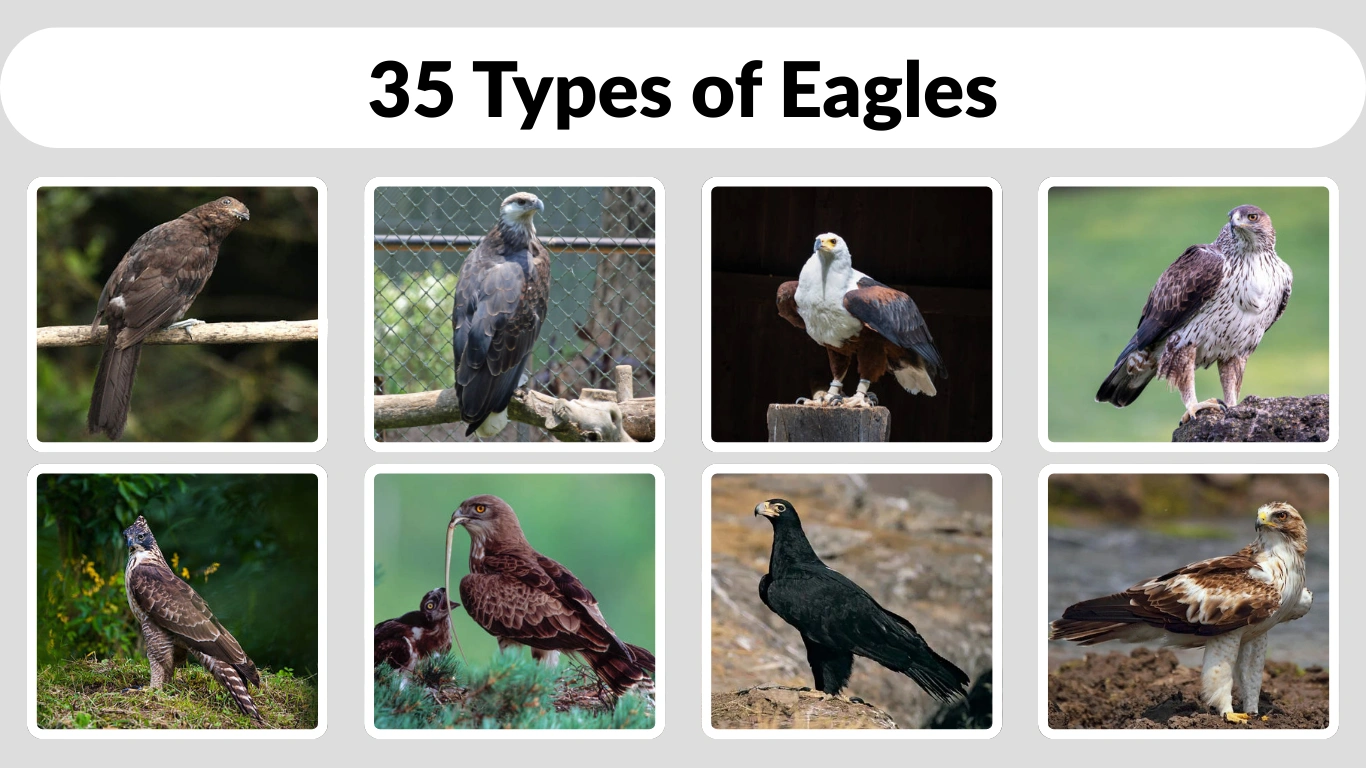
Eagles are among the most powerful and majestic birds of prey, known for their sharp eyesight, strong talons, and impressive wingspans. Found across diverse habitats—from dense forests and open grasslands to coastal cliffs and wetlands—these raptors play a vital role in maintaining ecological balance. This guide explores 35 different types of eagles, highlighting their unique characteristics, behaviors, and global distribution.
1. Bald Eagle (Haliaeetus leucocephalus)
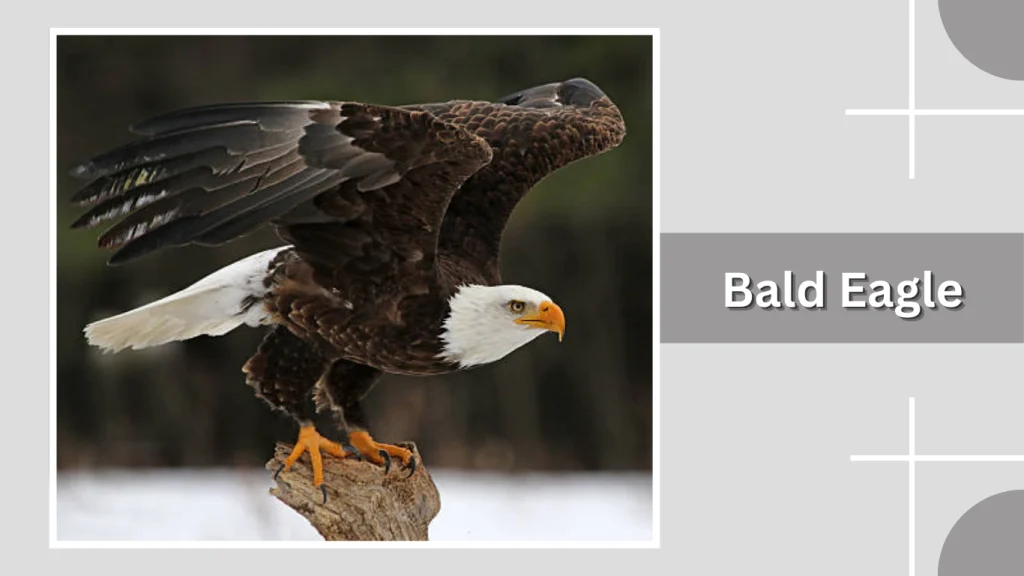
The Bald Eagle is one of the most recognizable birds of prey in the world and the national symbol of the United States. Known for its striking white head and tail contrasted with a dark brown body, this powerful raptor is closely associated with large bodies of water and is admired for its strength and soaring flight.
Identification
- Large raptor with a wingspan of about 6–7.5 feet
- White head and white tail (adults only)
- Dark brown body and wings
- Bright yellow hooked beak
- Yellow legs with sharp black talons
- Juveniles are mostly brown with mottled white markings
Habitat and Behavior
Bald Eagles are commonly found near rivers, lakes, wetlands, and coastal areas where fish are abundant. They prefer tall trees or cliffs for nesting and roosting. These eagles are strong fliers and often seen soaring high or perched quietly while scanning for prey. They are generally monogamous and may use the same nest for many years.
Diet and Lifecycle
The Bald Eagle’s diet mainly consists of fish, but it also eats waterfowl, small mammals, and carrion. It is known for opportunistic feeding and sometimes steals food from other birds. Bald Eagles mate for life, laying 1–3 eggs per breeding season. Both parents help incubate the eggs and raise the chicks until they fledge and learn to hunt on their own.
2. Golden Eagle (Aquila chrysaetos)
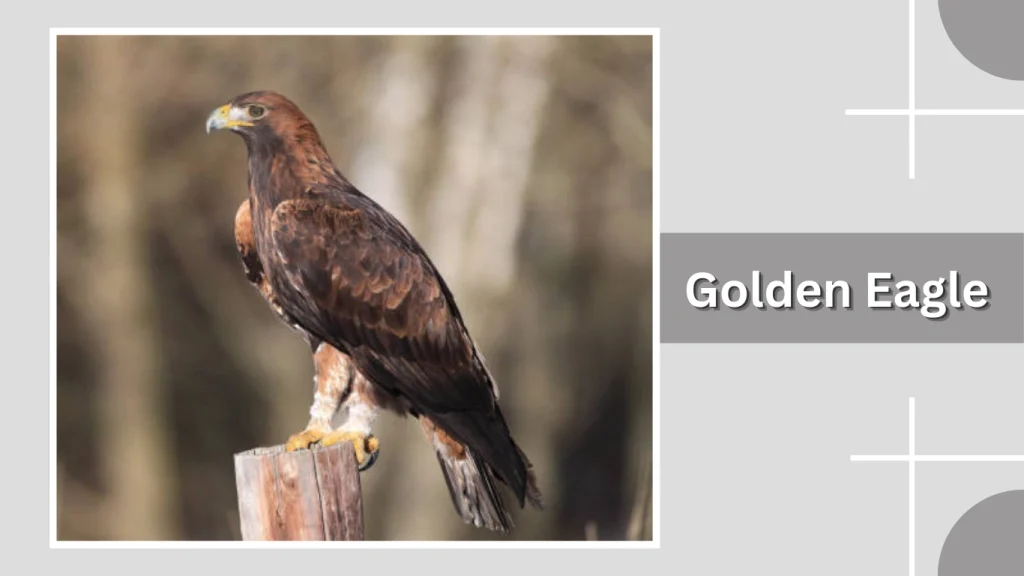
The Golden Eagle is one of the largest and most powerful eagles in the world. Known for its dark brown body and golden-feathered nape, this species is widely distributed across the Northern Hemisphere and is respected for its speed, strength, and hunting skill.
Identification
- Large eagle with a wingspan of about 6–7.5 feet
- Dark brown body with golden-brown feathers on the back of the head and neck
- Long, broad wings with slightly fingered tips
- Strong hooked beak, dark at the tip
- Feathered legs down to the feet
- Juveniles show white patches on wings and tail
Habitat and Behavior
Golden Eagles inhabit open and semi-open landscapes such as mountains, hills, grasslands, and deserts. They prefer remote areas with minimal human disturbance. These eagles are solitary or found in pairs and are exceptional soarers, often using thermal currents to glide for long distances while searching for prey.
Diet and Lifecycle
Golden Eagles primarily feed on small to medium-sized mammals, including rabbits, hares, and rodents, but they may also hunt birds and reptiles. They usually mate for life and build large nests on cliffs or tall trees. The female lays 1–4 eggs, and both parents participate in raising the young until they are ready to leave the nest.
3. White-tailed Eagle (Haliaeetus albicilla)
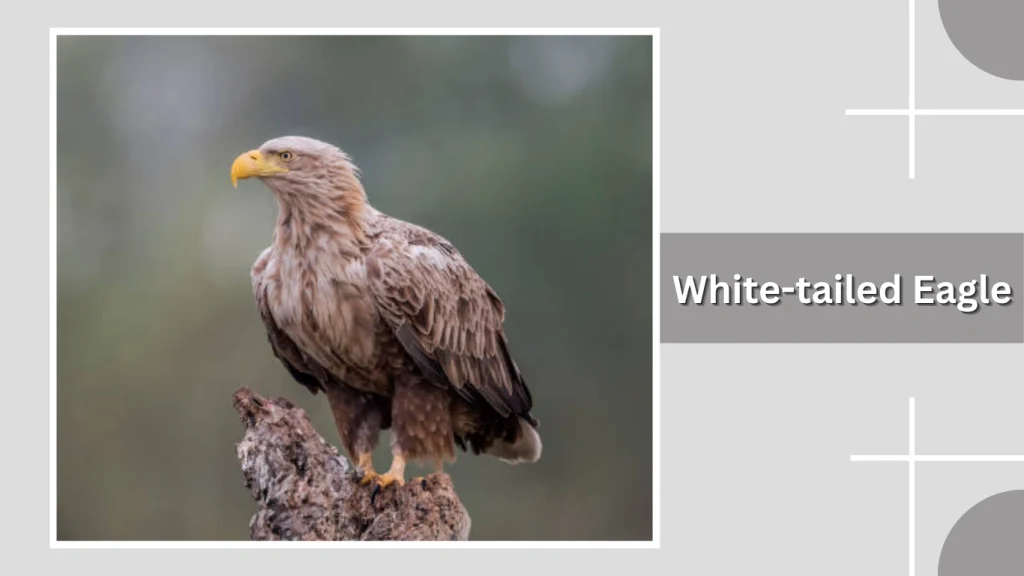
The White-tailed Eagle is one of the largest eagles in Europe and Asia, often called the “sea eagle” due to its strong association with coastal and wetland habitats. It is known for its massive size, broad wings, and distinctive pale tail.
Identification
- Very large eagle with a wingspan of up to 8 feet
- Broad, rectangular wings held flat in flight
- Pale gray-brown body
- Short, wedge-shaped white tail (adults)
- Large yellow hooked beak
- Yellow legs with powerful black talons
- Juveniles have darker bodies and tails
Habitat and Behavior
White-tailed Eagles are commonly found near coastlines, large lakes, rivers, and wetlands. They prefer quiet areas with tall trees or cliffs for nesting. These eagles are strong soarers and often glide slowly while searching for food. They are territorial during the breeding season and usually remain close to water.
Diet and Lifecycle
Their diet mainly consists of fish, but they also eat waterfowl, seabirds, and carrion. White-tailed Eagles often scavenge and may steal food from other birds. They typically mate for life and build huge nests that can be reused and expanded over many years. The female lays 1–3 eggs, and both parents care for the chicks until fledging.
4. Steller’s Sea Eagle (Haliaeetus pelagicus)
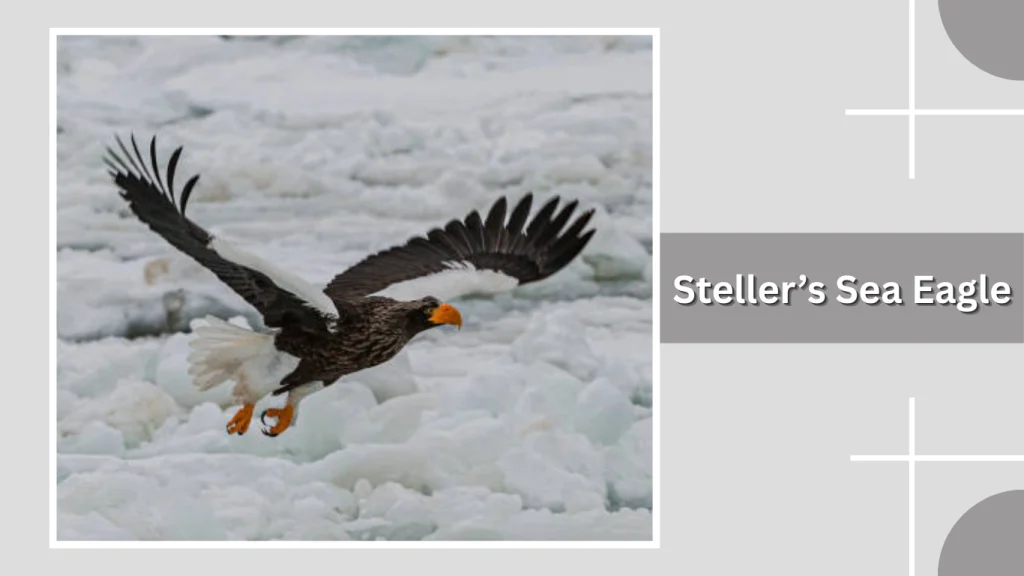
Steller’s Sea Eagle is one of the heaviest and most visually striking eagles in the world. Native to coastal northeastern Asia, it is easily recognized by its bold black-and-white plumage and massive yellow beak.
Identification
- Extremely large eagle with a wingspan up to 8 feet
- Dark brown to black body
- Bright white shoulders, tail, and thighs
- Massive, thick yellow beak
- Yellow legs with strong black talons
- Juveniles are darker and lack clear white markings
Habitat and Behavior
This species is closely tied to coastal areas, rivers, and estuaries, especially where fish are abundant. Steller’s Sea Eagles often perch on trees or rocky outcrops near water. They are powerful fliers but can appear heavy in flight. During winter, they may gather in groups near rich feeding grounds.
Diet and Lifecycle
Steller’s Sea Eagles primarily feed on fish, particularly salmon, but they also eat seabirds and carrion. They form long-term pair bonds and build large nests in tall trees or on cliffs. The female usually lays 1–2 eggs, and both parents are involved in incubation and raising the young until they become independent.
5. African Fish Eagle (Haliaeetus vocifer)
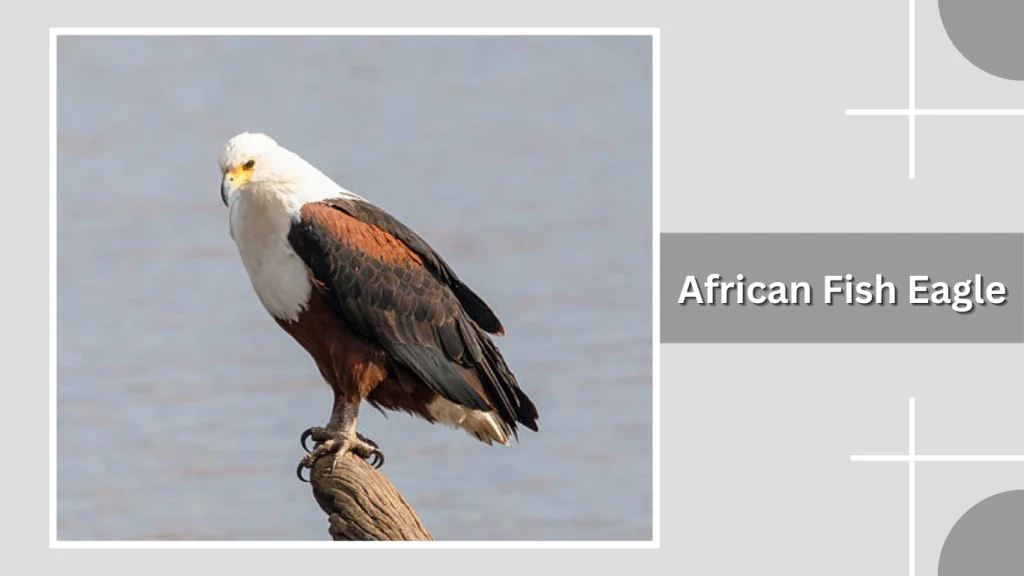
The African Fish Eagle is a highly recognizable and iconic bird of prey across sub-Saharan Africa. Famous for its loud, ringing call, this eagle is strongly associated with lakes and rivers and is often considered the “voice of Africa’s waters.”
Identification
- Medium-large eagle with a wingspan of about 6–7 feet
- White head, neck, and upper chest
- Dark brown body and wings
- Black tail with a white base
- Large yellow hooked beak with a black tip
- Yellow legs and strong black talons
- Juveniles are mostly brown with mottled markings
Habitat and Behavior
African Fish Eagles live near freshwater lakes, rivers, reservoirs, and coastal lagoons. They are often seen perched high in trees overlooking water or soaring above their territory. These eagles are territorial and usually found alone or in pairs. Their distinctive call is often used to mark territory.
Diet and Lifecycle
Their diet consists mainly of fish, which they catch with a swift swoop from the air. They also eat waterbirds, small mammals, and carrion when available. African Fish Eagles typically mate for life and build large stick nests in tall trees near water. The female lays 1–3 eggs, and both parents share in raising the chicks.
6. White-bellied Sea Eagle (Haliaeetus leucogaster)

The White-bellied Sea Eagle is a large coastal raptor widely distributed across South and Southeast Asia, Australia, and nearby islands. It is well known for its contrasting white underside and powerful, graceful flight over open water.
Identification
- Large eagle with a wingspan of about 6.5–7.5 feet
- White head, chest, and belly
- Gray to dark slate-colored wings and back
- Short, wedge-shaped white tail
- Strong gray hooked beak
- Pale legs with sharp black talons
- Juveniles are brown with lighter underparts
Habitat and Behavior
This eagle is commonly found along coastlines, estuaries, mangroves, rivers, and large lakes. It often soars high above the water or perches in tall trees near the shore. White-bellied Sea Eagles are usually seen alone or in pairs and are known for their loud, goose-like calls.
Diet and Lifecycle
The diet mainly includes fish, but these eagles also feed on sea snakes, turtles, seabirds, and carrion. They form long-term pair bonds and build large nests in tall trees or on cliff faces. The female typically lays 1–3 eggs, and both parents care for the young until they fledge.
7. Philippine Eagle (Pithecophaga jefferyi)
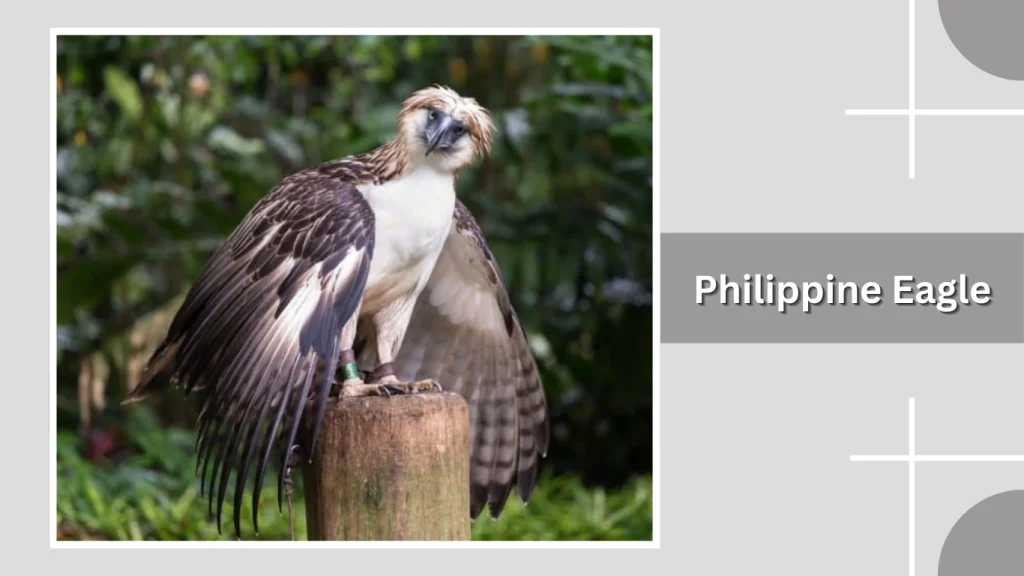
The Philippine Eagle is one of the rarest and most powerful eagles in the world and is the national bird of the Philippines. Known for its long crest and massive size, this eagle is a symbol of strength and conservation importance.
Identification
- Very large eagle with a wingspan of about 7 feet
- Creamy white belly and underparts
- Dark brown wings and back
- Long, shaggy crest feathers on the head
- Large bluish-gray hooked beak
- Strong yellow legs with massive talons
- Juveniles have paler feathers with less contrast
Habitat and Behavior
Philippine Eagles inhabit dense tropical rainforests, especially in mountainous regions. They are solitary and highly territorial birds that rely on large forest areas for survival. These eagles are powerful but stealthy fliers, often hunting within the forest canopy rather than open skies.
Diet and Lifecycle
Their diet includes flying lemurs, monkeys, birds, reptiles, and other forest animals. Philippine Eagles mate for life and have one of the longest breeding cycles among birds of prey. The female usually lays a single egg, and both parents care for the chick for over a year before it becomes independent.
8. Harpy Eagle (Harpia harpyja)
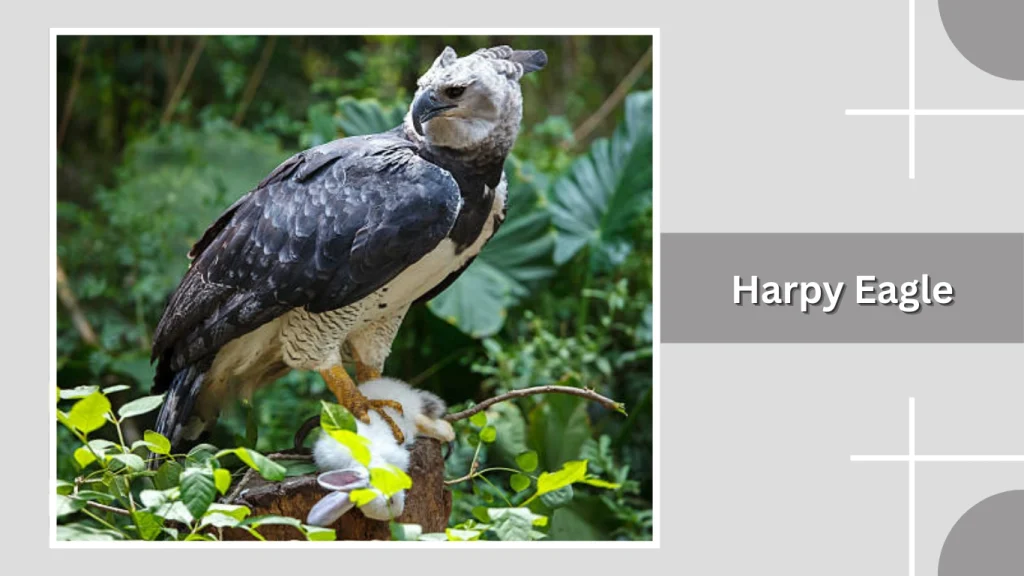
The Harpy Eagle is among the largest and strongest eagles on Earth, famous for its massive talons and fierce appearance. Native to the tropical forests of Central and South America, it is a top predator of the rainforest canopy.
Identification
- Very large eagle with a wingspan of about 6.5–7.5 feet
- Gray upperparts with a pale underside
- Black band across the upper chest
- Large head with a distinctive double crest
- Powerful black hooked beak
- Thick yellow legs with extremely large talons
- Juveniles are mostly white with darker wings
Habitat and Behavior
Harpy Eagles live in lowland tropical rainforests and depend on tall, mature trees for nesting. They are mostly solitary and hunt by silently gliding through the forest canopy. Unlike many eagles, they are adapted for short, powerful flights rather than long soaring.
Diet and Lifecycle
Their diet mainly consists of tree-dwelling mammals such as sloths and monkeys, along with birds and reptiles. Harpy Eagles mate for life and lay 1–2 eggs, though usually only one chick is raised. Both parents care for the young, and the chick may remain dependent for up to two years.
9. Crowned Eagle (Stephanoaetus coronatus)
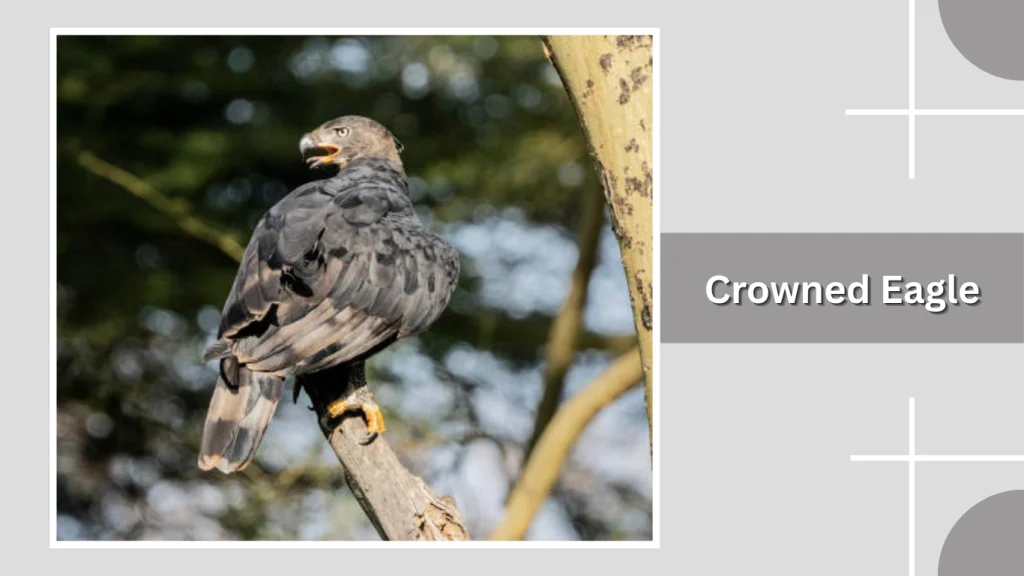
The Crowned Eagle is a powerful forest-dwelling raptor of sub-Saharan Africa, known for its strength and bold hunting style. It is considered one of Africa’s most formidable eagles, especially in wooded habitats.
Identification
- Large eagle with a wingspan of about 5.5–6 feet
- Dark brown upperparts with a pale, barred underside
- Distinctive crest of long feathers on the head
- Broad wings and long tail for maneuvering in forests
- Strong hooked beak
- Powerful yellow legs with large black talons
- Juveniles are much paler with less barring
Habitat and Behavior
Crowned Eagles prefer dense forests, woodlands, and forest edges. They are highly territorial and usually live in pairs. These eagles are agile fliers, capable of fast, direct flights through trees while hunting. They often perch quietly before launching sudden attacks on prey.
Diet and Lifecycle
Their diet mainly includes medium-sized mammals such as monkeys and small antelopes, as well as birds. Crowned Eagles mate for life and build large nests high in tall forest trees. The female typically lays 1–2 eggs, and both parents take part in raising the chick until it becomes independent.
10. Martial Eagle (Polemaetus bellicosus)
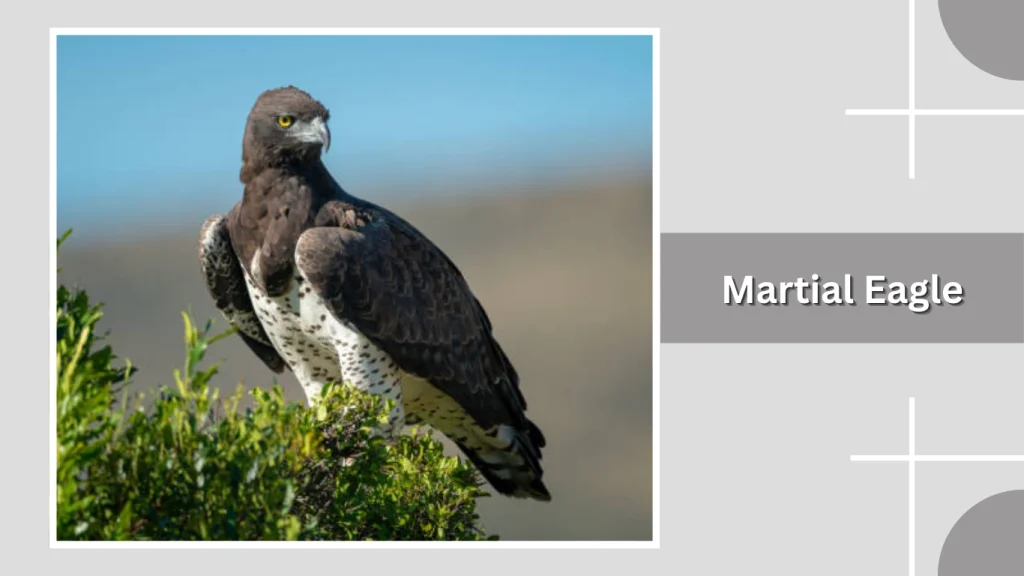
The Martial Eagle is the largest eagle in Africa and one of the most powerful birds of prey on the continent. Renowned for its immense strength and keen eyesight, it dominates open landscapes and is capable of taking surprisingly large prey.
Identification
- Very large eagle with a wingspan of about 6.5–8 feet
- Dark brown to blackish upperparts
- White underside heavily spotted with black
- Broad wings and a relatively short tail
- Strong hooked beak, dark gray to black
- Powerful yellow legs with long black talons
- Juveniles have less spotting and paler underparts
Habitat and Behavior
Martial Eagles are typically found in open savannas, grasslands, and semi-desert regions with scattered trees. They are usually seen soaring high in the sky, scanning vast areas for prey. These eagles are solitary or found in pairs and maintain large territories.
Diet and Lifecycle
Their diet includes mammals such as hares and small antelopes, birds including bustards, and reptiles. Martial Eagles mate for life and build large nests in tall trees or on cliffs. The female lays 1–2 eggs, and the chick requires a long development period before becoming fully independent.
11. Steppe Eagle (Aquila nipalensis)
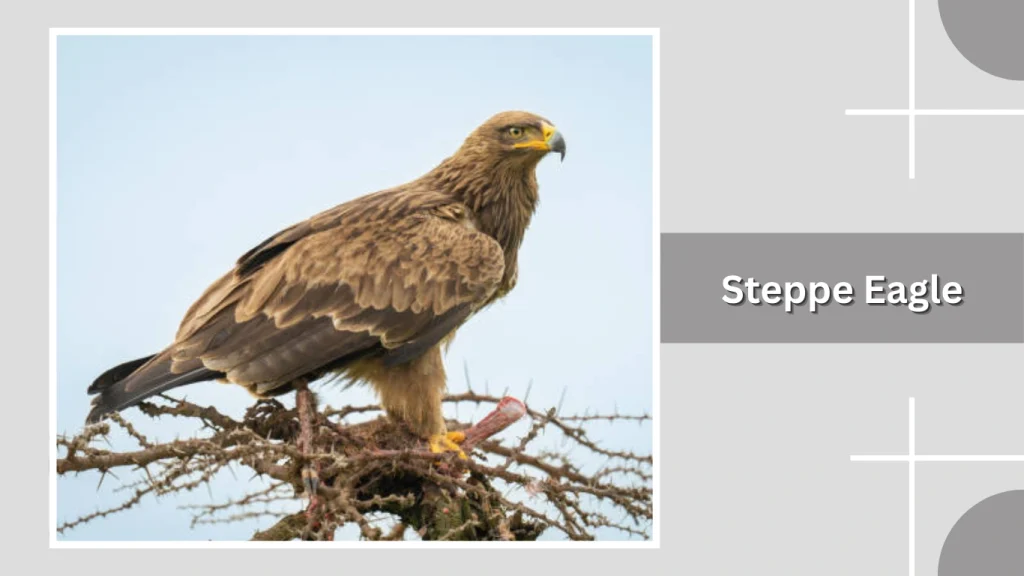
The Steppe Eagle is a large migratory eagle widely distributed across Eurasia, especially in open grasslands and semi-desert regions. It is known for its long-distance migrations and preference for vast, open landscapes.
Identification
- Large eagle with a wingspan of about 6–7.5 feet
- Dark brown body with slightly paler head and neck
- Broad wings with long fingered tips
- Yellow gape extending behind the eye
- Strong dark hooked beak
- Yellow legs with powerful talons
- Juveniles show lighter wing panels
Habitat and Behavior
Steppe Eagles inhabit open steppes, grasslands, and semi-arid plains. They are often seen soaring high or perched on the ground or low structures. This species is highly migratory, traveling thousands of kilometers between breeding and wintering grounds. They are generally solitary outside the breeding season.
Diet and Lifecycle
Their diet mainly consists of small mammals such as ground squirrels and rodents, along with birds and carrion. Steppe Eagles usually nest on the ground or low elevations. The female lays 1–3 eggs, and both parents help raise the young until they are capable of flight and hunting.
12. Tawny Eagle (Aquila rapax)
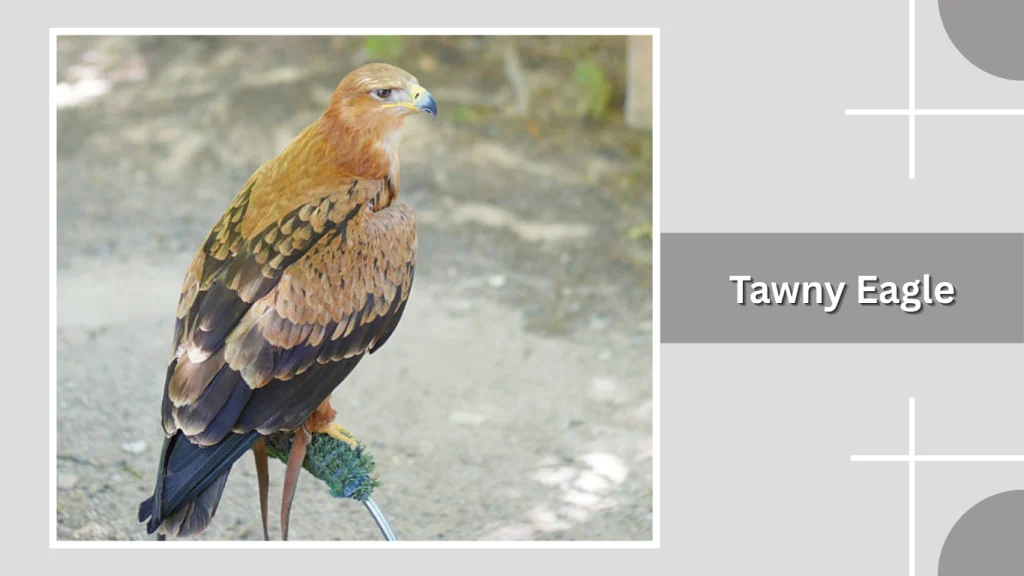
The Tawny Eagle is a widespread and adaptable raptor found across Africa and parts of Asia. It is known for its variable plumage color and opportunistic feeding habits, often seen scavenging as well as hunting.
Identification
- Medium to large eagle with a wingspan of about 5.5–6.5 feet
- Plumage varies from pale tawny to dark brown
- Broad wings with rounded tips
- Relatively short tail
- Strong hooked beak, dark gray
- Yellow legs with sharp black talons
- Juveniles are generally darker than adults
Habitat and Behavior
Tawny Eagles inhabit open savannas, grasslands, deserts, and semi-arid regions. They are often seen perched on trees, poles, or soaring over open ground. These eagles are less aerial than some others and frequently feed on carrion. They are usually solitary or found in pairs.
Diet and Lifecycle
Their diet includes small mammals, birds, reptiles, insects, and carrion. Tawny Eagles may steal food from other birds or scavenge at carcasses. They build nests in trees or on rocky outcrops. The female typically lays 1–3 eggs, and both parents participate in raising the chicks.
13. Eastern Imperial Eagle (Aquila heliaca)
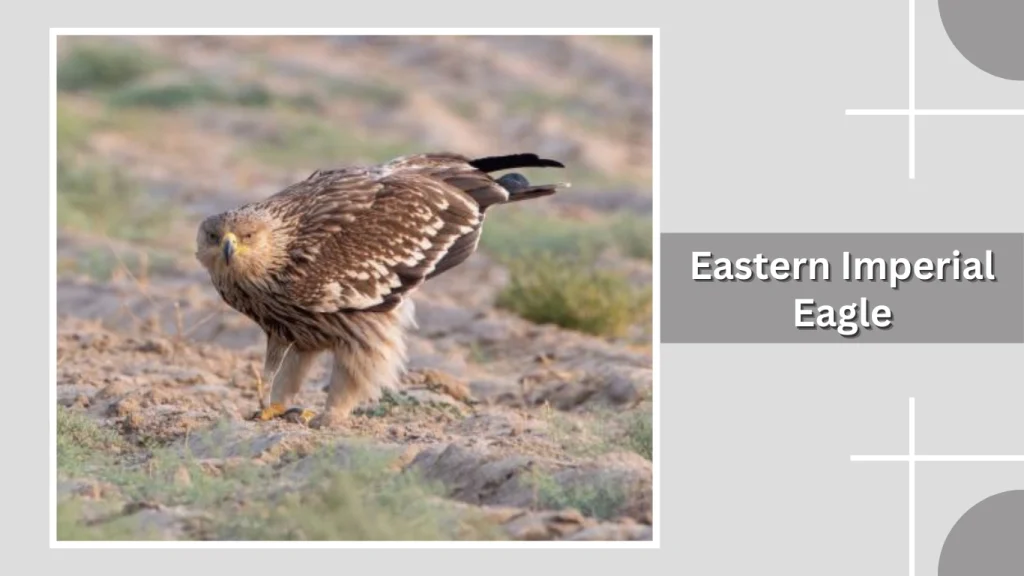
The Eastern Imperial Eagle is a large and majestic raptor native to Eastern Europe and Central Asia. It is admired for its regal appearance and powerful flight, often associated with open plains and wooded steppe regions.
Identification
- Large eagle with a wingspan of about 6–7.5 feet
- Dark brown body with lighter golden-brown head and neck
- Distinct white shoulder patches
- Broad wings and fairly long tail
- Strong hooked beak, dark gray
- Yellow legs with powerful talons
- Juveniles are paler with streaked plumage
Habitat and Behavior
This species prefers open grasslands, steppe, and agricultural areas with scattered trees for nesting. Eastern Imperial Eagles are usually solitary or found in pairs and are known for soaring high while searching for prey. They are territorial during the breeding season and defend large nesting areas.
Diet and Lifecycle
Their diet mainly consists of small to medium-sized mammals such as ground squirrels, as well as birds and reptiles. They nest in tall trees or occasionally on pylons. The female lays 1–3 eggs, and both parents share incubation and chick-rearing duties until the young fledge.
14. Spanish Imperial Eagle (Aquila adalberti)
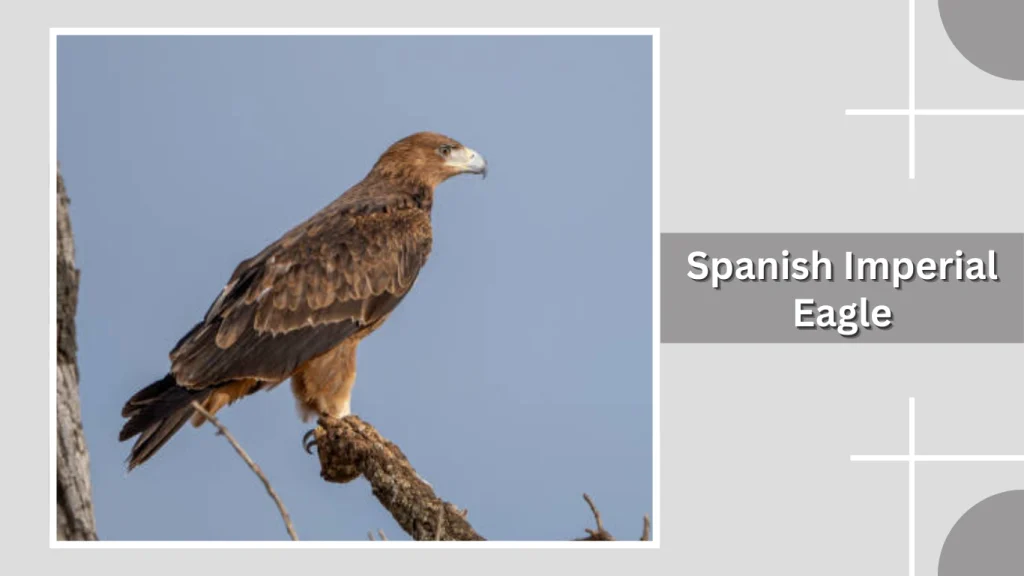
The Spanish Imperial Eagle is a rare and endangered eagle species found mainly in the Iberian Peninsula. It is closely related to the Eastern Imperial Eagle and is known for its powerful build and strong association with Mediterranean landscapes.
Identification
- Large eagle with a wingspan of about 6–7 feet
- Dark brown to blackish body
- Pale cream-colored head and neck
- Distinctive white shoulder patches
- Broad wings with fingered tips
- Strong hooked beak, dark gray
- Yellow legs with large black talons
- Juveniles are lighter brown with streaking
Habitat and Behavior
This eagle inhabits Mediterranean woodlands, open plains, and dehesa landscapes with scattered trees. It prefers quiet areas with minimal disturbance. Spanish Imperial Eagles are usually seen alone or in pairs and often soar high while surveying their territory.
Diet and Lifecycle
Their diet mainly consists of rabbits, along with birds and small mammals. They mate for life and build large nests in tall trees. The female typically lays 1–3 eggs, and both parents are involved in incubation and raising the young until they become independent.
15. Booted Eagle (Hieraaetus pennatus)
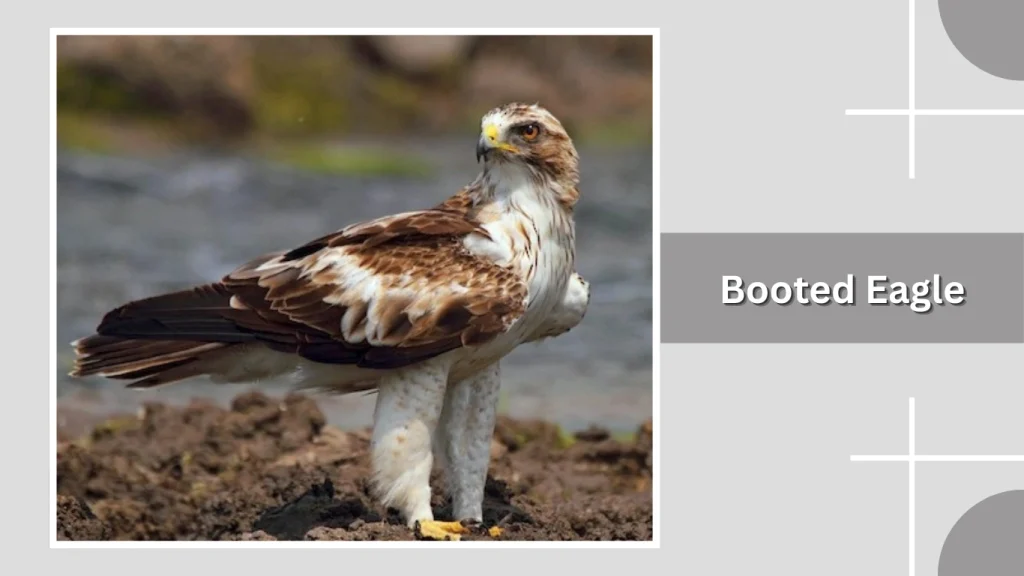
The Booted Eagle is a small but agile eagle species found across Europe, Asia, and parts of Africa. It gets its name from the feathers that fully cover its legs down to the toes, giving them a “booted” appearance.
Identification
- Small eagle with a wingspan of about 4–4.5 feet
- Two color forms: light and dark morph
- Light morph has pale underparts with dark wing edges
- Dark morph is uniformly dark brown
- Feathered legs down to the feet
- Short tail and relatively narrow wings
- Juveniles resemble adults but are slightly paler
Habitat and Behavior
Booted Eagles prefer open woodlands, forest edges, and hilly regions. They are migratory in many parts of their range and are often seen soaring gracefully or hovering while searching for prey. These eagles are usually solitary or found in pairs during the breeding season.
Diet and Lifecycle
Their diet consists mainly of small mammals, birds, reptiles, and large insects. Booted Eagles build nests in trees or on cliffs. The female typically lays 1–2 eggs, and both parents take part in incubation and chick care until the young fledge.
16. Lesser Spotted Eagle (Clanga pomarina)
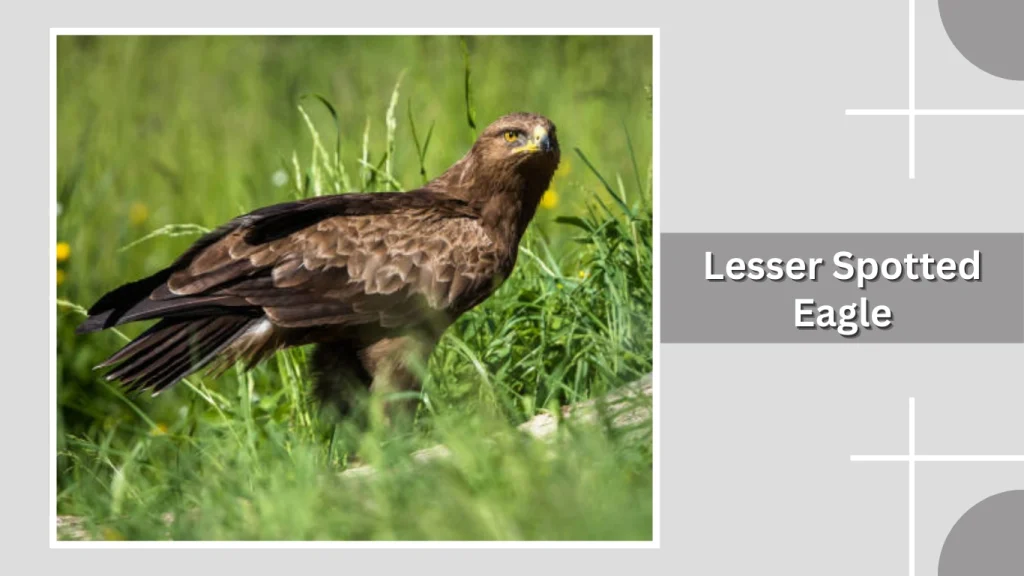
The Lesser Spotted Eagle is a medium-sized migratory eagle found mainly in Europe and parts of Asia. It is known for its graceful flight and preference for mixed landscapes that combine forests with open feeding areas.
Identification
- Medium-sized eagle with a wingspan of about 4.5–5.5 feet
- Dark brown body with slightly paler head
- Rounded wings with distinct “fingered” tips
- Short, rounded tail
- Yellow cere and legs
- Dark hooked beak
- Juveniles show small pale spots on wings
Habitat and Behavior
This species breeds in forested areas near wetlands, meadows, or farmland. It is a long-distance migrant, wintering in Africa. Lesser Spotted Eagles are usually quiet and shy, often seen soaring or perched silently while scanning for prey.
Diet and Lifecycle
Their diet includes small mammals, amphibians, reptiles, insects, and birds. They nest in tall trees and usually lay two eggs, though typically only one chick survives due to sibling competition. Both parents care for the young until migration begins.
17. Greater Spotted Eagle (Clanga clanga)
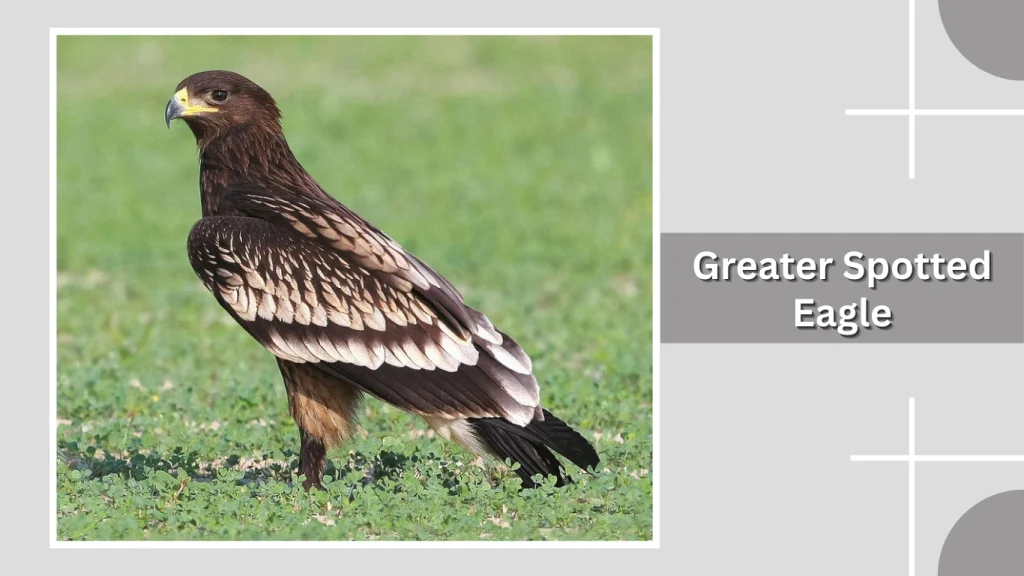
The Greater Spotted Eagle is a large, dark-plumaged eagle associated with wetlands and forested landscapes across Eastern Europe and Asia. It is more robust than the Lesser Spotted Eagle and is known for its broad wings and steady flight.
Identification
- Large eagle with a wingspan of about 5.5–6.5 feet
- Dark brown to nearly black plumage
- Broad wings with rounded tips
- Short, rounded tail
- Yellow cere and legs
- Strong dark hooked beak
- Juveniles have distinct white spots on wings and back
Habitat and Behavior
Greater Spotted Eagles prefer marshes, bogs, floodplains, and nearby forests. They are migratory and often travel long distances to wintering grounds. These eagles are usually solitary and are seen soaring low or perched near wetlands while hunting.
Diet and Lifecycle
Their diet mainly consists of small mammals, waterbirds, amphibians, and reptiles. They nest in tall trees near wetlands. The female typically lays 1–3 eggs, and both parents share incubation and care for the chicks until fledging.
18. Verreaux’s Eagle (Aquila verreauxii)
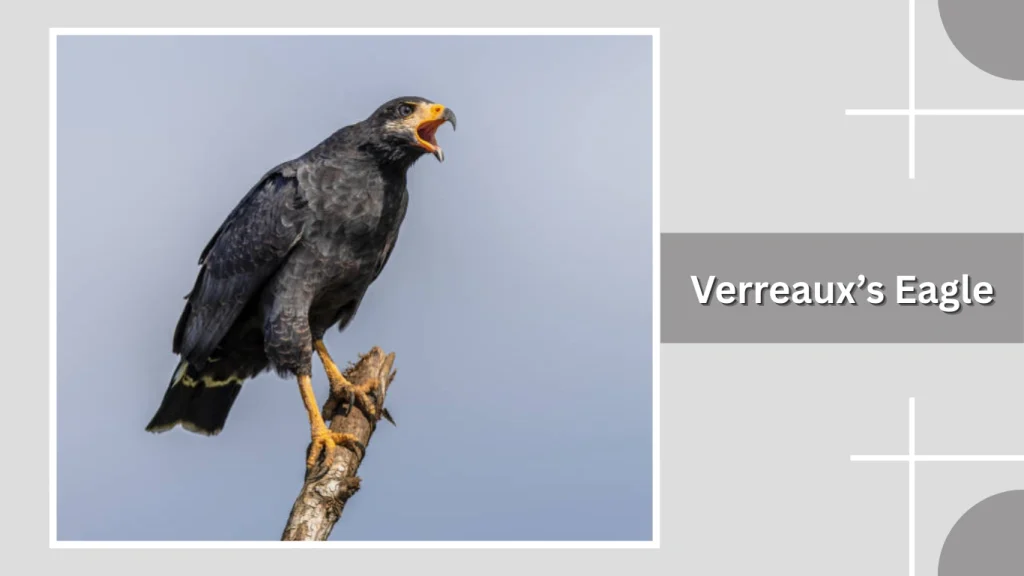
Verreaux’s Eagle, also known as the Black Eagle, is a striking raptor native to mountainous and rocky regions of sub-Saharan Africa. It is well known for its dramatic black-and-white plumage and specialization in hunting rock-dwelling prey.
Identification
- Large eagle with a wingspan of about 6–7.5 feet
- Mostly black plumage
- Bold white patches on the back and shoulders
- White underside with a dark central stripe
- Long, broad wings
- Strong hooked beak
- Yellow legs with powerful black talons
- Juveniles are brown with less contrast
Habitat and Behavior
This eagle prefers rocky hills, cliffs, mountains, and escarpments. It often nests on cliff ledges and is frequently seen soaring along rock faces. Verreaux’s Eagles are territorial and usually found alone or in pairs, using high vantage points to spot prey.
Diet and Lifecycle
Their diet is highly specialized, consisting mainly of rock hyraxes, though they may also take birds and small mammals. Verreaux’s Eagles mate for life and lay 1–2 eggs. Both parents participate in incubation and raising the chick until it becomes independent.
19. Wahlberg’s Eagle (Hieraaetus wahlbergi)
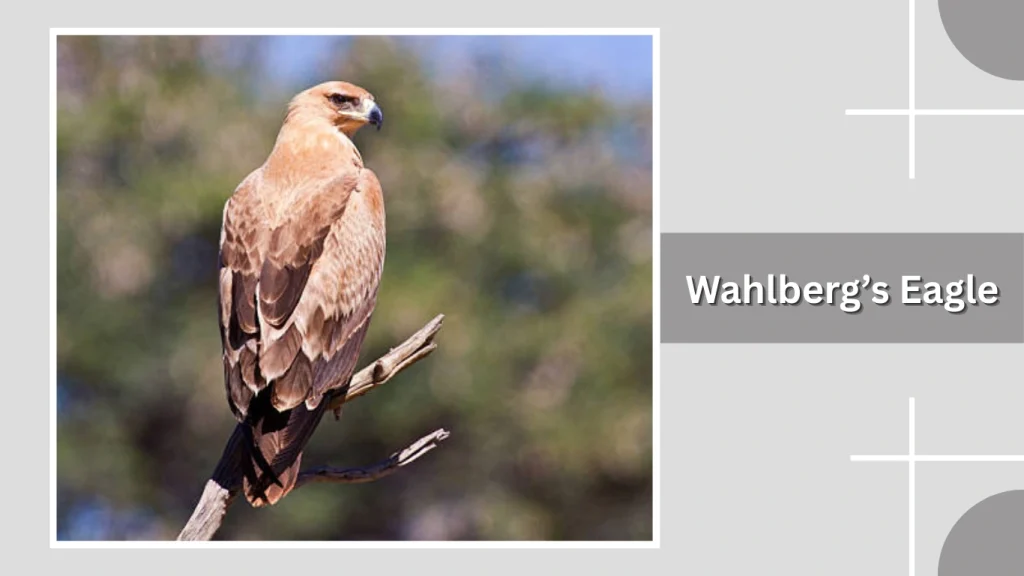
Wahlberg’s Eagle is a medium-sized migratory eagle found mainly in sub-Saharan Africa. It is known for its relatively slim build and preference for wooded savannas and forest edges.
Identification
- Medium-sized eagle with a wingspan of about 4.5–5.5 feet
- Uniform brown plumage with slight variation in shade
- Long wings with a narrow profile
- Relatively long tail
- Dark hooked beak
- Yellow legs with sharp talons
- Juveniles are slightly paler than adults
Habitat and Behavior
This species inhabits open woodlands, savannas, and forest margins. Wahlberg’s Eagles are migratory, moving seasonally within Africa. They are often seen soaring at moderate heights or perched quietly in trees while searching for prey.
Diet and Lifecycle
Their diet includes small mammals, birds, reptiles, and large insects. They build nests in tall trees. The female usually lays 1–2 eggs, and both parents are involved in incubation and raising the young until fledging.
20. Long-crested Eagle (Lophaetus occipitalis)
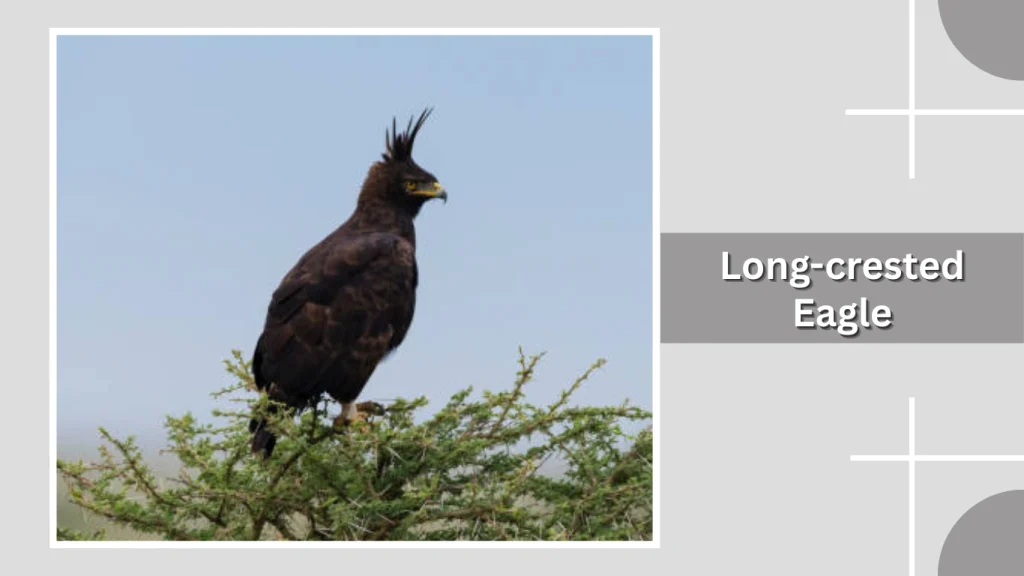
The Long-crested Eagle is a distinctive and elegant raptor found across sub-Saharan Africa. It is easily recognized by the long, shaggy crest on its head and its preference for forested and wooded habitats.
Identification
- Medium-sized eagle with a wingspan of about 5–6 feet
- Dark brown to black plumage
- Very long, loose crest feathers on the head
- White underwing panels visible in flight
- Short tail
- Dark hooked beak
- Yellow legs with sharp black talons
- Juveniles have shorter crests and browner plumage
Habitat and Behavior
Long-crested Eagles inhabit forests, wooded savannas, plantations, and even suburban areas. They are often seen perched quietly for long periods, scanning the ground for prey. These eagles are usually solitary or found in pairs and are not strong long-distance soarers.
Diet and Lifecycle
Their diet mainly consists of small mammals, especially rodents, along with birds and reptiles. They nest in tall trees and lay 1–2 eggs. Both parents share incubation and care for the young until they become independent.
21. Black Eagle (Ictinaetus malaiensis)
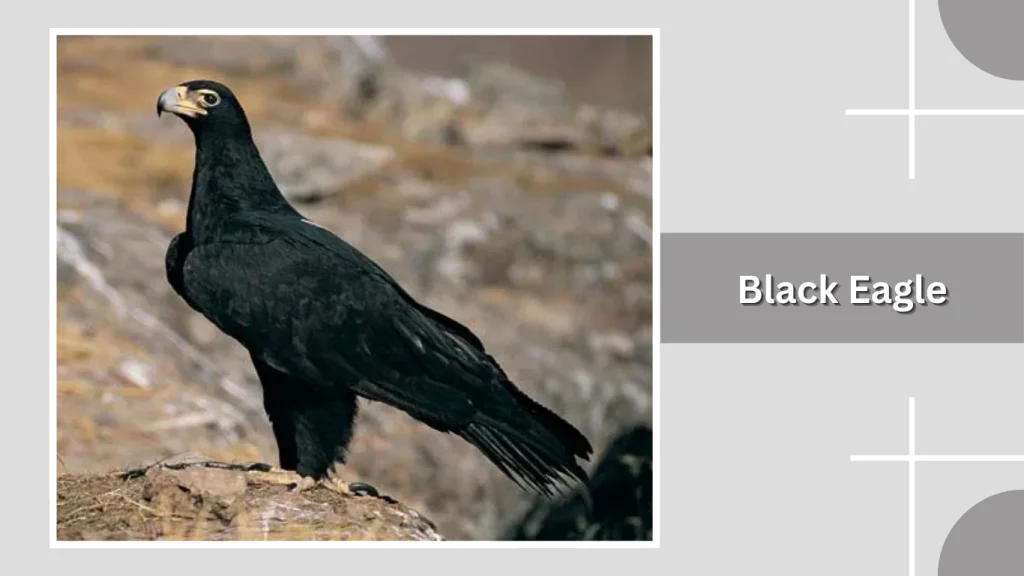
The Black Eagle is a large, slender eagle of tropical and subtropical forests in South and Southeast Asia. It is well known for its slow, floating flight and ability to glide just above the forest canopy.
Identification
- Large eagle with a wingspan of about 5.5–6.5 feet
- Entirely black plumage
- Long, broad wings with widely spread “fingers”
- Long tail with a shallow fork
- Yellow cere and legs
- Dark hooked beak
- Juveniles show brownish tones and streaking
Habitat and Behavior
Black Eagles prefer hilly forests, foothills, and mountainous regions. They are often seen soaring slowly over forested slopes, using their keen eyesight to locate prey. These eagles are generally solitary and highly territorial.
Diet and Lifecycle
Their diet includes birds, bird eggs, small mammals, reptiles, and occasionally bats. Black Eagles nest in tall trees on forested slopes. The female usually lays a single egg, and both parents take part in incubation and chick-rearing until fledging.
22. Indian Spotted Eagle (Clanga hastata)
The Indian Spotted Eagle is a medium-sized eagle native to the Indian subcontinent. It is closely associated with wetlands and open countryside and is often confused with the Lesser Spotted Eagle due to similar appearance.
Identification
- Medium-sized eagle with a wingspan of about 4.5–5.5 feet
- Dark brown plumage with faint pale spotting
- Broad, rounded wings
- Short, rounded tail
- Yellow cere and legs
- Dark hooked beak
- Juveniles show more noticeable pale spots on wings
Habitat and Behavior
This species prefers wetlands, marshes, riverbanks, and nearby open fields. Indian Spotted Eagles are usually seen soaring at low heights or perched near water while searching for prey. They are generally solitary and less migratory than related species.
Diet and Lifecycle
Their diet includes small mammals, amphibians, reptiles, birds, and carrion. They nest in tall trees near wetlands. The female typically lays 1–2 eggs, and both parents share incubation and chick care until the young are ready to fly.
23. Short-toed Snake Eagle (Circaetus gallicus)
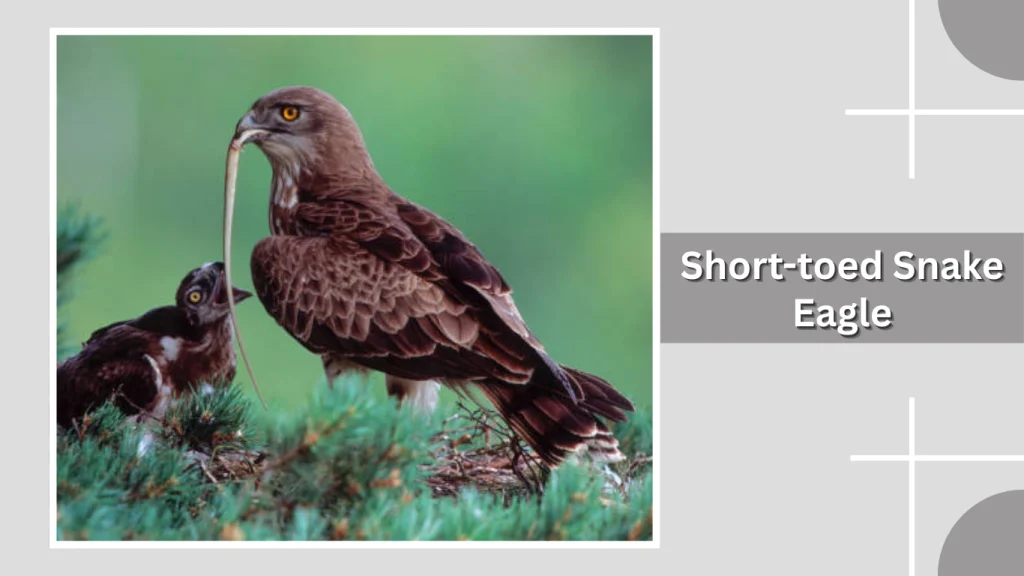
The Short-toed Snake Eagle is a specialized raptor known for its strong preference for reptiles, especially snakes. It is found across southern Europe, North Africa, and parts of Asia, often in open and semi-arid landscapes.
Identification
- Medium-large eagle with a wingspan of about 5.5–6.5 feet
- Pale underside with fine dark barring
- Dark brown upperparts
- Large rounded head with bright yellow eyes
- Short tail with bold dark bands
- Strong hooked beak
- Unfeathered yellow legs adapted for handling snakes
Habitat and Behavior
This eagle inhabits open countryside, grasslands, scrublands, and lightly wooded areas. It is often seen hovering or soaring while scanning the ground for reptiles. Short-toed Snake Eagles are migratory in many regions and are usually solitary or found in pairs.
Diet and Lifecycle
Their diet is dominated by snakes, along with lizards and occasionally small mammals. They nest in trees or on rocky slopes. The female usually lays a single egg, and both parents care for the chick until it becomes fully independent.
24. Crested Serpent Eagle (Spilornis cheela)
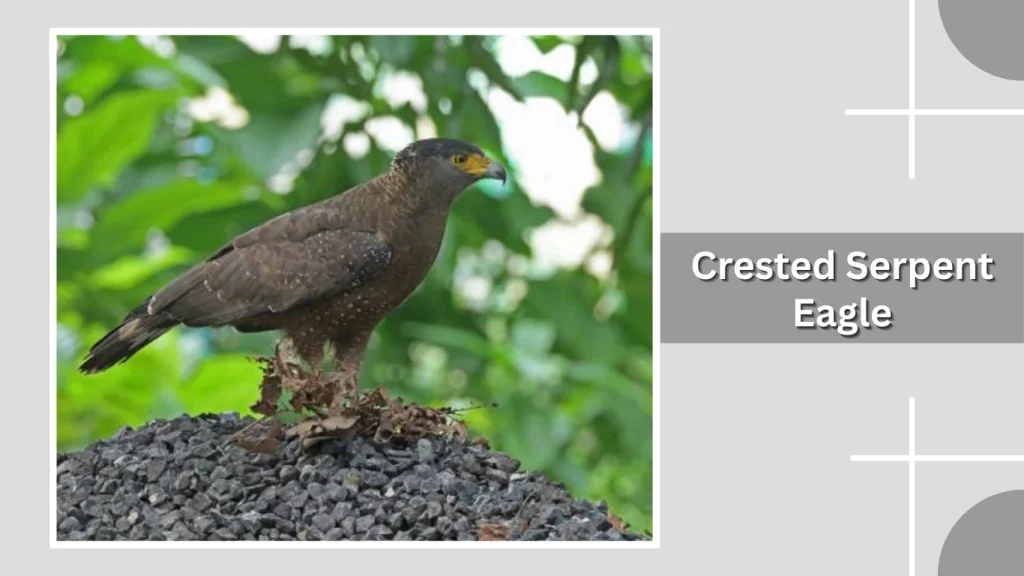
The Crested Serpent Eagle is a bold and vocal eagle commonly found across South and Southeast Asia. It is well known for its loud calls and strong association with forested landscapes.
Identification
- Medium-sized eagle with a wingspan of about 4–5 feet
- Dark brown upperparts with lighter, heavily barred underparts
- Broad, rounded wings
- Short tail with distinct white bands
- Prominent black crest on the head
- Bright yellow eyes and cere
- Unfeathered yellow legs with strong talons
Habitat and Behavior
This eagle inhabits forests, wooded hills, plantations, and forest edges. It is often seen perched conspicuously or soaring above the canopy while calling loudly. Crested Serpent Eagles are territorial and usually found alone or in pairs.
Diet and Lifecycle
Their diet mainly consists of snakes and other reptiles, along with amphibians and small mammals. They build nests high in trees. The female typically lays a single egg, and both parents are involved in incubation and caring for the chick until fledging.
25. Mountain Hawk-Eagle (Nisaetus nipalensis)
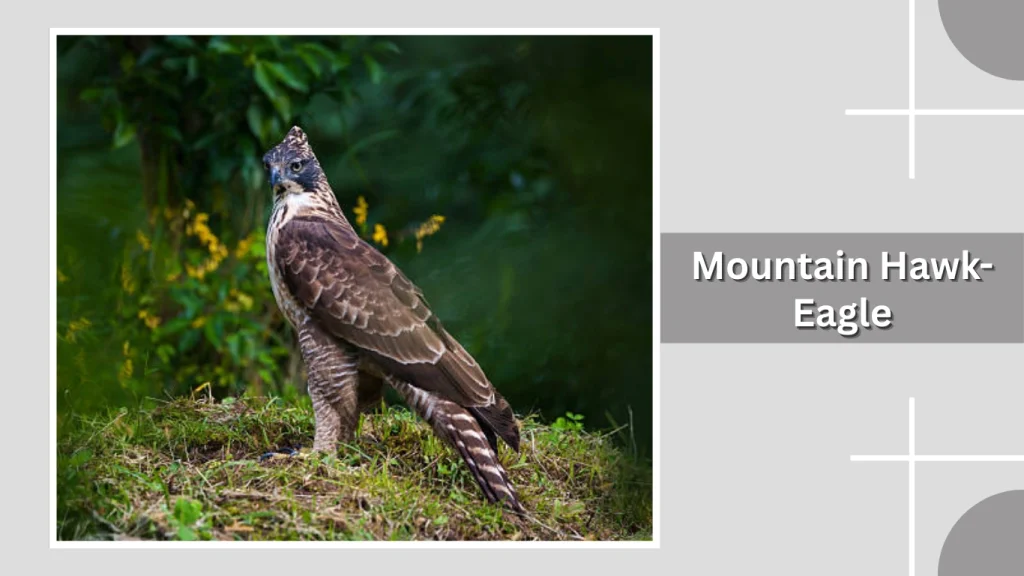
The Mountain Hawk-Eagle is a powerful forest raptor found in mountainous regions of South and Southeast Asia. It is known for its bold crest and strong hunting abilities within dense woodland habitats.
Identification
- Large hawk-eagle with a wingspan of about 5–6 feet
- Dark brown upperparts with white, heavily barred underparts
- Long, prominent crest on the head
- Broad wings and long tail
- Strong hooked beak
- Yellow legs with powerful black talons
- Juveniles are paler with less barring
Habitat and Behavior
This species inhabits montane forests, wooded hills, and forested slopes. It is usually seen soaring above forest canopies or perched quietly before launching fast attacks on prey. Mountain Hawk-Eagles are territorial and typically found alone or in pairs.
Diet and Lifecycle
Their diet includes birds, small mammals, and reptiles. They build large nests in tall forest trees. The female usually lays 1–2 eggs, and both parents share incubation and chick-rearing until the young become independent.
26. Changeable Hawk-Eagle (Nisaetus cirrhatus)
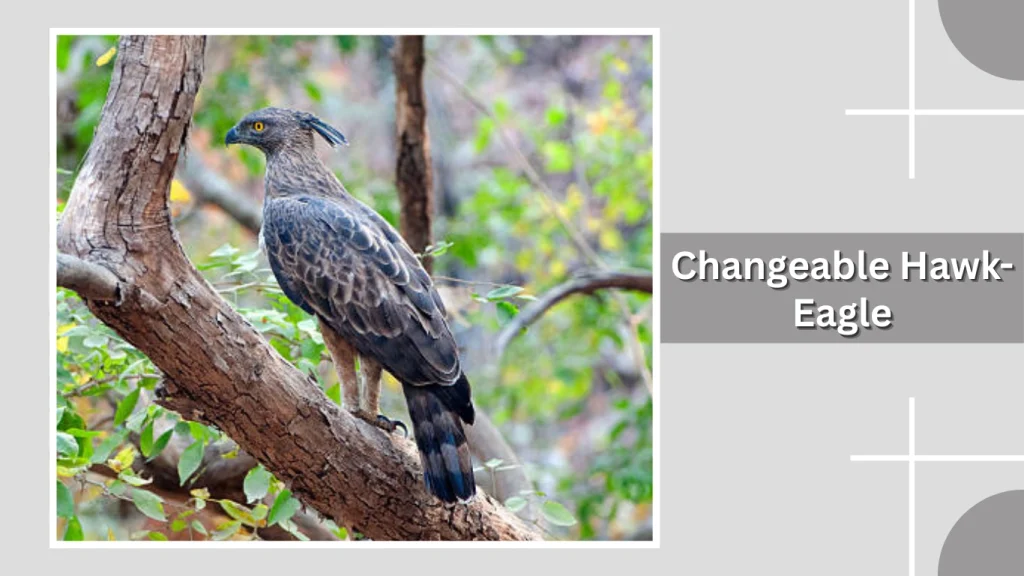
The Changeable Hawk-Eagle is a medium-sized forest eagle found across South and Southeast Asia. It is named for its highly variable plumage, which can differ greatly between individuals.
Identification
- Medium-sized hawk-eagle with a wingspan of about 4.5–5.5 feet
- Highly variable coloration ranging from pale to very dark
- Often shows a prominent crest on the head
- Broad wings and long tail
- Strong hooked beak
- Yellow legs with sharp black talons
- Juveniles are generally paler and more streaked
Habitat and Behavior
This species inhabits forests, wooded hills, plantations, and forest edges. Changeable Hawk-Eagles are adaptable and may live close to human settlements. They are often seen soaring or perched high while scanning for prey.
Diet and Lifecycle
Their diet consists of birds, small mammals, reptiles, and amphibians. They build nests in tall trees. The female usually lays a single egg, and both parents are involved in incubation and raising the chick until it flees.
27. Blyth’s Hawk-Eagle (Nisaetus alboniger)
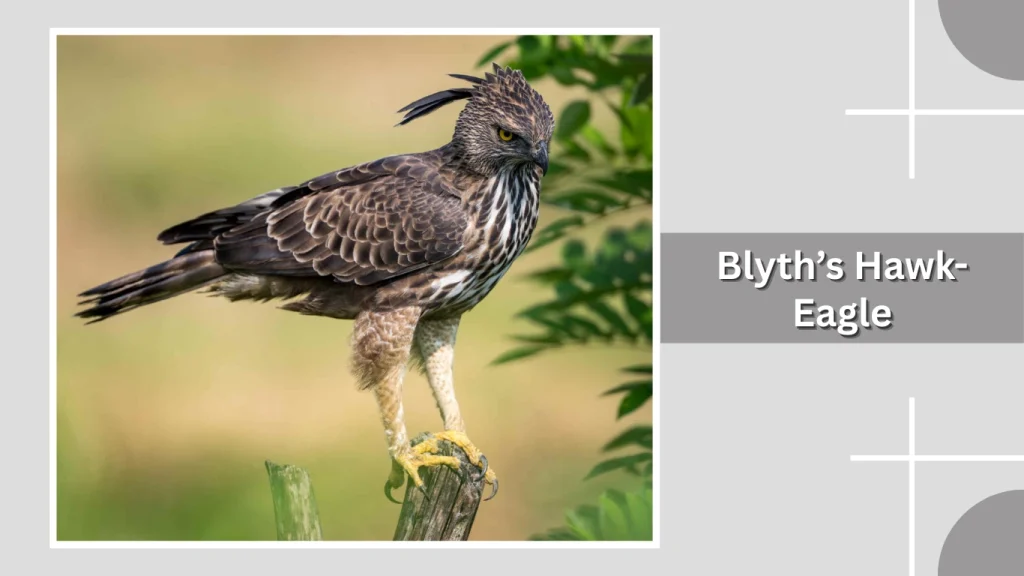
Blyth’s Hawk-Eagle is a medium-sized forest eagle native to Southeast Asia. It is less commonly seen and is known for its striking black-and-white pattern and preference for dense forests.
Identification
- Medium-sized hawk-eagle with a wingspan of about 4.5–5 feet
- Dark brown to black upperparts
- White underparts with bold black streaking
- Prominent crest on the head
- Broad wings and long tail
- Strong hooked beak
- Yellow legs with powerful talons
- Juveniles show browner tones
Habitat and Behavior
This eagle inhabits lowland and hill forests, especially primary and mature secondary forests. It is usually seen soaring above the canopy or perched quietly inside forest edges. Blyth’s Hawk-Eagles are generally solitary and territorial.
Diet and Lifecycle
Their diet includes birds, small mammals, and reptiles. They nest in tall forest trees. The female typically lays a single egg, and both parents take part in incubation and chick care until the young fledge.
28. Rufous-bellied Eagle (Lophotriorchis kienerii)
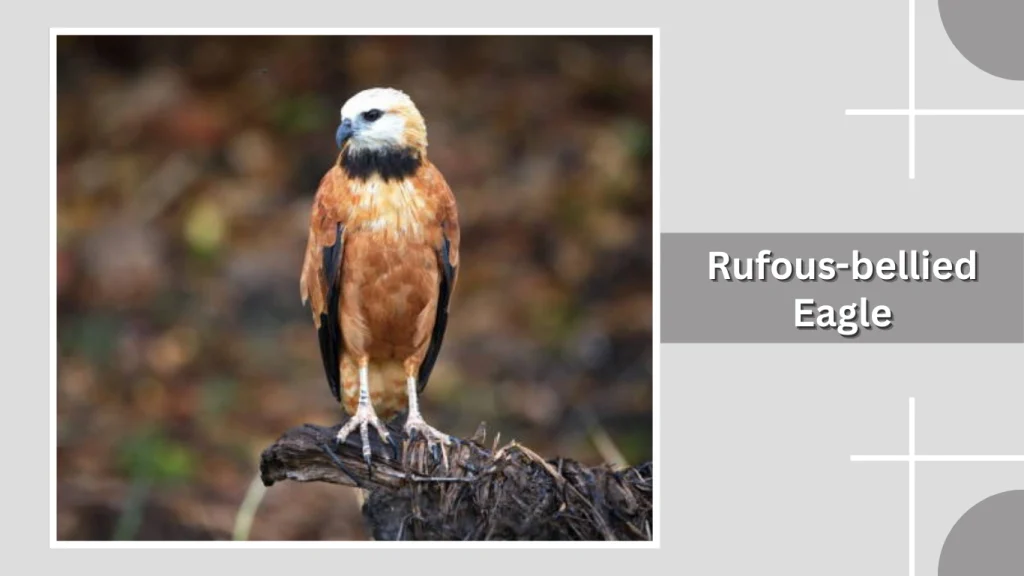
The Rufous-bellied Eagle is a striking and relatively rare eagle species found in South and Southeast Asia. It is known for its rich chestnut-colored underparts and strong, agile flight.
Identification
- Medium-sized eagle with a wingspan of about 4.5–5.5 feet
- Dark brown to black upperparts
- Distinct rufous or chestnut-colored belly and underparts
- Broad wings with white patches at the base
- Short crest on the head
- Strong hooked beak
- Yellow legs with sharp black talons
- Juveniles are paler with less rufous coloring
Habitat and Behavior
This species prefers forested hills, mountain slopes, and wooded valleys. Rufous-bellied Eagles are usually seen soaring above forest canopies or perched on high trees. They are generally solitary and maintain defined territories.
Diet and Lifecycle
Their diet consists mainly of birds, along with small mammals and reptiles. They build nests in tall trees within forests. The female usually lays 1–2 eggs, and both parents share incubation and care of the chicks until they become independent.
29. Bonelli’s Eagle (Aquila fasciata)
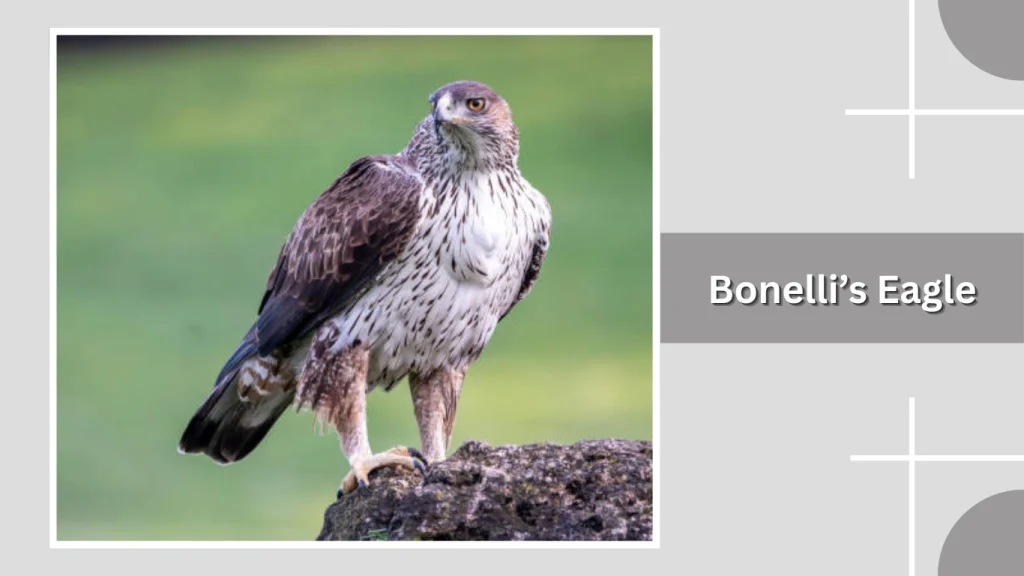
Bonelli’s Eagle is a powerful and agile eagle found across southern Europe, North Africa, and parts of Asia. It is well known for its bold hunting style and preference for rugged, open landscapes.
Identification
- Medium-large eagle with a wingspan of about 5.5–6.5 feet
- Dark brown upperparts
- Pale underside with heavy dark streaking
- Broad wings with dark trailing edges
- Long tail with faint banding
- Strong hooked beak
- Yellow legs with powerful talons
- Juveniles are warmer brown with less contrast
Habitat and Behavior
This eagle inhabits rocky hills, cliffs, open woodlands, and mountainous regions. It often nests on cliff ledges and hunts over open terrain. Bonelli’s Eagles are fast, aggressive hunters and are usually seen alone or in pairs, defending large territories.
Diet and Lifecycle
Their diet mainly includes birds, rabbits, and other small to medium-sized mammals. Bonelli’s Eagles mate for life and lay 1–2 eggs. Both parents incubate the eggs and raise the chicks until they fledge and become independent.
30. White-backed Eagle (Aquila africana)
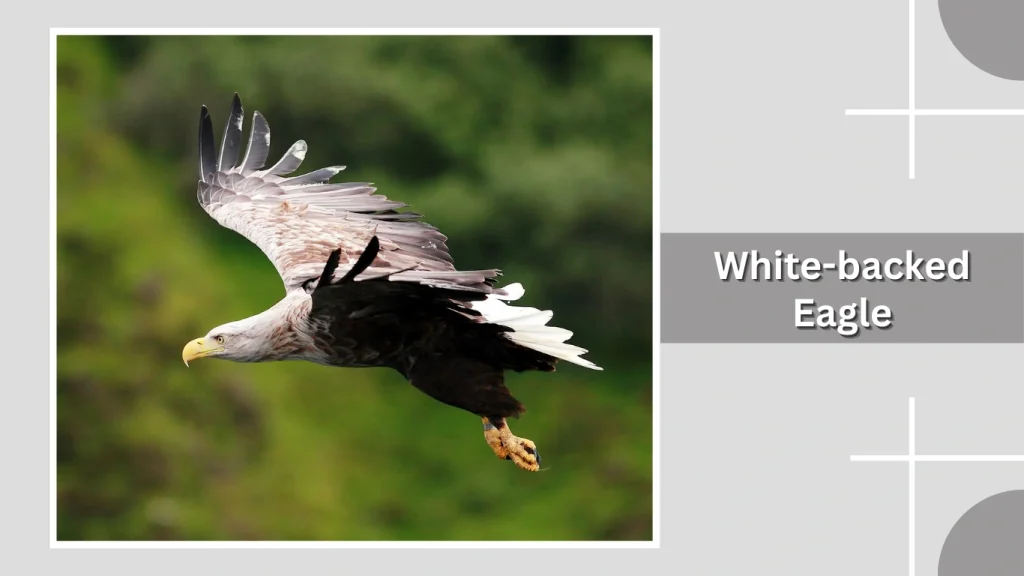
The White-backed Eagle is a medium-sized eagle found mainly in sub-Saharan Africa. It is less well known than some larger African eagles and is typically associated with forested and woodland habitats.
Identification
- Medium-sized eagle with a wingspan of about 5–6 feet
- Dark brown upperparts
- Distinct white patch on the lower back
- Pale underside with fine streaking
- Broad wings and medium-length tail
- Strong hooked beak
- Yellow legs with sharp black talons
- Juveniles are generally paler
Habitat and Behavior
This species prefers forest edges, woodlands, and wooded savannas. White-backed Eagles are usually seen soaring above the canopy or perched quietly in tall trees. They are generally solitary and maintain territories during the breeding season.
Diet and Lifecycle
Their diet includes small mammals, birds, and reptiles. They nest in tall trees and typically lay 1–2 eggs. Both parents take part in incubation and caring for the chicks until they are ready to fly.
31. Pallas’s Fish Eagle (Haliaeetus leucoryphus)
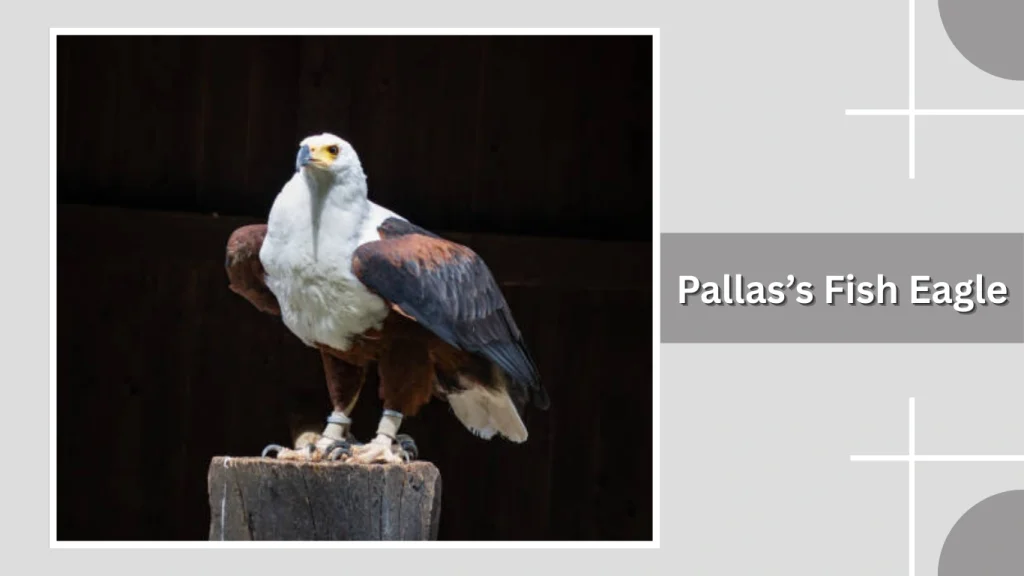
Pallas’s Fish Eagle is a large and rare sea eagle found in parts of Central and South Asia. It is strongly tied to large rivers and lakes and is known for its broad wings and powerful build.
Identification
- Large eagle with a wingspan of about 6.5–7.5 feet
- Dark brown body with paler head and neck
- White thighs and vent area
- Broad wings with blunt tips
- Large yellow hooked beak
- Yellow legs with strong black talons
- Juveniles are darker and more uniform in color
Habitat and Behavior
This species inhabits large rivers, lakes, reservoirs, and wetlands. It often perches near water or soars slowly while searching for prey. Pallas’s Fish Eagles are usually solitary or found in pairs and are considered partially migratory.
Diet and Lifecycle
Their diet mainly consists of fish, but they also eat waterbirds and carrion. They build large nests in tall trees near water. The female usually lays 1–3 eggs, and both parents share incubation and care of the young until fledging.
32. African Hawk-Eagle (Aquila spilogaster)
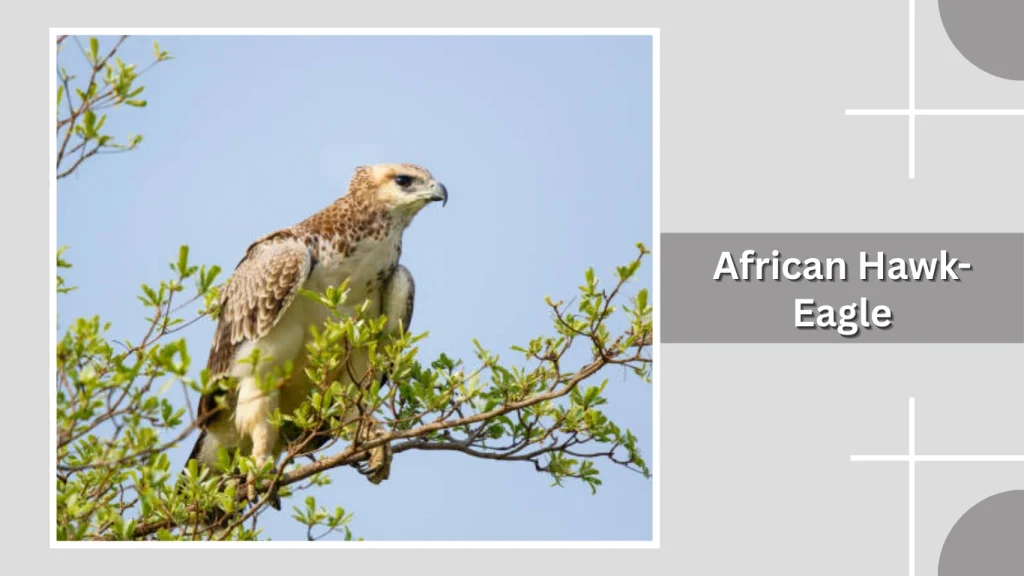
The African Hawk-Eagle is a sleek and agile raptor found across much of sub-Saharan Africa. It is known for its speed, sharp hunting skills, and preference for open and lightly wooded landscapes.
Identification
- Medium-sized eagle with a wingspan of about 5–6 feet
- Dark brown to black upperparts
- White underparts with bold dark barring
- Broad wings with dark trailing edges
- Medium-length tail with clear banding
- Strong hooked beak
- Yellow legs with sharp black talons
- Juveniles are browner with less contrast
Habitat and Behavior
This species inhabits savannas, open woodlands, and woodland edges. African Hawk-Eagles are fast, agile fliers often seen soaring or making sudden dives on prey. They are usually solitary or found in pairs and are territorial during breeding.
Diet and Lifecycle
Their diet consists mainly of birds, along with small mammals and reptiles. They nest in tall trees and usually lay 1–2 eggs. Both parents share incubation and chick-rearing duties until the young fledge.
33. Ayres’s Hawk-Eagle (Hieraaetus ayresii)
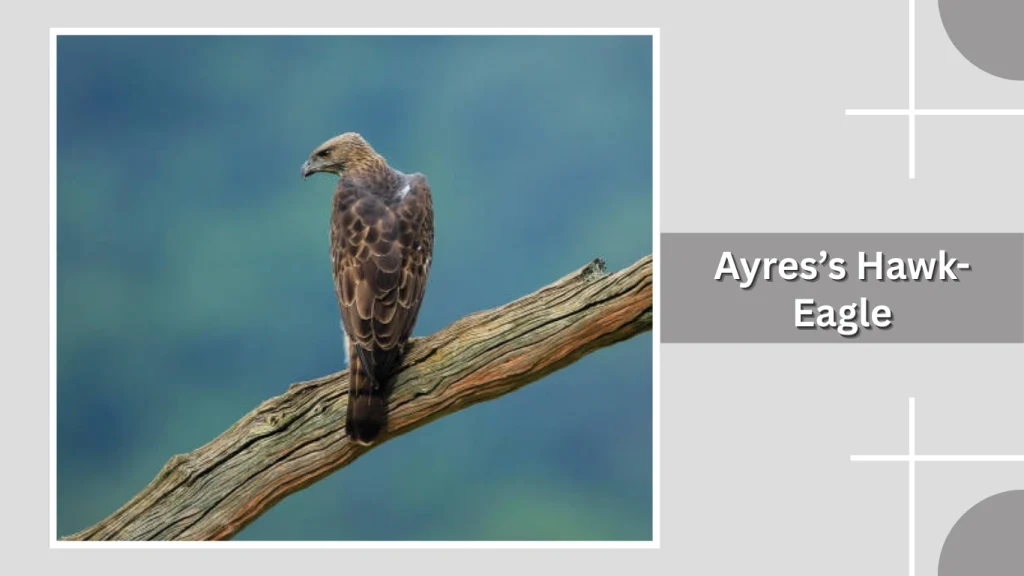
Ayres’s Hawk-Eagle is a small to medium-sized eagle native to sub-Saharan Africa. It is known for its agility, sharp hunting skills, and preference for wooded habitats.
Identification
- Small hawk-eagle with a wingspan of about 4–5 feet
- Dark brown upperparts
- White underparts with fine dark barring
- Rounded wings and medium-length tail
- Strong hooked beak
- Yellow legs with sharp black talons
- Juveniles show heavier streaking on the underside
Habitat and Behavior
This eagle inhabits forests, woodlands, plantations, and forest edges. It is often seen soaring above trees or perched quietly while scanning for prey. Ayres’s Hawk-Eagles are generally solitary and maintain territories during the breeding season.
Diet and Lifecycle
Their diet mainly includes birds, small mammals, and reptiles. They build nests high in trees. The female typically lays 1–2 eggs, and both parents take part in incubation and raising the young until they are able to fly and hunt independently.
34. Madagascar Fish Eagle (Haliaeetus vociferoides)
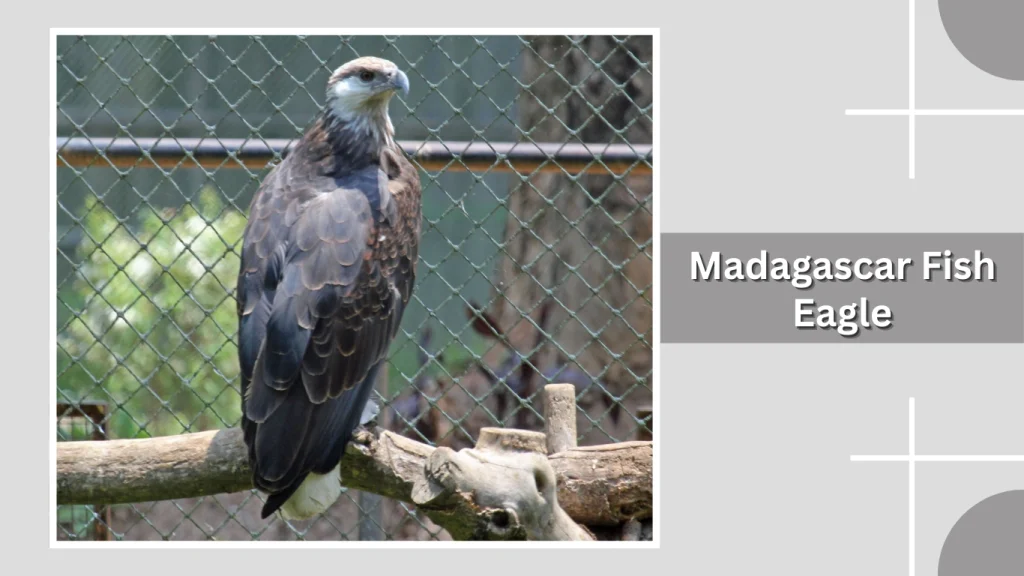
The Madagascar Fish Eagle is a rare and endangered eagle species found only on the island of Madagascar. It is closely tied to freshwater and coastal habitats and is considered one of the most threatened birds of prey in the world.
Identification
- Large eagle with a wingspan of about 6–7 feet
- Dark brown body
- White head, throat, and upper chest
- Dark tail with a white base
- Large yellow hooked beak
- Yellow legs with powerful black talons
- Juveniles are mostly brown with less contrast
Habitat and Behavior
This species inhabits coastal lagoons, lakes, rivers, and mangroves. It is usually seen perched near water or soaring slowly over feeding areas. Madagascar Fish Eagles are territorial and typically found alone or in pairs.
Diet and Lifecycle
Their diet consists mainly of fish, along with crustaceans and small waterbirds. They mate for life and build nests in large trees near water. The female usually lays 1–2 eggs, and both parents care for the chick until it becomes independent.
35. Sanford’s Sea Eagle (Haliaeetus sanfordi)
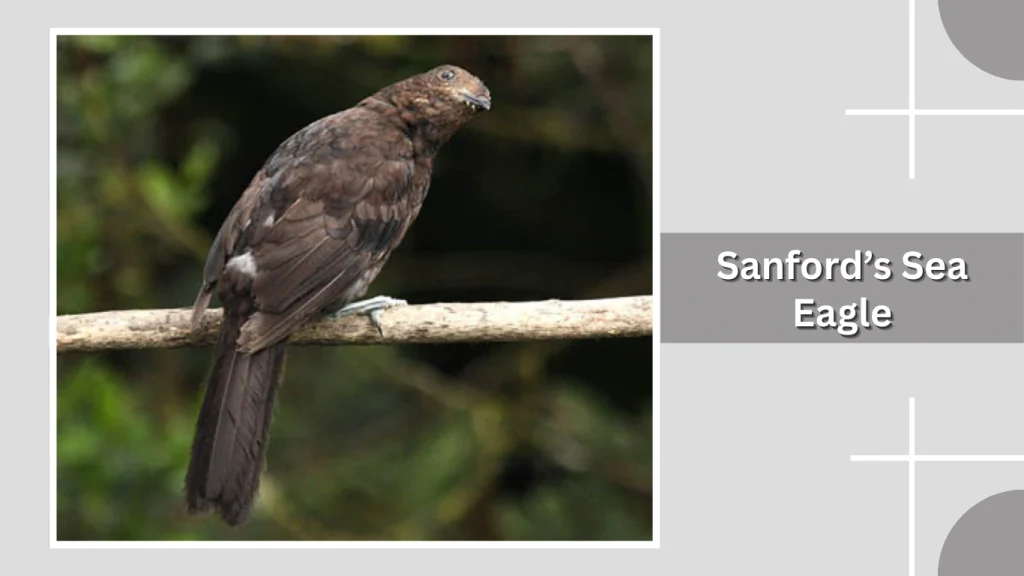
Sanford’s Sea Eagle is a large and little-known eagle species native to the Solomon Islands. It is closely related to other sea eagles and is adapted to coastal and island environments.
Identification
- Large eagle with a wingspan of about 6–7 feet
- Dark brown upperparts
- White head and upper chest
- Dark wings with lighter feather edges
- Short, wedge-shaped tail
- Large yellow hooked beak
- Yellow legs with strong black talons
- Juveniles are darker with less white
Habitat and Behavior
This species inhabits coastal forests, mangroves, and areas near lagoons and rivers. Sanford’s Sea Eagles are often seen perched high in trees or soaring along coastlines. They are usually solitary or found in pairs and maintain territories near water.
Diet and Lifecycle
Their diet mainly includes fish, along with seabirds and carrion. They build large nests in tall coastal trees. The female typically lays 1–2 eggs, and both parents share incubation and care of the young until fledging.
FAQs
What is the largest eagle species in the world?
The largest eagle by mass and overall power is generally considered the Harpy Eagle, while the Steller’s Sea Eagle is often regarded as the heaviest. In terms of wingspan, the White-tailed Eagle and Steller’s Sea Eagle are among the largest.
Which eagle is the strongest hunter?
The Harpy Eagle is widely considered the strongest hunter due to its massive talons and ability to capture large tree-dwelling mammals like sloths and monkeys within dense forests.
Are eagles found on every continent?
Eagles are found on every continent except Antarctica. They inhabit a wide range of environments, including forests, mountains, grasslands, deserts, and coastal regions.
What do eagles mainly eat?
Most eagles are carnivorous and feed on fish, birds, mammals, reptiles, and carrion. Some species specialize in certain prey, such as fish eagles or snake eagles.
How long do eagles live?
In the wild, eagles typically live between 20 and 30 years, depending on the species. Some individuals can live even longer in protected environments or captivity.