


The coconut octopus is one of the most fascinating marine animals ever studied. Known scientifically as Amphioctopus marginatus, this small but highly intelligent octopus has gained worldwide attention for its ability to use tools—an extremely rare trait among invertebrates. Found mainly in the Indo-Pacific region, the coconut octopus lives on open sandy seabeds where shelter is scarce. To survive, it collects coconut shells and other objects, carrying them across the ocean floor to build portable homes. This remarkable behavior has reshaped how scientists understand octopus intelligence.
What Is a Coconut Octopus
The coconut octopus, also called the veined octopus, is a shallow-water octopus species belonging to the family Octopodidae. It was formally described in 1888, but its extraordinary behavior was not widely recognized until marine biologists documented its tool use in the early 2000s.
Unlike reef-dwelling octopuses that hide in rock crevices, the coconut octopus often inhabits flat, featureless environments. This has driven the species to develop unique survival strategies, including collecting and transporting objects for shelter. These behaviors demonstrate advanced problem-solving skills, long-term planning, and environmental awareness.
Natural Habitat and Distribution

Geographic Range
The coconut octopus is primarily found in the Indo-Pacific region. Its range includes coastal waters of Indonesia, the Philippines, Malaysia, northern Australia, Papua New Guinea, and nearby tropical seas. It typically inhabits shallow waters, from just a few feet deep down to about 50 meters.
Habitat Types
This species prefers sandy and muddy seafloors rather than rocky reefs. It is commonly seen in open substrates, seagrass edges, and silty coastal flats. These environments provide abundant prey but very few natural hiding places, which explains the coconut octopus’s reliance on portable shelters.
Physical Characteristics
Size and Body Structure
The coconut octopus is relatively small compared to many octopus species. Its mantle usually measures about 8 to 10 centimeters long, with arms extending up to 30 centimeters. Despite its small size, it is strong, flexible, and highly coordinated.
Its soft, boneless body allows it to squeeze into narrow openings, including coconut shells, bottles, and bivalve shells. Powerful arms lined with sensitive suckers give it exceptional grip and manipulation abilities.
Color, Texture, and Pattern
This octopus typically displays mottled brown, beige, and cream coloration. Vein-like patterns run across its body, giving rise to its alternative name, the veined octopus. Like other octopuses, it can rapidly change color, brightness, and skin texture to match sand, mud, or debris.
Through specialized skin cells, the coconut octopus can form bumps, ridges, or smooth surfaces that closely imitate its surroundings, making it extremely difficult to detect.
Unique Anatomical Features
The coconut octopus possesses a highly developed nervous system, with more than half of its neurons located in its arms. Each arm can independently explore, taste, and manipulate objects. This distributed intelligence allows precise control when carrying shells, opening prey, or constructing shelters.
Why It’s Called the Coconut Octopus

The coconut octopus earned its name from its unusual habit of collecting coconut shells discarded into the ocean. It uses these shells as portable armor and temporary dens.
This behavior includes:
- Gathering halved coconut shells from the seafloor
- Carrying them beneath its body while walking on its arms
- Assembling the shells into a protective sphere
- Hiding inside when threatened
- Reusing shelters repeatedly
This is one of the clearest examples of tool use in any invertebrate species. The octopus not only uses objects but transports them for future use, showing planning and foresight.
Behavior and Intelligence
Tool Use and Problem Solving
The coconut octopus’s tool use is deliberate and strategic. It selects appropriately sized shells, carries them over long distances, and assembles them into a complete shelter. This behavior exposes the octopus to predators while traveling, suggesting it understands the future benefit of protection.
In addition to coconut shells, the octopus also uses bottles, cans, and shells, demonstrating adaptability rather than reliance on a single object type.
Camouflage and Mimicry
Beyond tools, camouflage is another critical survival skill. The coconut octopus can instantly blend into sand by flattening its body and altering color. When threatened, it may darken dramatically, raise its arms, or inflate its mantle to appear larger.
It can also mimic debris or rocks, remaining motionless for long periods to avoid detection.
Daily Activity Patterns
Coconut octopuses are primarily nocturnal. They spend daylight hours hidden inside shelters and become active at night to hunt. During foraging, they move methodically across the seabed, probing holes and disturbing sand to locate prey.
Diet and Hunting Methods
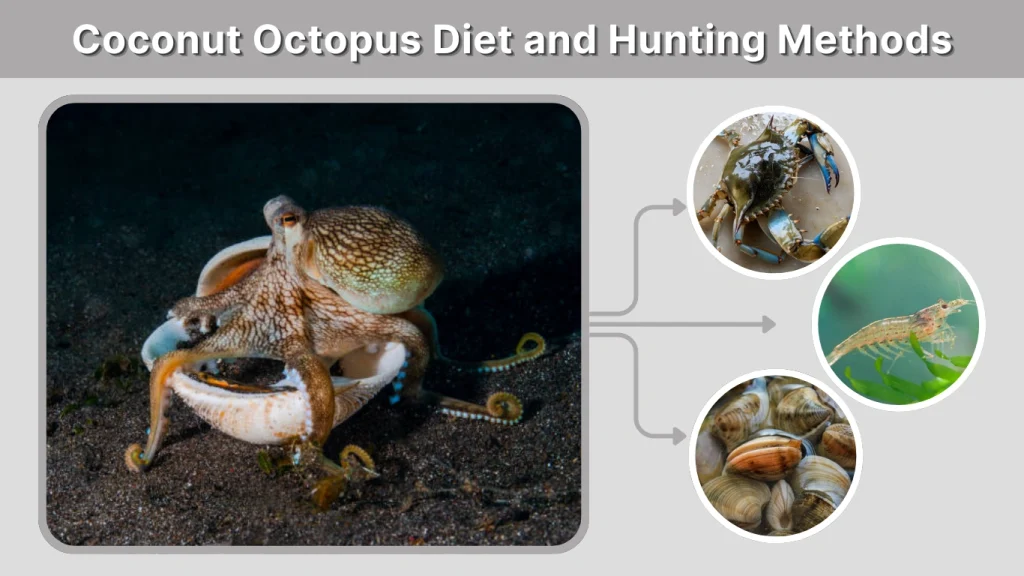
The coconut octopus feeds mainly on small crustaceans and mollusks. Its diet includes crabs, shrimp, clams, and snails. It hunts using ambush tactics, quickly pouncing on prey and enveloping it with its arms.
Once captured, the prey is subdued with venom delivered through the beak. The octopus then drills or pries open shells and consumes the soft tissue inside. This efficient hunting style allows it to thrive in open environments where hiding places are limited.
Reproduction and Lifecycle
Mating Behavior
Coconut octopuses reproduce through internal fertilization. Males use a specialized arm called the hectocotylus to transfer sperm into the female’s mantle cavity. Courtship is cautious, as females are often larger and may become aggressive. After mating, males typically experience rapid physical decline and usually die within a short period.
Egg Laying and Maternal Care
After fertilization, the female seeks a secure shelter, often inside a shell or crevice. She lays hundreds to thousands of eggs, attaching them in clusters to the inner surface of her den. Once egg laying is complete, she devotes herself entirely to guarding and cleaning the eggs.
During this time, the female rarely eats. She gently aerates the eggs with water currents, removes debris, and protects them from predators. This maternal care phase can last several weeks. By the time the eggs are ready to hatch, the female is severely weakened.
Early Life Stages
When the eggs hatch, tiny octopuses emerge as fully formed miniature versions of adults. In many cases, the mother dies shortly before or after hatching. The hatchlings enter a planktonic phase, drifting in open water where they feed on microscopic organisms before eventually settling onto the seabed.
Coconut Octopus Lifespan
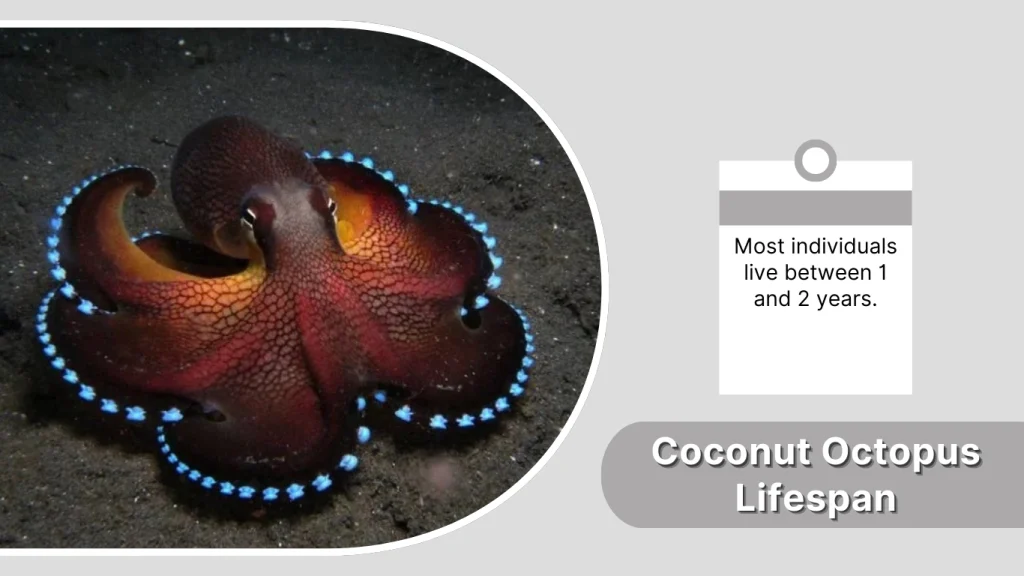
The coconut octopus has a relatively short lifespan, typical of small octopus species. Most individuals live between 1 and 2 years. Growth is rapid, and sexual maturity is reached within months.
Environmental factors such as water temperature, food availability, and predation pressure influence how long individuals survive. Warmer waters generally accelerate metabolism and shorten lifespan, while stable habitats with abundant prey support longer survival.
Predators and Threats
Coconut octopuses face numerous natural predators throughout their lives, including:
- Reef sharks and large fish
- Moray eels
- Rays
- Seabirds in shallow waters
- Marine mammals in some regions
Human activities also pose increasing threats. Coastal development, bottom trawling, pollution, and plastic debris degrade sandy seabed habitats. Although this species can use debris as shelter, habitat destruction reduces prey availability and nesting sites.
Coconut Octopus vs Common Octopus

The coconut octopus differs from the common octopus in several important ways:
| Feature | Coconut Octopus | Common Octopus |
| Habitat | Sandy, open seabeds | Rocky reefs, crevices |
| Tool use | Frequently documented | Rare, occasional |
| Shelter style | Portable dens | Permanent dens |
| Size | Small to medium | Medium to large |
| Behavior | Nocturnal, cautious | More territorial |
These differences reflect how each species has evolved to match its environment.
Ecological Importance
The coconut octopus plays a vital role in coastal ecosystems. As a predator, it helps regulate populations of crabs, mollusks, and small invertebrates. Its hunting activities influence prey distribution and contribute to the balance of sandy seabed communities.
By reusing shells and debris, the coconut octopus also alters microhabitats, creating shelters that may later be used by other small marine organisms.
Conservation Status
The coconut octopus is currently not listed as endangered, but population trends are poorly documented. Because it lives in shallow coastal waters, it is vulnerable to habitat loss, pollution, and climate-related changes such as rising sea temperatures.
Protecting seagrass beds, sandy flats, and coastal ecosystems is essential for maintaining healthy coconut octopus populations and the diverse marine life that shares its habitat.
FAQs
Why is the coconut octopus famous?
The coconut octopus is famous for using tools. It collects coconut shells and other objects, carries them across the seafloor, and assembles them into protective shelters. This behavior is one of the clearest examples of tool use in any invertebrate species.
Do coconut octopuses really use tools?
Yes. Scientific observations and underwater recordings have confirmed that coconut octopuses intentionally gather and transport shells and debris for future shelter, demonstrating planning and problem-solving abilities.
Where can coconut octopuses be found?
They are found mainly in the Indo-Pacific region, including Indonesia, the Philippines, Malaysia, and northern Australia. They live in shallow coastal waters with sandy or muddy bottoms.
How long do coconut octopuses live?
Most coconut octopuses live between one and two years. Like other octopus species, they grow quickly, reproduce once, and die shortly after their eggs hatch.
Are coconut octopuses dangerous to humans?
No. Coconut octopuses are shy, non-aggressive animals. They may bite if handled, but they are not considered dangerous to humans.