



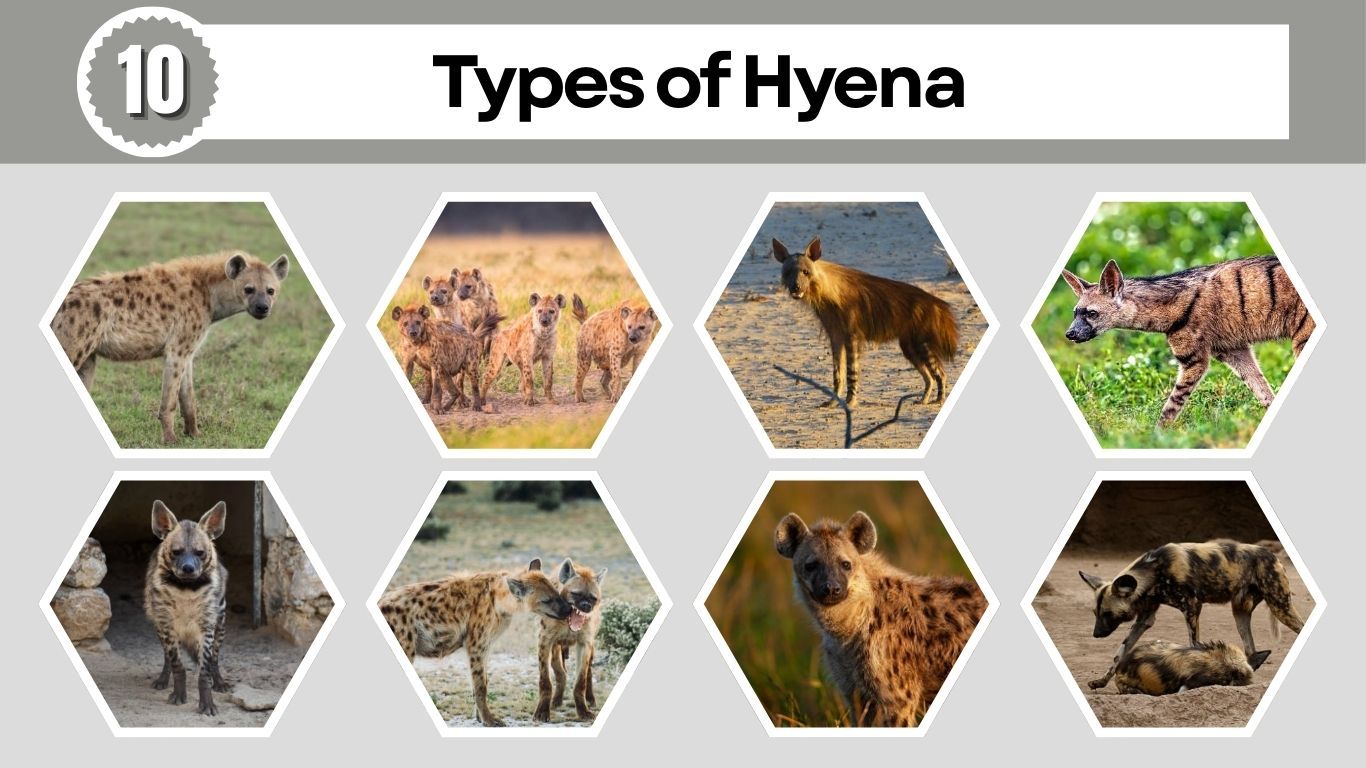
Hyenas are powerful, intelligent carnivores best known for their haunting calls, bone-crushing jaws, and important role as nature’s cleanup crew. Found across Africa and parts of Asia, these mammals belong to the family Hyaenidae and include both skilled hunters and specialized scavengers. From the clan-living spotted hyena to the insect-eating aardwolf, different types of hyenas have evolved unique behaviors, diets, and survival strategies that help maintain balance in the ecosystems they inhabit.
1. Spotted Hyena

The spotted hyena (Crocuta crocuta) is the largest and most powerful member of the hyena family. Native to sub-Saharan Africa, it is famous for its loud “laughing” calls, complex social structure, and incredible biting strength. Despite its scavenger reputation, the spotted hyena is actually a highly successful hunter and plays a major role in maintaining healthy ecosystems.
Identification
- Large, muscular body with a sloping back
- Sandy to grayish coat covered in dark round spots
- Broad head with strong jaws and blunt muzzle
- Rounded ears rather than pointed ones
- Females are noticeably larger than males
Habitat and Range
Spotted hyenas are widely distributed across sub-Saharan Africa. They thrive in savannas, open grasslands, woodlands, and semi-desert regions. They usually avoid dense rainforests and the highest mountain areas but adapt well to landscapes where large grazing animals are common.
Behavior and Social Structure
This species lives in large, complex groups called clans, which can include up to 80 individuals. Clans are female-dominated, and every member has a specific rank. Spotted hyenas communicate using whoops, giggles, growls, body posture, and scent marking.
Diet and Hunting Style
Spotted hyenas are opportunistic carnivores. They hunt animals such as wildebeest, zebras, and antelope, often working together to exhaust prey. They also scavenge and can consume bones, hooves, and hide, thanks to their extremely powerful jaws and digestive system.
2. Striped Hyena

The striped hyena (Hyaena hyaena) is a smaller and more solitary member of the hyena family, known for its shy nature and nocturnal lifestyle. It is found across parts of North and East Africa, the Middle East, Central Asia, and the Indian subcontinent. Unlike its spotted relative, this species relies more on scavenging and quiet foraging than active group hunting.
Identification
- Gray to pale-brown coat with bold black vertical stripes
- Long mane along the back that can be raised when threatened
- Slender body with a slightly sloping back
- Pointed ears and narrow muzzle
- Strong forelegs compared to the hind legs
Habitat and Range
Striped hyenas inhabit dry savannas, scrublands, rocky hills, deserts, and open woodlands. They often shelter in caves, crevices, or abandoned burrows and are well adapted to hot, arid climates where food can be scarce.
Behavior and Social Structure
This species is mostly solitary or seen in pairs, unlike the large clans of spotted hyenas. Striped hyenas are primarily nocturnal, spending the day resting in dens and emerging at night to forage. They are generally cautious, secretive, and avoid human contact.
Diet and Feeding Habits
Striped hyenas are mainly scavengers, feeding on carrion, bones, scraps, and waste. They also eat fruits, insects, small animals, and occasionally hunt weak or young prey. Their strong jaws allow them to crush bones to access nutritious marrow.
3. Brown Hyena
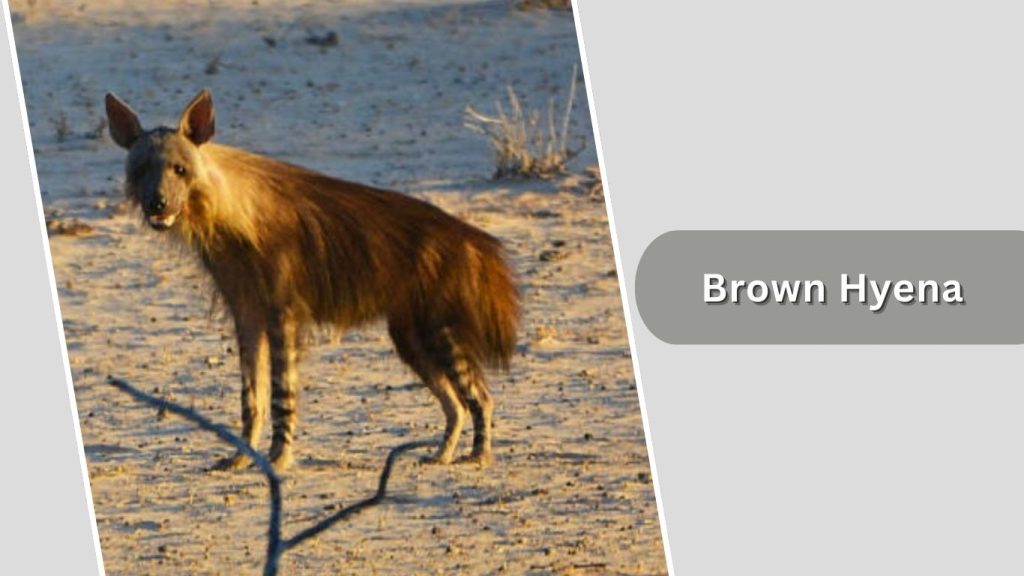
The brown hyena (Parahyaena brunnea) is a rare and distinctive hyena species known for its shaggy coat and more reserved behavior. It is mainly found in southern Africa, especially in desert and coastal regions. Compared to spotted hyenas, brown hyenas are less aggressive hunters and rely heavily on scavenging.
Identification
- Long, shaggy dark-brown fur covering most of the body
- Lighter-colored mane around the neck and shoulders
- Pointed ears and a broad, powerful head
- Stocky build with strong forequarters
- Bushy tail often darker at the tip
Habitat and Range
Brown hyenas inhabit deserts, semi-deserts, dry savannas, and coastal zones of southern Africa, including Namibia, Botswana, and South Africa. They often den in sandy burrows, rocky crevices, or thick vegetation near food sources.
Behavior and Social Structure
They usually live alone or in small family groups. Unlike spotted hyenas, brown hyenas are less vocal and are mostly nocturnal, traveling long distances at night in search of food. They maintain territories using scent marking.
Diet and Feeding Habits
Brown hyenas are primarily scavengers, feeding on carcasses left by larger predators. They also eat insects, eggs, fruits, and occasionally small animals. Along coastlines, they may consume seals, fish, and other marine remains.
4. Aardwolf

The aardwolf (Proteles cristata) is the smallest and most insect-specialized member of the hyena family. Unlike other hyenas, it does not hunt large animals or rely heavily on carrion. Instead, it feeds mainly on termites. It is found in eastern and southern Africa, where it plays an important role in controlling insect populations.
Identification
- Slender, fox-like body with a yellowish coat and black stripes
- Long, pointed ears and a narrow muzzle
- Black mane along the neck and back that stands erect when alarmed
- Smaller head and weaker jaws compared to other hyenas
- Bushy tail with a darker tip
Habitat and Range
Aardwolves live in open grasslands, scrublands, and lightly wooded savannas of eastern and southern Africa. They prefer areas with abundant termite mounds and usually shelter in burrows, often using abandoned dens of other animals.
Behavior and Social Structure
They are mostly solitary and nocturnal, spending nights foraging and days resting in underground dens. Aardwolves are shy, avoid conflict, and rely more on scent marking and posturing than aggression for defense.
Diet and Feeding Habits
Aardwolves feed almost entirely on termites, especially harvester termites. They use their long, sticky tongue to lap up thousands of insects in a single night. Occasionally, they may eat other insects or soft larvae.
5. Cave Hyena (Extinct)

The cave hyena (Crocuta crocuta spelaea) was a powerful prehistoric relative of the modern spotted hyena. It lived during the Ice Age and ranged across Europe and parts of Asia. Fossil evidence shows it was larger and more robust than today’s spotted hyena and often used caves as dens, where many of its remains have been discovered.
Identification
- Larger and heavier build than modern spotted hyenas
- Broad skull with extremely strong jaws
- Thick neck and powerful shoulders
- Shorter legs relative to body size
- Dense fur adapted to cold climates
Habitat and Range
Cave hyenas inhabited Ice Age Europe, western Asia, and parts of Siberia. They favored open steppe, grasslands, and areas near caves, which they used for shelter and raising young.
Behavior and Social Structure
Evidence suggests cave hyenas lived in social groups similar to modern spotted hyenas. They dragged large prey into caves, leaving behind bones of mammoths, woolly rhinoceroses, horses, and reindeer.
Diet and Feeding Habits
They were both active hunters and scavengers. Their diet included large Ice Age mammals, and their powerful jaws allowed them to crush massive bones to extract marrow and nutrients.
6. Giant Hyena (Extinct)

The giant hyena (Pachycrocuta brevirostris) was one of the largest hyena species that ever lived. It existed during the early to middle Pleistocene epoch and ranged across parts of Africa, Europe, and Asia. This massive hyena is believed to have been more heavily built than modern hyenas and was especially adapted for powerful bone-crushing.
Identification
- Extremely large, stocky, and powerfully built body
- Oversized head with massive jaws and teeth
- Short, thick legs compared to modern hyenas
- Broad chest and very strong forequarters
- Bone-crushing premolars adapted for heavy carcasses
Habitat and Range
Giant hyenas lived in open grasslands, steppe regions, and lightly wooded environments across Africa and Eurasia. Fossils have been found in areas that once supported large populations of prehistoric grazing animals.
Behavior and Social Structure
Scientists believe giant hyenas were dominant scavengers and possibly solitary or small-group feeders. Their size suggests they could drive other predators away from kills and control carcasses of very large animals.
Diet and Feeding Habits
Their diet likely focused on scavenging megafauna such as ancient elephants, rhinoceroses, horses, and large deer. With exceptionally strong jaws, giant hyenas specialized in cracking thick bones to access rich marrow.
7. East African Spotted Hyena
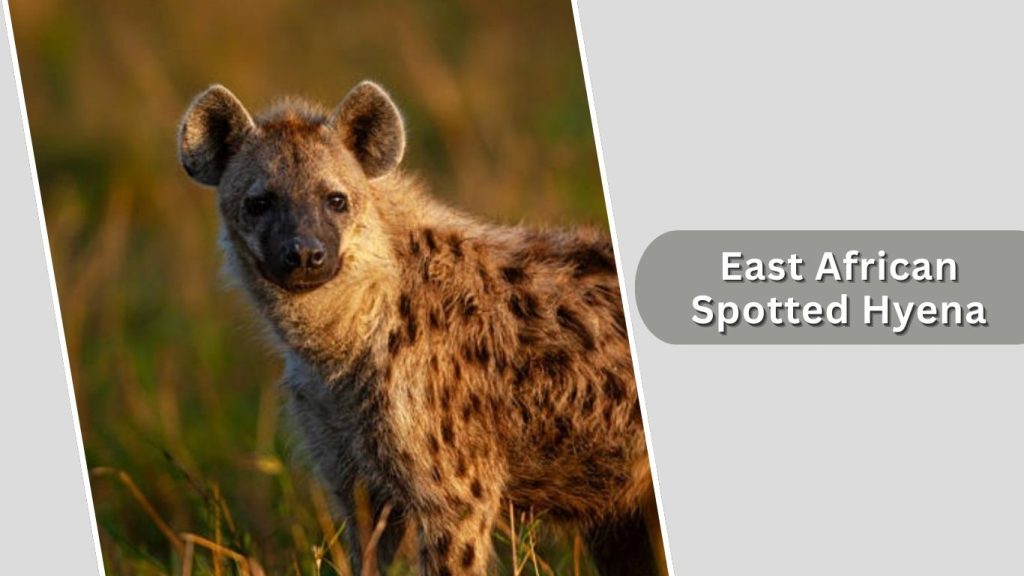
The East African spotted hyena is a regional form of the spotted hyena found mainly in Kenya, Tanzania, Ethiopia, and neighboring countries. It is one of the most well-studied hyena populations, famous for its large clan sizes and dominance in African savanna ecosystems.
Identification
- Sandy to gray coat with well-defined dark spots
- Large, powerful build with sloping back
- Broad skull and extremely strong jaws
- Rounded ears and blunt muzzle
- Females larger and heavier than males
Habitat and Range
This hyena lives across East Africa, especially in savannas, open plains, and grasslands such as the Serengeti and Maasai Mara. It prefers regions with abundant hoofed mammals and access to open hunting grounds.
Behavior and Social Structure
East African spotted hyenas form massive clans that can exceed 60 to 80 members. These clans are strictly female-dominated, with complex ranking systems. They use loud whoops to communicate across long distances.
Diet and Hunting Style
They are both skilled hunters and efficient scavengers. Their diet includes wildebeest, zebras, antelope, and other medium-to-large mammals. Coordinated group hunts and bone-crushing feeding habits make them one of Africa’s top predators.
8. Southern Spotted Hyena

The southern spotted hyena is a regional population of the spotted hyena found mainly in southern Africa, including Botswana, Namibia, Zimbabwe, and South Africa. It is especially well known from ecosystems like the Okavango Delta and Kruger National Park, where it plays a dominant role as both a hunter and scavenger.
Identification
- Light brown to gray coat with scattered dark spots
- Strong, muscular body with a sloping back
- Broad head with blunt muzzle
- Rounded ears and thick neck
- Females larger and more dominant than males
Habitat and Range
This hyena inhabits savannas, dry woodlands, semi-deserts, and open grasslands of southern Africa. It adapts well to both protected reserves and remote wilderness areas where large herbivores are common.
Behavior and Social Structure
Southern spotted hyenas live in large, structured clans that may contain dozens of individuals. These clans defend territories, cooperate in hunting, and communicate using whoops, growls, and scent markings.
Diet and Hunting Style
They hunt animals such as wildebeest, zebra, and springbok and also scavenge from other predators. Their extremely powerful jaws allow them to consume almost every part of a carcass, including large bones.
9. Cape Brown Hyena

The Cape brown hyena is a regional population of the brown hyena found mainly along the western and southern coasts of southern Africa, especially around Namibia and South Africa’s Cape regions. It is well adapted to dry, coastal, and desert-influenced environments.
Identification
- Long, shaggy dark-brown coat
- Distinct lighter mane around the neck and shoulders
- Strong forequarters and sloping back
- Pointed ears and powerful jaw
- Bushy tail often darker at the tip
Habitat and Range
Cape brown hyenas inhabit coastal deserts, semi-arid savannas, and scrublands. They often forage along shorelines, dunes, and inland dry plains, using burrows, caves, or dense vegetation for shelter.
Behavior and Social Structure
They are mostly nocturnal and live alone or in small family groups. Cape brown hyenas are shy and secretive, marking territories with scent and traveling long distances at night to find food.
Diet and Feeding Habits
Their diet consists mainly of carrion, but they also eat insects, eggs, fruits, and coastal food such as seals, fish remains, and seabirds when available.
10. Middle Eastern Striped Hyena

The Middle Eastern striped hyena is a regional population of the striped hyena adapted to arid and semi-arid landscapes of the Middle East. It is known for its secretive nature, strong scavenging habits, and ability to survive in harsh desert conditions.
Identification
- Pale gray to yellowish coat with clear black stripes
- Long mane along the back and neck
- Narrow muzzle with powerful jaws
- Pointed ears and slender build
- Dark legs and facial markings
Habitat and Range
This hyena is found across parts of the Middle East, including Saudi Arabia, Israel, Jordan, Iraq, and Iran. It inhabits deserts, rocky hills, scrublands, and dry open country, often sheltering in caves and crevices.
Behavior and Social Structure
Middle Eastern striped hyenas are mostly solitary and nocturnal. They avoid humans, move quietly through their territories at night, and rely on scent marking to communicate and define home ranges.
Diet and Feeding Habits
They are primarily scavengers, feeding on carcasses, bones, scraps, and organic waste. They may also eat fruits, insects, and occasionally hunt small animals when the opportunity arises.
FAQs
What is the largest type of hyena?
The spotted hyena is the largest living hyena species. It can weigh up to 85 kilograms (187 pounds) and has an extremely powerful build. Among all known hyenas, the extinct giant hyena was even larger, but today the spotted hyena dominates African ecosystems.
Are hyenas more hunters or scavengers?
Hyenas are both hunters and scavengers. Spotted hyenas, in particular, hunt most of their own food, often working in groups to take down large animals. Striped and brown hyenas rely more on scavenging, but all hyenas are capable of active hunting when opportunities arise.
Do hyenas live in groups or alone?
This depends on the species. Spotted hyenas live in large social groups called clans, which can include dozens of members. Brown hyenas live in smaller family groups, while striped hyenas and aardwolves are mostly solitary.
What do hyenas mainly eat?
Hyena diets vary by species. Spotted hyenas eat large mammals and carrion, brown and striped hyenas focus more on carcasses, bones, fruits, and scraps, and aardwolves eat mainly termites. This dietary diversity helps hyenas survive in many environments.
Are hyenas dangerous to humans?
Hyenas are generally shy and avoid people, but they can be dangerous if threatened or habituated to human settlements. Spotted hyenas are strong predators capable of attacking livestock and, rarely, humans, especially at night in areas where natural prey is scarce.